
Last updated: July 2026.
Do You Get Paid During Residency?
Being accepted into a Graduate Medical Education (GME) program is an honored achievement in the careers of all young doctors. Now you get to focus most of your time and energy on gaining new, hands-on skills as a medical practitioner. However, your MD program, whether an MD or MD/PhD program, likely brought forth a sizeable amount of debt. The median education debt for the Class of 2025 was $215,000 according to the AAMC, and that figure is expected to remain in the same range for Class of 2026 graduates. Like many MD and DO students, you were unlikely to have maintained a part-time job while in medical school. After relying on student loans, scholarships, and institutional funding, the idea of having an income sounds very alluring. If you are wondering how much does a medical resident make, you are not alone. As you fill out your ERAS application, you may be asking yourself: do you get paid during residency?
The short answer is yes. Think of a residency program in terms of other forms of graduate school education. Students in PhD programs almost never get admitted without some form of funding. High-level education like a PhD or medical residency is elite, as statistically few people pursue this work, and med/PhD students contribute to the institution training them. Medical residents teach, staff clinics, and perform rotations. Residents are no longer students in many senses; rather, they are more like physicians in training. As trainee physicians, they are paid for the service they provide to the institution and those around them.
Unlike other occupations and paid graduate positions, the pay structure for residents isn’t negotiated on a person-by-person basis, nor does it vary much based on one’s chosen medical specialty. The medical residency salary is largely decided by two factors: seniority and institution. To better understand how these two factors affect the salary of medical residents, let’s look further into the details of residency pay structures. For students earlier in their journey who want to assess where they stand for medical school admissions, IMA’s Pathfinder admissions calculator can help you gauge your competitiveness before you ever reach the residency stage.
Residency Pay Structure
It’s important to note that different countries have varying residency pay structures. For example, the United States and Canada. In the US, resident pay varies by institution, but in Canada, the pay varies depending on which province you are working in.
Without going too in-depth, it should be noted that the pay difference lies within the type of healthcare system each country utilizes. The United States utilizes a private, for-profit healthcare system, meaning most cost aspects are determined by the hospital. Whereas Canada utilizes a network of provincially-administered systems similar to a single-payer structure. It makes sense that a country whose healthcare system is organized by governmental power has a more regulated and top-down pay structure. This is also one of the reasons why physicians in the US are among the highest-paid doctors in the world.
Now, let’s direct our attention away from the politics of healthcare systems and look at the nitty-gritty of residency pay.
How Much Do Residents Make in the United States
In the US, there are two primary sources for resident pay information. The first source is AMA’s FREIDA database, which provides information about first-year compensation stats across a wide variety of specialties and allows you to search more than 13,000 ACGME-accredited programs. However, it needs to be noted that the FREIDA database also includes data from fellowships in their overall list, so the information can be deceiving. Some subspecialty fellowship listings reflect PGY4 or PGY5 wages, which will appear much higher than a true first-year resident salary.
The other source of residency compensation information is Medscape’s yearly Residents Salary and Debt Report. This report includes a further breakdown of contextual information, such as years beyond PGY1, medical school debt, and gender. Medscape’s sample size for this report is smaller than that of the AAMC; the 2025 survey included 646 respondents across 29-plus specialties. Like FREIDA, some of Medscape’s wage calculations include data from fellowships, so when you are looking at the higher end of averages, it is important to remember they may reflect pay rates for physicians well beyond their first post-graduate year.
A third and arguably the most authoritative source is the AAMC’s annual Survey of Resident/Fellow Stipends and Benefits. The 2025 edition drew data from 114,361 residents and fellows across 350 accredited institutions as of July 1, 2025. Because of its scope, the AAMC survey is the most reliable benchmark for understanding how much a medical resident makes at each training level.
Medscape’s surveys also include data on residents’ satisfaction with their pay and the number of hours and shifts worked. To get a more detailed picture of your would-be residency, we highly recommend reading each section of the Medscape survey. For those who may need assistance selecting a residency program or applying, we suggest Medical Residency Admissions and ERAS consulting.
Average Residency Pay in the US in 2026
The average medical resident salary in 2025 was approximately $75,000 per year, according to Medscape’s 2025 Resident Salary and Debt Report. That figure represented a 6.5% increase from the prior year, a notable jump from the 4% increase reported in 2024. For PGY1 residents specifically, the AAMC reports a national average of $68,166 per year, or roughly $5,680 per month before taxes. The median PGY1 salary is $66,986, with the 75th percentile at $71,657.
There is meaningful institutional variation. For perspective, a PGY1 resident at a program like the University of Pennsylvania may earn above $76,000, while a PGY1 at a smaller institution may start closer to $62,000. This range is considerably higher than it was just a few years ago, but geographic cost-of-living differences mean that a higher salary number does not always translate into greater purchasing power.
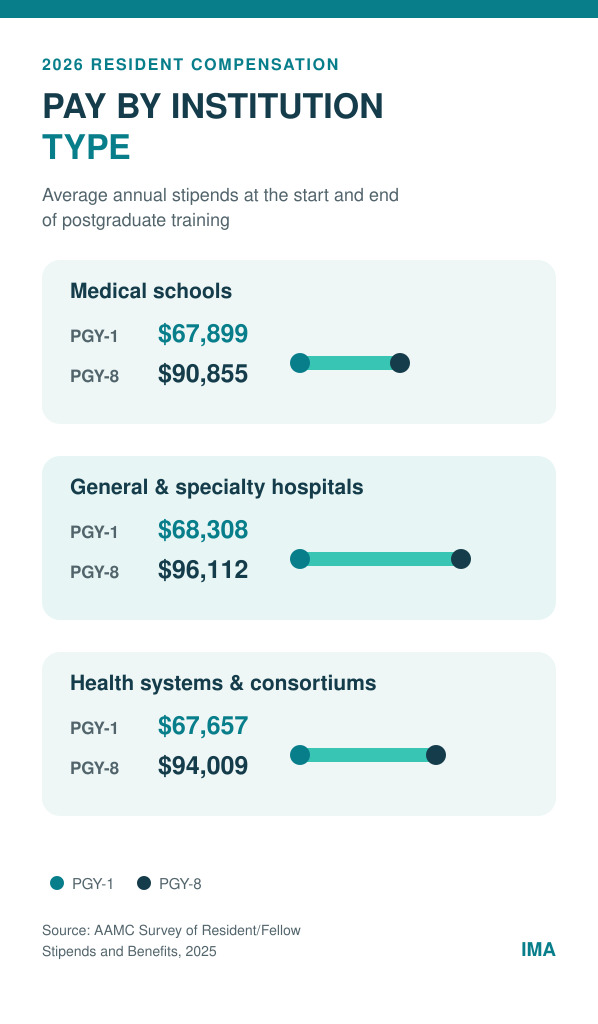
Resident pay is set by training level and the type of institution, not by medical specialty. The AAMC 2025 survey shows how average stipends differ across institution types:
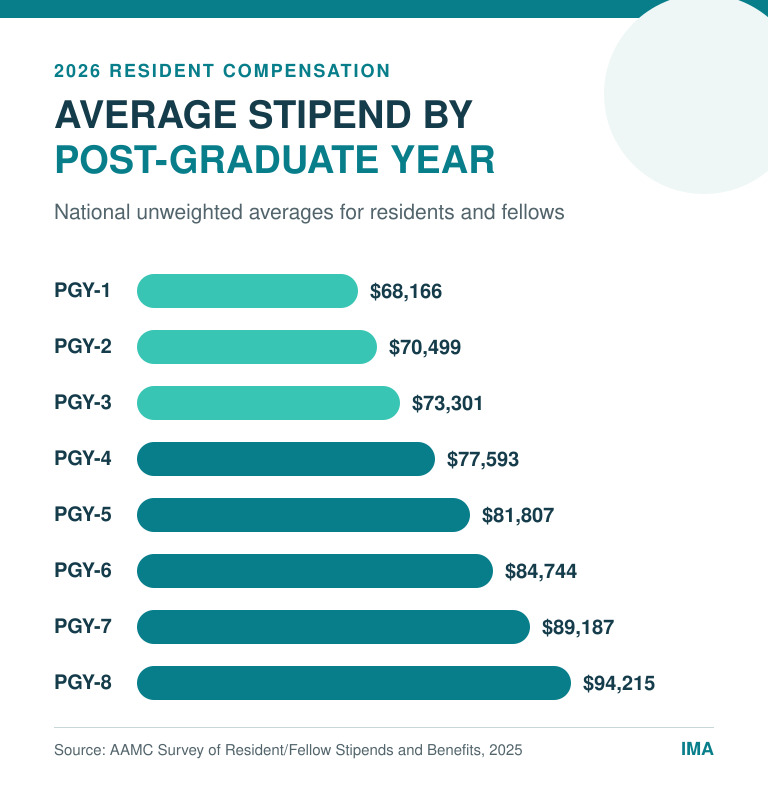
The following list is the average stipend based on residency year, per the 2025 AAMC Survey of Resident/Fellow Stipends and Benefits (data as of July 1, 2025):
Overall average (Medscape 2025): $75,000
- PGY1: $68,166
- PGY2: $70,499
- PGY3: $73,301
- PGY4: $77,593
- PGY5: $81,807
- PGY6: $84,744
- PGY7: $89,187
- PGY8: $94,215
The AAMC also breaks down averages by institution type. For PGY1 through PGY8, medical schools paid between $67,899 and $90,855. General and specialty hospitals paid $68,308 to $96,112. Health systems and consortiums paid $67,657 to $94,009. The differences across institution types are modest at the PGY1 level but widen at senior training levels.
There are a few points that can be made based on the information above. The first point is to note the hierarchical system. Residency programs that are available to recent DO and MD graduates begin at the PGY1 level, and combined programs or fellowships account for the higher averages at PGY4 and beyond. For the most part, initial residencies cluster around the $68,000 mark for PGY1, while fellowship-level figures push averages higher.
The next point is early match programs, such as neurology, ophthalmology, neurosurgery, and urology, have higher averages than normal match residencies. While there are a few reasons for this, the primary reason is that these early match specialties are quite long. For example, neurosurgery is one of the longest residencies, ranging from 6 to 10 years in some cases. Therefore the compensation average for that program includes PGY6 through PGY8 and beyond, which will be higher than the average compensation of a family medicine three-year data set.
What Resident Pay Actually Looks Like Per Hour
One of the most sobering ways to understand the medical residency salary is to break it down by hours worked. According to Medscape’s 2025 report, 79% of residents worked with patients for more than 40 hours per week, and 22% reported more than 70 hours per week. The ACGME officially limits residents to 80 hours per week, averaged over four weeks.
At the 2025 overall average of $75,000 per year, the effective hourly rate shifts dramatically depending on actual hours worked:
- 50 hours per week: approximately $29 per hour
- 60 hours per week: approximately $24 per hour
- 70 hours per week: approximately $21 per hour
- 80 hours per week: approximately $18 per hour
For comparison, the federal minimum wage remains $7.25 per hour, but many entry-level healthcare roles without doctoral-level training pay $20 to $30 per hour. This hourly reality is part of what drives strong feelings among residents about fair compensation, and it is worth keeping in mind when evaluating total residency compensation packages that include benefits like health insurance, disability coverage, and paid time off.
Resident Pay Growth Is Trailing Inflation
While resident salaries have risen in nominal terms, the gains have not kept pace with the cost of living. According to the AMA’s analysis of the 2025 AAMC data, stipends for residents and fellows grew at 2.2% from 2024 to 2025, the slowest rate of pay growth for physicians in training in four years. After adjusting for the Bureau of Labor Statistics’ Consumer Price Index, resident and fellow physician pay actually fell slightly, a 0.48% drop in real wages from 2024 to 2025.
This means that even though the headline salary numbers look better than they did a few years ago, residents’ purchasing power has not meaningfully improved. For trainees carrying six-figure medical school debt and living in high-cost cities where many large academic medical centers are located, this gap between nominal raises and real-world expenses is a genuine financial pressure point.
Resident Unionization and Its Effect on Pay
One significant development in recent years is the rapid growth of resident physician unions. The Committee of Interns and Residents (CIR-SEIU), the largest housestaff union in the United States, now represents over 40,000 resident physicians and fellows. That is more than double its membership from 2020, when it represented close to 18,000, making CIR one of the fastest-growing unions in the country during that period.
Unionization has produced tangible results at some institutions. For example, Stanford Health Care residents, who unionized in 2022, secured contract terms that pushed starting salaries above $100,000 for incoming 2025 residents. While that outcome is not typical across the country, it illustrates that collective bargaining can shift compensation significantly at individual programs.
For students comparing residency programs, it is worth noting whether a program’s residents are unionized, as this can affect not only salary but also benefits, duty hour enforcement, meal stipends, parental leave, and other working conditions. This is one of many factors, alongside location, specialty fit, and mentorship quality, that should factor into your decision.
US Resident Pay: Other Aspects
Medscape’s survey provides other relevant information for MD and DO students prepping for their residency applications.
Medscape notes that the pay gap between male and female residents remains smaller than the pay gap between male and female practicing physicians. The resident-level gap is approximately $700. The attending physician gap, however, has widened. Per Medscape’s 2026 Physician Compensation Report, the gender compensation gap among practicing physicians was just over $102,000 in male doctors’ favor, a 31% advantage. That represents an increase from approximately $91,000 and 29% reported two years earlier. While the $700 resident-level gap is beyond the margin of error, it is considerably more egalitarian than the post-residency landscape.
Resident satisfaction with pay paints a stark picture. In Medscape’s 2025 survey, 95% of residents said they believe most residents aren’t paid enough, and 58% reported that their compensation fell short of covering their expenses to varying degrees. More than one in three respondents felt residents would need to be paid at least 51% more to reach a level they considered fair. These numbers reflect a significant shift in sentiment from earlier years and align with the real-wage stagnation discussed above.
In the US, the majority of residents will receive added benefits like dental insurance, health insurance, and paid time off. According to Medscape’s 2025 report, 90% of residents have access to health insurance through their program. Most programs offer a benefits package that adds $10,000 to $20,000 in value beyond the base stipend. However, only about 9% of residents report receiving a housing allowance. Due to the nature of the United States healthcare system and medical unions, these benefits vary widely from institution to institution.
It is also worth mentioning that there are opportunities for non-salary compensation within US residency programs. This includes moonlighting, on-call assistant shifts, and hospital coverage shifts. While these one-off opportunities won’t make much difference to your overall earnings, they can help offset surprise expenses.
2026 Federal Student Loan Changes and What They Mean for Future Residents
A major policy shift took effect on July 1, 2026, that will reshape how future medical students finance their education, and by extension, how much debt they carry into residency. Under HR 1 (Public Law No. 119-21), signed into law on July 4, 2025, new graduate and professional students can no longer take out Federal Direct Graduate PLUS Loans. Federal Direct Unsubsidized Loans for graduate students are now capped at $50,000 annually and $200,000 over a lifetime.
For medical students, whose four-year cost of attendance often exceeds $297,000 at public schools and $408,000 at private schools (per AAMC data for the Class of 2026), the $200,000 federal cap creates a significant funding gap. Students will need to rely more heavily on institutional aid, private loans, or other sources to cover the difference.
Healthcare organizations have raised concerns that these caps could worsen the physician shortage by making medical education less accessible and potentially steering graduates toward higher-paying specialties to manage larger or less favorable private loan burdens. Students considering lower-paying fields like primary care or pediatrics may face particularly difficult financial calculations. This policy change makes it more important than ever for pre-med students and current medical students to plan their finances carefully and understand the full cost picture before committing to a program. If you are earlier in your journey, resources like IMA’s guide to pre-med internships can help you build a strong foundation before you take on the financial commitment of medical school.
Managing Loans on a Resident Salary
Given that the median medical school debt for the Class of 2025 was $215,000, and residents earn an average of $75,000 before taxes, the math during training years is tight. Most residents will not be able to make significant progress paying down their principal during residency. But that does not mean there is nothing you can do.
The most common approach during residency is enrolling in an income-driven repayment (IDR) plan. Under most IDR plans, your monthly payment is capped at a percentage of your discretionary income, which during residency will result in payments far lower than what you would owe under a standard 10-year repayment plan. If you are pursuing Public Service Loan Forgiveness (PSLF), years spent in residency at a qualifying nonprofit hospital count toward the required 120 payments, which is a meaningful benefit for those at academic medical centers and public hospitals.
Another option some residents consider is refinancing their federal loans with a private lender during residency. Refinancing can sometimes lower your interest rate, but it comes with real trade-offs: you lose access to federal protections like IDR plans, PSLF eligibility, and certain deferment and forbearance options. For most residents, refinancing during training only makes sense if you are certain you will not pursue PSLF and you can secure a meaningfully lower rate. It is a decision that deserves careful calculation rather than a quick sign-up. IMA’s Student Loan Repayment Calculator can help you compare scenarios, estimate monthly payments under different plans, and understand the long-term cost of various repayment strategies before you commit to a path.
A few practical steps that help during residency:
- Certify your income annually for IDR to keep payments low during training.
- Track qualifying PSLF payments from day one if you are at a nonprofit institution.
- Avoid forbearance if possible, as interest continues to accrue and capitalizes when forbearance ends.
- Build a small emergency fund (even $1,000 to $2,000) so that unexpected costs do not force you into high-interest credit card debt.
- If moonlighting, consider directing that income toward high-interest loans or your emergency fund rather than lifestyle expenses.
The real payoff on medical school debt comes after residency, when physician salaries rise substantially. But the choices you make during residency, particularly around repayment plan selection and whether or not to refinance, can save or cost you tens of thousands of dollars over the life of your loans.
What Residents Should Know Before Choosing a Program
Compensation is only one piece of the residency decision, but it is a legitimate one. Here are a few things worth considering as you evaluate programs:
Look at total compensation, not just the stipend. A program paying $66,000 with full health insurance, a meal stipend, and a $1,000 annual education allowance may be worth more than a program paying $70,000 with minimal benefits and no meal support. Ask about disability insurance, dental and vision coverage, parental leave policies, and conference funding.
Factor in cost of living. A program in a midsize city paying $67,000 may stretch further than a program in San Francisco or New York City paying $72,000. The AAMC data does not adjust for geographic cost of living, so you will need to do that math yourself.
Ask about moonlighting policies. Some programs allow external or internal moonlighting, which can provide an additional $1,000 to $5,000 per month depending on the specialty and setting. Other programs restrict or prohibit moonlighting entirely. This can meaningfully affect your financial situation, particularly in later PGY years.
Understand the trajectory. How much does a medical resident make in PGY1 versus PGY5 at that specific institution? The AAMC averages are useful, but individual programs set their own pay scales. A program with a lower starting salary but steeper annual increases may be more favorable over a five or six-year residency than one with a higher start and smaller raises.
For students still deciding which path in medicine to pursue, understanding the differences between MD and DO programs is an important early step, as both lead to residency eligibility but differ in philosophy and structure.
How Residency Pay Compares to Attending Physician Salaries
The gap between what residents earn and what practicing physicians earn remains enormous. At $75,000 per year, residents earn only about 25% of what licensed primary care physicians make (approximately $295,000 annually per the 2025 Doximity Physician Compensation Report) and roughly 16% of what licensed specialists earn (approximately $470,000). Surgical subspecialties push considerably higher, with neurosurgery topping out at $749,000 according to Doximity.
Per Medscape’s 2026 Physician Compensation Report, the average physician compensation across all specialties was $386,000, up 3% from the prior year. The top-earning specialties included orthopedics and orthopedic surgery ($611,000), cardiology ($575,000), radiology ($571,000), plastic surgery ($554,000), and anesthesiology ($543,000). Doximity’s figures, which use a different methodology, placed neurosurgery at $749,140, thoracic surgery at $689,969, and orthopedic surgery at $679,517.
The ratio of average attending pay to average resident pay is approximately 5:1. This is worth keeping in mind when the financial pressure of residency feels overwhelming. The training period is finite, and the compensation increase upon completion is among the largest single pay jumps in any profession.
You will have time to address your medical school debt after finishing your residency. During your residency, try to focus on the training and learning experience rather than fixating on earning the highest wage possible. The financial picture improves dramatically once you finish.
We wish you the best of luck as you venture to the next stage of your medical education, and for those who may need guidance when it comes to applying for residency, we are always here to offer our Medical Residency Admissions and ERAS consulting.
Frequently Asked Questions
How much does a medical resident make per year in 2026?
The overall average medical residency salary is approximately $75,000 per year according to Medscape’s 2025 report. The AAMC’s 2025 survey places the PGY1 average at $68,166, rising to $94,215 by PGY8. Actual pay varies by institution, geographic location, and training year. Programs at some unionized institutions have pushed starting salaries above $100,000, though that remains uncommon.
What are the highest-paid medical residencies?
Subspecialty residencies and fellowships at the PGY4 level and beyond typically report the highest averages. Allergy and immunology, hematology, rheumatology, and specialized surgical fellowships tend to rank at the top. However, these higher averages reflect more years of training rather than a fundamentally different pay structure. PGY1 salaries across most specialties fall within a relatively narrow range.
Can residents refinance their student loans during training?
Yes, but it involves trade-offs. Refinancing with a private lender may lower your interest rate, but you lose access to federal income-driven repayment plans and Public Service Loan Forgiveness eligibility. For most residents at nonprofit hospitals who may qualify for PSLF, staying on a federal repayment plan during residency is the more financially advantageous choice. Use a repayment calculator to compare scenarios before deciding.
How do the 2026 federal loan changes affect future residents?
Starting July 1, 2026, new graduate students can no longer borrow through the Federal Grad PLUS program, and federal unsubsidized loans are capped at $200,000 total. Since medical school costs typically exceed this cap, future students will need to cover the gap through institutional aid, scholarships, or private loans. This may increase the financial pressure residents face during training and could influence specialty choices.
Is resident pay enough to cover living expenses?
It depends on location and personal circumstances. In Medscape’s 2025 survey, 58% of residents reported that their compensation fell short of covering expenses to varying degrees. Residents in high cost-of-living cities tend to feel the squeeze most acutely. Benefits like employer-sponsored health insurance, meal stipends, and moonlighting opportunities can help offset the gap, but most residents live on tight budgets during training.