
For the 2026-2027 cycle, AMCAS began sending applications to MD schools on June 26, 2026. Each school then sends interview invites on its own schedule, with many starting in July, August or September and some continuing into winter. Having no med school interview invites by November is common, especially after a late submission. Silence usually means your file is still under review.
Trying to understand why you have no medical school interview invites can be extremely stressful. For most students, the feeling of helplessness after submitting their application is their greatest source of anxiety. During the application period, students are busy writing their personal statements and secondary essays, so there isn’t much time to sit and worry. After applications are complete, they have a lot more free time on their hands and often spend it worrying.
When Should You Expect to Hear Back?
So what should you do while waiting to hear back from medical schools? First, remember that interview dates vary by med school. For example, programs that have rolling admissions typically have a longer interview season, starting as early as July and ending as late as March. Check each medical school’s admissions website to confirm the dates and timeline for its interview season. We have provided a general interview timeline below that follows the overall schedule most medical schools use.
It also helps to know where your own application sits in the national calendar. According to the AAMC’s 2027 AMCAS cycle overview, the application opened May 5, 2026, submission began May 28, and the first transmission of application data to medical schools was June 26. The Early Decision Program deadline was August 3. The 2027 AMCAS Applicant Guide warns that verification may take six to eight weeks during peak season, and that materials received from June through September may take longer to process. Schools typically send secondary applications after they receive your verified primary, and most review a file for interview only after the secondary is complete. If you submitted in August or September, your file may have reached schools weeks after early applicants, so a quiet October or November is not unusual.
Our AMCAS 2027 timeline lays out the rest of the cycle month by month.
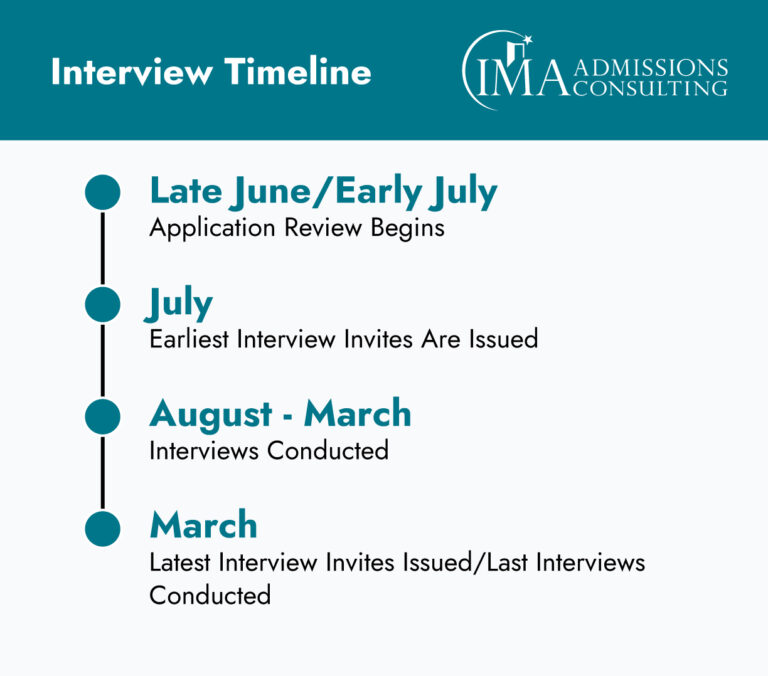
As you can see from the timeline above, there’s a period of about eight months in which medical school interviews are conducted. This timeline covers the overall interview period for medical schools in the United States. Most individual programs run a shorter season, though some run long: Johns Hopkins, for example, schedules interviews from September through March, and Emory runs from September to February. Many schools interview most heavily in the fall and early winter. Canadian medical schools use their own application systems and timelines, and many send invites in set rounds after their application deadline rather than on a rolling basis, so check each Canadian school’s site for its dates.
When Medical Schools Send Interview Invites This Cycle
The best single source is the AAMC’s MSAR Interview Policies report for the 2027 entering class, updated August 19, 2026. Schools report when they send invitations, the format they use, and whether interviews are virtual. A sample of what schools reported:
- July: University of Alabama at Birmingham (July 15), University of Pittsburgh (mid-July 2026), and Baylor College of Medicine (starting July 2026).
- August: Duke (mid-August), Yale, Ohio State, and Northwestern Feinberg (August 2026), Washington University in St. Louis (mid to late August), Mayo Clinic Alix (beginning August 2026), and Vanderbilt (August until January).
- September: Harvard (early September), Johns Hopkins (typically beginning in September), Penn Perelman (September), Emory (late August or early September 2026), and the University of South Alabama (mid-September for regular applicants, after Early Decision invites in the first week of September).
Two things stand out. First, a “start” month is only when a school begins sending invites. Many keep sending them for months, so not hearing in the first wave does not mean you’re out. Second, most of these schools report virtual interviews for the 2026-2027 cycle, so an invite may come with only a few weeks of notice but no travel.
DO schools run on a different clock. The 2026-2027 AACOMAS application opened for submissions on May 4, 2026, and the last day to complete a submission is April 30, 2027, according to AACOM’s key dates. Osteopathic colleges may extend offers of admission at any time after the interview, so many interview and admit on a rolling basis through the winter.
When Is It Too Late to Get an Interview?
How do you know when it’s too late to get an interview? Again, this is something you will need to confirm with each school, as each program has a different policy. Some medical schools do not want applicants reaching out for information and instead have a set date, often in the spring, by which they have communicated a decision: rejection, waitlist, or invitation to interview. Other schools may not contact each rejected applicant directly but will name a date as the deadline for interview invitations. Many medical schools are vaguer about their process, keeping a flexible approach that lets them adjust dates for each application season.
The national rules give you some guideposts. Under the AAMC protocols for admission officers, MD schools may notify Regular MD applicants of acceptance on or after October 15, and by March 15 they are asked to have issued acceptance offers at least equal to the expected size of their first-year class. After that point, most remaining seats are filled from waitlists, so new interview invites become rarer in late winter and spring. A November or December invite, on the other hand, is still squarely within the normal season.
A general rule of thumb with medical school interview invites is that no news is good news. No news might mean the med school is still weighing your application and you are still in the running. Even if several months have passed since you submitted, you could be on a pre-interview hold. A pre-interview hold is like being waitlisted before the interview. Your application could still be picked up again, or you could be invited to interview if more spots become available or you impress the admissions committee through additional communication.
What Silence Means and What to Check Right Now
Silence in November usually falls into one of four buckets. Before you assume the worst, check each one.
- Your file is not complete. Log in to AMCAS and confirm your application is verified, then check each school portal for missing secondaries, letters of evaluation, or fees. A school may not review an incomplete file at all.
- Your file is complete but still in the queue. Late-summer submissions are often reviewed in the fall and winter. This is the most common reason for silence.
- You are on a hold. Some schools tell you, and some don’t. A hold is not a rejection.
- The school has quietly passed. Some schools only send decisions at the end of the cycle. You can’t control this one, which is why the steps below matter.
Then do three things this week. Make sure every portal has your current email and phone number, and check your spam folder every day. Start interview prep now, not after the first invite. And if you have a real development since you applied, such as new clinical hours, a publication, or strong fall grades, send a short update letter to the schools whose policies allow one.
Possible Reasons Why You Aren’t Getting Interview Invites
When asking why you are not getting invitations to interview, the first logical question is, “What was wrong with my application?” It is crucial to reflect on this, for two reasons. First, even if you receive invites later in the season, you should know about anything in your application that may be a red flag for an admissions committee. Second, if you do not get any invites this season, you want to be aware of your mistakes so you don’t repeat them in the next application cycle. Let’s look at what you should consider when analyzing your application.
Did Your Stats Meet the Standards of the Medical Schools You Applied to?
While your application may have met the minimum med school requirements for the schools you applied to, that’s not always enough to secure an interview. Medical schools often receive thousands and sometimes tens of thousands of applications each year. Only a fraction of applicants receive an invitation to interview. You should check MSAR and the admissions website of each med school you are applying to and confirm the typical stats of accepted students. If your MCAT score and GPA are well below the typical range for that medical school, this is likely a reason you are not receiving invites. Always check these statistics before applying. If you did not do this for the current cycle, be sure to do it for the next one.
Did You Emphasize the Right Extracurriculars?
If your MCAT and GPA meet or even exceed the averages at the med schools you applied to, the reason you aren’t getting interview invites may be a less-than-impressive list of extracurriculars. Most medical schools look for certain types of extracurriculars, including clinical experience, volunteer work, shadowing, and research. How much one experience type is valued over another, and how much experience is expected, varies from program to program. For example, you should check how many hours of shadowing the schools you intend to apply to expect. Some med schools may not have requirements but might recommend a certain number of hours. Other medical schools with strong research facilities and required research in their curriculum may rate candidates with research experience higher than those without. Medical schools also place an emphasis on community service and engagement, so a lack of volunteer work in your AMCAS Most Meaningful Experiences might get your application waitlisted or rejected. If you are not getting any interviews despite a seemingly strong list of extracurriculars and solid GPA and MCAT scores, it may be because your experiences don’t present you as a suitable candidate for that school’s program.
One way to add experience to your list of extracurriculars is a pre-med shadowing study abroad program. Our healthcare internships give you supervised direct patient care hours, where you observe, help with triage and scribe. Interns never diagnose, prescribe or perform procedures. You can learn more about our internships on our website.
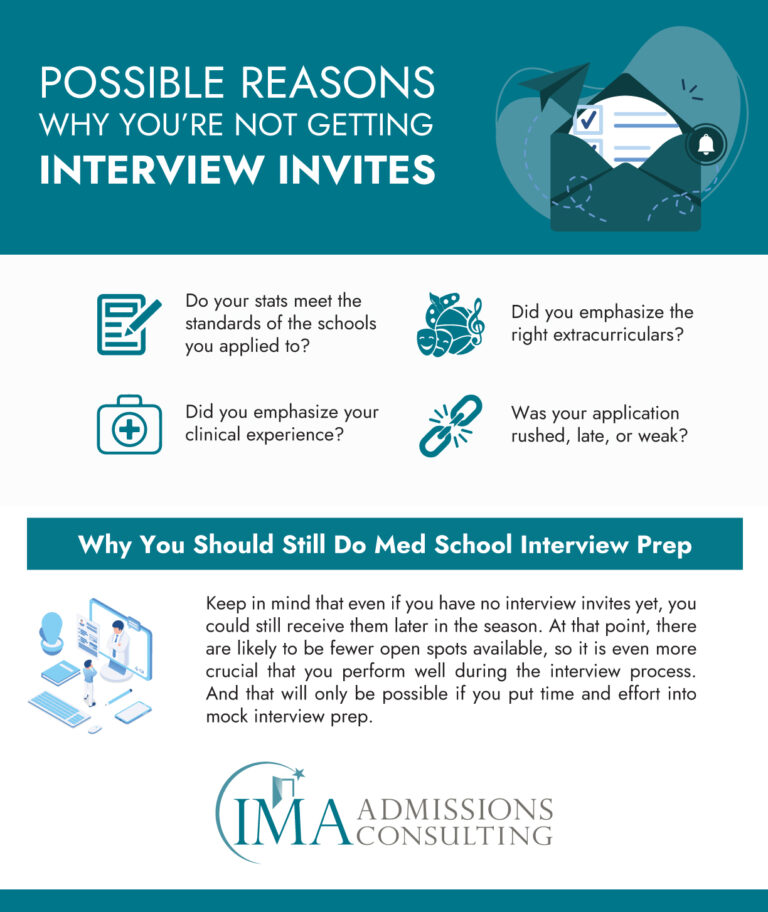
Did You Emphasize Your Clinical Experience?
Clinical experience is a critical extracurricular for medical schools. One of the most common reasons students are rejected is a lack of clinical experience. This may simply be because you do not understand what counts as “clinical” experience. Although shadowing hours take place in a clinical setting, they generally do not count as clinical experience. Shadowing is a more passive activity and can be a useful addition to your medical school resume, but it is not a replacement for clinical experience. Volunteer hours in a medical setting that do not involve patient contact, or an administrative job in a hospital, also do not usually count toward clinical experience.
Clinical experience is crucial not only as a checklist item for your AMCAS Work and Activities section but also as a way to meaningfully explore your interest in the medical profession. Admissions committees are looking for applicants who not only have a passion for medicine but can also back up that passion with insight gained through clinical work. This kind of experience can also help you write a well-informed, coherent personal statement and more specific secondary essays that reference these experiences and skills.
If you know your application was lacking meaningful clinical experiences, you may want to look for additional opportunities to gain these skills. If you do have a wealth of clinical experience on your application, reflect on whether you did a good job of showing it. Students often struggle with how to present their experiences in their application components. Reread your personal statement, the activities section, and your secondary essays. Do they convey the importance and significance of these experiences? Are you excited to read about them? If not, the admissions committee likely won’t be either.
Was Your Application Late, Rushed, or Weak?
This point closely ties in with the previous one. Reflect on whether your application was the best it could have been. Think about whether your essays showed your best skills and most significant activities, and whether the application as a whole presented a full picture of you as a candidate. Simply listing a series of impressive clinical activities or describing your academic merits is not enough. Your application should tell the committee the story of your journey to medical school. They should be engaged, and you should be a memorable candidate among thousands of other applications.
Late applications are generally not as competitive as applications submitted early. Because many schools review on a rolling basis, an application that reached schools in September is competing for fewer interview slots than one that arrived in late June. Naturally, if your application was late, it may also have been rushed. That often hurts quality, as you may not have carefully followed instructions, answered essay prompts fully, or caught spelling, grammar, and punctuation errors. Nothing will get your application set aside faster than grammar issues in your essays. Even if your essay tells the most compelling story possible, grammar issues and structural mistakes can undo it.
Why You Should Still Do Interview Prep
One of the most common mistakes students make during the medical school application process is waiting for an interview invitation before starting interview prep. It’s natural to want a break after submitting a long list of essays and documents, but the process isn’t over yet. Instead of sitting around and worrying about the status of your application, you can spend this time preparing for the next steps.
Even if you have no interview invites, you could still receive them later in the season. By that point, there will be fewer spots available, making it more crucial that you give a strong interview performance. That’s only possible if you put time and effort into your medical school interview prep. Some applicants receive interview invites just a few weeks after submitting their applications, and while that is great, it doesn’t leave them much time to prepare. The silver lining of your situation is that you have time to practice and master the skills the interview requires. You might receive your invitation less than a month before the interview date, and you don’t want to be caught off guard with little time to prepare. We recommend starting your interview prep as early as possible, even if you have no invites yet.
Med school interviews are generally challenging and require you to show strong communication skills and think quickly under pressure. These aren’t skills you can build overnight. However, once you learn them, they stay with you for life. Even if you do not get an invitation this cycle, these skills could help you land competitive extracurricular positions and prepare you for the next application cycle.
How to Prepare for Interviews
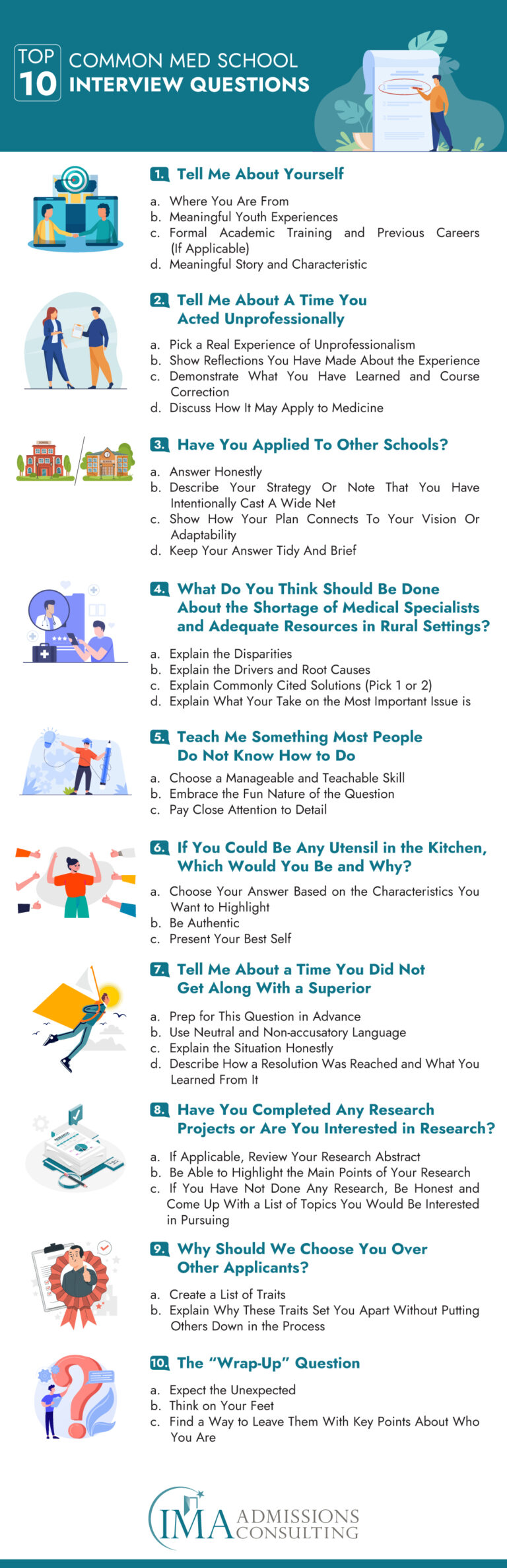
Prepping for a medical school interview isn’t as easy as looking up commonly asked questions. We recommend following the three-step approach below.
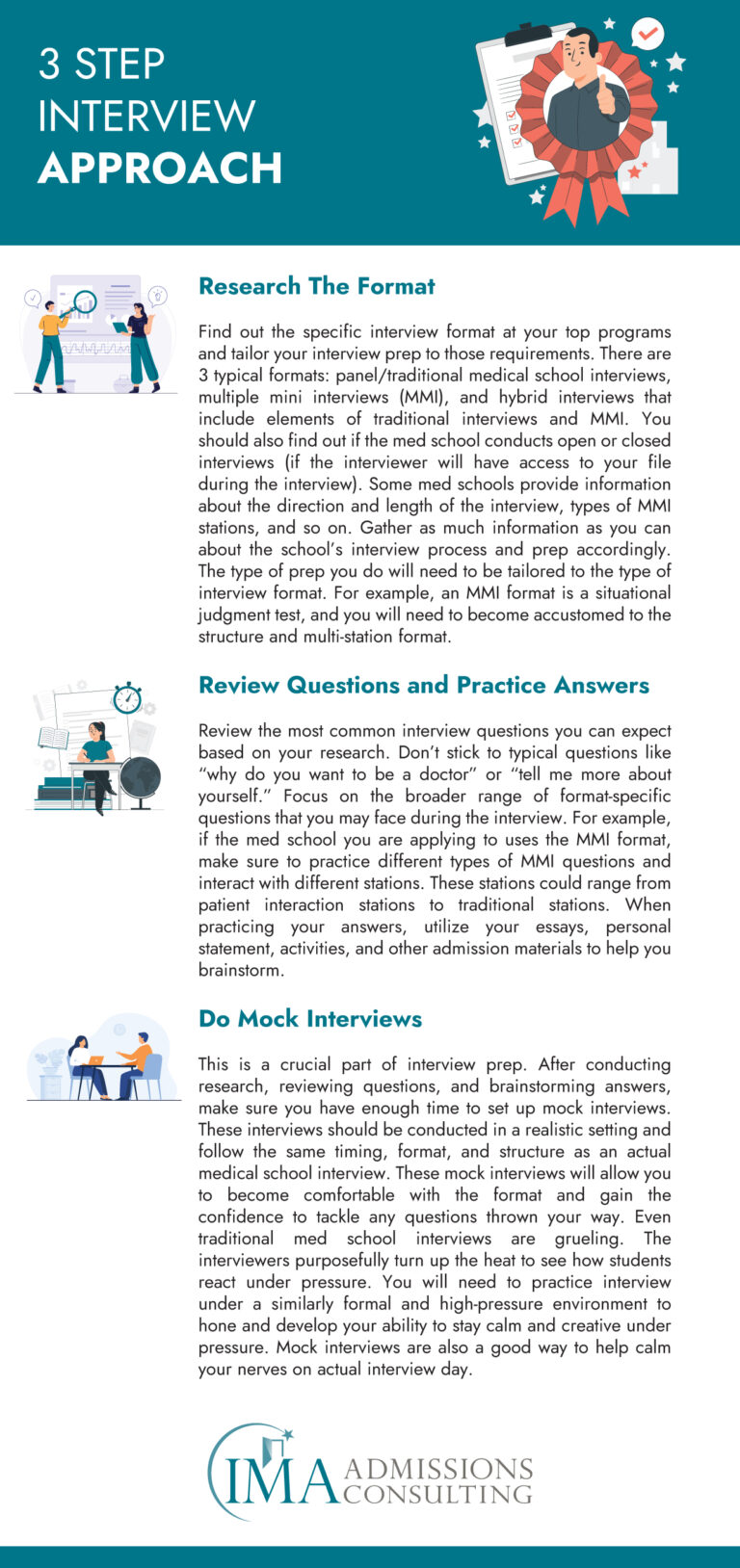
Because most schools in the MSAR report list virtual interviews for this cycle, practice on camera as well as in person. Test your lighting, audio, and internet connection, and rehearse answers while looking at the camera rather than the screen.
If you find that you struggle to improve your communication skills, or you still feel underconfident despite practice, it may be in your best interest to seek expert guidance. Medical school admissions consulting can help you identify your weaknesses and give you strategies for improvement.
The strategic, long-form interview prep outlined above is not just about knowing how to approach different types of questions; it is about building communication skills and confidence.
For more on prepping for med school interviews, read our article on the most common medical school interview questions, and for further guidance, consider our medical school admissions consulting service.
Additional Things You Can Do
Work on Gaining Additional Skills, Experiences, or Achievements
As explained above, one of the main reasons students with impressive applications don’t get an interview invite is a lack of meaningful extracurricular experience. If you feel a lot of anxiety about your chances and can clearly identify your extracurriculars as a weak point, focus on adding meaningful activities to your resume. The goal is a balance between being strategic, choosing activities that align with the values and mission of your top choice program, and picking activities that match your personal interests. Focus on the weakest parts of your application. If you already have plenty of research experience but not enough clinical experience, make an effort to gain clinical experience. If your top choice program values community service, consider a volunteer role.
It is not easy to find meaningful extracurricular experiences. Positions in prestigious or demanding activities are often very competitive. Start your interview prep early, so you can do well in interviews for these positions too.
You can share your additional achievements and experiences with med schools through letters of update and letters of interest.
Submit an Update or Letter of Interest
Submitting additional communications to a medical school can be a good idea, especially later in the application season, as long as the school accepts them. Additional communications help your candidacy stay fresh in the committee’s mind and give you a way to share new achievements and experiences.
There is a difference between a letter of update and a letter of interest. An update may be a simple change or addition to your profile and application (as far as the med school permits) and is a more informal form of communication. An update usually focuses on the details of what has changed in your application.
On the other hand, a letter of interest is a formal message that reaffirms your interest in the medical school’s program. This letter can also restate your unique experiences, strengths, and qualities. When writing a letter of interest, keep it brief and focus the content on what makes you a great candidate for that school.
Which letter you submit will depend on the medical school’s specific requirements. Some schools have a template or portal for updates and don’t accept any other form of communication, while others only accept updates through a letter of interest or letter of intent.
Submit a Letter of Intent
A letter of intent is a more specific letter that you would only send to one school. It confirms that the school is your top choice and that if offered a place in its program, you would definitely accept. You should only send one letter of intent, and ideally, we recommend waiting until after you have interviewed and been waitlisted by your top choice. If February arrives and you still have not received any interview invitations, you don’t have much to lose by sending a letter of intent to your top choice, if its policy allows. Medical schools watch their yield and want to interview and accept students who are likely to enroll. By reaffirming your commitment to the school, you may get the slight edge needed for an interview invite.
Conclusion
It is important to plan ahead and prepare for the worst. What will you do if you receive no interview invites? While this can be upsetting to think about, it is not necessarily the end of your dream. Use it as an opportunity to reflect and identify weak areas in your application. Think about how you can strengthen your application and whether you need a gap year to do it. Remember that your school list also plays a role in your chances of acceptance. Perhaps you haven’t given yourself the best chance by applying to schools where your stats fit well. At this stage, you can also consider working with a medical school admissions consultant to help you choose the right schools. If this cycle doesn’t work out, our guide to reapplying to medical school walks through the next one step by step.
Frequently Asked Questions
When is it too late to get a medical school interview?
This depends on the timeline of each medical school you applied to. Generally speaking, invitations can arrive as early as July and as late as March. Many schools in the AAMC’s MSAR Interview Policies report start sending invites in July, August, or September and keep sending them for months. Because AAMC protocols ask MD schools to have issued acceptances at least equal to their class size by March 15, new invites become much rarer after that.
When do med schools send interview invites?
Each school sets its own schedule. For the 2026-2027 cycle, AMCAS first sent applications to schools on June 26, 2026. Schools in the MSAR report list start dates from mid-July (such as UAB and Pittsburgh) to September (such as Harvard and Johns Hopkins), and many continue into the winter.
I have a high MCAT and GPA, why haven’t I received an invitation to interview yet?
If your academic record is solid and you haven’t been invited to interview yet, you may need to reflect on your list of extracurriculars. A lack of clinical experience is one of the most common reasons students don’t receive interview invites. Additionally, your activities may not show a clear fit with the programs. Timing matters too: a file completed in the fall may simply not have been reviewed yet.
How many schools should I send a letter of interest to?
You can send letters of interest to as many schools as you want, as long as each school’s policy allows them. If you have new achievements or experiences you’d like to share, you can send a letter of interest to each med school you applied to.
Can I submit a letter of intent to multiple schools?
No, you should only submit a letter of intent to a single school. Sending multiple letters of intent is dishonest, and because admissions committees highly value integrity and honesty, we strongly discourage sending more than one.
Why am I not getting interviews?
A common reason students receive no interview invites is a GPA and MCAT score below the school’s typical range for accepted students. If your stats fit the schools you applied to, review your extracurriculars to make sure you show strong clinical experience, and check that your application and secondaries were complete and submitted early.
As an international student, will I pay more for medical school?
The answer varies from school to school. At many private medical schools that accept international students, tuition is the same for all students. At public schools, tuition for out-of-state or international students is usually much higher than for in-state or in-province students. Check each school’s tuition page.
Should I still do med school interview prep if I have received no interview invites?
Yes. While you may not have received any invitations yet, it is still possible to receive one later in the season. You may receive an invitation less than a month before the interview takes place. Waiting until the last minute to begin your med school interview prep can keep you from putting your best foot forward and landing a spot in the program.
See more of our guides in your Google results: add International Medical Aid as a preferred source on Google.