Last updated: July 2026.
Prepping for the MCAT exam, which includes paying registration fees and other expenses, is an important part of applying for medical school. The majority of medical schools in both the US and Canada require the MCAT as part of the application process. Some even have strict cut-offs for MCAT scores to filter out primary applications. In 2026, the standard MCAT registration fee alone is $355, and that is just the starting point. When you factor in prep materials, potential tutoring, and travel to a testing center, the total cost of the MCAT can climb well above $1,000. Studying and spending an adequate amount of time preparing yourself for this roughly 7.5-hour exam is hard enough without the added worry of unexpected expenses. Most students know about the basic fees associated with the MCAT exam, such as the registration fee, but many do not know about the potential hidden costs. This guide breaks down every expense you should plan for in 2026, from registration and prep to travel and accommodations, so you can budget accurately and avoid surprises.
The MCAT is a Financial Commitment in 2026
There are various financial aspects to consider when taking the MCAT, from the cost of registering to travel expenses. Later in this guide, we will discuss the various ways to minimize the cost involved with taking the MCAT exam, including low-cost prep materials and the AAMC Fee Assistance Program. Not all of these cost-minimizing avenues are available to all students. For the average student, the exam is a significant expense that must be budgeted for carefully. As you plan your med school application, keep in mind that you will have to spend more than time and effort to prepare for your upcoming MCAT exam.
It is also worth understanding how MCAT costs fit into the larger picture of medical school expenses. The registration fee, prep costs, and travel are just the first financial commitments in a process that eventually includes medical school tuition and fees. If you want to see how borrowing for these costs could affect your finances long term, IMA’s Student Loan Repayment Calculator can help you model different repayment scenarios before you commit to additional debt.
MCAT Registration Fee and Pricing for 2026
The biggest question every student has when it comes to the MCAT is: how much does the MCAT cost? For the 2026 testing year, students can expect to pay $355 USD to register for the exam at all US and Canadian exam centers. This is an increase from the previous fee of $320. In addition to the $355 registration fee, international students testing outside the US, Canada, or US territories can expect to pay a $130 international fee (up from $115) plus any applicable local taxes (sales tax, GST/HST, value added tax, etc.). Canadian students also have to pay GST/HST on top of the base cost. However, the amount of tax varies depending on the province and local taxation policies.
The AAMC’s cancellation and rescheduling policies have also changed. Students should be aware of the following tiered fee structure for 2026:
- Rescheduling 60 or more days before the exam: $55 fee ($25 with FAP)
- Rescheduling 30 to 59 days before the exam: $110 fee ($45 with FAP)
- Rescheduling 10 to 29 days before the exam: $210 fee ($85 with FAP)
- Cancellation 30 or more days before the exam: Partial refund of $175
- Cancellation fewer than 30 days before the exam: No refund
Importantly, the deadline for any changes is now 10 days before your scheduled test date. No registration, rescheduling, or cancellation is allowed fewer than 10 days before the exam. This is a change from the previous 8-day deadline, so plan accordingly. We do not recommend waiting until the last minute to complete your registration. Under ideal circumstances, you should register for the exam 2 to 3 months in advance and after determining how much time you will need to properly prepare. If you are still deciding on timing, our guide on when to take the MCAT can help you pick the right test date for your schedule.
Registration for all January through September 2026 MCAT exam dates is currently open through the AAMC. The MCAT is not offered in October through December 2026.
MCAT Retake Limits and Cost Implications
Understanding the AAMC’s retake policy is essential for budgeting. You may attempt the MCAT no more than three times in a single testing year, no more than four times over two consecutive testing years, and no more than seven times in a lifetime. Each retake means paying the full $355 registration fee again, plus any associated travel and prep costs. A student who takes the exam three times in one year will spend at least $1,065 on registration fees alone.
This is one reason it pays to invest in thorough preparation before your first attempt. Spending an extra $300 to $500 on quality prep materials or tutoring can be far less expensive than needing a second or third attempt. For a more detailed look at how retaking affects your application timeline and finances, review the AAMC’s official scheduling fees page.
MCAT Prep Cost
Prepping for your upcoming MCAT exam can also be quite costly as it is one of the toughest exams that you will take. The test is designed to be challenging as the majority of medical schools consider your score to be a signifier of your intellect and your readiness for med school. The exam has a total seated time of approximately 7.5 hours (6 hours and 15 minutes of actual testing time, plus optional breaks) and is divided into 4 sections:
- Chemical and Physical Foundations of Biological Systems (59 questions, 95 minutes)
- Critical Analysis and Reasoning Skills, or CARS (53 questions, 90 minutes)
- Biological and Biochemical Foundations of Living Systems (59 questions, 95 minutes)
- Psychological, Social, and Biological Foundations of Behavior (59 questions, 95 minutes)
These 4 sections test your knowledge of foundational science, critical thinking, reading comprehension, and analytical reasoning across 230 total multiple-choice questions. The AAMC has confirmed that the MCAT format, sections, time limits, and scoring scale are not changing in 2026, though the organization has indicated it is working on potential future changes to shorten and modernize the exam. No specific timeline for those changes has been announced.
There are a handful of medical schools that do not require the MCAT, but the majority of colleges do consider it an important selection factor. Colleges that receive a high volume of applications each year use an applicant’s MCAT score in conjunction with their GPA as a filter to sort out the strongest and most competitive applications. In many cases, if you do not meet the college’s required minimum MCAT score, your application will likely be rejected before being reviewed. To get a sense of where you stand competitively, you can use IMA’s Medical School Admissions Calculator to evaluate how your GPA and MCAT score compare across different programs.
For this reason, it is crucial that students take MCAT prep seriously and put in the required time and effort to thoroughly prep for the exam. If you are unsure of how to study for the MCAT, the key thing to remember is this is not a test you can do well on by waiting until the last minute to prep and study. You need to thoroughly comprehend and understand key knowledge for each section of the MCAT, but you also must complete practice sessions to develop your critical reasoning and analysis skills.
To get all of the necessary prep completed, the average medical student will need to dedicate at least 300 to 400 hours of study time. As you plan your MCAT prep, be mindful to obtain all of the required prep materials and resources needed to help you study for the MCAT exam. These materials include textbooks and guides covering knowledge and concepts required for the test and question banks to help students answer various types of questions. The materials also include mock exams to aid students in getting familiar with the structure and test-taking conditions. In addition, students may want to receive additional expert help in the form of a prep course or tutoring. While basic free MCAT prep materials are available, the majority of MCAT prep does cost money. The amount of money you actually spend will vary depending on your study style, specific challenges, and academic requirements. If you need help building a realistic study timeline, our MCAT prep timeline for busy students is a good starting point.
Let’s discuss the different MCAT prep materials students can utilize and how much they cost in 2026.
Low-Cost and Free MCAT Prep Resources for 2026
Some MCAT prep resources are free and easily available online. While these free online resources may not provide a detailed MCAT prep curriculum, they do form a solid base on which you can begin building your study schedule and plan. It is ideal to go through these materials at the beginning of your prep to find out where you stand and what areas of prep you may need extra help with. Students can determine how and where to allocate their money during their MCAT prep period.
AAMC Materials for 2026
The AAMC has significantly expanded and restructured its prep offerings for 2026. Most notably, the AAMC now offers two free full-length practice exams, up from just one previously. The free resources include:
- Unscored Sample Test (230 questions, same format as the real exam, but no scaled score)
- Practice Exam 1 (full-length scored practice exam, newly free for 2026)
- Complete exam content outlines for each of the 4 sections in PDF format
- Content Outline Course (now includes 120 practice questions from the retired Official Guide to the MCAT Exam)
- Study planning guides and resources
On top of these free resources, the AAMC provides a collection of paid prep materials. You can choose to purchase these additional materials individually or as the AAMC MCAT Official Prep Online-Only Bundle. The bundle includes a 1-year subscription with access to 2,710 unique passage-based and independent questions. The bundle has a regular price of $390 USD, though it is sometimes available at a sale price of approximately $323.70. The AAMC has also introduced 3-month and 6-month product extensions for students who need to renew an active or recently expired subscription.
Individual items available for purchase include:
- 5 scored practice exams (Practice Exams 2 through 6), approximately $35 USD each. Practice Exam 6 is brand new for 2026.
- Question Pack Bundle, with a regular price of $90 USD (sometimes on sale for approximately $76.50)
- CARS Diagnostic Tool
- Planning and study resources priced from $15 to $45 USD each
In total, the AAMC now offers 7 full-length practice exams: 2 free and 5 paid. This is a meaningful improvement for students on a budget, since two scored or scoreable full-length exams can be completed at no cost before purchasing anything else.
One important change: the Official Guide to the MCAT Exam, previously sold for $34, has been retired. The 120 practice questions it contained are now included for free in the Content Outline Course. This is good news for students looking to reduce costs.
Other Low-Cost and Free Materials
You can utilize a variety of free online resources and courses including videos, blogs, webinars, sample question banks, and study guides. International Medical Aid offers a wealth of free blogs about prepping for the MCAT as well as our invaluable paid medical school admissions consulting services. We also offer fantastic pre-med shadowing study abroad programs to help students put together a more competitive application.
Khan Academy has historically offered a free MCAT prep course with extensive video lessons and practice questions, supported by the AAMC. As of mid-2026, the Khan Academy MCAT course remains available online. However, the long-term future of this resource beyond 2026 is uncertain; Khan Academy and the AAMC have stated they are in discussions about continuing the course but have not confirmed a timeline. Students who plan to rely on Khan Academy content should be aware of this and may want to download or complete the materials sooner rather than later.
For students looking for free MCAT practice questions, combining the AAMC’s free offerings with Khan Academy and other reputable online resources can provide a solid foundation before investing in paid materials.
Paid Consulting and Coaching Services
If you find yourself needing more intensive coaching or targeted instruction after taking advantage of the free prep materials and MCAT diagnostic test, you can choose to use a paid consulting service, such as an MCAT tutor or prep course. The MCAT is a difficult exam to study for entirely by oneself. If you prefer to enlist the help of a coach for your most challenging areas or you struggle to master answering CARS questions, tutoring and prep courses may help you significantly.
The cost associated with these services varies based on the type and amount of coaching you sign up for. On average, MCAT prep courses range in cost from approximately $300 to $5,000 USD or more. If you’d like to sign up for a 6-month coaching curriculum that covers all of the sections and includes many sample question banks and tests, you should budget to pay over $1,000 USD. You can get a cheaper bundle of study materials with self-paced online resources such as webinars and videos. Some students may opt to partake in a strategic number of tutoring classes to target their weakest areas.
As you create your MCAT study schedule, keep in mind that your top priority should be ensuring you adequately prep for the exam. Get all the help and guidance you need to put your best foot forward. Do not hesitate to seek additional help to address your key areas for improvement. It is better to invest your time and money toward your studying to ensure you do your best during the exam instead of saving money and performing poorly. If you need to retake the MCAT exam, you will need to pay registration and other associated fees again. With the 2026 registration fee at $355 per attempt and a maximum of three attempts per testing year, retakes can cost over $1,000 in registration fees alone. You may not be able to retake the exam during the same application cycle and will find yourself waiting until the next application cycle to take the MCAT again. In terms of medical school application costs, this is a significant waste of money. Not to mention the added stress of needing to postpone your plans for another year.
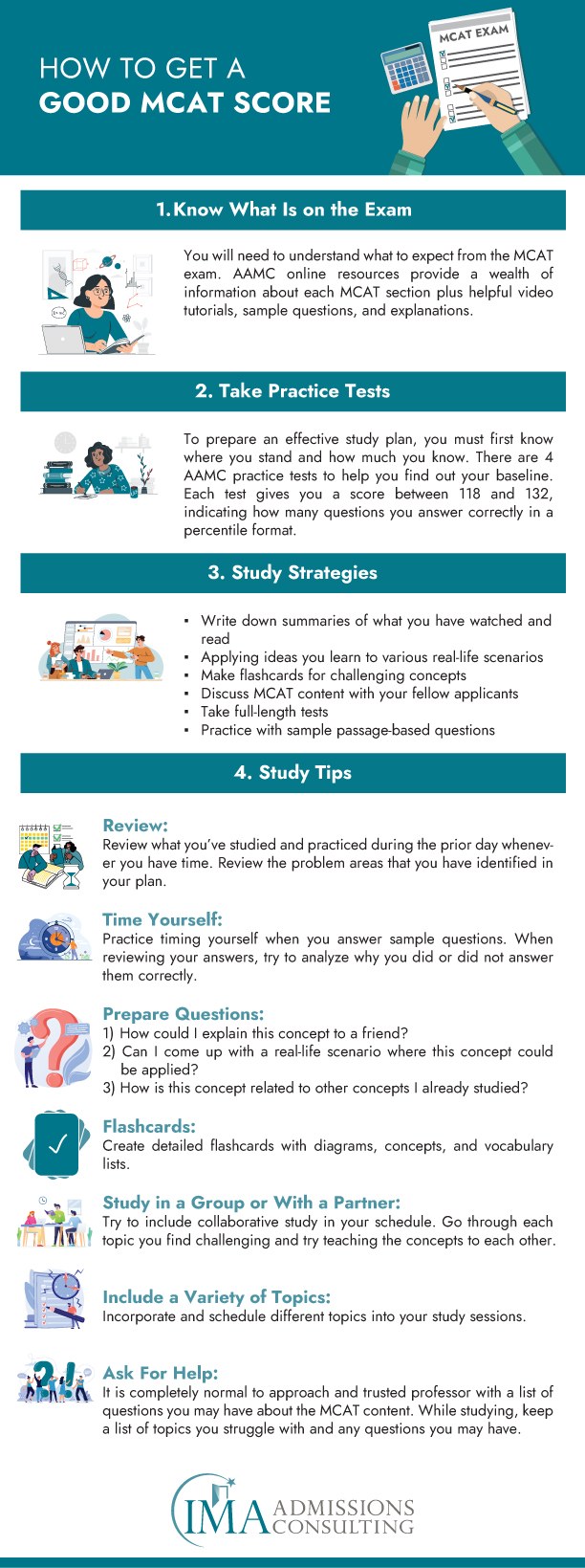
How to Get a Good MCAT Score
- Know What Is on the Exam
You will need to understand what to expect from the MCAT exam. AAMC online resources provide a wealth of information about each MCAT section plus helpful video tutorials, sample questions, and explanations. For a detailed breakdown of what score ranges medical schools expect, see our guide on what MCAT score you need to get into medical school.
- Take Practice Tests
To prepare an effective study plan, you must first know where you stand and how much you know. In 2026, the AAMC offers 7 total practice exams (2 free, 5 paid) to help you find out your baseline. Each scored test gives you a score between 118 and 132 per section, indicating how many questions you answer correctly in a percentile format.
- Study Strategies
- Write down summaries of what you have watched and read
- Apply ideas you learn to various real-life scenarios
- Make flashcards for challenging concepts
- Discuss MCAT content with your fellow applicants
- Take full-length tests under timed conditions
- Practice with sample passage-based questions
- Study Tips
Review: Review what you’ve studied and practiced during the prior day whenever you have time. Review the problem areas that you have identified in your plan.
Time Yourself: Practice timing yourself when you answer sample questions. When reviewing your answers, try to analyze why you did or did not answer them correctly.
Prepare Questions:
- How could I explain this concept to a friend?
- Can I come up with a real-life scenario where this concept could be applied?
- How is this concept related to other concepts I already studied?
Flashcards: Create detailed flashcards with diagrams, concepts, and vocabulary lists.
Study in a Group or With a Partner: Try to include collaborative study in your schedule. Go through each topic you find challenging and try teaching the concepts to each other.
Include a Variety of Topics: Incorporate and schedule different topics into your study sessions.
Ask For Help: It is completely normal to approach a trusted professor with a list of questions you may have about the MCAT content. While studying, keep a list of topics you struggle with and any questions you may have.
Travel and Associated Costs for the MCAT in 2026
The MCAT is not an online exam, meaning you will have to travel to a designated testing location to take your MCAT exam. One of the most commonly forgotten hidden costs associated with taking the MCAT is travel costs. This includes the cost required to get to your testing location and any other associated costs such as accommodations during the testing period. Travel and accommodation costs will vary depending on your distance from your designated testing center.
For reference, the average cost of a domestic airfare in the United States was approximately $428 in Q1 2026, according to the Bureau of Transportation Statistics. While driving to the testing center may be a cheaper option, the average fuel cost as of mid-2026 is approximately $3.79 per gallon (per AAA data), and gas prices have been volatile this year. Driving often takes longer, and if your testing center is several hours from your home, you may also need to budget for hotel accommodations. These accommodations could easily cost an additional $200 to $300 USD per night.
Students should also be aware that the AAMC implemented new security protocols at all Pearson VUE test centers as of April 2025. The check-in process now includes an infrared and metal detection wand scan, which means you should plan to arrive with extra time to account for this additional step.
Students can attempt to mitigate travel costs by selecting the closest exam center to their location when registering for the MCAT. By doing so, you will have to travel less and will accrue less cost in terms of travel and accommodations.
Those who reside in populated and urban areas will have an advantage as they are far more likely to find a nearby MCAT test center. Some students may not even need to arrange any travel accommodations and will simply be able to drive to the test center on the day of their scheduled exam date. If you live in a more rural area, you will likely need to travel to reach the nearest testing center. This may require you to travel to another city or town, plan for overnight accommodations, or pay for transportation to the test center. These travel costs can quickly accumulate.
Let’s consider an example of a student who must travel from a rural area to an urban area like Chicago. This student may easily spend $400 or more on a plane ticket to get to Chicago from their hometown. They will likely need to spend at least $50 USD on a rideshare or taxi to take them to the testing center and another $200 on a hotel room near the exam location. This doesn’t include the cost of food, snacks, and any other miscellaneous expenses which could easily be another $50 USD. In total, this student will spend roughly $700 USD on travel and accommodations for their MCAT exam.
It is important to keep in mind that the actual figures could be higher or lower depending on a variety of factors. Plane tickets and gas costs will vary depending on how far from the testing center you are. There are ways that you can try and save money on travel costs such as taking public transportation from the airport to your testing location instead of a rideshare. When taking a rideshare or taxi, you could easily pay $50 USD or more for a 30-mile trip, while taking the train or bus may only cost a few dollars. However, it is also important to remember that figuring out public transportation in an unfamiliar city is not an easy task and may create unneeded stress.
The cost of hotel accommodations can also become quite expensive if you choose to stay in a prime area of the city. However, if you choose to stay in a hotel located a further distance from your testing center, you will likely pay more for transportation.
Though the cost of travel may seem high, it is not a good idea to compromise on travel and hotel accommodations. The MCAT is a 7.5-hour seated test and you will need to be well-rested on the day of the exam to ensure that you do your best possible. Making hasty, last-minute travel arrangements can lead to you being late for the exam or too tired on the day of the MCAT. After taking months to carefully and adequately prep for the exam, you don’t want to receive a poor mark or miss the exam entirely due to one day.
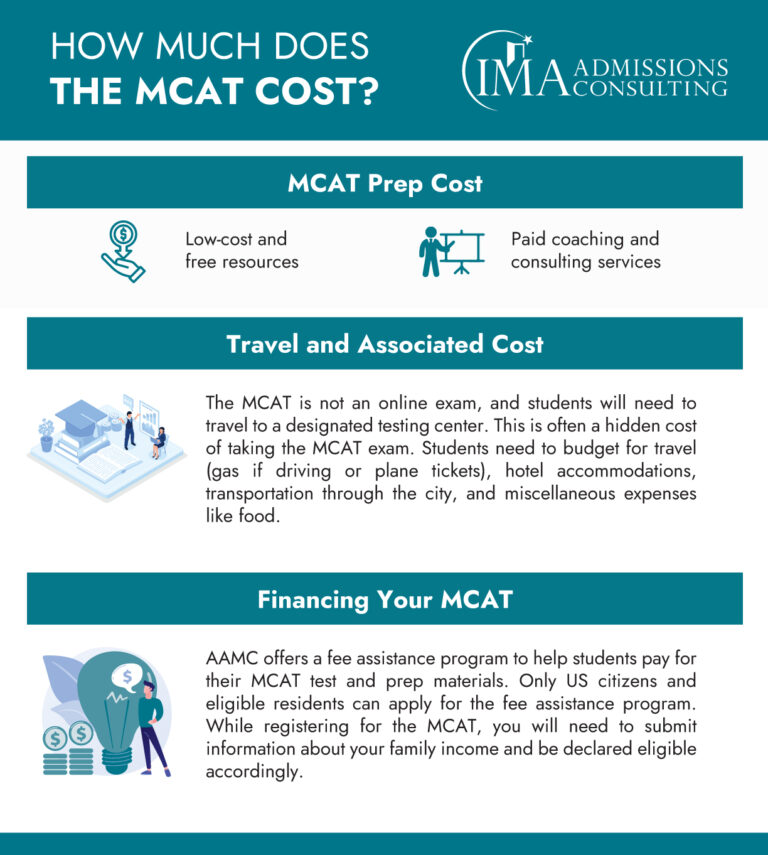
How Much Does the MCAT Cost? A 2026 Summary
MCAT Registration
- Standard registration: $355 USD (2026)
- International fee (outside US, Canada, US territories): $130 USD additional
- FAP reduced registration: $145 USD
MCAT Prep Cost
- Free resources: 2 free full-length practice exams from AAMC, Content Outline Course with 120 questions, Khan Academy MCAT course (availability may change), free online guides and blogs
- AAMC paid bundle: $323.70 to $390 USD
- Paid coaching and consulting services: $300 to $5,000+ USD depending on scope
Travel and Associated Costs
- The MCAT is not an online exam, and students will need to travel to a designated testing center. This is often a hidden cost of taking the MCAT exam. Students need to budget for travel (gas at roughly $3.79/gallon or plane tickets averaging around $428), hotel accommodations, transportation through the city, and miscellaneous expenses like food.
Financing Your MCAT
- AAMC offers a Fee Assistance Program providing over $2,000 in combined benefits to eligible students. Only those with a US-based home address can apply. While registering for the MCAT, you will need to submit information about your family income and be declared eligible accordingly.
Financing Your MCAT in 2026
The AAMC offers a Fee Assistance Program (FAP) to help students who come from economically disadvantaged backgrounds pay for their exam and prep materials. For 2026, each household reported on your application must have a total family income equal to or less than 400% of the 2025 national poverty level for your family size. You must have a US-based home address to be eligible. You may apply once per calendar year and be awarded a maximum of five times during your lifetime. The 2026 FAP application opened on February 2, 2026 and closes in December 2026.
As part of the program, students who are eligible for fee assistance pay only $145 USD to register for the MCAT instead of $355 USD. The 2026 FAP provides over $2,000 in total benefits, including:
- Reduced MCAT exam registration fee of $145
- Free AAMC MCAT Official Prep Online-Only Bundle
- Complimentary 2-year subscription to the MSAR online database
- Waiver for all AMCAS fees for one submission cycle, covering up to 20 medical school submissions
- Discounted PREview exam registration fees
- A 60% fee discount on up to 50 applications when applying for residency with ERAS
- Up to $1,000 in financial assistance for MCAT accommodations evaluation
Some third-party MCAT prep courses may offer subsidized fees for students who can show proof of enrollment in the AAMC Fee Assistance Program.
AAMC also offers discounted room rates at hotels near exam centers. All students can take advantage of this option. Although the discount rate is modest, it can still help mitigate some of the costs.
A Canadian MCAT Fee Assistance Program is offered by the AAMC as well. This program is organized by both the AAMC and AFMC (Association of Faculties of Medicine of Canada). Like the fee assistance program for US-based students, this program includes a reduced MCAT registration fee, free access to all AAMC MCAT Official Prep products, and more.
There are other strategies that students can use to try and minimize their MCAT costs. For example, if you need to travel to a testing center and want to lower the amount you will spend on accommodations, try picking a testing center near someone you know who will allow you to stay with them. There are also cheaper alternatives to hotels like Airbnbs and student hostels. Choosing one of these accommodations also helps save on food costs as you will be purchasing groceries to prepare rather than spending money on hotel room service.
MCAT Total Estimated Cost for 2026
For those still wondering “how much is the MCAT” and to better help students understand the expenses involved in taking the MCAT in 2026, we have put together a helpful example based on a specific student, who we will refer to as Amy. Amy has a US-based home address and does not qualify for the Fee Assistance Program. She has decided to sign up for a mid-range prep course and currently lives in a rural area of Illinois. Her MCAT exam will be conducted at a testing center in Chicago. Amy has chosen to fly into O’Hare airport. All of the cost estimates included are reflective of average 2026 costs for accommodations, travel, and transport in an urban US setting.
Here is a breakdown of Amy’s estimated costs:
- MCAT Registration: $355
- AAMC Prep Bundle: $390 (regular price)
- Mid-range prep course: $1,000 (estimate)
- Round-trip flight: $428 (2026 average)
- Rideshare to/from testing center: $50 to $100
- Hotel (1 night): $200 to $250
- Food and miscellaneous: $50 to $75
- Estimated total: approximately $2,473 to $2,598
Please note that the total cost for each student will vary depending on personal circumstances. For instance, you may live closer to a testing center and may not need to fly to the destination, or you may have friends you can stay with so you won’t have to pay for a hotel room. Students who qualify for the FAP will see significantly lower costs, particularly on the registration fee and prep materials.
What a Strong MCAT Score Is Worth Financially
It is easy to focus on the upfront costs of the MCAT and lose sight of the long-term financial picture. A strong MCAT score can affect which medical schools accept you, and that in turn affects your total cost of attendance, scholarship eligibility, and future earning potential. Students admitted to schools with generous financial aid packages or merit scholarships can save tens of thousands of dollars over four years of medical school.
Conversely, a weak score that leads to a retake costs you at minimum another $355 in registration, plus any additional prep and travel. If a weak score delays your application by a full cycle, you may lose a year of attending-level income on the other end of your career.
This is not to add pressure, but to make the point that spending thoughtfully on MCAT preparation is an investment, not just an expense. If you are trying to figure out whether to invest in a prep course or additional study materials, weigh that cost against the cost of a retake or a delayed application. For perspective on how medical school debt compounds over time and what repayment looks like at different income levels, try the Student Loan Repayment Calculator.
Frequently Asked Questions
How much does it cost to register for the MCAT in 2026?
The standard MCAT registration fee for 2026 is $355 USD at US and Canadian testing centers. International students testing outside the US, Canada, or US territories pay an additional $130 fee. Canadian students also pay applicable GST/HST. Students who qualify for the AAMC Fee Assistance Program pay a reduced fee of $145.
How much should I budget for total MCAT costs including prep and travel?
Total costs depend on your location, prep approach, and travel needs. A student using free resources and testing locally might spend under $500 total. A student who purchases the AAMC prep bundle, enrolls in a mid-range prep course, and travels by air could spend $2,000 to $2,600 or more. Building a detailed budget before you register helps avoid surprises.
What does the AAMC Fee Assistance Program cover in 2026?
The 2026 FAP provides over $2,000 in combined benefits, including a reduced $145 registration fee, the free AAMC Official Prep Online-Only Bundle, a 2-year MSAR subscription, AMCAS fee waivers for up to 20 schools, discounted PREview exam fees, and a 60% ERAS application discount. Eligibility requires a US-based home address and family income at or below 400% of the federal poverty level.
Can I get a full refund if I cancel my MCAT?
No. As of 2026, cancelling 30 or more days before your exam date results in a partial refund of $175, not a full refund. Cancelling fewer than 30 days before the exam results in no refund at all. No changes of any kind are allowed fewer than 10 days before the exam date. Plan your test date carefully to avoid losing money.
How many times can I take the MCAT, and what does retaking cost?
You may take the MCAT up to 3 times in one testing year, 4 times over two consecutive years, and 7 times in your lifetime. Each attempt requires paying the full $355 registration fee again, plus any travel and additional prep costs. Three attempts in one year would cost at least $1,065 in registration alone.