Aseptic filling of biologic drugs requires scientific precision and GMP rigor. CDMO companies are leaders in this field, combining environmental controls, validated processes and automated systems to ensure sterility and quality according to global standards of regulatory bodies. Fill-Finish operations are governed by detailed quality management systems that ensure batch traceability, cleanroom classification control and comprehensive documentation.
What Are Fill-Finish Operations in Biologics Manufacturing?
Fill-Finish operations mark the final and most delicate stage of biologics manufacturing, where sterile drug substances are transferred into final containers like vials or syringes under aseptic conditions.
This transition from bulk substance to finished dosage form is tightly controlled to prevent microbial, particulate, and pyrogen contamination. The process includes formulation (e.g., dilution or buffer exchange), sterile filtration, aseptic filling, container closure (capping or sealing), and labeling. Each step taking place in environments that meet ISO 5 or Grade A standards to ensure sterility. To meet these demands, CDMOs implement robust environmental controls, redundant filtration systems, and process automation designed to minimize human interaction.The entire process is documented in accordance with global regulatory standards (e.g., EMA Annex 1, FDA 21 CFR Part 211), ensuring that the final product meets release criteria and is safe for clinical or commercial use.
Single-use systems, closed-loop filling technologies, and barrier isolators are frequently used to reduce human intervention and environmental risk. Any deviation during this stage can compromise the entire batch; hence, real-time environmental monitoring, in-process controls (e.g., fill weight verification, integrity testing), and validated procedures are essential to ensuring the biologic drug maintains its safety, efficacy, and compliance through to the point of patient administration.
Key Sterility Measures Taken by CDMOs in Fill-Finish
Aseptic Fill-Finish is where drug substance becomes medicine, but only if sterility is uncompromised. Each element in the Fill-Finish process must work in harmony to exclude contaminants and maintain drug integrity. Sterility measures procedures go far beyond cleanrooms. Their precise implementation is essential to ensure product quality, patient safety, and compliance with global health authorities.
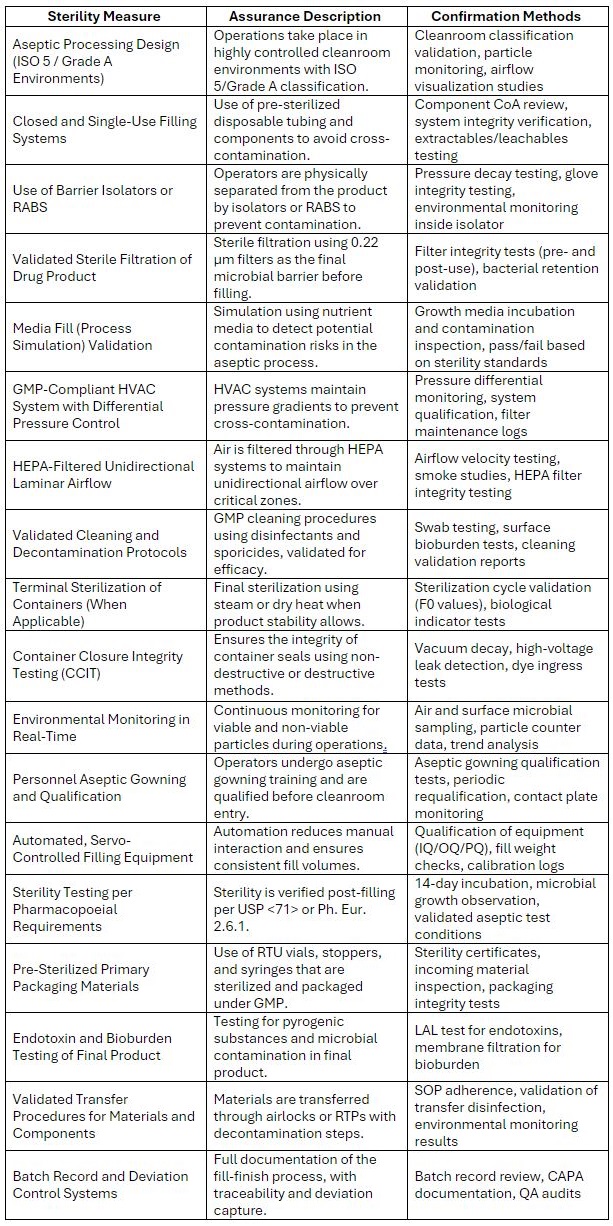
Every biologic product’s safety depends on an unbroken chain of sterility assurance. In Fill-Finish operations, even the smallest lapse can lead to batch rejection or patient risk. That’s why sterility measures are the critical control points of pharmaceutical trust.
How CDMOs Guarantee Quality and Regulatory Compliance in Fill-Finish
CDMOs implement robust quality management systems that align with international GMP guidelines such as FDA’s 21 CFR Part 211 and EMA’s Annex 1. Each stage of the aseptic process is governed by validated standard operating procedures (SOPs), controlled cleanroom environments, and stringent documentation practices to ensure full traceability and consistency. From the initialmaterial qualification and sterile filtration through container closure and labeling, every action is recorded and reviewed by independent quality assurance (QA) teams. These systems are reinforced by electronic batch records, deviation tracking, and real-time monitoring to prevent, detect, and correct any deviations from validated processes.
Verification of compliance involves a combination of in-process controls and post-process testing, covering both the process and the final product. Key quality checkpoints include fill weight verification, container closure integrity testing (CCIT), environmental and personnel monitoring, and sterility and endotoxin testing per pharmacopoeial standards. A CDMO company also rely on proactive quality metrics such as CAPA (Corrective and Preventive Actions) reviews, regular internal audits, and regulatory inspections readiness programs.
Technologies Enhancing Fill-Finish Reliability
The reliability of Fill-Finish systems is reinforced through integrated PLC/HMI control platforms, recipe-driven parameter settings, and qualification services including performance testing and hydrogen peroxide (VHP) decontamination validation. One key innovation is the integration of isolator-based vial filling, stoppering, and capping systems equipped with peristaltic pumps and 100% in-line check weighing. These systems allow processing of a wide range of vial formats, reduce contamination risks through barrier separation, and provide automated batch traceability by cap-marking mechanisms.
Upstream of the filling station, rotary vial washing machines and depyrogenation tunnels play a vital role in contamination control. The washing units are designed to handle thousands of vials per hour, using stainless steel components and needle-based washing stations for optimal internal and external vial cleaning. The depyrogenation tunnels ensure consistent heat treatment to remove endotoxins, with compact designs suited even for R&D or space-limited environments. Together, these pre-fill systems are critical in establishing aseptic conditions before a single drop of drug product enters a container.