Last updated: November 1, 2026
Which Colleges Have Pre-Med Programs?
Nearly every four-year college in the United States has a pre-med program, because pre-med is a track, not a major. You choose any major, take the medical school prerequisite courses and work with a pre-health adviser. What differs from college to college is the advising, the letter process, research access and whether a medical school seat can be reserved early.
That is why a list of colleges with pre-med programs is really a list of the ways colleges support pre-meds. The table groups well-known options by type of school, from the Ivy League to public flagships, HBCUs and combined college and medical school programs. If you want the ranked version, see our guide to the best pre-med colleges.
Colleges With Pre-Med Programs by Type of School
| Type of school | Examples | What pre-med looks like there |
|---|---|---|
| Ivy League | Harvard, Penn, Columbia, Cornell, Brown, Yale, Dartmouth, Princeton | Pre-health advising at every school; Harvard, Columbia and Cornell write committee or institutional letters, and Brown adds the eight-year Program in Liberal Medical Education |
| Private research universities | Johns Hopkins, Stanford, Duke, Northwestern, Rice, Case Western, Rochester, Notre Dame, Tulane, Villanova | Dedicated pre-health advising offices; letter processes vary, and Stanford, for example, has no committee letter process |
| Public flagships and large state universities | University of Washington, UNC Chapel Hill, Arizona State, Florida State, UC Riverside, Clemson, Pittsburgh | Advising offices that serve every major; ASU says students can be pre-health in any of its majors |
| Historically Black colleges and universities | Howard, Spelman | Howard’s Center for Preprofessional Education and Spelman’s Health Careers Program, which dates to 1971 |
| Combined college and medical school programs | Brown PLME, Rochester REMS, Case Western PPSP, Pitt GAP, UMKC six-year BA/MD, CUNY seven-year BS/MD | Admission to college plus conditional admission to medical school, as in Rochester’s eight-year REMS program |
| Colleges with a pre-health major | Notre Dame | A 64-credit Science Preprofessional Studies major built mainly for students heading to the health professions |
Is Pre-Med a Major at Any College?
Rarely. Most colleges, including Stanford, Arizona State and Florida State, state that they have no pre-med major. Notre Dame is one of the few with a related major, Science Preprofessional Studies, and even there students can reach medical school from other majors. The AAMC says medical schools have no required or preferred major.
So the better question is which major you will enjoy and do well in while you complete biology, chemistry, physics and the other prerequisites your target medical schools list.
Which Colleges Let You Reserve a Medical School Seat Early?
Combined programs admit high school seniors to college and, conditionally, to a medical school. Examples include Brown’s PLME, Rochester’s REMS, Case Western’s Pre-Professional Scholars Program, Pittsburgh’s Guaranteed Admission Program, UMKC’s six-year BA/MD and the CUNY School of Medicine’s seven-year BS/MD. Our guide to BS/MD programs explains how to apply, and the guide to accelerated pre-med programs compares six- and seven-year formats.
How Do You Choose a College From the List?
Start with fit and cost, then check four things on each college’s pre-health pages: who advises pre-meds, whether there is a committee letter, how students find research, and how close the nearest hospitals are. Our school-by-school pre-med guide answers these for more universities.
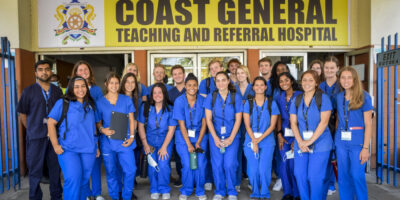
Clinical exposure before college also helps you decide whether pre-med is right for you. Hospital internships for high schoolers in Kenya and Peru let students 15 and older work alongside clinicians under supervision.
A Closer Look at Four Pre-Med Favorites
Last April, the Association of American Medical Colleges (AAMC) published a report showing a shortage of physicians in the country. At the current rate of supply and demand growth, the report predicts that the US will be up to 124,000 physicians short by 2034. While their number grows by 3% yearly, says the Bureau of Labor Statistics, the AAMC believes it isn’t fast enough.
It’s reasonable why the AAMC has stressed the need for decisive action as early as now. Getting from undergraduate studies to professional practice can take upwards of a decade, and this may not even include medical internships. The pre-med stage alone accounts for half of that timeframe or more. Depending on the school, prerequisites include a year of biology, physics, general and organic chemistry, biochemistry, and humanities.
The decision to enter a pre-med program isn’t to be taken lightly, but choosing a college is just as daunting. Here is a closer look at four colleges that pre-med students often ask about first.
Any Ivy League University
Nothing says “crème de la crème” more than an Ivy League school. The eight prestigious schools under this group, whose names are no less prominent in medicine (except Princeton), include:
- Harvard University
- Yale University
- Columbia University
- University of Pennsylvania
- Brown University
- Dartmouth College
- Cornell University
- Princeton University
In terms of pre-med programs, not all of these schools have one. For instance, while Harvard is well-known for its medical curriculum, it doesn’t have a pre-med concentration. On the other hand, Columbia has one of the best post-bacc pre-med programs. Cornell offers a few courses, while Brown has a program that combines an undergraduate degree with medical school.
While a pre-med program helps, any Ivy League school is ideal for pre-med as long as a student meets its requirements. The only major hurdle is the insanely low acceptance rate. One April report said Harvard’s rate dropped to a historic low of 3.19%. Cornell reportedly has the highest acceptance rate at around 6.9%, though it hasn’t released its official data as of this writing.
Northwestern University
While impressive, a medical diploma from an Ivy League school isn’t a requirement to become a doctor. As a matter of fact, according to the latest US News Best Colleges Rankings, non-Ivy League schools occupy six of the top ten slots.
One example is Northwestern University in Evanston, Illinois, which sits alongside Duke University in 10th place. The Northwestern Undergraduate Premedical Scholars Program (NUPSP) is at the heart of its pre-med program, accepting undergrads into its medical curriculum as early as their third year. After the fourth year, the program automatically enrolls them into medical school.
Under the NUPSP, undergrads who show dedication to pursuing medicine in their first two years don’t have to take the Medical College Admission Test. However, the university only extends this early invitation to as many as eight students. Additionally, they must still meet the pre-med requirements to gain a seat, so it’s not a faster way into medical school.
Johns Hopkins University
Diversity and inclusion have been the foundation of Johns Hopkins’ identity for decades, and those values extend to its pre-med program. Like those in most universities and colleges, Johns Hopkins’ pre-med students can come from any undergraduate background, not just related to science or health.
But perhaps the school’s defining feature is its commitment to supporting the underrepresented in medicine (URM). The AAMC defines this as:
“…those racial and ethnic populations that are underrepresented in the medical profession relative to their numbers in the general population.”
While the university doesn’t have a dedicated pre-med program, it supports students through pre-professional advising programs. One example is the Johns Hopkins Underrepresented in Medical Professions (JUMP), which helps students from URM minorities and those with limited income pursue a medical career.
Joining JUMP is as simple as filling out a form and attending one JUMP seminar. The deadlines for enrollment are the first of April and November every year.
Rice University
Rice may be well-known for its long history of collaboration with the National Aeronautics and Space Administration, but it doesn’t mean it isn’t an excellent pre-med choice. Despite not having a pre-med concentration like Harvard and Johns Hopkins, Rice’s pre-med opportunities appear in the form of the student-led Rice Pre-Medical Society.
The society’s flagship program is the Big Owl/Little Owl Program (BOP). It pairs undergrads with current medical students and practicing professionals, either in an individual meeting or monthly videoconference. This student-centric approach enables pre-med students to gain a deep understanding of current medical affairs.
Conclusion
The first step in pursuing a course in medicine involves asking what colleges have the best pre-med programs. Whatever program the college or university offers, the level of support it gives matters more than anything else.
That said, it’s only reasonable to be picky about one’s choice of pre-med school. But the learning opportunities, especially medical internships, one can gain are worth it. Learn more about our overseas medical internships and their benefits on our website.