Dental school is four years long. That is the direct answer most pre-dental students are looking for, and it applies to virtually every accredited DDS and DMD program in the United States. But the full picture of how long it takes to become a dentist includes more than just those four years. When you add in undergraduate study, the DAT, the application cycle, and potential specialization, the realistic dental school timeline stretches to eight years at a minimum and up to fourteen for some specialties. Understanding what each stage demands, in both time and money, is essential for making smart decisions now rather than scrambling later.
If you are a pre-dental student mapping out your path, this article breaks down the structure year by year. It covers costs you should plan for, salary benchmarks that inform your return on investment, and the steps that follow graduation, including licensure and specialty training. None of it is meant to discourage you. Dentistry remains one of the most financially stable and personally rewarding healthcare careers available. But it is a long road, and the students who succeed tend to be the ones who understood the full scope before they started.
The Pre-Dental Undergraduate Years: Your First Four Years
Most dental schools require a bachelor’s degree for admission. While a handful of programs accept students after three years of undergraduate coursework, the standard expectation is a completed four-year BA or BS. There is no single required major. Biology and chemistry are common choices, but dental schools accept applicants from a range of academic backgrounds as long as prerequisite coursework is completed.
Those prerequisites typically include general biology, general chemistry, organic chemistry, biochemistry, physics, and English. Some schools add anatomy, physiology, microbiology, or statistics to their required list. Because prerequisite requirements vary by school, it is worth checking the specific expectations of the programs you plan to apply to. The American Dental Education Association’s official site maintains a directory of accredited programs and is a reliable starting point for comparing requirements.
Beyond coursework, these four years are when you build the rest of your application. Competitive applicants typically log 100 or more hours of dental shadowing, and admissions committees look for sustained involvement rather than a single burst of activity. You will also prepare for and take the Dental Admission Test, usually in the spring or summer before your application year. Research experience, community service, and leadership roles round out a strong application, but shadowing and the DAT carry particular weight.
One thing to keep in mind: the application cycle itself takes time. Most students apply during the summer between their junior and senior years, interview in the fall and winter, and receive decisions in the spring. That means you need your DAT score and a significant portion of your shadowing hours completed before you start your senior year. Planning backward from those deadlines helps you avoid a compressed, stressful timeline.
How Long Is Dental School Itself: The Four-Year DDS/DMD Curriculum
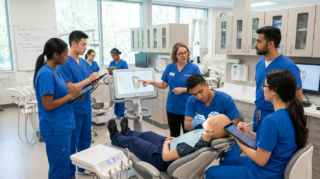
Once you are admitted, dental school follows a fairly consistent structure across programs. The first two years are primarily didactic, meaning you spend most of your time in classrooms and labs. Coursework covers anatomy, histology, pathology, pharmacology, dental materials, and occlusion, among other subjects. You will also begin developing clinical skills in simulation labs, practicing procedures on models before working with real patients.
The second two years shift toward supervised clinical practice. You treat patients in the school’s dental clinic under the direct supervision of licensed faculty. These clinical rotations cover restorative dentistry, periodontics, endodontics, prosthodontics, oral surgery, pediatric dentistry, and more. Some programs also include community-based rotations in underserved areas, which can offer broader exposure to different patient populations and oral health challenges.
A question that comes up often is the difference between a DDS (Doctor of Dental Surgery) and a DMD (Doctor of Medicine in Dentistry, or Doctor of Dental Medicine). The answer is straightforward: these degrees are identical in scope, training, and legal standing. The distinction is purely historical, based on which title a given university chose to adopt. Harvard, for example, awards a DMD; the University of Michigan awards a DDS. Both graduates sit for the same licensing exams and can practice the same procedures. Do not choose a program based on which degree abbreviation it grants.
The overall cost of these four years varies significantly depending on the type of institution. At public dental schools, in-state tuition generally falls in the range of $40,000 to $55,000 per year, putting the four-year total at roughly $160,000 to $220,000. Private dental schools are considerably more expensive, with annual tuition often reaching $70,000 to $100,000 or more, which means total program costs of $300,000 to $450,000 or higher. These figures do not include living expenses, instruments, equipment fees, or board exam costs. For context on how these numbers compare to other health professions, IMA has a detailed breakdown of what medical school tuition looks like across the U.S. and Canada.
Total Cost of Becoming a Dentist and What the Debt Looks Like
The sticker price of dental school gets a lot of attention, and it should. The average educational debt for a dental graduate in the 2025 to 2026 range is approximately $297,800. That figure includes both undergraduate and dental school borrowing for many graduates, though the majority of that debt comes from the four years of professional school.
To put that number in perspective, it is comparable to the debt levels carried by many medical school graduates. If you are interested in how other health professions compare on cost, IMA has written about the true cost of PA school, which provides a useful point of reference for students weighing different career paths.
Several factors affect your total cost. State residency matters enormously for public schools. Choosing a school in your home state can save $80,000 or more over four years compared to out-of-state or private tuition. Scholarships, military service programs (such as the Health Professions Scholarship Program through the U.S. military), and loan repayment programs through the National Health Service Corps can also reduce the burden, sometimes substantially. None of these options are guaranteed, but they are worth researching early.
How you manage your finances during school matters too. Interest on federal loans begins accruing immediately for unsubsidized loans, which means the total you owe at graduation is higher than the sum of your disbursements. Understanding how loan capitalization works, and making interest payments during school if you can, reduces the long-term cost. Income-driven repayment plans and Public Service Loan Forgiveness are available to dentists who meet specific employment and payment criteria, though the requirements are strict and the programs are subject to policy changes.
The key point is this: dental school debt is high, but it is manageable for most graduates because of the earning potential on the other side. The important thing is to enter with realistic expectations about both the cost and the repayment timeline, not just the salary figure.
Dentist Salary in 2026: What Earning Potential Looks Like After Graduation
According to the Bureau of Labor Statistics occupational data for dentists, the median annual wage for general dentists is $179,210. That figure represents the midpoint, meaning half of general dentists earn more and half earn less. Entry-level salaries are often lower, particularly for associate dentists in their first few years, while experienced dentists who own their practices or work in higher-cost-of-living areas can earn well above the median.
Specialists earn more, and in some cases significantly more. Oral and maxillofacial surgeons, for example, frequently exceed $239,200 per year. Orthodontists, periodontists, endodontists, and prosthodontists all tend to earn above the general dentist median as well, though exact figures vary by location, practice type, and years of experience.
A few salary considerations that pre-dental students sometimes overlook are worth noting. Geography plays a major role. Dentists in rural areas or regions with fewer providers often earn more than those in saturated urban markets, and some of these positions come with loan repayment incentives. Practice ownership changes the equation entirely, because owning a practice introduces both higher earning potential and significant business expenses, including staff salaries, equipment, rent, insurance, and supplies. The difference between gross revenue and take-home pay in private practice is substantial.
It is also worth understanding that the high repayment rate among dental graduates is partly a function of this earning potential. Most dentists are able to service even large loan balances within a reasonable timeframe, though those first few years after graduation, when salaries are at their lowest and loan payments are just beginning, can feel tight. Financial planning during school, not just after, makes a real difference.
Specialization: Adding Two to Six Years After Dental School
General dentistry does not require any training beyond the four-year DDS or DMD program and licensure. But if you want to specialize, you will need to complete a residency. Dental specialties recognized by the American Dental Association include orthodontics, periodontics, endodontics, prosthodontics, oral and maxillofacial surgery, pediatric dentistry, oral and maxillofacial pathology, oral and maxillofacial radiology, dental public health, dental anesthesiology, oral medicine, and orofacial pain.
Residency Lengths by Specialty
Residency programs vary in length. Orthodontics programs are typically two to three years. Periodontics, endodontics, and prosthodontics residencies generally run two to three years as well. Pediatric dentistry residencies are usually two years. Oral and maxillofacial surgery is the longest, requiring four to six years, and some OMS programs include a medical degree (MD) earned concurrently, which extends the training but broadens the scope of practice considerably.
Admission to these residencies is competitive. Programs consider dental school grades, class rank, board scores (particularly Part I and Part II of the National Board Dental Examinations or the Integrated National Board Dental Examination), research, letters of recommendation, and interview performance. Some specialties are more competitive than others. Orthodontics and oral surgery, for instance, consistently attract far more applicants than available positions.
The Total Timeline
When you add up the full path, the numbers look like this. A general dentist spends four years in undergraduate study, four years in dental school, and then enters practice, for a total of eight years after high school. A specialist spends those same eight years plus an additional two to six years in residency, for a total of ten to fourteen years. This is a long commitment, and it is worth being honest with yourself about whether specialization fits your goals, financial situation, and personal timeline before committing.
Building Clinical Exposure Before Dental School
Strong dental school applications are built on more than grades and test scores. Admissions committees want to see that you have spent real time in clinical environments, that you understand what dentistry looks like day to day, and that your interest is grounded in observation rather than assumption. This is where shadowing, volunteering, and structured clinical exposure matter.
For students looking to supplement domestic shadowing with broader perspective, internationally structured programs can be valuable. IMA offers dental-focused programs in which students observe licensed dentists performing procedures such as extractions, restorations, and preventive care in underserved communities. These experiences take place under direct supervision, with strict infection control and PPE protocols in place. Students do not perform procedures independently. Instead, they observe clinical workflows, assist in community oral hygiene education, and gain firsthand understanding of how limited access to fluoridation, preventive care, and dental infrastructure affects oral health outcomes in different populations.
This kind of exposure can strengthen a dental school application by demonstrating commitment, curiosity, and an understanding of oral health beyond the scope of a single domestic office. If you are still comparing schools and want to understand which programs may be more accessible to applicants at different stages, IMA has written about dental schools with competitive but realistic admissions profiles.
That said, international experience is a supplement, not a replacement for the core components of your application. Your GPA, DAT score, and domestic shadowing hours remain the foundation. Structured international programs are most useful when they add depth to an already solid application, not when they are used to fill gaps that need to be addressed directly.
Licensure, Boards, and Your First Year in Practice
Graduating from dental school does not automatically make you a licensed dentist. Every state requires passage of licensing exams before you can practice. The process generally involves three components: a written national board exam (now the Integrated National Board Dental Examination, or INBDE), a clinical licensing exam administered by a regional or state testing agency, and a state-specific jurisprudence exam covering the laws and regulations of the state where you plan to practice.
The INBDE is typically taken during dental school, often during the second year or early in the third year. Clinical licensing exams are usually taken in the fourth year. Regional testing agencies, such as CDCA-WREB and CITA, administer these exams, and not all states accept all regional exams, so you need to plan ahead based on where you intend to practice.
After licensure, most new general dentists enter practice as associates in an established dental office or group practice. This is a practical choice: it allows you to build clinical speed and confidence, develop a patient base, and earn income without taking on the financial risk of practice ownership immediately. Some graduates choose community health centers, military service, or academic positions instead. Each path has different financial and professional trade-offs.
Your first year will feel different from dental school. The volume of patients is higher, the pace is faster, and you are making clinical decisions with less immediate faculty oversight. Most new dentists describe the first year as a steep learning curve, even after four years of training. That is normal, and it levels out.
Planning Your Pre-Dental Timeline Starting Now
If you are early in your undergraduate career or still in high school, the best thing you can do right now is map out a realistic timeline. Work backward from your target dental school application date and identify when you need to complete prerequisites, take the DAT, accumulate shadowing hours, and submit your application. Build in buffer time. Things will not go exactly as planned, and a timeline with margin is far better than one that depends on everything going right.
If you are further along, perhaps already studying for the DAT or starting to compile your application, focus on the elements that are still within your control. Shadowing hours can still be added. Your personal statement can be sharpened. Letters of recommendation can be requested strategically. And if your GPA or DAT score is not where you want it to be, there are concrete steps you can take, including post-baccalaureate coursework or retaking the DAT, that are well-established in the admissions world.
Dentistry is a career that rewards patience, planning, and honest self-assessment. The timeline is long, the costs are real, and the work is demanding. But the profession offers strong financial stability, genuine autonomy, and the ability to provide care that directly improves people’s daily quality of life. If you have done the research, spent time in clinical settings, and still feel drawn to the work, that is a strong signal. Trust it, plan carefully, and take the next step that makes sense for where you are right now.
Frequently Asked Questions
Is there a difference between a DDS and a DMD degree?
No. A DDS (Doctor of Dental Surgery) and a DMD (Doctor of Medicine in Dentistry or Doctor of Dental Medicine) are the same degree with different names. Both require identical training, qualify graduates for the same licensing exams, and carry the same legal scope of practice. The name depends on the convention adopted by the granting university, not on any difference in curriculum or clinical preparation.
How much debt do most dental school graduates carry?
The average educational debt for a dental graduate in the 2025 to 2026 range is approximately $297,800. This figure varies significantly depending on whether you attend a public or private school, whether you qualify for in-state tuition, and how much you borrow for living expenses. Scholarships, military programs, and careful financial planning during school can reduce this total.
Can I practice as a general dentist without doing a residency?
Yes. A general dentist does not need to complete a residency after earning a DDS or DMD. After passing the INBDE, a clinical licensing exam, and a state jurisprudence exam, you are eligible to practice general dentistry. Residencies are required only for recognized dental specialties such as orthodontics, oral surgery, periodontics, and others. Some general dentists do choose to complete a one-year General Practice Residency (GPR) or Advanced Education in General Dentistry (AEGD) program for additional clinical training, but these are optional.