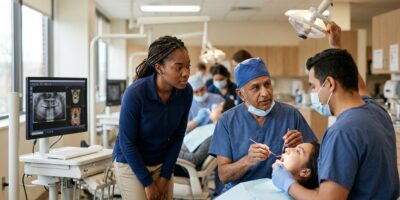

To become an oral and maxillofacial surgeon, you earn a bachelor’s degree, pass the DAT, finish a four-year DDS or DMD, and complete an accredited oral and maxillofacial surgery residency of at least four years, or six with an integrated MD. Then you get a state license and can pursue ABOMS board certification. Plan on 12 to 14 years after high school.
That makes this the longest training path in dentistry, and it ends with a surgeon who works in hospitals, surgery centers and private offices. If you mainly want to know what the job pays, IMA’s breakdown of oral and maxillofacial surgeon salary covers the full wage data. This guide covers the steps, the exams and the timeline.
The Path at a Glance
| Stage | Typical length | What you finish with |
|---|---|---|
| Undergraduate degree | 4 years | Bachelor’s degree, dental school prerequisites, DAT score |
| Dental school | 4 years | DDS or DMD, national board exam (INBDE) |
| OMS residency, certificate track | 4 years minimum | OMS certificate from a CODA-accredited program |
| OMS residency, MD-integrated track | Usually 6 years | OMS certificate plus an MD, with a year of general surgery |
| Licensing and board certification | Starts during and after residency | State license, ABOMS Qualifying Exam, Oral Certifying Exam |
The Bureau of Labor Statistics notes that oral and maxillofacial surgery programs typically take 4 to 6 years and may lead to a joint Medical Doctor (MD) degree. Add four years of college and four of dental school, and the full path after high school runs about 12 to 14 years.
What Oral and Maxillofacial Surgeons Do
Oral and maxillofacial surgery (OMS) is one of the 12 recognized dental specialties, and AAOMS calls it the surgical specialty of dentistry. BLS describes these surgeons as operating on the mouth, jaws, teeth, gums, neck and head, with work that ranges from removing impacted teeth to repairing a cleft lip and palate.
The AAOMS list of OMS procedures groups the work into these areas:
- Anesthesia: office sedation and general anesthesia for pain and anxiety control
- Dentoalveolar surgery: extractions, exposing impacted teeth and treating oral infections
- Dental implants: planning and placing implants to replace missing teeth
- Orthognathic surgery: repositioning the jaws, usually alongside orthodontic treatment
- Cleft and craniofacial surgery: repairing congenital and acquired defects, often in children
- Maxillofacial trauma: repairing facial fractures and injuries to nerves and ducts
- Temporomandibular joint care: diagnosing and treating jaw joint disorders and facial pain
- Pathology and reconstruction: managing tumors, cysts and infections, then rebuilding the jaw and face
OMS surgeons hold hospital staff privileges and practice in private offices, ambulatory surgery centers and hospitals. Some work in academic medicine, the military or research. If you are comparing this field with surgery on the medical side, IMA’s overview of types of surgeons and surgical specialties shows how OMS fits among the other surgical careers.
Step 1: Build a Strong Undergraduate Record
Most dental schools expect a bachelor’s degree. The American Dental Education Association (ADEA) says that, with a few exceptions, most dental students hold one before they enroll, and no specific major is required. A strong science foundation is still expected, so plan your biology, chemistry, organic chemistry and physics sequences early.
Your college years should also include time around patients and around dentistry. ADEA lists shadowing a dentist as a way to learn the pros and cons of the profession, and an oral surgery office is a good place to log some of those hours. IMA’s guide to dental shadowing hours explains how to plan and document them. For course lists and GPA targets, see the full breakdown of dental school requirements and prerequisites.
Clinical exposure abroad is another option. IMA’s dental internships abroad place pre-dental students in clinics where, under supervision of licensed clinicians, they help with patient intake, vital signs and other noninvasive tasks and see how a dental team runs. Pre-dental interns do not examine, clean or treat teeth, and how schools classify the hours is each school’s decision.
Step 2: Take the DAT and Apply to Dental School
The Dental Admission Test is required by all U.S. dental schools. According to the ADA’s DAT page, the 2026 exam has four tests and 280 items:
| DAT section | Items |
|---|---|
| Survey of the Natural Sciences | 100 |
| Perceptual Ability | 90 |
| Reading Comprehension | 50 |
| Quantitative Reasoning | 40 |
The DAT is given year-round at Prometric centers. You must wait 60 days between attempts, and a new score scale has applied since March 1, 2025. IMA’s DAT guide covers each section and how to prepare.
ADEA notes that applicants apply one year before they want to start. Most apply through ADEA AADSAS, and the 2026-27 cycle opened for submissions on June 3, 2026. IMA’s ADEA AADSAS application guide walks through each section.
Step 3: Earn a DDS or DMD
Dental school usually lasts four years and combines biomedical science courses with supervised patient care in the school clinic. You will earn either a DDS or a DMD. ADEA says there is no difference between the two: both meet the same accreditation requirements, and the school chooses which title to award. IMA explains the DDS and DMD degrees in more detail, and the guide on how long dental school takes breaks down each year.
How Do You Stand Out for an OMS Residency?
OMS is one of the more competitive specialties, so your dental school record matters. Focus on these:
- Class rank and grades: keep your basic science and clinical grades strong from year one.
- CBSE score: AAOMS offers OMS applicants the NBME Comprehensive Basic Science Examination. It has 200 items over 5 hours and 15 minutes, and starting in 2027 it moves to May and November dates. Details are on the AAOMS NBME page.
- Externships: short rotations in OMS departments let faculty see your work and let you see their program.
- Letters: ask OMS faculty who have watched you in clinic or in the operating room.
- Research: a case report or clinical project shows interest beyond the minimum.
How Does the OMS Residency Match Work?
Applicants send one application to many programs through ADEA PASS, whose current window runs May 13, 2026 to February 12, 2027. Programs then fill positions through the Postdoctoral Dental Matching Program run by National Matching Services, where OMS is a Phase II program in the 2027 Match. Check both sites for the exact deadlines for your cycle.
Step 4: Complete an OMS Residency (4 or 6 Years)
OMS residencies are accredited by the Commission on Dental Accreditation (CODA), and ABOMS board eligibility starts with graduating from a CODA-accredited program. The AAOMS directory of accredited programs lists about 100 programs, including federal service programs, and a little under half of them are dual-degree.
What Is the Difference Between the 4-Year and 6-Year Programs?
| Feature | 4-year certificate track | 6-year MD-integrated track |
|---|---|---|
| Degree earned | OMS certificate (single degree) | OMS certificate plus an MD (dual degree) |
| Medical school | Not included | Medical school coursework built into the program |
| General surgery | Required off-service rotations | Usually a full year of general surgery residency |
| Who chooses it | Residents who want the shortest route to practice | Residents who want an MD and a medical license option |
Both tracks meet the same CODA standards. The CODA accreditation standards for OMS set firm minimums for every resident:
- At least four years of full-time study
- At least 120 weeks on the clinical OMS service, with 52 weeks at a senior level and 26 of those in the final year
- At least 20 weeks on the anesthesia service, part of a 32-week anesthesia and medicine block
- At least 16 weeks on a surgical service outside OMS
- At least 300 anesthesia cases by graduation, including 50 patients younger than 13
- At least 175 major surgical procedures for each final-year resident position
Hospital-based residencies pay residents a stipend from Graduate Medical Education funding, according to AAOMS. Some MD-integrated programs handle the medical school years differently, so ask each program how those years are structured.
Step 5: Get Licensed
BLS notes that dentists must be licensed in the state where they work. Most states require a DDS or DMD from an accredited program, a written exam and a state or regional clinical exam. The written exam is usually the Integrated National Board Dental Examination (INBDE), a two-day test that the Joint Commission on National Dental Examinations says all U.S. states and territories accept for all or part of their written requirement.
BLS also notes that practicing in a dental specialty can require a specialty license after residency, and the rules differ by state. Check your state dental board early, and if you finish an MD-integrated program and want a medical license as well, check the state medical board too.
Step 6: Earn ABOMS Board Certification
Board certification from the American Board of Oral and Maxillofacial Surgery (ABOMS) is the specialty’s board credential. It takes two exams.
| ABOMS exam | Format | 2027 schedule |
|---|---|---|
| Qualifying Examination (QE) | Computer-based, 300 multiple-choice questions (30 unscored), 11 subject areas | January 9-16, 2027 |
| Oral Certifying Examination (OCE) | Three sections of four cases, 12 minutes per case, 144 minutes total | February 1-5, 2027, in Raleigh, North Carolina |
Graduates of CODA-accredited programs can sit for the ABOMS Qualifying Examination, and final-year residents can take it early through Fast Track. After passing the QE, you have three consecutive years to pass the Oral Certifying Examination. The OCE application requires verified hospital privileges for core OMS procedures and a current, full license, so a resident or fellowship license does not qualify.
Certification is not one and done. The ABOMS certification maintenance program runs on a 10-year cycle, with annual registration, 20 continuing education hours a year and two article review modules each year, plus clinical case scenarios in years 3, 6 and 9.
A Sample Timeline From College to Board Certification
Here is how the path might look for a student who starts college at 18 and moves straight through:
| Age (approx.) | Milestone |
|---|---|
| 18-21 | Undergraduate prerequisites, shadowing, clinical experience |
| 21 | DAT, then ADEA AADSAS application |
| 22-26 | Dental school; INBDE; OMS externships; CBSE; ADEA PASS and the Match |
| 26-30 or 26-32 | OMS residency, 4-year or 6-year track |
| Final residency year | ABOMS Qualifying Exam through Fast Track |
| 30-35 | State license, hospital privileges, Oral Certifying Exam within 3 years of the QE |
Gap years, research years or a fellowship add time, and that is common.
Oral and Maxillofacial Surgeon Salary and Job Outlook
BLS reports a median annual wage of $352,220 for oral and maxillofacial surgeons in May 2025, the highest of the dental occupations it lists. For comparison, general dentists had a median of $170,950. For percentiles, settings and what moves pay, see IMA’s oral surgeon salary guide.
On outlook, BLS projects employment of oral and maxillofacial surgeons to grow 6% from 2025 to 2035, from about 5,600 jobs to 5,900.
Who This Career Suits
The path suits students who like both dentistry and the operating room. Expect long residency hours, hospital call for facial trauma, and years of training after dental school. In return, you get a broad scope of practice, from office anesthesia to jaw reconstruction, and the top median wage in dentistry. If you want a shorter specialty route, IMA’s guide on how to become a dentist covers general practice and the other dental specialties.
Frequently Asked Questions
How many years does it take to become an oral and maxillofacial surgeon?
About 12 to 14 years after high school: 4 years of college, 4 years of dental school, and an OMS residency of at least 4 years, or about 6 years on the MD-integrated track. Board certification follows during and after residency.
Do oral and maxillofacial surgeons have to go to medical school?
No. A 4-year certificate residency after a DDS or DMD qualifies you to practice OMS. The 6-year integrated track adds an MD and a year of general surgery for residents who want a medical degree as well.
Is an oral surgeon the same as an oral and maxillofacial surgeon?
Yes. Oral surgeon is the common short name for the dental specialty of oral and maxillofacial surgery, which covers the mouth, teeth, jaws and face.
What exams does an oral and maxillofacial surgeon take?
The main ones are the DAT before dental school, the INBDE for licensure, often the NBME CBSE before applying to residency, a state or regional clinical exam, and the two ABOMS board exams: the Qualifying Examination and the Oral Certifying Examination.
How much do oral and maxillofacial surgeons make?
BLS reports a median annual wage of $352,220 for oral and maxillofacial surgeons in May 2025. IMA’s oral surgeon salary guide, linked in the pay section above, breaks down pay by setting and percentile.
Can oral and maxillofacial surgeons give general anesthesia?
Yes. CODA standards require each OMS resident to complete at least 20 weeks on the anesthesia service and at least 300 anesthesia cases by graduation, which is why office sedation and general anesthesia are core parts of the specialty.