MD vs DO in 2026: The Major Differences, and How to Choose
Every year, tens of thousands of students prepare for medical school. In addition to the choice of major, MCAT prep, or any other number of factors, one that faces practically every future physician is the choice between allopathic medicine (MD) and osteopathic medicine (DO). While both are full medical degrees that lead to licensure and practice, there are meaningful differences between the two. One is not necessarily better than the other, but depending on the type of medicine you wish to practice, one may be better suited to your goals and philosophy.
Before going any further, it is worth understanding what separates an MD from a DO. While both degrees lead to the same outcome, the paths diverge in important ways. Think about it like this: you can go pick up dinner, or you can have it delivered. Either way, you end up eating dinner at home (and one that you did not have to cook). The result is the same, but the experience and process differ. That distinction matters when you are choosing how to spend four years of medical school and the decades of practice that follow.
If you are still sorting out the basics of how MD and DO application systems differ, our guide on the differences between MD and DO application services is a useful companion to this article.
Differences
For most people, going to medical school means getting an MD. The majority of doctors in the United States are MDs, and the vast majority of medical schools produce graduates who carry the title of MD. At the risk of making a very general overstatement, MDs focus on the treatment of disease.
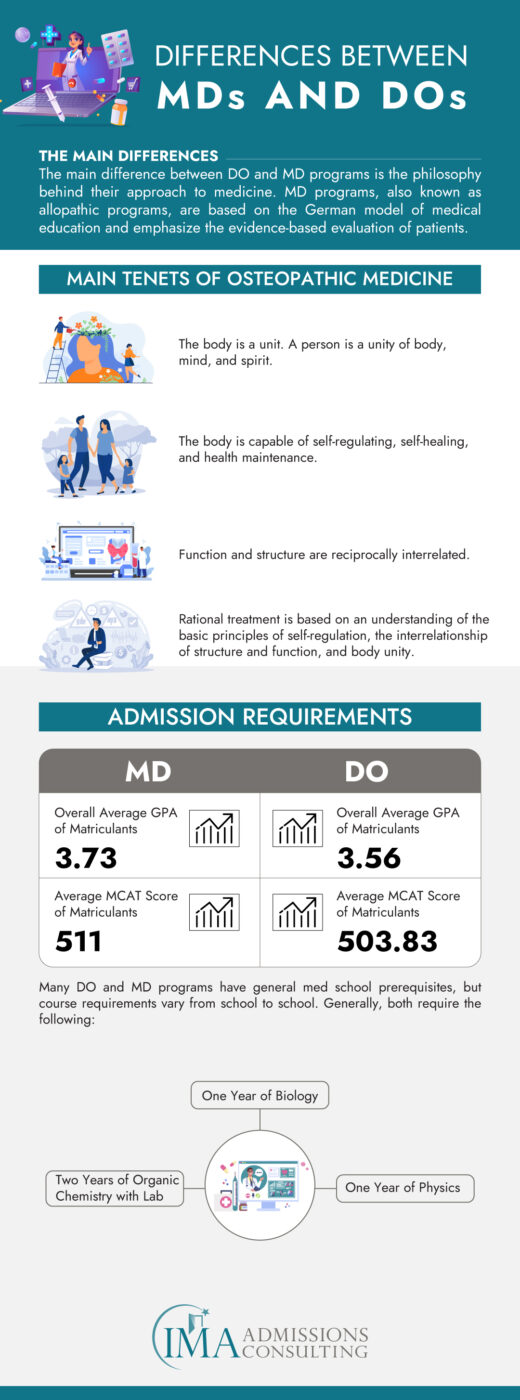
This is a stark philosophical difference from a DO. Instead, DOs focus on the health of the whole person. They are interested in how the entire body functions as a single entity, rather than individual systems in isolation. One way this manifests itself is that DO students must spend 200 hours learning how to perform Osteopathic Manipulative Treatment, or OMT. These techniques involve moving tissues and joints and have been clinically proven to help relieve some forms of pain. MDs receive no such training.
This difference in philosophy can best be explained using an example. Let us say that a patient presents with high blood pressure. Both an MD and a DO are going to encourage the patient to pursue a healthier diet and a more active lifestyle, as well as consider some prescription medications. However, look for the DO to be more hesitant with the medication, instead wanting to focus on healthier foods and more exercise first.
The DO Philosophy in Practice
The osteopathic approach rests on four core tenets: the body is a unit; the body has self-healing mechanisms; structure and function are interrelated; and rational treatment considers all three of those principles. These are not just theoretical ideas. They shape how DO students learn to think about patients from day one, and they influence clinical decision-making throughout a career. A DO-trained family physician, for example, may spend more appointment time discussing a patient’s sleep, stress levels, and home environment rather than jumping straight to a prescription pad.
That said, the line between MD and DO practice has blurred considerably over the past two decades. Many MD programs now incorporate lifestyle medicine, preventive health, and patient-centered communication into their curricula. And many DOs practice in ways that are indistinguishable from their MD colleagues, especially in procedural specialties. The philosophical difference is real, but it plays out on a spectrum, not as a hard boundary.
Admissions Differences
It is not only in philosophy that the MD and DO programs differ. The application process can be somewhat different. First, it is worth establishing that there are important similarities. Every DO and MD program requires students to complete an undergraduate degree, and they all require at least a year of basic biology, a year of physics, and a year each of general and organic chemistry (at minimum). Most also require some combination of calculus, statistics, biochemistry, or English. Note that there are no specific major requirements; Classics majors are just as prepared to be doctors as chemistry majors, as long as they fulfill the minimum course requirements. Our blog post on why the best pre-med major is not biology covers this in more detail. Also, everyone has to take the MCAT.
However, that is where the similarities start to end. MD programs offer more spots. According to the AAMC, 23,440 students matriculated into MD programs in the 2025-2026 cycle, up from 23,048 the year before, making it the largest incoming class to date. Total MD enrollment has now surpassed 100,000 students for the first time in history. On the DO side, AACOM data shows approximately 10,400 matriculants for the 2025 entering class, drawn from over 23,700 applicants across 46 accredited colleges of osteopathic medicine at 73 teaching locations in 36 states.
On the MD side, 54,699 people applied in 2025, a 5.3% increase from 2024 that reversed a three-year decline. The acceptance rate was approximately 44.5%. For DO programs, the acceptance rate was roughly 63%, though the matriculation rate (those who actually enroll) is closer to 44%, because many students accepted to both DO and MD schools ultimately choose the MD path. This distinction between acceptance and matriculation is important to understand when comparing competitiveness.
Academic benchmarks also differ between the two pathways. For the 2025-2026 MD cycle, the AAMC reports that the mean GPA for matriculants was 3.81, with an average MCAT of 512.1. For DO matriculants, available data from the 2024 cycle shows an average GPA of 3.63 and an average MCAT of 500. These are averages; competitive applicants at top programs in either system will often exceed them.
Do not make the mistake of thinking that DO programs are easier to get into, though. DO programs want students who see medicine the way they do, so if you are simply applying to a DO program because you think it will be an easier path, you are going to have a rough time getting through the application process. Admissions committees can tell the difference between genuine alignment with osteopathic principles and a backup plan.
How the Applicant Pool Has Changed
One of the most notable shifts in the past decade is the growth of osteopathic medical education. Close to 30% of all U.S. medical students now attend osteopathic schools, according to AACOM. More than 38,000 future physicians are being educated at a college of osteopathic medicine, and the number of licensed DOs has grown by 110% since 2010, compared to 21% growth in licensed MDs over the same period, per the FSMB’s 2024 Census of Licensed Physicians. That kind of growth tells you something about the increasing acceptance and demand for osteopathic-trained physicians.
Both pathways have also seen demographic changes. The AAMC reports that women made up 55% of MD matriculants in 2025-2026, continuing a trend that has accelerated in recent years. DO programs have historically attracted more non-traditional students, including career changers and those with gap years, though the age gap between MD and DO applicants has been narrowing as younger students increasingly consider both pathways from the start.
Similarities
Despite all these differences, there are many similarities. Both DOs and MDs can practice medicine anywhere in the United States. They can apply to each other’s residency programs, and we will talk more about that shortly. They take the same foundational science courses in medical school: anatomy, physiology, pharmacology, pathology, and so on. No matter which route you take, you will be a fully licensed, board-eligible physician by the end of it.
Both types of physicians can prescribe medication, perform surgery, order tests, admit patients to hospitals, and practice in every specialty. In most clinical settings, patients cannot tell the difference, and colleagues treat MDs and DOs as interchangeable.
Is One Better?
Some people mistakenly believe that an MD is more prestigious than a DO. They point to the fact that the MD is a more established degree and that MDs tend to hold more specialized roles. However, a lot of this has to do with the fact that there are simply more MDs; according to the FSMB’s 2024 census, 89% of actively licensed physicians in the United States hold an MD, while 11% hold a DO. With the rapid growth of DO programs and the increasing percentage of medical students choosing osteopathic schools, that ratio is shifting.
Instead of thinking about prestige, potential doctors should approach the question as a reflection of how they view medicine. If they are drawn to the treatment of specific diseases and systems, then an MD route may make more sense. If, on the other hand, they want to approach medicine through a more preventive, whole-person lens, then the DO option could be a better fit. For more on this question, our article on the MD vs DO pathway for pre-health students goes deeper into how each degree shapes a career.
MD vs. DO Residencies
Historically, MDs and DOs faced different residency systems. DO graduates applied to AOA-accredited residencies, while MDs applied to ACGME-accredited ones. That changed with the single accreditation system merger, completed in 2020, which brought all graduate medical education under the ACGME. Now, MDs and DOs apply to the same residency programs through the same match process. This was a major structural shift that effectively leveled the playing field.
The results speak for themselves. In the 2026 Main Residency Match, the largest in NRMP history, DO seniors achieved a record-breaking 93.2% PGY-1 match rate, according to AACOM’s March 2026 announcement. This was up from 92.6% in 2025. In the 2025 match, MD seniors matched at 93.5%, per NRMP data. The gap between MD and DO match rates is now just fractions of a percentage point, a dramatic change from a decade ago.
The 2026 match included more than 53,000 participants competing for over 44,000 positions. A total of 8,503 DO seniors participated, with 7,928 matching to first-year residency positions, both all-time highs. Including post-match placements through the Supplemental Offer and Acceptance Program (SOAP), AACOM reports that 99% of graduating osteopathic medical students obtained residency positions for 2025.
There are still some differences in licensing exams. MDs must pass the United States Medical Licensing Exam (USMLE), while DOs must pass the Comprehensive Osteopathic Medical Licensing Examination (COMLEX). However, some residency programs prefer or require USMLE scores regardless of the applicant’s degree, so many DO students take both exams. Both medical school curricula provide preparation for these exams.
Trends Among Residents
When it comes to earnings, the gap between MDs and DOs is best understood through the lens of specialty choice rather than degree type alone. According to Medscape’s 2025 Physician Compensation Report, the average physician in the United States earned $374,000, up from $363,000 in 2023. Primary care physicians averaged $287,000, while specialists averaged $404,000.
This matters because, according to 2024 AOA figures cited by the AMA, 57% of DOs practice in primary care specialties. MDs, as a group, are more evenly distributed across primary care and specialty fields. So the earnings difference between the two degrees is largely a reflection of practice patterns, not of the degree itself. A DO orthopedic surgeon and an MD orthopedic surgeon doing the same work in the same city will earn comparable salaries.
Those practice patterns are shifting, however. In the 2026 match, DO seniors increased their share of positions filled in several competitive specialties, including Child Neurology, Medicine-Pediatrics, and Orthopedic Surgery, per AACOM data. The top five specialties that DO seniors matched into in 2025 were internal medicine, family medicine, emergency medicine, pediatrics, and psychiatry. The percentage of match positions filled by DO students rose to 19.4%, and DO graduates were the only group of U.S. students to see an increase in their share of total positions.
DOs who choose to specialize and who perform well on both their COMLEX and USMLE exams can and do match into the most competitive residency programs in the country. In that scenario, there is no meaningful difference in earnings or career trajectory. If you are interested in how different medical specialties compare, our article on internal medicine vs. family medicine breaks down two of the most common paths for both MDs and DOs.
International Recognition
MDs enjoy universal recognition worldwide. DOs have full practice rights in more than 65 countries, according to AACOM, which is substantial but not universal. However, international recognition of the DO degree has been gaining ground steadily. In 2022, the World Federation for Medical Education (WFME) awarded 10-year recognition to the AOA’s Commission on Osteopathic College Accreditation (COCA), confirming that osteopathic medical schools meet internationally rigorous standards. Then in 2023, the International Association of Medical Regulatory Authorities (IAMRA) passed a resolution supporting the equivalency of U.S.-trained DOs and MDs among its 47 member countries, according to the AOA.
Progress continues in specific countries as well. In Canada, the AOA, the Canadian Osteopathic Association, and the National Board of Osteopathic Medical Examiners have been advocating for equal recognition of osteopathic residency training and board certification. The College of Physicians and Surgeons of British Columbia recently voted to amend its bylaws to recognize AOA family medicine board certification, marking a concrete step forward.
If you are considering practicing internationally, these developments are encouraging, but research the specific requirements in your country of interest before making assumptions. The landscape is improving year by year, but it is not yet uniform.
Compared to Foreign Degrees
We are focused on U.S. programs here, but some students consider foreign medical degrees. U.S. MDs and DOs lead in residency match rates by a wide margin. With MD seniors matching at 93.5% and DO seniors at 93.2% in 2025 and 2026 respectively, they far outpace international medical graduates. Caribbean medical school graduates, for example, have historically matched at rates between 50% and 70%, though top Caribbean programs may perform somewhat better.
This really does depend on the residency, however. Ultra-competitive residencies, like dermatology, will be dominated by graduates of U.S. MD programs. Of the roughly 70 Irish medical school graduates who apply for residencies in the U.S. in a given year, only one might end up with a dermatology placement. However, for those looking to practice general medicine, multiple routes can work. The key is understanding that a U.S. MD or DO will provide the strongest foundation for matching into the residency of your choice.
Admissions at a Glance: 2026 Comparison Table
| Factor | MD (Allopathic) | DO (Osteopathic) |
|---|---|---|
| Number of Programs | ~159 accredited schools | 46 accredited colleges at 73 locations |
| 2025 Applicants | 54,699 | ~23,700 |
| 2025 Matriculants | 23,440 | ~10,400 |
| Acceptance Rate | ~44.5% | ~63% accepted; ~44% matriculate |
| Avg. Matriculant GPA | 3.81 (2025) | 3.63 (2024 cycle) |
| Avg. Matriculant MCAT | 512.1 (2025) | 500 (2024 cycle) |
| Licensing Exam | USMLE | COMLEX (many also take USMLE) |
| Residency Match Rate (Seniors) | 93.5% (2025) | 93.2% (2026, record high) |
| OMT Training Required | No | Yes (200 hours) |
| International Recognition | Universal | 65+ countries; growing |
Which Is Right for You?
Ultimately, the choice of whether to pursue an MD or a DO comes down to the career goals and philosophical alignment of the individual student. Generally speaking, those drawn to a more prevention-centered form of medicine, in which a practitioner takes an active role in all aspects of a patient’s health, will find more alignment with the DO approach. Those wanting to focus on highly specialized treatment of specific diseases and systems may prefer the MD route, though both degrees provide access to every specialty.
The data makes one thing clear: the practical differences between MDs and DOs are shrinking. Match rates are nearly identical. Both degrees are respected. Both lead to the same clinical privileges. The most important factor is not which set of letters follows your name, but whether you have thought carefully about why you want to practice medicine and what kind of physician you want to become.
The best way to figure this out is through spending considerable time in clinical environments, asking questions, and reflecting on what you observe. Physician shadowing, clinical internships, and structured pre-health experiences all help clarify your thinking. If you are still early in the process and wondering why you want to be a doctor, that foundational question is worth sitting with before choosing between MD and DO. For those ready to gain structured experience, we offer pre-med internships and PA-focused internships that give you real exposure to clinical environments, mentorship, and the kind of reflection that makes your application stronger and your decision clearer.
What to Do While You Are Deciding
If you are a student weighing the MD vs. DO question, here are some concrete steps that will serve you well regardless of which path you choose:
- Shadow both MDs and DOs if possible. Ask them directly how their training shaped their practice. Pay attention to differences in how they approach the same patient scenarios.
- Research the specific schools you are interested in. Curriculum, clinical rotation sites, match lists, and culture vary enormously from school to school, sometimes more than they vary between MD and DO programs as categories.
- Take the MCAT seriously regardless of your target pathway. A strong MCAT score expands your options. If you are curious about what score you need, our article on MCAT scores for medical school covers this in detail.
- Gain clinical experience early. Medical schools in both systems value applicants who have spent real time in healthcare settings and can speak specifically about what they observed and learned. Read our guide on what internships a pre-med student should do for practical options.
- Talk to current students at both types of schools. Online forums can be useful, but direct conversations with students who are actually in the programs give you a much more accurate picture.
Building Perspective with International Medical Aid
Why Structured Experience Matters
Choosing between an MD or DO, or confirming that medicine is the right field at all, starts with understanding what clinical practice actually looks like. International Medical Aid (IMA), a not-for-profit founded by Johns Hopkins alumni, offers pre-health students structured global health internships that provide supervised clinical exposure, mentorship, and guided reflection. Whether you lean toward the disease-focused lens of an MD or the whole-person approach of a DO, direct observation of healthcare delivery in different settings helps you make a more informed decision.
Medical schools in both the MD and DO systems increasingly prioritize applicants with meaningful clinical exposure. According to the AAMC, a significant majority of programs rate clinical maturity and demonstrated understanding of healthcare as top admissions factors. Shadowing physicians and supporting care in underserved communities is more than an application line item. It provides a concrete window into the realities of healthcare practice and helps you confirm your fit before committing to a four-year program.
Clinical Shadowing Across Specialties
IMA places students in hospitals and clinics in locations such as Mombasa, Kenya and Cusco, Peru. You observe physicians in specialties including internal medicine, pediatrics, surgery, and mental health. These experiences allow you to compare how different clinical environments, patient populations, and healthcare systems approach the same fundamental challenges. Students observe, ask questions, and support care within approved and supervised limits. They do not provide unsupervised patient care.
Global Health in Action
IMA’s programs immerse you in region-specific health challenges, including HIV prevention initiatives in Uganda and maternal health projects in Ecuador. You gain practical understanding of disease management and preventive medicine by participating in community outreach such as hygiene education or nutrition workshops, always under professional supervision. A 2025 AACOM survey found that 65% of DO programs now value global health experience, marking it a meaningful credential for applicants to both MD and DO schools.
Cultural Context and Communication
Medicine is fundamentally about people. IMA complements clinical observation with cultural experiences that build empathy and adaptability. Whether you are learning about healthcare delivery in East Africa or the Caribbean, you gain insight into social determinants of health and learn to communicate effectively across cultural and linguistic barriers. IMA provides secure housing, private transportation, and 24/7 on-site support so you can focus on learning.
How IMA Supports Your Application
Pre-Trip Preparation
IMA handles logistics including visa assistance, travel insurance, and comprehensive safety briefings. Pre-departure sessions prepare you for clinical expectations, ethical boundaries, and cultural differences so you arrive ready to learn.
Mentorship and Reflection
On site, experienced healthcare professionals guide you through each clinical observation. After your internship, IMA continues to support you with admissions guidance, including personal statement feedback, interview preparation, and letters of recommendation. These are the kinds of specific, experience-based materials that strengthen applications to both MD and DO programs.
Who Should Consider IMA
IMA programs are designed for high school students, undergraduates, and gap-year students exploring pre-health pathways. No prior clinical experience is required. For high school participants, IMA provides additional structure, supervision, and communication with families to ensure a safe and age-appropriate experience. Placements are matched to each student’s level, and all participants operate within clear ethical and supervisory boundaries.
How to Get Started
Program lengths range from two to twelve weeks. Visit medicalaid.org to view current program details, application timelines, and available locations. For questions about placements or program fit, email [email protected]. Whether you are leaning toward an MD, a DO, or another healthcare role entirely, structured clinical exposure and honest reflection are among the most reliable ways to make that decision well.