The World Health Organization, for the second time since 2022, has declared a worldwide emergency. In just two months, monkeypox spread to over 65 countries, with the average number of confirmed cases per day jumping from below one in May to over 600 by the end of July. This 2022 monkeypox outbreak is the first time the disease has spread extensively outside of West and Central Africa.
Last updated: July 2026.
Since this article was first published during the 2022 outbreak, mpox (the WHO-approved name adopted in November 2022) has continued to evolve as a global health concern. A second WHO public health emergency was declared in August 2024 after a new clade Ib strain emerged from the Democratic Republic of Congo and spread to previously unaffected countries. That emergency was lifted in September 2025 following sustained declines in cases and deaths, and the Africa CDC lifted its continental emergency in January 2026 after mobilizing over 5 million vaccine doses across 16 countries. As of May 2026, global monthly confirmed cases have fallen below 1,100, with a case fatality rate of approximately 0.3% to 0.5%.
Critical treatment updates have also reshaped the clinical landscape. A phase 3 NIH-sponsored trial (STOMP) published in the New England Journal of Medicine found that tecovirimat (TPOXX), previously considered the primary antiviral option, was no better than placebo at resolving clade II mpox lesions or reducing pain. There are currently no FDA-approved treatments for mpox in the United States, though research into options for severe and immunocompromised cases continues. On the vaccine front, JYNNEOS remains WHO’s only prequalified mpox vaccine, with a freeze-dried version approved by the FDA in 2025 for easier stockpiling. A second vaccine, LC16m8 (KMB), received WHO Emergency Use Listing in November 2024 for patients one year of age and older. A CDC study published in March 2026 in The Lancet Infectious Diseases confirmed that primary JYNNEOS vaccination produces sustained immune memory for up to five years, with booster doses strongly enhancing antibody levels.
Between 2022 and January 2026, over 179,000 confirmed mpox cases were reported across 145 countries, with the Americas accounting for 41% and Africa 36%. New concerns include community transmission of clade Ib in several high-income countries, including the United States, Italy, and Spain, as well as the December 2025 detection in the United Kingdom of a novel clade Ib/IIb recombinant strain.
What is Monkeypox?
Monkeypox , which shares an evolutionary lineage with smallpox, a far more deadly poxvirus , is spread through contact with infected skin, bodily fluids, or infected animals. Monkeypox is also transmissible through airborne respiratory droplets, though airborne transmission is rare and relatively under-researched as of July 2022. The current outbreak of monkeypox in European and North American countries is primarily spreading amongst men who have sex with men.
Monkeypox was first reported in humans in the Democratic Republic of Congo in 1970, though the disease was first observed in laboratory monkeys in Denmark in 1953. Until recently, the virus has mostly been endemic to ten Central and Western African countries. Other monkeypox outbreaks include a 2003 outbreak in the U.S. traced to imported rodents, and a 2017 outbreak in Nigera , which occurred after the country had reported zero cases for over 30 years.
The smallpox vaccine can be used to prevent monkeypox infection. Some health experts contribute the decades of monkeypox presence in Africa to the continent’s lack of access to global stockpiles of smallpox vaccines.
The monkeypox strain active in the 2022 monkeypox outbreak has a fatality rate of around 1% but has risen as high as 3%. Most people infected with monkeypox experience rashes, fevers, and swollen lymph nodes and recover in a few weeks.
From Monkeypox to Mpox: The Official Renaming
In November 2022, the World Health Organization (WHO) officially adopted “mpox” as the preferred synonym for monkeypox following recommendations from global public health experts to reduce stigmatizing and discriminatory language. Both terms refer to the same disease caused by the mpox virus (MPXV), an orthopoxvirus closely related to smallpox. While public health agencies and medical literature now use “mpox” as the standard designation, “monkeypox” remains widely recognized in historical contexts.
The name “monkeypox” was given to the disease after being discovered among laboratory monkeys in 1958 in Copenhagen, Denmark. It wasn’t until 1970 that the disease was observed in humans. Although monkeypox was first found in monkeys, the original animal source of the disease is unknown , monkeys, like humans, are simply carriers of the disease. Many researchers speculate that rodents play a significant role in the transmission of monkeypox to humans
Transmission
Monkeypox is a contagious disease and there are several modes of transmission. Generally, monkeypox is spread from person to person through:
- Contact with infected lesions
- Contact with infected bodily fluids like saliva, semen, or blood
- Breathing in infected respiratory droplets
Monkeypox can also be spread among humans through objects that have come into contact with infected rashes or bodily fluids. This kind of transmission is less likely.
2022 Monkeypox Outbreak Transmission Trends
Research published in the New England Journal of Medicine reports that 98% of people diagnosed with monkeypox between April 27 and June 24, 2022, were bisexual or gay men. The research suggests that 95% of monkeypox cases in this timeframe were contracted through sexual activity.
Pets and Animals
Animal-to-human transmission has historically occurred through bites or scratches. Eating or preparing food with the meat or byproducts of an infected animal can also transmit the disease.
While research into other forms of animal-to-human and human-to-animal transmission is still ongoing, the CDC cautions that monkeybox could be spread between people and animals through:
- Sharing food or sleeping areas
- Licking and kissing
- Cuddling and petting
It’s still unclear to researchers whether or not monkeypox can be spread from humans to dogs or cats. As a precaution, pet owners should assume it can be spread to any mammal. If you have monkeypox symptoms, avoid contact with your pets and wildlife until you’re cleared by a doctor.
If your pet has not been exposed to monkeypox but someone in your household is showing symptoms, ask friends or family members to take care of the pet in a different environment until the disease has run its course. Disinfect your home before bringing the pet back.
Keep pets that have been exposed away from people and other animals for 21 days and avoid close contact. Don’t care for a pet if you are infected with monkeypox, even if the pet has already been exposed.
If anyone in your home is at increased risk for severe symptoms, you should avoid caring for an infected pet. This includes:
- People who have or have had eczema or dermatitis
- People who live with children 8 years old or younger
- People who are pregnant
- People who are immunocompromised
If you must care for pets while you’re infected with monkeypox, make sure to cover rashes and lesions and wear gloves and a mask while handling the animal. Wash your hands thoroughly before and after contact. Keep your pet from clothes, bedding, and any other objects that may have been in contact with infected rashes, bodily fluids, or open wounds.
Signs and Symptoms
Monkeypox symptoms usually appear within 6-13 days. The incubation period can range from 5-21 days. Generally, the symptoms of monkeypox are similar to, yet milder than, chickenpox.
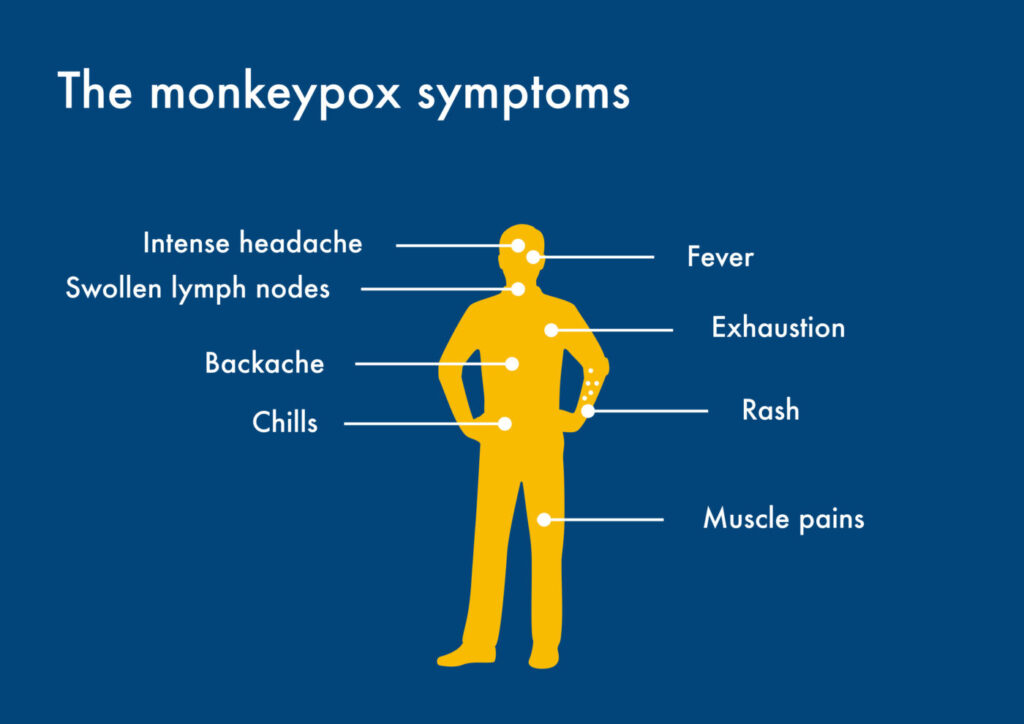
Early symptoms may consist of fatigue, muscle aches, swollen lymph nodes, fever, back pain, sore throat, dry cough, and intense headaches. The presence of lymphadenopathy (swollen lymph nodes) makes monkeypox distinct from other poxes, such as chickenpox.
Within 1-3 days of getting a fever, rashes and eruptions begin to appear. In most instances, rashes are concentrated on the face and limbs. In 95% of reported monkeypox cases, rashes appear in the face, in 75% they appear on the palms of the hands or the soles of the feet, and in 70% rashes appear in the mucous membranes in the mouth. In 30% of cases, rashes appear on genitalia. The eyes are affected in 20% of cases, specifically the conjunctivae and the cornea.
In some cases, rashes appear before the other symptoms. In others, a rash appears with no symptoms.
Monkeypox rashes evolve over the course of the inflection. Red macules appear in the beginning stage. Macules are flat rashes and don’t have raised bumps. The macules turn into firm, raised legions (papules), lesions with clear fluid (vesicles), and then lesions with yellow fluid (pustules). Eventually, the lesions dry up and fall off.
Infections produce a range of a few to thousands of lesions on the infected person. If the case is severe enough, the lesions form large sections of dead tissue which slough off.
The severity of the infection depends on the amount of exposure and underlying health problems. Children are more likely to develop severe symptoms. Loss of vision due to an infected cornea, encephalitis, sepsis, and bronchopneumonia are some of the more serious complications that can arise.
Scientists are currently unsure of the number of asymptomatic infections.
New Symptoms
Doctors have identified a few new symptoms associated with the current outbreak, some of which are mentioned above. These newly identified symptoms are not traditionally part of what defines monkeypox. New symptoms include:
- Rash appears before fever or fever never develops
- Bumps may be in different stages, even in the same area
- Open sores, pus-filled lesions, and bumps that resemble blisters
- In some cases, only 1-3 bumps appear
- Rashes first appear around the anus, genitals, and pubic area
Some new cases have also included tenesmus, proctitis, and bleeding in the lower intestine.
What’s causing the shift in symptoms? Scientists are unsure but research is underway.
Treatment and Prevention
Monkeypox is a self-limiting disease, meaning that it will eventually go away on its own. There is no specific cure or treatment. Treatment focuses on relieving symptoms and preventing secondary infections.
Patients are typically isolated to prevent the spread of the disease. In severe cases, patients may be hospitalized for supportive care, which may include fluids, pain relief, and oxygen therapy.
Management of mpox is primarily supportive, focusing on pain control, wound care, and hydration. Results from the landmark NIH-sponsored STOMP trial (published in 2025) demonstrated that tecovirimat (TPOXX) was no better than placebo at accelerating lesion healing or reducing pain in mild-to-moderate clade II mpox. As of 2026, there are no FDA-approved antiviral treatments specifically indicated for mpox in the United States, though tecovirimat remains available on a case-by-case basis through Expanded Access Investigational New Drug (EA-IND) protocols for severely immunocompromised patients.
The smallpox vaccine is recommended by the CDC for people who have been exposed to monkeypox and people who are at greater risk of developing severe symptoms. This includes
- Anyone who has been labeled as a contact of someone with monkeypox by public health officials
- Those with sexual partners who have been diagnosed with monkeypox
- Those who have had multiple sexual partners in an area where monkeypox is present
- People who work in environments that could expose them to poxvirus diseases, such as some lab workers and healthcare workers
Monkeypox can be prevented by avoiding contact with infected animals and people, which includes avoiding contact with bedding or clothing that has been used by an infected person.
In Central and West Africa, primates and rodents are common monkeypox carriers. Avoiding contact with these animals can help prevent the disease, including dead or sick animals and their bedding. The CDC keeps a list of animals that can spread monkeypox to avoid in these regions.
If you have a rash or other symptoms associated with monkeypox, you should isolate yourself from other people and contact your doctor or healthcare provider for a diagnosis..
Outlook and Containment Efforts
Following the global containment of the 2022–2023 clade II outbreak and the response to the clade Ib epidemic that spread across Central and East Africa from 2024, public health strategies have shifted from emergency response toward sustained surveillance and targeted immunization. In September 2025 the WHO ended its mpox Public Health Emergency of International Concern as cases in the hardest-hit countries declined, though the Africa CDC kept its continental emergency in place amid continued transmission in parts of the region.
The CDC is working with health departments and partners to contain the outbreak and prevent further spread. Isolation, contact tracing, and vaccination are key containment strategies. The smallpox vaccine is effective against monkeypox, and the CDC recommends that people who have been exposed to the virus be vaccinated.
Containing monkeypox is challenging because of the long incubation time. Since people may be infected for up to 21 days before developing symptoms, they can unknowingly spread the disease during this time. This is why many public health experts are calling for advanced contact tracing measures. Contact tracing would allow health officials to promptly notify people who may have been exposed to the virus and help them take steps to prevent spreading the disease and seek testing and treatment.
Some public health experts and journalists are concerned about an insufficient amount of monkeypox tests leading to underreporting. Limited testing combined with rapidly rising case counts can often suggest that an outbreak is larger than the numbers indicate.
Many confirmed cases also report that patients diagnosed with monkeypox often don’t know from who they caught the infection. Additionally, many confirmed cases involve patients who believe they haven’t come into contact with people with monkeypox. This could suggest that transmission is occurring through asymptomatic carriers. In any event, being unable to trace the source of infectious diseases can make containment more difficult.
As western countries organize to combat the spread of monkeypox, many are looking to African doctors and researchers for guidance. African scientists have been monitoring and researching the disease for decades, and their expertise is crucial to understanding how to best contain the outbreak.
The U.S. is in the process of expanding testing and plans to produce another 1.6 million vaccines in the coming months.
Frequently Asked Questions
Is mpox still a global health emergency in 2026?
No. The WHO lifted its second mpox public health emergency of international concern on September 5, 2025, after sustained declines in cases and deaths worldwide. The Africa CDC followed by lifting its continental emergency on January 22, 2026. However, WHO standing recommendations for mpox remain in effect through August 2026, and surveillance continues as clade Ib community transmission has been detected in several high-income countries.
What is the difference between mpox clade I and clade II?
Clade I, historically linked to Central Africa, causes more severe illness with fatality rates between 1% and 3% (historically up to 10%). Clade II, associated with West Africa, is far less virulent, with survival rates exceeding 99.9%. A newer sub-lineage, clade Ib, emerged in 2024 and spreads more readily through sexual contact. In December 2025, a recombinant clade Ib/IIb strain was first detected in the United Kingdom.
Does TPOXX (tecovirimat) work as a treatment for mpox?
Results from the NIH-sponsored STOMP trial, published in 2025, showed that tecovirimat was no better than placebo at achieving faster clinical resolution or pain reduction in adults with clade II mpox. As of mid-2026, there are no FDA-approved treatments for mpox in the United States. Research continues into potential treatments for severe cases and immunocompromised patients.
Which vaccines are available for mpox in 2026?
JYNNEOS (MVA-BN) remains the only WHO-prequalified mpox vaccine. The FDA approved a freeze-dried version in 2025 for easier stockpiling. A second vaccine, LC16m8 (KMB), received WHO Emergency Use Listing in November 2024 for use in individuals one year of age and older. A March 2026 CDC study confirmed that JYNNEOS provides sustained immune memory for up to five years, with boosters significantly increasing antibody levels.
How many mpox cases have been reported worldwide as of 2026?
Between 2022 and January 31, 2026, over 179,600 confirmed mpox cases were reported across 145 countries and territories. The Americas accounted for 41% of cases, followed by Africa at 36% and Europe at 18%. Monthly global cases have declined significantly, with approximately 1,066 confirmed cases reported in April 2026 and a case fatality rate of about 0.3%.