
Last updated: July 2026.
Entering the healthcare field brings an alphabet soup of professional designations: MD (Medical Doctor), DO (Doctor of Osteopathic Medicine), and DC (Doctor of Chiropractic). These acronyms, while they all mark commitment to healthcare, hint at unique education paths, methodologies, and scopes of practice. A common question also arises regarding the status of chiropractors: are they doctors? Here, we aim to answer these questions and more, clarifying the distinctions between MDs, DOs, and DCs in healthcare.
With over 1,082,000 licensed physicians in the United States as of 2025 and approximately 70,000 licensed chiropractors practicing nationwide, the landscape of healthcare professionals is broader and more varied than ever. Understanding the real differences between these credentials matters whether you are choosing a provider or considering a career in medicine. Our knowledgeable team at International Medical Aid (IMA) can provide much-needed clarity on these matters. We’re here to lend a helping hand to individuals searching for medical schools, or those contemplating an international pre-med shadowing program. Let’s get into the specifics.
Medical Doctors (MDs): Education, Training, and Practice in 2026
The term healthcare invariably conjures up images of Medical Doctors (MDs). With historical roots reaching back to ancient times, MDs form the backbone of today’s healthcare system, armed with training in allopathic medicine.
Allopathic medicine, a term coined in the 19th century, distinguishes mainstream medicine from homeopathy and other alternative practices. Its foundation lies in empirical, scientific approaches that treat diseases with interventions, such as drugs or surgery, producing effects contrary to the disease itself.
MDs are fully licensed practitioners, equipped to diagnose and treat a wide spectrum of health conditions. Their specializations may range from general practice areas such as family medicine, internal medicine, and pediatrics, to niche areas like neurology or cardiology.
Functioning in a variety of roles, MDs work as clinicians, researchers, educators, and policymakers, impacting healthcare on a global scale in clinics, hospitals, laboratories, and government agencies. According to the AAMC’s 2025 workforce data, the United States had 1,032,365 active physicians in 2024, of which 866,460 were in direct patient care. That translates to roughly 255 direct patient care physicians per 100,000 people.
The Rigorous Journey to MD
Becoming an MD involves an arduous academic and training process. The pathway typically commences with a bachelor’s degree in a science-based subject, although some may hail from diverse disciplines.
Pre-medical training usually incorporates courses in biology, chemistry, physics, mathematics, and occasionally, social sciences. Postgraduate education entails a four-year commitment to medical school, starting with two years dedicated to foundational medical sciences and theoretical knowledge acquisition.
Students steep themselves in anatomy, biochemistry, pharmacology, psychology, medical ethics, and health law, leveraging a mix of classroom and laboratory learning experiences. The latter half of the medical school curriculum pivots towards practical clinical experience.
In their third and fourth years, students commence rotations across various medical specialties, guided by experienced MDs. They garner invaluable hands-on experience across a spectrum of practice areas from internal medicine, surgery, pediatrics, psychiatry to obstetrics and gynecology.
Post-medical school, the learning curve extends into residency programs, lasting three to seven years, or even longer in certain specialties. Here, nascent MDs gain comprehensive clinical experience in their chosen specialty, working in tandem with seasoned physicians and dealing with increasingly intricate medical conditions. This stage nurtures a profound understanding of their specialty, culminating in board certification and independent practice.
MD Admissions by the Numbers: 2025-2026 Data
The scale of MD education in the United States reached a significant milestone recently. According to an AAMC press release from December 2025, total enrollment in U.S. MD-granting medical schools surpassed 100,000 students for the first time in the 2025-2026 academic year. The total number of medical school applicants rose 5.3%, reversing a three-year decline.
There are currently approximately 158 LCME-accredited MD-granting institutions in the country, with new schools continuing to open. Methodist University Cape Fear Valley Health School of Medicine aims to welcome its first class in 2026, and LECOM Jacksonville plans to launch a new four-year campus the same year.
Here is a snapshot of the entering MD class for 2025-2026:
- Average MCAT score: 513
- Median undergraduate GPA for matriculants: 3.87
- Women comprised 55.0% of matriculants, marking the seventh consecutive year women represented the majority
- Approximately 56,000 applications were submitted to MD programs, with about 22,000 students matriculating
The financial commitment is substantial. While tuition and mandatory fees alone for the 2025-2026 academic year averaged $43,648 at public schools and $74,661 at private schools, total costs run much higher. When accounting for full housing, equipment, and living expenses, the AAMC reports the median 4-year total Cost of Attendance (COA) for the Class of 2026 is $297,745 for public medical schools and $408,150 for private medical schools. According to AAMC data, 70% of the graduating medical school class of 2025 had an average educational debt of $223,130, up 5% from the prior year. If you are trying to understand what your monthly payments might look like after graduation, IMA’s Student Loan Repayment Calculator can help you model different repayment scenarios based on your expected debt load.
A significant financial change took effect on July 1, 2026, under the One Big Beautiful Bill Act (OBBBA). Federal Grad PLUS loans were eliminated for new borrowers, capping federal Direct Unsubsidized Loans for professional medical students at $50,000 per year, with a $200,000 lifetime cap for professional programs ($257,500 aggregate including undergraduate loans). These caps mean prospective medical students must carefully plan how to cover costs exceeding $200,000 through institutional grants, private loans, or savings.
A Compass in the Journey to MD
Given the demanding nature of the path to MD, aspiring students often seek assistance from medical school admissions consulting. The competitive and intricate nature of admissions can be overwhelming. Professional guidance can streamline the process, ensuring students make the best impression on admissions committees.
At IMA, we offer this essential service, assisting potential MDs on the formidable path to medical school. Our services extend from guiding appropriate pre-medical coursework selection, preparing for the Medical College Admission Test (MCAT), crafting an influential personal statement to acing interviews.
We appreciate the challenges involved in finding the right medical school, whether you are searching locally or broadening your horizons internationally. Our consulting services aim to match you with the school best suited to your career goals. Additionally, we provide guidance on scholarships and financial aid, ensuring you have the requisite resources to succeed. If you want to see where you currently stand, try the IMA Pathfinder medical school admissions calculator to get a preliminary assessment of your competitiveness based on your GPA, MCAT score, and extracurricular profile.
The Pivotal Role of MDs in 2026 Healthcare
The MD’s role in contemporary healthcare is dynamic and broad. They wear multiple hats, functioning as healthcare providers, educators, patient advocates, researchers, and healthcare leaders. Their allopathic medicine practice, backed by rigorous scientific research and clinical trials, ensures the delivery of state-of-the-art, effective treatments to patients.
Beyond providing care, MDs also champion public health initiatives, advocate for patient rights, and push for progressive healthcare policies. They play a crucial role in shaping future healthcare professionals, passing on accumulated knowledge and skills.
The demand for MDs continues to grow. The AAMC projects that the United States will face a physician shortage of up to 86,000 physicians by 2036, including a shortfall of between 20,200 and 40,400 primary care physicians. The Bureau of Labor Statistics projects overall employment of physicians and surgeons to grow 3% from 2024 to 2034. Meanwhile, one in five physicians (20%) is 65 or older, and another 22% are between 55 and 64, meaning a large portion of the current workforce will retire within the next decade.
Compensation reflects this demand. BLS data from May 2024 reports a median annual wage for physicians and surgeons equal to or greater than $239,200 (the BLS top-codes physician salaries, so the actual median is higher). The 2026 Medscape Physician Compensation Report places the average salary for all U.S. physicians at $386,000, including both primary care and specialists.
Overall, the journey to becoming an MD, while demanding, is rewarding. The career avenues available to MDs are diverse, spanning clinical care, research, education, and policy-making. Should this pathway inspire you, remember help is available. Services like medical school admissions consulting offer invaluable support on your path to becoming an MD.
Doctors of Osteopathy (DOs)
Doctors of Osteopathy (DOs) are fully licensed physicians whose privileges mirror those of MDs, including the ability to diagnose, treat, perform surgery, and prescribe medication. Doctors of Osteopathy (DOs) constitute a significant and rapidly growing branch of the healthcare profession.
As licensed physicians, DOs share many responsibilities with MDs. However, DOs differentiate themselves with their unique healthcare delivery philosophy.
Osteopathic medicine follows a holistic approach, prioritizing the treatment of the individual as a whole rather than isolated symptoms. The philosophy emphasizes preventive healthcare, fostering a proactive rather than reactive healthcare environment.
The osteopathic profession has grown substantially. According to the American Osteopathic Association’s 2025 statistics, there are now 167,216 DOs in the United States and over 207,000 osteopathic physicians and medical students combined. DO schools now educate close to 30% of all U.S. medical students, a remarkable increase from a much smaller share just a decade ago.
The Practice of Osteopathic Medicine
The philosophy central to osteopathic medicine is the perception of the body as an interlinked and cohesive entity. Here, the conviction is that all the body’s systems are intertwined, and a disruption in one can reverberate through the others.
Thus, DOs adopt a holistic treatment approach that transcends merely addressing specific ailments or symptoms. Their aim is to unearth the core reasons for illness, taking into account the impact of lifestyle, environmental factors, and emotional health on the overall well-being of a patient.
There’s a distinguishing aspect of DOs: their intricate knowledge of the human musculoskeletal system. This system, a weave of nerves, muscles, and bones, is not merely an anatomical wonder. It’s the fundamental framework that influences every function and health aspect of our bodies.
Integral to the training of a DO is the mastery of osteopathic manipulative treatment (OMT). This collection of hands-on skills is used by DOs as a tool for diagnosing, treating, and even preventing various diseases or injuries. Such techniques equip DOs with the capability to detect and rectify structural and tissue irregularities, optimize blood flow, and facilitate the body’s natural healing process.
The Journey to Becoming a DO
Like MDs, the journey to becoming a DO is academically and personally demanding. It starts with undergraduate studies, often in science-related fields, although this is not a prerequisite.
Aspiring DOs then proceed to osteopathic medical school, a challenging four-year program that parallels the training MDs receive. However, DOs have additional commitments, with hundreds of extra hours spent studying the human musculoskeletal system and mastering OMT techniques. Currently, 48 accredited colleges of osteopathic medicine operate across 75 teaching locations in 36 states, according to the AACOM. Enrollment has surged, with more than 39,200 osteopathic medical students enrolled in the 2024-2025 academic year, representing a 66% increase over the last decade. More than 58.7% of first-year DO matriculants for 2024-2025 were women.
After completing osteopathic medical school, DOs enter a residency program in their chosen specialty field. This stage can last between three and seven years and involves in-depth, practical training. Here, they hone their OMT techniques, learn to manage medical and surgical emergencies, and develop specialties that may range from family medicine to neurosurgery.
The pathway to becoming a DO is competitive, with many candidates vying for limited seats in osteopathic medical schools. As such, services like medical school admissions consulting can provide a competitive edge. These services offer aspiring DOs assistance with preparing for the Medical College Admission Test (MCAT), personal statement writing, application submissions, and interview preparation, among others.
DO’s Role in 2026 Healthcare
In the healthcare environment of today, DOs stand out with their distinct holistic health approach. This perspective allows them to provide patients with a broader scope of care that takes into account physical ailments along with emotional, social, and environmental impacts on health. DOs can be found in a variety of healthcare environments, ranging from individual clinics and large hospitals to educational institutions and public health agencies.
Reflecting the profession’s longstanding commitment to primary care, 53% of osteopathic candidates matched into primary care residency programs in 2025. At the same time, approximately 45% of DOs currently practice in non-primary care specialties, including emergency medicine, anesthesiology, OB-GYN, psychiatry, and surgery. In the 2026 U.S. News & World Report Best Medical Schools Rankings, osteopathic medical schools accounted for nine of the top 10 medical schools with the most graduates practicing in primary care, six of the top 10 for graduates practicing in rural areas, and five of the top 10 for graduates practicing in Health Professional Shortage Areas.
For those taking on the role of DOs, the scope of their contribution often extends beyond the immediate realm of patient care. They frequently serve as educators, researchers, and advocates for a more comprehensive view of health. Their influence can be seen in improving the delivery of healthcare services, contributing to medical research, and molding health policy. Emphasizing preventive healthcare, they play an integral role in addressing public health concerns and curtailing healthcare costs.
The path to becoming a DO, while exacting, is immensely rewarding. It offers a unique perspective on health and wellness, a viewpoint increasingly appreciated and needed in an era of growing physician shortages. For those drawn to a patient-centric philosophy that encompasses all facets of health, the journey towards becoming a DO may be the one to pursue. With the appropriate guidance and support services, such as medical school admissions consulting, this demanding pursuit can become significantly more manageable.
MD vs DO: A Comparison
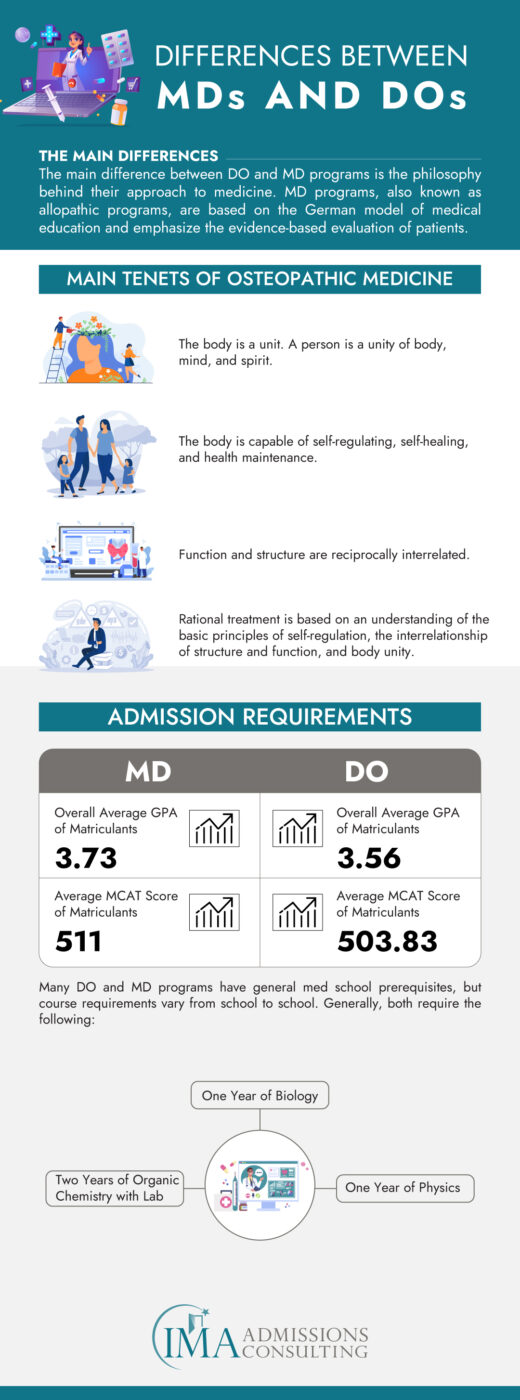
When distinguishing between MDs and DOs, one must bear in mind that both are fully licensed and authorized to practice medicine in all its dimensions. The pivotal differences between them rest on their distinct philosophies of treatment and approaches to patient care.
MDs practice allopathic medicine, a more conventional approach that focuses on treating specific symptoms to combat illnesses. This method often leans on medications and surgical interventions to manage and treat medical conditions.
In contrast, DOs subscribe to a more holistic perspective on healthcare, concentrating on treating the patient as an integrated whole rather than focusing solely on isolated symptoms. The osteopathic philosophy underscores the body’s intrinsic capacity to heal, and DOs are trained to weave this philosophy seamlessly into their medical practice. Their primary aim is to foster wellness through enhancing health and preventing diseases.
The Single Accreditation System: A Major Shift Since 2020
One of the most significant developments in recent years for both MDs and DOs is the completion of the single graduate medical education (GME) accreditation system. This transition, which concluded in June 2020 after a five-year process that began in July 2015, means the Accreditation Council for Graduate Medical Education (ACGME) now serves as the nation’s sole accreditor for both osteopathic and allopathic residencies and fellowships.
In practical terms, this means MD and DO graduates now compete in the same National Resident Matching Program (NRMP) Match and train side by side in the same ACGME-accredited residency programs. The distinction between MD and DO residencies that once existed has been eliminated.
The results have been encouraging for DO graduates. In the 2026 NRMP Main Residency Match, the largest in history, DO seniors achieved a record-high PGY-1 match rate of 93.2%, up from 92.6% in 2025. That figure is very close to the 93.5% rate for U.S. MD seniors. In 2025, DO seniors achieved a 99% final residency placement rate, the highest for all applicant types. The 2026 Match saw 38,354 applicants match to a PGY-1 position overall, an increase of 687 from the prior year.
This convergence in residency training and match outcomes means the practical career differences between an MD and DO degree have narrowed considerably. The choice between the two pathways now rests more on personal philosophy and preference than on career limitations.
Regardless of your leaning towards the MD or DO path, seeking professional advice like medical school admissions consulting can help you work through the complex and fiercely competitive landscape of medical school admissions. Expert teams, such as those at IMA, are equipped and ready to support you on your journey towards becoming a healthcare provider.
Understanding Chiropractors (DCs)
Chiropractors (DCs), or Doctors of Chiropractic, are healthcare practitioners who specialize in the non-surgical treatment of back pain and other musculoskeletal conditions. Approximately 70,000 chiropractors are currently licensed in the United States, and they treat more than 35 million Americans annually, according to the American Chiropractic Association.
Their core therapeutic modality is the chiropractic adjustment, a technique involving manual manipulation of the spine. The role they play extends to an encompassing approach that advocates for exercise, ergonomic adjustments, and patient education to underpin overall health and well-being.
The central tenet of chiropractic philosophy is the correlation between the body’s structure, notably the spine, and its function, orchestrated by the nervous system. Chiropractors suggest that a misaligned spine can influence the nervous system, resulting in various discomforts, pain, or functional discrepancies.
Hence, DCs primarily focus on mitigating pain and enhancing patients’ functional abilities, championing healthier lifestyles. They also motivate patients to take the reins of their health, providing counsel on exercises, dietary adaptations, and lifestyle modifications to thwart the reappearance of health complications.
The Chiropractor Doctor: Educational Journey
The educational route for a Chiropractic Doctor usually starts with at least three years of undergraduate study, often culminating in a four-year bachelor’s degree, typically in the sciences. This is followed by an intensive program at a chiropractic college, generally lasting about four years (or 10 trimesters of year-round study), culminating in the Doctor of Chiropractic (DC) degree. The curriculum includes an exhaustive study of human anatomy, physiology, neurology, orthopedics, diagnostic imaging, and spinal adjustment techniques. Clinical internships, where students provide direct patient care under experienced supervision, are also part of this program.
Chiropractic colleges in the United States are accredited by the Council on Chiropractic Education (CCE), which currently accredits 19 chiropractic programs, guaranteeing that the graduates meet the stringent academic and professional standards required for chiropractic practice. Approximately 11,000 chiropractic students are currently enrolled across these programs. New campuses continue to open; for example, Southern California University of Health Sciences launched a new Arizona campus in Tempe in January 2026, the first DC program in that state. To practice, graduates must also pass national board exams administered by the National Board of Chiropractic Examiners. Every state requires chiropractors to be licensed.
Are Chiropractors Doctors?
It’s common to ask, “Is a chiropractor a physician?” The answer depends on how you define “physician.” Traditionally, physicians are medical doctors (MDs) or Doctors of Osteopathy (DOs) who have completed medical school, residency training, and are licensed to prescribe medication and perform surgeries.
While a chiropractic doctor undergoes rigorous education and they are often referred to as “doctors,” they do not hold medical degrees. Their training is heavily centered around the neuromusculoskeletal system, equipping them to diagnose and treat specific health issues related to the spine and joints. However, they do not perform surgery or prescribe medication.
A chiropractic doctor will frequently work in tandem with MDs and DOs when a patient’s needs exceed the scope of chiropractic care. This collaborative model ensures that patients receive comprehensive care, combining the strengths of each discipline.
The Merits of Chiropractic Doctor Care
Chiropractic doctor treatment holds distinct worth, primarily for individuals seeking non-invasive, drug-free remedies for musculoskeletal complications. It proves beneficial in the management of back pain, neck discomfort, headaches, and injuries related to physical activity. It also offers relief for chronic conditions such as osteoarthritis and fibromyalgia. This brand of care, gaining approval from reputable establishments such as the American Chiropractic Association, is underpinned by a growing volume of research testifying to its effectiveness.
The demand for DCs is increasing. According to the Bureau of Labor Statistics, employment of chiropractors is projected to grow 10% from 2024 to 2034, much faster than the average for all occupations, with about 2,800 openings projected each year over the decade. The median annual wage for chiropractors was $79,000 as of May 2024, up from $76,530 the prior year. The U.S. chiropractic market is expected to reach $28.71 billion by 2030.
Even though a chiropractic doctor may not be classified as a physician in the same category as MDs or DOs, they are nonetheless crucial healthcare specialists with a concentrated focus. Their unique proficiency in the structure and function of the human body, coupled with their commitment to a patient-centered modality of care, solidifies their indispensable role in the healthcare team. Those intrigued by what chiropractic care can offer should consider seeking out a credible chiropractic practitioner in their vicinity.
Dissecting Osteopathy and Chiropractic Doctor
Within the healthcare sphere, there often arises a certain degree of overlap in the roles and philosophies of varied professionals, prompting inquiries such as: what distinguishes osteopathy from chiropractic care? Both osteopathic physicians (DOs) and chiropractors (DCs) endorse a holistic approach to healthcare, firmly believing in the body’s innate ability to heal. However, their methodologies and focus areas differ considerably.
Osteopathic physicians, in their capacity as fully licensed professionals, can prescribe medications and carry out surgeries. Their treatment approach embraces the body as an interconnected system and incorporates techniques such as osteopathic manipulative treatment (OMT) that concentrates on the musculoskeletal system.
On the contrary, chiropractors narrow their focus particularly on diagnosing and addressing mechanical disorders of the musculoskeletal system, with special attention to the spine. Their chief method of treatment often entails a variety of manual therapy known as spinal manipulation or adjustment.
MD vs DC: A Contrast
Medical Doctors (MDs) and Chiropractors (DCs) both play essential roles in healthcare, but their areas of focus, training, and the nature of care they provide can be different.
MDs are typically trained in the allopathic model of care. This model is traditionally symptom-based, aiming to treat the apparent health issue through methods such as medication and surgery.
In contrast, a chiropractic doctor is trained in the chiropractic model of care, which looks at the body as a whole and aims to treat the root causes of health issues rather than merely the symptoms. This form of care often includes manual adjustments of the spine, with the belief that many health issues stem from spinal misalignments that impact the nervous system.
While MDs can provide a wide range of medical care and can specialize in many different areas, DCs are specialized in their field and focus particularly on the spine and musculoskeletal system. They can offer non-invasive, drug-free options for the treatment of many conditions, making them an essential part of many patients’ healthcare teams.
The compensation difference is significant. As noted, the BLS reports a physician median wage equal to or greater than $239,200 per year (May 2024), with the Medscape average for all physicians at $386,000. By comparison, the median annual wage for chiropractors was $79,000 in the same period. Both career tracks require doctoral-level education, but the scope of practice, training length, residency requirements, and earning potential differ substantially.
Choosing between an MD and a chiropractic doctor often depends on a patient’s specific needs, the type of care they’re seeking, and their personal beliefs about health and wellness. Both can offer valuable services, and in many cases, they work together to provide comprehensive care for patients.
DO vs DC: Osteopathy vs Chiropractor
When comparing DO vs DC, both professions emphasize a holistic approach to treatment, but there are crucial differences. DOs are fully licensed physicians who can prescribe medication and perform surgery, while DCs focus on diagnosing and treating mechanical disorders of the spine and nervous system, and cannot prescribe most medications or perform surgeries.
The educational investment also differs. DO students attend four-year osteopathic medical schools followed by three to seven years of residency training in ACGME-accredited programs, the same residencies MD graduates enter. DC students attend four-year chiropractic programs and, upon licensure, can enter practice immediately without a residency requirement, though some pursue postgraduate specialization.
As we’ve seen, MDs, DOs, and DCs have distinct philosophies and approaches to treatment. If you’re considering a career in medicine, medical school admissions consulting can be invaluable. We also offer a pre-med shadowing study abroad program that can provide structured clinical exposure and professional mentorship in real healthcare settings.
Understanding the distinctions between MDs, DOs, and DCs can be crucial for anyone interested in pursuing a career in healthcare. Each path offers its unique benefits and challenges, so it’s essential to carefully consider your personal preferences, career goals, and philosophies about health and wellness.
Whether you’re already committed to a specific path or you’re still comparing options, resources such as the American Medical Association can provide valuable information and guidance. If you’re considering a career in medicine, we also offer a pre-med shadowing study abroad program to provide structured experiences and professional perspective. Book an appointment with IMA today to start your journey.
Frequently Asked Questions
Can DOs prescribe medication and perform surgery like MDs?
Yes. DOs are fully licensed physicians with the same practice rights as MDs. They can prescribe medication, perform surgery, and specialize in any medical field. The key difference is that DOs receive additional training in osteopathic manipulative treatment (OMT) and approach patient care with particular emphasis on the body as an integrated system. Since 2020, both MD and DO graduates train in the same ACGME-accredited residency programs.
What is the difference between a chiropractor and a medical doctor?
A chiropractor (DC) specializes in non-surgical, drug-free treatment of musculoskeletal conditions, primarily through spinal manipulation. A medical doctor (MD) is trained in allopathic medicine and can prescribe medication, perform surgery, and treat a full range of medical conditions. MDs complete residency training after medical school; chiropractors do not have a mandatory residency. Both hold doctoral degrees, but their scopes of practice differ significantly.
Do MDs and DOs apply through the same residency match?
Yes. Since the single accreditation system was completed in 2020, both MD and DO graduates compete in the same NRMP Match for ACGME-accredited residency positions. In the 2026 Match, DO seniors achieved a record 93.2% PGY-1 match rate, compared to 93.5% for MD seniors. This convergence means choosing between MD and DO programs has less impact on residency options than it once did.
How much does medical school cost in 2026?
For tuition and mandatory fees alone in 2025-2026, public medical schools averaged $43,648 and private schools $74,661. Accounting for housing and living expenses, the AAMC reports the median four-year total Cost of Attendance for the Class of 2026 is $297,745 at public schools and $408,150 at private schools. The average educational debt for the class of 2025 was $223,130 among those who borrowed. Effective July 1, 2026, federal Grad PLUS loans were eliminated for new borrowers and Direct Unsubsidized Loans were capped at $50,000 per year ($200,000 professional limit), changing how future medical students finance their degrees.
Is the demand for physicians and chiropractors growing?
Yes, both fields are projected to grow. The AAMC projects a physician shortage of up to 86,000 by 2036, and the BLS projects 3% employment growth for physicians from 2024 to 2034. Chiropractor employment is projected to grow 10% over the same period, much faster than average. Both career paths offer strong long-term demand, though physician salaries (median at or above $239,200) are substantially higher than chiropractor salaries (median $79,000).