Last updated: July 2026.
The dental school interview is one of the most important steps on the path to becoming a dentist. It is your chance to show an admissions committee who you are beyond your GPA and DAT score, and to demonstrate that you have the judgment, communication skills, and motivation to succeed in a rigorous clinical program. With 78 accredited dental schools now operating in the United States and an applicant pool that ADEA reports is at its highest level in a decade, interview preparation matters more than ever.
This guide presents 200 dental school interview questions, including expert responses for 35 of them, to help you prepare for the 2026-27 admissions cycle. Whether you are working through common interview question formats for the first time or refining your approach to ethical scenarios, the goal is the same: to help you walk into your interview informed, composed, and ready to show what you bring to the profession.
Expert responses are included not as scripts to memorize but as examples of structured, thoughtful reasoning. They show how to organize your thinking, address the interviewer’s underlying concern, and connect your answer to real experience. Alongside these, you will find practical guidance on interview formats (including newer ones like MMI and asynchronous video interviews), financial literacy questions you should expect in 2026, and a section on questions you should ask the schools interviewing you.
If you are still building your clinical exposure and pre-dental experience, IMA’s Pre-Dentistry/Dentistry Internship Abroad programs offer structured, supervised opportunities to observe dental care in international settings, work alongside licensed professionals, and reflect on what you have seen. That kind of grounded, specific experience tends to stand out in interviews.
What Has Changed for the 2026-27 Dental School Admissions Cycle
If you prepared for dental school interviews using materials from 2023 or 2024, several significant changes have occurred since then. Interviewers may ask about any of these, and demonstrating awareness of them signals that you are engaged with the profession you want to enter.
The DAT Now Uses a 200-600 Scoring Scale
Effective March 1, 2025, the ADA replaced the old 1-30 DAT scoring scale with a new 200-600 scale. All scores, including those from tests taken before March 2025, are now reported on the new scale through ADEA AADSAS. The national average score is approximately 400, which represents the 50th percentile. Competitive applicants to most dental schools should aim for an Academic Average of roughly 420-440 or above on this new scale. For the most selective programs, scores of 460 or higher are typical among admitted students. The DAT registration fee has also increased to $560 for the 2026 testing year. If you are still preparing for the DAT, IMA’s updated Definitive Guide to the Dental Admission Test covers the new scoring system, updated organic chemistry specifications (effective April 2026), and current retake policies.
Grad PLUS Loans Are Being Eliminated for New Borrowers
Starting July 1, 2026, new dental school students can no longer borrow through the federal Grad PLUS loan program. This is the single largest change to dental school financing in years. New annual borrowing limits for professional students are set at $50,000, with an aggregate limit of $200,000 for professional programs and a lifetime cap of $257,500 including undergraduate debt. The fixed interest rate on new direct unsubsidized loans disbursed on or after July 1, 2026, is 8.07%. This means that dental school applicants interviewing in 2026 should be prepared to discuss how they plan to finance their education with more specificity than in previous cycles. Interviewers may ask about your awareness of these changes and your financial planning. If you want to understand how different loan amounts and interest rates affect your repayment timeline, the IMA Student Loan Repayment Calculator can help you model realistic scenarios before and during dental school.
The Applicant Pool Is Growing
ADEA data released in April 2026 shows that the 2025 entering class is the largest dental school cohort since 2000. Total predoctoral enrollment reached 28,925 students in 2025-26, up from 27,920 the prior year. The average acceptance rate across U.S. dental schools is approximately 16%, meaning roughly 1 in 6 applicants receives an offer. At the most competitive schools (Harvard, Penn, UCLA, Columbia), acceptance rates range from about 3.5% to 8%. The average admitted student holds a cumulative GPA of 3.5 or higher and a DAT Academic Average of 420 or above on the new scale.
Interview Formats Now Include Asynchronous Video
In addition to the traditional one-on-one, panel, and MMI (Multiple Mini Interview) formats, some dental schools now use asynchronous video interviews as part of their screening process. Schools like NYU use platforms such as Kira Talent, where you record responses to prompts on camera without a live interviewer present. If a school you are applying to uses this format, practice recording yourself answering questions. Pay attention to your eye contact with the camera, your pacing, and your ability to organize a response within a time limit.
AI in Dentistry Is Now an Interview Topic
Artificial intelligence is no longer a futuristic concept in dental care. The FDA has cleared AI-assisted diagnostic tools for both 2D intraoral radiographs and 3D CBCT imaging. Dental schools are beginning to integrate AI into their curricula, and ADEA’s 2024-2027 strategic goals include “re-envisioning the model for oral health education” with an emphasis on innovation. Interviewers may ask what you think about AI’s role in clinical decision-making, its ethical implications, or how it might change patient care. You do not need to be a technical expert, but you should be able to discuss the topic thoughtfully.
Updated Tuition and Cost Data
According to ADA data for 2025-26, the average first-year cost of dental school (tuition and mandatory fees) is $46,845 for residents at public schools, $79,168 for non-residents at public schools, and $90,090 at private schools. The average total four-year cost of a dental education is approximately $258,187, ranging from about $188,009 at public universities to $354,984 at private institutions. The 2026-27 AADSAS application fee is $264 for the first school and $115 for each additional school. Eligible applicants can apply for the ADEA Fee Assistance Program, which waives fees for three AADSAS-participating schools.
How Dental School Interviews Are Structured in 2026
Understanding the format you will face is as important as knowing the content. Here are the main interview types currently in use across U.S. dental schools:
Traditional One-on-One: Still the most common format. You sit with one interviewer (often a faculty member, current student, or admissions committee member) for 20-45 minutes and respond to a series of questions. The interview may be “open file” (they have read your application) or “closed file” (they have not). Knowing which type your school uses helps you decide how much context to provide in your answers.
Panel Interview: Similar to the traditional format but with two or more interviewers. Maintain eye contact with the person who asked the question while occasionally including the other panel members.
Multiple Mini Interviews (MMI): You rotate through a series of short stations (typically 6-10), each presenting a different scenario, question, or task. MMIs test your ability to think on your feet, communicate under time pressure, and respond to ethical, situational, and interpersonal prompts. Preparation for MMIs should include practicing timed responses to unfamiliar prompts.
Group Interview: You discuss a topic or solve a problem alongside other applicants. Interviewers observe your teamwork, listening skills, and ability to contribute without dominating.
Asynchronous Video Interview: You record responses to pre-set prompts via a platform like Kira Talent. There is no live interviewer. You typically have a short preparation window (30-90 seconds) and a fixed recording time (1-3 minutes per question). Practice with a webcam beforehand.
No matter the format, interviewers are looking for the same core qualities: clear thinking, genuine motivation, ethical reasoning, self-awareness, and the ability to communicate with warmth and precision. If you want to assess how your overall application profile stacks up before interview season, the IMA Pathfinder admissions calculator can help you identify areas of strength and areas that may need attention.
Dental School Interview Question #1
During a routine dental examination, you notice an adolescent patient has several dental caries. However, the patient is anxious about dental procedures and is reluctant to agree to treatment. How do you proceed?
Discussion: The case involves managing dental anxiety, a common barrier to receiving oral care, particularly in younger patients. The key is to build trust and educate the patient about the importance of treating caries to prevent further oral health deterioration.
Expert Answer: My approach would be to first create a calming environment for the patient. I would engage in a gentle conversation to understand their fears. Utilizing age-appropriate language, I would explain the process and necessity of treating caries, emphasizing that early intervention is key to avoiding more invasive procedures in the future.
I’d introduce them to the concept of ‘tell-show-do’, where I explain the steps (tell), demonstrate on a model (show), and proceed with their consent (do). Providing options for pain management, such as topical numbing gels or distraction techniques, could also help ease their anxiety.
I would make sure to involve their guardian in the conversation, ensuring that they understand the situation and the proposed treatment plan. Gaining consent from both the patient and their guardian is crucial.
Concluding Reflections: Addressing dental anxiety, especially in young patients, is vital for fostering a positive outlook towards dental care. Through patient education, a supportive environment, and a compassionate approach, we can help patients overcome their fear and receive the necessary treatment. This scenario exemplifies the dentist’s role as both a healer and an educator.
Dental School Interview Question #2
You have a patient who insists on a cosmetic procedure that you believe is not in their best interest. How do you address their request?
Discussion: This scenario tests the ethical obligation to prioritize a patient’s health over their aesthetic desires. It involves a delicate balance between respecting patient autonomy and professional integrity.
Expert Answer: I would begin by listening to the patient’s concerns and desires to understand their motivation for requesting the cosmetic procedure. Then, I would explain my professional assessment, detailing why I believe the procedure isn’t in their best interest, discussing potential risks and long-term implications.
Education is key; I would offer alternative treatments that align more closely with their overall oral health goals. If applicable, I would show before-and-after images of similar cases and provide literature on the risks and benefits of various options.
It’s essential to ensure the patient feels heard and respected throughout the discussion. If the patient still wishes to proceed, I would recommend seeking a second opinion, thereby upholding my duty to provide ethical care while respecting their autonomy.
Concluding Reflections: This situation highlights the ethical complexities in dentistry. It’s important to maintain a balance between respecting patient wishes and adhering to professional guidelines that prioritize patient health. Effective communication and a patient-centered approach are paramount in such ethical dilemmas.
Dental School Interview Question #3
Why do you want to be a dentist?
Discussion: This question probes the candidate’s motivation and personal connection to the field of dentistry. It’s a chance to demonstrate genuine passion and understanding of the profession.
Expert Answer: My desire to become a dentist stems from a deep appreciation for the unique blend of science, artistry, and direct patient care that the field offers. I find the combination of technical skill and creative problem-solving to address individual patient needs to be incredibly fulfilling. My goal is to leverage these elements to improve oral health outcomes and make a tangible impact on patients’ quality of life. For me, dentistry is not just about teeth; it’s about contributing to someone’s overall well-being and seeing the immediate positive effect that quality dental care can have.
Concluding Reflections: An effective response to this question demonstrates a clear and thoughtful motivation for entering the field, reflecting both an understanding of what the profession entails and a commitment to the responsibilities it carries.
Dental School Interview Question #4
What are your strengths and weaknesses?
Discussion: Self-assessment questions like this one gauge the applicant’s self-awareness and capacity for professional growth.
Expert Answer: One of my strengths is my meticulous nature. In a field where precision is paramount, I take great care in ensuring accuracy and thoroughness in my academic work, which I plan to extend into my clinical practice. As for a weakness, I can sometimes be overly critical of my performance. While this drives me to constantly improve, I’m learning to balance this by celebrating achievements and taking constructive feedback positively, viewing it as a pathway to excellence rather than criticism.
Concluding Reflections: Discussing weaknesses can be challenging, but when framed as areas for development, they show an openness to growth. Strengths should be relevant to the demands of dental school and the profession.
Dental School Interview Question #5
What are your academic and extracurricular achievements?
Discussion: This question seeks to highlight the applicant’s drive, commitment, and ability to excel both in and out of the classroom.
Expert Answer: I graduated at the top of my class from Harvard University, an achievement that speaks to my commitment and ability to manage a rigorous academic schedule. My research on oral microbiota garnered attention at the American Student Dental Research Symposium, marking a significant milestone in my research career. As president of the Harvard Pre-Dental Society, I spearheaded initiatives that served our local communities and offered guidance to fellow students. Moreover, my time volunteering at Massachusetts General Hospital’s dental clinic allowed me to connect with and learn from diverse patient populations, further emphasizing the role of community engagement in my dental practice.
Concluding Reflections: Applicants should be prepared to discuss achievements that showcase their leadership, academic prowess, and commitment to service, which are all qualities valued in dental professionals.
Dental School Interview Question #6
What are your career goals?
Discussion: This question assesses the candidate’s foresight and ambition within the field of dentistry.
Expert Answer: My immediate career goal is to gain diverse clinical experience by working in different dental settings, which will give me a broad perspective on patient care. Long-term, I aspire to specialize in pediatric dentistry, as I’m passionate about early prevention and education. Ultimately, I aim to establish a practice that not only addresses dental issues but also serves as a community resource for oral health education, particularly focusing on underserved areas.
Concluding Reflections: Articulating clear short-term and long-term goals shows the interviewer that the candidate has a vision for their future and understands the path to achieve it.
Dental School Interview Question #7
Why are you interested in our dental school?
Discussion: Interviewers want to see that the candidate has done their homework and is genuinely interested in what their school uniquely offers.
Expert Answer: Your dental school’s commitment to innovation and community health aligns perfectly with my professional values. The curriculum’s integration of cutting-edge technology and evidence-based practice is precisely the environment I seek for my dental education. Additionally, the community outreach programs and opportunities for international externships resonate with my desire to address oral health disparities both locally and globally.
Concluding Reflections: An effective response indicates that the candidate’s values are in harmony with those of the school, suggesting a good fit between the applicant and the institution.
Dental School Interview Question #8
What do you know about our dental school’s mission and values?
Discussion: This question is meant to test the candidate’s understanding of the school’s ethos and their alignment with it.
Expert Answer: I am impressed by the school’s mission to develop skilled, ethical professionals who are leaders in both their communities and the dental field. The emphasis on values such as compassion, excellence, and integrity resonates with my ethos. I am particularly drawn to the school’s dedication to lifelong learning and the cultivation of a diverse and collaborative community, which I believe are essential to advancing the field of dentistry.
Concluding Reflections: Candidates need to demonstrate that their choice of dental school is informed and intentional, reflecting a match between their goals and the school’s offerings.
Dental School Interview Question #9
How would you describe your communication skills?
Discussion: Dentistry is as much about communicating effectively with patients and colleagues as it is about technical skills.
Expert Answer: I would describe my communication skills as clear, compassionate, and collaborative. During my time as a volunteer health educator, I honed the ability to translate complex health information into understandable terms for diverse audiences. Additionally, working in a team setting has refined my ability to actively listen, provide constructive feedback, and effectively convey ideas, ensuring a harmonious and productive team dynamic.
Concluding Reflections: Effective communication is a cornerstone of dental practice, and candidates should be ready to illustrate their proficiency with concrete examples.
Dental School Interview Question #10
How would you handle a difficult patient?
Discussion: The response to this question reveals the candidate’s interpersonal skills and ability to manage challenging clinical situations.
Expert Answer: Handling a difficult patient requires patience, empathy, and strong communication skills. I would approach the situation by actively listening to the patient’s concerns, acknowledging their feelings, and providing clear, calm responses. I’d seek to understand the root cause of their difficulty and collaborate with them to find a mutually agreeable solution, always maintaining professionalism and compassion.
Concluding Reflections: A successful dental professional must be adept at managing a range of patient interactions, including those that are challenging, with a focus on maintaining patient trust and satisfaction.
Dental School Interview Question #11
What qualities are most important in a dentist?
Discussion: This question probes the candidate’s understanding of the professional and personal attributes essential for success in dentistry.
Expert Answer: The most important qualities in a dentist include strong manual dexterity, keen attention to detail, and excellent communication skills. It is also crucial for a dentist to possess empathy, as it enables a genuine connection with patients and understanding of their concerns. An effective dentist should also be a good problem solver with the ability to make decisions that are in the best interest of the patient’s health and wellbeing.
Concluding Reflections: Identifying and embodying these qualities shows the interviewer that a candidate is aware of the comprehensive skill set required to be a proficient dentist.
Dental School Interview Question #12
Describe any inconsistencies or weaknesses in your record or application.
Discussion: The interviewers are assessing the candidate’s honesty, self-awareness, and ability to address and learn from past shortcomings.
Expert Answer: I acknowledge that my undergraduate GPA may not fully reflect my academic capability, as I faced significant family challenges in my sophomore year. I responded by developing stronger time-management and stress-coping strategies, which have since allowed me to improve my academic performance consistently. This experience has also taught me resilience and determination, qualities I believe are vital in a demanding field such as dentistry.
Concluding Reflections: Candidness about one’s weaknesses, coupled with evidence of growth, demonstrates maturity and the ability to overcome obstacles.
Dental School Interview Question #13
How have you overcome a personal conflict?
Discussion: This question evaluates the candidate’s conflict resolution skills and emotional intelligence.
Expert Answer: When I encountered a personal conflict with a colleague during a group project, I initiated a private conversation to openly discuss our differences. By actively listening to each other’s viewpoints, we identified a mutual goal for the project’s success. We agreed on a compromise in task delegation that played to our respective strengths, resulting in not only a successful project outcome but also a strengthened professional relationship.
Concluding Reflections: This approach illustrates the ability to handle interpersonal conflicts constructively, an essential skill in a collaborative healthcare environment.
Dental School Interview Question #14
What field of dentistry do you prefer?
Discussion: This question seeks insight into the candidate’s interests and how they align with the current trends and needs in dentistry.
Expert Answer: While I am open to exploring different fields during my dental education, I am particularly drawn to prosthodontics because of its blend of precision, aesthetics, and its profound impact on patients’ quality of life. The ability to restore function and appearance is deeply rewarding and aligns with my passion for both healthcare and the meticulous craftsmanship that dentistry demands.
Concluding Reflections: Expressing a specific interest while remaining open to the breadth of the field demonstrates both direction and adaptability.
Dental School Interview Question #15
Why have you picked dentistry instead of becoming a social worker?
Discussion: The interviewer is gauging the candidate’s motivation for choosing a healthcare profession that is technically oriented over one that is more traditionally focused on social support systems.
Expert Answer: Dentistry provides a unique opportunity to combine my interest in science and hands-on care with my passion for social impact. It allows me to engage directly in clinical interventions that have immediate and tangible results while also addressing broader issues like health education and access to care. In this way, I believe dentistry embodies the preventive and direct support principles central to social work but through a medical-scientific approach.
Concluding Reflections: A thoughtful comparison shows the candidate’s commitment to patient care and community well-being, traits shared with social work but expressed through the practical application of dental medicine.
Dental School Interview Question #16
How did you choose your major?
Discussion: The purpose of this question is to understand the thought process behind the candidate’s academic choices and their relevance to a career in dentistry.
Expert Answer: I selected my major in biochemistry because it offered a robust foundation in the biological sciences while also delving into the chemical processes that underlie human health. This major has provided me with a deep understanding of the molecular aspects of bodily functions, which is directly applicable to the bio-materials and physiological processes I will encounter in dentistry.
Concluding Reflections: Choosing a major relevant to dental study underlines the candidate’s dedication and foresight in preparing for a dental career.
Dental School Interview Question #17
What do you read for fun?
Discussion: This query aims to glean insights into the candidate’s personality and interests outside of academia.
Expert Answer: Beyond my academic reading, I enjoy exploring works of historical fiction. They allow me to understand different cultural contexts and historical periods, which I find enriching and perspective-giving. Reading for pleasure is not only a great way to relax but also helps me maintain a balance between my academic and personal life.
Concluding Reflections: Discussing personal reading preferences can demonstrate the candidate’s well-rounded character and life balance.
Dental School Interview Question #18
What steps have you taken to find out more about dentistry as a career?
Discussion: This question assesses the extent of the candidate’s initiative in exploring the field of dentistry.
Expert Answer: To enhance my understanding of the dental field, I have observed dentists across multiple disciplines, devoted time at prominent dental clinics, and engaged in dental research. My time at Aspen Dental, Pacific Dental Services, and Heartland Dental has afforded me a comprehensive view of the practical duties that come with the profession. These engagements have broadened my perspective on the complexities and gratifications associated with dental careers.
Concluding Reflections: A systematic approach to exploring the field shows commitment and ensures that the candidate’s choice to pursue dentistry is well-informed. If you are still building your clinical exposure, structured programs can help. For guidance on how to gain meaningful patient-adjacent experience, see this guide to gaining real experience around patients.
Dental School Interview Question #19
How do you study/prepare for exams?
Discussion: This question investigates the candidate’s learning style and ability to manage academic responsibilities.
Expert Answer: I approach studying through a combination of active recall, spaced repetition, and interdisciplinary integration of concepts. I find that discussing material with peers in study groups and teaching concepts I’ve learned helps solidify my understanding. Additionally, I create a structured study schedule leading up to exams to ensure comprehensive coverage of all material without last-minute cramming.
Concluding Reflections: Outlining a proactive and systematic study strategy shows that the candidate has developed effective learning techniques crucial for success in dental school.
Dental School Interview Question #20
Where do you see yourself in 10 years?
Discussion: This question is aimed at understanding the candidate’s long-term vision and aspirations within the profession.
Expert Answer: In 10 years, I see myself as an established dentist who not only practices clinically but also contributes to the field through research and education. I aim to be involved in community health initiatives and possibly take on a teaching role at a dental school to help shape future professionals in the field.
Concluding Reflections: Articulating a clear and ambitious vision for the future indicates the candidate’s commitment to contributing meaningfully to the field of dentistry over the long term.
Dental School Interview Question #21
What role do you think dentists play in the healthcare system?
Discussion: This question explores the candidate’s perspective on the broader impact of dentistry within the overall healthcare framework.
Expert Answer: Dentists play a critical role in the healthcare system, not only by addressing oral health issues but also by being key players in the early detection of systemic diseases that often manifest symptoms in the oral cavity. They also contribute to preventive healthcare, educating patients about oral hygiene and its effects on overall health. As integral parts of interdisciplinary care teams, dentists work alongside other healthcare professionals to provide comprehensive patient care.
Concluding Reflections: Recognizing the multifaceted role of dentists in healthcare illustrates a candidate’s understanding of the profession’s importance. For more context on how different clinical team members work together, see this breakdown of clinical team roles in a hospital setting.
Dental School Interview Question #22
What is the most significant challenge facing dentistry today?
Discussion: The question aims to evaluate the candidate’s insight into current issues in the field of dentistry.
Expert Answer: One of the most significant challenges facing dentistry today is the issue of access to care. Many populations, including those in rural areas and lower socioeconomic groups, do not have adequate access to dental services. This disparity leads to untreated dental diseases, which can have profound impacts on systemic health. As a future dentist, I am committed to advocating for policies and programs that improve access to dental care for underserved communities.
Concluding Reflections: Identifying a major challenge in dentistry shows a candidate’s awareness of the profession’s societal responsibilities and a commitment to public health. In 2026, you should also be prepared to discuss challenges related to student debt (especially given the elimination of Grad PLUS loans), the growing role of Dental Service Organizations (DSOs) in practice consolidation, workforce distribution in rural areas, and the ethical integration of AI into clinical decision-making.
Dental School Interview Question #23
How do you plan to finance your dental education?
Discussion: This question assesses the candidate’s foresight and planning abilities regarding the financial aspect of their education. In 2026, this question carries additional weight because of major changes to federal student loan programs.
Expert Answer: I have prepared for the financial responsibility of dental school through a combination of savings, scholarships, and loans. I am applying for scholarship opportunities and am willing to participate in work-study programs. I also plan to manage my finances carefully during school to minimize debt and ensure that I am in a stable financial position upon graduation.
Concluding Reflections: A clear financial plan reflects a candidate’s practicality and readiness to handle the substantial investment of dental school. With average four-year costs now around $258,187 (and up to $354,984 at private schools, according to ADA 2025-26 data), and with federal Grad PLUS loans no longer available to new borrowers starting July 1, 2026, demonstrating financial literacy is more important than ever. Strong candidates should be familiar with the new $50,000 annual borrowing limit, the ADEA Fee Assistance Program, the NHSC Scholarship Program, state-based loan repayment programs, and institutional aid options.
Dental School Interview Question #24
How do you feel about the use of technology in dentistry?
Discussion: This question gauges the candidate’s adaptability and openness to innovation in dental practices.
Expert Answer: I am very enthusiastic about the integration of technology in dentistry, as it continually improves patient outcomes and the efficiency of dental procedures. Technologies like digital impressions, CAD/CAM, and 3D printing are revolutionizing dental restorations and prosthetics. As a dentist, I look forward to embracing these advancements and continually updating my skills to provide the best care possible.
Concluding Reflections: A positive outlook on the use of technology suggests a candidate is forward-thinking and prepared to evolve with the dental profession. In 2026, you should also be ready to discuss FDA-cleared AI diagnostic tools for radiograph interpretation, teledentistry platforms, and the ethical considerations that come with relying on algorithmic recommendations in clinical settings.
Dental School Interview Question #25
Can you discuss an ethical dilemma you’ve faced and how you dealt with it?
Discussion: The question seeks to understand the candidate’s moral reasoning and integrity in challenging situations.
Expert Answer: During my volunteer work at a dental clinic, I noticed a colleague taking a few supplies home, which I knew was against the clinic’s policy. Faced with an ethical dilemma, I decided to approach my colleague directly and privately, expressing my concern and the importance of adhering to the clinic’s rules. My colleague appreciated my discreet and non-confrontational approach and ceased the behavior. If the action had continued, I was prepared to report it to the clinic management.
Concluding Reflections: This answer demonstrates the candidate’s ability to handle ethical issues with discretion and assertiveness.
Dental School Interview Question #26
How do you plan to balance work and personal life as a dentist?
Discussion: This question addresses the candidate’s ability to manage the demanding nature of the profession with personal well-being.
Expert Answer: Work-life balance is crucial for long-term success and personal happiness. As a dentist, I plan to set clear boundaries between my professional and personal life, dedicating time for self-care, hobbies, and family. I believe in the importance of time management and prioritizing tasks to ensure productivity at work while preserving time for rest and relaxation.
Concluding Reflections: A planned approach to balance underscores the candidate’s anticipation of the rigors of the profession and their commitment to personal health and wellness.
Dental School Interview Question #27
How do you handle criticism?
Discussion: This question tests the applicant’s ability to respond constructively to feedback, a quality essential for professional growth.
Expert Answer: I view criticism as an opportunity for growth rather than a setback. During my undergraduate studies, I received critical feedback on a research project. Instead of taking it personally, I engaged with my professor to understand her perspective and sought advice on how to improve. This experience taught me the value of constructive criticism in honing my skills and knowledge.
Concluding Reflections: Demonstrating the capability to handle criticism with grace and a positive attitude is indicative of a mature and growth-oriented individual, qualities that are important in the field of dentistry.
Dental School Interview Question #28
What has been your most rewarding volunteer experience?
Discussion: The question explores the candidate’s altruism and ability to reflect on experiences that contribute to personal and professional development.
Expert Answer: My most rewarding volunteer experience was at a local dental clinic serving underprivileged communities. I assisted with organizing patient records and sterilizing equipment. The highlight was seeing patients leave with a relieved smile after receiving care they thought they couldn’t afford. This deepened my commitment to providing compassionate care and reinforced my desire to pursue dentistry as a career.
Concluding Reflections: Such experiences highlight a candidate’s commitment to community service and the ability to find personal fulfillment in helping others, traits highly valued in healthcare professions.
Dental School Interview Question #29
How do you plan to stay current with the evolving field of dentistry?
Discussion: This question evaluates the candidate’s commitment to continuous learning and professional development.
Expert Answer: I plan to stay current with the evolving field of dentistry through regular continuing education courses, attending professional conferences, and being an active member of dental associations. Furthermore, I am committed to reading dental journals and participating in study groups with colleagues to discuss new research and clinical techniques.
Concluding Reflections: A dedication to lifelong learning is essential in healthcare, and expressing such a commitment reflects well on a candidate’s suitability for the dental profession.
Dental School Interview Question #30
Can you discuss a time when you had to make an ethical decision in a clinical setting?
Discussion: This question assesses the candidate’s ability to handle complex ethical situations with sound judgment.
Expert Answer: During my internship at a dental office, I observed a situation where a patient could not afford a recommended procedure. The dentist suggested an alternative that was less effective but more affordable. I was asked for my opinion, and I advocated for full transparency regarding the efficacy of the options. We decided to provide the patient with all the information, including possible financial assistance programs, which allowed the patient to make an informed decision.
Concluding Reflections: This response demonstrates the candidate’s ethical integrity and commitment to patient autonomy, both of which are critical in healthcare settings.
Dental School Interview Question #31
Why should we choose you over other candidates?
Discussion: This question challenges the candidate to articulate their unique qualities that make them the ideal choice for the dental program.
Expert Answer: While I am aware that you have many skilled candidates, I bring a unique blend of passion for dentistry, dedication to service, and a strong academic foundation. I have demonstrated my commitment through extensive volunteer work, research in oral health, and leadership in student organizations. I am confident that my hands-on experience, combined with my ability to work collaboratively and my eagerness to make a positive impact on patients’ lives, sets me apart.
Concluding Reflections: A confident yet humble presentation of one’s strengths and experiences can effectively convey a candidate’s suitability and readiness for the challenges of dental school and the profession.
Dental School Interview Question #32
As a dentist, you encounter a patient with persistent bad breath despite maintaining good oral hygiene. They are frustrated and looking to you for a solution. How do you approach this situation?
Discussion: This scenario presents a case where a patient’s issue may have multiple underlying causes, not just limited to oral hygiene. The dentist must balance showing empathy with a thorough investigation into the possible systemic or local causes for the patient’s condition.
Expert Answer: The first step is to acknowledge the patient’s diligence in maintaining oral hygiene while validating their concern. I would conduct a comprehensive oral examination to rule out any local oral health issues. If no dental cause is apparent, I would discuss other potential factors with the patient, such as diet, medications, and habits like smoking.
I would then explore systemic causes, considering referral to a physician if a medical condition such as diabetes or gastroesophageal reflux disease (GERD) could be contributing to their symptoms. I would discuss the various options and explore the patient’s medical history for any clues.
Education is a critical component of this process. I would provide the patient with information on the potential causes of halitosis and the importance of a multi-disciplinary approach to diagnosis and management. This approach not only demonstrates my commitment to their overall well-being but also empowers the patient through knowledge.
Throughout this process, I would ensure that communication remains clear and compassionate, always seeking informed consent before proceeding with any investigative or treatment procedures.
If further dental consultation is required, such as a periodontal assessment, I would explain the reasoning and benefits behind this recommendation. My objective is to establish a comprehensive and proactive treatment plan that addresses both immediate concerns and long-term health.
Concluding Reflections: This case illustrates the importance of a comprehensive approach to dental care, recognizing that oral health is intricately connected to the body’s systemic conditions. The use of clear communication and a collaborative approach respects the patient’s autonomy and promotes an effective dentist-patient relationship. It’s also a reminder of the dentist’s role in not only treating oral conditions but also in recognizing signs that may indicate broader health issues, thereby contributing to the patient’s overall health.
Dental School Interview Question #33
A patient comes to you with an aesthetic concern regarding their teeth but has a limited budget. How would you manage their expectations while providing the best possible care?
Discussion: This question gauges the interviewee’s ability to handle the financial aspects of dental care while maintaining a high standard of patient service. It is important for a dentist to communicate effectively, provide options, and prioritize treatments in accordance with the patient’s needs and resources.
Expert Answer: My approach would involve first understanding the patient’s specific concerns and desired outcomes. It is essential to listen carefully and empathize with their situation. After a thorough examination, I would discuss all possible options, being transparent about the costs and expected results of each.
Considering the budget constraints, I would prioritize treatments that address the most urgent aesthetic issues while also offering the best value. If complex procedures are financially unfeasible, I would suggest alternative treatments that can still significantly improve the patient’s smile within their budget.
Education plays a key role here; I would ensure the patient is aware of the benefits and limitations of each option, allowing them to make an informed decision. Additionally, I would explore payment plans or phased treatments that could make the costs more manageable over time.
Throughout the discussion, I would ensure the patient feels heard and respected, without feeling pressured. My goal is to build a treatment plan that aligns with their financial capacity while also delivering satisfactory results and preserving their oral health.
Concluding Reflections: This scenario underscores the need for dentists to be adept at adjusting dental treatments to individual circumstances without compromising on quality. It also highlights the importance of good dentist-patient communication, financial counseling in healthcare, and the creative application of dental knowledge to meet diverse needs.
Dental School Interview Question #34
How would you handle a situation where a child patient is extremely anxious about getting a cavity filled?
Discussion: This prompt evaluates the candidate’s ability to manage pediatric patients with dental anxiety, requiring a combination of clinical skills and a compassionate, patient-centered approach.
Expert Answer: Dealing with dental anxiety, especially in children, is a crucial part of pediatric dentistry. In such a scenario, I would begin by creating a welcoming and non-threatening environment for the child. This involves using child-friendly language, explaining procedures using simple terms, and perhaps demonstrating on a toy or model to demystify the equipment and process.
I would engage the child in conversation about their interests to build rapport and distract them from the procedure. Additionally, I would involve the parent or guardian in the process, reassuring them and seeking their input on ways to calm the child.
To address the anxiety directly, I might employ techniques such as controlled breathing, visualization, or even audiovisual aids if the clinic is equipped with them. If necessary, and with parental consent, the use of mild sedatives or nitrous oxide can be considered to ease the child’s fear.
During the procedure, I would provide positive reinforcement and take breaks as needed to ensure the child remains as comfortable as possible. Post-procedure, I would educate both the child and the parents on the importance of the treatment they received and provide guidance on maintaining oral health to prevent future cavities.
Concluding Reflections: This scenario stresses the importance of empathy, patience, and adaptability in pediatric dentistry. It also showcases the need for dentists to have a toolkit of strategies to manage dental anxiety, thereby fostering a positive dental experience for young patients and laying the groundwork for a lifetime of good oral health habits.
Dental School Interview Question #35
How would you handle a disagreement with a senior dentist or faculty member regarding a treatment plan for a patient?
Discussion: This scenario tests your understanding of professional hierarchy, communication skills, patient safety, and willingness to seek guidance respectfully.
Expert Answer: I would approach the situation with humility and a primary focus on patient safety. First, I would ask open-ended questions in a private setting to understand the faculty member’s rationale, as they have significantly more clinical experience than I do. I would present my observations and thoughts calmly, framing them as a desire to learn rather than an argument. If, after our discussion, I still had serious concerns regarding patient safety or ethical standards, I would consult the clinical director or an academic advisor for guidance, ensuring that patient welfare remains the top priority throughout.
Concluding Reflections: Working through professional disagreements requires balancing respect for mentorship with an unwavering commitment to patient safety and evidence-based practice.
Dental School Interview Question #36
You are faced with a patient who consistently fails to adhere to oral hygiene recommendations and cancels follow-up treatments. What strategies would you employ to improve their compliance without straining the professional relationship?
Discussion: This question assesses the candidate’s ability to manage a common issue in dental practice, which is patient adherence to oral health guidance and treatment plans, while maintaining a constructive and professional rapport.
Expert Answer: To address a patient’s repeated non-compliance, I would first attempt to identify any barriers they are facing that might prevent them from following through with oral hygiene recommendations and scheduled treatments. Understanding the patient’s perspective is crucial, as there can be many reasons for non-compliance, from fear and anxiety to financial constraints or a simple lack of understanding of the importance of the recommended care.
I would then engage in a non-judgmental conversation, reassuring the patient that my primary concern is their health and well-being. By employing empathetic communication and active listening, I aim to build trust and a stronger dentist-patient relationship.
Education is a powerful tool. I would spend time explaining the risks associated with poor oral hygiene and the benefits of treatment, ensuring the patient has a clear understanding of how their actions impact their health. I would use visual aids, models, or even technology to help illustrate these points in a more relatable way.
I would also consider the patient’s lifestyle and suggest realistic and manageable steps they can take towards better oral health, possibly breaking down their treatment into smaller, more manageable appointments. Flexibility in scheduling and offering reminders can also significantly help in improving appointment adherence.
Moreover, positive reinforcement can be very effective. Acknowledging any small progress they make towards better oral health can motivate patients to continue on the right path.
Finally, if traditional methods don’t lead to improvements, I would be open to referring the patient to a dental hygienist or a counselor who specializes in health-related behaviors. This could provide the patient with additional support to overcome their challenges.
Concluding Reflections: Persistent non-compliance requires a patient-centric approach that focuses on open communication, education suited to the individual, and supportive strategies to motivate behavioral change. It’s a dentist’s role to not only treat but also to guide patients towards healthier habits, working with them patiently and respectfully to achieve better oral health outcomes.
READ MORE
Motivation and Career Goals
37
What are your specific career goals within dentistry?
38
What do you hope to achieve as a dentist?
39
Why are you interested in our dental school’s specific program(s)?
40
How will your education at our dental school help you achieve your career goals?
41
What do you see as the biggest challenges and opportunities facing dentistry in the next 10-20 years?
42
How do you plan to stay involved in the dental community and contribute to the advancement of the profession?
Personal Qualities and Skills
43
What are your strengths and weaknesses as they relate to dentistry?
44
How do you handle stress and pressure?
45
How do you work under pressure?
46
How do you manage your time effectively?
47
How do you deal with difficult people?
48
How do you communicate with patients and their families?
49
How do you handle criticism and feedback?
50
How do you work as part of a team?
51
How do you stay motivated and focused?
52
How do you learn new things?
53
How do you deal with setbacks and failures?
54
How do you maintain a healthy work-life balance?
Knowledge and Experience
55
What do you know about the latest dental technologies and advancements?
56
What are your thoughts on the future of dentistry?
57
What are your experiences with dental research?
58
What are your experiences with patient care?
59
What are your experiences with dental shadowing or volunteering?
60
What are your experiences with dental lab work?
61
What are your experiences with leadership or teamwork in a clinical setting?
62
What are your experiences with public speaking or teaching?
63
What are your experiences with working with diverse populations?
64
What are your experiences with working in underserved communities?
65
What are your experiences with working with people with disabilities?
Ethics and Professionalism
66
What are the ethical principles that guide your work?
67
How would you handle a situation where a patient requests a treatment that you believe is not in their best interest?
68
How would you handle a situation where you see another dental professional behaving unethically?
69
What are your thoughts on the importance of diversity and inclusion in the dental profession?
70
How would you promote cultural competency in your dental practice?
71
How would you ensure that your patients have access to affordable, high-quality dental care?
Other Personal Thoughts, Attitudes, and Ethos Questions
72
What are your hobbies and interests outside of dentistry?
73
What do you like to do for fun?
74
What is your favorite book or movie?
75
What is one thing you would change about the world?
76
What is one thing you are grateful for?
77
What do you think is the most important quality for a dentist to have?
78
How do you plan to stay current with the latest dental research and advancements?
79
What are your thoughts on the importance of continuing education for dentists?
80
How do you plan to contribute to the advancement of the dental profession?
81
What do you think is the biggest challenge facing the dental profession today?
82
How do you plan to address the challenge of disparities in access to dental care?
83
What are your thoughts on the role of dentists in public health?
84
How do you plan to give back to your community as a dentist?
85
What are your thoughts on the importance of ethical decision-making in dentistry?
86
How would you handle a situation where you have to make a difficult ethical decision?
87
What do you think is the most important thing for dentists to remember when it comes to patient care?
88
How would you build relationships with your patients?
89
How would you deal with a patient who is anxious or afraid of dental procedures?
90
How would you explain a complex dental procedure to a patient in a way that they can understand?
91
What do you think is the most important thing for dentists to do to maintain a successful practice?
92
How would you manage your time and resources effectively?
93
How would you market your practice to new patients?
94
How would you build and maintain a good team of dental professionals?
95
How would you handle a patient who is unhappy with your services?
96
How would you deal with a patient who is verbally abusive or threatening?
97
How would you handle a situation where you make a mistake during a dental procedure?
98
How would you deal with a patient who has a medical condition that could complicate their dental treatment?
99
How would you handle a patient who is unable to pay for your services?
100
What are your thoughts on the importance of interprofessional collaboration in healthcare?
101
How would you collaborate with other healthcare professionals to provide the best possible care for your patients?
102
What are your thoughts on the importance of advocacy in dentistry?
103
How would you advocate for your patients and the dental profession?
104
What are your thoughts on the importance of diversity and inclusion in the dental workforce?
105
How would you promote diversity and inclusion in your dental practice?
106
What are your thoughts on the importance of sustainability in dentistry?
107
How would you reduce your environmental impact as a dentist?
108
What are your thoughts on the importance of technology in dentistry?
109
How would you use technology to improve your dental practice?
110
What are your thoughts on the importance of lifelong learning in dentistry?
111
How would you continue to learn and grow as a dentist throughout your career?
112
What are your thoughts on the importance of mentorship in dentistry?
113
How would you give back to the dental profession by mentoring future dentists?
114
What are your thoughts on the importance of research in dentistry?
115
How would you contribute to the advancement of dental knowledge through research?
116
What are your thoughts on the importance of public health dentistry?
117
How would you promote oral health and prevent dental disease in your community?
118
What are your thoughts on the importance of dental insurance?
119
How would you make dental care more affordable and accessible for all patients?
120
How do you plan to prepare for the future of dentistry?
121
What challenges and opportunities do you see for the dental profession in the next 10-20 years?
122
What are your thoughts on the expanding role of teledentistry in rural and underserved areas?
123
What makes you a good fit for our dental school?
124
Why should we choose you over other candidates?
125
What do you hope to gain from your dental education?
126
How will you contribute to our dental school community?
127
What are your thoughts on the importance of community service?
128
How would you give back to the community as a dental student?
129
What are your thoughts on the importance of leadership?
130
How have you demonstrated leadership in the past?
131
How do you plan to be a leader in the dental profession?
132
What are your thoughts on the importance of diversity and inclusion in the dental school community?
133
How would you promote diversity and inclusion in our dental school?
134
What are your thoughts on the importance of sustainability in dental education?
135
How would you reduce your environmental impact as a dental student?
136
What are your thoughts on the importance of technology in dental education?
137
How would you use technology to improve your dental education?
138
What are your thoughts on the importance of lifelong learning in dental education?
139
How would you continue to learn and grow as a dental student?
140
What are your thoughts on the importance of mentorship in dental education?
141
How would you give back to the dental school community by mentoring future dental students?
142
What are your thoughts on the importance of research in dental education?
143
How would you contribute to the advancement of dental knowledge through research?
144
What are your thoughts on the importance of public health dentistry education?
145
How would you promote oral health and prevent dental disease on campus?
146
What are your thoughts on the importance of dental insurance education?
147
How would you make dental care more affordable and accessible for all students?
148
What challenges and opportunities do you see for dental students in the next 10-20 years?
149
How do you plan to prepare for the future of dental education?
Personal Qualities and Skills
150
How do you handle stress and pressure in a clinical setting?
151
How do you maintain a positive attitude in difficult situations?
152
How do you build rapport with patients?
153
How do you explain complex dental procedures to patients in a way that they can understand?
154
How do you deal with patients who have different cultural backgrounds and values?
155
How do you deal with patients who have anxiety or fear of dental procedures?
156
How do you handle patients who are noncompliant with treatment plans?
157
How do you deal with conflict with other dental professionals?
158
How do you give and receive feedback effectively?
159
How do you stay organized and manage your time effectively in a busy clinical setting?
160
How would you handle a situation where a patient’s behavior or comment is causing you frustration or anger?
Knowledge and Experience
161
What are the latest advances in dental technology and how do you plan to use them in your practice?
162
What are the most common dental diseases and conditions that you would expect to see in your practice?
163
How would you manage a patient with a complex medical history?
164
What are your experiences with dental emergencies?
165
What are your experiences with dental research?
166
What are your experiences with public health dentistry?
167
What are your experiences with working with underserved populations?
168
What are your experiences with working with people with disabilities?
169
What are your experiences with teaching or mentoring?
170
What are your experiences with working in a team environment?
Ethics and Professionalism
171
What are your thoughts on the importance of patient confidentiality?
172
How would you handle a situation where a patient requests a treatment that you believe is not in their best interest?
173
How would you handle a situation where you see another dental professional behaving unethically?
174
What are your thoughts on the importance of informed consent?
175
How would you ensure that your patients are fully informed about their treatment options before making a decision?
176
What are your thoughts on the importance of ethical decision-making in dentistry?
177
How would you handle a situation where you have to make a difficult ethical decision?
178
What are your thoughts on the importance of cultural competency in dentistry?
179
How would you promote cultural competency in your practice?
180
What are your thoughts on the importance of diversity and inclusion in the dental profession?
181
How would you promote diversity and inclusion in your practice?
Other Questions
182
What are your hobbies and interests outside of dentistry?
183
What do you like to do for fun?
184
What is your favorite book or movie?
185
What is one thing you would change about the world?
186
What is one thing you are grateful for?
Future Goals and Plans
187
What are your goals for after dental school?
188
What type of dental practice would you like to open?
189
How do you plan to give back to the dental profession and the community?
190
Where do you see yourself in 10 years?
191
What are your thoughts on the importance of lifelong learning in dentistry?
192
How do you plan to stay current with the latest dental research and advancements?
193
What are your thoughts on the importance of interprofessional collaboration in healthcare?
194
How would you collaborate with other healthcare professionals to provide the best possible care for your patients?
195
What are your thoughts on the importance of advocacy in dentistry?
196
How would you advocate for your patients and the dental profession?
197
What are your thoughts on the importance of diversity and inclusion in the dental workforce?
198
How would you promote diversity and inclusion in your dental practice?
199
What are your thoughts on the importance of sustainability in dentistry?
200
How would you reduce your environmental impact as a dentist?
Questions to Ask Dental Schools
Questions to ask dental schools during your interview are equally as important as the answers you provide. They reflect your level of interest, your knowledge about the dental field, and your critical thinking abilities. Research each school’s specific programs, clinical training model, and community partnerships so your questions demonstrate genuine preparation, not generic curiosity.
When attending a dental school interview, it’s essential to come prepared with thoughtful questions. Asking insightful questions not only demonstrates your genuine interest in the school but also helps you gather the information you need to make an informed decision about whether the school is the right fit for you. For a broader look at the kinds of questions that work well across healthcare program interviews, see this guide to questions to ask during your medical school interview. Here are 25 examples of questions that you could ask during a dental school interview:
1
Can you tell me more about the hands-on patient care experiences that are available to students in the first year?
2
How does the curriculum integrate clinical and didactic components throughout the program?
3
What opportunities are there for research, and how can students get involved?
4
Are there mentorship programs available for students, and how are mentors assigned?
5
How does the school support students in preparing for their licensing exams?
6
What kinds of community service or outreach programs are dental students encouraged to participate in?
7
Can you explain the school’s approach to interprofessional education and its benefits?
8
How does the dental program incorporate new technologies and advancements in the field?
9
Are there opportunities for students to study or volunteer abroad?
10
What are the unique aspects of your clinical training compared to other dental schools?
11
How do students receive feedback on their clinical work, and how is progress monitored?
12
Could you describe the school’s philosophy on patient care and student education?
13
What are the most popular electives or specialties that students choose, and why?
14
How does the dental school facilitate professional development and networking opportunities for students?
15
In what ways does the curriculum address current issues in dentistry, such as access to care or the opioid epidemic?
16
How does the school’s location enhance the educational experience for dental students?
17
Are there student-run clinics or special programs where students can gain additional clinical experience?
18
What type of career services are available to students during and after their time at the school?
19
Can you describe a successful initiative that was led by dental students in recent years?
20
How does the school encourage and support student wellness and work-life balance?
21
What are the steps taken by the school to ensure a diverse and inclusive environment for all students?
22
Are there any upcoming changes or developments in the school’s curriculum or facilities that prospective students should know about?
23
How do alumni stay connected with the school, and what type of network exists for graduates?
24
What is the school’s approach to evidence-based dentistry in the curriculum?
25
Can you share some recent accomplishments or recognitions that the dental school has received?
Remember to listen actively during the interview and the school’s presentation. It’s advisable to avoid asking questions that are easily found on the school’s website or in its promotional materials. Your questions should encourage a deeper discussion about the school’s philosophy, the specifics of the program, and how it aligns with your career goals.
Key Strategies for the 2026-27 Dental School Interview Cycle
Preparing for Common Dental School Interview Questions
As you get closer to entering dental school, preparing for the interview is crucial. A successful interview is not just about answering questions correctly; it’s about conveying your genuine motivation, your clinical awareness, and your readiness for the demands of a four-year doctoral program. Dental school interviews in 2026 incorporate a variety of question types designed to assess your personal qualities, ethics, and understanding of the profession.
Why Practicing Common Questions Matters
Common dental school interview questions typically aim to understand your motivation, your approach to learning, and your readiness to face the challenges of dental school. Practicing these questions repeatedly gives you a real advantage, not because you memorize answers, but because you develop comfort with the format and confidence in structuring your responses. Familiarity reduces anxiety and lets you focus on substance rather than scrambling for words.
What Interviewers Are Actually Evaluating
Dental school interviews are a two-way assessment. The school is evaluating whether you have the qualities, judgment, and motivation to succeed in their program. You are evaluating whether the school’s training model, clinical opportunities, and culture match what you need. Both parties are gathering information. Approach the interview as a professional conversation, not a test. Demonstrate your knowledge, skills, and interest while also paying attention to what the school reveals about its values and offerings.
These interviews involve a range of questions that require you to calmly articulate your experiences, ethical views, and problem-solving capabilities. If you are applying to programs that use MMI formats, practice timed responses to unfamiliar prompts. If you are facing a traditional panel interview, practice maintaining eye contact and addressing multiple interviewers. For asynchronous video interviews, practice recording yourself and reviewing the footage for pacing, clarity, and eye contact with the camera.
How to Prepare Effectively
Thorough preparation is essential for a standout performance. It is not merely about rehearsing answers but about deeply understanding each school’s ethos, aligning it with your own experiences and goals, and clearly articulating your aspirations in the field of dentistry.
In this preparation process, do not overlook the power of mock interviews and the strategic examination of dentistry ethical scenarios. These methods sharpen your articulation and ethical reasoning, crucial for handling complex interview questions. A mock interview, in particular, serves as an excellent tool to simulate the interview environment, allowing you to practice responses and receive feedback in real time. If possible, practice with someone who has been through dental school admissions or who works in healthcare, so the feedback is grounded in relevant experience.
By integrating an understanding of the school’s mission with reflective personal insight and goal-setting, alongside rigorous mock interview practice and ethical scenario analysis, your preparation will build a solid foundation. This multifaceted approach ensures that you can confidently express your suitability for the dental program and leave a clear, positive impression on the interview panel. Students who also want to practice traditional interview techniques used in medical and dental admissions may find overlap between the two formats useful.
Preparing for Ethical Scenarios
Dentistry ethical scenarios form a crucial part of the interview process. These scenarios test your ability to work through complex situations with professionalism and ethical consideration. Understanding the ethical responsibilities of a dentist and being able to discuss them convincingly is essential. Be prepared to address topics such as patient confidentiality, informed consent, managing conflicts of interest, responding to observed misconduct by colleagues, and balancing patient autonomy with professional judgment.
Practical Interview Tips
Implementing practical interview strategies can be the difference between an average and an exceptional performance. Key tips include: dress professionally and conservatively; arrive early; practice active listening and respond to the actual question asked (not the question you wish had been asked); manage your nerves through controlled breathing; and demonstrate genuine curiosity about the school. For those still building their foundation of clinical exposure, dental internships for students interested in healthcare careers can provide the kind of concrete experiences that make interview answers specific rather than generic.
The Role of Admissions Consulting
Dental School Admissions Consulting services can provide personalized guidance to help you work through the complexities of the dental school application process. From refining your personal statement to targeted interview preparation, these consultants offer expertise that can strengthen your application. If you’re considering consulting, exploring options through comprehensive guides on medical school admissions consulting can be beneficial, as much of the strategic framework applies to dental admissions as well.
International Pre-Dental Experience
Gaining international experience through structured dental internships abroad can significantly enrich your pre-dental background. It demonstrates your willingness to learn from diverse clinical environments and shows a commitment to understanding global health perspectives. You can find more about international internships and how they can add to your education through internships and volunteering opportunities for dentists.
Reflecting on Pre-Dental Experience
Reflecting on your pre-dental experience during your interview allows you to discuss your journey and commitment to the field of dentistry with specificity. Whether it’s through shadowing professionals, volunteering, or engaging in relevant research, these experiences are instrumental in building a solid foundation for your dental career. Strong interview answers draw on specific moments, specific patients (de-identified), and specific things you learned. Avoid vague generalities about “wanting to help people” without concrete examples to support them.
Preparing for dental school interviews by engaging with a wide range of questions, learning how to articulate your thoughts on ethical scenarios, and implementing effective interview strategies can make a substantial difference in your admissions outcome. Broadening your perspective with structured clinical exposure and understanding the 2026 admissions landscape will equip you with the knowledge and experiences necessary to succeed. For more guidance on dental education pathways, consider reviewing whether dentists go to medical school to better understand how dental training fits within the broader healthcare education system. With thorough preparation, clear self-knowledge, and an honest understanding of what dental school requires, your interview can become the strongest part of your application.
What Strong Candidates Demonstrate in 2026
As we conclude this guide, it is worth summarizing what dental school admissions committees are looking for in 2026. The 200 questions in this guide are not just prompts; they are windows into the qualities that matter most in the profession. Interviewers want to see candidates who can think clearly under pressure, who have genuine curiosity about oral health and its connection to systemic well-being, who understand the ethical weight of clinical decisions, and who have taken concrete steps to confirm that dentistry is the right path for them.
The current admissions landscape is competitive. With 78 accredited dental schools, nearly 29,000 enrolled students, and an average acceptance rate of about 16%, the interview is where qualified candidates distinguish themselves from equally qualified peers. Your GPA and DAT score get you to the interview. Your preparation, self-awareness, and ability to communicate with honesty and clarity are what earn you a seat in the class.
Using Expert Guidance and Support
Admissions consulting and structured clinical programs can provide guidance as you prepare, ensuring you present a clear and honest picture of who you are and what you intend to contribute. Combined with insights from pre-dental internships and direct clinical observation, these resources will help you develop a narrative that is specific, credible, and grounded in experience rather than aspiration alone.
Moving Forward After Your Interview
As you move forward from your interviews, whether you’re reflecting on questions you asked the schools or reviewing how you handled a challenging scenario prompt, know that each question you’ve prepared for is evidence of your seriousness about this profession. Dental school is a significant commitment of time, energy, and money. The interview is your opportunity to show that you understand what you are signing up for and that you are ready.
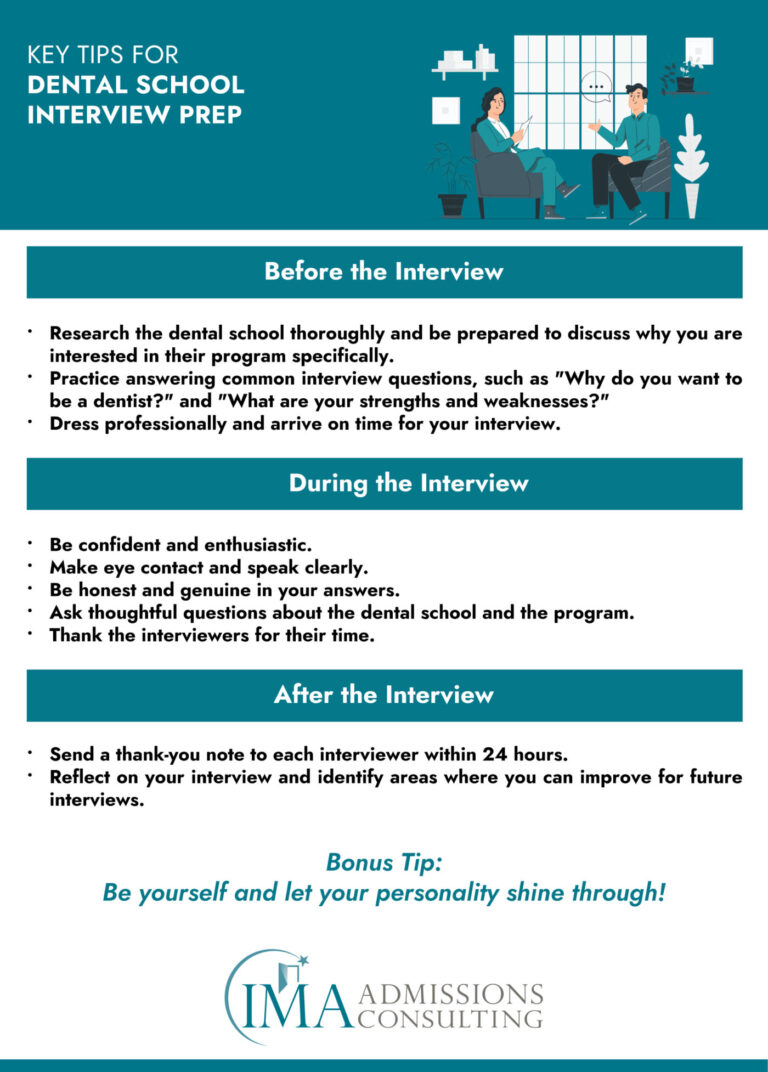
Here is a succinct graphic rich with key pointers for your dental school interview prep, a quick-reference tool to keep your strategy sharp and focused.
2026 Dental School Admissions at a Glance
The following reference points reflect the most current data available as of mid-2026. Use these benchmarks to ground your interview preparation in reality.
Accredited dental schools in the U.S.: 78 (ADA, 2025-26)
Total predoctoral enrollment: 28,925 students (ADA, 2025-26)
Average acceptance rate: Approximately 16% (ADEA, 2025-26)
Average GPA of admitted students: 3.5 or higher cumulative
DAT scoring scale: 200-600 (effective March 1, 2025); national average approximately 400
DAT registration fee: $560
AADSAS application fee: $264 first school, $115 each additional
Average first-year tuition (public, resident): $46,845 (ADA, 2025-26)
Average first-year tuition (private): $90,090 (ADA, 2025-26)
Average total four-year cost: Approximately $258,187 (ADA, 2025-26)
Median dentist salary: $179,210 (BLS, May 2024 data)
Projected job growth for dentists: 4% from 2024 to 2034 (BLS)
Percentage of dental students who are female: 58.1% (ADA, 2025-26)
Federal Grad PLUS loans: No longer available to new borrowers starting July 1, 2026
New annual federal loan limit for professional students: $50,000
INBDE licensure exam fee: $890
Frequently Asked Questions
What interview format should I expect for dental school in 2026?
Most dental schools still use the traditional one-on-one format, but many have adopted Multiple Mini Interviews (MMI), panel interviews, or asynchronous video interviews. Check each school’s admissions page to confirm their format so you can practice accordingly. Some schools use more than one format during the same interview day.
How has the DAT scoring scale changed, and what score do I need?
As of March 1, 2025, the DAT uses a 200-600 scale instead of the previous 1-30 scale. The national average is approximately 400. Competitive applicants typically score 420 or above on the Academic Average, and top-tier programs often admit students with scores of 460 or higher. All historical scores are now reported on the new scale through AADSAS.
What should I know about financing dental school in 2026?
Federal Grad PLUS loans are no longer available to new dental school borrowers starting July 1, 2026. The new annual borrowing limit for professional students is $50,000, with an aggregate cap of $200,000 for professional programs. Average four-year costs are approximately $258,187. Use the IMA Student Loan Repayment Calculator to model different repayment scenarios based on your expected debt load.
How competitive is dental school admission right now?
The average acceptance rate is about 16%, and the 2025 entering class is the largest cohort since 2000. Applicant growth is beginning to outpace available seats. Successful applicants typically hold a cumulative GPA of 3.5 or higher. At the most selective schools, acceptance rates range from roughly 3.5% to 8%.
Should I mention AI or technology trends during my dental school interview?
Yes. AI-assisted diagnostics, teledentistry, and 3D printing are active areas of development in dental care. The FDA has cleared AI tools for radiograph analysis, and ADEA’s strategic goals emphasize innovation in dental education. You do not need to be a technical expert, but showing awareness of these developments and their ethical implications demonstrates that you are engaged with where the profession is heading.