
Public discussion about telehealth has never dropped off in recent years. With a sudden surge in 2020 linked to the pandemic followed by a slight decrease, it is still a hot topic due to technology implementation, application potential, growing popularity, and an urgent need by doctors and patients.
Luckily, businesses can take advantage of software development services for medicine to get scalable, secure apps and platforms built with the latest technology and best practices. Let’s explore how telehealth innovations are shaping modern healthcare and change the way patients obtain medical advice, get prescriptions, and receive care without actual visit to the clinic.
Factors that drive telemedicine growth
Back in 2020, telehealth growth was fuelled by COVID-19, and never lost its importance ever since. Notably, in the early days of the pandemic, the use of telemedicine in the United States expanded 23 times. Today, the global telehealth market reached $123.26 billion, and is projected to grow by 24.68% from 2025 to 2030.
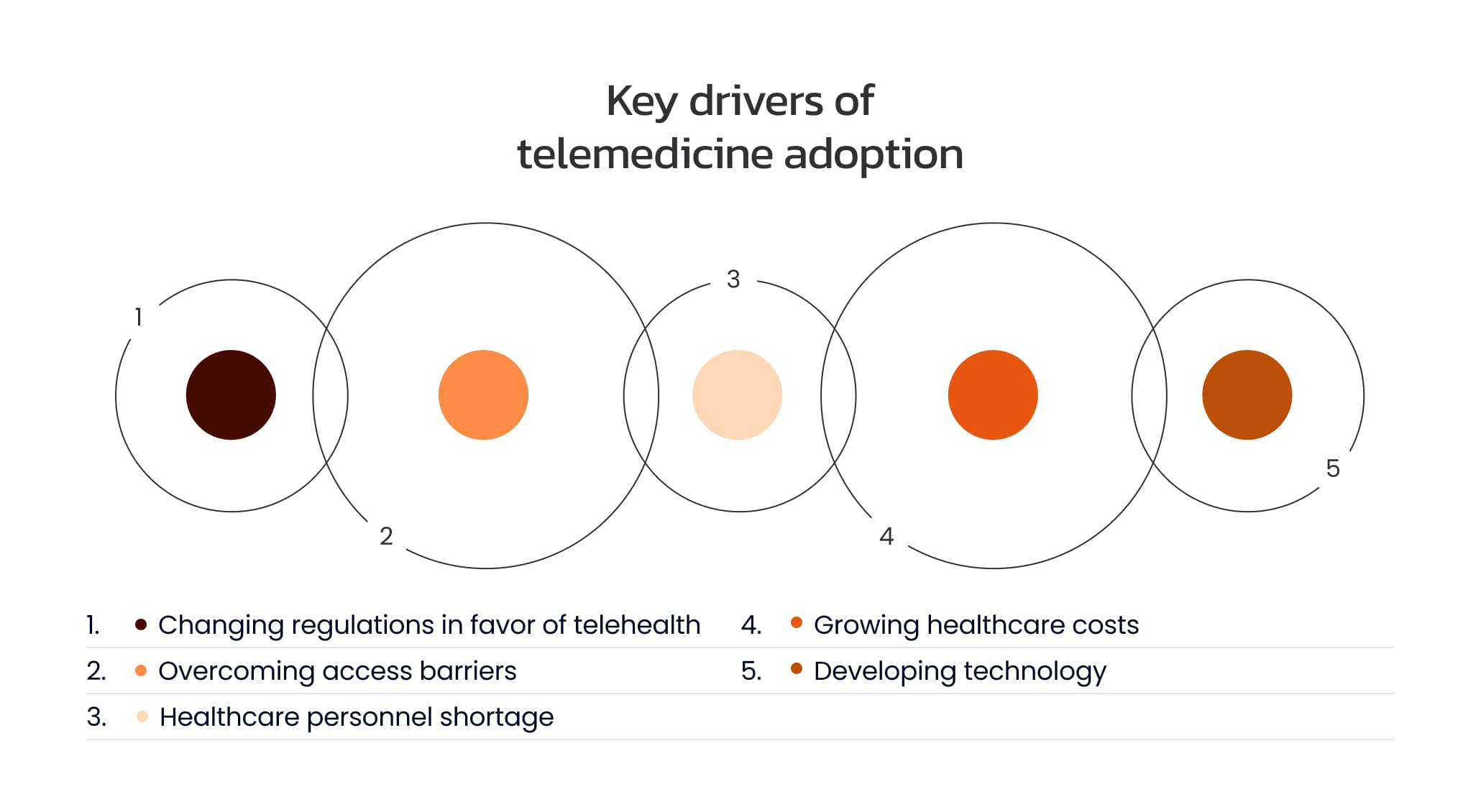
Overall, the future of telemedicine is shaped by:
- Changing regulations in favor of telehealth: 2020 showed the importance of remote patient consulting and monitoring in the face of extreme circumstances. The regulatory bodies acknowledged telehealth value, improving patients’ access opportunities.
- Overcoming access barriers: telemedicine software and devices allows patients from remote areas access healthcare without hours of driving, meaning better care for underserved populations.
- Healthcare personnel shortage: flexible scheduling helps to prevent medical staff burnout, redistribute workloads, as there is no need for physical presence, and reduce unnecessary personal visits on issues like chronic condition checks.
- Growing healthcare costs: telehealth reduces healthcare costs, saves on-site resources, decreases healthcare facilities load, and improves scheduling efficiency meaning less no-shows and cancellations.
- Developing technology: systems and platforms for remote consultations are being enriched with technology like cloud computing and integrations with wearable devices. AI in telehealth helps to create personalized care plans and generate health insights.
Overall, the industry moves forward in terms of technology, demand, and the need to overcome telemedicine challenges.
Trends in telemedicine
Telemedicine has become a part of daily lives relatively recently and has won the hearts of doctors and patients: 57% of healthcare leaders reported to change their opinion to be more favorable towards virtual visits than it was before 2020.
Nowadays, we observe emerging tendencies, as well as continuation of the earlier ones. Future of telemedicine may include positive policy shifts aimed at service expansion, easier reimbursement, and better care. Here are more trends to expect.

International collaboration perspectives
As a part of healthcare, telemedicine remains complex in terms of regulatory compliance, data security, and collaboration between patients, clinics, and insurance companies. Nevertheless, today, countries explore possibilities of telemedicine integration both internally and internationally.
Collaborative efforts in forms of programs and initiatives of organizations like World Health Organization, American Telemedicine Association, and Doctors Without Borders show the great potential for collaboration, yet meet many challenges along the way.
Implementation of AI in telemedicine
Artificial intelligence in telehealth has become a useful tool for clinical decision support, symptoms assessment, and patient assistance in the form of chatbots and virtual agents. AI in telemedicine revolutionizes healthcare, bringing its reduced costs, better workflows, and automated documentation to its early adopters, while patients get more personalized services, accurate diagnoses, and 24/7 support.
Care models flexibility
Modern telehealth combines online consultation and offline visits, meaning more flexible care for patients and better resource allocation for clinics and hospitals. They can enhance patient monitoring, diagnosis, and treatment, bringing the best of both approaches while cross-covering their drawbacks.
Improved mental health services
Now, when mental health issues have been accepted as equally important as physical health, and stigma at least partially removed, it gave a new breath to remote mental health consulting. In 2023, mental health-related visits accounted for the majority of telehealth visits, with 58% of patients utilizing specialized platforms. The demand is clear, and the telehealth platforms keep up with it, improving service quality, coverage, and confidentiality.
Increased interoperability
Among trends in telemedicine there is a distinct course towards more integrated healthcare systems. It is quite understandable: scattered data hinders business growth, slows down care delivery, and increases silos medical data inside departments. In contrast, telehealth platforms connected with patient portals, clinics’ EHR, medical devices, and lab software give a multifaceted picture of one’s health condition and improves care results.
Telehealth adoption in hospitals
Hospitals do not remain on the sidelines when it comes to telehealth adoption. Сardiology and dermatology consultations, chronic disease management and post-surgical care, when available online, result in better care continuity, less hospital readmissions, and fewer in-person visits. Such expansions facilitate workflow, decrease paperwork, and save costs, therefore lowering hospital’s workload and improving care.
Strengthened cybersecurity
Growing digitalization brings not only benefits, but also threats. With cyber crime levels and related losses setting new records every year, healthcare organizations must strengthen cybersecurity to keep patient data safe. This telehealth trend is backed by the fact that the healthcare industry suffers the most from cybercrime — 67% of healthcare organizations experienced ransomware attacks in 2024, with the largest data breach being 100 million data records.
Patient-centric care
Today, personalization drives value across industries, and it’s also true for healthcare. Patient-centric care respects individual preferences, provides tailored care, promotes active patient participation and education about their health conditions, and provides clear information in a psychologically safe environment. This trend for a fast, reliable, and personalized access to healthcare for all patients categories is projected to last.
Remote patient monitoring
The future of telemedicine includes more active patient inclusion in their health monitoring. WIth the rapid wearables development, IoT advancements, and mHealth expansion, people can collect their health data with the help of smart watches, fitness trackers, specialized sensors and other devices and share it with their healthcare providers. This leads to early problem detection, lower hospitalizations, and better chronic disease management.
Telemedicine challenges
Despite many advancements that have moved telehealth forward in recent years, there are also challenges concerning its implementation and use.
- Legacy systems: old technologies and infrastructure restrain seamless data collection, sharing, and integration. Outdated healthcare software is vulnerable to cyberthreats, is inflexible, costly, and is hard to scale, making it difficult to expand your business.
- Difficulties in navigating technology: many users may lack technical skill to use telehealth platforms. Additionally, rural and underserved areas might suffer from bad internet connection, making video consultations unavailable.
- International barriers: healthcare domain can vary greatly from country to country, making international telehealth collaboration hard. Businesses that strive to enter foreign markets face tangible challenges in terms of regulations and system peculiarities.
- Cyberthreats: cybersecurity remains number one issue for healthcare providers, as breaches of patients’ data result in identity thefts, fees, financial losses, legal actions, and reputation loss.
Conclusion
The future of telemedicine looks promising, yet clouded by regulatory complexities and legacy systems, hampering healthcare organizations to provide secure, patient-centered services. Telehealth makes healthcare accessible, easy, fast, and precise. Scalable, flexible solutions open new growth opportunities for private practices, clinics, and hospitals all the same.