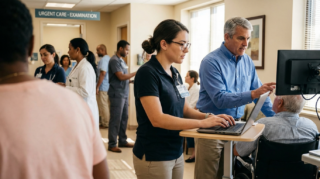
A medical scribe is a trained professional who documents clinical encounters in real time, working alongside a physician or other provider during patient visits. If you are a pre-med or pre-PA student trying to figure out what is a scribe and whether the role is worth your time, the short answer is that scribing is one of the most efficient ways to gain meaningful clinical exposure while earning a paycheck. It builds fluency in medical terminology, gives you a front-row seat to clinical reasoning, and produces the kind of sustained physician contact that leads to strong letters of recommendation. It is not glamorous, it is not easy, and it is not “just typing.” But for students who want to understand how medicine actually works on a daily basis, few roles offer a better combination of access, education, and practical skill-building.
Scribing has grown rapidly over the past decade for a clear reason: physicians spend a significant portion of their workday on administrative tasks, including Electronic Health Record (EHR) documentation. According to research published through the American Medical Association’s physician well-being resources, many physicians spend nearly twice as much time on paperwork and EHR management as they do on direct patient care. Scribes exist to change that ratio. By handling real-time documentation, scribes allow physicians to focus on the patient in front of them. That arrangement creates a unique learning environment for students: you are standing in the exam room, listening to the clinical conversation, watching the physical exam, and translating all of it into a structured medical record. The educational value is built into the job itself.
What a Medical Scribe Actually Does During a Shift
The core responsibility of a medical scribe is to document the patient encounter as it happens. That means you follow the physician into the exam room and record the history of present illness (HPI), review of systems, physical examination findings, assessment, and plan of care. You are not a passive observer sitting in a corner. You are actively listening, processing medical terminology, and constructing a coherent clinical narrative in the EHR while the physician interacts with the patient.
This requires more than fast typing. You need to understand anatomy, physiology, and common disease presentations well enough to anticipate what the physician will say next and to recognize when something in the documentation does not match what you heard. You learn the difference between a chief complaint and a differential diagnosis not from a textbook, but from watching a physician work through it dozens of times a day. Over weeks and months, your medical vocabulary expands, your understanding of clinical workflows sharpens, and your ability to process complex information under time pressure improves substantially.
It is worth being very clear about what a scribe does not do. Scribes are non-clinical staff. You do not touch patients, provide medical advice, administer medications, assist with procedures, or perform any physical task related to patient care. You do not help a patient out of a wheelchair or take vital signs. Your role is documentation and observation. Crossing those boundaries is not a gray area; it is a violation of your role, and reputable scribe companies and clinical sites enforce this strictly. Scribes also have full access to sensitive patient health information, which means strict compliance with HIPAA regulations is not optional. Breaches of patient confidentiality can end a scribing career and create serious problems for future professional applications.
Medical Scribe Salary: What the Pay Actually Looks Like
One of the practical advantages of scribing over unpaid shadowing or volunteering is that you earn money while gaining clinical exposure. The average annual salary for a medical scribe in the United States is approximately $41,129, which works out to roughly $20 per hour. That figure varies by location, employer, and experience level.
Regional differences are real. Scribes working in the District of Columbia earn closer to $45,538 on average, while California ($45,365) and Massachusetts ($44,761) also sit at the higher end of the pay range. In lower cost-of-living areas, the hourly rate may be closer to $15 or $16. Hospital-based positions sometimes pay more than outpatient clinic roles, and some scribe companies offer small raises after initial training is complete or after you earn a professional credential.
For most pre-med and pre-PA students, the salary is not the primary draw. The real financial appeal is that scribing replaces what would otherwise be unpaid hours spent shadowing or volunteering in a clinical setting. You are building your application while covering rent, groceries, or tuition costs. That practical reality matters, especially for students who cannot afford to work for free during their gap years or while completing undergraduate coursework. The Bureau of Labor Statistics Occupational Outlook Handbook provides broader context on healthcare support roles and wage trends if you want to compare scribing pay against other entry-level clinical positions.
Training, Certification, and What You Need to Get Hired
A common misconception among pre-health students is that you need a college degree or specific certification before you can start scribing. In reality, most scribe positions require only a high school diploma and a minimum typing speed of around 60 words per minute. Some companies prefer candidates who have completed introductory coursework in anatomy, physiology, or medical terminology, but this is not always mandatory.
How Scribe Training Programs Work
Most large scribe companies (ScribeAmerica, PhysAssist, Proscribe, and others) run their own training programs, which typically last two to three weeks. Training covers EHR navigation, medical terminology, documentation standards, HIPAA compliance, and the specific workflows of the clinical specialty you will be assigned to. After classroom or online training, there is usually a period of floor training where you shadow an experienced scribe before working independently with a physician.
The learning curve is steep. Expect the first few weeks on the floor to feel overwhelming. You will encounter abbreviations, medication names, and clinical concepts you have never seen before, and you will be expected to document them accurately under time pressure. This difficulty is part of the value. The rapid learning that happens during the first few months of scribing is one of the reasons medical schools and PA programs view the experience so favorably.
Optional Credentials: AMSP and CMSP
While certification is not federally required, you can pursue the Apprentice Medical Scribe Professional (AMSP) credential by passing a 100-question exam. After accumulating 200 hours of scribe work, you become eligible to apply for the Certified Medical Scribe Professional (CMSP) designation. These credentials are not necessary for most scribe positions, but they can strengthen your resume and signal commitment to the role if you plan to scribe for an extended period. They also demonstrate to admissions committees that you took the work seriously enough to formalize your training.
Typical Time Commitment
Most scribe organizations require a minimum commitment of six months and the ability to work at least two shifts per week, totaling around 16 hours. Some companies require a one-year commitment. Before you sign on, make sure you understand the scheduling expectations and whether they are compatible with your academic schedule. A six-month commitment at 16 hours per week translates to roughly 400 hours of clinical exposure, which is a substantial amount for any health professions application.
How Scribing Strengthens Medical School and PA School Applications
Scribing provides two categories of application value: the clinical experience itself and the relationships you build with supervising physicians.
Clinical Hours That Actually Count
For medical school applicants, scribing qualifies as clinical experience because it involves sustained, direct exposure to patient care and clinical decision-making. You are in the room during the encounter. You hear the patient’s story, observe the physical exam, and watch the physician synthesize information into a diagnosis and treatment plan. The AAMC’s guidelines for pre-med preparation emphasize the importance of meaningful clinical exposure, and scribing fits that standard well.
For PA school applicants, scribing is widely accepted as Patient Care Experience (PCE) or Healthcare Experience (HCE), depending on the program. CASPA allows applicants to categorize their scribing hours, and many PA programs value scribing highly because it demonstrates familiarity with the clinical environment and comfort with medical documentation. If you are building your PA application, scribing pairs well with other forms of direct patient care experience. Students interested in understanding what PA programs look for can review details on getting hired as a physician assistant, which covers the broader landscape of PA career entry.
Letters of Recommendation
This is one of the most underappreciated benefits of scribing. Because you work one-on-one with a physician for hundreds of hours, you develop a professional relationship that most shadowing or volunteer experiences cannot replicate. A physician who has watched you document 500 patient encounters can write a letter that speaks specifically to your clinical aptitude, professionalism, work ethic, and intellectual curiosity. That level of detail carries real weight in admissions review. Generic letters that say “this student observed in my clinic” are far less compelling than letters that describe how you handled complex documentation, asked thoughtful questions, or demonstrated growth over time.
What to Say on Your Application
When you write about scribing in your personal statement or activity descriptions, focus on what you learned about clinical reasoning, patient communication, and the realities of medical practice. Avoid vague language about “being inspired.” Instead, describe specific moments: a diagnostic puzzle that changed how you think about differential diagnosis, a patient interaction that taught you something about empathy under time pressure, or a workflow challenge that gave you insight into healthcare systems. Admissions committees read thousands of scribe descriptions. The ones that stand out are specific, reflective, and honest about both the value and the limitations of the role. For guidance on other parts of your application, including secondary essay prompts for medical school, being specific and authentic applies across every section.
EHR Skills: A Practical Advantage That Extends Beyond Applications
Electronic Health Records are the backbone of modern clinical practice, and scribing gives you hands-on proficiency with EHR systems that most students do not develop until residency or clinical rotations. Whether you work in Epic, Cerner, Athena, or another platform, you will learn how to enter orders, locate lab results, review imaging reports, and structure clinical notes in a way that meets documentation standards.
This skill set is more practical than it might seem from the outside. Medical students routinely report that EHR documentation is one of the steepest learning curves during their clinical clerkships. Students who enter medical school with scribing experience have a meaningful head start. They already understand how notes are structured, how to locate information quickly, and how documentation connects to billing, coding, and quality metrics. These are not glamorous skills, but they are the daily mechanics of clinical medicine, and knowing them well makes you a more effective student and eventually a more effective physician.
Beyond medical school, EHR fluency signals to residency programs that you can handle the documentation demands of residency from day one. It is a practical competency that complements your academic credentials, and it is one of the few skills you can build in a paid, pre-matriculation role.
Scribing Compared to Shadowing, Volunteering, and Other Clinical Roles
Students often ask how scribing compares to other forms of clinical exposure. The answer depends on what you need for your specific application and where you are in your pre-health timeline.
Shadowing is passive observation. You watch a physician work, but you have no defined role in the encounter. It is useful for confirming your interest in a specialty and for understanding the physician’s day, but it does not build clinical skills or produce strong letters of recommendation on its own. Most applicants need some shadowing, but it is rarely sufficient as your only clinical experience.
Clinical volunteering, such as working in a hospital or free clinic, offers exposure to the healthcare environment and demonstrates service. But the depth of clinical learning varies widely depending on the setting and your specific role. Some volunteer positions involve meaningful patient interaction; others are primarily logistical.
Scribing occupies a unique middle ground. It is more structured and educationally rich than shadowing, it is paid, and it produces a defined skill set (EHR documentation, medical terminology, clinical workflow knowledge) that other roles typically do not. The trade-off is that scribing requires a significant time commitment and does not involve direct patient care. If you are a PA school applicant, you may still need additional PCE hours from a hands-on role such as EMT, CNA, or medical assistant work.
For students who want to build clinical exposure across different settings, including international ones, structured global health programs can complement domestic scribing experience. Observing how clinical documentation and patient flow work in resource-limited settings offers a different kind of perspective. IMA’s programs, for example, allow students to observe clinical workflows in high-volume tropical medicine clinics in East Africa, where documentation systems and patient management look very different from a U.S. emergency department. Students who are planning both domestic and international experiences during their pre-health years can find useful context in how early application decisions affect medical school admissions, which addresses broader timeline and strategy questions.
How to Find a Scribe Position and Set Yourself Up Well
Landing a scribe job is straightforward if you approach it with preparation. Start by identifying the major scribe companies that operate in your area. ScribeAmerica is the largest national employer, but regional companies and individual physician practices also hire scribes directly. Hospital systems sometimes run their own in-house scribe programs with slightly different hiring processes.
When you apply, highlight any relevant coursework (anatomy, physiology, medical terminology), your typing speed, and your ability to commit to the required schedule. If you have prior clinical exposure, even informal shadowing, mention it. During interviews, demonstrate that you understand the role is documentation-focused and that you are prepared for the learning curve.
Once you are hired, invest seriously in the training period. Take notes, review medical terminology on your own time, and ask your training scribe or supervising physician questions when appropriate. The scribes who get the most out of the experience are the ones who treat it as a professional role, not just a line on their resume. Show up on time, document accurately, respect patient confidentiality, and build a genuine working relationship with your supervising physician. That relationship is what ultimately produces the strong letter of recommendation, the clinical knowledge, and the professional maturity that admissions committees want to see.
If you plan to scribe for a year or more, consider pursuing the AMSP or CMSP credential. It adds structure to your professional development and gives you something concrete to reference on your application. And if you are working in a specialty that interests you, pay attention to the patterns you see in patient presentations, treatment decisions, and clinical reasoning. Those observations will be valuable material for your personal statement and interview responses.
Realistic Expectations: What Scribing Will and Will Not Do for You
Scribing will give you clinical vocabulary, EHR skills, sustained physician exposure, and a credible source for a letter of recommendation. It will strengthen your understanding of how medicine works on the ground, day after day, in ways that classroom learning cannot replicate. It is a genuinely useful role for pre-med and pre-PA students, and admissions committees across the country recognize it as such.
Scribing will not, on its own, make you a competitive applicant. You still need strong academics, a compelling personal statement, research or scholarly activity, community involvement, and evidence of leadership or sustained commitment to something you care about. Scribing is one piece of a larger profile, and it works best when combined with other experiences that show different dimensions of who you are and why you are pursuing medicine or healthcare.
Be honest with yourself about fit, too. If you struggle with fast-paced environments, sustained attention to detail, or long shifts on your feet, scribing may be challenging in ways that are not productive. That is fine. There are other paths to clinical exposure. The goal is not to check a box; it is to build real understanding of clinical medicine and to demonstrate that understanding convincingly when you apply.
Frequently Asked Questions
Do I need a college degree to become a medical scribe?
No. Most scribe positions require only a high school diploma and a typing speed of approximately 60 words per minute. Some employers prefer candidates with coursework in anatomy, physiology, or medical terminology, but a college degree is not a standard requirement. Many undergraduate students scribe part-time while completing their bachelor’s degree.
Does scribing count as clinical experience for medical school and PA school?
Scribing is widely accepted as clinical experience for medical school applications because it involves direct exposure to patient encounters and clinical decision-making. For PA school, scribing is typically categorized as Patient Care Experience (PCE) or Healthcare Experience (HCE) on the CASPA application, though classification varies by program. Check the specific requirements of the programs you plan to apply to, as some PA schools may want additional hands-on patient care hours from a different role.
How long do most pre-med students work as scribes?
Most scribe companies require a minimum commitment of six months, with at least two shifts (roughly 16 hours) per week. Many pre-med and pre-PA students scribe for one to two years, especially during gap years. A six-month commitment at the minimum hours produces approximately 400 hours of clinical exposure, which is a strong foundation for most applications.