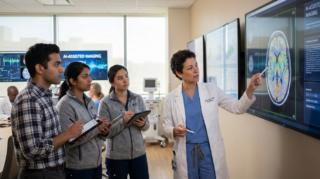
Artificial intelligence in healthcare is not a topic you can afford to think about later. If you are a pre-med student in 2026, AI is already embedded in the clinical settings you will eventually rotate through, the admissions conversations happening at the schools you are applying to, and the professional expectations waiting for you on the other side of residency. Over 1,200 AI-enabled tools have now received FDA clearance, spanning radiology, pathology, cardiology, primary care triage, and surgical planning. This is not speculative technology. It is the operating environment you are training to enter.
What makes this moment different from even two or three years ago is scale. AI in medicine has moved past isolated pilot programs and into the routine workflow of hospitals and clinics. Ambient documentation tools transcribe patient encounters in real time. Diagnostic algorithms flag abnormalities on imaging before a radiologist opens the file. Predictive models estimate which post-surgical patients are most likely to deteriorate overnight. For pre-med students, the question is no longer whether AI will matter in your career. The question is whether you understand it well enough to use it wisely, talk about it credibly in applications, and build the clinical judgment that no algorithm can replace.
How AI Is Already Changing What Happens in Clinical Settings
The biggest immediate change for medical students is time. Studies have consistently shown that physicians spend nearly twice as much time on documentation and administrative tasks as they do on direct patient care. AI-powered ambient scribes and automated note-generation tools are starting to compress that ratio. For students entering clinical rotations in the next few years, this means less time watching an attending type into an EHR and more time observing how clinical decisions actually get made.
That shift matters more than it might sound. When a student’s rotation experience centers on watching documentation, they absorb less about differential diagnosis, communication, and the subtle cues that separate a good clinician from a great one. As AI handles more of the clerical burden, the educational value of rotations could increase substantially, but only for students who come prepared to engage with what they are seeing.
AI is also present in the operating room. Surgical AI systems now capture surgeon motion data and cognitive load indicators, offering real-time guidance and complication prediction during procedures. In 2025, researchers successfully performed the first realistic autonomous machine surgery, a gallbladder removal, without direct human control of the instruments. That milestone does not mean surgeons are being replaced. It means the expectations for how surgeons interact with technology are changing fast. Students interested in surgical specialties should expect to encounter AI-assisted tools during training, and they should be ready to think critically about when those tools help and when they might introduce new risks.
Outside of U.S. academic medical centers, AI adoption looks different but is just as instructive. In high-volume clinical settings in Kenya and Tanzania, for example, AI-assisted triage and ambient documentation tools are being introduced to reduce provider burnout and improve patient throughput. Students who participate in structured international health programs can observe how these tools function in resource-constrained environments, which often exposes both the promise and the limitations of AI more clearly than a well-funded U.S. hospital would. The role of institutional readiness in shaping medical education experiences is worth considering as you think about where and how you want to gain clinical exposure.
What Admissions Committees Are Starting to Value
Medical school admissions committees are paying attention to AI literacy, though not in the way many applicants assume. You do not need to arrive at your interview with a computer science degree or a machine learning publication. What committees are increasingly interested in is whether applicants can think critically about technology’s role in patient care, whether they understand the ethical dimensions of algorithmic decision-making, and whether they can articulate how human judgment remains central to medicine even as tools become more powerful.
This shows up most directly in secondary essays and interviews. If a school asks about a challenge in healthcare or a trend you are watching, AI is a legitimate and timely topic. But the quality of your response depends entirely on specificity. Saying “AI will help doctors be more efficient” is generic and unmemorable. Saying “I observed how an AI triage tool in a rural clinic changed which patients were seen first, and it made me think about who decides what counts as urgent” is concrete, reflective, and shows genuine engagement.
The AAMC’s competencies for entering medical students include critical thinking, ethical responsibility, and the ability to work with complex information. AI literacy maps onto those competencies naturally. You do not need to frame it as a separate skill set. You need to show that you can think carefully about how new tools affect patients, providers, and systems.
Beyond essays, your experiences matter. If you have worked on a research project involving health data, participated in a clinical setting where AI tools were in use, or even taken a relevant course in biostatistics or health informatics, those details belong in your application. They signal that you are paying attention to where medicine is headed, not just where it has been.
AI and the “Will Doctors Be Replaced?” Question
This question comes up constantly, and the honest answer is more nuanced than the headlines suggest. A few years ago, prominent voices in tech predicted that fields like radiology and pathology would be automated out of existence. That has not happened. In 2026, AI augments the work of radiologists and pathologists. It flags findings, prioritizes worklists, and catches patterns that might be missed in a high-volume reading session. But the final interpretation, the clinical context, the conversation with the patient, the judgment call about what to do next, those remain with the physician.
The Bureau of Labor Statistics projects continued growth for physicians and surgeons over the coming decade, which is consistent with the broader pattern: demand for doctors is driven by aging populations, expanding access to care, and the complexity of chronic disease management. AI does not reduce that demand. It changes the texture of the work.
That said, the composition of physician skills is shifting. Career prospects for professionals who combine medical expertise with technical fluency in AI and data analysis are projected to grow significantly. If you are a pre-med student who also enjoys statistics, coding, or systems thinking, you are well positioned. If those subjects feel foreign to you, that is fine too, but some basic familiarity with how algorithms work, what training data means, and why model transparency matters will serve you well throughout your career.
The real risk is not replacement. It is what researchers call “automation bias,” the tendency to over-rely on a tool’s output without applying independent judgment. If a generation of physicians trains in an environment where AI pre-screens every lab result and pre-reads every image, will those physicians be able to function when the tool is unavailable or wrong? That is a training design question, and it is one that medical educators are actively grappling with. As a pre-med student, simply being aware of this tension puts you ahead of most applicants.
Writing About AI in Your Medical School Essays
AI presents a real opportunity in personal statements and secondary essays, but it also presents a trap. The opportunity is that AI is a substantive, current topic that lets you demonstrate critical thinking, ethical awareness, and intellectual engagement with the future of the profession. The trap is that vague, buzzword-heavy writing about AI sounds like every other applicant who skimmed a headline and tried to sound forward-thinking.
If you choose to write about AI, anchor your essay in a specific experience or observation. Maybe you watched a physician use a clinical decision support tool and noticed that it changed how the patient interaction felt. Maybe you worked on a research project where data quality issues made you skeptical about algorithmic accuracy. Maybe you read about algorithmic bias in dermatology, where diagnostic AI has performed poorly on darker skin tones, and that connected to your interest in health equity. Whatever the angle, it needs to be yours.
One important note on process: admissions committees are well aware that applicants can use AI to write their essays. Using ChatGPT or a similar tool to draft your personal statement is a bad idea, not just because it is ethically questionable, but because the output tends to be generic, over-polished, and missing the specific details that make an essay memorable. That said, using AI-based feedback tools to check your structure, flag vague language, or identify areas where you could be more specific is a reasonable and increasingly common practice. The distinction is between AI as your ghostwriter and AI as your editor. Committees can usually tell the difference.
When discussing AI in your writing, focus on the “human-in-the-loop” concept. This is the principle that AI should enhance what a physician can do for a patient, not replace the physician’s presence, empathy, or judgment. Framing your interest in AI around how it can create more time for patient relationships, reduce diagnostic errors, or extend care to underserved populations is far more compelling than framing it around efficiency or cost savings alone. The AMCAS application process gives you multiple places to showcase this kind of thinking, from your personal statement to your most meaningful experiences.
Ethical and Legal Realities You Should Understand Now
One of the most important things a pre-med student can understand about AI in medicine is the accountability structure. In 2026, when an AI tool contributes to a clinical error, the legal responsibility falls on the clinician, not the software vendor. The physician who relied on the AI output is the one who faces malpractice liability. This is not a hypothetical edge case. It is the current legal framework, and it shapes how every responsible physician interacts with AI tools.
For students, this means that learning to critically evaluate AI-generated recommendations is not optional. It is a core professional skill. You need to understand concepts like sensitivity and specificity as they apply to diagnostic algorithms. You need to know what it means when a model is described as a “black box” and why that lack of transparency can be dangerous. You need to be able to ask: What data was this tool trained on? Does it perform equally well across different patient populations? What happens when the tool is wrong?
Bias in AI is not a theoretical concern. Multiple studies have documented that diagnostic algorithms trained primarily on data from one demographic group perform less accurately on others. Dermatology AI that underperforms on darker skin, cardiac risk models that underestimate risk in women, pulse oximeters with race-based accuracy gaps; these are real examples with real clinical consequences. The WHO’s guidance on ethics and governance of AI for health provides a useful framework for thinking about these issues, and it is worth reading even at the pre-med stage.
Students who engage with these questions seriously will stand out, not just in admissions, but in the profession. Medicine has always required ethical reasoning. AI adds new layers to that requirement, but the underlying skill is the same: the ability to hold complexity, weigh competing values, and act in the patient’s interest even when the easy answer is to defer to whatever the screen says.
Building the Right Skill Set Before Medical School
You do not need to become a data scientist before you apply to medical school. But a few practical steps can make a meaningful difference in how prepared you feel and how compelling your application looks.
First, take a statistics or biostatistics course if you have not already. Understanding basic concepts like probability, confidence intervals, and study design is essential for interpreting the evidence behind any AI tool. Many medical schools are now integrating data science modules into their curricula, and students who arrive with some quantitative foundation will have an easier time.
Second, seek out clinical exposure that includes technology. Not every shadowing experience will involve AI tools, but if you can observe in a setting where electronic health records, clinical decision support, or telemedicine platforms are in active use, pay attention to how clinicians interact with those systems. Notice what they trust, what they double-check, and what frustrates them. Those observations are valuable material for your application and your own professional development.
Third, read critically. Follow what the major medical journals are publishing about AI. The New England Journal of Medicine, JAMA, and The Lancet all run regular pieces on clinical AI. You do not need to understand every technical detail. Focus on the clinical implications, the ethical debates, and the outcomes data. This habit will keep you current and give you real substance to draw on in essays and interviews.
Fourth, consider how international or cross-cultural clinical exposure might broaden your perspective. When AI tools designed for one healthcare system are deployed in another, the gaps in training data and workflow assumptions become visible quickly. Students who have seen healthcare delivery in different contexts are often better at recognizing these gaps. The reasons medical volunteering and observation in Kenya can be valuable go beyond clinical hours; they include exposure to different systems, resources, and patient populations that deepen your understanding of what technology can and cannot solve.
Finally, stay grounded. AI is important, but it is one piece of a much larger picture. The fundamentals of becoming a good doctor have not changed: scientific knowledge, communication skills, empathy, resilience, ethical integrity, and the willingness to keep learning. AI literacy adds to that foundation. It does not replace it.
What This Means for Your Next Steps
If you are a pre-med student reading this in 2026, the most practical thing you can do is stay curious and stay honest. Curious about how AI actually works in clinical settings, not just how it is described in press releases. Honest about what you know and do not know, both with yourself and in your applications.
You are entering a profession that has always adapted to new tools, from the stethoscope to the MRI to the electronic health record. AI is the next chapter in that story, and it is a significant one. But the physicians who will use it best are not the ones who know the most about machine learning. They are the ones who understand patients, who think critically about evidence, who take ethical responsibility seriously, and who never stop questioning whether the tool in front of them is actually helping.
That is the kind of physician admissions committees are looking for. It is also the kind of physician patients deserve. If you are building toward that, you are already headed in the right direction.
Frequently Asked Questions
Do I need to know how to code to get into medical school?
No. Coding skills are not a requirement for medical school admission at any U.S. allopathic or osteopathic program. However, basic familiarity with data analysis, statistics, and how algorithms function will become increasingly useful during medical training and clinical practice. If you have the opportunity to take an introductory course in programming or biostatistics, it can strengthen your application and your readiness, but it is not a prerequisite.
Should I mention AI in my medical school personal statement?
You can, but only if you have something specific and genuine to say. A personal statement that references AI should be grounded in a real experience, observation, or question you have engaged with. Vague statements about AI improving healthcare will not distinguish you. If AI connects to a meaningful moment in your clinical exposure, research, or intellectual development, it can be an effective topic. If it does not, there is no pressure to include it.
Is AI going to reduce the number of physician jobs available?
Current projections do not support that concern. The Bureau of Labor Statistics continues to project growth in physician employment, driven by population aging, chronic disease prevalence, and access expansion. AI is changing the nature of physician work by automating certain administrative and diagnostic tasks, but it is increasing the need for clinicians who can interpret AI outputs, manage complex patients, and make nuanced decisions that algorithms cannot.