The ERAS Residency Application: A Definitive Guide for 2026
By now, you have come so far since your first day of medical school and are likely getting ready to pick a career path. Your knowledge, hardships and experiences have shaped you into the physician you are about to become. We understand that applying for residency using the Electronic Residency Application Service (ERAS) can be a stressful process, so we are here to help guide you through it.
The 2026 ERAS cycle brought significant changes, including updated application dates, new platform features, and the continued shift of certain specialties away from ERAS entirely. Before walking through the full process, let’s outline the ERAS timeline and what you should expect your third and fourth years of medical school to look like. Below you can find a timeline created using information, resources and dates provided by AAMC.
2026 ERAS Timeline
Third Year of Medical School
September through May
- Begin developing your CV (Curriculum Vitae). Your CV should be more detailed than a standard resume. A CV will list your work, experiences and other notable highlights of your medical career. Make sure to add things like published papers to your CV as well. Keeping a well-detailed and up-to-date CV is essential and can make getting letters of recommendation from doctors easier.
- Around this time, it is a good idea to look into the match outcomes for specialties. You should compare the qualifications and match rates for the specialties you are interested in. This will give you a good idea of what specialties expect and require. You’ll improve your success rate by knowing what exam scores and how many letters you will need for your chosen specialty. Checking out the most competitive and least competitive specialties can help you see how you measure up.
- This is a good time to research residency and career planning by utilizing the AMA’s compilation of physician workforce data and residency programs. If you want to understand how residency fits into the broader training structure, our guide to residency and fellowship covers the fundamentals.
June through August
- The 2026 ERAS season opens on June 4 at 9:00 a.m. ET. While you cannot yet submit your application, MyERAS becomes available for you to begin entering your information and uploading documents.
- ERAS tokens become available starting June 25. Get your token from the Registrar’s Office or Career Center. After receiving your token, click “Register” on MyERAS and begin completing the ERAS application. Keep in mind you can only register once, so fill out the application carefully.
- Register with the NRMP for the Main Residency Match. NRMP Match registration opens on September 15 at 12:00 p.m. ET, with a standard registration fee of $70 if you register before January 30, 2026. After that date, an additional $50 late fee applies.
- Be aware that some specialties do not use ERAS. Ophthalmology uses the SF Match system. Emergency medicine and obstetrics and gynecology now use ResidencyCAS instead of ERAS, a major change that took effect in recent cycles. Urology also operates its own match process. If you are applying to any of these specialties, confirm the correct application platform well in advance.
- If you haven’t already compiled your list of faculty members whom you’d like to have write a letter of recommendation for you, do so now.
Fourth Year of Medical School
September through October
- September 3 at 9:00 a.m. ET is the first date you can certify and submit your ERAS application for the 2026 cycle. Once you certify your application, you can no longer edit it. Programs will not have access to review applications until September 24 at 9:00 a.m. ET. All applications submitted between September 3 and September 24 will appear to programs as submitted on September 24.
- Begin interview prep. The AAMC has partnered with Thalamus to provide a centralized interview scheduling and management platform, which is free to applicants. This tool can simplify the logistics of coordinating multiple interviews across different programs.
- If you have not already taken the USMLE Step 2 CK, now is the time to start prepping for it. The exam is administered at Prometric testing centers throughout the United States, but you should schedule your exam as soon as possible to secure your preferred date and location.
October through December
- Residency interviews begin. If you need help prepping for your residency interview, review and practice common residency interview questions. Reviewing CaRMS questions can be helpful, too, even if you are applying within the United States.
- Medical Student Performance Evaluations (MSPE) will be released in early October.
- Print off the Residency Preference Exercise to help compare and contrast programs you’re interested in.
- For those who applied through separate early match processes (such as ophthalmology via SF Match), January is usually when deadlines are set.
January through February
- Interviews are wrapping up. NRMP ranking opens on February 2 at 12:00 p.m. ET. Log in and begin curating your rank order list. The Rank Order List certification deadline is March 4 at 9:00 p.m. ET.
March
- Match Week 2026 begins on Monday, March 16. The NRMP will email you on that day to let you know whether you have been matched. Match Day, when you find out where you matched, is Friday, March 20, 2026.
What Changed in the 2026 ERAS Cycle
The 2026 application season introduced several updates that applicants should understand before they begin the process. Some of these changes affect what’s on the application itself, while others affect which platform you use.
Emergency Medicine and OB-GYN No Longer Use ERAS
One of the most significant shifts in recent cycles is that both emergency medicine and obstetrics and gynecology residency programs have moved to ResidencyCAS, a separate centralized application platform. OB-GYN made this shift first, and emergency medicine followed for the 2025-2026 cycle. If you are applying to either of these specialties, you will not use ERAS or MyERAS. ResidencyCAS uses a tiered pricing model similar to ERAS but with fees roughly 20% lower overall. For example, 46 applications (the average number submitted in a recent cycle) would cost approximately $683 through ResidencyCAS, compared with about $810 under ERAS.
Program Signaling
ERAS now allows applicants to assign and send signals to programs at the time of application. The number of available signals varies by specialty. For the 2026 cycle, anesthesia and plastic surgery residency applicants can also submit “Why Us” essays alongside their signals, giving programs additional context about an applicant’s interest. This feature is similar in concept to supplemental essays used in medical school admissions. If you are applying to specialties that offer signaling, use your signals strategically on programs where you have genuine interest and a realistic chance of matching.
Specialty-Specific Application Questions
Applicants to anesthesiology, neurological surgery, and integrated plastic surgery now encounter new specialty-specific questions within the ERAS application. These responses are visible only to programs within that specialty, so they offer an opportunity to speak directly to what matters in that field.
New “Hometown(s)” Section
The 2026 ERAS application added a “Hometown(s)” field that allows applicants to select places they currently or previously lived and feel strong ties to. This is particularly useful for students attending medical school far from home who want programs in their home region to understand their geographic connection. For example, a student from Tennessee attending medical school in New York can now highlight that connection directly on the application.
Postgraduate Training Section Expanded
Previously, only training accredited by the ACGME, AOA, RCPSC, or UCNS could be listed in the postgraduate training section. The 2026 application now allows you to include any residency or fellowship training, even if it is not accredited by these organizations. If your training program is not accredited by one of those bodies, you are required to specify the accrediting organization.
Academic/Professionalism Section Renamed and Split
The section previously titled “Academic/Professionalism Interruptions” has been renamed to “Academic/Professionalism: Interruptions or Extensions” and split into two separate questions. One addresses academic interruptions or extensions, and the other addresses professionalism concerns. This gives applicants more clarity when reporting these items.
Looking Ahead to 2027
The AAMC has announced that beginning with the 2027 ERAS cycle, the “Publications” section will be renamed “Scholarly Works” to encourage applicants to emphasize the quality of their research rather than the quantity. Additionally, all letters of recommendation will go through a centralized AAMC Letter Writer Portal. These changes are worth knowing about now if you are early in your medical school career.
2026 Match Results at a Glance
Understanding recent match data can help you set realistic expectations. The 2026 Main Residency Match was the largest in NRMP history:
- Over 53,000 applicants registered, an increase of 875 from the previous year.
- More than 44,000 residency positions were offered across over 6,800 program tracks.
- 93.5% of all positions filled when the matching algorithm was processed.
- 48,050 applicants submitted a certified rank order list.
- 79.8% of certified applicants matched to PGY-1 positions.
- 93.5% of U.S. MD seniors matched, consistent with the rate from 2024 and 2025.
- 93.2% of U.S. DO seniors matched (7,928 out of 8,503 participants), a 0.6% increase from the prior year.
- 9,696 applicants went unmatched, an increase of 155 over 2025.
- 2,862 positions across 941 programs remained unfilled after the algorithm ran, an increase of 389 positions from 2025. Of these, 2,581 positions were offered through SOAP.
Primary care specialties represented the largest share of positions with 20,712 offered, but the collective fill rate dropped slightly to 92.1%. Family medicine’s fill rate fell to 83.6%, leaving 899 positions unfilled. Internal medicine offered 11,632 categorical and primary positions and achieved a 95.2% fill rate. Emergency medicine, which saw significant volatility in recent years, posted a 95.6% fill rate across 3,198 positions. Psychiatry filled 97.4% of its 2,516 positions. If you are still considering which specialty to pursue, these numbers provide useful context about competition and availability. For a broader view of how the MD and DO pathways feed into the match, that resource may help clarify the landscape.
Part 1: ERAS Match Essentials
What is the Main Match?
The Main Match is the method utilized by the NRMP to facilitate and organize the ERAS application process. Each year, thousands of applicants compete for residency spots across the country. In 2026, over 53,000 applicants registered for the match, competing for more than 44,000 positions. These applicants use the ERAS database (or ResidencyCAS, for emergency medicine and OB-GYN) to apply to programs of interest. The programs respond to applicants by inviting them to attend interviews during the fall and winter of their fourth year of medical school. After the interview season draws to an end, applicants create and submit a Rank Order List of programs they would accept a contract with. Programs also submit a Rank Order List of the applicants they’d like to accept. Then the Main Match plays matchmaker and sets up applicants and programs. On the Monday of Match Week, applicants are notified as to whether they have been matched or not. Applicants who have not been matched can attempt to secure residency program spots that remain unfilled before the official results are released.
How Do I Make an Informed Specialty Decision?
Medical school is your time to explore the various specialties and career paths that the world of medicine has to offer. Every specialty has pros and cons, so it is important to be honest with yourself about your likes and dislikes. Make notes about the specialty pros and cons as you encounter them during rotations, research, electives and clinicals. You should also consider where you want to live in the future and the type of practice you’d like to have. Certain areas have different needs when it comes to specialties. If you are still undecided, spend more time on rotations in the specialties you’ve narrowed down. Do not be afraid to consult with doctors and your advisor about this decision.
It also helps to think about your application narrative as a whole. The strongest applications tell a coherent story about why a particular specialty makes sense for you, drawing from your clinical rotations, research interests, and personal experiences. Our guide on why your story is your strongest application asset offers practical advice on how to build that kind of coherence across your materials.
Clerkship
Setting up a clerkship has its advantages and may give you a competitive edge. During the end of their third year, students are given the option to pursue a sub-internship and additional clerkship electives. Students should take advantage of this opportunity to work more closely with attendings, patients and residents. These internships provide an opportunity to stand out and show your interest and dedication to your chosen field. Elective clerkships are also an ideal time to request letters of recommendation from attendings.
Letters of Recommendation
Letters of recommendation (LORs) are influential in securing interviews. These letters provide residency programs with an in-depth look at who you are as a candidate. Your letter writer should be someone who has seen both your performance in clinicals and has knowledge of your skills. You should give your writer enough time to get to know you and enough time to write the LOR. Asking for a LOR on your first day is too soon, but asking on the last day doesn’t give the writer time to write the LOR. Also, provide them with a copy of your CV and/or personal statement to aid in their writing. If a faculty member offers to write you a letter of recommendation before you have asked them to do so, seize this opportunity. Are you unsure of who to ask? Letters of recommendation should be written by faculty members who know you well, have observed you and worked with you through clinical situations. The better the faculty member knows you, the stronger and more impactful the LOR will be for supplementing your application.
Two of the letters should be written by faculty members who work within your specialty of interest. Keep in mind that less is more with LORs. The ERAS system allows you to upload an unlimited number of LORs, but you can only assign a maximum of four per program. If a program requires three letters of recommendation, do not send them four or five unless you have a strong reason. Instead of sending an abundance of LORs, send well-crafted and impactful ones that speak directly to your qualifications.
Note: Beginning with the 2027 ERAS cycle, all letters of recommendation will be submitted through a centralized AAMC Letter Writer Portal. If you are early in medical school, keep this in mind as you build relationships with potential letter writers.
Curriculum Vitae (CV)
In addition to LORs, your CV is where you can show your strengths. Your CV should highlight the attributes that make you stand out as a talented applicant. Remember to keep your CV concise and include information that will showcase your accomplishments, such as:
- Educational background
- Applicable certifications and licenses
- Work experiences
- Awards and relevant achievements
- Languages you are fluent in
- All applicable skills
Keep it simple and maintain the balance between professionalism and relevance. Your CV should be interesting and memorable. If you need guidance on how to present your experiences effectively, the same principles that apply to improving a medical school application carry over to residency materials: specificity, honesty, and a clear connection between what you’ve done and what you’re pursuing.
Personal Statement
Your personal statement gives you the chance to connect with committee members on both a personal and professional level. Remember, there are thousands of other applicants hoping to get into the same programs you are applying to. Use your personal statement as a marketing tool. You should make yourself known to the committee and showcase why you are the best fit for their program. Some key things to include in your personal statement include medical experiences, research experiences and your outside interests. Discuss your career goals and how you intend to apply your residency training to your future medical career. Your personal statement should be used to highlight information that cannot be found anywhere else in your ERAS application; do not reiterate details from your CV. This statement should be about you and your relationship and dedication to your chosen specialty. Try to keep your personal statement to one page in length (around 600 to 800 words). Make sure to check your work and get a proofreader.
Part 2: 16 Steps to Completing Your ERAS Application
Now, it is time to break down how to work through the ERAS process. This guide and AAMC will help make your application process go smoothly.
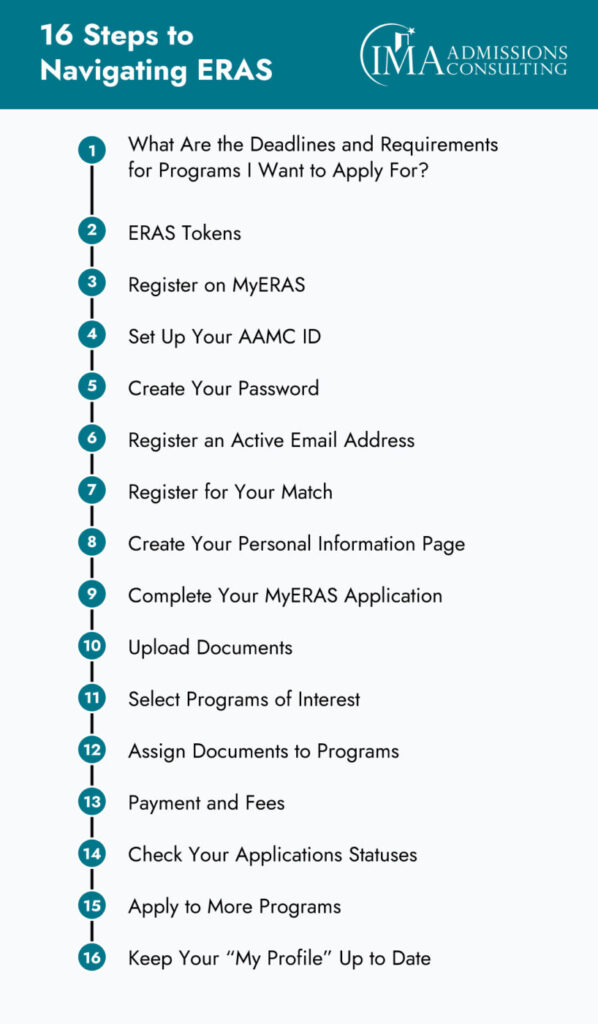
Step 1: What are the deadlines and requirements for programs I want to apply to?
- Start off by ensuring the specialty programs you’re interested in are a part of the upcoming ERAS cycle. You can verify their participation here. If your specialty of interest is emergency medicine or obstetrics and gynecology, you will need to apply through ResidencyCAS rather than ERAS.
- You can check the program’s requirements through the program’s website or on the ERAS portal.
Step 2: ERAS Tokens
- Your medical school’s Career Center or Registrar’s Office will send you your token via email. For the 2026 cycle, tokens become available starting June 25. Stay on the lookout for this email.
- If you are an unmatched graduate applying for programs and you have previously had a token, you will need to purchase another token.
- International medical graduates (IMGs) obtain their ERAS token through the ECFMG’s MyIntealth portal. There is a non-refundable fee of $165 for this service.
Step 3: Register on MyERAS
- You will want to register as soon as you receive your token. This helps ensure all of your documents and information are uploaded and in order. Documents can take a few days to upload, and photos typically take two days to upload.
- Visit MyERAS to proceed with the registration process. Carefully read and answer the ERAS application questions.
- After successfully registering on MyERAS, you can access your account here.
Step 4: Set Up Your AAMC ID
- Carefully follow the step-by-step instructions for setting up your AAMC ID. If you do not know your AAMC ID but are prompted to enter it, do not enter anything. Towards the end of registration, the ERAS system will process your information and generate an AAMC ID for you.
Step 5: Create a Password
- Create a strong, unique password for the site. Make sure to keep track of this password. However, if you do forget your password, you can click “Forgot My Password” on the MyERAS application login page. You will then receive an email with your password.
Step 6: Register an Active Email Address
- This is the email address that you will have to include in your ERAS application during registration. It is recommended to use your school email address, but any active, professional email address will do.
Step 7: Register for Your Match
NRMP registration for the 2026 Main Residency Match opens September 15, 2025. The standard registration fee is $70 if you register by January 30, 2026. After that date, an additional $50 late registration fee applies. Registering with ERAS does not automatically register you with the NRMP or any other matching service; you must complete each registration separately.
Step 8: Create Your Personal Information Page
After successfully registering on MyERAS, it is time to fill out your personal information. Your personal information can always be updated, even after you have submitted your ERAS application. However, ensure that your permanent address is correct, as this cannot be changed after submitting your ERAS application.
Aside from the standard personal information, such as your name, contact info, etc., the following information may have you stumped. Check only the ones applicable to you.
- AOA ID (Required for all DO applicants)
- NBOME ID (Required for all DO applicants)
- ECFMG Certification (Only applies to foreign medical graduates)
- Checkbox to indicate participation in NMS/Couples Match (Optional)
- Checkbox to indicate participation in NRMP/Couples Match (Optional)
- ACLS, BLS, and PALS Certification info and dates
New for the 2026 cycle: you will also see a “Hometown(s)” field where you can select places you have currently or previously lived and feel strong ties to. Fill this out if you want programs in a specific region to understand your geographic connection.
Step 9: Complete Your MyERAS Application
- Begin by clicking “My Application.” You will only complete one application, and once you have certified and submitted it, it will be sent to the programs of your choosing. Documents like LORs and your personal statement can be customized for each program and are attached later.
- The “Biographical Information” section is an optional section regarding your race and ethnicity. You can choose to fill out this section or leave it blank.
- If you are applying to anesthesiology, neurological surgery, or integrated plastic surgery, you will encounter specialty-specific questions. These responses are only visible to programs within that specialty, so answer them thoughtfully.
- If your specialty offers program signaling, you will be able to assign signals at the time of application. Some specialties, such as anesthesia and plastic surgery, also allow “Why Us” essays alongside signals. Use these strategically.
- Review your application before certifying and submitting it. Check the spelling and grammar in all fields.
- Before submission, there is a section titled “Designated Dean’s Office” authorization to view your application after it has been submitted. Select yes.
Step 10: Documents
This section is for uploading your personal statement, LORs and transcripts. Here you will prepare your application materials to best present yourself to programs.
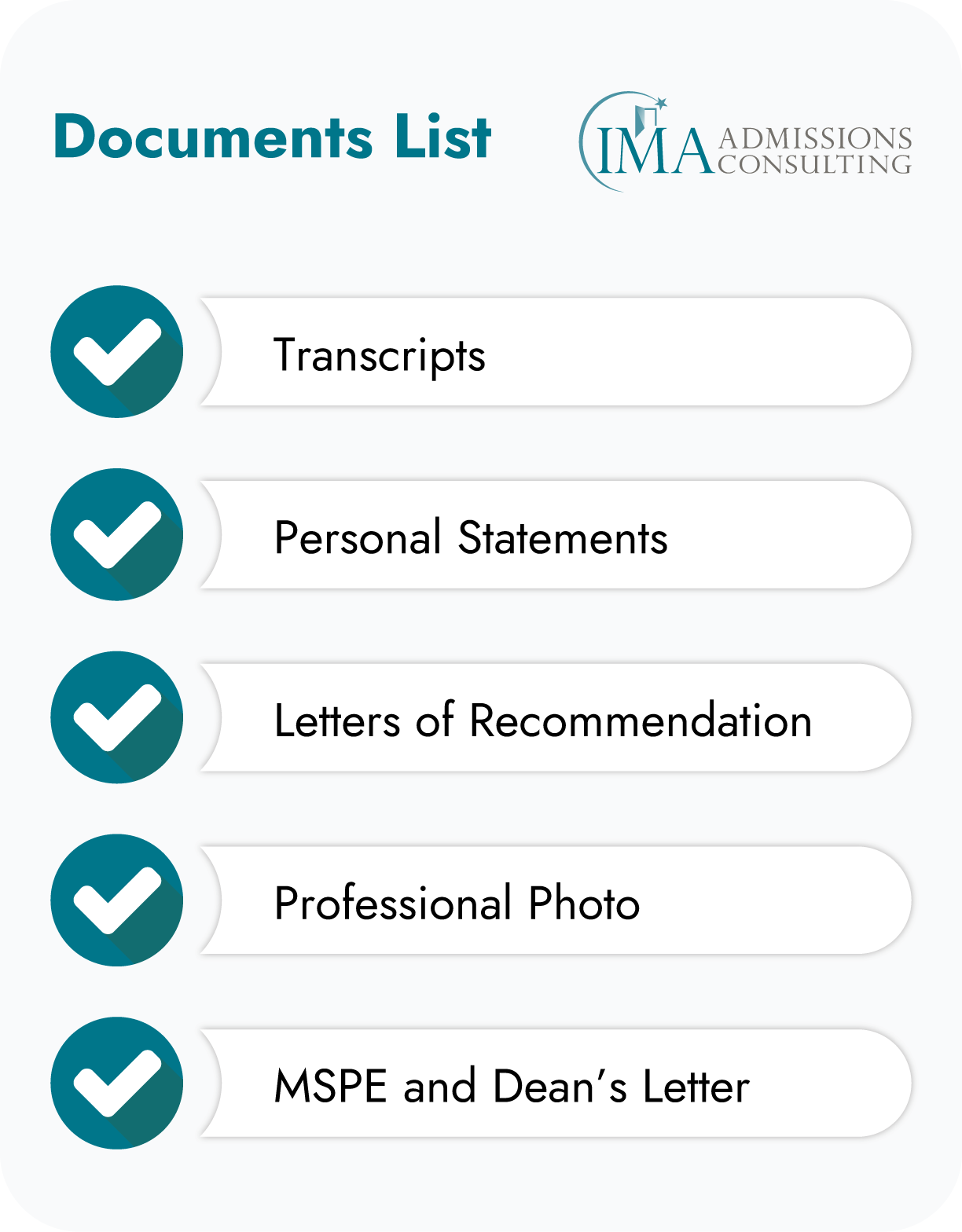
Transcripts – MD programs will require your USMLE transcripts, while DO programs will need your COMLEX transcript. You will need to know your ID number for the transcript you are requesting. Each transcript costs $80, assessed once per ERAS season.
Personal Statements – You can assign different personal statements for different programs. Keep in mind you can only send one personal statement per program. You cannot edit or update a personal statement once it is sent to a program, so double-check your personal statements.
Letters of Recommendation – You can upload an unlimited number of letters of recommendation but may only assign a maximum of four per program. You will need at least three per program in most cases. Make yourself aware of deadlines and requirements for LORs for each program you are applying to.
Professional Photo – Upload your photo so residency programs can put a face to the name. Always choose a professional photo where your face is clearly visible.
MSPE and Dean’s Letter – Your “Designated Dean’s Office” will be the party responsible for uploading your MSPE/Dean’s Letter and medical school transcripts.
Step 11: Choose Your Programs of Interest
- Locate and click on the “Programs” tab. You can search for your programs of interest by ACGME number, location or specialty. You can save a program to apply to it at a later time. This gives you the chance to organize your documents for all the programs you want to apply for. You can also edit your selected programs (adding or removing) prior to sending out your ERAS application.
- If you receive a prompt stating “Incomplete Registration,” this indicates one or more of the programs is not participating in the ERAS cycle.
- After you have submitted your application, you will not be able to remove a program, but you can request the withdrawal of your application.
- The only time you can remove programs is when they are in your “Selected Programs” list. If your application has already been sent to the program, you can request your application be withdrawn. While ERAS does not remove your application from the program, the application will be marked “withdrawn.” After ERAS has marked your application as withdrawn, it is best to contact the program directly and inform them of your intent to withdraw.
- We highly recommend reviewing each step multiple times before certifying and submitting your ERAS application.
- The “Applied to Programs” are programs that have been sent your official ERAS application. The only area of this section that can be edited is the assigning documents portion.
Step 12: Assigning Documents to Programs
- After finalizing your list of programs, you will need to assign documents to the programs. All programs you apply to will receive the same basic documents, including your ERAS application, transcript, photo and Dean’s Letter/MSPE. Some documents must be personally assigned by you, such as personal statements, LORs and USMLE/COMLEX transcripts.
- If you submit a letter of recommendation that needs to be revoked and re-submitted, the author of the LOR can do so.
- Your photo needs to be assigned to all programs.
Please note that unassigning a document from a program does not remove the document from the specified program’s server. The program may have already received and reviewed the document, so it is important to be diligent during this process.
Step 13: Payment and Fees
- It is now time to apply and pay. Before your application is sent to the programs of your choosing, you must submit your payment via MyERAS. Take your time to look over all associated ERAS costs to understand the breakdown and better manage your residency budget.
- For the 2026 cycle, ERAS application fees are based on the number of programs you apply to per specialty. Applying to 1 through 30 programs costs $11 each. Any additional programs beyond 30 cost $30 each. USMLE and COMLEX transcripts each cost $80, assessed once per season.
- When you are ready to submit payment, make sure to review and understand the fee breakdown. Complete payment and keep a copy of the invoice in your records.
Step 14: Check Your Application Status
- The “Programs Applied to” section and message center are vital when it comes to keeping an eye on the progress of your application. Check the message center for any correspondence from programs. The AAMC-Thalamus integration also provides a centralized platform for managing interview invitations and scheduling.
Step 15: Applying to More Programs
- You can apply to additional programs any time during the ERAS application season. The 2026 ERAS season runs until 5:00 p.m. ET on May 31, 2026. To apply to more programs, complete the same steps you did upon applying for your initial round of programs.
Step 16: Keeping Your “My Profile” Up to Date
- The “My Profile” section contains important information about how the programs can get ahold of you. If your information changes, such as you move or change your phone number, update this section as soon as possible. For international students, you will need to keep your Visa status and ECFMG status current.
Part 3: The Interview, Match Day, and Post Match
The Interview
- Scheduling interviews can be a stressful process. Your first couple of interviews will prove to be the most nerve-wracking. It is best to schedule your most important interviews (those for your top-ranked programs) in the middle of your interview schedule. Your first interviews will serve as practice runs as you get a feel for the interviewing process, while the last interviews you schedule should be for programs that aren’t too high up on your list. By the end of the interviewing process, you will most likely be tired and may not give your all at these final interviews.
- Prepping for your interviews is important. You should take your time to review interview practice questions online. Researching the programs for further information about their location, patient populations and demographics will also help you during the interview. You will also have a basis on which to form questions to ask during your interview.
- When the time for interviews rolls around, it is essential to make a good first impression. This is the first time you will be meeting with the program face-to-face (or via video, as many programs continue to conduct virtual interviews). Be nice to everyone you encounter and dress professionally (neutral colors, skirts, pants, suits).
- After completing the interview, consider sending a residency letter of intent to improve your standing.
- After you have completed all program interviews, you will need to rank the programs. Rank all of the programs you are willing to attend, and rank them in the order you’d want to attend them. The NRMP ranking system opens on February 2 at 12:00 p.m. ET. All rank order lists must be certified by March 4 at 9:00 p.m. ET.
Matching or Not Matching
- Match Week 2026 begins on Monday, March 16. On Monday, applicants receive an email stating whether they have been matched or not.
- Applicants who are unmatched will have the opportunity to match into unfilled positions through the Supplemental Offer and Acceptance Program (SOAP). In the 2026 cycle, 2,581 positions were offered through SOAP. SOAP begins on Monday, March 16 at 10:00 a.m. ET and runs through Thursday, March 19 at 9:00 p.m. ET. The MyERAS application opens for SOAP on March 16 at 11:00 a.m. ET, and programs cannot review applications until Tuesday, March 17 at 8:00 a.m. ET. If you applied to at least one residency program before March 16 at 7:30 a.m. ET, you will not pay any additional application fees during SOAP. If you have not previously applied, a $99 fee applies, plus $80 per transcript if not already submitted.
- Matched candidates are notified on Friday, March 20 where they have been matched.
Post Match
After matching and before starting your residency, dedicate some time to relax and take time off. You’ve put in a lot of work and deserve a much-needed rest. Use the time between match and residency start to handle practical matters such as housing, licensing paperwork, and orientation requirements at your matched program.
Understanding ERAS Costs and Budgeting for the Match
The cost of applying for residency adds up quickly, and it is worth understanding the full picture before you begin. Many applicants are surprised by how much the process costs when you combine application fees, transcript costs, match registration, travel, and interview preparation.
For the 2026 cycle, ERAS charges $11 per program for the first 30 programs within a single specialty, and $30 for each additional program beyond that. In recent cycles, applicants submitted an average of roughly 82 total applications, which means costs can climb into the hundreds of dollars on application fees alone. Add the USMLE transcript fee of $80 (or COMLEX at $80), the NRMP registration fee of $70, and potential interview travel costs, and you are looking at a significant investment.
If you are applying to specialties that now use ResidencyCAS (emergency medicine or OB-GYN), fees are structured differently and are approximately 20% lower overall. Still, budget carefully. Students who are managing significant debt from medical school should plan for these expenses early, ideally setting aside funds during the summer before fourth year. Some schools offer emergency funding or residency application grants; check with your financial aid office.
How Prior Clinical Experience Strengthens a Residency Application
While your medical school rotations form the backbone of your clinical preparation, experiences you had before and during medical school also matter. Residency programs look for evidence that your interest in a specialty developed over time, not just during a single rotation. Structured clinical exposure from undergraduate or gap-year experiences, including programs that offered mentorship, patient observation, and reflective practice, can help demonstrate sustained commitment.
If you built clinical experience through programs like those offered by International Medical Aid, those experiences can serve as meaningful examples in your personal statement or interview responses. The key is to connect those earlier experiences to your current trajectory in a way that feels genuine and specific.
Part 4: Final Guidance for the 2026 Cycle
Applying for residency can be both confusing and time-consuming. When you are ready to start the ERAS application process, use this guide as a reference point and refer to it when you don’t know what step to take next or want to check your progress. A few final points worth emphasizing for 2026:
- Confirm which platform your specialty uses. ERAS covers most specialties, but emergency medicine and OB-GYN use ResidencyCAS. Ophthalmology uses SF Match. Urology has its own match process.
- Pay attention to the new features in the 2026 ERAS application, especially program signaling, specialty-specific questions, and the hometown(s) field. These are opportunities to give programs useful information about your fit.
- The 2026 ERAS season opens June 4 at 9:00 a.m. ET for building your application. You can submit starting September 3. Programs begin reviewing on September 24. Plan your timeline accordingly.
- Match Day for the 2026 cycle is March 20, 2026.
If you need additional help and resources, don’t be afraid to seek out the personalized help of residency admissions consulting services. Good luck with all your future endeavors.

Frequently Asked Questions
Which programs participate with ERAS?
The AAMC’s ERAS Directory lists all of the programs participating in ERAS for the upcoming cycle. Note that emergency medicine and obstetrics and gynecology programs now use ResidencyCAS instead of ERAS.
How can I apply to programs not participating in ERAS?
If you are planning to apply to a program that is not in the upcoming cycle or doesn’t use ERAS, it is best to contact the program directly to find out the best way to apply. Some specialties use ResidencyCAS, SF Match, or their own application systems. For further help applying for residency, consider utilizing the help of a residency admissions consulting service.
How can I access MyERAS?
You can access MyERAS through the use of an ERAS token. You will need to contact the Designated Dean’s Office, Career Center or Registrar’s Office to receive your token. For international medical graduates, tokens are available through the ECFMG’s MyIntealth portal starting June 25.
How do I contact the Designated Dean’s Office?
Those still in college or recent graduates can contact the med school they attend or attended. International students should contact the ECFMG.
When I register with MyERAS, am I automatically registered with NRMP or other matching services?
No, registering with ERAS does not register you with any other matching services. You will need to register with NRMP and other services separately. NRMP registration for the 2026 cycle opens September 15, 2025.
When should I begin applying to residency programs?
For the 2026 cycle, you can begin submitting applications starting September 3 at 9:00 a.m. ET. The MyERAS platform opens earlier, on June 4, so you can start preparing your application during the summer.
When can programs view my application?
For the 2026 cycle, programs can begin reviewing applications on September 24 at 9:00 a.m. ET. All applications submitted between September 3 and September 24 will appear to programs as submitted on September 24.
How does using MSAR increase my chances of acceptance?
MSAR provides you with information about medical schools, specifically valuable information about admission requirements. This allows you to review these stats and choose the school that is the best fit for you. While MSAR is primarily used for medical school applications rather than residency, the research habits it builds carry forward.
What is the deadline for submitting the MyERAS application?
The 2026 ERAS season ends at 5:00 p.m. ET on May 31, 2026. However, each program has its own deadline for receiving your application, and most programs review applications well before the season closes. It is important to check the deadline for all programs you’re interested in and submit as early as possible.
Which supporting documents should I include?
Your application should include your ERAS personal statement, LORs, photo, med school transcript and MSPE. Optional documents include USMLE and COMLEX transcripts and ECFMG status reports. Check each program’s requirements, as some will require specific transcripts.
How many LORs should I submit?
You can upload an unlimited number of LORs to the ERAS system, but you can only assign a maximum of four per program. Most programs require three. Focus on quality over quantity.
Does an MSPE or Dean’s Letter count as a LOR?
No, neither MSPEs nor Dean’s Letters count as a letter of recommendation.
Should I submit my USMLE/COMLEX scores?
Some programs will require these transcripts as part of your application. Check with the program to determine if these documents are optional or required. Each transcript costs $80, assessed once per ERAS season.
What specialties no longer use ERAS?
As of the 2026 cycle, emergency medicine and obstetrics and gynecology use ResidencyCAS. Ophthalmology uses SF Match. Urology operates its own match system. Always confirm the correct application platform for your specialty before you begin.
What is program signaling, and should I use it?
Program signaling is a feature that allows you to indicate genuine interest in specific programs at the time of application. The number of signals available varies by specialty. For anesthesia and plastic surgery, you can also submit “Why Us” essays alongside your signals. Use your signals on programs where you have real interest and where demonstrating that interest could meaningfully affect your chances of receiving an interview invitation.