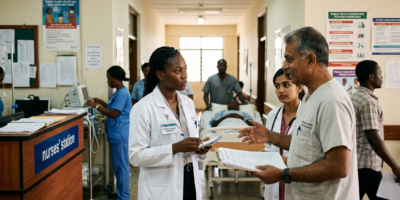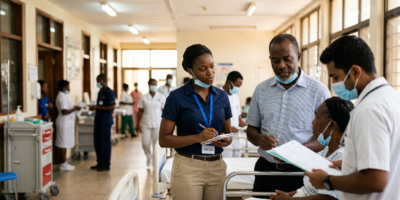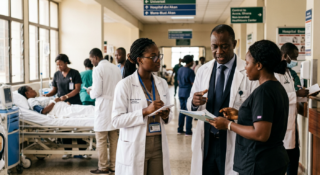


A global health personal statement works when it is specific, honest and humble. The AMCAS essay allows 5,300 characters, including spaces, so a global health story has to earn its place. Strong essays center the patients, clinicians and systems you saw, describe your role accurately and show what you questioned, not how much you helped.
A global health experience can be one of the most meaningful parts of your medical school application, but only if you write about it well. Every cycle, many applicants mention international clinical exposure in their personal statements. Some of those essays stand out and many do not, and the difference rarely comes down to how dramatic the experience was. It comes down to how honestly, specifically and thoughtfully the applicant reflects on what they saw, what they questioned and what they carried forward. Our guide to ethical global health internships is useful background before you start drafting.
The challenge is real. According to the 2027 AMCAS Applicant Guide, the space for the personal statement is 5,300 characters including spaces, or about one page, and the same essay goes to every medical school you apply to. If your global health experience takes up space in that essay, it needs to earn its place. Admissions committees are not impressed by the fact that you traveled. They are looking for evidence of reflection, self-awareness, clinical curiosity and maturity. A well-written account of an international health experience can show all of those qualities. A poorly written one can raise questions about your judgment, your ethics or the depth of your understanding.
Why Admissions Committees Pay Close Attention to Global Health Essays
Medical schools want students who think carefully about health systems, equity and their own position within clinical settings. A global health experience puts all three under a spotlight. When a reader sees that you spent time in a clinical setting abroad, they immediately look for a few specific signals.
First, they want to see that you understood your role. Were you an observer? A supervised assistant? Did you stay within appropriate boundaries? Any suggestion that you performed clinical tasks beyond your training, or that you saw yourself as a provider rather than a learner, will undermine your credibility. Second, they want evidence that you noticed systemic and structural factors. Describing a patient’s condition is not enough; readers want to see that you thought about why it presented the way it did, what resources were or were not available and how the health system shaped the care you saw. Third, they want honesty about what you did not know. Applicants who acknowledge confusion, discomfort or the limits of their own perspective tend to write the strongest essays.
The AAMC’s premed competencies for entering medical students include Self-Awareness (formerly cultural humility), Understanding Others (formerly cultural awareness), Ethical Responsibility to Self and Others, Service Orientation and Critical Thinking. A global health experience gives you concrete material for several of these at once, provided you write about it with precision. Our overview of the 17 AAMC core competencies explains each one.
What Strong Global Health Personal Statements Look Like
The best personal statements that draw on international clinical exposure share a few habits. They do not try to summarize the entire experience. They do not open with a sweeping statement about poverty or suffering. They do not present the applicant as a hero. Instead, they tend to do the following.
Start With a Specific, Grounded Moment
Rather than beginning with “During my time in [country], I witnessed the devastating effects of healthcare inequality,” a strong essay opens with one concrete scene. Maybe it is a morning in a clinic when you watched a physician explain a diagnosis to a patient through an interpreter. Maybe it is the moment you realized that a piece of equipment you take for granted in U.S. hospitals was not available. The scene should be small enough to fit in two or three sentences and vivid enough to anchor the reader.
This opening does two things. It shows that you were paying attention, and it gives your reader a clear image to return to as the essay develops. Admissions committees read a great many essays, and specificity is what makes yours memorable.
Move From Observation to Reflection
After grounding the reader in a moment, the essay should turn to what you made of it. This is where many applicants stumble. They describe what they saw but never examine what it meant, or they leap to broad conclusions about global health as a field. The middle of your essay should hold your most honest thinking. What did you not understand at first? What assumptions did you bring, and how were they challenged? What did you notice about the relationship between a clinician and a patient that changed how you think about communication, trust or resource allocation?
This reflective section is where Self-Awareness and Understanding Others show up, not as buzzwords but as a real intellectual and emotional process. If you spent time in a setting where clinical officers or community health workers carried much of the care, writing about those interactions can show that you are thinking seriously about how different systems distribute clinical responsibility. Our guide to clinical officers in Kenya describes one of those roles.
Foreground Host Expertise and Uncertainty
The people you learned from are the experts in your story. The physician who managed a ward with limited supplies, the nurse who explained a family’s concerns, the community health worker who knew every household on the route: these people should appear in your essay as skilled professionals, not as background. Name their roles, describe what they did and credit what you learned from them.
It is also fine, and often stronger, to admit what you still do not know. You spent weeks, not years, in a health system you were only beginning to understand. A sentence such as “I still do not fully understand how the hospital decided which patients were referred onward” signals maturity. Certainty about a system you saw briefly signals the opposite.
Connect Backward and Forward
A personal statement is not a travel essay. It is an argument for why you should be admitted to medical school, so your global health experience must connect to the rest of your story. Link it backward to what drew you to medicine and forward to how it shapes your intentions as a future physician. You do not need to declare a specialty or commit to a career in global health. You do need to show that the experience gave you a more informed understanding of what medicine involves, and that this understanding strengthened your commitment rather than simply confirming what you already believed.
If your background includes work on health equity at home, connect your international observations to patterns you have seen closer to home, such as how people find and act on health information in your own community. Drawing that connection shows range and intellectual consistency.
A Before-and-After Writing Example
The example below is fictional. It shows how one paragraph changes when the writer centers the people and the system rather than themselves.
Before: “In Kenya I saw the devastating reality of poverty. The hospital had almost nothing, and the patients were desperate for help. Every day I helped treat dozens of patients, and I realized how much difference one person can make. This experience showed me I was meant to be a doctor.”
After: “On my third morning on the pediatric ward, the attending physician checked a toddler’s hydration with a pinch of skin and a look at the child’s eyes, then asked the mother how many wet diapers there had been since yesterday. I had read about dehydration, but I had never seen a diagnosis built so carefully from so little equipment. Later I recorded the next patient’s vital signs under a nurse’s supervision and noticed how quickly she checked my numbers. I still do not know how the ward decided which children were sent to the referral unit, and that question has stayed with me.”
What Changed and Why
| Before | After | Why it works better |
|---|---|---|
| “Devastating reality of poverty” | A single ward, a single morning | Specific scenes are believable and memorable |
| “Patients were desperate for help” | A mother answering a clinical question | Patients appear as people with knowledge, not as objects of pity |
| “I helped treat dozens of patients” | Recording vital signs under supervision | The role is described accurately, with the supervisor visible |
| Applicant as hero | Physician and nurse as experts | Host expertise is credited |
| “I was meant to be a doctor” | An open question the writer still holds | Honest uncertainty shows reflection |
Ethical Pitfalls That Weaken Global Health Essays
This is where many otherwise strong applicants lose ground. Writing about a global health experience comes with ethical responsibilities that are easy to overlook when you are focused on making your essay impressive.
The Savior Problem
If your essay implies that you went abroad and helped people who could not help themselves, that is a problem. It suggests a lack of awareness of the long history of paternalism in global health and a failure to recognize the expertise, agency and resilience of the communities you visited. Admissions committees are attuned to this. They have read many essays that cast the applicant as the protagonist of someone else’s healthcare story, and they are not interested in another.
The fix is straightforward: center the people and systems you saw, not yourself. Write about what the local clinicians did, how the health system functioned and what patients communicated. Your role in the essay should be that of a thoughtful, curious and appropriately humble learner. That is what you were, and that is what the admissions committee wants to see.
Exaggerating Your Clinical Role
If you were a pre-med student in a structured program, you were not the one treating patients. You were learning under supervision, assisting within approved limits and watching licensed clinicians make decisions. Your essay must reflect that. Overstating what you did, even subtly, can damage your credibility with readers who understand how clinical settings work. Phrases like “I treated,” “I diagnosed” or “I managed” are not appropriate unless they describe tasks you genuinely performed within your scope and under direct supervision.
Accurate does not mean minimal. If you recorded vital signs, helped with intake or took part in patient interviews under supervision, say so plainly and name who supervised you. Being honest about your role does not weaken your essay; it makes it believable. An essay that describes carefully watching a physician work through a differential diagnosis, and then reflects on what that taught you about clinical reasoning, is far more compelling than one that inflates your part. Our guide on whether shadowing abroad counts for medical school covers how to describe the same experience in your activities section.
Reducing People to Their Suffering
Patients in any setting deserve to be described with dignity. If your essay describes people only in terms of illness, poverty or hardship, it flattens their humanity and suggests you saw them mainly as objects of pity or learning. Strong essays notice the full context of a person’s life, not just their condition. If a patient’s resilience, humor, family support or specific concerns stood out to you, those details paint a richer and more respectful picture.
The same principle applies to entire communities. Avoid language that frames a country or region as uniformly poor, chaotic or in need of rescue. Health systems everywhere are complex, with strengths and weaknesses, innovations and shortcomings. Comparing settings, as our article on public vs private hospitals in Peru does, is a good reminder that one country can contain very different kinds of care.
Sharing Details That Identify a Patient
A personal statement is read by many people at many schools. Never include a patient’s name, photo, exact age with a rare diagnosis, village or any combination of details that could identify them. Change or leave out details that are not essential, and keep the focus on what you learned rather than on the patient’s private story. Our guide to patient privacy during clinical placements covers the same principle for notes and social media.
Structuring the Global Health Section Within Your 5,300 Characters
The AMCAS personal statement is a single essay with a strict character limit, and global health is only one part of your story. One of the most common mistakes is letting an international experience dominate the essay at the expense of your academic preparation, your clinical exposure in the U.S., your research, your personal background and your understanding of medicine as a profession.
Decide Whether It Is Your Central Story or a Supporting Element
Before drafting, make an honest assessment. Is your global health experience the single most important thing that shaped your decision to pursue medicine, or one of several significant experiences? If it is the centerpiece, it can reasonably take 40 to 60 percent of the essay, with the rest given to context and forward-looking reflection. If it is a supporting element, keep it to roughly 25 to 35 percent and integrate it tightly with the rest of your narrative.
Either approach can work. What does not work is a long global health story that leaves no room for the reader to understand who you are outside that one experience. If you have also volunteered in a local free clinic, done research on health disparities or worked as an EMT, those experiences matter too, and they help committees see a pattern of commitment rather than a single event. Our guide to how many clinical hours medical schools expect can help you weigh any single experience against the rest.
Use Transitions That Show Intellectual Development
The best personal statements read as an arc of development, not a chronological list. When you bring in your global health experience, link it to what came before and after. “My time in the clinic confirmed something I had been thinking about since my first semester volunteering at a community health center” is far stronger than “Next, I participated in a global health program in Peru.” Show how your thinking evolved, not just where you went.
Avoid the Laundry List
Your personal statement is not your activities list. You do not need to mention every placement, site visit or day of your program. Pick the one or two moments that produced the most genuine reflection and write about those in detail. Depth beats breadth in a personal statement.
What to Do If Your Experience Was Complicated or Uncomfortable
Not every global health experience goes smoothly. You may have seen care that concerned you, felt unprepared or overwhelmed, or struggled with the ethics of being a foreign student in a clinical setting. These are not weaknesses in your story. Handled well, they are some of the strongest material you can write about.
Admissions committees value ethical reasoning. If something made you uncomfortable and you can explain why, which principles were in tension and what you did with that discomfort, you are showing exactly the thinking medical schools want to develop. You do not need to resolve every tension neatly. You do need to show that you noticed it and took it seriously.
If you are unsure how to write about ethical complexity without sounding critical or naive, frame your observations in terms of systems rather than individuals. Instead of “The doctor did something I disagreed with,” write about the structural constraints that shaped the decision, differences in how resources are allocated, or the tension between standard protocols and real-world limits. IMA’s article on cultural competency in global medical programs offers useful context for processing those observations.
Honesty about difficulty does not make you look weak. It makes you look like someone who pays attention and thinks critically. “I initially felt uncomfortable with how little I could contribute, and that discomfort pushed me to think harder about what it means to be useful in a clinical setting” shows growth. “I immediately adapted and made a huge impact” shows a lack of self-awareness.
An Annotated Reflection Example
This short reflection is fictional and labeled for teaching. Notes in brackets explain what each sentence is doing.
“The nurse who ran the antenatal clinic in Cusco knew most of her patients by name and remembered which ones lived two buses away. [Credits a host professional and her expertise.] When a young mother missed her appointment, the nurse did not scold her; she asked about the bus fare and the harvest. [Shows a system factor, not a personal failing.] I had assumed missed appointments meant patients did not care, and I was wrong. [Names an assumption and corrects it.] I still wonder how a clinic can plan around reasons it cannot fix. [Holds an open question honestly.] It is a question I expect to keep asking in any clinic I work in. [Connects forward without claiming a specialty.]”
Practical Drafting Steps Before You Submit
Writing about a global health experience is not something to do in one sitting. The reflection matters as much as the writing. These steps help.
Write Down Your Raw Memories First
Before you worry about structure or word choice, spend 30 minutes writing everything you remember: specific patients without identifying details, conversations with clinicians, moments of confusion, things that surprised you, sounds, settings and small details. This freewrite is not your essay. It is the raw material you will draw from. Many applicants skip this step and end up writing from a vague impression rather than concrete memory.
Identify Your Strongest Anchor Moment
From your freewrite, pick the single moment that produced the most genuine emotional and intellectual response. That is your anchor. It does not need to be the most dramatic thing that happened. It needs to be the thing you thought about most, the moment that shifted something in your understanding. Build your essay around it.
Draft, Then Cut
First drafts are always too long. Write everything you want to say, then cut to fit 5,300 characters. Every sentence should serve your central argument: that you are a thoughtful, prepared, ethically aware person who belongs in medical school. If a sentence is interesting but does not support that argument, remove it. Our guide on how to improve your medical school application shows where the personal statement fits alongside your other materials.
Get Feedback From Someone Who Will Be Honest
Share your draft with a pre-health advisor, a trusted mentor or a peer willing to give direct feedback. Ask them specifically: Does this sound authentic? Does it avoid the savior narrative? Is my role described accurately? Are the host clinicians visible? Does it connect clearly to why I want to be a physician? The AAMC’s page on the AMCAS application is a good reference for what the full application asks of you.
Read It Out Loud
This simple step catches a surprising number of problems. If a sentence sounds awkward aloud, rewrite it. If a paragraph feels like it is trying too hard, simplify it. Your personal statement should sound like you at your most thoughtful and articulate.
What Your Essay Says About You as a Future Physician
Every choice in your personal statement, from the moment you select to the language you use and the way you describe other people, tells the committee something about your judgment, empathy and readiness. Writing about global health is a high-stakes version of this because it involves cross-cultural dynamics, resource differences and clinical ethics in ways domestic experiences often do not.
The applicants who write these essays well treat the experience as a starting point for harder questions, not a finished story with a clean moral. They acknowledge what they learned without overstating their impact. They describe what they saw without reducing people to case studies. They connect the experience to a larger pattern of engagement with health equity, clinical learning and self-reflection.
Your global health experience does not need to be the most impressive thing on your application. It needs to be the most honestly told. If you can write about it with specificity, humility and real curiosity, it will do what a good personal statement should: make the reader want to meet you. If you are still planning that experience, IMA’s pre-med internships abroad in Mombasa and Cusco give you supervised clinical time, mentors and documented hours to reflect on.
Frequently Asked Questions
Should My Entire Personal Statement Focus on My Global Health Experience?
Not necessarily. If it is the experience that solidified your commitment to medicine, it can be the central thread. Most strong statements weave several experiences together to show a pattern of engagement and growth, so make sure your background, motivation and development are also represented.
How Do I Write About Clinical Experience Abroad Without Overstating My Role?
Use precise language. Describe what you did, who supervised you and what you learned. Phrases such as “I observed,” “I recorded vital signs under supervision” and “I watched as the physician” are honest. Avoid language that implies you diagnosed, treated or made clinical decisions on your own.
Can Writing About Global Health Hurt My Application?
It can if the essay is poorly written. Essays with a savior tone, exaggerated clinical involvement, undignified descriptions of people or communities, or no ethical reflection raise concerns. The experience itself is not the risk; how you interpret and present it is.
How Long Is the AMCAS Personal Statement?
The 2027 AMCAS Applicant Guide allows 5,300 characters, including spaces, or about one page. The same essay is sent to every medical school you apply to.
Can I Mention a Patient in My Personal Statement?
Yes, if you protect their privacy. Leave out names, photos and any combination of details that could identify them, and focus on what you learned rather than on the patient’s private story.
How Do I Avoid a Savior Narrative?
Center the clinicians, patients and systems you saw. Credit host professionals as experts, describe your role accurately, admit what you still do not understand and connect the experience to questions you will keep asking as a physician.
Should I Write About an Experience That Made Me Uncomfortable?
Often, yes. Explaining what bothered you, which principles were in tension and what you did with that discomfort shows ethical reasoning. Frame it around systems and constraints rather than criticizing individuals.