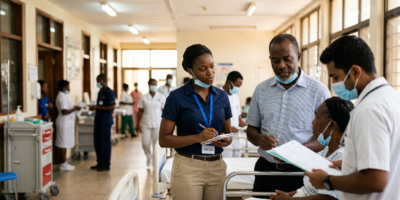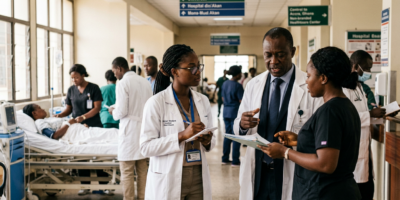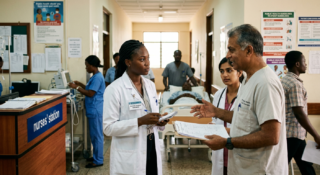
Every year, thousands of pre-health applicants sit across from an interviewer and try to explain why a particular experience matters. For IMA alumni preparing to talk about their global health experience in school interviews, the challenge is not having nothing to say. It is knowing how to say it well. An international health experience can strengthen an application, but only when the applicant frames it with precision, honesty, and genuine self-awareness. Interviewers at medical schools, PA programs, dental schools, nursing programs, and OT programs have heard vague statements about “helping people in need” too many times. What they want is something more grounded.
This article breaks down how to talk about a structured global health experience in admissions interviews. It covers what interviewers are actually evaluating, how to structure your answers, what mistakes to avoid, and how to connect an international clinical observation experience to the specific competencies that admissions committees care about. Whether you are applying to MD, DO, PA, dental, nursing, or OT programs, the principles are the same: be specific, be honest, and let the experience speak through concrete detail rather than grand claims.
What Admissions Committees Are Really Evaluating When You Mention Global Health
It helps to understand what is on the other side of the table. Medical school acceptance rates hover around 40 to 45 percent for applicants in recent cycles, according to AAMC applicant and matriculant data. PA, dental, and nursing programs are similarly competitive. That means interviewers are not just checking boxes. They are trying to figure out who you are, how you think, and whether you are ready for the demands of clinical training.
When an applicant mentions a global health experience, the interviewer is listening for several things. First, they want to know whether you can articulate what you actually observed and did, not in general terms, but with specificity. Second, they are evaluating your capacity for reflection. Did this experience change how you think about healthcare systems, cultural differences, resource limitations, or your own assumptions? Third, they are gauging your ethical awareness. Do you understand the boundaries of what you were doing? Can you talk about the experience without slipping into a savior narrative or inflating your role?
Interviewers at competitive programs are well practiced at spotting vague or rehearsed answers. A response like “I went abroad and saw how people in developing countries lack access to care, and it made me want to become a doctor” is too thin to carry weight. It tells the interviewer nothing about your critical thinking, your observation skills, or your readiness to handle the complexity of a clinical career. What works is specificity, honest emotion, and the ability to connect a moment you witnessed to a broader insight about healthcare.
Structuring Your Answer: The Difference Between a Good Response and a Forgettable One
One of the most useful frameworks for interview answers is simple: situation, observation, reflection, connection. This is not a rigid formula, but it keeps your answer grounded in real detail rather than floating in abstraction.
Start With a Specific Situation
Rather than opening with a sweeping statement about global health disparities, begin with a single moment. Maybe you were observing in a clinic and noticed how a physician communicated a diagnosis to a patient through a translator. Maybe you watched a community health worker conduct outreach in a setting with no running water. The more specific the scene, the more your interviewer can see it, and the more credible your answer becomes.
For example, an IMA alumnus preparing for a PA school interview might say: “During a clinical observation rotation at a public hospital, I watched a clinical officer manage a line of thirty patients in a morning. He triaged based on visual assessment because there was no electronic health record system. That single morning taught me more about clinical prioritization than any textbook chapter on triage.”
Move to What You Observed, Not What You Did
This is where many applicants make a critical mistake. They inflate their role. In a structured program like IMA, students observe, support within approved limits, and learn under professional supervision. They do not practice medicine, and they should never describe their experience as if they did. Interviewers respect honesty about what you observed far more than exaggeration about what you performed.
A strong answer names what you saw and positions yourself accurately as an observer and learner. “I assisted by recording patient vitals under supervision” is fine if that reflects a verified, approved activity. “I treated patients” is not accurate for an observational program, and an experienced interviewer will likely probe further if you overstate your involvement.
Reflect Honestly, Including on Discomfort
The reflection portion of your answer is where you distinguish yourself from other candidates. Admissions committees want to hear that you thought critically about what you experienced. Did you notice something that challenged your assumptions? Were you uncomfortable at any point, and why? Did you recognize a gap in your own knowledge or cultural understanding?
This is also where ethical awareness matters. If you observed a clinical setting with fewer resources than you expected, how did that shape your understanding of healthcare delivery? If you noticed differences in how patients were treated compared to what you have seen in the United States, what did you make of that? The ability to sit with complexity, rather than reduce everything to a neat lesson, is exactly the kind of maturity that admissions committees value.
Connect to Your Path, Not a Generic Statement
Finally, tie the observation and reflection back to your specific career goals. This connection should be precise. If you are applying to medical school, explain how the experience informed your understanding of clinical decision-making or health systems. If you are applying to a PA program, you might talk about how watching mid-level providers in another country clarified what draws you to the PA model of care. For dental school applicants, an observation about oral health access in a resource-limited community can anchor a meaningful answer about why you want to practice dentistry.
The key is that the connection should sound like it could only come from you. If your closing sentence could be swapped into anyone else’s interview, it is too generic.
Common Mistakes IMA Alumni (and All Applicants) Should Avoid
Even well-prepared students stumble in interviews when they discuss international experiences. Here are the patterns that weaken an otherwise strong answer.
Savior Narratives and Voluntourism Language
Admissions committees are increasingly sensitive to language that frames the applicant as someone who went abroad to rescue people. Statements like “I went to help those less fortunate” or “I made a real difference in their lives” raise flags. They suggest a lack of awareness about the structural causes of health disparities and, sometimes, a lack of humility.
A better approach is to center the people and systems you observed, not yourself as a hero. Talk about what the local healthcare workers were doing, what you learned from them, and what you came to understand about the community’s existing strengths. The WHO health workforce fact sheet projects a shortfall of 10 million health workers by 2030, concentrated in low- and lower-middle-income countries. Understanding those systemic realities, and being able to articulate them, is far more impressive than claiming personal credit for short-term impact.
Vague or Unverifiable Claims
If you say you “performed procedures” or “provided care,” you need to be ready for follow-up questions. If you cannot answer those questions accurately and in detail, your credibility takes a serious hit. Structured programs like IMA emphasize observation, professional supervision, and approved support roles. Staying within that frame is not a weakness in an interview. It is a sign that you understand clinical boundaries, which is exactly what a future clinician needs to demonstrate.
Failing to Connect the Experience to the Specific Program
An interviewer at a PA school is evaluating you for a PA program, not a general interest in global health. If you talk about your experience in ways that do not connect to the specific profession you are pursuing, the answer falls flat. Before your interview, think carefully about which aspects of your global health experience are most relevant to the program you are applying to. For PA school, the emphasis might be on team-based care and the role of mid-level providers. For dental school, it might be oral health access. For nursing, it might be community-based care models or patient communication under difficult circumstances.
IMA’s blog has practical resources for interview preparation across different program types. For medical school applicants, a review of common medical school interview questions can help you anticipate where a global health experience fits naturally into your answers. PA school applicants will find that frequently asked PA school admissions questions follow similar patterns but with profession-specific nuances worth preparing for.
Handling Tough Follow-Up Questions With Confidence
Interviewers do not always stop at “Tell me about your experience.” They probe. They challenge. They ask questions that test whether your reflection is genuine or rehearsed. Here are a few follow-ups that IMA alumni and other applicants should be ready for.
“What Was the Most Difficult Part of Your Experience?”
This question is designed to test self-awareness and emotional maturity. A strong answer is honest without being dramatic. Maybe the hardest part was watching a patient wait hours for care you could not provide. Maybe it was recognizing the limits of what a short-term observer can contribute to a community with long-term needs. Maybe it was confronting your own assumptions about how healthcare should work. Whatever you say, ground it in a specific moment and explain what you took away from it.
“How Did You Handle an Ethical Dilemma?”
This is a common question across MD, DO, PA, dental, and nursing interviews, and a global health experience gives you real material to work with. Perhaps you observed a situation where resource scarcity forced a clinician to make a choice you found difficult to process. Perhaps you noticed a cultural practice that conflicted with your own clinical training. The goal is not to present yourself as someone who had all the answers, but as someone who recognized the complexity and thought carefully about it. For more preparation on this type of question, IMA’s guide to ethical challenge questions in medical school interviews offers useful framing.
“What Would You Do Differently?”
This question rewards humility. Maybe you would have studied more about the local healthcare system before arriving. Maybe you would have spent more time learning the language. Maybe you would have asked more questions of your supervising clinicians. The answer should show that you are capable of honest self-assessment, which is a quality every health professions program wants to see in its students.
“Did This Experience Change Your Career Goals?”
Be careful here. If the honest answer is no, say so, and explain why the experience reinforced goals you already had. If the answer is yes, be specific about what changed and why. Avoid sweeping claims like “It confirmed my calling to medicine.” Instead, name the specific observation or moment that shifted your thinking, and explain the new direction with clarity.
Why Ethical Framing Matters More Than Most Applicants Realize
Admissions committees at medical schools, PA programs, dental schools, and nursing programs are paying increasing attention to how applicants discuss international experiences. There is a growing awareness in health professions education that short-term global health exposure, when poorly framed, can reinforce harmful dynamics rather than promote genuine understanding.
This does not mean you should avoid talking about your experience. It means you should talk about it well. Ethical framing means acknowledging that you were a guest in someone else’s healthcare system. It means recognizing the expertise of local providers. It means being honest about the limits of what you contributed versus what you gained. And it means avoiding language that reduces patients or communities to props in your personal growth story.
Programs that include structured reflection, mentorship, and professional supervision give participants better material for this kind of framing. When you can reference specific conversations with supervising physicians, specific debriefing sessions, or specific readings you completed as part of a program’s curriculum, your answer has a foundation that interviewers can respect. The Bureau of Labor Statistics occupational outlook projects strong demand growth across healthcare professions, which means admissions committees can afford to be selective about the maturity and ethical readiness of the applicants they admit.
Practical Preparation Steps Before Interview Day
Knowing what to say is one thing. Being ready to say it under pressure is another. Here are concrete steps to prepare.
Write Out Three to Five Specific Moments
Before your interview, sit down and write out three to five specific moments from your global health experience that you can describe in detail. For each one, note what you observed, what you felt, what you learned, and how it connects to your career goals. You are not memorizing scripts. You are building a library of real material that you can draw from naturally in conversation.
Practice With Someone Who Will Challenge You
Find a friend, advisor, or mentor who will ask follow-up questions. The goal is not to rehearse perfect answers but to practice thinking on your feet. If someone asks “Why does that matter?” or “What did you actually do in that situation?” you should be able to respond without stumbling.
Know Your Program’s Values
Every school has a mission statement. Many have specific language about diversity, global health, community engagement, or cultural competency. Before your interview, read the program’s mission and note where your experience aligns naturally. Do not force the connection, but be ready to make it if the opportunity arises.
Review Your Application for Consistency
If you wrote about your global health experience in your personal statement or activity descriptions, make sure your interview answers are consistent. You do not need to repeat what you wrote word for word, but contradictions or exaggerations will raise concerns. This is especially important for applicants who described specific activities or responsibilities. Everything you claim should be accurate and verifiable.
Prepare to Talk About What You Did Not Know
One of the most disarming and effective interview moves is admitting what you did not know before, during, or after your experience. “I went in thinking X, and I came out understanding Y” is a powerful structure when it is genuine. It shows growth, humility, and the capacity to learn from experience, all qualities that health professions programs value highly.
Turning a Structured Experience Into a Genuine Interview Asset
The gap between an experience and an interview asset is filled by reflection. Two students can participate in the same program, in the same clinical setting, for the same number of weeks, and come away with completely different levels of readiness for an admissions interview. The difference is almost always in how much thought they put into processing what they saw.
IMA alumni who prepare well for interviews do not just recall what happened. They have thought about why it happened, what it means for the healthcare systems they observed, and what it taught them about the kind of clinician they want to become. They can articulate the difference between observing a healthcare system under resource constraints and practicing in a well-funded academic medical center. They can name specific moments of professional growth without overstating their role or underselling their learning.
This kind of preparation takes time and effort. It also takes honesty. Not every moment of a global health experience is profound. Some days are routine. Some observations do not lead to grand insights. That is fine. The best interview answers often come from small, specific, honest moments, not from trying to manufacture significance where there was none.
If you are an IMA alumnus preparing for interviews, start early. Write, reflect, practice, and be willing to sit with the complexity of what you experienced. The admissions committee does not need you to have solved global health inequity. They need to see that you paid attention, thought critically, and came back with a clearer sense of who you are as a future healthcare professional.
Frequently Asked Questions
Should I mention my global health experience in every interview answer?
No. Bring it up when it is directly relevant to the question being asked. If an interviewer asks about a time you faced a challenge, a moment that shaped your career goals, or how you developed cultural awareness, your global health experience may fit well. But forcing it into every answer can make you seem one-dimensional. Let the question guide your choice of material, and draw from your full range of experiences.
Will interviewers view a short-term international experience negatively?
Not if you frame it honestly. Interviewers are skeptical of applicants who overstate the impact of a short-term experience or describe it in voluntourism terms. But a well-structured program with professional supervision, clear learning objectives, and built-in reflection gives you credible material. Focus on what you observed, what you learned, and how it shaped your thinking. Avoid claiming you made a lasting impact on a community during a brief visit.
How do I talk about my IMA experience without sounding like I am just listing activities?
Ground every point in a specific moment or observation. Instead of saying “I shadowed doctors and participated in community health outreach,” describe a single interaction or clinical scenario you witnessed, explain what surprised or challenged you about it, and connect it to a lesson about healthcare delivery, communication, or your own professional development. Specificity is the antidote to generic activity lists.