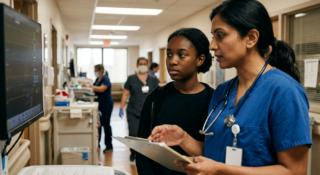
High school students ER exposure is one of the most searched and most misunderstood topics in pre-health planning. The emergency room carries a certain gravity that other clinical settings do not. It is fast, unpredictable, and intense. For a teenager considering a career in medicine, nursing, or emergency care, watching an ER team in action can be one of the most clarifying experiences available. But clarity requires honesty about what “exposure” actually means at this age, what the boundaries are, and what makes the difference between a meaningful learning experience and a wasted (or unsafe) one. A responsible medical internship for high school students in emergency settings prioritizes observation, safety protocols, and guided reflection over direct patient involvement.
This article is written for both students and parents. If you are a high school student interested in emergency medicine, or a parent trying to figure out whether ER shadowing or an ER-adjacent internship is appropriate for your teenager, the goal here is to give you a realistic picture. Not the TV version. Not the brochure version. The real one.
What ER Exposure Actually Means for a High School Student
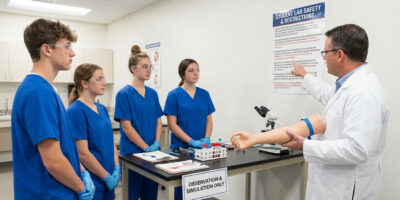
When we talk about ER exposure for teens, we are talking about structured observation. That distinction matters. High school students do not treat patients, make clinical decisions, perform procedures, or work independently in any emergency department. They observe. They watch how triage works, how teams communicate under pressure, how doctors and nurses assess a patient who just walked through the door or arrived by ambulance. They see the pace, the noise, the waiting, and the decision-making process that most people never get to witness.
In a well-run program, a student might observe an ER physician taking a patient history, watch a nurse start an IV or draw blood, see an EKG being performed, or listen while a care team discusses next steps for a trauma case. The student is not a participant in care. The student is a witness to it, and that is enough to be genuinely educational.
This is true whether the setting is a hospital in the United States or a clinical site abroad. The Bureau of Labor Statistics projects continued strong growth in healthcare occupations, which means more students than ever are seeking early clinical exposure. But the quality of that exposure depends entirely on structure, supervision, and expectations.
Why Emergency Medicine Attracts Pre-Health Students Early
Emergency medicine stands apart from other specialties in a few concrete ways that make it appealing to students still figuring out their interests. First, it is generalist by nature. ER physicians see everything: cardiac events, fractures, infections, psychiatric emergencies, pediatric cases, trauma. A student observing in the ER over even a short period will see a wider range of conditions than they would in most other departments.
Second, the pace reveals something important about clinical work that other settings often hide. Medicine involves long stretches of routine punctuated by moments of intense decision-making. The ER compresses that cycle. For a student who is trying to figure out whether clinical medicine is genuinely interesting to them, not just theoretically appealing, a few shifts in the ER can offer real answers.
IMA’s blog post on pathways to emergency medicine for high school students breaks down what students should know about this specialty and how early exposure fits into a longer plan. The key point is that exposure is not the same as commitment. You do not need to decide you want to be an ER doctor at 16. You just need to see enough to know whether this world pulls you in or pushes you away, and both answers are valuable.
What Students Will and Will Not Do in the ER
Setting expectations clearly matters for both students and parents. Here is what structured ER observation typically includes, and what it does not.
What Students Can Expect
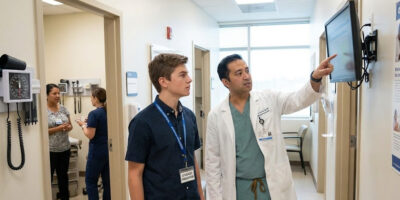
Students in a supervised program will generally shadow healthcare professionals during active shifts. They may watch the triage process, where incoming patients are assessed and prioritized based on the severity of their condition. They may observe diagnostic steps such as imaging, lab work, and physical exams. They will see how interprofessional teams communicate: how a nurse hands off information to a physician, how a physician consults a specialist, how a social worker intervenes when the patient’s needs go beyond clinical care.
In international settings, students may also observe conditions that are less common in the United States. In parts of East Africa, for example, malaria and typhoid cases present regularly. In parts of South America, respiratory infections and parasitic diseases may appear more frequently. These differences give students a broader understanding of global health, and they also raise important questions about resource allocation, prevention, and access to care.
What Students Will Not Do
Students will not diagnose patients. They will not administer medication. They will not perform procedures, no matter how minor. They will not make treatment recommendations. They will not access patient records independently, and they will not discuss patient information outside the clinical setting. These are not arbitrary restrictions. They are legal, ethical, and professional standards that protect patients, protect students, and maintain the integrity of clinical learning.
This is a point worth repeating for students who may feel frustrated by the limits of observation: your job is to learn, not to intervene. The learning itself is the value. The CDC’s National Center for Health Statistics reported approximately 130 million emergency department visits in the US in 2021 alone. Emergency rooms are high-volume, high-stakes environments, and the professionals working in them have years of training. Watching them work with full attention is not passive. It is how clinical understanding begins.
Safety, Supervision, and What Parents Should Ask
Parents are right to have questions about ER exposure for their teenagers. The ER is not a classroom. It is an active clinical environment where things can be emotionally intense, physically uncomfortable, and occasionally distressing. Any program that places minors in or near an ER should be able to answer the following questions clearly.
Who supervises the students during clinical hours, and what are that person’s qualifications? What is the student-to-supervisor ratio? What happens if a student feels overwhelmed or needs to step away? What protocols are in place for emergencies involving the student, not just the patients? Where do students stay, who manages housing, and what communication systems are in place between the program and parents?
These questions are not optional. They are the baseline for responsible programming. If a program cannot answer them specifically, that is a serious concern.
IMA’s high school internships page outlines the structure, supervision, and safety protocols students and parents can expect, including housing details, staff roles, and how communication works during the program. For parents evaluating any program, domestic or international, this kind of transparency should be the minimum standard.
Emotional Readiness Is a Real Factor
Not every 16-year-old is ready to see what happens in an ER. That is not a criticism; it is a fact. Students may witness severe injuries, acute illness, or death. They may see patients in distress, families receiving difficult news, or medical teams making rapid decisions under pressure. These moments are part of the reality of healthcare, and they deserve to be taken seriously.
Good programs prepare students for this before they ever set foot in a clinical setting. They provide orientation sessions that address what students might see and feel. They build in structured reflection time, where students can process their experiences with mentors or peers. They make it clear that feeling affected by what you witness is not a weakness; it is a sign that you are paying attention.
Students should honestly assess their own readiness, and parents should be part of that conversation. Maturity, emotional resilience, and the ability to observe without inserting yourself into a situation are all real factors. If a student is not ready this year, that does not mean the door is closed. It means waiting until the timing is right, which is a mature decision in itself.
How ER Observation Fits Into a Longer Pre-Health Plan
ER exposure is one piece of a much larger picture. It is not a checkbox on an application. Admissions committees at medical schools, PA programs, nursing schools, and other health professions programs are looking for evidence that a student understands what clinical work involves and has reflected on it meaningfully. According to AAMC guidance on clinical experiences for pre-med students, the quality and thoughtfulness of clinical exposure matters more than the sheer number of hours.
A student who spends two weeks observing in an ER and comes away with specific, honest reflections about what they saw, what surprised them, what concerned them, and how it shaped their thinking, will have more to offer in a personal statement or interview than a student who logged 200 hours but cannot articulate what they learned.
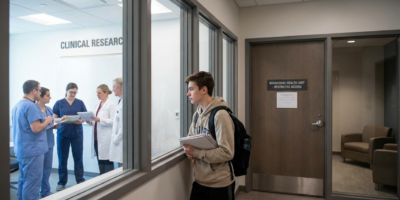
That said, ER observation works best as part of a broader set of experiences. A student might also consider shadowing in primary care, volunteering in a community health setting, or spending time in a clinical research environment. The blog post on real ways high school students can gain experience around patients walks through several options and helps students think about which combinations make sense for their interests and goals.
What to Watch Out for in ER Exposure Programs
Not all programs are equal. Some are well-structured, professionally supervised, and educationally sound. Others are vague about what students will actually do, who will supervise them, or what clinical access really looks like.
Here are some things that should raise concerns. If a program promises “hands-on” ER experience for minors, ask exactly what that means. Minors do not provide hands-on patient care in any legitimate clinical setting. If a program cannot name the supervising clinicians or describe the daily structure, that is a problem. If a program focuses heavily on the adventure or travel component and barely mentions clinical protocols, ethical standards, or safety, it may not be a serious educational experience.
Parents and students should also be cautious about programs that guarantee specific outcomes, such as a set number of clinical hours, guaranteed patient interaction, or admissions advantages. No program can guarantee admission to any school, and no ethical program would promise unsupervised patient contact for a teenager.
The right program will be specific about what students will observe, honest about the limits, transparent about supervision and safety, and focused on helping students learn rather than impressing them.
Preparing to Make the Most of ER Observation
Students who approach ER observation with preparation and intention will get significantly more out of it. Before the experience begins, it helps to read about basic ER workflow, common conditions, and the roles of different team members. You do not need to memorize medical terminology, but understanding the difference between a triage nurse and an attending physician, or knowing what an EKG measures, will help you follow what you are seeing.
During the experience, take notes. Write down what you observed, what questions came up, what you did not understand, and what affected you. These notes will be useful months or even years later, when you are writing application essays or preparing for interviews. Pay attention not only to the clinical side but to the human side: how providers communicate with patients, how they handle stress, how they make decisions with incomplete information.
After the experience, reflect honestly. Did you feel drawn to this environment, or did it confirm that a different path is a better fit? Both responses are useful. The purpose of early clinical exposure is not to lock you into a career at 17. It is to give you real information so your decisions going forward are grounded in experience, not imagination.
Frequently Asked Questions
Can high school students perform any medical procedures during ER observation?
No. High school students observe and learn in the ER; they do not perform procedures, administer treatments, or make clinical decisions. This applies to every legitimate program, whether domestic or international. Students are there to watch, ask questions during appropriate moments, and build understanding of how emergency care works.
How should parents evaluate whether an ER exposure program is safe for their teenager?
Ask specific questions about supervision ratios, the qualifications of supervising clinicians, daily structure, housing arrangements, emergency protocols, and communication systems between the program and families. A trustworthy program will answer these questions directly and in detail. If a program is vague about safety or supervision, consider that a warning sign.
Will ER observation help with medical school or other health professions applications?
ER observation can strengthen an application if the student reflects on the experience thoughtfully and can articulate what they learned. Admissions committees value genuine understanding of clinical environments over raw hours. The experience is most useful as part of a broader pattern of clinical exposure, volunteering, and academic preparation, not as a standalone credential.