High school students who are drawn to medicine often zero in on blood draws because they appear to be a clear, concrete clinical skill. Parents usually focus on the safety and liability side: who is allowed to do venipuncture, what training is required, and whether any program is promising something a minor cannot legally do. Most of that curiosity starts while families compare structured medical opportunities for high school students and try to figure out what “lab experience” really means in a teen role.
Once students understand how laboratories operate, there are still plenty of credible ways to build lab exposure without touching a needle. Many of the strongest pathways start with observation, documentation habits, and supervised, non-invasive responsibilities that mirror how clinical teams rely on lab data. Students planning ahead can also use the same pillar resources that cover high school medical internships to map which lab-adjacent options fit their age, maturity, and local policies.
What Phlebotomy Actually Is In A Hospital
Phlebotomy is not simply “drawing blood.” It is a controlled process that includes patient identification, correct labeling, chain-of-custody for specimens, infection control, and communication with the lab about which tests are ordered. A small mistake can create serious downstream problems, such as a mislabeled specimen, the wrong test result tied to the wrong patient, or delayed care because a sample has to be recollected.
In most hospitals, phlebotomists and trained clinical staff follow strict protocols for patient verification and specimen handling. That is why hospitals treat phlebotomy as a regulated clinical task, not an entry-level skill for minors to practice during an internship.
Why Blood Draws Are Usually Off-Limits For Minors
Even when a teen is mature and motivated, blood draws sit in a category that hospitals usually restrict for clear reasons: patient safety, liability, infection risk, and scope of practice rules. Venipuncture is an invasive procedure. It involves breaking the skin and handling blood, which introduces exposure risks and requires documented training and supervision standards that most teen programs are not designed to provide.
Age restrictions also matter. In many places, phlebotomy roles are tied to employment standards, clinical certifications, and occupational health policies that are written for adult staff. Some facilities set minimum ages for clinical areas or for any task involving bloodborne pathogen exposure. Because rules vary by country, state, and facility, families should treat any program that guarantees teen blood-draw experience as something to verify carefully in writing.
What “Lab Exposure” Can Mean For High-School Students
The good news is that “lab exposure” does not have to mean performing venipuncture. For teens, it usually falls into one of three categories: clinical laboratory observation, lab-adjacent support roles, or research-style experiences that build real data skills.
The most credible experiences are the ones that clearly define what the student will see, what the student will do, and who is responsible for supervision.
Clinical Laboratory Observation
Some programs can arrange observation in laboratory environments where students learn how specimens move through the system. This may include watching how samples are received, labeled, prioritized, and processed, and how results are verified and communicated back to clinical teams. Students often learn more from seeing workflow and quality control than they expect, because they start to understand how much of medicine depends on accurate lab data.
In many hospitals, access to lab spaces is restricted, so observation may occur from designated areas or through scheduled walk-throughs rather than full shifts. That is still valuable if the program includes explanation from staff and time for questions.
Lab-Adjacent Support Roles That Are Realistic For Teens
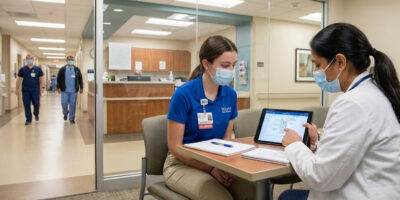
Some teen roles are not inside the lab but still teach how lab work connects to patient care. Examples include supporting front-desk flow in clinics that frequently order labs, assisting with patient directions and check-in, or helping organize patient education materials that explain why labs are ordered and how patients should prepare.
These roles can feel less exciting than “phlebotomy,” but they are often more accessible and more consistent over time. They also build reliability, which is one of the biggest factors hospitals look for when deciding whether a teen can be trusted with higher-responsibility observation later.
Simulation And Skills Practice Without Patients
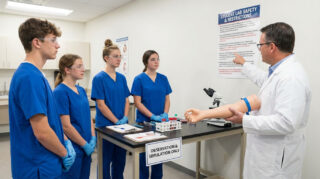
If a student is interested in technical skills, the safest place to learn mechanics is a simulation. Some structured programs teach concepts such as sterile technique, safe glove use, and taking basic vital signs under direct supervision. That does not replace phlebotomy training, but it builds a practical foundation and shows that the student respects clinical boundaries.
A key distinction is where the “hands-on” happens. Skills practice should be on models, training tools, or peers in controlled settings, not on patients.
What Teens Should Watch For In Programs That Mention Phlebotomy
Because “hands-on” marketing can be vague, families should look for specific, concrete descriptions of boundaries. A credible program will plainly state that minors do not perform blood draws and will explain what lab-related learning replaces that.
Here are a few questions that quickly clarify whether a program is structured or just using buzzwords:
- Who is the supervising professional responsible for the student at all times in clinical areas
- Will the student be observing lab workflow, clinic workflow, or both
- How are privacy and consent handled in any area where patient identifiers may be visible
- What tasks are explicitly prohibited for minors, including venipuncture and specimen handling
- What training is required before the student enters any clinical setting
If the answers feel fuzzy, that is usually a sign that the experience is not designed with teen boundaries in mind.
Building A Lab-Focused Profile Without Drawing Blood
Students who want future lab or diagnostic careers can build a strong foundation in high school without ever performing phlebotomy. The most effective approach is to stack experiences that reinforce one another: academic preparation, credible exposure, and a record of disciplined follow-through.
Academic preparation matters here in a very practical way. Chemistry, biology, and statistics show up constantly in lab medicine. Students who take those courses seriously can connect what they learn in class to what they observe in clinical settings. They also tend to ask better questions when they are watching lab workflows or reading about diagnostic tests.
Consistency matters just as much. A student who shows up weekly for a clinic support role for six months often earns more trust than a student who attends one short “lab day.” Over time, staff are more willing to explain processes, point out interesting cases in a privacy-safe way, and suggest additional opportunities.
Documentation also separates serious students from casual ones. Keeping a clean log of hours, dates, departments, and general learning points makes it easier to describe lab exposure accurately later, without exaggerating what happened.
How Our Programs Approach Lab Exposure
In our programs at International Medical Aid, lab exposure for teens is designed around supervised observation and clear limits. Students may observe how diagnostics support care across departments, and any technical skills practice is kept in simulation-style learning rather than performed on patients. The goal is to show how lab medicine fits into real clinical decision-making while maintaining boundaries that protect patients and students.
Next Steps
If a high-school student is specifically interested in phlebotomy, the most realistic plan is usually to treat high school as the preparation phase: learn how labs work, build strong science habits, and gain credible clinical exposure that respects scope limits. Then, when age and local requirements allow, the student can pursue formal phlebotomy training through approved programs that include the correct supervision and certification pathways.
For now, focus on the question that actually predicts future success: not “Can I draw blood yet,” but “Am I building the knowledge, reliability, and clinical awareness that labs and hospitals reward when I am eligible.”