High school students who care about medicine are constantly told to “get hours.” Volunteer at a hospital. Help in the community. Join every club you can. That advice can turn into a confusing checklist of unrelated activities that feel busy but not meaningful. A better approach is service-learning, where community work is designed, supervised, and reflected on like a real course, not just a sign-in sheet. For teens who want their effort to matter now and in the future, service-learning can sit alongside more traditional paths like high school medical internships as a powerful way to grow.
Once you examine how health education programs use service-learning in college and medical school, a pattern emerges. The most effective projects combine academic learning, genuine community needs, and structured reflection so students actually change the way they see patients and systems, not just how many hours they log. High-school students can borrow that same model on a smaller scale.
Why Service-Learning Beats One-Off Volunteering
Traditional volunteering is usually task-focused. You show up, hand out items, clean a space, or help staff with small jobs. That work can be meaningful, but the learning is mostly accidental. Service-learning adds two elements: clear learning goals and built-in reflection. Organizations like the American Red Cross and national youth programs describe it as using academic and civic skills to meet a real community need while tying the experience back to what students are studying.
In healthcare settings, that means you are not just “helping at a clinic.” You are deliberately connecting what you know about biology, public health, communication, or ethics to what you see on site. Instead of scattering your energy across unrelated volunteer roles, you stay with a smaller number of carefully chosen projects long enough to see patterns, consequences, and outcomes.
Research on health-related education shows that service-learning can improve academic learning, professional responsibility, and understanding of health disparities when intentionally and reflectively implemented.
For future pre-med or health-professional applicants, that difference matters. Admissions committees consistently say they care more about depth and impact than about raw hour counts. Service-learning makes it easier to tell a coherent story about what you did, why it mattered, and how it changed you.
What Service-Learning In Healthcare Looks Like For Teens
Service-learning in healthcare for high school students usually focuses more on public health and support than on direct clinical care. You are not diagnosing or treating patients. Instead, you are helping address real needs around education, access, or daily barriers to staying healthy.
One example might be a semester-long project tutoring younger children with asthma at an after-school program, paired with reading about pediatric asthma, health literacy, and environmental triggers. You might learn how inhalers work in science class, see how often kids forget or misuse them in the program, and design a simple teaching tool to close that gap. Over time, you would track attendance, collect simple feedback, and reflect on what is changing and what is not.
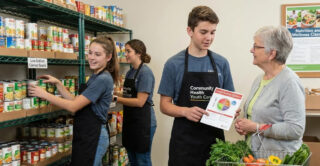
Another example could be supporting a food bank or community-kitchen program that serves patients from a local clinic. Service-learning here would mean more than handing out boxes. You might look at how food insecurity affects diabetes or heart disease, talk with clinic partners about what they see, and help create basic information sheets or short workshops that explain healthier choices using ingredients the food bank actually stocks.
In some cases, schools and community partners build formal courses around this work. In others, motivated students work with a teacher, counselor, or club advisor to turn an existing volunteer role into a more structured service-learning project, with agreed-upon goals and check-ins. Either way, the key features are consistent: real service, real need, and real thinking about what you are learning.
How Service-Learning Builds Skills Healthcare Schools Actually Care About
Service-learning is not just “volunteering with extra homework.” Properly designed projects build exactly the kinds of competencies that health-professions programs use to evaluate applicants.
On the academic side, studies in medical and health professions education link service-learning to a deeper understanding of course content and a more confident use of knowledge in real-world situations. When you have to explain a concept to patients, families, or children, you quickly discover what you do and do not truly understand.
On the personal and professional side, service-learning supports growth in communication, teamwork, leadership, and cultural awareness. Projects in underserved communities, in particular, help students see how social factors like housing, transportation, language, and income shape health, not just biology. That kind of insight directly maps onto the “service orientation,” “cultural competence,” and “social skills” competencies that organizations such as the AAMC highlight for future medical students.
When you combine these pieces, a strong healthcare service-learning project gives you:
- A specific community or patient-centered need you tried to address
- A record of what you actually did over time
- Evidence that you can work with others and handle responsibility
- A deeper understanding of health beyond textbook cases
Those elements make for stronger essays, interviews, and recommendation letters later on, whether you apply to pre-med programs, nursing, public health, or other allied-health paths.
Designing A Healthcare Service-Learning Project In High School
You do not need a formal course to benefit from service-learning, but you do need some structure. A useful way to design a project is to move through four simple stages: listening, planning, doing, and reflecting.
Listening comes first. Before deciding what you want to “fix,” talk with people who already work in the space. That might mean meeting with a clinic social worker, a school nurse, a community-health worker, or staff at a nonprofit. Ask what challenges they see repeatedly and what kind of help would genuinely support their work. Guidance documents for students working in communities emphasize entering with humility, respect for local knowledge, and a willingness to learn before acting.
Planning is next. Once you understand a specific need that is realistic for a high-school student to address, work with your partner and a teacher or advisor to define what you will do and what you hope to learn. Will you run weekly sessions? Help redesign materials. Organize logistics for recurring events. At this stage, it helps to pick one or two goals to measure progress, such as attendance, completion of a curriculum, or participant feedback.
Doing is the visible part, but it should feel different from a drop-in volunteer role. You show up on a regular schedule, stick with the same population or site, and adjust based on what you see. Research on service-learning in health education shows that sustained engagement over weeks or months is what leads to deeper learning, not one-time events.
Reflection ties everything together. After each session or at defined checkpoints, take time to write or talk about what happened. What surprised you? What worked. What felt uncomfortable. How did the experience change your understanding of health, community, or your own strengths and limits? Programs that build in regular reflection show stronger growth in students’ judgment and sense of responsibility than programs that focus solely on hours.
Keeping Healthcare Service-Learning Ethical And Safe
Any time teens step into health-related work, even at the edges, ethics and safety have to stay at the center. National guidelines for student clinical experiences stress that the primary purpose of these experiences is observation, not hands-on treatment, and that untrained students should not perform procedures on patients.
For service-learning, that means your role should stay firmly on the side of education, support, and non-clinical help. You might explain a handwashing poster, help families navigate clinic logistics, run a health-themed activity for younger students, or help connect people to resources. You should not be drawing blood, giving injections, handling medications, or presenting yourself as a provider.
Projects should also respect privacy. You do not need names or identifying details to learn from what you see. If you keep a reflection journal, keep it generic and never post stories or photos from health settings online without explicit, written permission. Colleges and professional schools increasingly screen applicants who exaggerate or cross ethical boundaries in their early experiences. Staying conservative now protects both the people you serve and your own future applications.
How Service-Learning Connects To Internships And International Programs
Service-learning and more traditional clinical exposure do not compete; they reinforce each other. A student who spends a year helping at a community health program and then joins a supervised hospital-based internship will arrive with a much stronger sense of context. They will notice how social and economic factors shape what they see on the wards, not just the biology.
Our programs at International Medical Aid are built around that connection. Students spend part of their time observing in hospitals and clinics and the rest participating in well-planned community-outreach activities that resemble service-learning: health education sessions, preventive campaigns, and partnerships with local organizations. Those experiences are paired with structured reflection on global health, ethics, and social determinants of health so that teens do not just “do activities,” but think critically about who benefits, what could be improved, and how their own future roles might contribute.
Documenting Service-Learning For Future Applications
The way you record and describe service-learning will determine how powerful it appears later. Rather than listing separate volunteer roles with a few words each, consider grouping them into a single, coherent project with a clear purpose and outcome. Application systems for health-profession schools emphasize quality, impact, and reflection over sheer quantity of entries.
When you log your experience, include:
- Where you served and with whom
- How long were you there, and how often do you participate
- What specific problem or need were you addressing
- What changed over time, even in small ways
- What you learned about yourself and about healthcare
Those notes will make it much easier to write future “most meaningful experience” essays, talk with advisors, or answer interview questions about service orientation and commitment to underserved communities.
Next Steps For Teens And Parents
If you are a student, the best first move is to look at what you are already doing or what is available in your community and ask, “Could this be turned into a service-learning project instead of just scattered hours?” Talk with a teacher, counselor, or club advisor about building a simple structure around one health-related role you either have or want to explore.
If you are a parent, look for programs that focus on reflection, learning goals, and community partnerships, not just hours and travel. Ask how teens are supervised, what kinds of tasks they will perform, and how the program ensures that community needs drive the work, not just student résumés.
Over the course of high school, a small number of well-chosen service-learning experiences in healthcare can shape your understanding of patients, systems, and your own strengths far more than a long list of disconnected volunteer positions. Combined with thoughtful clinical exposure and, when appropriate, supervised international programs, they give you the kind of grounded, ethical foundation that future healthcare training will expect.