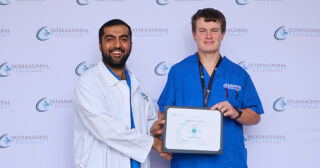
A pre-PA internship in Kenya gave Nate Homsey, a 2025 University of Delaware graduate who works as a firefighter and EMT, his first month of shadowing physicians. At Coast General Teaching and Referral Hospital in Mombasa, he rotated through internal medicine, emergency, surgery and an HIV/AIDS care unit, then joined community clinics. This is his story.
For aspiring healthcare providers, every shadowing hour, clinical encounter and patient story matters. Competitive programs for medical school, nursing or physician assistant studies expect more than strong grades. They want students who can demonstrate adaptability, cultural sensitivity and the ability to connect classroom theory with real-world patient care. If you are still learning how these placements work, our guide to what a physician assistant internship is and how to get one is a good place to start.
For Nate Homsey, a recent graduate of the University of Delaware’s College of Health Sciences, the search for those experiences led him thousands of miles away from home. After earning his degree in medical diagnostics with a pre-physician assistant concentration, Nate decided that the best way to prepare for PA school was not only to continue his service as a firefighter and EMT in Pennsylvania but also to spend a month in Kenya with International Medical Aid’s program for medical shadowing abroad.
The decision marked a turning point. Previous trips abroad had been vacations in Europe. This time, Nate chose to spend his summer working alongside physicians in Coast General Teaching & Referral Hospital in Mombasa, one of Kenya’s busiest teaching hospitals. His goal was clear: gain meaningful shadowing hours, serve communities with limited access to care, and grow into the kind of healthcare professional PA programs look for.
“Some of the world’s most vulnerable populations are severely underserved,” Nate explained. “I wanted to travel and help people who don’t have good access to high-quality healthcare.”
What followed was four weeks of intensive learning in the wards, eye-opening experiences in rural clinics, and cultural immersion that reshaped his outlook on both medicine and life.
Key Points
- Where: Coast General Teaching and Referral Hospital in Mombasa, a 723-bed county and regional referral hospital, plus rural community clinics.
- Rotations: internal medicine, emergency medicine, surgical wards and the comprehensive care unit for HIV/AIDS treatment.
- What he did: shadowed physicians, took part in rounds and presented a case, and took vitals and patient histories under supervision.
- What he brought: years as a firefighter and EMT, plus a medical diagnostics degree that made lab values familiar.
- What he took home: shadowing hours for PA school, stories for essays and interviews, and a clearer picture of the provider he wants to be.
Why Kenya Was the Right Fit
When students begin mapping out their journey toward healthcare careers, one of the first challenges is building a competitive application. PA programs in particular place a heavy emphasis on shadowing, and many ask for direct observation of physicians and physician assistants in clinical practice. Our guide to how many shadowing hours schools expect explains why programs care about this time. While students in the U.S. can sometimes find shadowing opportunities in hospitals or private practices, placements are often limited, competitive and focused on only a narrow range of cases.
For Nate, the opportunity to work in an international teaching hospital promised something different: breadth, depth and diversity of experience.
He arrived in Mombasa just weeks after walking across the graduation stage at Delaware, diploma in hand. His academic preparation had been rigorous. The medical diagnostics curriculum required mastery of subjects like hematology, clinical chemistry, immunology and blood banking. These courses gave Nate a technical foundation, but he knew that PA school admissions committees would want to see how he applied that knowledge in a clinical setting.
That’s where IMA’s Kenya internship came in. Designed for students like Nate who are motivated and academically prepared but in need of robust clinical exposure, the program provided placements at Coast General, community outreach opportunities and mentorship from seasoned healthcare providers.
The decision to go abroad also reflected Nate’s service-oriented mindset. As a firefighter and EMT, he was accustomed to responding to emergencies, providing immediate care and supporting vulnerable people in moments of crisis. Taking that experience to Kenya meant scaling it to a new environment, one where patients often traveled hundreds of miles for care and where diseases he had only read about in textbooks were part of the daily caseload.
This mix of academic preparation, service background and a drive to expand his horizons made Kenya the right choice. It was an environment where he could both contribute and grow, learning from physicians in resource-limited settings while offering the perspective of someone who had already worked in emergency response.
Immersion in a Teaching Hospital
The centerpiece of Nate’s internship was his rotation at Coast General Teaching & Referral Hospital, a sprawling public institution that serves as both a clinical training ground and a lifeline for the people of Mombasa and surrounding regions. The hospital is the largest in the area and a referral point for complex cases, meaning patients arrive with a wide range of conditions, from common infections to advanced diseases requiring specialized interventions.
For Nate, this was his first formal experience shadowing doctors, and it immediately underscored the differences between theory and practice.
Rotations Across Departments
He spent time in multiple departments, including internal medicine, emergency medicine, surgical wards and the comprehensive care unit focused on HIV/AIDS treatment. Each rotation brought new lessons and new challenges. In internal medicine, he observed the careful process of building differentials, analyzing lab values and developing treatment plans with limited resources. In the emergency unit, the pace was faster, with patients arriving in critical condition from road accidents, severe infections or cardiac events.
The HIV/AIDS unit exposed Nate to the deep intersection between medicine and society. He learned that many patients traveled from rural towns to seek care in Mombasa, often because of stigma in their own communities.
Grand Rounds and Active Participation
One of the defining features of teaching hospitals is the tradition of grand rounds, structured discussions where physicians, interns and students present patient cases, review lab findings, debate differentials and consider treatment strategies. For Nate, participating in these sessions was a turning point. He not only listened to senior physicians work through complex cases but also presented an entire round himself.
“I advocated for myself and actively participated in rounds and patient care,” he said. “I learned how to take vitals in a meaningful way and how to take an enhanced patient history.”
For a pre-PA student, experiences like these are invaluable. They build the kind of critical thinking, communication and confidence PA school requires, and that is the purpose of IMA’s pre-PA internships, but in an environment where diseases, resource limitations and cultural dynamics present unique challenges.
Bridging Classroom and Clinic
What stood out to Nate was how much his academic training informed his hospital experience. Concepts that once lived in lecture notes, such as hematology, clinical chemistry and blood banking, suddenly became essential in understanding patient cases.
“I was ahead of my peers when it came to diagnostics and understanding medical terms, which gave me confidence,” he reflected. “It was interesting to see the lab values I learned in school in a hospital setting and how they apply to a patient’s diagnosis.”
That confidence, built on a solid academic foundation, allowed him to contribute meaningfully to discussions and absorb even more from the physicians guiding him.
By the end of his month in Mombasa, Nate had not only logged coveted shadowing hours but also developed a richer, more nuanced view of healthcare, one where adaptability, resourcefulness and cultural humility were just as important as scientific knowledge.
Confronting the Realities of Global Health
Working in an under-resourced hospital in Kenya meant seeing medicine practiced under circumstances very different from those Nate was used to as an EMT in Pennsylvania. In the U.S., patients expect access to advanced imaging, routine bloodwork and specialists for nearly every condition. At Coast General, care had to be more direct, creative and resourceful.
Diseases Rarely Seen in the U.S.
Nate encountered patients with illnesses he had only read about in textbooks. Malaria, for example, was a daily reality. Physicians at Coast General diagnosed and treated it constantly, often in patients who had delayed seeking care until symptoms were severe. Tuberculosis, hepatitis and dengue fever were also common. Each disease required careful clinical judgment, particularly when diagnostic tools were limited.
In addition to infectious diseases, Nate also saw the consequences of chronic conditions in patients who lacked regular care. Hypertension and cardiac complications often presented late, when damage was already advanced. For a pre-PA student, these cases underscored how social determinants of health, such as income, geography and stigma, can have just as much impact as biology.
The HIV/AIDS Unit and the Weight of Stigma
The comprehensive care unit for HIV/AIDS patients made a lasting impression on Nate. He observed not only the medical complexity of managing the virus but also the emotional burden carried by patients. Many had traveled hundreds of miles to seek treatment at Coast General, deliberately avoiding clinics closer to home where they feared being recognized.
Nate explained: “Patients traveled hundreds of miles to attend this free clinic because they didn’t want to be seen by clinics in their hometown due to the stigma. But they were so grateful for the care.”
This insight revealed a side of medicine that goes beyond charts and lab values. Even the best treatment plans can fail if patients are too ashamed or afraid to seek care. Learning this lesson early gave Nate an understanding that will shape his approach as a future PA: treating patients means addressing their medical condition and the social realities that surround it.
Limited Resources, Unlimited Determination
Resource limitations were a daily reality at Coast General. Not every test could be run, not every imaging scan ordered, and not every drug was immediately available. For U.S. students accustomed to extensive hospital resources, this was an important shift in perspective. Physicians had to be precise and thoughtful with what they ordered, often relying heavily on clinical judgment, patient history and basic diagnostics.
Rather than discouraging him, this environment motivated Nate. He learned that healthcare providers in resource-limited settings must think creatively, adapt constantly and make every decision count. Those lessons in adaptability are exactly what PA programs hope to see in applicants, because adaptability is what defines effective providers.
Much of that frontline work in Kenya is carried by professionals with no exact U.S. equivalent. Our overview of clinical officers in Kenya explains a role that future PAs often find especially interesting to watch.
Lessons in Compassion and Resilience
While Nate gained extensive technical exposure in Mombasa, some of the most profound lessons were emotional. Observing patients in critical condition and witnessing life-and-death moments reshaped his understanding of what it means to be a healthcare provider.
The Head Trauma Patient
One case stands out in particular. In the emergency and casualty unit, Nate observed a patient with severe head trauma. Physicians attempted a bedside procedure to reduce swelling, a moment that brought Nate closer than ever to the intensity of hospital medicine. Despite the team’s efforts, the patient did not survive.
“For the first time, I observed a bedside procedure to reduce swelling in a patient with severe head trauma,” Nate shared. “We lost that patient, and I never even got to speak to him. I visited him in the morgue and will always remember that patient.”
The loss was sobering. For Nate, it was not just about observing medicine but also grappling with the reality that not every story ends in recovery. It was a reminder that healthcare providers carry both the victories and the heartbreaks of their work.
Carrying Stories Forward
For many students, the first patient death they witness is an inflection point. It forces reflection on resilience, empathy and the importance of human connection in medicine. Nate internalized the lesson quickly: “It’s a reminder to advocate for patients and a reflection that everything we do as healthcare providers matters.”
This reflection will serve him well in PA school and beyond. Admissions committees consistently emphasize that they want applicants who not only understand the science but also grasp the human dimension of medicine. Nate’s story of visiting the morgue, honoring the patient’s life and carrying that experience forward is precisely the kind of maturity that distinguishes a strong applicant. Our guide to getting into PA school covers how experiences like this fit the rest of an application.
Comparing EMT Work and Hospital Practice
As an EMT, Nate was no stranger to emergencies. He had responded to motor vehicle accidents, cardiac arrests and community crises back home. But the structure of hospital care was different. Rather than stabilizing a patient for transfer, as he would in the field, Nate now saw the continuum of care: how diagnostics, interventions and follow-up unfolded in a hospital environment.
This gave him a new appreciation for the interconnectedness of healthcare roles. EMTs, nurses, physicians and PAs all play a part in the system. Witnessing that system in Kenya, with limited resources and immense patient need, reinforced how essential teamwork and compassion are across every stage of care.
Building on EMT and Firefighter Skills
Nate’s years of experience as a firefighter and EMT were more than just résumé lines. They were formative experiences that shaped how he approached his time in Kenya. While he arrived at Coast General as an intern eager to learn, his background in emergency response meant he wasn’t starting from zero.
Confidence Under Pressure
Emergency medical technicians are trained to remain calm in high-stakes situations. Nate’s training translated directly into his ability to observe and engage meaningfully in Coast General’s casualty unit, where trauma and critical care cases often arrived one after another.
“My background in emergency medicine as an EMT made me valuable to the doctors there,” he explained.
Even though his role was primarily observational, Nate’s familiarity with triage, patient stabilization and medical terminology made him an asset to the teams he shadowed. Rather than being overwhelmed by the pace and intensity, he felt at home in environments where quick thinking and composure were essential.
Transferable Skills
Working as an EMT had taught Nate the basics of vital signs assessment, patient communication in urgent settings and the importance of rapid but careful decision-making. In Kenya, these skills gave him confidence when taking vitals, conducting patient histories or following the reasoning behind a physician’s treatment plan.
It also gave him perspective. In the U.S., EMTs focus on stabilization and transfer to a higher level of care. In Mombasa, Nate was able to see what happened next: how physicians developed diagnoses, pursued interventions and followed patients through recovery or, in some cases, through end-of-life care. That continuity deepened his appreciation for the interconnected roles in healthcare.
Balancing Learning and Contribution
For Nate, one of the key lessons of the internship was learning when to contribute and when to step back. His EMT skills made him comfortable in emergencies, but he was careful to remember his role as a student in a different healthcare system. By balancing humility with confidence, he built strong relationships with physicians, residents and fellow interns.
This balance of contributing when possible and observing when necessary is a hallmark of professional maturity. It’s also exactly the adaptability PA programs look for when reviewing applicants. Students who want to think through that balance before they go will find our guide to ethical engagement in global health useful.
Beyond the Hospital Walls: Community Health Outreach
One of the defining features of IMA’s pre-PA program is that it extends beyond hospital rotations. While Coast General provided Nate with invaluable clinical exposure, it was in rural villages and community clinics that he saw another side of medicine, one rooted in prevention, education and accessibility.
Rural Outreach Clinics
On weekends, Nate traveled with IMA staff and fellow interns to villages where formal healthcare infrastructure was limited or nonexistent. Clinics were set up in schools, community centers or even outdoor spaces, bringing medical care directly to people who otherwise might never see a physician.
For Nate, these experiences were eye-opening. Patients arrived with untreated infections, chronic conditions or basic needs that had gone unaddressed for years. Sometimes, a simple wound cleaning or a course of antibiotics made an immediate and visible difference. In other cases, patients were referred to hospitals for follow-up care that could not be provided on-site.
The communities’ gratitude was striking. Many villagers had walked long distances to attend the clinics, eager for any opportunity to receive care. For Nate, it was a reminder of the privilege of access that many in the U.S. take for granted.
Health Education as Preventive Medicine
Community outreach was not limited to treating immediate conditions. IMA also emphasized health education, recognizing that prevention is as critical as intervention. Nate and his peers helped deliver sessions on hygiene practices, menstrual health education for girls and mental health awareness.
These sessions were often interactive, with students and villagers asking questions, sharing personal experiences and discussing cultural beliefs around health. For Nate, participating in these conversations highlighted the importance of cultural sensitivity. Delivering health education requires not only medical knowledge but also respect for local traditions and practices.
Seeing the Broader Picture of Global Health
The rural outreach reinforced a lesson Nate had already begun to learn at Coast General: healthcare is about more than just hospitals and doctors. Public health measures, education and access are equally critical to community well-being.
“IMA has a prominent presence in the community,” Nate said. “It was fulfilling to bring high-quality care to patients who’ve never seen a hospital or a doctor before.”
These experiences helped him appreciate the dual mission of IMA: providing clinical exposure for interns while delivering tangible benefits to underserved populations. It goes beyond just shadowing physicians and into the opportunity to contribute to a model of healthcare that seeks to empower communities.
Coast General Teaching & Referral Hospital (CGTRH)
While rural clinics exposed Nate to community-based health challenges, his hospital rotations reminded him of the importance of large teaching institutions in Kenya’s healthcare system.
Formerly known as Coast Province General Hospital, it is one of Kenya’s largest and most significant public healthcare institutions. According to the hospital’s own history, it was founded in 1908 as the native civil servant hospital in Makadara, moved to its current location in 1957 and was inaugurated on March 29, 1958. In 2019, an executive order and act of the Mombasa County Government renamed it Coast General Teaching and Referral Hospital.
Today, CGTRH is a Level 5 referral and teaching hospital with 723 beds. It serves a primary population of about one million people and a secondary population of about three million across Kenya’s coastal region, which is why patients arrive from far beyond Mombasa itself.
Its infrastructure includes Accident & Emergency for adults and children, surgical and medical ICUs, a high-dependency unit, main and minimal access theaters, a cancer center, a cardiac cath lab, a renal dialysis unit and a maternity wing with a newborn unit. As both a teaching and referral hospital, CGTRH also plays a central role in training Kenya’s future healthcare professionals while delivering critical, affordable care to its communities.
What a Pre-PA Internship in Kenya Includes Today
Nate’s month followed the same basic structure IMA’s pre-PA program uses now, and the program page sets out what a new intern can expect. Interns shadow physicians and other clinicians at Coast General, usually moving to a new department each week. In Mombasa, departments open to interns include emergency medicine, surgery, internal medicine, pediatrics and obstetrics. Hospital days run six to eight hours on weekdays.
Lectures, clinical simulations and community clinics fill the rest of the week, along with health education in schools and a weekly cultural activity. The Kenya program runs year-round for stays of 2 to 12 weeks, so a student can choose a two-week introduction or, like Nate, a full month. Our guide to choosing a clinical internship length compares the options week by week.
Support is built in. Interns live in a gated residence with three meals a day and daily transport to the hospital, and staff are on call 24/7. IMA has maintained a 100% safety record for all high school and pre-health interns. For a day-by-day picture of the site, see what a supervised week in a Kenya medical internship looks like.
What Can Pre-PA Interns Do at the Hospital?
Under the supervision of licensed clinicians and within their training level, IMA interns take part in direct patient care. They take vital signs, help with patient intake and triage, conduct basic patient interviews and assist with noninvasive tasks, alongside ward rounds, department rotations, clinical simulations and community outreach. They do not diagnose, prescribe or perform invasive procedures.
The pre-PA program page adds a detail that mattered in Nate’s case: interns who already hold a certification, such as EMT or phlebotomy, may be invited to do more, and they stay within that training. The host hospital and local rules set the limits, and the supervising clinician decides what each student may help with on a given day.
How Are the Hours Documented?
IMA logs hours by date, department and shift. Supervisors sign the log, and IMA’s U.S.-based Medical Director validates it. That record is what you will draw on when you enter the experience in your application, so keep your own notes alongside it: the departments you rotated through, the cases you learned from and what you did in each setting. For a closer look at the Mombasa hospital from a pre-PA point of view, read our guide to pre-PA shadowing in a Kenya hospital.
How Nate’s Experience Fits a CASPA Application
PA applicants enter their experiences in CASPA, and the category you choose matters, because programs set minimums for some categories and not others. CASPA’s own experience definitions are a useful starting point, though CASPA notes that each program’s definitions and requirements can differ.
| CASPA category | CASPA’s definition, in short | How it applies to a month like Nate’s |
|---|---|---|
| Shadowing | Time spent officially following and observing a health care professional at work, preferably in the PA field | Most hospital hours spent following physicians |
| Healthcare Experience | Paid or unpaid work where you are not directly responsible for a patient’s care but may have patient interaction, such as taking vitals | Supervised tasks such as vitals, depending on the program |
| Patient Care Experience | Work where you are directly responsible for a patient’s care, for example as an EMT, paramedic, CNA or phlebotomist | Nate’s EMT work at home, not his student role abroad |
Does Shadowing Abroad Count for PA School?
Shadowing abroad can be entered as shadowing in CASPA, but programs decide how much weight it gets. Some want a minimum number of hours with a PA specifically, so a month spent mostly with physicians may need to be paired with PA shadowing at home. Read each program’s requirements before you apply, and describe your role exactly as it was. Our guide to describing shadowing abroad in CASPA walks through each entry field.
Where Do EMT Hours Fit?
Nate’s years as an EMT are the kind of work CASPA lists under Patient Care Experience, and they are likely to carry more weight for his application than any single month abroad. Students without a certification have other routes to those hours, which we cover in how to get patient care hours for PA school without a certification. For how programs weigh direct care, see direct patient care hours and your competitive edge.
How Should You Write About an Experience Like This?
The strongest essays use one specific moment, like Nate’s patient with head trauma or the HIV/AIDS patients who traveled to avoid stigma, and explain what it changed in how you think. Name your role plainly, credit the clinicians who taught you and avoid suggesting you treated patients on your own. Our guide to international clinical hours for PA school covers how admissions committees read this kind of experience.
Experiencing Kenya Beyond Medicine
While Nate’s internship centered on rotations at Coast General and community outreach, his month in Kenya also offered moments of discovery outside the hospital. Experiencing Kenyan culture firsthand gave him a deeper understanding of the context in which healthcare is delivered and allowed him to connect with peers in ways that will stay with him for years.
Safaris and Natural Wonders
On weekends, Nate joined fellow interns on trips that showcased the natural beauty of Kenya. In Nairobi National Park, he saw wildlife against the backdrop of a modern city. In the Maasai Mara, he witnessed the Great Migration, where wildebeests and zebras move in staggering numbers across the plains.
“There were hundreds of thousands of animals on the move with wildebeests and zebras as far as the eye can see,” Nate recalled.
These experiences weren’t just tourist excursions. They were opportunities to reflect, bond with other interns and appreciate the richness of a country that had welcomed him. For many students, these shared experiences become just as memorable as the hospital rotations themselves, cementing friendships that extend well beyond the internship.
Cultural Exchange
Equally important were the day-to-day cultural interactions. Nate shared meals with local physicians and interns, learned about Kenyan traditions and exchanged stories about life back home. From trying regional dishes to settling into the rhythms of Mombasa, each interaction deepened his sense of connection.
Cultural immersion is a vital part of IMA’s philosophy. By engaging fully with local communities, interns build not only clinical skills but also the cultural humility necessary for future healthcare providers. Nate’s willingness to listen, observe and participate enhanced his overall growth.
Preparing for PA School and Beyond
By the time Nate boarded his return flight, he carried more than just a collection of shadowing hours. He brought back confidence, perspective and a renewed commitment to his career goals.
Building a Competitive Application
Shadowing physicians in the U.S. can be challenging to arrange and often limited in scope. Nate’s month in Kenya gave him broad shadowing exposure, from internal medicine rounds to surgical cases and community outreach. These experiences will help with PA school shadowing expectations and also give him compelling stories to share in essays and interviews.
Admissions committees look for applicants who understand healthcare beyond the classroom. Nate’s reflections on treating patients with dignity, advocating for the underserved and adapting to limited resources show maturity and insight that will set him apart.
Humanizing Patient Care
One of Nate’s most important takeaways was the importance of human connection. He emphasized calling patients by their first names rather than referring to them by their conditions. For him, this small act became a way to humanize the doctor-patient relationship and reinforce trust.
“Shadowing in the hospital in Kenya gave me perspective and opened my eyes to different patient populations,” Nate said. “It also taught me compassion and the importance of calling patients by their first names and not by their condition.”
These lessons in empathy will continue to guide him through PA school and into practice.
Long-Term Aspirations
Nate’s internship also helped clarify his long-term vision. Beyond PA school, he hopes to return to Kenya or join organizations such as Doctors Without Borders, providing care in conflict zones and underserved areas. His month with IMA not only prepared him academically and professionally but also inspired a broader commitment to global health service.
The timing fits a growing profession. Every October, PA Week highlights how physician assistants extend care, and our PA Week guide to the PA workforce looks at where PAs work and how students can explore the career.
Advice for Future Interns
As Nate reflected on his time in Kenya, he offered advice for students considering similar opportunities.
“Go in with an open mind, ask questions, and learn as much as you can about their culture and the way they provide medical care so you can merge your existing clinical knowledge with real-world experience,” he advised.
Practical Preparation
Future interns should prepare both academically and personally. A strong foundation in coursework, diagnostics, anatomy and public health makes it easier to contribute meaningfully. But just as important is preparing for the emotional challenges of shadowing in resource-limited settings, where not every patient survives and where systemic barriers complicate care.
A few practical steps help:
- Review the departments you are likely to rotate through and the conditions common in coastal Kenya, such as malaria, tuberculosis and HIV.
- If you hold a certification, bring proof of it and ask IMA before you travel what, if anything, you may be invited to help with.
- Plan how you will record each day: department, cases you learned from, what you did and questions you want to follow up on.
- Think ahead about how you will handle a patient death or a case that stays with you, and who you will talk to about it.
- Read the PA programs’ shadowing and experience requirements before you go, so you know what to log.
Embracing Cultural Humility
Nate emphasized the importance of cultural humility. Students must be ready to listen, respect local practices and adapt. Successful interns are those who arrive not to impose their perspective but to learn from a different healthcare system and the patients it serves.
Making the Most of the Experience
Finally, Nate encouraged students to take full advantage of every opportunity. Whether it was participating in rounds, observing a bedside procedure or leading a health education session in a rural school, each experience contributed to his growth. The more interns invest in their time abroad, the more they carry forward into their professional journeys.
Final Thoughts
Nate Homsey’s month in Kenya with International Medical Aid was more than just an internship. It bridged the gap between academic preparation and professional readiness. At Coast General Teaching & Referral Hospital, he gained shadowing hours, observed diseases rarely seen in the U.S. and participated in grand rounds that built his clinical confidence. In rural villages, he engaged in health education and community outreach that highlighted the importance of public health. And through cultural immersion, he built friendships and perspective that will last a lifetime.
For Nate, the experience confirmed his path toward becoming a physician assistant and deepened his commitment to serving underserved communities at home and abroad.
“It was so fulfilling to help patients who need it most,” he said. “Every day reminded me why I want to be a PA and work in underserved communities.”
Nate’s story reflects the mission of IMA: preparing future healthcare providers with skills, empathy and cultural sensitivity while delivering meaningful care to those who need it most.
For students considering their next step, Nate’s journey is proof that an IMA internship in Kenya can be the bridge between classroom knowledge and a career dedicated to making a difference.
Nate’s story has also been featured by the University of Delaware’s UDaily, which profiled his experience in Kenya and highlighted how his background in medical diagnostics and emergency response shaped his internship with International Medical Aid (UDaily, September 23, 2025).
Frequently Asked Questions
What Did Nate Do During His Pre-PA Internship in Kenya?
Over four weeks at Coast General Teaching and Referral Hospital in Mombasa, he shadowed physicians in internal medicine, emergency medicine, surgery and the HIV/AIDS comprehensive care unit, took part in rounds and presented a case, and took vitals and patient histories under supervision. On weekends he joined rural community clinics and health education sessions.
Does Shadowing Abroad Count Toward PA School Requirements?
CASPA has a shadowing category for time spent following and observing a health care professional, preferably a PA. Each program decides how it weighs hours abroad, and some require a set number of hours with a PA specifically, so check every program’s requirements and describe your role accurately.
Is Taking Vital Signs Patient Care Experience in CASPA?
Not usually. CASPA lists taking vitals as an example of Healthcare Experience, where you have patient interaction but are not directly responsible for care. Patient Care Experience means being directly responsible for a patient’s care, for example as an EMT, CNA or phlebotomist. Programs can define these differently.
Can EMTs Do More During an IMA Pre-PA Internship?
Sometimes. IMA’s pre-PA page says interns who already hold a certification, such as EMT or phlebotomy, may be invited to do more, staying within that training. The host hospital, local rules and the supervising clinician set the limits on any given day.
How Long Is IMA’s Pre-PA Program in Kenya?
The Kenya program runs year-round for stays of 2 to 12 weeks, and interns usually move to a new hospital department each week. Nate chose four weeks, which let him rotate through four areas of the hospital and join community clinics.
Is the IMA Kenya Program Safe?
Interns live in a gated residence with daily transport to the hospital, and staff are on call 24/7. IMA has maintained a 100% safety record for all high school and pre-health interns. You can review the details on the pre-PA internships page.