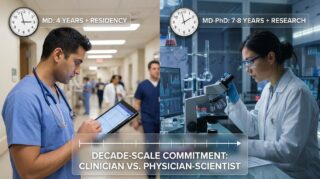
Choosing between an MD and an MD-PhD is not a branding decision. It is a structural decision about how you want to spend roughly a decade of your life and what kind of professional role you are building toward. Both paths produce physicians. One also produces a researcher. The training timelines, daily realities, and career trajectories diverge in ways that matter, and understanding those differences clearly is the first step toward making a decision you will not regret.
What Each Degree Actually Involves
The MD (Doctor of Medicine) is a four-year professional degree. It includes two years of preclinical coursework (anatomy, physiology, pharmacology, pathology, and related sciences) followed by two years of clinical rotations across specialties. After completing the MD, graduates enter residency training, which lasts 3 to 7 years, depending on the specialty.
The MD-PhD is a dual degree, typically completed through the Medical Scientist Training Program or similar combined programs. Students complete the preclinical years of medical school, then shift to three to five years of doctoral research in biomedical sciences, and then return to complete clinical rotations. Total training time is usually 7 to 8 years for the combined degree, followed by residency and, often, a postdoctoral research fellowship.
The key difference is not just time. It is a purpose. The MD trains clinicians. The MD-PhD trains physician-scientists, individuals expected to maintain active research programs alongside some level of clinical practice throughout their careers.
Training Timeline, Side by Side
An MD student typically follows this path: four years of medical school, then three to seven years of residency, with possible fellowship training afterward. Most MD graduates are in independent clinical practice by their early to mid-thirties.
An MD-PhD student follows a longer path: two years of preclinical medical school, three to five years of PhD research, two years of clinical rotations, then residency, and often a postdoctoral fellowship. Many MD-PhD graduates do not reach independent positions (faculty or equivalent) until their mid to late thirties, and some not until their early forties.
This is not a minor difference. It is a decade-scale commitment that affects earning potential, personal milestones, and career flexibility. Students who pursue the MD-PhD should be doing so because they want a career built around research, not because the program is free (more on that below).
Funding and Cost
Most MSTP programs are fully funded. The National Institutes of Health funds many MSTPs, which means tuition is covered, and students receive a stipend for living expenses throughout the combined program. This is a meaningful financial advantage compared to the MD alone, which frequently results in $200,000 to $300,000 or more in educational debt.
However, “free” is not the right framing. The cost of the MD-PhD is time. Three to five additional years of training at a stipend (typically $30,000 to $40,000 per year) instead of a physician’s salary represents a significant opportunity cost. Students who complete the MD and enter residency sooner begin earning attending-level salaries years earlier. Over a career, this financial gap can be substantial, particularly for students who would have entered high-compensation specialties.
What the PhD Years Look Like
The PhD phase is where the two paths diverge most sharply. During these years, MD-PhD students are full-time graduate researchers. They join a laboratory, develop a research question, design and execute experiments, analyze data, write papers, and defend a dissertation.
This is not a checkbox exercise. PhD research is often isolating, uncertain, and slow. Experiments fail. Projects stall. The skills required, including tolerance for ambiguity, self-directed problem-solving, and deep technical expertise in a narrow area, are fundamentally different from the skills used in clinical medicine.
Students who thrive in PhD training tend to be genuinely curious about mechanism-level questions. Why does this disease behave this way at the molecular level? Can we identify a target that changes the course of this condition? How do we design a study that produces data strong enough to shift clinical practice?
Career Paths After Each Degree
MD graduates enter residency and then begin clinical practice. Career options include private practice, hospital-based employment, academic clinical roles, administrative medicine, consulting, public health, health policy, medical education, and many other paths.
MD-PhD graduates are expected to pursue physician-scientist careers, typically in academic medical centers. The standard path involves residency, often followed by a postdoctoral research fellowship, then a faculty position that includes both clinical responsibilities and an independent research laboratory. The split between clinical and research time varies, but many physician-scientists aim for 60 to 80 percent of their time in research.
Maintaining an active research program while practicing clinical medicine is demanding. It requires grant funding (often from the NIH), publications, mentoring of trainees, and ongoing laboratory management, all alongside clinical duties.
Admissions: What Programs Look For
MD admissions evaluate academic performance (GPA, MCAT), clinical experience, research exposure, leadership, service, and personal qualities. Research experience is valued but not required for most MD programs. Clinical exposure and a demonstrated understanding of what physicians do day to day are essential.
Highly competitive medical programs like Columbia’s evaluate everything MD programs evaluate, plus a significant research track record. Competitive applicants typically have two or more years of sustained research experience, often with publications or conference presentations. The research statement is a critical component of the application.
Questions to Ask Yourself Honestly
Before choosing between these paths, sit with these questions:
- Do you want to run a laboratory? Not “do you find research interesting,” but do you want to write grants, manage a team, and design multi-year studies?
- Are you drawn to mechanism-level questions? Physician-scientists typically work at the intersection of basic science and clinical medicine.
- Can you handle the time commitment honestly? Seven to eight years of training before residency is a real cost.
- Are you pursuing the PhD for the right reasons? Funding and prestige are not strong enough reasons to add three to five years to your training.
- What does your research experience tell you? If you found bench work tedious and were counting the hours until you could get back to clinical activities, that information is valuable. Trust it.
What This Does Not Mean
Choosing the MD does not mean you cannot do research. Many MD physicians conduct clinical research, participate in clinical trials, and contribute meaningfully to medical knowledge. Academic medicine is full of MD-only faculty who maintain productive research careers.
Choosing the AAMC dual-degree training overview does not mean you are locked into bench science forever. Some physician-scientists transition to clinical research, health policy, biotech, or academic leadership roles.
Making the Decision
There is no universally correct answer. The MD is the right choice for most students interested in clinical medicine, even those who enjoy research. The MD-PhD is the right choice for a smaller group of students whose career vision centers on building a research program while maintaining clinical expertise. Clarity on that front is worth more than any degree suffix.