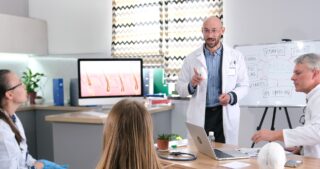

Shadowing vs clinical experience comes down to responsibility. When you shadow, you watch a physician work and carry no patient-care duties. Clinical experience gives you a defined role with patients, such as a CNA or EMT. AMCAS lists them as separate experience types, and most applicants benefit from both, though each school sets its own expectations.
That difference shapes how you plan your time, which roles you look for and how you describe each activity when you apply. This guide explains what each one shows a committee, where the gray areas sit, how to classify common activities and how to record them honestly. For the step-by-step version of shadowing itself, see how to shadow a doctor.
Why Pre-Meds Get Confused
For pre-med students building an extracurricular record, one question keeps coming up: what is the real difference between physician shadowing and clinical experience, and which one matters more to admissions committees?
Much of the confusion comes from how loosely people use the phrase “clinical experience.” Some advisors put everything that happens in a hospital or clinic into that bucket and treat shadowing as one more clinical activity. The application itself is more specific. The AMCAS Work/Activities menu, as listed by UConn’s pre-med advising office, includes Physician Shadowing/Clinical Observation as its own experience type. Paid Employment and Community Service/Volunteer appear separately, each split into Medical/Clinical and Not Medical/Clinical.
Admissions offices draw the same line in their own guidance. UCSF’s MD admissions FAQ is one example of a school that describes the experiences it looks for in its own words, which is why you should read the guidance of every school on your list. In practice, shadowing is an observational role. You are in the room watching a physician work, but you are not responsible for patient care. Clinical experience usually means you have defined duties in the care environment and regular contact with patients.
That split leaves many applicants unsure whether their shadowing hours meet a clinical expectation at all, or whether they have misread the requirement. The AAMC adds a useful nuance. Its shadowing fact sheet says clinical experience is important for confirming that medicine fits you, but it doesn’t necessarily have to include shadowing. In a 2016 AAMC survey, 87% of responding admissions officers said they accept an alternate activity instead of clinical shadowing.
The practical takeaway is simple: this is rarely an either/or decision. Shadowing and active clinical experience are not interchangeable. One shows that you understand what physicians do. The other shows that you can handle real patient contact and the demands that come with it. Most strong applicants build both, and each school’s own guidance tells you how much weight it puts on each.
Pillar 1: Physician Shadowing Shows You Understand the Career
What Is Physician Shadowing?
Physician shadowing is an observational experience. You follow a doctor through the day in clinic, on the wards or in the operating room, and your job is clear: watch, listen and learn.
You are not there to treat patients or perform procedures. You are there to see what physicians do, how they think and how they move through a working day. No one expects a pre-med student to carry medical responsibility in this setting, and admissions committees know that. The AAMC notes that the physician must introduce you to each patient as a premedical student, and that a patient may ask you to step out. Respecting that request is part of the experience, not a failure of it.
What Does Shadowing Show Admissions Committees?
The value of shadowing lies in what you understand afterward, not in anything you physically did.
First, it shows informed decision making. Shadowing is your reality check. It signals that you are applying based on what you have seen yourself: the paperwork, the hard conversations, the long days and the tradeoffs that come with the job. Advising offices such as Johns Hopkins describe shadowing as a way to make an informed career decision.
Second, it shows that you understand the physician’s role. By watching how doctors work with nurses, physician assistants, technicians and other staff, you begin to see what is distinctive about being a physician. That understanding matters when an interviewer asks why you want to be a physician rather than another type of clinician, one of the most common medical school interview questions.
Third, it gives you direct exposure to bedside manner. You see how experienced physicians build trust, deliver bad news, manage conflict and respond when families are frightened or angry. Those moments teach you what good medicine looks like in practice, and they give you specific scenes to reflect on later.
Finally, shadowing in more than one specialty shows genuine exploration. Time with a family physician, a surgeon and a pediatrician tells an admissions committee that your interest doesn’t rest on one narrow view of medicine. Even a few days in a second setting can change how you talk about the field.
What Can’t Shadowing Show?
Shadowing is valuable, but it is not enough on its own.
It shows that you are interested and that you did your homework before applying. It can’t show who you are when you are the one responsible for a task, even a small one. Because it is passive, it can’t prove your resilience, empathy, teamwork or service orientation. It only shows that you have watched those qualities in other people.
To show that you can handle patient contact, contribute to a team and stay steady when things are difficult, you need the second pillar: active clinical experience.
Pillar 2: Active Clinical Experience Shows You Can Do the Work
What Counts as Active Clinical Experience?
Active clinical experience means you hold a role in a healthcare setting and carry real responsibility, usually with direct patient contact. Unlike shadowing, you are not watching from the corner. You are part of the routine that keeps patients safe, comfortable and cared for. The AAMC’s list of ways to gain experience without shadowing includes hospice volunteer, certified nursing assistant, volunteer EMT, hospital scribe and caretaker for an ill family member.
Strong examples include both paid and volunteer positions. Paid roles often include:
- Emergency medical technician
- Certified nursing assistant
- Medical assistant
- Phlebotomist
- Medical scribe, with the caveats covered below
Volunteer roles can include:
- Hospice volunteer
- Hospital volunteer in patient transport, inpatient units or similar patient-facing areas
- A steady role supporting and caring for an ill or disabled family member
The common thread is simple. You interact with patients regularly, and what you do affects their comfort, safety or care.
What Does Clinical Experience Show Admissions Committees?
If shadowing shows that you understand the career, active clinical work shows that you have the temperament for it. Committees read these roles as the main evidence of how you treat people and how you handle yourself under strain. This is where you move from saying you care about people to showing it.
The AAMC premed competencies give you useful language for what sustained clinical work can demonstrate:
- Service Orientation, when you keep returning week after week to a hospice or clinic because you care about the people there, not the line on your activity list.
- Empathy and Compassion and Interpersonal Skills, when you sit with a confused older adult, calm a frightened child or help a patient keep their dignity during a vulnerable moment.
- Resilience and Adaptability, when you handle busy shifts, difficult conversations and the emotional weight of seeing people at their worst.
- Teamwork and Collaboration, when you work alongside nurses, technicians and physicians, understand your role, communicate clearly and support the group.
- Reliability and Dependability, when you show up for every scheduled shift over months.
These experiences answer a blunt question for the committee: are you comfortable with real medicine, including bodily fluids, emotional strain and suffering, and not only with the idea of the white coat?
Clinical roles have limits too. An EMT may gain intense experience in prehospital care but know little about long-term management on the wards. A CNA may become excellent at bedside care and still need shadowing to see the physician’s diagnostic and leadership role. That is why each pillar covers the other’s blind spot.
Why Most Applicants Benefit From Both Pillars
Shadowing and clinical work answer different questions for the people reading your file.
If you only have shadowing, a reader may wonder whether you have ever been responsible for anyone. Can you handle pressure? Do you enjoy talking with patients yourself, or do you prefer watching professionals do it?
If you only have clinical work, such as a long history as an EMT or CNA, another set of questions appears. Why a physician and not another health profession? Do you understand how long the training is, what the job looks like day to day and what kind of responsibility you are asking for?
The strongest applicants use both pillars to build a clear, believable story. Here is a hypothetical example:
“As an EMT, I learned that I thrive in direct patient care and high-pressure situations, but I also saw how limited my scope was. When I shadowed an emergency physician, I watched her pull the full clinical picture together, lead the team and carry final responsibility for the treatment plan. That combination of patient contact and broader decision making is what draws me to becoming a physician.”
That kind of answer is hard to give credibly if one pillar is missing.
Shadowing vs Clinical Experience at a Glance
| Question | Physician shadowing | Active clinical experience |
|---|---|---|
| What is your role? | Observer | Defined duties with patients |
| Who carries responsibility? | The physician | You, within your training or certification |
| What does it show? | An informed understanding of the physician’s work | How you treat patients and handle pressure |
| Typical settings | Clinic, wards, operating room | EMS, nursing units, hospice, clinics, labs |
| AMCAS experience type | Physician Shadowing/Clinical Observation | Paid Employment or Community Service/Volunteer, Medical/Clinical |
| Common gap it leaves | No evidence of your own patient care | Less insight into the physician’s specific role |
| Best paired with | A patient-facing role | Shadowing across a few specialties |
How to Classify Common Activities
AMCAS asks you to pick the experience type yourself. The 2027 AMCAS Applicant Guide says that because the information is self-identified, you decide which option fits best. The table below gives IMA’s suggested starting point for ten common activities. It is not an AAMC ruling, and individual schools may read activities differently.
| Activity | Your responsibility | Likely experience type |
|---|---|---|
| Following a family physician in clinic for a week | Observe only | Physician Shadowing/Clinical Observation |
| Observing surgery and ward rounds in a hospital abroad | Observe only | Physician Shadowing/Clinical Observation |
| Paid scribe in an emergency department | Document visits beside a physician | Paid Employment, Medical/Clinical |
| Certified nursing assistant on a medical unit | Bedside care within your certification | Paid Employment, Medical/Clinical |
| Medical assistant in a clinic | Vital signs, intake, clinic support | Paid Employment, Medical/Clinical |
| Volunteer EMT | Prehospital care within your certification | Community Service/Volunteer, Medical/Clinical |
| Hospice volunteer sitting with patients | Companionship and comfort | Community Service/Volunteer, Medical/Clinical |
| Hospital front desk or gift shop volunteer | Little or no patient contact | Community Service/Volunteer, Not Medical/Clinical |
| Caring for an ill family member over months | Daily practical care | Depends on your schools; describe it plainly |
| Research assistant who consents patients for a study | Patient contact within a protocol | Research/Lab, or Medical/Clinical if patient contact dominates |
When an activity sits on the line, choose the type that matches what you mostly did, then let the description carry the detail.
The Gray Areas: Scribes and Hospital Volunteers
Some roles sit in the middle and need careful presentation.
Medical scribing is an excellent way to learn terminology, documentation and how physicians reason through cases. You are in the room for the history, the exam and the decision, and the AAMC lists hospital scribe among its alternatives to shadowing. The risk is that the role can become passive. Hundreds of scribe hours with little direct patient contact can read like extended shadowing, and a profile built only on scribing can feel lopsided. Scribing works best alongside a role where you interact with patients yourself and show empathy and service directly.
Hospital volunteering depends entirely on what you actually do. Greeting visitors at the front desk or stocking supplies helps the hospital, but it is not strong clinical experience. Roles in patient transport, inpatient units, pediatrics or hospice care, where you regularly talk with patients and their families, are clearly relevant. If your hospital lets you choose an assignment, ask for the one with the most patient contact.
Research is another gray zone. A lab role with no patients belongs under research. A study coordinator role where you consent and follow patients can carry real patient contact, so describe exactly what you did and let the experience type match the bulk of the work.
The Myth of the Magic Number
People want a number, and forums are full of them. Hour ranges get repeated so often that they start to sound like requirements. The AAMC publishes no minimum for shadowing or clinical hours, and its shadowing fact sheet points you to each school’s own guidance.
Rough ranges can help you plan a calendar, but they are not what earns an interview. Committees care more about consistency and reflection than about a raw total. A student who works four hours a week for a year at the same hospice, builds relationships and can describe how they grew will usually read stronger than someone who packs 200 hours into one rushed summer and barely remembers anyone’s name.
Long-term involvement signals reliability and dependability. Thoughtful reflection in your Work and Activities entries and Most Meaningful essays shows maturity and self-awareness. The hour count is background information, not the headline.
For the planning ranges students often discuss, see our guide to shadowing hours and treat any range as a planning aid rather than a target. Applying to dental school instead? Our guide to dental shadowing covers general dentist hours and how to log them.
Your real goal is to collect experiences that give you specific, honest stories you can tell in your application and interviews.
How to Find Each Type of Experience
The two pillars are found in different ways, so plan your search separately.
For shadowing, start with physicians you already know: your own doctors, family friends, alumni from your college and physicians connected to your pre-health advising office. Many hospitals also run formal observership or shadowing programs with their own forms, immunization records and privacy training. The AAMC suggests contacting physicians at least a few weeks before you hope to start. Our guide on how to ask to shadow a doctor includes sample emails and a follow-up schedule.
For clinical experience, look for roles with training built in. EMT and CNA courses lead to certifications that let you take on defined duties. Hospice organizations usually run volunteer training before you meet patients. Hospitals often list patient-facing volunteer assignments separately from front-desk roles, so ask which units need help with transport, companionship or patient support.
When you compare options, a few questions help:
- How often will I be with patients rather than near them?
- Can I commit to a regular schedule for at least several months?
- Who will supervise me, and who could verify my hours later?
- What training do I need before my first shift?
- Will this role still fit when my course load gets heavier?
A role you can keep for a year is usually worth more than an impressive title you can only hold for a few weeks.
Reflection Prompts That Turn Hours Into Stories
Hours become useful in an application only when you can describe what they taught you. A short note after each shift or shadowing day makes that much easier months later. Record the date, the setting and one moment, without names or details that could identify a patient.
These prompts work for both pillars:
- What surprised me today about how care actually happens?
- What did a physician, nurse or other team member do that I want to remember?
- When did I feel uncomfortable, and what did I do with that feeling?
- What did a patient or family member seem to need that no one could fully provide?
- What question am I still thinking about, and who could I ask?
Over a semester, these notes show you patterns. You may notice that you are drawn to continuity of care, to fast decisions or to the conversations that happen after a diagnosis. Those patterns become the backbone of your Work/Activities entries, your Most Meaningful essays and your interview answers, and they help you explain why medicine, and not another health profession, fits you.
How to Balance Shadowing, Clinical Work and Everything Else
A practical sequence is to start with some shadowing so you can confirm that medicine fits you, then build a steady base of clinical work and add more shadowing as your questions change. Many applicants keep one primary clinical role for a few hours a week, add periodic blocks of shadowing during breaks and fit service and research around their coursework.
| Stage | Focus | Why it helps |
|---|---|---|
| Early college | A first round of shadowing in one or two specialties | Confirms that medicine fits before you commit years to it |
| Following semesters | One steady patient-facing role a few hours a week | Builds consistency and the stories committees remember |
| Breaks and summers | Short shadowing blocks in new specialties | Widens your view without disrupting coursework |
| Before applying | Reflection notes for each activity | Turns hours into specific Work/Activities entries |
The goal is not to do everything at once. It is to show a clear progression over time and to prove that you can handle academic work while reliably showing up for patients.
How to Record Each Activity Honestly
AMCAS allows up to 15 Work/Activities entries, each described in 700 characters or fewer, and you may mark up to three as most meaningful for an extra 1,325 characters. Each entry also names a contact who can verify the experience.
- Use the experience type that matches your actual role.
- Describe observation as observation. Write “observed” rather than “assisted” unless you had a defined task.
- Report hours you can document, and keep your logs and signed records.
- Lead with one specific moment and what it taught you, rather than restating a job description.
- Connect each story to a competency, such as Teamwork and Collaboration or Service Orientation, without forcing the label into every sentence.
Treat every entry as a chance to show growth. Set the scene briefly, say what you actually did and explain how your perspective changed. Specific moments are more convincing than general claims.
Common Mistakes When Describing Each Pillar
Strong experiences can still read weakly if you describe them carelessly. These are the mistakes advisors see most often:
- Inflating observation. Writing that you “assisted” or “treated” when you watched invites questions in an interview and can raise ethical concerns. Observation described honestly is still valuable.
- Listing duties instead of learning. A job description tells the reader what the role involves, not what you took from it. Replace the task list with one scene and what it changed in your thinking.
- Counting the same hours twice. If you scribed and shadowed the same physician, decide which entry the time belongs to and say so clearly.
- Hiding the hard parts. A shift where you felt out of your depth, and what you did next, often says more about your Resilience and Adaptability than a smooth one.
- Ignoring your verifier. Every entry names a contact. Keep that person informed, thank them, and make sure your description matches what they would say about you.
- Treating the pillars as rivals. Your entries should show how shadowing and clinical work informed each other, not compete for the same space.
Fixing these takes little time and makes every hour you have already worked count for more.
Building a Competitive Edge With Ethical Global Experience
As applicant pools grow stronger, many students look for ways to develop competencies that are hard to build in familiar settings. Domestic roles can show service and teamwork well. It is often harder to show Understanding Others, Self-Awareness and sound ethical judgment in cross-cultural care without seeing a different health system.
That is where global health experience can help, and it is also where serious risks appear.
The Ethical Line: Avoiding Voluntourism
The AAMC has long warned students to be careful with international programs that are built to sell an experience first and protect patients second. Its guidelines for premedical students in clinical experiences abroad say the primary purpose of a student clinical experience is observation, not hands-on treatment. They warn that taking on tasks beyond your training can make you look unethical to admissions committees, and that an agency suggesting you will practice medicine rather than observe deserves serious reservations.
This kind of voluntourism is a problem for two reasons. It can harm patients, and it signals to admissions committees that an applicant is willing to cross ethical lines for a better story. The AMA Journal of Ethics discussion of voluntourism explains why short-term programs that put untrained students in clinical roles do lasting damage.
IMA’s programs are built on the opposite principle. IMA follows the AAMC guidelines for premedical students in clinical settings abroad, and pre-med interns are learners and observers. They do not act as providers. In the operating room, for example, you stand a few feet from the table and watch, and skills teaching happens in simulation sessions rather than on patients.
How an IMA Internship Supports Each Pillar
An ethical, mentored global program can strengthen the shadowing pillar and build competencies that are difficult to develop at home. It does not replace patient-facing clinical work, and you should present it accurately.
For the shadowing pillar, IMA’s medical shadowing abroad places pre-med interns in teaching hospitals in Mombasa, Kenya and Cusco, Peru. After a physician-led orientation on how the wards run, infection control and the AAMC guidelines, you shadow physicians on ward rounds and rotate through departments such as emergency medicine, maternity, pediatrics and surgery, one department a week for six to eight hours a weekday. Most interns in Mombasa are placed at Coast General Teaching and Referral Hospital, a 750-bed public hospital.
Beyond the hospital, the program adds clinical simulations, a Global Health Lecture Series on healthcare policy, health disparities and public health programs, physician seminars on the conditions you see on the wards, and community clinic days where you help with the nonclinical work that lets an outreach day run. Hours are logged and signed, and IMA’s pre-med page states plainly that each medical school decides how to classify them and that observation does not automatically count as direct patient care.
For most applicants, that means recording time in pre-med internships abroad as Physician Shadowing/Clinical Observation and keeping patient-facing clinical work at home as a separate entry. Used that way, a global program adds perspective on resource limits, culture and ethics without blurring the two pillars.
Fulfilling Core Competencies: A Comparison
A structured global program doesn’t replace domestic experience. It can add to it. The table below compares a typical domestic option with what an observation-based IMA internship can add for several of the AAMC competencies, using only what the program describes.
| Area | Typical domestic option | What a structured IMA internship can add |
|---|---|---|
| Physician shadowing | A few hours with one local physician, enough to see clinic flow | Ward rounds and weekly rotations through departments such as emergency medicine, maternity, pediatrics and surgery |
| Active clinical experience | A patient-facing role at home, such as CNA, EMT or hospice volunteer | Not a substitute. Keep your domestic clinical role and record IMA time as observation |
| Service Orientation | Volunteering at one clinic or community organization | Community clinic days and hygiene and health education in schools, in a supporting nonclinical role |
| Teamwork and Collaboration | Shifts alongside a few other volunteers | Daily work alongside local physicians, nurses and other interns across cultures and roles |
| Understanding Others and Self-Awareness | Diverse patients inside a familiar system | Observing how culture, policy and resources shape care in a different health system |
| Resilience and Adaptability | A heavy course load or busy semester | Living and learning in a new country and adapting to a resource-limited hospital setting |
| Ethical Responsibility to Self and Others | Ethics rarely discussed explicitly | Orientation on the AAMC guidelines, debriefs with mentors and practice declining tasks outside your training |
When you can describe how you adapted to those conditions and still respected your limits, your reflection becomes concrete. That is far more convincing than a general claim that you “know to do the right thing.”
From Checked Box to Compelling Candidate
The real question is not “shadowing or clinical experience.” A competitive application usually needs both pillars working together.
- Shadowing shows that your choice of medicine is informed, not romanticized.
- Clinical experience shows that you can handle patient care: empathy, resilience, teamwork and comfort with the realities of illness.
- Honest classification and specific descriptions show the judgment committees look for.
Your goal is not to stack hours for their own sake. It is to use those hours to demonstrate the AAMC competencies through specific, honest stories. Build a steady base of patient-facing work, add shadowing across a few specialties, consider an ethical global program to widen your perspective, and record every activity as exactly what it was. For more ways to build the clinical side, see 10 ways to get clinical experience.
Frequently Asked Questions
What Is the Difference Between Shadowing and Clinical Experience?
Shadowing is observation: you follow a physician in a clinic, hospital or operating room and carry no patient-care duties. Clinical experience gives you a defined role with regular patient contact, such as CNA, EMT or hospice volunteer. AMCAS lists Physician Shadowing/Clinical Observation as a separate experience type from Medical/Clinical work, and most applicants benefit from both.
Does Shadowing Count as Clinical Experience?
Usually not on its own. Shadowing shows that you understand the profession, but it does not show how you act when you are responsible for a task. Most schools look for separate patient-facing work. The AAMC also notes that clinical experience does not have to include shadowing, and 87% of admissions officers in a 2016 AAMC survey said they accept an alternate activity.
Is Shadowing Required for Medical School?
Many schools recommend it, but requirements vary, so check each school’s admissions pages. If shadowing is hard to arrange, the AAMC lists alternatives such as hospice volunteering, CNA work, volunteer EMT service, scribing and caring for an ill family member.
How Many Hours of Each Do I Need?
There is no AAMC minimum for either. Schools care more about consistency over time and what you learned than about a total. Four hours a week in one setting for a year usually reads stronger than a large number of hours packed into one summer.
Is Medical Scribing Shadowing or Clinical Experience?
Scribing is usually listed as paid medical or clinical work because you have a defined job beside the physician. It teaches terminology and clinical reasoning well, but it can be fairly passive, so pair it with a role that gives you direct patient contact.
What Makes a Shadowing Experience Stand Out?
What you can say about it. Committees look for evidence that you saw the real daily work of physicians, including the less glamorous parts, and can still explain why you want the role. Shadowing in more than one specialty and reflecting clearly on how physicians lead teams and talk with patients matters more than the hour total.
Are International Clinical Experiences Viewed Differently?
Yes, they are scrutinized closely. Committees are wary of programs that let students work beyond their training. Programs built on supervised observation, cultural learning and community work can add perspective when they stay within the AAMC guidelines for students abroad.
How Should I List an International Shadowing Program?
List observation as Physician Shadowing/Clinical Observation and describe it as observation. In IMA’s pre-med program your role is observational, hours are logged and signed, and each medical school decides how to classify them. Keep your patient-facing work at home as a separate entry.