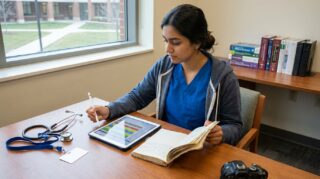

To track clinical hours well, log every session within a day: the date, start and end times, the setting, your supervisor’s contact, the category and a short reflection. Put each hour in one category only. The 2027 AMCAS application allows 15 experiences, each with a verifier schools may contact, so your log needs to hold up.
Free tool: Log clinical, shadowing, volunteer and research hours with Pre-Med Hours Tracker by IMA, a free Chrome extension. Your entries stay on your device and export to CSV.
Getting into medical school is not only about GPA and MCAT scores. It is also about the quality of your clinical, shadowing and volunteer experience, and about how clearly you can describe it. Those hours are evidence of your commitment and your understanding of the profession, and the volume can run to hundreds of hours across several roles. That is exactly when tracking falls apart. This guide covers the categories, the fields every entry needs, a worked example, weekly checks and how the log turns into your application.
Clinical vs Shadowing vs Volunteer Hours
One of the most common mistakes is putting experiences in the wrong category. Committees look at clinical, shadowing and service experience through different lenses, and misclassifying them weakens an otherwise strong profile. The categories also come with their own rules on each application, so learn them before you start logging.
What Usually Counts as Clinical Experience?
Clinical experience generally means time spent with patients in a care setting where you interact with them or contribute to their care, within your training. The exact definitions belong to each application service and each school, so treat the examples below as typical rather than guaranteed:
- Scribing: documenting in the medical record alongside a physician.
- Certified roles: EMT, CNA or medical assistant positions.
- Hospital volunteer roles with patient contact: transporting patients, keeping patients company or helping on a unit, as the role allows.
- Patient-facing support work: roles where you talk with patients directly, such as hospice volunteering.
If you are helping staff but never interact with patients, such as filing records in an office away from the wards, that is usually non-clinical work. For a fuller picture of what committees value, read our guide to the pre-med clinical experience matrix.
Where Does Shadowing Fit?
Shadowing is observation: you follow a clinician to learn what the work involves, and you do not provide care. The AAMC’s shadowing fact sheet says it gives you a better understanding of a doctor’s typical day and familiarity with different specialties and settings. AMCAS has a separate experience type for physician shadowing and clinical observation, so log shadowing on its own rather than folding it into clinical hours. Supervised observation abroad belongs here too. Our guide to shadowing vs clinical experience explains the difference in detail.
What Counts as Non-Clinical Volunteering?
Non-clinical service shows commitment to your community and your ability to work inside an organization. It does not stand in for clinical exposure. Typical examples:
- Community service: food banks, building projects, tutoring or mentoring.
- Hospital support without patient contact: administrative work, the information desk or donation drives.
- Fundraising: events or campaigns for nonprofits.
Research is its own category. Log it separately with your principal investigator as the contact. Our guide to research hours for medical school covers how much research matters.
How to Avoid Double Counting
Double counting means listing the same hour in more than one place. It inflates your totals, and it is the kind of discrepancy that raises questions. Each hour gets one home.
- Split mixed roles honestly. If a hospital job included both patient care and front-desk work, divide the hours by what you actually did.
- Separate observation from care. An afternoon watching a physician is shadowing, even if it happened during a clinical job.
- Leave out travel and downtime. Commuting, flights, orientation days off and waiting time are not clinical hours. Log only the hours you spent in the activity.
- Keep teaching separate. Lectures, workshops and simulations during a program are educational activities, not patient hours.
PA applicants face a stricter version of this rule. CASPA’s experience instructions say you cannot repeat hours between experience types, and that a position covering several categories should be listed in each with the hours and duties divided. CASPA also notes that each program’s definitions vary. Our guide to patient care vs healthcare experience for PA school walks through those categories.
Why Accuracy Matters
Admissions committees read thousands of applications. They look for clarity, consistency and integrity, and every entry you list is a factual claim you must be ready to stand behind.
Verification and Investigations
For each Work/Activities entry, the 2027 AMCAS Applicant Guide asks for a contact person whom medical schools may contact to verify that the experience occurred, such as your supervisor or the person who ran the program. When you submit, you certify that your application is current, complete and accurate, and the AAMC investigates any alleged falsification, omission or discrepancy in application materials.
If your hours don’t match what your supervisor remembers or what their records show, your integrity is the thing in question. Exaggeration, even by accident, can cost you an interview or an acceptance. Honest, precise numbers protect you.
The Narrative Needs the Details
Tracking is not only counting. Each AMCAS entry has a 700-character description, and you can mark up to three as most meaningful, with an extra 1,325 characters each. An entry like “10 hours: shadowed a surgeon” gives you nothing to write about. A detailed log lets you recall:
- A specific interaction that taught you something about communication.
- An ethical question you watched a team work through.
- A moment that changed how you understood the health care team.
That level of detail is impossible to rebuild months later without a log, which is why reflection belongs in every entry.
The Fields Every Log Entry Needs
A notebook or calendar is not enough. Your log should be structured, consistent and easy to check. A cloud spreadsheet you can sort, filter and back up works well.
| Field | What to record | Why it matters |
|---|---|---|
| Date | The day of the session | Lets you total hours by date range, which AMCAS asks for |
| Start and end time | Exact times, not rounded | Prevents slow inflation of your totals |
| Organization and setting | Organization name, city and country, unit or department | AMCAS asks for organization, country and city |
| Category | One of: clinical, shadowing, non-clinical service, research | Keeps each hour in one place |
| Role and activities | What you did or observed, in plain words | Supports your description and protects against overclaiming |
| Supervisor and contact | Full name, title, email and phone | The verifier schools may contact |
| Sign-off | Supervisor initials or signature, and the date | Turns your log into a record someone else has confirmed |
| Reflection | Two or three sentences, no patient identifiers | Raw material for essays and interviews |
Your Supervisor Contact Is Your Verifier
Medical schools may contact this person to confirm your experience, sometimes long after you finish. Protect that link:
- Ask for contact details on your first day and confirm them before you leave.
- Send a short thank-you note when you finish a rotation or role.
- Keep a separate contact list with a second email or phone number.
- If your supervisor leaves, ask who else can confirm your hours, such as a charge nurse, volunteer coordinator or department manager.
If you have no formal contact at all, the AMCAS guide lets you enter someone who can verify your participation, and it even allows you to list yourself. Treat that as a last resort and explain the situation in your description.
A Worked Example
Here is how a hypothetical student might log one month. The numbers are illustrative.
| Date | Category | Setting | Start | End | Hours | Sign-off |
|---|---|---|---|---|---|---|
| Oct 3 | Clinical | Hospital volunteer, emergency department | 4:00 PM | 8:00 PM | 4.0 | Volunteer coordinator |
| Oct 7 | Shadowing | Family medicine clinic | 8:30 AM | 12:15 PM | 3.75 | Physician |
| Oct 10 | Clinical | Hospital volunteer, emergency department | 4:00 PM | 7:50 PM | 3.83 | Volunteer coordinator |
| Oct 12 | Non-clinical service | Food bank | 9:00 AM | 12:00 PM | 3.0 | Shift lead |
| Oct 17 | Clinical | Hospital volunteer, emergency department | 4:00 PM | 8:00 PM | 4.0 | Volunteer coordinator |
| Oct 21 | Shadowing | Family medicine clinic | 8:30 AM | 12:30 PM | 4.0 | Physician |
Totals for the month: clinical 11.83 hours, shadowing 7.75 hours, non-clinical service 3.0 hours. Note the Oct 10 shift: it ended at 7:50, so it is logged as 3.83 hours, not 4. Each row has exactly one category, so the three totals add up to the 22.58 hours actually worked.
A Five-Minute Weekly Check
Once a week, review your log:
- Every session from the past week is entered, with times rather than estimates.
- Each row has one category, and no hour appears twice.
- Sign-offs are current, or you have a plan to collect them.
- Supervisor contact details are still correct.
- Each entry has a short reflection.
- Your running totals by category match the sum of the rows.
How Structured Programs Help With Documentation
Structured programs take much of the paperwork off your plate because documentation is built in. In IMA’s pre-med internships abroad, your hours are logged and signed. The record lists dates, departments and hours, signed by your supervising physician and validated by IMA’s U.S. Medical Director, and every intern who completes the program receives a certificate of completion.
How those hours are classified is still up to each school. IMA’s program page says so directly: each medical school decides how to classify them, and observation does not automatically count as direct patient care. Log program time as shadowing or clinical observation, and keep lectures, simulations and travel time out of your hour totals. Nursing students face a similar question; our guide to nursing shadowing vs clinical placements explains how placement hours differ from credit-bearing clinicals.
Getting the Most From International Experience
International observation can show adaptability and an understanding of health care beyond your own system. It needs the same care in documentation to meet U.S. admissions expectations. Committees want to see that the hours were supervised, meaningful and documented.
When you log abroad, capture more than the procedure you watched. Note the context: the conditions you saw most often, how the team worked with limited resources and how communication changed across languages. Before you travel, review CDC travel health guidance for your destination. Our guide on whether shadowing abroad counts for medical school explains how schools view this experience.
From Log to Application
Choosing Your Most Meaningful Experiences
You can mark up to three experiences as most meaningful. Your log is how you choose them. Scan your entries for the roles where you wrote the most thoughtful reflections, again and again. If a role only has generic entries, it probably won’t make a strong most meaningful essay. Our AMCAS Work and Activities guide shows how to turn entries into descriptions.
Build Reflection Into Every Entry
Right after each session, answer one or two questions:
- What assumption did today challenge?
- How did this shape my reasons for pursuing medicine?
- How did the team’s communication affect patient care?
For context on what other applicants report, read our analysis of average clinical hours for medical school.
For planning targets, see our guide to clinical hours for med school.
High school students can start with our guide to tracking clinical hours in high school.
Common Tracking Mistakes
Deliberate misrepresentation is unethical and can end a career before it starts. Most lost hours, though, come from simple errors.
Rounding Up
Do not round. If you worked 3 hours and 50 minutes, record 3 hours 50 minutes, or 3.83 hours. Rounding that shift to 4 hours adds 10 minutes. Do it across 60 shifts and you have claimed 10 hours you did not work, which is exactly the kind of gap a verifier notices.
Losing Contact Information
Schools may verify experiences long after they end. Supervisors change jobs, emails and phone numbers. Keep a separate contact list and check it each term.
Waiting to Log
Memory fades fast. If you wait two weeks to write up a shift, you lose the details that make an entry useful. Log the hours and the reflection the same day.
Mixing Categories
Do not list time washing lab glassware as clinical hours because the lab is in a hospital. It shows a misunderstanding of what the categories mean. If you are unsure, ask yourself whether you were with patients, observing a clinician, serving a community or doing research, and pick one.
If you want structured clinical observation with documentation built in, explore our guide to clinical experience for med school for the full range of options.
Frequently Asked Questions
Is There a Minimum Number of Hours for Medical School?
The AMCAS application does not set a minimum, and expectations vary by school. Check each school’s own guidance, and focus on steady experience you can describe well rather than a number.
Can Shadowing Hours Count as Clinical Hours?
Log them separately. AMCAS has its own experience type for physician shadowing and clinical observation. Shadowing complements hands-on clinical roles such as CNA or EMT work, but it does not replace them.
Should I Track Research Hours?
Yes, in their own category. Record the dates, your principal investigator as the contact, and a short description of your role and what you learned. Research is listed separately from clinical work.
What If My Supervisor Leaves or Retires?
Ask another person who saw your work to serve as your contact, such as a charge nurse, volunteer coordinator or department manager. If no one is available, the AMCAS guide lets you list someone who can verify your participation, including yourself, so explain the situation in your description.
Do IMA Internship Hours Automatically Count as Clinical?
No. IMA’s record lists your dates, departments and hours, signed by your supervising physician and validated by its U.S. Medical Director. Each medical school decides how to classify them, and observation does not automatically count as direct patient care.
How Do I Split Hours From a Job That Mixed Patient Care and Office Work?
Divide the hours by what you actually did and list each part once. CASPA requires this for PA applicants, and it is good practice for any application.
Do Travel Time and Orientation Count Toward Clinical Hours?
No. Log only the time you spent in the clinical or service activity itself. Travel, waiting time and orientation lectures stay out of your totals.
How Long Should I Keep My Hour Logs?
Keep your logs and any signed sheets permanently. Schools may contact your verifiers after you apply, and a clean record is easy to store and hard to rebuild.