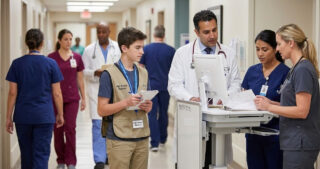
High-school students who are curious about healthcare often imagine a single doctor and a few nurses running everything on a unit. Then they step into a real hospital and see dozens of badges, job titles, scrubs in different colors, and team members moving in and out of patient rooms all day. Families want to know who is responsible for what, how decisions are made, and where a teen observer or intern fits into that picture. Those questions become even more important when students start looking at structured medical internships for high school students that promise exposure to “the healthcare team.”
Once you look more closely, it becomes clear that modern care is built on interprofessional teams: physicians, nurses, therapists, pharmacists, social workers, technicians, and many others working together around each patient. Research on these teams shows that when roles are clear and collaboration is strong, patient outcomes and staff satisfaction both improve. For students, that reality is best learned early, through guided clinical exposure and an early healthcare exploration guide that helps you watch not just what one person does, but how the whole team operates.
Why Clinical Teams Matter More Than Job Titles
Every patient in a hospital or clinic sits at the center of a web of people. Some diagnose, some deliver treatment, some coordinate logistics, and some support housing, food, or mental health needs. Interprofessional collaboration research has shown that when roles align well, care is safer and more efficient; when they do not, tasks are duplicated, gaps appear, and mistakes are more likely.
For high-school students, the main takeaway is simple: focusing only on “the doctor” or “the nurse” misses most of what is really happening. If you learn to watch the whole team, you will understand clinical environments much more quickly and make better choices about your future role. You will also have more to say in future applications and interviews than “I followed a doctor for a day.” You will be able to describe how decisions moved through the team and who handled which responsibilities at the bedside.
The Core Group You See Around Most Patients
Most inpatient and outpatient teams share a core set of roles, even though exact titles vary by country and hospital. When you stand in a hallway as a teen intern or observer, these are the people you will likely see over and over again.
Physicians
Physicians (and in some settings, physician associates or other advanced-practice providers) lead diagnosis and many high-level treatment decisions. On a typical day, they:
- Review labs, imaging, and notes from other team members
- Talk with patients and families about symptoms, options, and next steps
- Coordinate with nurses and allied health professionals to set overall plans
Studies of team-based care emphasize that physicians work best when they treat themselves as part of a collaborative group rather than giving orders in isolation. As a student, you will usually see them during rounds, short hallway discussions, or focused visits to address a change in status.
Nurses
If physicians set many of the broad plans, nurses usually carry them out and adapt them hour by hour. In many teams, nurses act as central connectors: they interpret orders, track vitals and symptoms over time, communicate with families, and call for help when something changes.
From a teen’s perspective, nurses are often the people you interact with most. You check in at the nurses’ station, ask where you should stand, and watch them juggle medications, procedures, documentation, and constant questions. If you pay attention, you will also see how nurses translate complex medical language into terms patients understand and how they advocate when a plan does not align with what they are seeing in real time.
Allied Health Professionals
“Allied health” covers a wide range of professionals who are not physicians or nurses but are central to diagnosis, therapy, and discharge planning. Depending on the unit, you might see:
- Physical, occupational, or speech therapists help patients regain function
- Respiratory therapists managing oxygen and ventilators
- Radiologic or ultrasound technologists performing imaging studies
- Dietitians counseling patients about nutrition
- Social workers and case managers arrange follow-up care or community resources
Guides to interprofessional teams consistently list these roles as core members, not extras. If you only watch the physician at the bedside and ignore therapists rolling equipment down the hallway or social workers talking with families, you will miss half the story.
The Extended Team You Might Not Notice At First
Beyond the core group, many other people shape each patient’s experience. You may not see all of them in the room, but you will feel their impact in how smoothly days go.
On many units, pharmacists review medication orders, check for interactions, and recommend adjustments. Laboratory professionals run tests that determine whether treatments are working. Radiologists interpret imaging and send structured reports that guide decisions. Patient care assistants assist with bathing, mobility, and basic comfort. Clerks manage charts, phones, and scheduling. In primary care settings, community-health workers and patient navigators connect clinic visits with home realities.
For a high-school observer, learning to spot these quieter roles is one of the fastest ways to move from “I watched a doctor” to “I saw how a team actually functions around a complex patient.”
What A Teen Actually Sees On Rounds
When you participate in a structured high-school program, your experience of the team often starts on rounds. A typical sequence might look like this:
A small group arrives at the bedside: one or two physicians, a nurse, maybe a trainee, and sometimes a therapist or social worker. The nurse summarizes how the patient did overnight. The physician or advanced-practice provider asks questions, examines the patient, and discusses options. If therapy or discharge planning is involved, those team members add details about mobility, home supports, or community resources. The group decides on changes to medications, tests, or activity levels, and the nurse and therapists carry out that plan over the next several hours.
Meanwhile, other team members are working offstage. Laboratory and imaging results arrive. Pharmacists adjust doses based on kidney function or interactions. Case managers talk with insurance or community agencies. If you follow the day closely, you will see how information flows and how decisions are never really “one person’s call.”
Shadowing guidelines from national organizations stress that the primary purpose of student clinical experiences is observation, not direct care. Your job is to watch what each team member contributes, not to try to jump in. That mindset makes it much easier to see how roles fit together instead of focusing on how you personally can “do more.”
How To Watch A Team Like A Future Professional
High school students often focus on medical facts during shadowing: diagnoses, lab results, and procedure names. Those details matter, but they are not the only thing worth watching. You can gain a lot by tracking patterns in how the team communicates and divides work.
A simple approach is to pick one question for each day and quietly look for answers. For example:
- Who speaks first when the team enters a room, and why
- How nurses and physicians handle disagreements or new information
- When therapists or social workers are invited into conversations
- How the team updates patients and families after a big change
- What happens when something goes wrong and needs to be fixed quickly
Interprofessional education research uses similar questions to help university students understand other professions and build collaboration skills. You can start that same learning in high school by treating each day on the unit as a chance to study teamwork, not just science.
Where Teens Fit Into Clinical Teams
As a teen intern or observer, you are not a full team member. You are a learner standing near the team. That position still comes with responsibilities.
Programs that follow national guidance on student clinical experiences expect high-school learners to:
- Follow confidentiality rules and avoid sharing patient details outside appropriate settings
- Introduce themselves clearly as students or observers, not as staff
- Leave the room when asked or when a situation becomes especially sensitive
- Ask questions away from the bedside and at times that do not slow down care
- Accept that they may not be included in every encounter, even if it seems interesting
Within those limits, you can still contribute in small ways. Many programs allow teens to help with non-clinical tasks such as straightening waiting areas, escorting patients when staff request it, or organizing educational materials. These actions free up staff time and show that you respect the team’s workload, which in turn can lead to more teaching and invitations to observe important moments.
Using Early Experience To Learn About Career Options
Once you see the full team around a patient, you can start asking more specific questions about your own future path. Clinical exposure is not only about confirming an interest in medicine; it is also about discovering careers you might never have considered.
A day on a surgical unit might spark interest in anesthesia nursing or perioperative therapy. Time in a stroke unit could introduce you to speech-language pathology. Observing a discharge planning meeting might reveal the extent to which social workers and case managers influence whether patients actually get what they need after leaving the hospital. Pre-health resources aimed at high school and early college students emphasize that this kind of early, broad exposure supports better long-term decision-making and stronger applications later.
If you keep a short log after each shift that notes which roles you saw and how they worked together, patterns will emerge. Over time, you may find yourself writing more about certain professions or settings. That is a sign you should learn more about those roles, not proof that you must commit immediately, but useful guidance as you choose classes, future internships, and eventually college paths.
How Our Programs Introduce Clinical Teams Abroad
In our high school programs at International Medical Aid, clinical exposure is designed around teams rather than individual preceptors. Students rotate through multiple units and community settings, watching how physicians, nurses, allied health professionals, and support staff work together in different resource environments. Group seminars draw on current research about interprofessional collaboration to help teens connect what they see to big-picture questions about health systems and career options.
Because the focus remains on observation and non-clinical support, high school students remain within ethical boundaries, even in international settings where practices can vary. At the same time, they see clinical teams handling conditions and constraints that may be very different from home, which makes questions about roles, responsibilities, and teamwork even more vivid.
Next Steps For Students And Families
If you want to make the most of early clinical exposure, think of each experience as a chance to study the team, not just the disease. Students and families can:
- Learn common clinical roles before entering a hospital so badges and titles feel less confusing.
- Ask programs how they introduce team members and whether students will see more than one profession in action.
- Encourage teens to keep short, confidential notes about who they observed and how those people interacted.
- Revisit those notes each year to see whether certain roles keep standing out.
By approaching observation this way, high-school students can move beyond vague impressions like “I liked being in the hospital” and instead describe concrete experiences with nurses, therapists, technicians, and other professionals. That level of detail will help them decide where they want to fit in, whether as future physicians or in one of the many other roles that keep clinical teams functioning.
Hospital Clinical Team Pay in 2026
Pay across the hospital clinical team varies widely by role and training. The table below shows current median or average U.S. compensation (BLS May 2024, with physician averages from Medscape 2026).
| Role | Typical Annual Pay |
|---|---|
| Attending physician | $239,200 or more (avg about $386,000) |
| Resident physician | $68,166 to $94,215 by training year |
| Nurse practitioner | $132,050 |
| Physician assistant | $133,260 |
| Registered nurse | $93,600 |
| Medical and health services manager | $117,960 |
Frequently Asked Questions
Who is the highest-paid member of the hospital clinical team?
Attending physicians earn the most, with a median wage of $239,200 or more and averages around $386,000 in 2026, far above other clinical roles.
How much do nurses and PAs make compared to doctors?
Registered nurses earn a median of $93,600, physician assistants $133,260, and nurse practitioners $132,050 (BLS, May 2024), below physician pay but with much shorter training.
Do hospital administrators earn more than clinicians?
Medical and health services managers earn a median of $117,960, comparable to advanced-practice clinicians but generally below physicians.