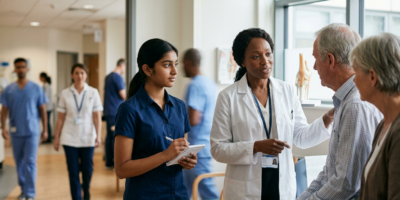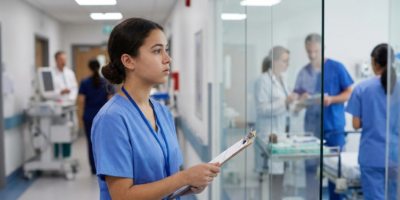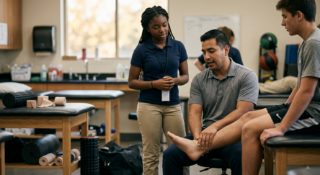
Working with athletes in clinical high school settings is one of the most requested types of early healthcare exposure, and for good reason. Students who play sports or have watched a teammate recover from an ACL tear or a concussion often develop a genuine curiosity about how injuries are assessed, treated, and rehabilitated. That curiosity is worth taking seriously. But it is equally important for students and parents to understand, clearly and honestly, what a high school intern’s role in a sports medicine setting actually looks like.
The short answer: high school students in clinical sports settings observe. During medical internships for high school students, they watch licensed professionals work. They ask questions. They may assist with basic setup tasks. They do not diagnose, treat, or provide hands-on patient care. This is not a limitation of a particular program; it is the appropriate boundary for someone who has not yet entered professional training. The value of the experience comes from proximity to real clinical decision-making, not from performing clinical tasks. Understanding that distinction early puts a student ahead of most applicants who overstate their involvement or misunderstand the purpose of observation.
What Sports Medicine Actually Covers
When high school students say they want to work in sports medicine, they often picture sideline emergency care or professional team doctors. The field is much broader. Sports medicine includes orthopedic evaluation, physical therapy, athletic training, rehabilitation science, concussion management, exercise physiology, and preventive care. A sports medicine physician may be an MD or DO who completed a fellowship after residency in family medicine, emergency medicine, pediatrics, or internal medicine. Athletic trainers hold their own professional certification and operate under a different scope of practice. Physical therapists bring yet another set of skills and credentials.
For a high school student, understanding these distinctions is part of the exposure itself. Observing how different professionals collaborate around a single patient, say, an athlete recovering from a shoulder injury, reveals how healthcare works as a system rather than a solo act. That perspective is genuinely useful, both for career decision-making and for the kind of reflective thinking that admissions committees value later on.
Students who are still weighing different healthcare paths can find helpful context in IMA’s guides for future doctors and health professionals at the high school level, which outline several specialties and what early preparation looks like for each.
What High School Interns Actually See and Do
A realistic picture matters more than an exciting one. In a structured clinical sports medicine observation, a high school student might spend a morning watching an athletic trainer assess range of motion in a soccer player’s knee. They might observe a physician reviewing imaging results with a patient and explaining treatment options. They might see a physical therapist guide a post-surgical patient through a series of exercises designed to restore strength and stability.
Observation and Supported Tasks
The student’s role during all of this is to watch carefully, take notes, and ask thoughtful questions when appropriate. In some settings, a student may help set up treatment areas, organize supplies, or observe how patient intake paperwork is completed. None of these tasks involve clinical judgment, and none should. When documentation is involved, strict privacy rules apply. In the United States, HIPAA regulations govern patient information, and any student in a clinical setting must understand and respect those rules, even as an observer.
What a Sample Day Might Look Like
A typical day in a sports medicine observation might begin with a brief orientation from a supervising clinician, followed by several hours of observing patient consultations and evaluations. After a break, the afternoon might include watching rehabilitation sessions, sitting in on a discussion about injury prevention strategies, or observing how an athletic trainer prepares for game-day coverage. The day usually ends with a debrief, where the student can discuss what they saw and ask questions they held during clinical hours. Schedules vary depending on the setting, the supervising professionals, and the program’s structure.
The CDC’s resources on youth sports concussion give a sense of one area students may encounter during observation, since concussion evaluation and return-to-play protocols are a routine part of many sports medicine settings.
Safety, Supervision, and What Parents Need to Know
Parents considering a clinical observation experience for their teenager have every right to ask hard questions. Safety and supervision should be nonnegotiable, not afterthoughts.
Supervision Structure
Any reputable program places high school students under direct professional supervision at all times during clinical hours. This means a licensed physician, athletic trainer, physical therapist, or other qualified clinician is present and responsible for the student’s conduct and safety. The student should never be left alone with a patient or placed in a situation where they are expected to make any clinical decision.
Housing and Communication
For programs that involve travel, whether domestic or international, parents should ask specifically about housing arrangements, the ratio of staff to students, emergency protocols, and how communication is handled. Can a parent reach a program coordinator at any time? Is there a clear chain of contact? What happens if a student feels uncomfortable or unwell? These are not overprotective questions. They are baseline expectations.
Age-Appropriate Boundaries
High school students are minors. Responsible programs make this fact central to program design, not incidental. Students at this age should not be asked to handle biohazardous materials, assist with invasive procedures, or operate medical equipment. If a program’s marketing suggests otherwise, that is a reason to look more carefully, not less.
For families evaluating structured programs, IMA’s high school internship options outline what students can expect in terms of supervision, structure, and the types of clinical and community health settings available.
How Sports Medicine Exposure Fits into a Pre-Health Path
Early clinical exposure does not guarantee admission to any school. It does, however, give students something concrete to reflect on, and reflection is what medical school and health professions admissions committees actually want to see.
Building Genuine Understanding, Not Just Resume Lines
A student who can describe watching an athletic trainer assess a stress fracture and explain what that taught them about clinical reasoning is more compelling than a student who lists “sports medicine internship” on an activity sheet with no further detail. The AAMC’s guidance on what medical schools look for in applicants consistently emphasizes self-awareness, empathy, and evidence of sustained interest over a list of credentials.
The same applies to students considering athletic training, physical therapy, physician assistant studies, or nursing. Each of those paths values demonstrated understanding of what the work involves. Watching a physical therapist spend 45 minutes guiding a frustrated athlete through painful rehab exercises teaches a student something about patience, communication, and the daily reality of that career. That kind of exposure is hard to get from a textbook.
Connecting the Experience to What Comes Next
Students who complete a sports medicine observation should take time to journal about what they saw, what surprised them, and what questions they still have. These notes become useful material for college essays, scholarship applications, and future interviews. A student who reflects honestly on the experience, including the parts that were slow, confusing, or less glamorous than expected, demonstrates the kind of maturity that admissions readers notice.
For students thinking about how to document and present their clinical exposure as they build toward college, IMA’s advice on creating a pre-med resume while still in high school offers practical steps.
Domestic and International Settings: Real Differences to Consider
Some sports medicine observation opportunities take place in U.S. clinics and hospitals. Others are part of international programs where students observe healthcare in a different country’s system. Both have value, but the experiences are not interchangeable, and families should understand the differences.
U.S.-Based Observation
In the United States, sports medicine clinics and hospital-based programs tend to have well-established protocols for student observers. Equipment is typically current, electronic medical records are standard, and the regulatory framework around student involvement is clearly defined. Students observe within a system they are already somewhat familiar with, which can make it easier to process what they are seeing in real time.
International Observation
International settings offer a different kind of educational value. A student observing sports medicine care in a country with fewer resources may see clinicians making decisions under constraints that are uncommon in U.S. practice. They may encounter different cultural approaches to pain, recovery, and physical activity. These are not better or worse experiences; they are different lenses. For a student serious about understanding healthcare broadly, that range of perspective matters.
What does not change between domestic and international settings is the student’s role. In both cases, high school students observe and support within clearly defined limits. They do not provide care. According to the Bureau of Labor Statistics’ overview of athletic trainer roles, even certified professionals work under physician direction in many settings. A high school observer’s scope is, appropriately, far narrower.
Is Your Student Ready? Honest Questions for Families
Not every high school student is ready for clinical observation, and that is perfectly fine. Maturity matters more than enthusiasm. A student who can sit quietly during a long patient evaluation, respect boundaries they do not fully understand yet, and process emotionally complex situations (an athlete receiving bad news about a career-ending injury, for instance) will get more from this experience than one who is simply excited about the idea of sports medicine.
Questions Worth Asking Before Applying
Parents and students should consider a few practical questions. Can the student follow instructions consistently without being reminded? Are they comfortable asking questions respectfully, even of adults they do not know? Can they handle situations where they feel bored, uncertain, or out of their depth without withdrawing or acting out? These are not trick questions. They are honest indicators of whether the timing is right.
If the answer to some of those questions is “not yet,” that does not mean the student should abandon the idea. It means they might benefit from another year of preparation, perhaps through volunteering, coursework in anatomy or physiology, or a less intensive shadowing arrangement closer to home.
The Role of Parental Involvement
For families considering a clinical observation program, parental involvement is not helicoptering. It is due diligence. Review the program’s safety policies. Ask about the credentials of supervising clinicians. Understand the daily schedule. Know who your student can contact if something goes wrong. A strong program welcomes these questions and answers them clearly. If a program is vague about supervision or safety, treat that as a red flag.
What Students Take Away from Sports Medicine Observation
The best outcome of a sports medicine observation is not a polished resume line. It is a clearer sense of what healthcare work actually feels like, day to day, in a specific setting. Some students come away more certain that sports medicine is their path. Others realize they are more drawn to surgery, or public health, or a field entirely outside healthcare. Both results are equally valuable at this stage.
What matters most is that the student engaged honestly, respected the boundaries of their role, and came away with something real to reflect on. That kind of experience, grounded, supervised, and thoughtfully structured, is the foundation that serious pre-health preparation is built on. It does not need to be dramatic to be meaningful. It just needs to be real.
Frequently Asked Questions
Will my high school student get to work directly with athletes during a sports medicine observation?
High school students in clinical sports medicine settings observe licensed professionals as they evaluate and treat athletes. Students do not provide direct patient care, perform assessments, or make clinical decisions. Their role is to watch, ask questions at appropriate times, and support basic non-clinical tasks under supervision. This observational role is standard and appropriate for students who have not yet entered professional training.
Is a sports medicine observation safe for a high school student?
In a well-structured program, yes. Safety depends on consistent professional supervision, clear boundaries around what students can and cannot do, established emergency protocols, and transparent communication with parents. Before enrolling in any program, families should ask specifically about the supervision ratio, the credentials of overseeing clinicians, housing arrangements if travel is involved, and how the program handles emergencies or student concerns.
How does a sports medicine observation help with college or pre-health applications?
Clinical observation gives students firsthand exposure to healthcare decision-making, teamwork, and patient interaction, all of which are qualities that admissions committees value. The experience itself does not guarantee admission to any program. Its value depends on how thoughtfully the student reflects on what they observed, what they learned about themselves and the profession, and how they articulate that understanding in essays and interviews.