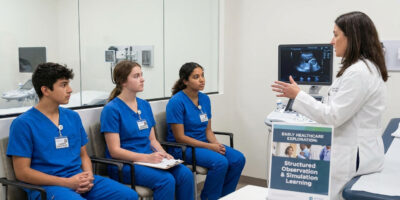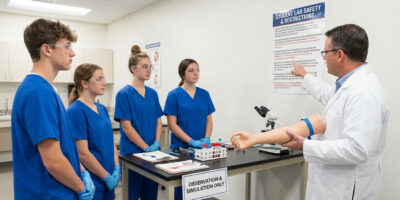
Clinical environments can be demanding for experienced professionals. For a high school student encountering a hospital or clinic for the first time, the experience may include sights, sounds, and emotional situations that require deliberate preparation. Students who pursue hospital internships for high school students benefit significantly from understanding, before they arrive, what kinds of stress are normal and how clinical professionals manage them.
Stress in a clinical setting is not a sign that a student is unsuited to healthcare. It is a predictable response to a high-stakes environment. What matters is whether a student has the self-awareness to recognize what they are experiencing, the practical tools to manage it appropriately, and the judgment to remove themselves from a situation when it exceeds their current capacity. For a structured overview of how clinical observation experiences are designed to keep students safe and supported, this pathway-building guide outlines supervision models and program expectations that apply directly to teen interns.
Types of Stress Teen Interns Commonly Encounter
Not all clinical stress is the same. Students entering healthcare settings typically encounter three distinct types, each requiring a different response.
Environmental stress comes from the physical setting itself: constant activity, unfamiliar equipment, clinical odors, procedural sounds, and a pace of work that does not slow as it does in a classroom. This type of stress is almost universal among first-time clinical observers and typically decreases significantly within the first few shifts as the environment becomes familiar.
Emotional stress arises from witnessing patient suffering, distress, or difficult outcomes. Seeing a patient in pain, observing a family receive difficult news, or watching a clinical team respond to an emergency can be emotionally intense experiences for students who are not yet accustomed to the emotional demands of healthcare work. This is one of the primary reasons that teen clinical experience programs include structured debriefings and supervisor check-ins.
Cognitive stress comes from the volume and complexity of information in a clinical environment. Students who are trying to observe everything, remember what they are seeing, follow supervision instructions, and maintain professional conduct simultaneously can experience mental fatigue quickly. This is normal and improves with experience and clear expectations.
Evidence-Based Strategies for Managing Clinical Stress
The strategies clinical professionals use to manage workplace stress are well-documented and directly applicable to teen interns. These are not informal coping mechanisms. They are professional skills.
Preparation reduces uncertainty, and uncertainty is a primary driver of stress.
Students who know in advance what a shift will look like, what they are permitted to do, who their supervisor is, where they should go if they feel overwhelmed, and what the exit protocol is experience significantly less acute stress than students who arrive without that information. Any reputable healthcare internship program will provide a thorough orientation for exactly this reason.
Controlled breathing is a physiologically grounded tool.
Slow, deliberate breathing activates the parasympathetic nervous system and reduces the physical symptoms of acute stress. Clinical professionals use controlled breathing instinctively in high-pressure moments. Students can practice this technique in advance and use it whenever they feel their stress response escalating. The American Institute of Stress has published accessible explanations of the physiological basis for breathing techniques that students may find useful as preparation.
Naming the experience reduces its intensity.
Research in affective neuroscience consistently shows that identifying and labeling an emotional state reduces its physiological impact. Students who recognize that what they are feeling is a stress response, rather than a sign that something is wrong with them, are better equipped to manage it. Journaling observations and emotional responses after each shift is a structured way to develop this self-awareness over time.
Knowing when to step back is a professional skill, not a failure.
Every reputable structured program for teen clinical experience includes a clear protocol for students to remove themselves from a situation that is exceeding their capacity. Using that protocol is the correct response to feeling overwhelmed. It is not a disqualifying event. Students who recognize their limits and act on them demonstrate the kind of self-regulation that healthcare careers require at every level.
What Supervisors Expect From Teen Interns Under Pressure
Clinical supervisors who work with high school students in observational roles have consistent expectations about how students should conduct themselves when stress levels are high.
They expect students to remain quiet and stationary during urgent situations unless directly instructed otherwise. An emergency or high-acuity event is not a moment for the student to ask questions, move closer, or attempt to assist. The correct behavior is to step back to a clear area, stay calm, and wait for instructions.
They expect students to report discomfort honestly and promptly rather than pushing through in silence. A student who feels faint, nauseated, or emotionally overwhelmed and does not report it creates a risk for themselves and a distraction for clinical staff. Supervisors are not evaluating students on their ability to tolerate distress without acknowledging it. They are evaluating students on their judgment and honesty.
They expect students to maintain professional conduct regardless of how they feel internally. This means keeping expressions neutral in patient areas, avoiding audible reactions to clinical situations, and not discussing what they have witnessed with other students within earshot of patients or families.
Building Stress Tolerance Over Time
Stress tolerance in clinical settings is developed through repeated exposure, structured reflection, and honest self-assessment. It is not something students either have or do not have before they begin.
Students who complete healthcare internships across multiple sessions, or who participate in extended programs such as those offered in global health settings, consistently report that their capacity to remain composed and focused in challenging clinical environments improves measurably over the course of the program. The initial environmental and emotional stress becomes more manageable as the setting becomes more familiar and as students develop a clearer sense of their own role and limits.
The American Psychological Association publishes research on occupational stress and resilience that is relevant to anyone entering a high-intensity professional environment. The frameworks used to support licensed healthcare workers under sustained occupational stress share foundational elements with the coping strategies that are appropriate for teen interns, adapted for the specific context of observational learning.
Summer healthcare experiences for teens that include structured debriefing, peer reflection, and supervisor feedback accelerate this development. Students who emerge from these programs with a realistic and honest assessment of how they respond to clinical stress, and a set of practical tools for managing it, are significantly better prepared for the academic and professional environments ahead.
Frequently Asked Questions
Is it normal for high school students to feel stressed during clinical internships?
Yes. Stress in a first clinical environment is a predictable and normal response, not a sign that a student is unsuited to healthcare. Clinical settings are high-stakes, fast-paced, and emotionally demanding. Most students experience some combination of environmental stress from the physical setting, emotional stress from witnessing patient suffering, and cognitive stress from the volume of new information. All three types typically decrease as the setting becomes more familiar and as students develop a clearer sense of their role and limits.
What should a teen intern do if they feel overwhelmed during a clinical shift?
A teen intern who feels overwhelmed should use the exit protocol established during their program orientation. Every reputable clinical program for high school students includes a clearly defined process for removing oneself from a situation that is exceeding current capacity. Using that protocol is the correct professional response, not a failure. Students should notify their supervising staff member immediately rather than pushing through in silence, which creates a risk for the student and a potential distraction for clinical staff.
Can stress during a clinical internship indicate that medicine is not the right career?
Not necessarily. A single stressful experience in a clinical environment is not a reliable indicator of long-term career fit. Stress tolerance in clinical settings is a skill that develops through repeated exposure, structured reflection, and honest self-assessment. Many physicians, nurses, and allied health professionals describe their early clinical experiences as significantly stressful. What matters is whether a student’s stress response decreases over time with experience and whether they find the work meaningful enough to continue developing that tolerance.
What preparation helps reduce stress before a first clinical shift?
The most effective preparation for managing clinical stress is specific rather than general. Students who know in advance who their supervisor is, what the daily schedule involves, what they are and are not permitted to do, where to go if they feel unwell, and what the exit protocol is experience significantly less acute stress than those who arrive without that information. Programs that provide thorough orientation before any clinical access begins are directly reducing the uncertainty that drives most first-shift stress.
How do clinical professionals manage stress during high-pressure situations?
Clinical professionals use several evidence-based strategies for managing occupational stress. Controlled breathing, which activates the parasympathetic nervous system and reduces physical stress symptoms, is used instinctively in high-pressure moments. Naming emotional states rather than suppressing them reduces their physiological intensity. Structured debriefing after difficult clinical events, both individual and team-based, is a standard component of clinical professional development. Many of these same strategies are appropriate for teen interns and are often incorporated into the structured reflection components of well-designed clinical programs.
Does stress during international clinical programs differ from domestic clinical settings?
Yes, in degree rather than in type. International clinical programs introduce additional sources of stress beyond those present in domestic settings, including unfamiliar environments, language barriers, distance from home support systems, and exposure to healthcare contexts that may involve more severe disease presentations or resource constraints. Well-structured international programs account for this by providing 24-hour on-site staff support, structured daily debriefs, peer group processing, and clear protocols for students who need to reduce their clinical exposure at any point during the program.
How should teen interns handle witnessing a patient death or serious medical event?
Witnessing a patient death or a serious medical emergency is an experience that some teen interns encounter, particularly in global health settings. The immediate appropriate response is to follow supervisor instructions, step back from the area if directed, and remain calm and quiet. After the event, the student should have access to a structured debrief with a supervising staff member. Programs that do not have a formal protocol for supporting students after significant clinical events are not operating at the standard that minor participants require.