
Last updated: May 2026.
Do You Get Paid During Residency? 2026 Salary Data and What to Expect
Yes, you get paid during residency. In 2026, the average resident physician in the United States earns approximately $75,000 per year, according to Medscape’s 2025 Residents Salary and Debt Report. That figure is up from $70,000 the prior year, reflecting a 6.5% year-over-year increase. But context matters. When adjusted for inflation using the Bureau of Labor Statistics’ Consumer Price Index, resident pay actually fell slightly, dropping 0.48% in real terms from 2024 to 2025. So while the number on your paycheck is climbing, your purchasing power may not be.
Being accepted into a Graduate Medical Education (GME) program is an honored achievement in the careers of all young doctors. Now you get to focus most of your time and energy on gaining new, hands-on skills as a medical practitioner. However, your MD program, whether an MD or MD/PhD program, likely brought forth a sizeable amount of debt. The median medical school debt for the class of 2025 reached $215,000, according to the AAMC. Like many MD and DO students, you were unlikely to have maintained a part-time job while in medical school. After relying on student loans, scholarships, and institutional funding, the idea of having an income sounds very alluring. As you are filling out your ERAS application, you may be asking yourself, do you get paid during residency?
The short answer is yes. Think of a residency program in terms of other forms of graduate school education. Students in PhD programs almost never get admitted without some form of funding. High-level education like a PhD or medical residency is elite, as statistically few people pursue this work, and med/PhD students contribute to the institution training them. Medical residents teach, staff clinics, and perform rotations. Residents are no longer students in many senses; rather, they are more like physicians in training. As trainee physicians, they are paid for the service they provide to the institution and those around them.
Unlike other occupations and paid graduate positions, the pay structure for residents isn’t negotiated on a person-by-person basis, nor does it vary much based on one’s chosen medical specialty. How much residents make is largely decided by two factors: seniority and institution. To better understand how these two factors affect the salary of medical residents, let’s look further into the details of residency pay structures.
Residency Pay Structure
It’s important to note that different countries have varying residency pay structures. For example, the United States and Canada. In the US, resident pay varies by institution, but in Canada, the pay varies depending on which province you are working in. In Canada, the average PGY-1 salary is approximately $63,779, calculated as the mean across ten provincial pay scales.
Without going too in-depth, it should be noted that the pay difference lies within the type of healthcare system each country utilizes. The United States utilizes a private, for-profit healthcare system, meaning most cost aspects are determined by the hospital. Whereas Canada utilizes a network of provincially-administered systems similar to a single-payer structure. It makes sense that a country whose healthcare system is organized by governmental power has a more regulated and top-down pay structure. This is also one of the reasons why physicians in the US are among the highest-paid doctors in the world.
Now, let’s direct our attention away from the politics of healthcare systems and look at the nitty-gritty of residency pay.
How Much Do Residents Make in the United States
In the US, there are several primary sources for resident pay information. The most authoritative is the AAMC’s annual Survey of Resident/Fellow Stipends and Benefits. The 2025 report, released in November 2025, includes data from 350 nonprofit ACGME-accredited institutions covering 114,361 residents and fellows, with stipend information current as of July 1, 2025. This is the largest and most methodologically rigorous dataset available on resident compensation.
Another source is AMA’s FREIDA database, which provides information about first-year compensation stats across more than 13,000 ACGME-accredited programs. However, it needs to be noted that the FREIDA database also includes data from fellowships in their overall list, so the information can be deceiving. For reference, FREIDA lists first-year resident physician salaries in subspecialties like abdominal radiology at figures that appear high for someone who is in their first year post-graduate (PGY1). Abdominal radiology is trained in some subspecialty fellowships after one’s initial residency in radiology, so this number is reflective of a PGY4 or PGY5 wage.
The other commonly cited source of residency compensation information is Medscape’s yearly Residents Salary and Debt Report. This report includes a further breakdown of contextual information, such as years beyond PGY1, medical school debt, and gender. Medscape’s sample size for this report is smaller than that of the AAMC; the 2025 survey included 646 respondents across 29-plus specialties. Like FREIDA, some of Medscape’s wage calculations include data from fellowships, so when you are looking at the higher end of averages, it is important to remember they are pay rates for those freshly out of med school.
Medscape’s surveys also include data on residents’ satisfaction with their pay and the number of hours and shifts worked. To get a more detailed picture of your would-be residency, we highly recommend reading each section of the Medscape survey. For those who may need assistance selecting a residency program or applying, we suggest Medical Residency Admissions and ERAS consulting.
Average Residency Pay in the US in 2026
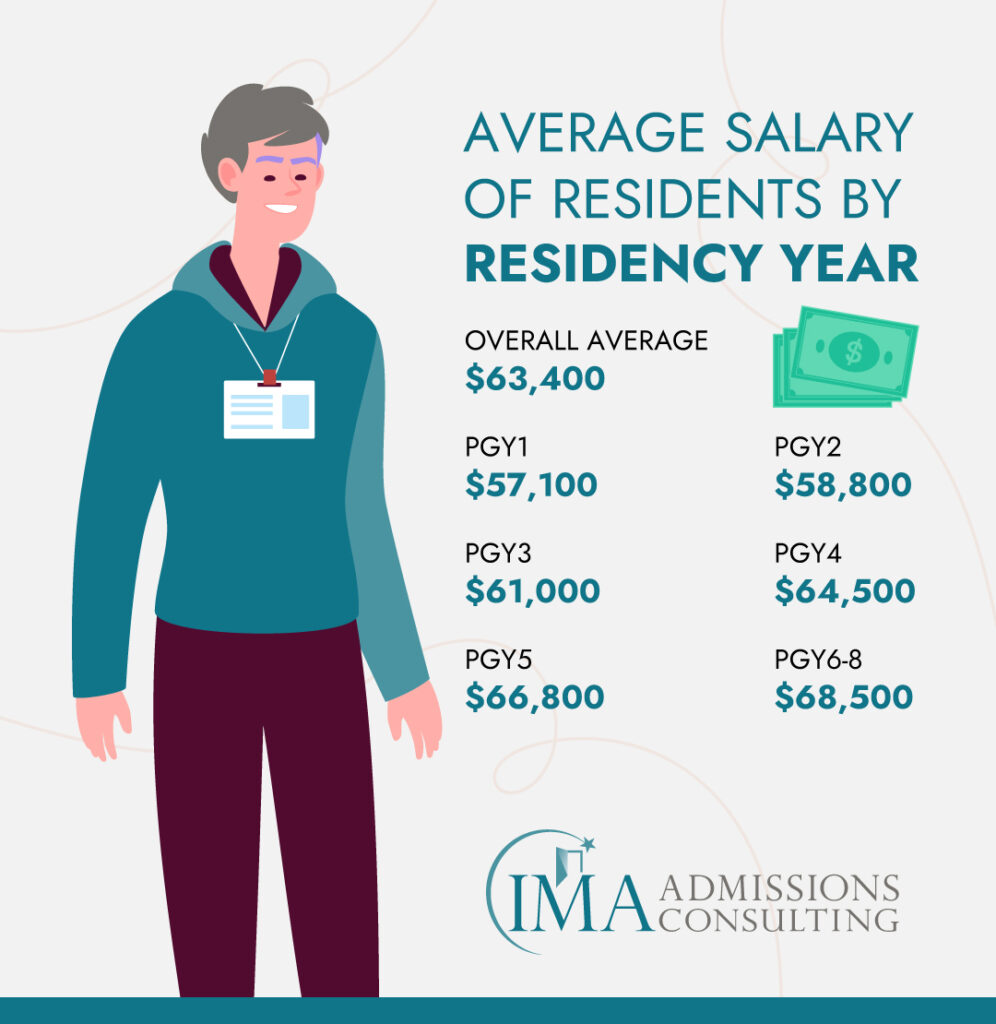
Based on the 2025 AAMC survey, here is the average resident and fellow stipend by post-graduate year:
Overall average (Medscape 2025): $75,000
- PGY1: $68,166
- PGY2: $70,499
- PGY3: $73,301
- PGY4: $77,593
- PGY5: $81,807
- PGY6: $84,744
- PGY7: $89,187
- PGY8: $94,215
These figures come from the AAMC’s unweighted national averages across 350 institutions and more than 114,000 trainees. First-year residents can expect to earn in the range of roughly $62,000 to $76,000 depending on the institution and region. For example, a PGY-1 at the University of Pennsylvania earns $76,347, while a first-year at the Medical University of South Carolina makes $61,935. That is a difference of nearly $15,000 for the same level of training.
Medscape’s 2025 report groups the data slightly differently: first- or second-year residents averaged $68,000, third-year residents averaged $72,000, and those in their fourth year or beyond averaged $79,000.
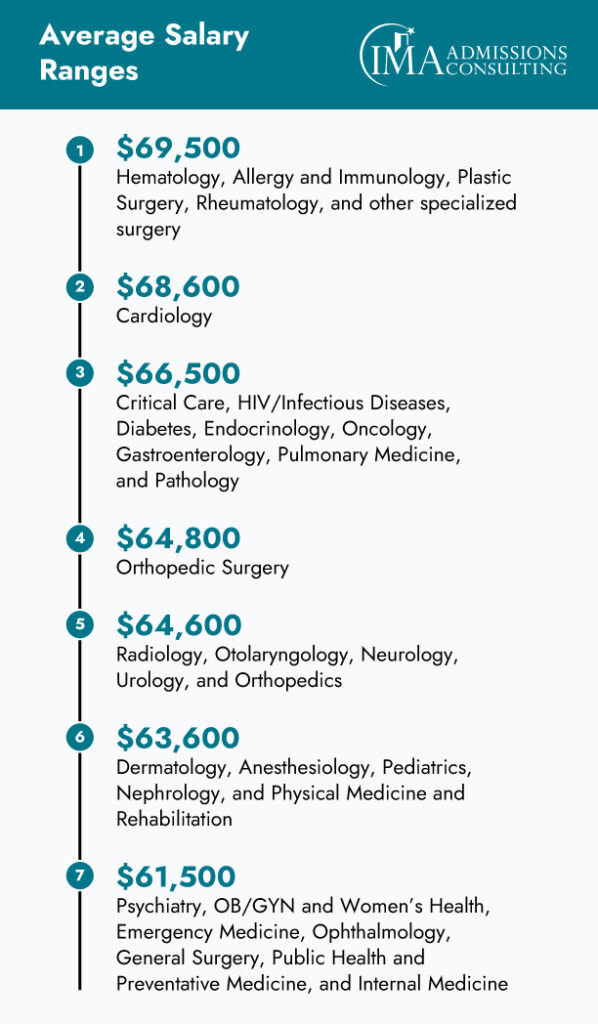
There are a few points worth making based on the information above. The first is the hierarchical system. Residency programs that are available to recent DO and MD graduates don’t appear at the higher end of average pay lists, because the top-earning categories represent combined programs and fellowships beginning at PGY4 and beyond.
The next point is early match programs, such as neurology, ophthalmology, neurosurgery, and urology, which have higher averages than normal match residencies. While there are a few reasons for this, the primary reason is that these early match specialties are quite long. For example, neurosurgery is one of the longest residencies, ranging from 6 to 10 years in some cases. Therefore the compensation average for that program includes PGY6-8 and beyond, which will be higher than the average compensation of a family medicine 3-year data set.
How Residency Pay Varies by Institution Type
The AAMC data also reveals meaningful differences in compensation depending on the type of institution where you train. According to the 2025 survey, the unweighted average stipends from PGY1 through PGY8 were:
- Medical schools: $67,899 (PGY1) to $90,855 (PGY8)
- General and specialty hospitals: $68,308 (PGY1) to $96,112 (PGY8)
- Health systems and consortiums: $67,657 (PGY1) to $94,009 (PGY8)
At the PGY1 level, these differences are relatively small. But by PGY8, a fellow at a general or specialty hospital could be earning more than $5,000 per year above a peer at a medical school-based program. Over the course of a multi-year fellowship, that gap adds up.
Geography plays a role as well. According to Salary.com data as of mid-2026, higher cost-of-living areas like Washington, D.C. ($70,379 average), California ($70,112), and Massachusetts ($69,178) tend to offer higher base stipends. However, these figures should be weighed against the local cost of living. A higher salary in San Francisco or Boston may not stretch as far as a lower one in a more affordable city.
US Resident Pay: Satisfaction, Hours, and the Real Hourly Rate
Medscape’s 2025 survey provides important context beyond the base salary number. In that survey, 95% of residents said they believe most residents are not paid enough. When asked about their own pay specifically, 73% felt underpaid.
The data on whether compensation covers basic living expenses is equally striking. Fifty-eight percent of residents said their compensation fell short of covering living costs to varying degrees. Only 37% said they earned about as much as they needed, and just 5% said they earned more or much more than they needed. Nearly one-fifth reported earning much less than they needed.
When asked how much more residents should be paid for compensation to be fair, more than one in three respondents said at least 51% more. Over 70% of respondents said residents need at least a 26% raise. Panacea Financial’s 2025 survey of residents and fellows found that trainees rated their compensation satisfaction at 5.1 out of 10.
Part of the dissatisfaction stems from the hours. According to Medscape, 79% of residents worked with patients for more than 40 hours per week, and 22% saw patients for more than 70 hours a week. When you calculate the effective hourly rate, it puts things in perspective. At $75,000 per year:
- At 50 hours per week: roughly $29 per hour
- At 60 hours per week: roughly $24 per hour
- At 80 hours per week: roughly $18 per hour
For someone with an MD or DO degree, over $200,000 in student debt, and years of advanced training, earning $18 per hour during a demanding work week is a legitimate source of frustration. This is one reason the resident unionization movement has accelerated in recent years.
Medscape notes that the pay gap between male and female residents remains smaller than the pay gap between male and female practicing physicians. The resident pay gap is approximately $700 per year. The attending physician pay gap, however, has widened. According to the 2026 Medscape Physician Compensation Report, male physicians now earn an average of roughly $102,000 more per year than their female counterparts, a gap of approximately 31%. While the $700 resident-level gap is still beyond the margin of error, it is considerably more egalitarian than the post-residency landscape.
Resident Unionization: A Growing Force in 2026
One of the most significant developments affecting resident compensation in the mid-2020s is the rapid growth of resident physician unions. Membership in the Committee of Interns and Residents (CIR-SEIU), the largest resident union in the country, roughly doubled between the onset of the COVID-19 pandemic and the mid-2020s. Membership grew from close to 18,000 residents and fellows in 2020 to more than 37,000 by early 2025 and over 40,000 by 2026.
A study published in JAMA Network Open surveyed 1,235 resident physicians and found that 20% reported working in unionized hospitals. Among non-unionized resident physicians, 63% reported an intention to vote to unionize.
What does unionization mean for pay? The results so far have been concrete. When the University of Massachusetts resident physicians, interns, and fellows ratified a new contract, union members secured a 9.5% compensation increase over three years in addition to a $5,000 annual stipend for mental health services. At Stanford Health Care, residents who unionized in 2022 secured raises that the union said would push starting salaries above $100,000 for incoming 2025 residents.
These are outliers for now. Most programs have not seen raises that large. But the trend is worth watching, especially if you are comparing programs and want to understand what levers exist for improving compensation during your training years.
Medical School Debt and the Residency Pay Reality
Residency pay cannot be understood in isolation from the debt residents carry into it. The AAMC reports that the median educational debt for the class of 2025 was $215,000, and the average among indebted graduates was $216,659. When undergraduate debt is included, the total average rises to approximately $246,659.
In Medscape’s 2025 survey, more than half of respondents carried at least $150,000 in medical school loans. This is the financial backdrop against which a $68,000 to $75,000 salary has to be evaluated.
There is also a significant new development on the federal student loan front. Recent federal legislation eliminated Grad PLUS loans for new borrowers (with an exception for some students enrolled prior to July 1, 2026), changed income-driven repayment plan structures, and scaled back Public Service Loan Forgiveness provisions. For students currently in medical school or about to begin, this changes the financial calculus considerably. If you were counting on PSLF during residency and beyond, it is essential to verify how the new rules apply to your specific borrowing timeline. Students entering medical school in 2026 or later should speak with a financial aid officer early about how these changes affect their repayment strategy.
For pre-med students still early in the pipeline, understanding the full financial picture of a medical career, from MCAT preparation through residency, is part of making a well-informed decision about whether this path fits your goals and circumstances.
Benefits and Non-Salary Compensation
In the US, the majority of residents will receive added benefits like dental insurance, health insurance, and paid time off. According to Medscape’s 2025 report, 90% of residents have access to health insurance through their program. Most residency programs offer a benefits package that adds $10,000 to $20,000 in value beyond the base stipend. Due to the nature of the United States healthcare system and medical unions, these benefits vary widely from institution to institution.
Housing stipends remain uncommon. Only about 9% of residents report receiving a housing allowance, according to the 2025 Medscape data. For residents in high cost-of-living cities, this can make a meaningful difference in the financial experience of training.
It is also worth mentioning that there are opportunities for non-salary compensation within US residency programs. This includes moonlighting, on-call assistant shifts, and hospital coverage shifts. While these one-off opportunities won’t make much difference to your overall earnings, they can help offset surprise expenses. If moonlighting is important to you, ask about institutional policies during your residency interviews, as not all programs allow it.
What This Means for Pre-Med and Pre-Health Students
If you are still in the pre-med phase, years away from residency, these numbers might feel abstract. But they matter for two reasons.
First, they shape your financial planning. Knowing that you will earn roughly $68,000 to $75,000 during residency, while carrying over $200,000 in debt, should inform how you borrow during medical school. It should also inform whether you pursue schools with strong scholarship packages, whether you consider MD versus DO pathways with different cost structures, and how you think about specialty choice and residency length.
Second, understanding the full trajectory of a medical career, from clinical internships as an undergraduate through residency and attending practice, helps you make better decisions at every stage. The students who enter medical school with realistic expectations about the training timeline, compensation, and workload tend to be more resilient when the hard years arrive.
This is also why early clinical exposure matters. Before you commit to the financial and personal demands of medical training, spending structured time in clinical settings helps you confirm that this is the right fit. Programs like accumulating meaningful clinical hours during your undergraduate years serve a dual purpose: they strengthen your application and they give you an honest look at what medical practice involves day to day.
Wrapping Up: What 2026 Residents Should Know
While pay is an important factor in medical residency, it is not the only factor. The Medscape data consistently shows that despite pay dissatisfaction, residents value the training itself. In prior surveys, large majorities reported being satisfied with their learning experience and having good relationships with their attending physicians, nurses, and PAs.
Here are the key financial takeaways for 2026:
- The average resident salary is approximately $75,000, with PGY1 starting around $68,166 per AAMC data.
- Pay varies meaningfully by institution, with PGY1 salaries ranging from roughly $62,000 to over $76,000.
- Nominal pay is rising, but real wages (adjusted for inflation) declined slightly in the most recent data.
- Resident unionization is expanding rapidly and has produced measurable compensation gains at some institutions.
- The median medical school debt is $215,000 for the class of 2025, and federal loan program changes may affect future repayment strategies.
- Most programs offer benefits packages worth $10,000 to $20,000 beyond the base stipend.
You will have plenty of time to pay off your medical school debt after finishing your residency. According to the 2025 Doximity Physician Compensation Report, primary care physicians average around $295,000 annually, while specialists average $470,000. That means your earnings as a practicing physician will likely be four to six times your residency salary. During your residency, you should try to engage fully in the training and learning experience rather than focusing exclusively on earning the highest wage possible.
We wish you the best of luck as you venture to the next stage of your medical education, and for those who may need guidance when it comes to applying for residency, we are always here to offer our Medical Residency Admissions and ERAS consulting.
Resident Salary by Training Year (PGY)
The table below shows average annual resident and fellow stipends by post-graduate year, drawn from the AAMC Survey of Resident/Fellow Stipends and Benefits (2025, the most recent release).
| Training Year | Average Annual Stipend (AAMC 2025) |
|---|---|
| PGY-1 | $68,166 |
| PGY-2 | $70,499 |
| PGY-3 | $73,301 |
| PGY-4 | $77,593 |
| PGY-5 | $81,807 |
| PGY-6 | $84,744 |
| PGY-7 | $89,187 |
| PGY-8 | $94,215 |
Frequently Asked Questions
What US residencies are the highest paid?
At the top of the list are allergy and immunology, medical genetics, hematology, rheumatology, and most forms of specialized surgery. It is important to remember that these are subspecialty residencies (PGY4+), so their averages include years of seniority-based pay increases that shorter residencies do not.
What are the highest paid doctors in 2026?
According to Doximity’s most recent physician compensation report, neurosurgery ($749,000), thoracic surgery ($690,000), and orthopedic surgery ($680,000) are the highest-paid medical specialties. The average physician salary across all specialties is now approximately $386,000 to $403,000, depending on the source. You can read more in our breakdown of how much doctors make by specialty.
Is there a link between residency competitiveness and pay?
Yes, to some extent. These variations in pay aren’t overly large in the grand scheme of things. Of course, there are also exceptions to this like dermatology. Dermatology is an extremely competitive residency but sits right around the average mark for resident pay. It is important to consider when during the medical career these residencies take place, as subspecialty residencies (PGY4+) will always have higher average pay than residencies for PGY1 and PGY2.
Are there non-salary compensation opportunities?
Yes. While these vary by institution, there are often moonlighting, on-call assistant shifts, and hospital coverage shift opportunities. All of these provide non-salary compensation. Additionally, most programs offer benefits packages worth $10,000 to $20,000 per year, including health insurance, dental coverage, and paid time off.
Why do family medicine residents get paid less?
When researching “how much do resident doctors make,” many will see that family medicine is ranked among the lowest in earnings. While the average income for a family medicine resident is less than other residencies, they aren’t being paid less per year of training. A family medicine residency is much shorter than other medical specialty residencies, meaning the data for the average salary is only inclusive of up to PGY3-4. A neurosurgery average, by contrast, includes data through PGY6-8 or beyond, which pulls the average up considerably.
If I switch residencies, will I go back to a PGY1 salary?
In the US, if you switch from one residency to another (assuming both are normal match), you are likely to experience a slight pay cut. The big exception is when moving from a general residency to a more specialized one; in this case, you will be reset to earning a PGY1 wage.
How much more do fellows earn than residents?
When thinking about fellowships, it is best not to think of them as standalone programs, but rather as residencies that begin at PGY4 and beyond. Per the 2025 AAMC data, a PGY4 averages $77,593 and a PGY8 averages $94,215. The pay for a fellowship follows the same seniority-based structure as residency.
How does resident pay compare to what attending physicians earn?
At $75,000 per year, residents earn only about 25% of what licensed primary care physicians earn (averaging around $295,000) and roughly 16% of what specialists make (averaging around $470,000), according to the 2025 Doximity Physician Compensation Report. While the gap is large, it reflects the training nature of residency. Most physicians see their income multiply four to six times upon completing training.
Will unionization increase resident salaries?
It already has at some institutions. Stanford Health Care residents secured raises pushing starting salaries above $100,000 for 2025. University of Massachusetts residents won a 9.5% increase over three years plus a $5,000 annual mental health stipend. These results are not universal, but the trend toward resident unionization is accelerating, with over 40,000 residents now represented by CIR-SEIU nationwide.