
Your roadmap for test dates, registration deadlines, score release schedules, and essential MCAT preparation tips for the 2026 testing year.
For prospective medical students in the United States, Canada, and various parts of the world, the Medical College Admission Test (MCAT) is one of the most important hurdles to earning an M.D. or D.O. degree. This standardized exam, administered by the Association of American Medical Colleges (AAMC), serves as a crucial metric by which medical school admissions committees assess applicants’ foundational knowledge in science, critical thinking, and problem-solving skills.
Beyond mere numbers on a score report, the MCAT is designed to gauge whether you have the academic and reasoning abilities to excel in a medical curriculum and, eventually, in clinical practice. If you are still working through your prerequisite coursework, our guide to pre-med requirements can help you map out what you need before sitting for the exam.
Although the MCAT is known to be challenging, the good news is that its difficulty is purposeful: medical schools want to ensure their incoming students have the scientific knowledge, research acumen, and verbal reasoning skills necessary for success in both classroom and clinical settings. As you plan your path toward medical school, understanding the MCAT’s structure, the timing of test dates, and the score release schedule can help you optimize your application timeline.
In this comprehensive guide, we walk you through the full 2026 MCAT testing calendar, including all 2026 MCAT dates, deadlines for registration, rescheduling, and score releases. We also cover key topics such as eligibility, the frequency of taking the MCAT, and essential test-day policies. Whether you’re a first-time test taker or planning a retake, you’ll find tips on mapping out your study schedule, deciding when to take the exam, and getting ready for every aspect of MCAT test day. Planning effectively and familiarizing yourself with the exam’s requirements can reduce stress, maximize your preparedness, and boost your chances of a strong MCAT performance.
What Is In This Guide
- Overview of the MCAT: Format, Sections, and Scoring
- What Changed for the 2026 MCAT Testing Year
- 2026 MCAT Testing Dates Calendar at a Glance
- Understanding MCAT Registration and Deadlines
- Score Release Timeline Explained
- Fees, Rescheduling, and Cancellations
- Who is Eligible to Take the MCAT?
- When Should You Take the MCAT?
- Preparing for the MCAT: Study Strategies and Resources
- International Students and Special Permissions
- Retaking the MCAT: How Often Can You Test?
- Navigating Test Day: What to Expect
- The Fee Assistance Program in 2026
- Frequently Asked Questions (FAQ)
- Final Tips for the 2026 MCAT Cycle
Overview of the MCAT: Format, Sections, and Scoring
Before getting into the 2026 test dates, it’s important to understand the MCAT’s overall format and scoring system. This foundational knowledge helps you appreciate why certain deadlines and timelines exist (e.g., for score releases) and how best to align your preparation with your scheduled test date.
MCAT Format
The MCAT tests the skills and knowledge that medical educators and practicing doctors deem essential for success in medical school. The MCAT comprises four sections:
- Chemical and Physical Foundations of Biological Systems (Chem/Phys)
- Covers general chemistry, organic chemistry, introductory physics, basic biochemistry, and biology.
- Emphasizes how physical and chemical principles underlie human body functions and the biochemical interactions that enable life.
- Critical Analysis and Reasoning Skills (CARS)
- Tests reading comprehension and analytical thinking skills using humanities and social sciences passages.
- You must draw inferences, assess arguments, and evaluate information under timed conditions.
- Biological and Biochemical Foundations of Living Systems (Bio/Biochem)
- Focuses on biology and biochemistry concepts, including the function of biomolecules, cellular processes, and organismal biology.
- Integrates key principles learned in undergraduate biology and biochemistry courses.
- Psychological, Social, and Biological Foundations of Behavior (Psych/Soc)
- Assesses knowledge of psychology, sociology, and related research methods.
- Explores how behavioral and sociocultural factors influence health, illness, and medical care.
The MCAT has 230 total questions. Each of the three science sections contains 10 passages with 4 to 7 questions each, plus 15 stand-alone questions. The CARS section includes 9 passages with 5 to 7 questions each. Each section is allotted between 90 to 95 minutes, and you’ll receive optional breaks in between. The total content time is approximately 6 hours and 15 minutes, and total seated time (including optional breaks) is around 7.5 hours.
Scoring System
Each of the four MCAT sections is scored on a scale of 118 to 132, for a possible total score range of 472 to 528. The scale’s midpoint for each section is 125 (total midpoint of 500), which corresponds roughly to the 50th percentile. A score of approximately 511 places you near the average for accepted M.D. applicants, which falls around the 81st percentile. Students aiming for top-10 medical programs typically score in the 519 to 522 range. For a more detailed breakdown of what different scores mean for your applications, see our guide on what MCAT score you need to get into medical school.
Timing and Breaks
You can move on to the next section as soon as you finish the current section, or you can take the full optional break time (10 minutes between two of the sections and one 30-minute mid-exam break). Remember that unused time from a section or a break does not roll over to the next exam portion. It’s crucial to pace yourself during the test and know that you can’t go back to previous questions once you move forward.
With the format and timing in mind, let’s look at what’s new for the 2026 testing year before covering the full calendar.
What Changed for the 2026 MCAT Testing Year
While the exam’s format and scoring remain the same as in prior years, the AAMC has made several notable changes for the 2026 cycle that test-takers should know about.
A February Test Date for the First Time
For the first time ever, the AAMC is offering an MCAT test date in February. The February 13, 2026 date fills what was previously a gap between the January dates and the March testing window. This is a meaningful addition for students who need a few extra weeks of preparation after the January cluster but don’t want to wait until March.
30 Test Dates Across the Full Calendar
The 2026 testing year includes approximately 30 official test dates, running from January 9 through September 12, 2026. The MCAT is not offered in October, November, or December. This is consistent with prior years but worth remembering if you are planning a late-cycle retake.
Registration Opened for All Dates at Once
Unlike some prior years where registration opened in separate waves (fall for early dates, spring for summer dates), 2026 registration opened on October 21, 22, and 23, 2025, with staggered access starting at 12:00 p.m. ET each day. All January through September 2026 test dates were made available during this window. As of spring 2026, registration remains open for any dates that still have available seats.
New AAMC Official Prep Resources
The AAMC has released Practice Exam 6, a brand-new 230-question full-length practice exam drawn from previously administered MCAT questions. It is available for individual purchase at $35 or as part of the Online-Only Bundle ($323.70). In addition, Practice Exam 1 is now free through the AAMC MCAT Official Prep Hub, lowering the cost barrier for students in the early stages of preparation.
MCAT No Longer Offered in Quebec
Due to regulations outlined in Quebec’s Bill 96, which requires that all business be conducted in the French language, the AAMC is unable to administer the MCAT exam in the province. Students in Quebec will need to travel to another Canadian province or to the United States to take the exam. This policy has been in effect since 2024 and continues into 2026.
Exam Content Trends
Although no structural changes have been made to the MCAT since the current version launched in April 2015, analysis of the new AAMC Practice Exam 6 suggests that the exam continues to move away from pure recall-based questions and toward integrated reasoning. This means that memorizing facts alone is not enough; the MCAT increasingly rewards students who can apply concepts across disciplines and interpret data in context.
2026 MCAT Testing Calendar at a Glance
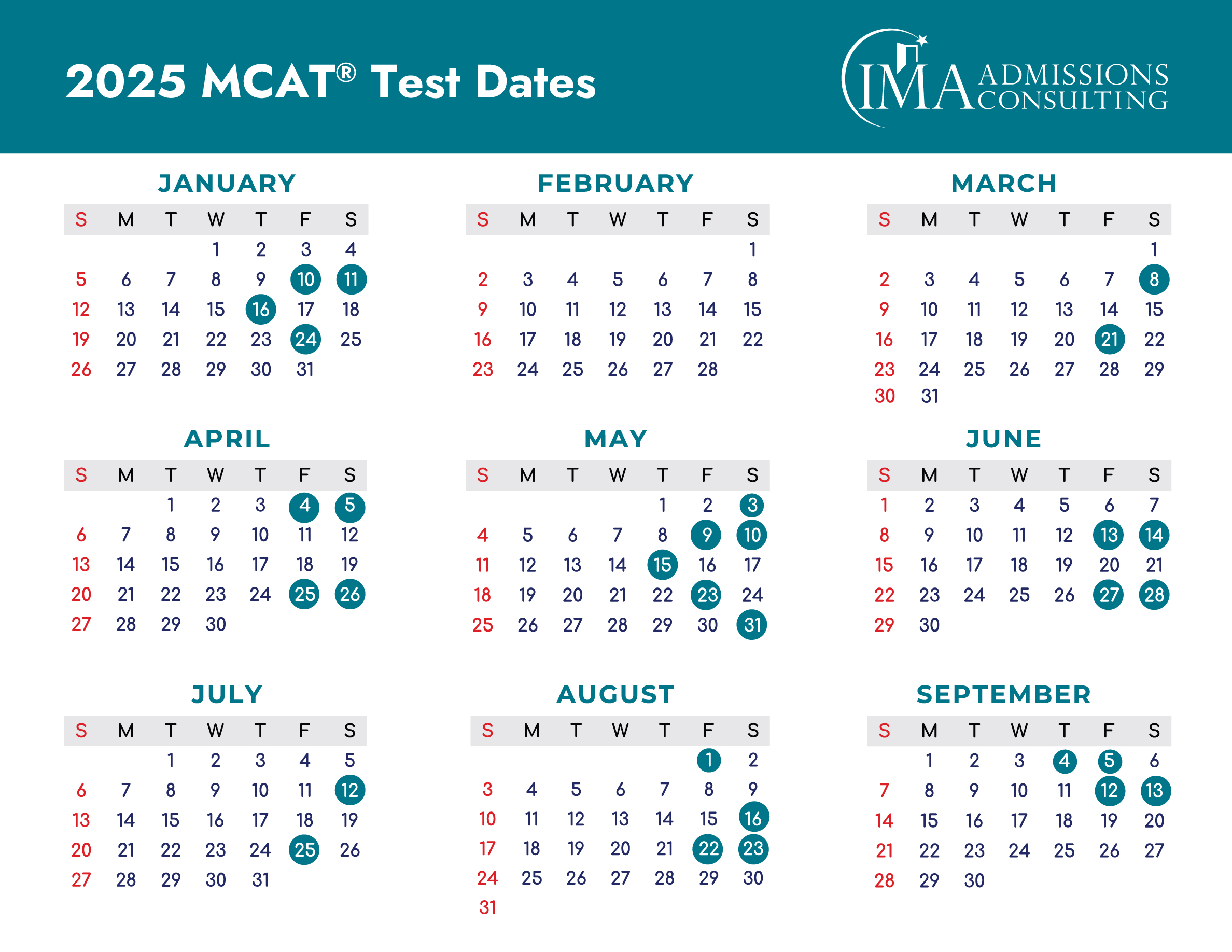
Below is the official 2026 MCAT testing calendar for U.S. test centers, including the corresponding score release dates. Remember that all scheduling deadlines fall at 11:59 p.m. local test center time on the deadline day. Score release times are typically by 5:00 p.m. ET on the indicated day.
Important Note:
- The 10-day deadline before your test date is the final day to schedule, reschedule, or cancel a reservation. It is also the last day to edit personal information such as your name, address, and consents.
- Refer to the AAMC scheduling fees page for the most current fee amounts and policies.
| 2026 Test Date | Score Release Date |
|---|---|
| January 9 | February 10 |
| January 10 | February 10 |
| January 15 | February 17 |
| January 23 | February 24 |
| February 13 | March 17 |
| March 7 | April 7 |
| March 20 | April 21 |
| April 10 | May 12 |
| April 11 | May 12 |
| April 24 | May 27 |
| April 25 | May 27 |
| May 2 | June 2 |
| May 8 | June 9 |
| May 9 | June 9 |
| May 14 | June 16 |
| May 22 | June 23 |
| May 30 | June 30 |
| June 12 | July 14 |
| June 13 | July 14 |
| June 26 | July 28 |
| June 27 | July 28 |
| July 11 | August 11 |
| July 24 | August 25 |
| July 31 | September 2 |
| August 15 | September 15 |
| August 21 | September 22 |
| August 22 | September 22 |
| September 3 | October 6 |
| September 4 | October 6 |
| September 11 | October 13 |
| September 12 | October 13 |
Key Takeaways
- The 60-day and 30-day deadlines come into play if you want to avoid higher registration fees as you schedule or adjust your exam date.
- The 10-day deadline is crucial: after this point, no rescheduling or cancellation is possible, and you cannot change personal information in your registration.
- Score releases generally happen 30 to 35 days after each exam date. Knowing your score release date is essential if you aim to meet medical school application timelines.
- Several dates in April, May, and June are offered in back-to-back pairs (e.g., April 10 and April 11). This gives you slightly more flexibility when booking, but popular weekend dates still fill quickly.
The testing dates and deadlines for Canadian and international test centers often mirror the U.S. schedule, but slight variations may exist. Note that the MCAT is not offered in Quebec in 2026 due to Bill 96 language regulations. If you plan to test outside the United States, always check the AAMC website for the most accurate and up-to-date international calendar.
MCAT Registration and Deadlines
Registration Windows
For the 2026 testing year, MCAT registration opened in a single consolidated window. The AAMC registration system allowed preliminary paperwork (account setup, personal information, consents) starting October 1, 2025. Actual exam date and location selection opened in a staggered rollout on October 21, 22, and 23, 2025, at 12:00 p.m. ET each day. All January through September 2026 test dates were made available during this window.
This is a departure from some prior years when registration opened in two waves (fall for early dates, spring for summer dates). In 2026, you can register for any remaining available date right now through the AAMC registration system.
The 10-Day Deadline
Remembering the 10-day cutoff before your chosen test date is the most critical deadline. By this point, you must finalize any scheduling changes, cancellations, or modifications to your personal information. While you can make changes right up to this deadline, settling your test plans earlier is often advisable to avoid last-minute stress or complications if your preferred seat is no longer available.
Last-Minute Scheduling and Availability
Since many MCAT test dates fill up months in advance, you should register as early as possible to secure your preferred date and location. Some examinees, especially those applying in the same cycle, prefer the earliest dates in the year (January through April) to ensure their MCAT scores are ready for primary medical school applications (which typically open in late May or early June). If these seats fill quickly, consider later dates or travel to a test center that is not your top choice. For a detailed look at how timing affects your entire application, our article on when you should take the MCAT covers the strategic considerations in more depth.
Advance Scheduling for Special Cases
Certain groups, such as examinees with approved testing accommodations, may receive advance scheduling options. If you’re eligible for such a benefit, you will typically be notified directly by Pearson VUE or AAMC. Be sure to monitor your email for instructions and deadline reminders.
Score Release Timeline Explained
Most 2026 MCAT score release dates fall roughly one month after each test date. The AAMC ensures that this timeframe remains consistent so applicants can plan their application timeline accordingly. Scores are generally posted by 5:00 p.m. ET on the official release date. One important note: the AAMC does not send a notification when your score is released. You must log in to your AAMC account to check.
Here’s why the timing matters:
- Medical School Applications: Many applicants wish to have their scores in hand before submitting their primary application. This allows them to make informed decisions about target schools based on their MCAT performance.
- Retake Considerations: If you’re contemplating a retake, you must receive your score before deciding. Waiting until late in the cycle might reduce your flexibility with test dates.
- Rolling Admissions: Most U.S. medical schools have rolling admissions policies, meaning submitting your application as early as possible can be advantageous.
If you sit for a January or early spring MCAT, you’ll have your scores in time for the primary application window (beginning late May or early June), allowing you to apply very early. If you take the exam in the late summer or early fall, your scores will arrive much later in the cycle, which may or may not affect your competitiveness, depending on each medical school’s rolling policies. To understand how to use your score strategically once you receive it, see our MCAT score calculator guide.
Fees, Rescheduling, and Cancellations
2026 Registration Fees
The AAMC uses a tiered fee structure based on how far in advance you schedule your MCAT exam. For the 2026 testing year, the standard registration fee is $355 (or $145 for students approved through the Fee Assistance Program). Students testing outside the United States, Canada, or U.S. territories are charged an additional $130 international testing fee. Because fee amounts can change, always confirm the current figures on the AAMC scheduling fees page before registering.
Rescheduling and Cancellation Fees
Changing your test date or test center incurs additional fees that increase as your exam date approaches:
- 60 or more days before your exam: Approximately $55 to reschedule your date or location.
- 30 to 59 days before your exam: Approximately $100 to reschedule.
- 10 to 29 days before your exam: Approximately $200 to reschedule.
- Cancellation: You may receive a partial refund of approximately $175 if you cancel 30 or more days before your test date. Canceling after that point typically means forfeiting more of the fee, or all of it past the 10-day deadline.
- Emergency Refund Requests: In certain extenuating circumstances (e.g., severe illness, natural disasters), the AAMC may offer an emergency refund option. Proof is required, and requests are not guaranteed to be approved.
Fee Assistance Program recipients pay reduced rescheduling fees at each tier (approximately $20, $40, and $80 at the 60-day, 30-day, and 10-day windows, respectively). Again, confirm all current amounts directly with the AAMC.
The “10-Day” Constraint
After the 10-day cutoff, there is no option to reschedule. You also lose the ability to edit your registration details. You can explore an Emergency Refund Request if an emergency arises within that 10-day window. However, such approval is not automatic, and you should not rely on it as a guarantee if you change your mind or face a non-critical situation.
Who is Eligible to Take the MCAT?
General Eligibility
You can take the MCAT if you plan to apply to any health professions school that accepts MCAT scores to satisfy their admissions requirements. This includes but is not limited to:
- M.D.-granting programs (allopathic)
- D.O.-granting programs (osteopathic)
- Podiatric (D.P.M) programs
- Veterinary (D.V.M) programs
- Any other health-related program that accepts MCAT scores as part of admissions
When registering, you must agree to a statement confirming your intention to apply to a health professions program that accepts MCAT scores.
International Students
There are no additional eligibility hoops for international students. If you hold (or are currently pursuing) an MBBS or equivalent degree from outside the U.S. or Canada, you can register for the MCAT without seeking special permission. You should, however, check the AAMC’s guidelines and your prospective programs to ensure they accept MCAT scores from international applicants.
Special Permission
If you’re not planning to apply to a health professions program or enrolled in a medical school (other than an MBBS program), you must request “special permission” to take the MCAT. Email the MCAT program office ([email protected]) with your reasoning for taking the exam. Processing these requests can take up to five business days or more during peak times, so be mindful of registration deadlines.
When Should You Take the MCAT?
Determining the best time to take the MCAT is a strategic decision that can impact your entire medical school application cycle. Below are some key considerations to help you choose the right test date:
Timing Relative to the Application Cycle
Most medical students take the MCAT the same year they apply. For instance, if you plan to start medical school in Fall 2027, you typically apply in the 2026 cycle (with applications opening in June 2026). In that case, you’d want to have your MCAT scores ready by early summer 2026, allowing you to submit your primary applications as soon as they open. Many advisors recommend taking the MCAT by April, and no later than the end of May, for same-cycle applicants.
Allowing Time for Retakes
If you believe you may retake the MCAT, scheduling your first exam earlier in the year (such as January through May) leaves you wiggle room to retest in the summer or early fall if needed. The new February 13 date for 2026 also provides an additional early option. This is especially valuable because MCAT test dates from June onward can fill quickly, and you might not secure your ideal date if you wait until the last minute.
Mastery of Content
The MCAT covers a broad range of undergraduate-level science topics in biology, chemistry, physics, biochemistry, psychology, and sociology. Ensure you’ve completed the relevant coursework or self-study before booking your test date. The AAMC recommends studying for roughly 300 hours total. Many students spread this across 3 to 6 months of dedicated preparation, though the timeline varies depending on individual study habits and academic background. For a closer look at which courses matter most, see our article on pre-med requirements.
Advisor Consultation
If you can access a pre-health or academic advisor, consult them when planning your MCAT timeline. Advisors can help you determine whether your current coursework, extracurricular commitments, and personal responsibilities allow for adequate MCAT preparation. Understanding the AAMC core competencies can also help you evaluate your readiness across non-academic dimensions. If you do not have a pre-health advisor, you can use the National Association of Advisors for the Health Professions (NAAHP) as a resource to connect with someone who can guide you.
Personal Readiness
The MCAT is not just another exam; it’s a significant milestone on your path to medical school. If you rush into the exam without being prepared, you risk underperforming, which could lead to a retake (and additional fees, stress, and time). While earlier is typically better, do not take the exam before you’re ready.
MCAT Prep Study Strategies and Resources
Foundational Courses
Because the MCAT’s science sections draw on content from prerequisite courses like general chemistry, organic chemistry, physics, biology, and biochemistry, it’s critical to have a strong foundation in these areas. Ensure you’ve taken (or are concurrently taking) these courses well before your test date. Introductory psychology and sociology are also important for the Psychological, Social, and Biological Foundations of Behavior section.
Study Materials and Practice Exams
- AAMC Official Guides and Question Packs: The AAMC offers official practice exams that closely mimic the real MCAT’s format and difficulty. For 2026, the AAMC has added Practice Exam 6 ($35) and made Practice Exam 1 available for free. The full Online-Only Bundle is priced at $323.70. These are the closest thing to the actual exam and are considered essential for gauging readiness.
- Commercial Prep Courses: Companies like Kaplan, Princeton Review, and Blueprint MCAT offer structured prep courses, which can be classroom-based or online.
- Self-Study: Many students use books, flashcards, online videos, and free question banks.
- Study Groups: Collaborating with peers can help you stay motivated and clarify difficult concepts.
Create a Study Schedule
Designing a study plan is one of the most critical aspects of MCAT success. Factors to consider:
- Total Study Time: The AAMC recommends approximately 300 hours. Many students spread this across 12 to 16 weeks, though some take 3 to 6 months depending on their schedule and baseline knowledge.
- Daily and Weekly Goals: Break down your content review, practice questions, and full-length exams into manageable milestones.
- Full-Length Simulations: Aim to take 4 to 6 full-length MCAT practice exams under timed conditions to build endurance and familiarity. With the AAMC now offering six official practice exams (one free), you have more options than in prior years.
- Review: Dedicate ample time to thoroughly analyze your incorrect answers and revisit weak areas. Analysis of AAMC Practice Exam 6 suggests the test increasingly rewards integrated reasoning over simple recall, so practice applying concepts across disciplines.
Balancing Commitments
If you’re juggling academic coursework, a job, or extracurricular activities, be realistic about how much daily or weekly time you can devote to MCAT study. It’s often better to postpone the exam rather than attempt to prepare amid an overwhelming schedule.
International Students and Special Permissions
International Test Centers
The AAMC offers MCAT testing in various countries worldwide, although seat availability can be limited. Register early to secure a convenient location if you’re outside North America. International examinees pay the standard registration fee ($355 for 2026) plus a $130 international testing fee. Always confirm these amounts on the AAMC website before registering.
The Quebec Exception
Students in Quebec should be aware that the MCAT is not offered anywhere in the province for 2026. This is due to Bill 96, which requires all business in Quebec to be conducted in French. The AAMC has confirmed it is unable to administer the English-language MCAT under these regulations. If you are based in Quebec, you will need to plan travel to another Canadian province (such as Ontario) or to the United States. Factor in travel costs, accommodation, and additional preparation time when choosing your test date.
Visa and Travel Considerations
Some international students prefer traveling to the United States or Canada to take the MCAT. In that case, consider travel, accommodation, and potential visa requirements. Plan these logistics well in advance, preferably at least 2 to 3 months before your test date.
MBBS and Equivalent Degrees
Students in (or graduates of) MBBS programs can register for the MCAT without additional permission. All other international students or medical graduates should check the AAMC guidelines to confirm their eligibility.
Special Permission Requests
As stated earlier, if you do not plan on applying to a health professions program or you’re enrolled in a medical program other than MBBS, you must request special permission by emailing the MCAT program office. Be mindful of the time it might take for the AAMC to respond.
Retaking the MCAT: How Often Can You Test?
Although the MCAT can be taken multiple times, specific limits prevent excessive retesting and encourage students to be intentional about each attempt. These limits are unchanged for 2026:
- Single Testing Year: Up to 3 attempts.
- Two Consecutive Years: Up to 4 attempts total.
- Lifetime Limit: 7 attempts in your entire lifetime.
Both voided exams (where you choose to void your score at the end of the test) and no-shows (failure to appear on test day) count toward these limits. You can only hold one seat registration at a time; after your exam date passes (or you cancel), you can schedule another. It typically takes about 24 hours after your test date for the system to update your eligibility to register again.
What Happens After 7 Attempts?
Once you have used all seven lifetime attempts, the AAMC registration system will not allow you to schedule another exam. However, you can email the AAMC requesting special permission for an additional attempt. The MCAT program office will review your request and respond, but these exceptions are granted sparingly and require a strong justification. This is not something to count on as a backup plan.
Should You Retake the MCAT?
Retaking the MCAT should be a carefully considered decision. While medical schools can see all your MCAT attempts, many admissions committees focus primarily on your highest or most recent score. However, multiple attempts may raise questions about your consistency and preparation strategy.
Consider retaking the exam if:
- You had significant personal or technical issues on test day.
- You scored well below your target range.
- You identified clear, fixable weaknesses in content or test-taking strategy.
If your final score is near the median of accepted students at your target schools, you should consult with an advisor to determine whether a retake would genuinely benefit your application or pose unnecessary risk. For a more detailed analysis of when retaking makes sense, our retaking the MCAT guide covers the decision-making framework in detail.
Test Day and What to Expect
Arrival and Check-In
Plan to arrive at the test center at least 30 minutes before your scheduled start time. You must present a valid, unexpired government-issued photo ID (e.g., passport, driver’s license). The name on your ID must match exactly the name you used to register.
What to Bring
- Required: A valid ID.
- Recommended: Light sweater or jacket since test center temperatures can vary.
- Food/Drink: You can store snacks and drinks in a locker, which you can only access during breaks.
- Medication: If you need medication during the test, plan to keep it in your locker and take it during breaks.
Check-In and Security
Test-day security is strict. You’ll likely have your palms scanned or photographed, and you’ll need to store personal items (bags, phones, etc.) in a locker. Unauthorized items are not allowed in the testing room. Taking breaks outside the designated times or leaving the testing facility can jeopardize your test.
During the Exam
You’ll have access to an on-screen timer, which counts down your remaining time for each section. You can also flag questions within the section to review them if time allows. The test center provides noteboards (or laminated sheets) and markers for scratch work; be sure to follow instructions on how to use them properly.
Optional Breaks
You get short breaks between sections (typically 10 minutes each) and one longer, 30-minute break about halfway through the exam. Breaks are your opportunity to use the restroom, eat a snack, or take medication. However, if you finish a section early, the remaining time does not carry over to your break, nor can you “bank” break time to add to another section.
Voiding Scores
After the final section, you have the option to void your score. Once you void, there is no way to retrieve that score. A voided exam still counts toward your lifetime MCAT attempt limits, so consider this carefully.
The Fee Assistance Program in 2026
The cost of preparing for and taking the MCAT adds up. Between the $355 registration fee, prep materials, and potential rescheduling charges, the financial burden is real. The AAMC’s Fee Assistance Program (FAP) exists to reduce this burden for eligible students.
Eligibility and Application
The 2026 FAP application opened on February 2, 2026, and closes in December 2026. You qualify if every household on your application (yours and your parents’, if applicable) has a 2025 total family income at or below 400% of the federal poverty level. You apply directly through the AAMC, and approval typically takes a few weeks.
What the FAP Covers
FAP recipients in 2026 receive a meaningful package of benefits:
- Reduced MCAT registration fee ($145 instead of $355)
- Reduced rescheduling and cancellation fees at each deadline tier
- Access to all AAMC MCAT Official Prep products (including the new Practice Exam 6)
- A complimentary 2-year subscription to the Medical School Admission Requirements (MSAR) online database ($36 value)
- A waiver for all AMCAS application fees for one submission, covering up to 20 medical school applications ($1,068 value), submitted by December 31, 2027
Canadian Fee Assistance
The AAMC and the Association of Faculties of Medicine of Canada (AFMC) jointly offer a fee assistance program for Canadian examinees registering during the 2026 testing year. Benefits include access to AAMC Official Prep products, a reduced MCAT registration fee, and accommodation services financial benefits where applicable. Canadian students should check the AAMC’s Canadian-specific FAP page for full details and eligibility criteria.
Why This Matters for Your Timeline
If you think you may be eligible for fee assistance, apply early. FAP approval can take time, and you do not want to miss a registration deadline while waiting for your application to be processed. Having FAP approval in hand also means you can register for your preferred date at the reduced rate without worrying about whether you’ll be reimbursed later.
How International Medical Aid Can Help You Plan for the MCAT and Medical School Admissions
The MCAT and the medical school admissions process can feel overwhelming, especially with many critical decisions: when to test, how to study, where to apply, and more. This is where International Medical Aid comes in. As a comprehensive resource for pre-med students, we offer personalized guidance and evidence-based strategies to simplify your process and help you stand out in a competitive applicant pool.
Personalized MCAT Preparation
MedicalAid.org understands that a one-size-fits-all approach rarely works for MCAT prep. Every student comes with unique academic backgrounds, learning styles, and scheduling constraints. Our resources and mentorship programs are designed to:
- Diagnose Strengths and Weaknesses: Through personalized assessments and one-on-one advising, you can identify subject areas where you need extra practice, whether it’s chemistry, biology, psychology, or critical reading.
- Build Efficient Study Plans: Expert medical school application advisors can help you create a strategic study schedule that accommodates your work, classes, or other responsibilities, ensuring you spend time where it truly counts.
- Recommend High-Yield Materials: Rather than juggling countless books and online tools, you’ll get clear recommendations on vetted study resources, practice exams, and review techniques that align with your budget and timeline.
Application and Admissions Support
Achieving a strong MCAT score is only half the battle. MedicalAid.org provides admissions guidance to help you craft a compelling application:
- Personal Statement Review: Receive detailed feedback on your essay to ensure it reflects your experiences, motivations, and readiness for medical school.
- Extracurricular and Clinical Advising: How many shadowing hours do you need, or which volunteering opportunities will resonate most with admissions committees? Our advisors can point you to the right activities that strengthen your profile.
- School Selection Strategy: With thousands of applicants competing for limited spots, targeting the right mix of programs is essential. IMA helps you balance “reach,” “target,” and “safety” schools based on your stats, experiences, and career goals.
Ongoing Mentorship and Community
IMA goes beyond quick fixes by fostering a supportive environment where students can continually learn and adapt:
- Useful Content: Stay updated on the latest trends in MCAT prep, interview strategies, and medical school requirements through regular online events.
- Peer Networking: Connect with fellow pre-med students, share tips, and find accountability partners who understand the demands of the MCAT and the admissions process.
- Expert Insights: From admissions officers to current medical students, you’ll have access to professionals who’ve been through the process successfully and can offer insider perspectives.
Whether you’re mapping out your initial MCAT study plan or refining your entire application for medical school, MedicalAid.org is a practical resource. With personalized advising, strong content, and a supportive community, you’ll be better equipped to meet every milestone, from scoring well on the MCAT to putting together an application that represents who you are.
Frequently Asked Questions (FAQ)
Below are common questions examinees ask about the MCAT, registration, and test-day logistics.
Can I View Other Available Test Dates Without Losing My Current Reservation?
Yes. You can log back into the MCAT Registration System and browse available seats. Your reservation is only lost if you reschedule and pay for a new seat.
When is the Last Day I Can Reschedule or Cancel?
You can reschedule or cancel your MCAT exam until the 10-day deadline before your test date. After that, no rescheduling is permitted, and cancellations may only qualify for an Emergency Refund Request under special circumstances.
How Long Do I Have to Wait to Retake the Exam?
The MCAT Registration System usually updates within 24 hours after your test date. Once it’s updated, you can register for a new exam. Remember the test attempt limits and scheduling deadlines for future test dates.
How Do I Get Notified If a Seat Opens on a Full Test Date?
AAMC provides the MCAT Appointment Notification Request tool. You can sign up for an email alert if your preferred test date and location become available. Act fast when you receive a notification; seats can fill up again quickly.
Does My Preparation Differ for M.D. vs. D.O. Programs?
Not really. The MCAT is structured to evaluate foundational knowledge and problem-solving skills needed for both allopathic (M.D.) and osteopathic (D.O.) medical schools. Both paths share highly similar curricula, especially through the pre-clerkship and clerkship years.
What if I’m Taking the MCAT for a Non-Medical Health Program?
If your health profession (e.g., veterinary or podiatric) program accepts MCAT scores instead of other standardized tests, you should prepare similarly to pre-med students. The exam content is the same for all test-takers.
Can I Skip the Breaks?
Yes. Breaks are optional. You can proceed to the next section immediately, but the unused break time is not added to your next section’s timer.
Is the MCAT Offered in Quebec?
No. Due to Bill 96, which requires all business in Quebec to be conducted in French, the AAMC does not administer the MCAT in Quebec. Students based in Quebec need to test in another province or in the United States.
Are There Any New AAMC Practice Exams for 2026?
Yes. The AAMC released Practice Exam 6 for the 2026 testing year. It contains 230 questions drawn from previously administered exams and costs $35 individually or is included in the Online-Only Bundle ($323.70). In addition, Practice Exam 1 is now free.
Final Tips for the 2026 MCAT Cycle
With the 2026 MCAT test dates laid out, it’s vital to plan your registration and study schedules in harmony with these deadlines. By understanding the 60-day, 30-day, and 10-day cutoff dates, you can avoid paying extra fees and ensure you lock in a test date and location that aligns with your medical school application timeline.
Here are our final recommendations for MCAT success:
- Register Early
MCAT seats can disappear quickly, especially in densely populated areas and for popular test months (April, May, June). Since all 2026 dates are already open for registration, check seat availability now if you haven’t already. - Study with Intention
The MCAT is exhaustive, covering a wide range of topics. Use official AAMC materials (including the new Practice Exam 6 and the now-free Practice Exam 1) and high-quality practice exams to gauge your progress. Identify weak areas and bolster them through targeted study rather than random review. - Take Practice Exams Under Realistic Conditions
Simulate real test-day conditions, including timing yourself and limiting breaks to the official durations. This helps you build stamina for the 7.5-hour exam. - Seek Guidance
If you feel stuck, consult academic advisors, student forums, or tutoring services. An outside perspective can help you refine your approach and boost your confidence. - Be Strategic About Timing
If you’re applying to medical school in the upcoming cycle, aim for a test date that provides ample preparation time while aligning with your application deadlines. Many advisors recommend testing by April and no later than the end of May for same-cycle applicants. If you anticipate a retake, the January, February, or March dates give you the most flexibility. - Manage Stress and Mental Health
Adequate rest, healthy eating, and stress-management techniques (e.g., meditation, exercise, or hobbies) can significantly improve your focus and mental endurance. - Keep an Eye on Score Release Dates
Plan your secondary application submissions and interview prep around when you expect to receive your MCAT results. Having your score in hand can guide your school selection strategy. Remember, the AAMC does not send notifications; you must check your account directly. - Apply for Fee Assistance If Eligible
The FAP can save you hundreds of dollars on registration, prep materials, and medical school application fees. The 2026 application is open now and closes in December 2026. Don’t leave money on the table if you qualify.
By following these guidelines and thoroughly reviewing all essential details about MCAT registration, eligibility, and exam-day logistics, you can create a structured plan that leads to success. Whether you are an aspiring physician (M.D. or D.O.), a future podiatrist, a veterinarian, or another healthcare professional, the MCAT is a pivotal step in your education. Your greatest allies are preparation, timing, and a clear understanding of the process. For students who want to strengthen their clinical understanding and build the kind of perspective that medical schools value, knowing what to expect before getting into medical school can help you think through what comes next.
Additional Resources
- MCAT Score Calculator: Predict and Convert Your Scores
- Best Classes to Take Before the MCAT
- Retaking the MCAT: Everything You Need to Know
- MCAT Sections Guide: Experts Explain the MCAT
- What Is a Good MCAT Score?
The MCAT is a challenging but rewarding test that serves as a gateway to a fulfilling career in healthcare. With the proper timeline, robust preparation, and an organized approach, you can confidently work through the 2026 MCAT testing cycle and position yourself as a competitive candidate for medical or other health-related professional schools. Good luck on your MCAT preparation and your future in the medical field.