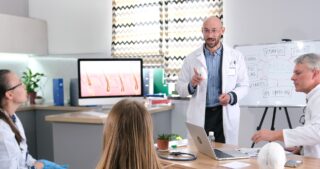
Why Pre-Meds Are Confused?
For pre-med students seeking to build a strong extracurricular record, one question persists: What is the real difference between physician shadowing and clinical experience, and which one actually matters more to admissions committees?
Much of the confusion stems from how people use the term’ clinical experience.’ Some advisors throw everything that happens in a hospital or clinic into that bucket and treat shadowing as just another clinical activity. For medical school applications, especially on AMCAS, that is not how it really works.
In practice, AMCAS and many admissions offices treat these as two different things. Shadowing is a purely observational role. You are in the room, watching the physician work, but you are not responsible for patient care. Clinical experience, on the other hand, usually implies active, hands-on involvement where you have defined duties in the care environment.
That split leaves applicants stuck in the middle, wondering whether their 100 hours of shadowing actually meet any kind of clinical expectation or if they have misread the requirement entirely.
The key point is simple: this is not an either/or decision. Shadowing and active clinical experience are not interchangeable. They are two separate, non-negotiable pillars of a competitive application. One shows that you understand what physicians actually do. The other shows that you can handle real patient contact and the demands that come with it. A serious applicant needs both.
Pillar 1: Physician Shadowing (Do You Understand the Career?)
Defining the Pillar
Physician shadowing is a passive, observational experience. You follow a doctor through their day in clinic, the hospital, or the operating room. Your job is simple and very clear: watch, listen, and learn.
You are not there to treat patients or perform procedures. You are there to see what physicians actually do, how they think, and how they move through their day. No one expects a pre med student to carry medical responsibility in this setting, and admissions committees know that.
What Shadowing Shows Admissions Committees
The value of shadowing is in what you understand afterward, not in what you physically did.
First, it shows informed decision making. Shadowing is your reality check. It signals that you are not applying based on TV shows or secondhand stories, but on what you have seen with your own eyes: the paperwork, the hard conversations, the long days, and the tradeoffs that come with the job.
Second, it shows that you understand the physician’s role. By watching how doctors work with nurses, PAs, techs, and other staff, you start to see what is unique about being a physician. That understanding is essential when you are asked in an interview, “Why do you want to be a physician rather than another type of provider?”
Third, it gives you direct exposure to bedside manner. You see how experienced physicians build trust, deliver bad news, manage conflict, and respond when families are scared or angry. Those moments tell you a lot about what good medicine looks like in real life.
Finally, shadowing across more than one specialty shows serious exploration. Time with a primary care doctor, a surgeon, and a pediatrician, for example, tells an admissions committee that you did not base your decision on one narrow view of the field.
What Shadowing Does Not Show
Shadowing is necessary, but it is not enough on its own.
It shows that you are interested and that you did your homework before applying. It does not show who you are when you are the one stepping in for a patient, even in a small way. Because it is passive, it cannot prove your resilience, empathy, teamwork, or service orientation. It only shows that you have watched those qualities in other people.
To demonstrate that you personally can handle patient contact, contribute on a team, and stay steady when things are difficult, you need the second pillar: active clinical experience.
Pillar 2: Active Clinical Experience (Do You Have The Character For The Work?)
Defining The Pillar
Active clinical experience means you hold a real role in a healthcare setting and carry actual responsibility, usually with direct contact with patients. Unlike shadowing, you are not just watching from the corner. You are part of the routine that keeps patients safe, comfortable, and cared for.
Strong examples of active clinical work include both paid and volunteer positions.
Paid roles often include:
- Emergency Medical Technician (EMT)
- Certified Nursing Assistant (CNA)
- Medical Assistant
- Phlebotomist
- Medical Scribe, with some important caveats
Volunteer roles can include:
- Hospice volunteer
- Hospital volunteer in patient transport, inpatient units, or similar patient-facing areas
- A consistent role supporting and caring for an ill or disabled family member
The common thread is simple. You interact with patients regularly and what you do has consequences for their comfort, safety, or care.
What Active Clinical Experience Shows Admissions Committees
If shadowing shows that you understand the career, active clinical work shows that you have the temperament for it.
Admissions committees read these roles as the main evidence for your interpersonal and intrapersonal skills. This is where you move from saying you care about people to proving it in real situations.
Through sustained clinical work you can show:
- Service orientation, when you keep returning week after week to a hospice or clinic because you care about the people, not the line on your CV.
- Social skills, empathy, and compassion are needed when you sit with a confused elder, calm a frightened child, or help a patient maintain dignity during very vulnerable moments.
- Resilience and adaptability are key when you handle busy shifts, difficult families, system quirks, and the emotional wear that comes with seeing people at their worst.
- Teamwork, when you work alongside nurses, techs, physicians, and other staff, involves understanding your role, communicating clearly, and supporting the group effort.
These experiences answer a blunt question for the committee: do you have the stomach for real medicine, including bodily fluids, emotional strain, and human suffering, not just the prestige and the white coat.
Active clinical work does have its limits, though. An EMT may get intense experience in pre hospital care, but might still know very little about long term management on the wards. A CNA may become excellent at bedside care, but need shadowing to fully understand the physician’s diagnostic and leadership role. Which brings you back to the fact that you need both pillars.
Why You Need Both Pillars
Shadowing and active clinical work are not interchangeable. They answer different questions for the people reading your file.
If you only have shadowing, committees are left thinking: you have watched medicine, but have you ever been responsible for anyone. Can you handle pressure? Do you enjoy talking to patients, or do you prefer watching professionals do it?
If you only have active clinical work, such as a long history as an EMT or CNA, another set of doubts appears. Why a physician and not another health professional? Do you truly understand how long the training is, what the job actually looks like, and what kind of responsibility you are asking for?
The strongest applicants use both pillars to build a clean, believable story. For example:
In my work as an EMT, I learned that I thrive in direct patient care and high-pressure situations, but I also saw how limited my scope was. When I shadowed Dr Smith in the emergency department, I watched how she pulled together the full clinical picture, led the team, and carried final responsibility for the treatment plan. That combination of hands-on work and broader decision-making is what draws me to being a physician.
You cannot credibly give that kind of answer if you are missing one of the pillars.
The Gray Area: Scribes And Volunteers
Some roles sit in the middle and require careful presentation.
Medical scribing is an excellent way to learn terminology, documentation, and how physicians think through cases. You are in the room for history, exam, and decision-making. The risk is that the role can become very passive. If all you have is eight hundred hours of scribing and almost no direct patient contact, your profile can feel lopsided and forgettable. Scribing is best used in conjunction with more hands-on work that demonstrates empathy, touch, and service.
Hospital volunteering is entirely dependent on what you actually do. Greeting at the front desk or stocking supplies may help the institution, but it is not strong clinical experience. On the other hand, roles in patient transport, inpatient units, pediatrics, or hospice care, where you regularly interact with patients and their families, are high-value and clearly relevant.
The Myth Of The Magic Number
People want a number. Forums are full of them. You will see ranges like one hundred fifty to two hundred clinical hours and thirty to fifty shadowing hours as common targets.
Those ranges are useful for rough planning, but they are not what earns you acceptance.
The AAMC and seasoned advisors are consistent on this point. Committees care far more about quality than raw volume. A student who shows up four hours a week for a year at the same hospice, builds relationships, and can describe how they grew will usually be stronger than someone who stacks two hundred hours into one rushed summer and barely remembers anyone’s name.
Long-term involvement signals reliability and dependability. Thoughtful reflection in your Work and Activities entries and Most Meaningful essays shows maturity and self-awareness. The hour count is background information, not the headline.
Your real goal is to collect experiences that give you specific, honest stories you can tell in your application and interviews, not to max out a tally on a spreadsheet.
Building A Competitive Edge With Ethical Global Experience
As the bar rises, many applicants seek ways to stand out and develop competencies that they cannot fully develop in familiar settings. Domestic roles can show service orientation and teamwork. It is often much harder to show cultural humility, cultural awareness, and ethical judgment in cross-cultural care without leaving your usual environment.
That is where global health comes in, and also where serious risks appear.
The Ethical Line: Avoiding Voluntourism
The AAMC has warned students to be cautious with international programs that are built to sell an experience first and protect patients second. When companies over promise that undergraduates will “actually practice medicine,” they invite scope of practice violations and put vulnerable people at risk.
This kind of voluntourism is a problem for two reasons. It can harm patients, and it signals to admissions committees that an applicant is willing to cross ethical lines for the sake of a story.
At International Medical Aid, we exist as the opposite of that model. We were founded as a non profit with a First Do No Harm philosophy and a strict code of ethics. Our programs are built around a simple principle that matches AAMC guidance. Pre med students are learners and observers. They do not act as independent providers.
When we talk about hands on experience, we mean tasks that are appropriate for your training and performed under close supervision. That may include recording vitals, helping collect patient histories, assisting with basic non invasive procedures when permitted, and participating in community health education. These activities give you genuine involvement while keeping patient safety and local regulations at the center.
How International Medical Aid Strengthens Both Pillars
An ethical, mentored global health internship can support both pillars and add a third layer of high value competencies that are difficult to build at home.
For the shadowing pillar, our programs include structured physician observation across a range of specialties in international hospitals. You see how different systems handle emergency care, surgery, pediatrics, obstetrics, and more, often in settings with resource constraints that highlight the core of clinical reasoning.
For the active clinical pillar, you participate in supervised clinical rotations and community outreach projects where your role is clearly defined, appropriate, and meaningful. You are part of the team without pretending to be something you are not.
On top of that, you gain concrete evidence of cultural competence, resilience, adaptability, and ethical responsibility. You work in new cultural contexts, adapt to limited resources, and think through real ethical questions with guidance rather than improvising alone.
When an experience is built this way, it does not just add more hours to your list. It gives you specific, credible stories that show committees who you are and why you are ready for the next step.
Fulfilling Core Admissions Requirements: A Comparison
An integrated, ethical global program does not replace domestic experiences. It amplifies them. When you look at the AAMC core competencies through this lens, the difference between ad hoc domestic roles and a structured International Medical Aid internship becomes clear.
Physician Shadowing
A traditional option might be a few hours with a local primary care physician, enough to see clinic flow but not much variety.
With IMA, you shadow across multiple specialties in a busy global hospital setting, such as surgery, pediatrics, and obstetrics and gynecology. You see how physicians think and lead teams in a very different healthcare environment, which gives you richer material for your “Why medicine” and “Why physician” answers.
Active Clinical Experience
At home, many students end up in low-impact roles, such as restocking supplies or handing out water, with only occasional patient interaction.
In an IMA internship, you participate in supervised, appropriate clinical activities as part of structured rotations. That can include recording vitals, helping collect histories, observing procedures from an appropriate vantage point, and supporting community health initiatives, always within a clearly defined scope of practice.
Service Orientation
Domestic service often means volunteering at a free clinic or community organization, which is valuable but usually limited to a single setting.
IMA interns support ongoing community medical clinics and public health education projects in underserved areas. You see how service links directly to health equity and system-level challenges, which makes your commitment to service feel much more concrete to an admissions reader.
Teamwork
At home, you may work with one or two other volunteers on a shift and only occasionally intersect with clinical staff.
Through IMA, you collaborate every day with local physicians, nurses, allied health professionals, and other interns. You have to learn how to communicate across cultures, roles, and systems, which is exactly what teamwork looks like in real global medicine.
Cultural Competence
Domestic roles can expose you to diverse patient populations, but you are still operating inside a familiar system and culture.
IMA places you inside a new healthcare system entirely. You see how culture, policy, resources, and history shape what care is possible, who accesses it, and how decisions are made. That immersion gives you concrete, credible stories to back up any claims of cultural humility.
Resilience And Adaptability
Many students point to a heavy course load or a busy semester as proof of resilience. Committees see that every day.
Living and working in a new country, adjusting to different norms, and functioning in a resource-limited clinical setting demands a different level of flexibility. When you can describe how you adapted to those conditions and still showed up for patients, your resilience becomes real on the page.
Ethical Responsibility
In many domestic roles, ethics is rarely discussed explicitly and is almost never a formal part of the experience.
In an IMA program, ethical responsibility is built into the design. You receive structured teaching on global health ethics, debrief real-world dilemmas with mentors, and practice saying no to tasks that fall outside your training. That gives you something far more powerful than a vague “I know to do the right thing.” You can point to specific situations where you protected patients and respected boundaries.
See how an integrated global program compares to ad-hoc domestic experiences in building a competency-driven profile.
| AAMC Core Competency | Traditional Domestic Option (Ad-Hoc) | The IMA Internship Advantage |
|---|
From Checked Box To Compelling Candidate
The real question is not “shadowing or clinical experience.” A truly competitive application needs both pillars working together.
- Shadowing shows that you understand what physicians actually do and that your decision to pursue medicine is informed, not romanticized.
- Active clinical work shows that you have the character for patient care: empathy, resilience, teamwork, and a genuine comfort with the realities of illness.
Your goal is not to stack hours for their own sake. Your goal is to use those hours to demonstrate the AAMC core competencies through specific, honest stories. That is what committees remember.
The strongest applicants use domestic roles to build a solid foundation, then add experiences that fill the remaining gaps in cultural humility, resilience, and ethical judgment. A carefully designed, mentored global health internship with International Medical Aid can play that capstone role. It allows you to strengthen both pillars, grow in the highest value competencies, and turn a basic activity list into a coherent, compelling narrative about why you are ready to train as a future physician.
Frequently Asked Questions
What is the difference between physician shadowing and clinical experience?
Physician shadowing is purely observational. You are following a doctor in a clinic, the hospital, or the operating room so you can see what physicians actually do, how they think, and how they interact with patients and teams. You are not responsible for patient care. Clinical experience usually means you have an active role in the care environment, often with regular patient contact and defined duties that affect comfort, safety, or workflow. Admissions committees expect to see both: shadowing to prove you understand the career, and active clinical work to prove you can participate in patient care.
Does shadowing alone count as clinical experience on my application?
Shadowing is required and highly valued, but on its own it does not satisfy what most admissions offices mean when they ask for clinical experience. Shadowing shows that you have done your homework about the profession and are making an informed decision. It does not show how you behave when you are the one responsible for a task, even a small one. Committees usually want to see both shadowing hours and separate evidence of active, patient-facing work, such as EMT, CNA, medical assistant, hospice, or patient transport.
How many hours of shadowing and clinical experience do I need?
There is no universal cutoff, but common planning targets are roughly 30 to 50 hours of shadowing and at least 150 to 200 hours of active clinical experience, with many competitive applicants falling higher than that. More important than the number is how those hours are structured. Four hours per week over a year in one setting shows far more reliability and depth than 200 hours crammed into a single summer. Committees care most about longitudinal involvement and the quality of your reflection, not who reports the highest total.
What types of roles count as active clinical experience?
Active clinical experience usually involves regular, meaningful contact with patients where your work has consequences for their comfort or care. Classic examples include EMT, CNA, patient care aide, medical assistant, phlebotomist, hospice volunteer, and hospital volunteer roles in patient transport or inpatient units. Long-term caregiving for an ill family member can also be appropriate in some cases. Administrative roles such as front desk check-in or pure stocking and filing usually belong in a different category because they do not clearly show patient-facing work.
Is medical scribing considered shadowing or clinical experience?
Scribing sits in a gray zone. It is excellent for learning terminology, documentation, and how physicians reason through cases, so it is very strong for understanding the physician role. However, it can be quite passive and may involve limited direct interaction with patients. Some committees see heavy scribing with no other experience as glorified shadowing. Scribing is strongest when you pair it with a role that gives you hands on patient contact, such as CNA work, hospice volunteering, or another direct care position.
What makes a shadowing experience impressive to admissions committees?
The strength of a shadowing experience lies in what you can say about it, not in the badge or title. Committees are looking for evidence that you have seen the real day-to-day life of physicians, including the less glamorous parts, and that you can explain why you still want the role. Shadowing across more than one specialty, paying attention to how physicians lead teams and communicate with patients, and reflecting clearly on what you learned about the profession will all make your shadowing stand out more than simply reporting a number of hours.
How can I balance my time between shadowing, clinical work, and everything else?
A practical sequence is to start with some shadowing so you can confirm that medicine genuinely fits you, then build a steady base of active clinical work, and layer in additional shadowing as needed. Many successful applicants maintain one primary clinical role at a few hours per week, add periodic blocks of shadowing, and fit in community service and research based on their goals and capacity. The goal is not to do everything at once, but to show a clear progression over time that you can handle academic work while reliably showing up for patients.
Are international clinical experiences viewed differently by admissions committees?
Yes. International experiences are scrutinized closely. Committees are very wary of voluntourism, where students travel briefly, do work outside their training, and inadvertently put patients at risk. Programs that encourage undergraduates to give injections, suture, or act as independent providers are seen as serious ethical red flags. On the other hand, structured programs that emphasize supervised shadowing, appropriate tasks, cultural humility, and community based work can add real value by demonstrating resilience, adaptability, and global awareness when they are clearly within scope.
How does an International Medical Aid internship support both pillars?
An International Medical Aid internship is designed to strengthen both shadowing and active clinical pillars within an ethical framework. In the hospital, you spend time observing physicians across different specialties in resource-limited settings, which deepens your understanding of clinical reasoning and the physician role. In supervised clinical and community settings, you may help collect histories, record vitals, support education efforts, and assist with appropriate non-invasive tasks. The structure is built around learning, patient safety, and clear scope of practice, so you can grow in service, cultural competence, and ethical judgment without crossing professional lines.
What is the best way to write about my shadowing and clinical work in my application?
Treat every experience as a chance to demonstrate competencies rather than restate a job description. In your Work and Activities entries, briefly set the scene, then focus on what you actually did, the skills you used, and how your perspective changed. Use specific moments instead of general claims. Tie your stories to concrete qualities such as empathy, teamwork, reliability, cultural humility, or ethical responsibility. The more clearly you can connect a real situation to a competency that matters in medicine, the more convincing your application will be.