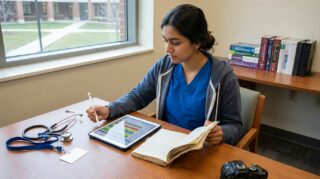
Getting into medical school is not just about GPA and MCAT scores, but also about the quantity and quality of your clinical and volunteer experience. For pre-health students, these hours are tangible evidence of your commitment, maturity, and understanding of a healthcare career. However, the sheer volume of experience required, often hundreds or even thousands of hours across various roles, can lead to poor tracking and documentation.
Tracking these hours accurately is not just administrative housekeeping, but is a mandatory ethical and logistical requirement for admission. Admissions committees rely on verifiable data to assess your background, and any discrepancy can jeopardize your application.
Let’s take a look at the necessity of meticulous logging, which clarifies the distinction between clinical and non-clinical roles, and provides the practical strategies our most successful pre-medical interns use to ensure their hours are robust, defensible, and ready for their AMCAS, AACOMAS, or TMDSAS applications.
Defining the Essentials: Clinical vs. Volunteer Hours
One of the most common pitfalls for aspiring medical students is failing to categorize their experiences correctly. The admissions committee (AdCom) views “clinical” and “volunteer” experience through very specific lenses, and misclassification can significantly weaken your overall profile.
We stress that clinical hours are generally weighted more heavily because they demonstrate direct patient interaction, comfort in medical settings, and exposure to the realities of healthcare delivery. Non-clinical volunteer hours, while necessary, show community commitment and altruism outside of the medical context.
What Qualifies as Clinical Experience?
Clinical experience, also known as “patient exposure,” must involve direct, hands-on patient contact. This is the opportunity to observe the practice of medicine and gain empathy for the patient experience, not just the doctors’ perspective.
The core requirement is that you are in a setting where you are responsible for, or interact closely with, patients whose care you are observing or assisting with.
Examples of qualifying clinical roles often include:
- Scribing: Directly observing physician interactions and documenting in the EMR.
- Certified Roles: EMT, CNA, or Medical Assistant positions.
- Hospital Volunteer Roles: Transporting patients, assisting nurses with basic care (feeding, turning), or taking vital signs.
- International Experiences: Structured shadowing and hands-on clinical observation completed through supervised programs like those offered by IMA, where you are integrated into hospital or clinic teams.
Crucially, if you are helping staff but are isolated from patients (e.g., filing charts in the hospital basement), it is generally considered non-clinical administration, not clinical exposure. For more detailed guidance on what medical schools actually value, read our comprehensive guide on the pre-med clinical experience matrix.
What Counts as Traditional Volunteering?
Traditional or non-clinical volunteering demonstrates your commitment to service and your ability to work within a community structure. While these roles are essential for showing well-roundedness and altruism, they do not satisfy the required clinical component.
Examples of non-clinical volunteering:
- Community Service: Working at a food bank, building homes, or mentoring children.
- Hospital Support: Administrative duties, staffing the gift shop, and organizing donation drives.
- Fundraising: Working events or campaigns for non-profit organizations.
- Laboratory Work: Bench research, unless it involves direct human subject interaction (which is rare for undergraduate volunteers).
We highly encourage our interns to engage in both categories. A competitive application often features a healthy balance—perhaps 200-300 hours of traditional volunteering and significantly more (often 500+ hours) of dedicated clinical experience.
Why Tracking Accuracy is Non-Negotiable
Admissions committees handle thousands of applications each year. They look for clarity, consistency, and integrity in the experiences listed. When you list an experience, you are making a factual claim that you must be prepared to defend.
The Verification Process and Audits
The application services, AMCAS (for MD schools) and AACOMAS (for DO schools), reserve the right to audit applicants. If an AdCom flags an experience or the hours seem disproportionate, they may request verification. This means they will contact your listed supervisor directly.
If your logged hours do not align with the supervisor’s memory or official records, your integrity is called into question. Exaggeration, even unintentional, can be grounds for rejection or retraction of an acceptance. Honesty is paramount.
Crafting the Narrative: The Importance of Reflection
Tracking hours is not just about counting time; it’s about documenting context. Your application requires narrative descriptions (up to 700 characters in AMCAS) for your most impactful experiences. A simple entry like “10 hours: Shadowed Dr. Smith” is useless.
A detailed log entry, however, allows you to pull specific, compelling anecdotes when you write your essays. You should be able to recall:
- A specific patient interaction that taught you empathy.
- A challenging ethical scenario you observed.
- A moment of professional failure or success that defined your understanding of the healthcare team.
This level of detail is impossible to reconstruct months later without a comprehensive log. This ability to transform raw data into a powerful personal statement is why we emphasize meticulous record-keeping during our pre-medical internship programs, where reflection is built into the schedule.
The Essential Components of an Hour Log
A simple notebook or calendar is not sufficient. Your log must be structured, consistent, and easily verifiable. We recommend using a digital format (such as a secure cloud-based spreadsheet) that supports instant filtering and backup.
Logistical Details: Who, What, Where, When
Every entry, regardless of whether it’s clinical or volunteer, must contain the following five essential pieces of information:
| Log Detail | Description & Importance |
|---|---|
| Date & Time | Record the exact start and end times for the session. This prevents rounding errors and ensures you have definitive proof for verification. |
| Location | The precise hospital wing, clinic address, or organization name. This is crucial for verifying international experiences. |
| Supervisor Name & Contact | The full name, title, and current contact information (email and phone) of the person who can verify your participation. |
| Specific Tasks Performed | What you did, observed, or assisted with. Be detailed: “Observed physician perform lumbar puncture on patient presenting with severe headache” vs. “Watched a procedure.” |
| Reflection Notes | Your personal takeaway. What surprised you? What challenged your assumptions? What did you learn about the healthcare team or patient care? |
These five elements are mandatory for every single shift or session you log. If you cannot provide all five, the experience is difficult to verify and may be discounted.
The Supervisor Contact: Your Professional Lifeline
The supervisor contact is the most critical component because they are your verifier. Medical schools will reach out to this person to confirm your hours, your role, and your professionalism.
Best practices for managing supervisor contacts:
- Ask for contact information on your first day and update it regularly.
- Send a brief thank-you email after major milestones (e.g., completion of a rotation) to maintain the relationship.
- Keep a separate master contact list with backup phone numbers, LinkedIn profiles, or secondary emails.
- If a supervisor leaves, immediately secure the contact information of a secondary supervisor (e.g., the charge nurse, department manager, or HR representative).
How IMA Structures and Simplifies Hour Tracking
One significant advantage of participating in our structured international clinical programs is that the logistical burden of verification is largely handled for you.
- Built-In Logging Systems: Our programs include mandatory daily or weekly log submissions that are reviewed by program staff to ensure accuracy and completeness.
- Official Documentation: We provide official documentation and certificates of completion detailing the dates, locations, and the total clinical and shadowing hours accrued under supervision.
- Focused Environment: Because our internships are immersive, your time is almost exclusively dedicated to clinical exposure and organized educational activities, meaning far fewer hours are wasted on non-clinical administrative tasks, simplifying categorization and tracking.
This structured environment mitigates the risk of ambiguity that often plagues self-sourced shadowing experiences. Learn more about how to maximize these opportunities by reading our guide on shadowing vs. clinical experience.
Maximizing Your IMA International Experience
International clinical experiences, such as those we offer in East Africa and South America, are powerful components of an application and demonstrate cross-cultural competency and adaptability. However, tracking these hours requires extra diligence to meet U.S. admissions standards.
Ensuring Documentation Integrity Abroad
Medical schools value international experience, but they scrutinize its authenticity. You must demonstrate that the hours were meaningful, supervised, and documented professionally.
When working alongside international healthcare professionals through IMA, ensure your log entries capture not only the medical tasks observed but also the context—the prevalence of diseases like malaria or typhoid, resource limitations, and cultural nuances in patient communication.
Before traveling abroad, we advise reviewing relevant health and safety guidelines, such as those from the Centers for Disease Control and Prevention (CDC) on travel warnings and global health safety standards, which provide context for your clinical environment.
Transitioning from Log to Application: Reflective Writing
The ultimate goal of tracking is to feed the narrative of your application. The AMCAS Work & Activities section requires you to convert hours into achievements.
Choosing the Most Meaningful Experiences
AMCAS allows applicants to designate up to three “most meaningful experiences” (MMEs). These require a significantly longer essay (up to 1,325 characters) that explains why the experience was meaningful and what you learned about medicine, yourself, or patient care.
Your detailed logs are the foundation for choosing these MMEs. You should be able to scan your entries and identify the placements where you had the most profound or repeated reflective entries. If an experience only has generic entries, it likely won’t qualify as an MME.
The Reflective Log Entry
When updating your log, add a dedicated column for “Reflection.” Immediately after a shift, ask yourself:
- What assumptions did I challenge today?
- How did this experience inform my decision to pursue medicine?
- How did the team dynamics impact patient care?
For more detailed strategies on documenting your experiences effectively, read our article on average clinical hours for medical school.
Avoiding Common Tracking Pitfalls
While intentional misrepresentation is unethical and career-ending, many students lose hours due to simple administrative errors.
Pitfall 1: Rounding Hours
Do not round up. If you worked 3 hours and 50 minutes, record 3 hours and 50 minutes (or 3.83 hours). If you consistently round 50 minutes to 4 hours over dozens of shifts, you could easily inflate your total by 20-50 unearned hours. This discrepancy is easily flagged during verification.
Pitfall 2: Neglecting Contact Information
Medical schools often verify hours years after the fact. If your supervisor has changed jobs, changed emails, or retired, you could be left without proof. Maintain a separate contact list and periodically verify that their professional email addresses are still active.
Pitfall 3: Waiting Too Long to Document
If you wait two weeks to document a shift, you will forget crucial details. The moment you leave the facility, your memory starts to fade. Implement a policy of recording hours and reflections within 12 hours of completion.
Pitfall 4: Mixing Categories
As discussed earlier, strict categorization is mandatory. Do not list time spent cleaning research glassware as clinical hours because the lab is located in a hospital. This demonstrates a lack of understanding of what medical schools value.
Frequently Asked Questions
What is the minimum number of hours required for medical school?
There is no strict, official minimum set by AMCAS or AACOMAS, but competitive applicants generally have hundreds of hours of experience. We recommend aiming for a minimum of 150–200 hours of direct clinical experience and 100–150 hours of non-clinical volunteering. Top-tier applicants often exceed 500 clinical hours. Quality is always more important than quantity, but you need a baseline quantity to demonstrate sustained commitment.
Can shadowing hours count as clinical hours?
Yes, shadowing (observing a physician) is a type of clinical experience because it exposes you directly to patient care environments, but it is typically separated into its own category on the application (Physician Shadowing). While essential, shadowing is generally viewed as less impactful than hands-on patient exposure (like CNA work or EMT duties). Ensure you clearly distinguish between active clinical roles and passive shadowing.
Should I track my research hours?
Absolutely. Research is a critical component of most competitive applications, but it should be tracked separately. Record the dates, the lab PI (Principal Investigator) as the supervisor, and a detailed description of your methodology and findings. Research is a separate section on the AMCAS application.
What should I do if my supervisor leaves their job or retires?
This is a common issue. If the original supervisor is unreachable, first try to find a secondary supervisor who can confirm your hours (e.g., the charge nurse or the department manager). If that fails, contact the organization’s Human Resources or Volunteer Services department. If you absolutely cannot find a verifier, you must list the experience as “Unverifiable” and include an honest explanation, though it may be discounted by the AdCom.
Do hours accrued during an IMA internship automatically qualify as clinical?
Yes, the hours documented during your structured clinical rotations with International Medical Aid are classified as clinical shadowing or observation, as they involve direct integration into hospital and clinic teams where you observe and interact with healthcare providers and patients. We provide the documentation and logistical support needed to ensure these hours are verifiable and highly educational.
How long should I keep my detailed hour logs after applying to medical school?
You should keep your detailed logs, including any signed verification sheets, indefinitely. While the verification process usually concludes before matriculation, we advise keeping them for at least five years after starting medical school, as professional licensing bodies or residency programs may occasionally look back at your pre-medical experiences.