A nuclear medicine physician is a doctor who uses radioactive tracers to diagnose and treat disease. To become one, you finish college, four years of MD or DO school and a clinical year, then a three-year ACGME nuclear medicine residency and the ABNM board exam, about 12 years in all. Radiologists can also qualify through nuclear radiology training.
That 12-year count starts on the first day of college. The early steps are the same as for every other physician, and our guide on how to become a doctor in the United States covers them in detail. This page focuses on what is specific to nuclear medicine: the residency and its entry levels, the radiology alternative, the two boards that certify the field, the work itself, and what the job pays.
What a Nuclear Medicine Physician Does
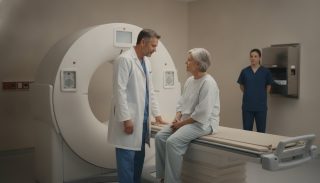
The 2026 ACGME program requirements define nuclear medicine as the specialty that uses the tracer principle, most often with radiopharmaceuticals, to evaluate molecular, metabolic, physiologic and pathologic conditions of the body for diagnosis, therapy and research. In plain terms, the physician gives a patient a small amount of a radioactive drug that collects in a specific organ or type of cell, then reads the images a scanner builds from the signal, or uses a larger dose of a similar drug to treat the disease.
The Society of Nuclear Medicine and Molecular Imaging explains that conventional imaging such as X-ray, MRI and ultrasound shows anatomy, while nuclear medicine imaging shows organ function and cellular activity, which can reveal disease at an earlier stage. SNMMI lists three main tools:
- PET: positron emission tomography with tracers such as FDG, PSMA and FES, often combined with CT or MRI
- SPECT: a rotating gamma camera that produces three-dimensional images of blood flow and organ function, often combined with CT
- Hybrid imaging: PET/CT, PET/MRI and SPECT/CT, which show anatomy and function in one set of images
The ACGME requirements spell out the studies residents must learn to select, perform and interpret. They include bone scans and bone density, myocardial perfusion imaging with treadmill and drug stress testing, thyroid and parathyroid studies, gastrointestinal and liver studies, infection imaging, brain studies for dementia, epilepsy and brain death, cancer imaging, lung scans for pulmonary embolism, kidney studies, and PET/CT for both cancer and non-cancer questions.
What Is Radiopharmaceutical Therapy?
Radiopharmaceutical therapy treats disease with a radioactive drug that travels to the target cells. According to SNMMI, nuclear medicine procedures are approved to treat thyroid cancer, prostate cancer and neuroendocrine tumors, and clinical trials are testing other uses. SNMMI describes theranostics as diagnostic imaging and targeted treatment combined into one process: a low-dose tracer, most often on a PET scan, shows whether the disease takes up the agent, and a similar high-dose agent then treats it. Patients whose disease shows up on the scan are the ones likely to respond.
This therapy work is a large part of training. The ACGME requires every resident to complete at least 35 therapeutic drug administrations, including at least 10 oral doses of radioactive iodine (I-131) split between cancer and benign thyroid disease, and at least 10 injected or infused radiopharmaceutical treatments using at least two different FDA-approved agents.
Is a Nuclear Medicine Physician the Same as a Nuclear Medicine Technologist?
No. A nuclear medicine physician is an MD or DO who completed residency, interprets the studies and prescribes the therapy. The BLS describes nuclear medicine technologists as professionals who prepare and administer radioactive drugs for imaging or treatment, and their typical entry-level education is an associate’s degree. The two work side by side, but the training paths do not overlap.
Steps to Become a Nuclear Medicine Physician
- Earn a bachelor’s degree with the prerequisite science courses, strong grades and clinical experience.
- Complete medical school. You need an MD from an LCME-accredited school or a DO from a COCA-accredited college. Graduates of schools outside the United States need ECFMG certification or a full state license, per the ACGME eligibility rules; our IMG guide to US residency and ECFMG certification covers that route.
- Pass your licensing exams. MD students take the USMLE series and DO students take COMLEX. Our explainer on USMLE Step 1 and our comparison of COMLEX and USMLE explain the sequence.
- Finish a clinical year. Both the ACGME and the ABNM require one year of graduate medical education with at least nine months of direct patient care before nuclear medicine training starts.
- Complete nuclear medicine residency. The ACGME program is 36 months long for residents who enter at the first level.
- Get licensed and board certified. Pass the ABNM certification exam, or the ABR nuclear radiology exam if you trained as a radiologist, and hold a state medical license.
The ACGME Nuclear Medicine Residency
The 2026 ACGME nuclear medicine program requirements set the length at 36 months and allow three entry levels, depending on the training you already have:
| Entry level | What you must have completed | Nuclear medicine training |
|---|---|---|
| NM1 | One year of graduate medical education with at least 9 months of direct patient care | 36 months |
| NM2 | A full residency program in another specialty | 24 months |
| NM3 | A diagnostic radiology residency | 12 months |
The prior training must come from an ACGME-accredited, AOA-approved, Canadian (RCPSC or CFPC) or ACGME-I Advanced Specialty program. Beyond the 35 therapies described above, residents must log at least 100 cardiovascular exercise or drug stress studies and at least 100 pediatric nuclear medicine procedures in the ACGME Case Log System, keep basic and advanced cardiac life support current, and take an annual in-training exam.
Every resident also completes classroom and laboratory work in radiation physics and instrumentation, radiation protection and regulations, the mathematics of measuring radioactivity, radiochemistry, and radiation biology. A required radiopharmacy rotation covers ordering and unpacking radioactive materials, quality control on dose calibrators and survey meters, preparing patient doses, and cleaning up spills. Work hours fall under the ACGME limit of 80 hours a week, averaged over four weeks. For how residency fits into the larger training system, see our overview of how residency and fellowship work.
Why Does Nuclear Medicine Training Include So Much Radiation Safety?
Because nuclear medicine physicians handle unsealed radioactive material, they must meet federal training rules to become what the Nuclear Regulatory Commission calls an authorized user. The ABNM lists these as part of its training requirements for the certification exam: at least 700 hours of training and experience, including at least 200 hours of classroom and laboratory training, plus supervised hands-on work and a preceptor’s written attestation. An accredited residency is built to cover all of it.
The Diagnostic Radiology and Nuclear Radiology Alternative
You do not have to start in a nuclear medicine residency. Many physicians who do nuclear imaging trained first in diagnostic radiology, and both the ABNM and the ABR offer routes for them. If you are weighing the two fields, our guide on how to become a radiologist covers the diagnostic radiology residency in full.
The ABNM accepts several radiology-based paths to its own exam:
- 16 months of nuclear medicine during a four-year diagnostic radiology residency, at an institution with an accredited nuclear medicine or nuclear radiology program
- Combined training in separately accredited nuclear medicine and diagnostic radiology programs, totaling five years with 16 to 24 months of nuclear medicine
- 12 months of nuclear medicine after radiology residency, added to the 4 months already completed during it
- A 12-month nuclear radiology fellowship after diagnostic radiology residency
The ABR’s nuclear radiology subspecialty certificate is the other option. Candidates must hold an ABR certificate in diagnostic radiology (or IR/DR) and complete one year in an ACGME- or RCPSC-accredited nuclear radiology fellowship or nuclear medicine residency. The ABR also offers a 16-month pathway inside diagnostic radiology residency: four months of nuclear radiology already required in residency, eight dedicated months in nuclear medicine, molecular imaging, radiotheranostics or radiopharmaceutical therapy, and four months in a related imaging field, with an application filed at least six months before residency ends.
Which Pathway Should You Choose?
Choose the direct nuclear medicine residency if you want the shortest route and a practice centered on PET, therapy and nuclear cardiology. Choose diagnostic radiology plus nuclear training if you also want to read CT, MRI and ultrasound, which widens the jobs you can take. Our explainer on what a radiologist does day to day shows what that broader reading work looks like. Physicians in other specialties have a third option: the ABNM gives up to one year of credit to physicians certified or board eligible in another ABMS specialty, so they need two years of nuclear medicine training, and a combined internal medicine and nuclear medicine program leads to both certificates in 48 months.
Nuclear Medicine Physician Training Timeline by Route
| Route | After high school | Training after medical school |
|---|---|---|
| Clinical year plus 36-month nuclear medicine residency | About 12 years | 4 years |
| Combined internal medicine and nuclear medicine | About 12 years | 4 years (48 months, two certificates) |
| Diagnostic radiology with the ABR 16-month nuclear radiology pathway | About 13 years | 5 years (clinical year plus 4 years of radiology) |
| Diagnostic radiology plus a nuclear radiology fellowship | About 14 years | 6 years |
These totals assume four years of college and four of medical school, with no research years or gap years. Our timeline of how long it takes to become a doctor compares these lengths with other specialties.
Board Certification: ABNM and ABR
The American Board of Nuclear Medicine says certification means a physician has completed the required clinical training, been judged competent by the residency program director, passed a secure computer-based exam on the medical uses of tracers and the related physical sciences, and holds a medical license. In 2026 the exam ran from October 5 to October 17 at Pearson VUE testing centers, with applications open from April 1 to May 31.
The ABNM eligibility rules set two limits. You must take the exam within seven years of finishing nuclear medicine residency, and you get up to three attempts. If you fail three times or pass the seven-year mark, you must complete another year of training in an accredited nuclear medicine or nuclear radiology program before trying again. The program director must also send the ABNM a signed evaluation of your clinical competence.
The ABNM certification exam page also links a blueprint, sample questions and a study guide. On the radiology side, the ABR nuclear radiology exam is a one-day remote computer exam of 180 image-rich questions lasting about four hours, offered once a year, typically in January, and scored pass or fail. ABR candidates have six calendar years from finishing training to become certified.
Nuclear Medicine Physician Salary and Job Outlook
BLS does not publish a separate wage line for nuclear medicine physicians. Its Occupational Outlook Handbook for physicians and surgeons reports May 2025 median annual wages for the closest groups:
| Group (BLS, May 2025) | Median annual wage |
|---|---|
| All physicians and surgeons | 275,930 |
| Radiologists | 420,860 |
| Physicians, all other | 265,930 |
Figures are in US dollars. Nuclear medicine physicians who trained as radiologists are likely counted under the radiologist title, while those from the direct residency may fall in the physicians, all other group, so treat the two as a range rather than an exact figure. For context, the lowest 10 percent of all physicians earned less than $76,560 and the highest 10 percent of physicians earned more than $488,320 in that May 2025 wage data. See our list of the highest-paid doctors in the United States for how radiology compares.
What Is the Job Outlook for Nuclear Medicine Physicians?
BLS projects overall physician and surgeon employment to grow 4% from 2025 to 2035, with about 22,100 openings each year. Radiologist jobs are projected to grow 3%, from 28,700 to 29,600, and the physicians, all other group also 3%. BLS links physician demand to an aging population and rising chronic disease. In nuclear medicine, SNMMI notes that theranostics is spreading from neuroendocrine tumors and metastatic prostate cancer into cardiology and inflammatory disease, which adds therapy work to the imaging base. Physicians who also treat cancer patients work closely with oncologists; our guide to what an oncologist does explains that partner specialty.
Who Nuclear Medicine Suits
Nuclear medicine fits students who like physics and chemistry as much as clinical medicine, enjoy reading images, and want a mix of diagnosis and treatment. You spend much of the day interpreting PET and SPECT studies, but you also meet patients for consultations, consent, stress tests and therapy, then follow them after treatment. It suits people comfortable with strict regulatory rules, because radiation safety and documentation are part of every dose.
Getting Clinical Experience Before Medical School
Medical schools want proof that you have spent real time around patients before you commit to the long road above. IMA’s pre-med internships abroad place students in hospitals and clinics where, under the supervision of licensed clinicians, they take part in direct patient care such as vital signs, intake and triage, alongside ward rounds and rotations. That experience will not teach nuclear medicine, but it shows admissions committees you understand what patient care involves.
Frequently Asked Questions
How many years does it take to become a nuclear medicine physician?
About 12 years after high school on the direct route: four years of college, four of medical school, a clinical year, and a three-year nuclear medicine residency. Radiology-based routes take 13 to 14 years because the diagnostic radiology residency adds time.
Is nuclear medicine a residency or a fellowship?
It is both. Nuclear medicine is its own ACGME residency, 36 months after a clinical year. Diagnostic radiologists can instead complete a one-year nuclear radiology fellowship or enter a nuclear medicine residency at the NM3 level for 12 months.
Which board certifies nuclear medicine physicians?
The American Board of Nuclear Medicine (ABNM) certifies physicians who complete nuclear medicine training. Radiologists can earn the American Board of Radiology’s nuclear radiology subspecialty certificate, which requires an ABR diagnostic radiology certificate plus a year of accredited nuclear training.
Do you need to be a radiologist to practice nuclear medicine?
No. The direct nuclear medicine residency accepts physicians after a clinical year, and graduates sit for the ABNM exam without radiology training. Radiology training is one of several routes, not a requirement.
What is the difference between nuclear medicine and nuclear radiology?
Both use radioactive tracers for imaging and therapy. Nuclear medicine is a stand-alone specialty certified by the ABNM, while nuclear radiology is an ABR subspecialty earned by diagnostic radiologists who add a year of nuclear training or complete the 16-month pathway in residency.
How much do nuclear medicine physicians make?
BLS does not track nuclear medicine physicians on their own. In May 2025 the median annual wage was $420,860 for radiologists and $265,930 for physicians in the all other group, the two BLS categories where these doctors are most likely counted.
How can a pre-med student explore nuclear medicine?
Take physics and chemistry seriously, ask to shadow in a hospital nuclear medicine or radiology department, and build broad patient care experience. Our guide to radiology shadowing for pre-health students explains how to set that up.
See more of our guides in your Google results: add International Medical Aid as a preferred source on Google.