


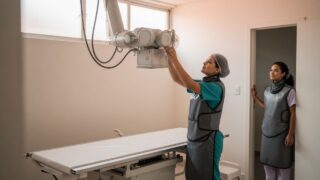
Radiology shadowing means spending time in an imaging department, watching how X-ray, CT, MRI and ultrasound exams are done and how images become diagnoses. You see two settings: the scan rooms, where technologists position patients and run the equipment, and the reading room, where radiologists interpret images and report to the care team.
Imaging touches almost every patient in a hospital, which makes it one of the best places to see how medicine actually works. This guide explains what you will see, who does what, how to stay safe around radiation, how to ask for a placement and how to record your hours. If you are new to shadowing in general, our guide to shadowing a doctor as a pre-medical student covers the basics.
What Radiology Shadowing Looks Like
Most departments split into two worlds that run side by side. Where you spend your time shapes what you learn.
The Modality Suites
Each imaging method, or modality, has its own room and routine:
- X-ray (radiography): fast exams of the chest, bones and abdomen. You see positioning, patient communication and how a technologist checks that an image is usable before the patient leaves.
- CT: cross-sectional images in seconds. Watch how the team screens patients for contrast allergies and kidney function before an injection.
- MRI: strong magnets, no ionizing radiation, long exams. Safety screening for implants and metal is strict, and you will be screened too.
- Ultrasound: sound waves, no radiation, and a lot of hands-on scanning by the sonographer. Pregnancy, abdominal and vascular studies are common.
- Fluoroscopy: live X-ray video used during swallowing studies and procedures, where radiation safety rules are most visible.
In the suites you learn the patient side of imaging: explaining an exam to someone who is anxious, positioning a patient in pain, and moving a busy schedule along.
The Reading Room
The reading room is quiet, dim and full of screens. Radiologists review studies, compare them with earlier images, call referring physicians about urgent findings and dictate reports. Shadowing here shows you the diagnostic reasoning: why a radiologist recommends one follow-up test over another, or how a subtle finding changes a plan. Ask before you speak, since reading-room work needs concentration.
Radiologist, Technologist or Sonographer
Who Does What in an Imaging Department?
Shadowing helps you tell these careers apart, and the training paths are very different.
| Role | Main work | Typical training |
|---|---|---|
| Diagnostic radiologist | Interprets images, performs image-guided procedures, advises other physicians | Medical school, one clinical year, then a four-year diagnostic radiology residency |
| Radiologic technologist | Positions patients and performs X-ray, CT and other imaging exams | Usually an associate degree and an accredited program; certification often required |
| MRI technologist | Runs MRI scanners, injects contrast where trained | Usually an associate degree; many start as radiologic technologists |
| Diagnostic medical sonographer | Performs ultrasound exams and summarizes findings for physicians | Associate degree or postsecondary certificate with clinical training |
For radiologists, the American Board of Radiology requires a year of clinical training before residency and then a four-year accredited diagnostic radiology residency. According to the Bureau of Labor Statistics, radiologic and MRI technologists typically need an associate degree, held about 278,100 jobs in 2025 and are projected to grow 5 percent from 2025 to 2035.
Certification through the ARRT starts with completing an ARRT-approved educational program in a discipline such as radiography or sonography.
Sonography is growing fastest of the three. The BLS projects 14 percent growth for diagnostic medical sonographers from 2025 to 2035, with about 92,200 jobs in 2025. If ultrasound interests you, our article on Medical Ultrasound Awareness Month and imaging careers looks at that path more closely.
Radiation Safety While Shadowing
How Do You Stay Safe Around Radiation?
Radiation safety is part of the culture of every imaging department, and watching how staff follow it is part of what you learn.
The core principle is ALARA, “as low as reasonably achievable.” The CDC describes three protective measures: time, distance and shielding. Spend as little time as needed near a source, stay as far away as you can, and keep a barrier between you and the source. In practice, that means you stand behind the control-room shield during X-ray and CT, wear a lead apron if you are ever asked to stay in a fluoroscopy room, and never walk into a room while an exam is running.
Pregnancy screening is another routine you will see. RadiologyInfo, run by the RSNA and the American College of Radiology, tells patients it is very important to tell the technologist or radiologist if they are pregnant, and that imaging staff are trained to use the smallest amount of radiation needed. Technologists ask about pregnancy before many exams, and you should tell the department yourself if it applies to you.
MRI has a different risk: the magnet is always on. Expect a screening form before you enter, and leave phones, keys, cards and anything metal outside Zone IV, the scanner room.
A simple safety checklist for your first day:
- Ask where to stand for each modality before the first exam starts.
- Follow every instruction from the technologist on duty, even if it seems cautious.
- Complete MRI screening honestly, including piercings and implants.
- Wash your hands between patients and follow the department’s infection-control steps.
- Keep patient names, faces and screens out of any notes or photos.
Asking for a Radiology Placement
How Do You Ask to Shadow in Radiology?
Radiology departments get fewer shadowing requests than emergency or surgery, so a clear, specific ask often works.
1. Start with a person, not a department inbox. A radiologist you have met, a technologist program director at a community college or a hospital’s volunteer office are all good first contacts. 2. Say what you want to see. “I would like to spend a morning with a CT technologist and an afternoon in the reading room” is easier to approve than “anything in radiology.” 3. Mention your paperwork up front. Many hospitals require immunization records, a background check and a HIPAA training certificate before you can shadow. 4. Offer flexible times. Mid-morning on a weekday is often calmer than a Monday morning rush. 5. Follow up once after a week, then thank them after the visit.
Our guide on how to ask to shadow a doctor, with a sample letter has templates you can adapt for a radiologist or technologist.
Questions to Ask During Radiology Shadowing
Ask at natural pauses: between patients in the suites, or when a radiologist turns from the screen. Good questions include:
- Why was this exam ordered instead of a different modality?
- What makes an image technically good enough to read?
- How do you decide when a finding needs a phone call instead of a written report?
- How has your work changed with newer scanners and protocols?
- What did you wish you had known before choosing this career?
- For technologists: why did you choose your modality, and how did you train for it?
For more ideas sorted by timing, see our list of questions to ask while shadowing a doctor.
Radiology Shadowing Abroad
Shadowing in another health system shows how imaging works when equipment is shared across a large population and referrals arrive from far away. IMA’s radiology internships abroad place students in the radiology department at Coast General Teaching and Referral Hospital in Mombasa, Kenya. Interns shadow technologists and radiologists, follow exams and note questions for their mentor. Where the department allows, they help with simple, noninvasive tasks under supervision. Interns do not operate the imaging equipment, and they follow staff instructions on radiation safety at all times.
Stays run from two weeks, year-round, for 2 to 12 weeks, usually six to eight hours a weekday. Licensed clinicians supervise, staff are on call 24/7 and every intern is matched with a Program Mentor. IMA has maintained a 100% safety record for all high school and pre-health interns. What you see depends on the equipment in service and the cases that day, so radiology works well alongside rotations in other departments. Our guide on whether you can specialize in your medical internship explains how to build a focus without missing the wider picture.
Logging Your Hours
How Do You Log Radiology Shadowing Hours?
Record each session the same day while details are fresh:
| Field | Example |
|---|---|
| Date and hours | Oct 14, 8:00 to 12:00 (4 hours) |
| Setting | CT suite, then reading room |
| Supervisor | Name and credentials of the radiologist or technologist |
| What you saw | Trauma CT workflow, contrast screening, a call about an urgent finding |
| What you learned | One sentence of reflection, with no patient identifiers |
Keep a signature or confirming email from your supervisor. Medical, PA and radiography programs each decide how to classify shadowing, so record what happened accurately and let each application system decide where it fits. At IMA, hours are logged by date, role and shift, and IMA’s U.S.-based Medical Director validates the record. Our guide to tracking clinical and volunteer hours shows how to keep one record for every experience.
Frequently Asked Questions
Is Radiology Shadowing Good for Pre-Med Students?
Yes. Imaging touches almost every hospital patient, so radiology shadowing shows how diagnoses are made and how specialists work with other physicians. Pair it with time in a patient-facing department so you also see direct care.
Will I Be Exposed to Radiation While Shadowing?
Departments are designed to keep visitors’ exposure as low as reasonably achievable. You stand behind shielding during X-ray and CT, keep your distance and follow the technologist’s instructions. MRI and ultrasound use no ionizing radiation.
Should I Shadow a Radiologist or a Radiologic Technologist?
Try both if you can. Technologists show the patient side of imaging, and radiologists show how images are read and reported. If you are choosing a career, shadow the role you plan to train for.
What Should I Wear for Radiology Shadowing?
Wear business casual or scrubs, depending on the department’s rules, and closed-toe shoes. Leave jewelry and metal items behind on MRI days, and bring your ID badge and any paperwork the hospital asked for.
Can I Operate Imaging Equipment as an Intern?
No. On IMA’s radiology internship, interns do not operate the equipment. Where the department allows, they help with simple, noninvasive tasks under supervision, alongside shadowing technologists and radiologists.
How Many Radiology Shadowing Hours Do I Need?
There is no single requirement. Each medical, PA or radiography program sets its own expectations, so check the programs you plan to apply to and keep a dated, signed log of every session.











