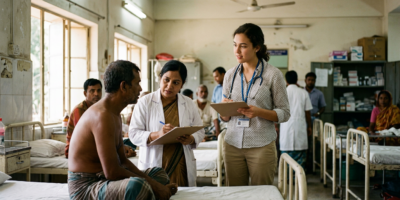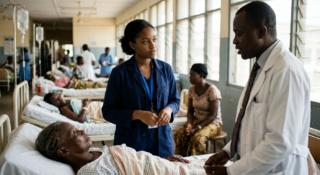
When a physician in a well-funded U.S. hospital suspects a pulmonary embolism, the standard workup often includes a CT pulmonary angiogram, D-dimer lab testing, and possibly a ventilation-perfusion scan. When a physician in a district hospital in rural sub-Saharan Africa suspects the same condition, those tools may not exist in the building. The clinical decision-making process in resource-limited hospitals is not a simplified version of what happens in wealthier settings. It operates on a fundamentally different set of inputs, constraints, and trade-offs. For pre-med students preparing for careers in medicine, understanding this distinction matters more than you might expect.
Clinical decision-making in resource-limited hospitals is shaped by a combination of fewer diagnostic tools, higher patient volumes relative to staff, a different disease burden, and supply chains that do not always deliver what clinicians need. These are not failures of individual competence. They reflect systemic realities that affect how clinicians prioritize, diagnose, and treat. If you are considering a global health clinical experience, or if you simply want a clearer picture of how medicine functions outside a well-resourced academic medical center, this article breaks down what actually changes and why it should inform how you think about your own training.
How Resource Constraints Reshape the Diagnostic Process
In a high-income clinical environment, diagnosis often follows a protocol-heavy pathway. You order labs, imaging, and specialty consults. You rule things in and rule things out using data. In many low- and middle-income countries (LMICs), clinicians rely far more heavily on history-taking and physical examination because the confirming tests may not be available, may be prohibitively expensive for the patient, or may require a referral that takes days of travel.
This does not mean clinicians in these settings are guessing. It means their clinical reasoning is more weighted toward pattern recognition, epidemiological probability, and physical exam findings. A provider in a region with high malaria prevalence, for instance, may begin empirical treatment for malaria based on a clinical presentation and local disease patterns, even without a rapid diagnostic test, because the risk of withholding treatment outweighs the risk of treating presumptively. That logic is sound within its context, even though it would not match the protocol at a U.S. emergency department.
For pre-med students, this is worth sitting with. Much of your training so far has likely emphasized the importance of evidence-based medicine driven by data and testing. That framework is valuable. But clinical decision-making resource-limited hospitals demand a different application of evidence, one where population-level data, clinical experience, and immediate patient need take on greater weight. Observing this firsthand can sharpen your understanding of how medical reasoning actually works when the tools change.
The WHO’s data on global health workforce shortages adds another layer. With an estimated global shortfall of 10 million health workers projected by 2030, concentrated heavily in Africa and Southeast Asia, the clinicians making these decisions are also doing so under enormous time pressure. Fewer providers per patient means less time per encounter, which means the diagnostic process has to be efficient in ways that students trained in U.S. settings rarely see.
What Changes When Supplies Are Not Guaranteed
Beyond diagnostics, treatment decisions shift significantly when supply chains are unreliable. A clinician may know the ideal medication for a condition but prescribe an alternative because the first-line drug is out of stock. Surgical teams may delay or modify procedures based on the availability of anesthesia, sutures, or even reliable electricity. These are not hypothetical scenarios. They are routine realities in many hospitals across LMICs.
Prioritization Under Scarcity
One of the most striking differences students observe in medicine in low-resource settings is how prioritization works. In a U.S. hospital, triage sorts patients by acuity, but the assumption is that all patients will eventually receive care. In a resource-limited hospital, clinicians sometimes face genuine allocation decisions: which patient receives the last unit of blood, which surgical case gets the available operating time, which child receives the remaining course of antibiotics.
These decisions are not made carelessly. They involve clinical judgment, ethical reasoning, and an awareness of outcomes that most pre-med students have only read about in bioethics textbooks. Watching a clinician work through that calculus in real time, weighing severity against likelihood of benefit against available supply, is a form of education that no lecture can replicate.
Improvisation and Resourcefulness
Students also commonly observe clinicians and staff improvising with available materials. This might mean using locally sourced items for wound care, adapting equipment for purposes beyond its original design, or creating workarounds for infrastructure gaps like intermittent power or limited clean water access. This resourcefulness is not a sign of inadequacy. It reflects deep practical knowledge and problem-solving skill under pressure.
For students interested in how clinical skills develop in these contexts, IMA’s discussion of the role of clinical officers in Kenya’s healthcare system provides a concrete example of how healthcare professionals in LMICs are trained and authorized to fill critical gaps in care delivery.
The Disease Burden Is Different, and So Is the Logic
Clinical decision-making does not happen in a vacuum. It responds to the conditions that walk through the door. In many LMICs, the disease burden looks substantially different from what students encounter in U.S. clinical settings. Communicable diseases such as malaria, tuberculosis, and HIV/AIDS remain leading causes of morbidity and mortality in many regions, alongside rising rates of non-communicable diseases like cardiovascular disease and diabetes.
This dual burden creates a decision-making environment where clinicians must be fluent in two very different categories of care simultaneously, often without the subspecialty support that U.S. hospitals rely on. A single provider in a rural clinic might manage an HIV patient’s antiretroviral regimen in the morning, treat a child with severe dehydration from diarrheal disease at midday, and counsel a patient with uncontrolled hypertension in the afternoon.
The WHO Global Health Estimates document this dual burden clearly, showing that communicable diseases still account for a disproportionate share of death and disability in low-income countries, even as non-communicable diseases are increasing. For pre-med students, understanding this pattern matters because it shapes what you would actually observe in a clinical setting abroad. It also reveals how healthcare resource constraints interact with disease patterns to create clinical challenges that are distinct from anything you would see in most U.S. hospitals.
Conditions related to poverty, malnutrition, and limited access to clean water also appear at rates that students may not have encountered before. Seeing the downstream clinical effects of structural determinants of health, not as a concept on a slide but as a patient in front of you, changes how you understand the relationship between social conditions and clinical presentations.
Why This Matters for How You Think About Medicine
If you are applying to medical school, you have probably heard that admissions committees value experiences with underserved populations, cultural competency, and ethical reasoning. That is true. But the deeper point is not about checking a box. Understanding how clinical decision-making works under constraint teaches you something important about the foundations of medical reasoning itself.
When you remove the advanced imaging, the extensive lab panels, and the on-call specialists, what remains is the clinician’s ability to think. History, physical exam, clinical reasoning, knowledge of local epidemiology, awareness of what resources exist, and judgment about what to do with incomplete information. These are core medical skills, and they are on full display in resource-limited hospitals precisely because there is less infrastructure to lean on.
For pre-med students, observing this process, under proper supervision and within approved boundaries, builds a kind of clinical awareness that is hard to develop in other settings. You begin to see that medicine is not a fixed set of protocols but a practice of reasoning that adapts to context. That understanding will serve you in any clinical environment you eventually work in, whether it is a rural U.S. clinic, an urban emergency department, or an international health organization.
The AAMC’s core competencies for entering medical students include items like critical thinking, ethical responsibility to self and others, and service orientation. A global health clinical experience that is structured, supervised, and reflective can provide genuine evidence of these competencies, not because the experience is exotic, but because the clinical environment demands a different kind of attention from you as an observer.
IMA’s approach to ethical engagement in global health programs is worth reviewing if you want to understand how responsible programs frame these experiences for students. The emphasis is on observation, learning, and respect for local systems, not on students performing clinical work beyond their training.
What Students Commonly Misunderstand Before Going
One of the most common misconceptions pre-med students carry into a global health experience is that medicine in low-resource settings is simply “worse” medicine. That framing is inaccurate and, frankly, disrespectful to the clinicians working in those environments. What you observe is not inferior care. It is care delivered under different conditions, often with remarkable skill and judgment.
The “Savior” Trap
Some students arrive expecting to help fix problems. The reality is that a pre-med student, no matter how motivated, is not going to improve a hospital’s outcomes during a short-term program. Your role is to observe, to learn, and to contribute only within the boundaries set by supervising professionals and the host institution. The value of the experience is in what it teaches you, not in what you deliver. Students who internalize this distinction tend to get far more out of the experience and to represent it more honestly in applications and interviews.
Confusing Context With Competence
Another misunderstanding is conflating the resource environment with the skill of the providers. A physician who accurately diagnoses pneumonia using a stethoscope and patient history, without a chest X-ray, is not practicing lower-quality medicine. That physician is demonstrating a level of clinical acumen that many providers in high-resource settings never have to develop because they have imaging available. Recognizing this reframes what you are observing and allows you to learn from it rather than judge it.
Students who approach these experiences with humility and genuine curiosity tend to develop the kind of perspective that admissions committees and, more importantly, future patients will value. IMA’s writing on why early clinical exposure changes how students prepare for medicine speaks to this directly: the earlier you build real clinical awareness, the more grounded your preparation becomes.
How to Prepare Yourself for What You Will Observe
If you are considering a structured global health experience that includes time in a resource-limited clinical setting, preparation matters. Not just logistical preparation, but intellectual and ethical preparation.
Start by reading about the healthcare system of the country you will be in. Understand its structure, its staffing model, its funding, and the most common conditions treated. This background will make your observations far more meaningful because you will understand the “why” behind what you see.
Study the ethical principles of global health engagement. Concepts like cultural humility, the difference between charity and solidarity, and the importance of sustainable systems rather than short-term fixes are not just theoretical. They will shape how you interpret every clinical interaction you witness.
Think carefully about your role. You are not a provider. You are not a consultant. You are a student, observing and learning under supervision. That role has real value, but only if you respect its boundaries. The clinicians you observe have earned their expertise through years of training and practice in their specific context. Your job is to watch, ask thoughtful questions when appropriate, and reflect seriously on what you see.
Finally, plan how you will process the experience afterward. Structured reflection, whether through journaling, guided debriefs, or conversations with mentors, helps you move from raw observation to genuine understanding. Without reflection, even a powerful clinical experience can become a collection of disconnected memories rather than a meaningful part of your professional development.
Frequently Asked Questions
Is clinical decision-making in resource-limited hospitals less evidence-based than in the U.S.?
No. Clinicians in resource-limited settings still use evidence-based reasoning, but they apply it within a different set of constraints. When diagnostic tools are limited, clinical evidence shifts toward history, physical exam findings, local epidemiological data, and population-level treatment guidelines. The reasoning is rigorous; the inputs are different.
Will observing care in a low-resource hospital count as clinical experience for medical school applications?
Structured, supervised observation in clinical settings can contribute to your clinical exposure hours. However, how it is valued depends on how you describe the experience and what you learned. Admissions committees generally look for evidence of reflection, ethical awareness, and genuine engagement rather than a specific setting or hour count. Do not assume that any program guarantees credit or a specific admissions outcome.
What should I focus on during clinical observation in a resource-limited setting?
Pay close attention to how clinicians gather information, how they reason through diagnoses with limited tools, how they communicate with patients and families, and how they make allocation decisions. Focus on the reasoning process, not just the outcomes. Ask yourself what you would have expected in a U.S. setting and why the approach differs. These observations will be far more valuable to your development than simply logging hours.