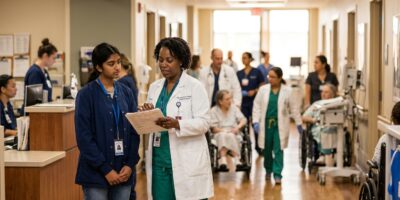
Ethics around medications for teen observers is not a theoretical topic. It is one of the most concrete, immediately relevant issues a high school student will face during any clinical observation experience, whether through medical summer internships for high school students in hospital pharmacies, community clinics, or international health settings. Medications carry real consequences. The World Health Organization estimates that medication errors cost approximately $42 billion annually worldwide, and in the United States alone, the FDA reports roughly 1.3 million injuries each year tied to medication errors. For a teenager standing in a pharmacy for the first time, watching prescriptions move from shelf to patient, the stakes become personal and visible.
This matters to students because clinical observation is one of the clearest ways to build early understanding of healthcare systems, and pharmacy is a significant part of that picture. It also matters to parents considering the best medical internships for high school students, because the line between observing and participating must be clearly drawn and firmly maintained. No high school student should be handling prescription medications, giving advice about drugs, or accessing patient health records. What they should be doing is watching, listening, reflecting, and beginning to understand the ethical weight that comes with every pill counted and every label printed. This article lays out the specific ethical boundaries, what responsible observation looks like, how structured programs handle supervision, and why this kind of early exposure can be genuinely valuable when approached with the right expectations.
Why Medication Ethics Matter More Than Most Teens Expect
Most high school students arrive at a clinical observation thinking of medications as products on a shelf. That impression changes quickly. Even a short period of observation in a pharmacy setting reveals that every medication decision involves layers of judgment: drug interactions, dosage accuracy, patient history, allergies, affordability, and the possibility of harm if any of those layers is missed. The CDC’s medication safety resources detail the scope of this problem, noting that medication errors remain one of the most common and preventable sources of patient harm in healthcare.
For a teen observer, the ethical dimension isn’t about memorizing drug names or learning compounding techniques. It is about recognizing that the professionals around them carry real responsibility for the people who depend on those medications. A pharmacist checking a prescription isn’t just performing a mechanical task. They are acting as a safety net, often the last one, between a physician’s order and a patient’s body. Understanding this is exactly the kind of professional awareness that high school students are well positioned to absorb, even if they are years away from clinical training.
Parents should know that responsible observation programs make these stakes explicit from the start. Students are briefed on what they will see, what they are expected to do (which is observe and reflect), and what they must not do (which includes touching medications, offering advice, or accessing confidential information). The ethical framework isn’t an afterthought. It is the foundation of the experience.
The Specific Boundaries Teen Observers Must Respect
There is no gray area here. High school students in any clinical pharmacy observation, domestic or international, should operate under a clear set of rules. These are not suggestions. They are non-negotiable.
No Handling of Medications
Teen observers do not pick up, count, sort, package, or distribute any prescription medication. This applies to over-the-counter products in clinical settings as well. The reasons are straightforward: liability, patient safety, and the fact that medication handling requires licensure and training that a high school student does not have.
No Patient Counseling or Advice
Even if a patient asks a question directly, the correct response for a teen observer is to defer immediately to the supervising pharmacist or technician. This is not about being unhelpful. It is about recognizing that medication advice, no matter how basic it may seem, can carry serious consequences if it is wrong. A student who understands this is already learning something important about professional scope.
No Access to Patient Records
Patient privacy protections, including standards equivalent to HIPAA in the United States, apply in every responsible clinical setting. Teen observers should not read, photograph, copy, or discuss specific patient information. Confidentiality agreements are typically signed by both the student and a parent or guardian before any observation begins. Programs that skip this step are programs worth questioning.
No Unsupervised Time in the Pharmacy
A licensed pharmacist or designated clinical supervisor should be present and aware of the student’s location at all times during observation hours. This is a basic structural safeguard that protects both the student and the patients being served. If a student finds themselves alone in a dispensing area, something has gone wrong.
These boundaries may sound restrictive. They are. And that is exactly the point. Learning to respect the limits of your role, especially when you are new and eager, is one of the most important professional habits a future healthcare worker can develop. Students preparing for pre-health pathways will find that this principle applies in operating room observation and every other clinical setting as well.
What Responsible Pharmacy Observation Actually Looks Like
So if students are not handling medications or counseling patients, what are they doing? Quite a lot, actually.
A well-structured pharmacy observation gives students a front-row seat to the systems and decisions that keep patients safe. They watch how prescriptions are received, verified, filled, and checked. They see how pharmacists flag potential drug interactions and communicate with physicians. They observe inventory management, which in international settings often involves working with limited supplies and making difficult allocation decisions. They listen as pharmacists counsel patients, noting not just the information shared but the way it is communicated, adapted for literacy levels, language barriers, or cultural context.
After each observation period, structured programs build in time for reflection and discussion. This is where much of the real learning happens. A supervising pharmacist or program mentor walks through what students observed, answers questions, and pushes students to think about the ethical dimensions of what they saw. Why was a particular medication chosen over another? What happens when a patient cannot afford the prescribed drug? How do pharmacists handle situations where a patient wants a medication that may not be appropriate?
These conversations are age-appropriate, professionally grounded, and far more valuable than any hands-on task a teenager could perform. They build the kind of ethical reasoning and systems thinking that admissions committees at medical, pharmacy, PA, and nursing schools want to see. The AAMC’s guidance on preparing for medical school consistently emphasizes the importance of reflection and ethical awareness alongside clinical exposure.
How Structured Programs Protect Students and Patients
Parents have every right to ask hard questions about how a program keeps their teenager safe in a clinical environment. In fact, a program that cannot answer those questions clearly is a program to avoid.
Supervision and Staff Oversight
In a well-run observation program, students are never placed in a clinical setting without direct supervision from a licensed professional. For pharmacy observations, this means a licensed pharmacist is present and responsible for the student at all times. Program staff, separate from the clinical supervisors, provide additional oversight through daily check-ins, structured debriefs, and clear escalation protocols if a student encounters a situation that feels uncomfortable or inappropriate.
Housing, Communication, and Daily Structure
For programs that involve travel, especially international ones, parents should expect transparent information about where their child will be staying, who is responsible for them outside of clinical hours, and how communication works. Structured programs provide regular updates, emergency contact protocols, and clear daily schedules. The clinical observation is only one part of the day; the rest should be accounted for with the same level of care. IMA’s high school programs overview outlines the kind of structure families should expect from a serious program.
Confidentiality Agreements and Ethical Briefings
Before a student sets foot in a pharmacy, they should receive a thorough briefing on patient privacy, professional conduct, and the specific ethical expectations of the setting. Both the student and their parent or guardian typically sign confidentiality agreements. This is standard practice and a good sign that the program takes these issues seriously.
What to Do If Something Feels Wrong
Responsible programs teach students what to do if they witness something concerning, whether it is a potential medication error, a boundary violation, or a situation that makes them uncomfortable. The answer is always the same: report it to your supervisor or program staff immediately. A student who understands this, and who feels empowered to act on it, is already practicing the kind of ethical awareness that defines good healthcare professionals.
Why This Matters for College Applications and Beyond
Early clinical exposure matters on a college or professional school application, but not in the way many students assume. Admissions committees are not impressed by a list of settings a student walked through. They are looking for evidence that the student reflected on what they saw, understood the ethical weight of clinical work, and developed genuine insight into how healthcare systems function.
Pharmacy observation, done well, provides exactly this kind of material. A student who can write or speak thoughtfully about watching a pharmacist manage a drug shortage, counsel a patient through a complex regimen, or catch a potentially dangerous interaction has something meaningful to say. That kind of reflection stands out far more than a list of hours logged.
It is worth noting that no single observation experience guarantees admission to any program. What it does is give students a foundation of real understanding that strengthens their candidacy over time. Students who are thinking ahead to pre-med preparation will find that pharmacy observation adds a dimension of ethical and systems-level thinking that complements other forms of clinical exposure.
Maturity and Readiness: An Honest Conversation for Students and Parents
Not every high school student is ready for clinical observation, and that is completely fine. The maturity required is real: the ability to stand quietly and observe without intervening, to hear difficult information about patients and keep it confidential, to follow rules even when no one is watching, and to handle the emotional weight of seeing people who are sick or in pain.
Parents know their child better than any program can. If your teenager is someone who takes rules seriously, handles unfamiliar situations with composure, and is genuinely curious rather than just resume-building, they are likely a good candidate. If they are still developing those qualities, a year or two of growth before pursuing clinical observation is not a setback. It is good judgment.
Students should ask themselves honestly: Can I watch and not touch? Can I hear private health information and keep it to myself? Can I follow instructions from a supervisor, even if I disagree or do not understand the reason in the moment? These are not trick questions. They are the baseline for professional conduct in any healthcare setting.
The National Institute of Mental Health’s research on adolescent brain development confirms what most parents already sense: the prefrontal cortex, responsible for judgment and impulse control, continues developing well into a person’s mid-twenties. This does not mean teenagers cannot observe responsibly. It means that strong external structure, clear rules, and attentive supervision are not optional add-ons. They are essential.
Choosing the Right Program: What to Verify Before Committing
For parents and students evaluating observation programs with a pharmacy or medication component, a short list of practical questions will go a long way.
Ask who will supervise your student in the pharmacy setting. Ask whether the program requires confidentiality agreements. Ask what the daily schedule looks like, hour by hour, and who is responsible for the student during non-clinical hours. Ask how the program handles situations where a student witnesses something ethically concerning. Ask whether the program has clear policies preventing students from handling medications or interacting with patients about their prescriptions.
A serious program will answer these questions directly, without hedging or vague language about “immersive experiences.” If the answers are not clear, keep looking. There are responsible options available, and your student deserves one that prioritizes their safety and professional development over marketing language.
Frequently Asked Questions
Will my teenager handle any medications during a pharmacy observation?
No. In a properly structured observation program, high school students do not handle, count, sort, package, or distribute any medications. Their role is to observe licensed professionals at work and to participate in supervised educational discussions about what they see. Any program that allows minors to handle prescription drugs is operating outside appropriate boundaries.
How does a pharmacy observation help with college or professional school applications?
Pharmacy observation provides material for reflective writing and interviews. Admissions committees value students who can articulate what they learned about patient safety, ethical decision-making, and how healthcare systems work. The experience itself does not guarantee admission to any program, but thoughtful reflection on ethical dilemmas and professional conduct strengthens a student’s overall candidacy.
What should parents ask a program before signing up for a clinical observation?
Ask about the supervision structure, specifically who is responsible for your student during clinical and non-clinical hours. Ask whether confidentiality agreements are required. Ask for a detailed daily schedule. Ask how the program handles ethical concerns or uncomfortable situations. Ask about housing, communication protocols, and emergency procedures. Clear, specific answers to these questions are a strong indicator of a responsible program.