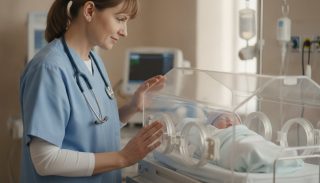

To become a neonatologist, you earn a bachelor’s degree, complete four years of medical school, finish a 36-month pediatrics residency, then train 36 months in an accredited neonatal-perinatal medicine fellowship. After that you need board certification in general pediatrics and in neonatal-perinatal medicine. Counting from college, the path takes about 14 years.
A neonatologist is a pediatrician who has specialized in the sickest newborns, so the first stretch of training is the same as the path to becoming a pediatrician. The newborn focus is added during fellowship, which is where most of the hands-on intensive care training happens.
Neonatologist Training Path at a Glance
| Stage | Length | What happens | Rule set by |
|---|---|---|---|
| Bachelor’s degree | Usually 4 years | Science courses, the MCAT, clinical and research experience | Medical schools |
| Medical school (MD or DO) | 4 years | Classroom years, clinical rotations, licensing exams | Medical schools, licensing boards |
| Pediatrics residency | 36 months | Inpatient, outpatient, emergency, NICU and newborn nursery rotations | ACGME (2026) |
| Neonatal-perinatal medicine fellowship | 36 months | At least 12 months of clinical NICU training and at least 12 months of research | ACGME (2026) |
| General pediatrics board exam | After residency | Initial certification from the American Board of Pediatrics | ABP |
| Neonatal-perinatal medicine board exam | After fellowship | Subspecialty certification from the ABP | ABP |
The American Academy of Pediatrics gives parents the same summary of what training neonatologists have: at least 4 years of medical school, three years of general pediatrics residency, three more years of newborn intensive care training, and certification from the American Board of Pediatrics and its Sub-board of Neonatal-Perinatal Medicine.
What a Neonatologist Does in the NICU
Neonatologists care for newborns who are premature, critically ill or born with conditions that need intensive treatment. According to the AAP, their work includes diagnosing and treating breathing disorders, infections and birth defects, managing babies who need surgery, making sure critically ill infants get the nutrition they need to grow, and attending high-risk deliveries where a baby may need help right away.
Most of that work happens in the neonatal intensive care unit (NICU) and special care nurseries. The AAP notes that neonatologists practice in children’s hospitals, university medical centers and large community hospitals, and that some see babies for short-term follow-up after discharge. They also consult with obstetricians before birth when a problem is found during pregnancy.
A typical week for an attending neonatologist can include:
- Leading NICU rounds with residents, fellows, nurses, respiratory therapists and pharmacists
- Attending deliveries flagged as high risk and stabilizing newborns in the delivery room
- Managing ventilators, IV nutrition and medications dosed for very small patients
- Meeting with parents about a baby’s condition, treatment options and plans for going home
- Seeing graduates of the NICU in a follow-up clinic to track growth and development
- Supervising and teaching trainees, which is part of the job in most academic units
If you want to see how the attending role differs from training, IMA’s guide to attending physicians and residents explains who carries final responsibility for patients.
Step 1: College, the MCAT and Medical School
There is no required major. Medical schools look for the standard prerequisites in biology, chemistry, physics and math, a competitive MCAT score, and evidence that you understand patient care. IMA’s step-by-step guide on how to become a doctor covers the application years in detail.
Both MD and DO graduates can become neonatologists. The ABP accepts graduates of medical schools accredited by the LCME or the American Osteopathic Association for its general pediatrics exam, and the ACGME accepts residency training completed in ACGME-accredited or AOA-approved programs for fellowship entry.
In medical school, a pediatrics clerkship and a NICU elective are the most direct way to test your interest. You will also take the licensing exam sequence; IMA explains how scoring on the first exam changed in its article on the USMLE Step 1 pass/fail change.
What Experience Helps Before Medical School?
Clinical exposure that puts you near patients and families counts for more than a long list of titles. Shadowing a pediatrician, volunteering in a hospital, and research in child health all help. Through IMA’s pre-med internships abroad, students work under licensed clinicians on vital signs, patient intake and triage, basic patient interviews and other noninvasive tasks, alongside ward rounds and community outreach. How those hours are classified on an application is each school’s decision.
Step 2: Complete a Pediatrics Residency
Neonatal-perinatal medicine is a pediatric subspecialty, so you must first finish residency in pediatrics. The ACGME’s 2026 pediatrics program requirements set the residency at 36 months. Inside those three years, residents must complete 40 weeks of inpatient care, including 12 weeks of intensive care with at least 4 weeks in a pediatric ICU and at least 4 weeks in a NICU, plus 4 weeks in the newborn nursery. Neonatal delivery room stabilization is listed among the required skills.
The ABP adds its own rule: residents must complete at least 12 months at each training level, from R-1 to R-3, and leave beyond one month extends training. Residency matching runs through ERAS and the NRMP Main Residency Match; IMA’s ERAS residency application guide walks through the application itself.
Can You Get There Through Medicine-Pediatrics?
Yes. The ACGME neonatal-perinatal medicine requirements accept completion of either a pediatrics residency or a combined internal medicine-pediatrics residency as the prerequisite. NRMP lists the same two routes. Under an ABP and ABIM agreement, med-peds residents train two years in each field over four years, so this route adds about one year.
Step 3: Train in a Neonatal-Perinatal Medicine Fellowship
The ACGME 2026 neonatal-perinatal medicine requirements state that “the educational program must be 36 months in length.” Programs must be based in a NICU that is staffed and equipped around the clock, and the sponsoring hospital system must also have an obstetrics and gynecology residency with maternal-fetal medicine specialists, so fellows learn about high-risk pregnancy as well as newborn care.
Key requirements fellows must meet:
| Requirement | What the ACGME says (2026) |
|---|---|
| Length | 36 months |
| Clinical time | A minimum of 12 months of clinical experience |
| Research | A minimum of 12 months dedicated to research and scholarly activity, starting in the first year |
| Procedures | Neonatal resuscitation, venous and arterial access, evacuation of air leaks, endotracheal intubation and umbilical catheterization |
| Delivery room | Skill in stabilization and resuscitation of critically ill neonates |
| Follow-up | Participation in follow-up for high-risk neonates in a NICU follow-up clinic |
| Perinatal skills | Identifying high-risk pregnancy and recognizing signs of fetal distress |
Fellows also learn to prepare newborns for transport, manage ventilatory and nutritional support, and take part in the care of infants who need cardiac surgery. The requirements spell out that fellows must be able to talk with families about the emotional impact of a premature birth or a life-threatening condition, which is a large part of the daily job.
For a broader look at how fellowships fit after residency, see IMA’s explainer on what a medical fellowship is.
How Do You Match Into a Neonatology Fellowship?
Neonatal-perinatal medicine fills its positions through the NRMP Medicine and Pediatric Specialties Match, which combines more than 30 internal medicine, pediatric and multidisciplinary subspecialties on one rank list. NRMP lists the typical fellowship length as three years and requires applicants to have completed a residency in pediatrics or medicine-pediatrics. Research and strong letters from NICU attendings during residency help your application.
Step 4: Earn Board Certification in Neonatal-Perinatal Medicine
Certification comes in two layers. First you pass the ABP’s general pediatrics certifying exam after residency. According to the ABP’s general criteria for subspecialty certification, candidates must hold and keep initial certification in general pediatrics and hold a valid, unrestricted medical license in the United States, its territories or Canada. Temporary or training licenses are not accepted.
Then you meet the neonatal-perinatal medicine admission requirements: three years of full-time, broad-based fellowship training in a program accredited by the ACGME or the Royal College of Physicians and Surgeons of Canada. The program director must verify satisfactory completion, rate clinical competence and professionalism, and provide evidence of scholarly activity. You then must pass the subspecialty certifying exam. The ABP page, last updated November 25, 2025, also notes that leave beyond three months during the three years must be made up and that part-time training may stretch over no more than six years.
Is Licensing Separate From Board Certification?
Yes. A state medical license lets you practice; board certification shows you met a specialty’s standards. Licensing requires passing the USMLE or COMLEX sequence and meeting state board rules, while certification comes from the ABP.
Neonatologist Training Timeline by Route
| Path | College | Medical school | Residency | Fellowship | Total after high school |
|---|---|---|---|---|---|
| Pediatrics route | 4 years | 4 years | 3 years | 3 years | About 14 years |
| Med-peds route | 4 years | 4 years | 4 years | 3 years | About 15 years |
Time in a research year, a gap year or extended leave adds to these totals. IMA’s timeline for becoming a doctor compares this with other specialties.
Neonatologist Salary: What BLS Reports
The Bureau of Labor Statistics does not publish a separate wage figure for neonatologists. The closest BLS occupation is general pediatricians, which sets a baseline for the field. In the May 2025 OEWS data for pediatricians, general, BLS reports:
| Measure (May 2025) | Pediatricians, general |
|---|---|
| Employment | 39,390 |
| Mean hourly wage | $101.98 |
| Mean annual wage | $212,110 |
| 10th percentile | $91,470 |
| 25th percentile | $138,290 |
| Median annual wage | $210,040 |
| 75th percentile | $273,700 |
| 90th percentile | $338,500 |
Because neonatologists complete three more years of fellowship and work in intensive care with night and weekend coverage, their pay is not captured by these general pediatrics figures. Treat the table as a floor for the specialty, not a neonatology salary. For how pay varies across fields, see IMA’s list of the highest-paying medical specialties.
Job Outlook for Neonatologists
BLS projects overall employment of physicians and surgeons to grow 4 percent from 2025 to 2035, with about 22,100 openings each year on average over the decade. BLS reported a median annual wage of $275,930 for all physicians and surgeons in May 2025. It also notes that an expected decline in the child population may constrain demand for pediatricians and pediatric surgeons.
Demand for neonatal care depends on births and on how many babies need intensive care, and NICUs are concentrated in children’s hospitals and large medical centers. That means jobs cluster in cities and academic centers, and a willingness to move widens your options.
Who Neonatology Suits Best
Neonatology suits people who want acute, procedure-heavy intensive care with patients who cannot speak for themselves, and who are comfortable spending long conversations with worried parents. It also suits people who like research, since fellows spend at least a year on it. If you prefer long-term outpatient relationships with children as they grow, general pediatrics may fit better.
Questions to ask yourself during rotations:
- Do I stay calm when a delivery turns urgent and a newborn needs resuscitation?
- Am I comfortable with shift work, nights and in-house call?
- Can I support families through uncertainty, long hospital stays and sometimes loss?
- Do I enjoy physiology and small, precise adjustments to medications and ventilator settings?
If you are still deciding between pediatric fields, IMA’s guide to residency and fellowship explains how training choices stack up, and its overview of neonatal care and resuscitation programs covers newborn resuscitation training that many NICU clinicians complete.
Frequently Asked Questions
How long does it take to become a neonatologist?
About 14 years after high school: four years of college, four years of medical school, a 36-month pediatrics residency and a 36-month neonatal-perinatal medicine fellowship. Choosing a combined medicine-pediatrics residency adds about one year.
Is a neonatologist a pediatrician?
Yes. A neonatologist completes a full pediatrics residency, earns general pediatrics certification from the American Board of Pediatrics, and then adds three years of fellowship and a second ABP certification in neonatal-perinatal medicine.
Can a DO become a neonatologist?
Yes. The ABP accepts graduates of medical schools accredited by the American Osteopathic Association for its general pediatrics exam, and the ACGME accepts residency training completed in ACGME-accredited or AOA-approved programs for fellowship entry.
Do neonatology fellows have to do research?
Yes. The 2026 ACGME requirements call for at least 12 months dedicated to research and scholarly activity, starting in the first year, and the ABP requires the program director to provide evidence of scholarly activity before a fellow can be certified.
How much does a neonatologist make?
BLS does not publish a separate neonatologist wage. The closest group, general pediatricians, had a median annual wage of $210,040 and a 90th percentile wage of $338,500 in May 2025. Neonatologists have three more years of subspecialty training, so that figure is a baseline only.
What is the difference between a neonatologist and a maternal-fetal medicine specialist?
A neonatologist trains through pediatrics and cares for the newborn, mainly in the NICU. Maternal-fetal medicine specialists train through obstetrics and gynecology and care for the pregnant patient. The two often work together on high-risk pregnancies, which is why ACGME requires neonatology programs to have access to maternal-fetal medicine specialists.
Where do neonatologists work?
Mostly in neonatal intensive care units and special care nurseries. The AAP notes that neonatologists practice in children’s hospitals, university medical centers and large community hospitals, and some provide short-term outpatient follow-up after discharge.
See more of our guides in your Google results: add International Medical Aid as a preferred source on Google.