
To learn how to become a podiatrist, plan on about 11 years after high school: a bachelor’s degree with lab science prerequisites, the MCAT, a 4-year Doctor of Podiatric Medicine (DPM) program applied to through AACPMAS, a 3-year hospital residency, the APMLE licensing exams, a state license, and optional board certification through ABFAS or ABPM.
Podiatrists are physicians and surgeons of the foot, ankle and lower leg. The route looks a lot like the path to becoming an MD or DO, but the schools, application service, residency match and exams are their own system. This guide walks through each step in order, with the current numbers from the organizations that run them.
The Podiatrist Path at a Glance
| Step | Typical length | Who sets the rules |
|---|---|---|
| Undergraduate prerequisites | 3 to 4 years (minimum 90 semester hours) | AACPM and each college |
| MCAT (or another accepted test) | Taken 12 to 18 months before entry | AAMC and each college |
| DPM degree | 4 years | CPME-accredited colleges |
| Podiatric medicine and surgery residency | 3 years | CPME |
| APMLE Parts I, II and III | Across school and residency | NBPME |
| State license | After residency requirements are met | State podiatric boards |
| Board certification (optional) | After residency | ABFAS or ABPM |
Step 1: Earn a Bachelor’s Degree With the Right Prerequisites
AACPM’s admissions requirements call for a minimum of three years or 90 semester hours of college credit at an accredited institution. In practice, nearly all applicants finish a bachelor’s degree, usually in biology, a physical science or a health field. Any major works if the science courses are in place.
The required courses are the same core sequence premedical students take:
- Biology: 8 semester hours
- General or inorganic chemistry: 8 semester hours
- Organic chemistry: 8 semester hours
- Physics: 8 semester hours
- English: 6 semester hours
Every science course must include a lab, and AACPM states that courses designed for non-science majors are not accepted. Many students add biochemistry, anatomy and physiology, which overlap heavily with the MCAT and with the first two years of podiatric school. If you are mapping out your schedule, our guide to the best classes to take before the MCAT covers the order that works for most students.
What GPA Do Podiatry Schools Look For?
AACPM does not publish a minimum GPA, but it does publish matriculant averages. According to AACPM’s applicant and matriculant statistics, students who entered podiatric medical school in fall 2025 averaged a 3.5 overall GPA and a 3.3 science GPA. That same report counts 752 applicants in the 2025-26 cycle and 519 first-year students who started in fall 2025.
Step 2: Take the MCAT
The MCAT has traditionally been the only standardized test podiatric schools required, and it is still the one every college accepts. AACPM’s admissions page lists which other tests each school takes during the AACPMAS cycle: 10 of the 11 schools also accept the DAT, three accept the OAT, and one (LECOM) accepts the ACT or SAT. Western University of Health Sciences accepts the MCAT only.
Two timing rules matter. First, AACPM states that MCAT scores more than three years old at the time of application are not acceptable. Second, the last MCAT date a school will consider before a fall start ranges from March at Midwestern’s Arizona college, to May at Barry University, to June at most other schools.
What MCAT Score Do You Need for Podiatry School?
There is no published cutoff. AACPM reports that the fall 2025 matriculants averaged 492.7 on the MCAT, with section averages near 123 in each of the four sections. That is lower than the averages for MD programs, which you can compare in our breakdown of what MCAT score you need for medical school. A stronger score still widens your choice of schools and can help offset a weaker semester.
Step 3: Apply to DPM Programs Through AACPMAS
AACPMAS is the centralized application for podiatric medicine. You submit one application and one set of transcripts, AACPMAS verifies the coursework and calculates your GPA, and it sends the file to each college you choose.
For each cycle, AACPMAS opens on the first Wednesday in August for fall admission the following year. AACPM lists March 1 as the priority deadline and June 30 as the final deadline for that fall. Applying early in the cycle is the safer plan, since interviews fill as the year goes on. Schools also require letters of recommendation, sent directly to each school or through Interfolio or Virtual Evals depending on the college, and a personal interview.
How Many Podiatry Schools Are There?
AACPM describes eleven podiatric medical schools in the AACPMAS system. The CPME list of podiatric medical colleges shows 10 fully accredited colleges plus the LECOM School of Podiatric Medicine in Erie, Pennsylvania, which was granted preaccreditation in May 2025. The accredited colleges are in Arizona, California (two), Florida, Iowa, Illinois, New York, Ohio, Pennsylvania and Texas.
Does Shadowing a Podiatrist Help?
Yes. The Bureau of Labor Statistics notes that shadowing a podiatrist can be helpful for DPM applicants, and many letters of recommendation come from those experiences. Hours with a podiatrist show the admissions committee that you know what the specialty involves, and broader patient care hours show you are comfortable with patients. Our guide on how to ask to shadow a doctor includes a sample email you can adapt for a local podiatry office.
Step 4: Complete the 4-Year DPM Program
The DPM curriculum runs four years. The first two years cover the same basic sciences as other medical degrees, including anatomy, physiology, biochemistry, microbiology, pathology and pharmacology, with extra depth in lower extremity anatomy and biomechanics. The last two years move into supervised clinical rotations in clinics and hospitals, along with clerkships at programs you may want for residency.
| DPM year | Main focus |
|---|---|
| Year 1 | Basic sciences, general and lower extremity anatomy |
| Year 2 | Pathology, pharmacology, introduction to clinical medicine |
| Year 3 | Clinical rotations in medicine, surgery and podiatry |
| Year 4 | Clerkships and residency applications through CASPR |
Step 5: Match Into a 3-Year Residency
Every new DPM completes a residency. AACPM’s residency overview describes the Podiatric Medicine and Surgery Residency (PMSR) as three years of postgraduate training, based in hospitals and approved by CPME under its residency standards. Some programs carry an added credential in Reconstructive Rearfoot/Ankle Surgery (PMSR/RRA), which leads to the RRA certification pathway with ABFAS.
Students apply in their final year through CASPR, the Central Application Service for Podiatric Residencies, which has run the podiatric match since 1976. Interviews for many programs take place at CRIP, the Centralized Residency Interview Program, where programs and applicants meet in one location. AACPM publishes the CASPR and CRIP schedule for each cycle, currently 2026-2027.
After residency, some podiatrists add a fellowship. BLS lists options such as podiatric wound care, diabetic foot care and limb preservation. For a broader look at how graduate training works across medicine, see our guide to residency and fellowship.
Step 6: Pass the APMLE and Get a State License
The American Podiatric Medical Licensing Examination (APMLE), run by the National Board of Podiatric Medical Examiners, is the national exam series required for licensure in podiatric medicine. According to the APMLE exam content page, it has three parts:
- Part I covers basic sciences: general and lower extremity anatomy, biochemistry, physiology, microbiology and immunology, pathology and pharmacology.
- Part II covers clinical knowledge: medicine, radiology, orthopedics, biomechanics and sports medicine, anesthesia and surgery, and community health, jurisprudence and research.
- Part III is the final exam for licensure and tests evaluation, diagnosis and treatment using case presentations, radiographs and photographs.
NBPME has terminated the separate Part II clinical skills exam (CSPE), so current students take the three parts above.
Every state requires podiatrists to be licensed. BLS notes that candidates must pass all parts of the qualifying exam and that some states add their own requirements, so check the podiatric board in the state where you plan to practice.
Step 7: Earn Board Certification
Board certification is not needed for a license, but BLS notes that many podiatrists choose to earn it, and it generally requires both work experience and an exam. Two boards certify podiatrists.
| Board | Focus | Main steps |
|---|---|---|
| ABFAS (American Board of Foot and Ankle Surgery) | Foot surgery and RRA surgery | Part I didactic and CBPS exams for board qualification, then Case Review of your own surgical cases for certification |
| ABPM (American Board of Podiatric Medicine) | Podiatric medicine | One two-part exam: a 125-question didactic section and a 9-case clinical section, passed in the same year |
The ABFAS pathway to certification requires a CPME-accredited residency of at least three years, an active unrestricted license and surgical hospital privileges, with every post-residency case logged until you pass Case Review. ABPM’s board exam requires at least three years of CPME-approved residency, can first be taken the fall after residency, and must be applied for within eight years of graduation. Its 2026 exam ran October 8 and 9 at Pearson testing centers.
What a Podiatrist Does Day to Day
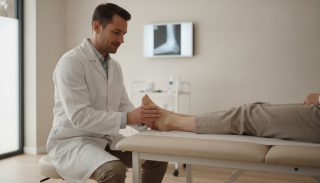
BLS describes podiatrists as providing medical and surgical care for people with foot, ankle and lower leg problems. A normal week can include diabetic foot exams and wound care, treating heel pain and sports injuries, ordering and reading X-rays, prescribing medication and orthotics, and operating on bunions, hammertoes, fractures and ankle problems.
Most podiatrists work in podiatry offices, group medical practices or hospitals. BLS reports that most work full time, evening and weekend hours are common, and some take call for urgent cases. Podiatry sits close to orthopedic surgery, and many foot and ankle patients see both.
Podiatrist Salary From BLS
The BLS Occupational Outlook Handbook reports a median annual wage of $160,300 for podiatrists in May 2025. The lowest 10 percent earned less than $66,010, and the highest 10 percent earned more than $309,670.
| Work setting (May 2025) | Median annual wage |
|---|---|
| Federal government | $222,550 median wage |
| Offices of physicians | $207,240 median wage |
| Offices of other health practitioners | $132,900 median wage |
| Hospitals | $132,290 median wage |
The low end of the range includes many podiatrists in their first years out of residency. For percentiles, state data and what moves pay, see our full podiatrist salary guide.
Job Outlook for Podiatrists
BLS counts about 10,000 podiatrist jobs in 2025 and projects employment to grow 2 percent from 2025 to 2035, slower than the average for all occupations. That still works out to about 200 openings per year, mostly to replace podiatrists who retire or leave the field. BLS ties demand to an aging population and the growing prevalence of chronic diseases such as diabetes and obesity, which drive many foot and mobility problems.
Timeline: How Long It Takes to Become a Podiatrist
Here is a typical timeline for a student who goes straight through:
| Age (approx.) | Milestone |
|---|---|
| 18 to 22 | Bachelor’s degree, prerequisites, shadowing |
| 21 | MCAT in spring, AACPMAS opens in August |
| 22 to 26 | DPM program and early APMLE parts |
| 26 to 29 | PMSR residency, APMLE Part III (the final licensing exam), state license |
| 29 and up | Board qualification and certification |
That adds up to roughly 11 years after high school, fewer than most MD surgical specialties and similar to many primary care paths.
Build Clinical Experience Before You Apply
Admissions committees want proof that you have worked around patients, not just read about the specialty. A podiatry office near home is the best start, and clinical experience in other settings counts too. IMA’s pre-med internships abroad place students in hospitals and clinics where, under licensed clinicians, they take vital signs, help with patient intake and triage, and join ward rounds and outreach, including diabetic and wound care cases that come up often in podiatry. How those hours are classified on an application is each school’s decision.
Frequently Asked Questions
Do you need the MCAT to become a podiatrist?
Every podiatric medical school accepts the MCAT, and it is the traditional requirement. Ten of the 11 schools listed by AACPM also accept the DAT, and a few accept the OAT. Scores older than three years at application are not accepted.
Is a podiatrist a real doctor?
Yes. Podiatrists earn a Doctor of Podiatric Medicine (DPM) degree, complete a 3-year hospital residency, pass a national licensing exam series and hold a state license. They diagnose, prescribe medication and perform surgery on the foot, ankle and lower leg.
How long is podiatry residency?
The standard Podiatric Medicine and Surgery Residency (PMSR) is three years of postgraduate training approved by CPME. Some programs add the Reconstructive Rearfoot/Ankle (RRA) credential, and some graduates complete a fellowship afterward.
Is it hard to get into podiatry school?
AACPM counted 752 applicants in the 2025-26 cycle and 519 first-year students in fall 2025. Matriculants averaged a 3.5 overall GPA and a 492.7 MCAT, so strong science grades, a solid MCAT and real clinical exposure still matter.
What is the difference between ABFAS and ABPM?
ABFAS certifies podiatrists in foot surgery and reconstructive rearfoot and ankle surgery through exams and a review of the candidate’s own surgical cases. ABPM certifies in podiatric medicine through a two-part exam covering didactic knowledge and clinical cases.
How much does a podiatrist make?
BLS reports a median annual wage of $160,300 for podiatrists in May 2025, with the top 10 percent above $309,670. Pay is highest in federal government and physician offices. Our podiatrist salary guide has the full breakdown.
Can you become a podiatrist without a bachelor’s degree?
AACPM’s minimum is three years or 90 semester hours of college credit with the required lab sciences, so a degree is not strictly required. Nearly all students admitted to DPM programs have finished a bachelor’s degree.