


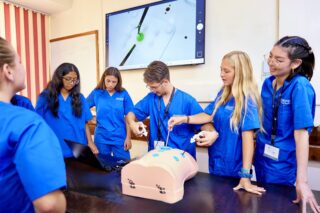

Occupational therapy shadowing means spending time beside a licensed occupational therapist to see how therapy works with real patients. Most OT programs ask for 20 to 40 observation hours, often split across at least two settings, before you apply. Requirements differ by school, so check each program before you plan your hours.
Shadowing is the activity; observation hours are the record you build from it. Our guide to OT observation hours and clinical hours covers how OTCAS handles those records and how to document them. This guide covers the earlier steps: finding a placement, choosing settings, knowing what to do on site and deciding whether shadowing abroad belongs in your plan.
What Occupational Therapy Shadowing Is
What does an OT shadowing student actually do?
An occupational therapy shadowing student follows a licensed occupational therapist (OTR) or a certified occupational therapy assistant (COTA) through a normal workday. The student watches evaluations and treatment sessions, listens to how the therapist explains goals to patients and families, and asks questions between sessions. The therapist stays responsible for every patient interaction.
Occupational therapy focuses on the daily activities a person needs or wants to do, such as dressing, eating, writing, working or playing. So shadowing shows you more than exercises. You see a therapist break a task into parts, adapt the environment and teach a new way to finish the task. A shadowing student in a pediatric clinic might watch a child practice buttoning with a modified board. A student in inpatient rehabilitation might watch a stroke survivor relearn how to get dressed with one hand.
Is shadowing the same as volunteering or fieldwork?
Occupational therapy shadowing is not the same as volunteering, and neither one is fieldwork. Shadowing centers on watching a therapist work. Volunteering usually means helping an organization with its own tasks, such as running activities at a senior center. Level I and Level II fieldwork are graded parts of an accredited OT curriculum that your program arranges after you enroll. Some schools accept volunteer time with a therapist as part of the requirement, which our guide to occupational therapy volunteer experience explains.
How Many Shadowing Hours OT Schools Ask For
What is the typical OT observation hour requirement?
Published requirements for entry-level OT doctorate programs commonly fall between 20 and 40 hours, and many programs also require at least two different settings. The examples below come from the programs’ own admissions pages and observation forms.
| Program | Hours required | Setting rule | Who must supervise |
|---|---|---|---|
| Texas Christian University OTD | At least 30 | Two different settings | OT or OTA, not an OT aide |
| University of Florida OTD | 30 | At least two diverse settings | Licensed OT or licensed OTA |
| Cedar Crest College OTD | At least 40 | At least two settings | Licensed OT |
| LSU Health Shreveport OTD | At least 40 | 20 pediatric and 20 adult inpatient rehabilitation | One licensed OT per setting |
| UNLV OTD | At least 40 observation or volunteer hours | At least two practice settings | Licensed OT or certified OTA |
Sources: Texas Christian University (TCU, 2026), University of Florida observation form (UF, 2026), Cedar Crest College observation form (Cedar Crest, 2024), LSU Health Shreveport admissions criteria (LSU Health Shreveport, 2026) and the UNLV OTD admission instructions (UNLV, 2025).
Do some programs accept fewer hours or online shadowing?
Some OT programs set lower minimums or accept alternatives. UNLV lets applicants count a virtual Intro to OT module for 20 of its 40 required hours, and it also accepts an introductory OT course in place of hours (UNLV, 2025). LSU Health Shreveport offers an online shadowing program as an alternative to its 40 in-person hours (LSU Health Shreveport, 2026). These options are program-specific. Never assume a school accepts virtual hours unless its own page says so.
Why do programs ask for more than one setting?
Occupational therapy looks very different from one setting to the next. School-based therapists work on handwriting and classroom participation. Hand therapists work on fine motor recovery after injuries. Mental health OTs build routines and coping skills. Programs that ask for two or more settings want proof that you understand the range of the profession, not only one clinic. LSU Health Shreveport goes further and names the settings: 20 hours in pediatrics and 20 hours in adult inpatient rehabilitation (LSU Health Shreveport, 2026).
How to Find Occupational Therapy Shadowing
Where can I shadow an occupational therapist?
The most common places to shadow an occupational therapist are hospital rehabilitation departments, outpatient clinics, pediatric therapy practices, public school districts, skilled nursing facilities, home health agencies and mental health programs. Start with places where you already have a connection: your own past therapist, a family friend who works in healthcare, your university’s pre-health advising office or a local hospital’s volunteer office.
Large hospitals usually route shadowing requests through a formal process with forms, immunization records and a background check. Smaller private practices often decide faster, because the therapist you speak with may also own the clinic. Ask early, since paperwork can take several weeks.
How should I ask an occupational therapist to shadow?
Keep the first request short and specific. Name the setting you want to see, the number of hours you hope to complete, your availability and the programs you plan to apply to. Mention that you can complete any required paperwork. Follow up once after a week if you hear nothing, then move to the next clinic. Therapists see patients all day, so a clear, brief email gets more replies than a long one.
When should pre-OT students start shadowing?
Many pre-OT students start shadowing in the first or second year of college, once they are fairly sure OT interests them. Starting early lets you spread hours across settings without crowding them into one summer. Some programs count only recent hours, so check each school’s time window before you count very old hours.
What to Do During OT Shadowing
How should I prepare and behave on site?
Arrive early, dress in clean business casual clothing with closed-toe shoes, and follow the clinic’s rules on phones and note-taking. Introduce yourself to front desk staff as well as the therapist. Patients can always decline to have a student in the room, so step out without fuss if asked. Save most of your questions for the time between sessions.
What should I watch for during sessions?
Watch how the occupational therapist moves from evaluation to a plan. Notice which tasks the therapist chooses, how the therapist grades a task to make it harder or easier, and what equipment or adaptations appear. Listen for how goals are written in terms of daily life, such as “dress independently” rather than “improve shoulder range.” These details give you real material for interviews and essays.
What should I write down after each day?
Write a short entry the same day: the date, the setting, the supervising therapist’s name and credentials, the hours you completed and two or three things you learned. Leave out anything that could identify a patient. The OTCAS observation hours section asks for the facility, the date range, whether the hours were paid or volunteer, the hours completed and the diagnoses and patients you observed, and OTCAS does not verify those entries itself (OTCAS Applicant Help Center, 2026). Most programs therefore ask for a signed form from the therapist, as the table above shows.
Occupational Therapy Shadowing Abroad
Can shadowing abroad count toward OT school?
Shadowing abroad can strengthen an application, but each OT program decides whether to count those hours toward its requirement. Some programs accept international hours supervised by a licensed occupational therapist. Others want every required hour in the United States, or they name specific U.S. settings. Ask each program’s admissions office before you go, and plan some domestic hours as well so your requirement is safe either way.
What does OT shadowing look like in Kenya?
International Medical Aid (IMA) places pre-OT students, OT students, recent graduates and licensed occupational therapists at Coast General Teaching and Referral Hospital in Mombasa, Kenya, through its occupational therapy internship in Kenya. Interns spend six to eight hours a weekday with the hospital’s occupational therapy team, usually from about 8 AM to 4 PM. Areas of interest include physical rehabilitation, pediatrics, mental health and care of older adults.
Most of an IMA intern’s day is spent beside an occupational therapist or another clinician, watching assessments and therapy sessions. Under supervision, and where the hospital allows it, interns help with simple, noninvasive tasks such as setting up a therapy station or supporting a group exercise session. OT students work within the scope their own program has trained them for. Interns never assess patients alone, plan treatment or stand in for local staff.
Why do students add an international setting?
An international setting shows how occupational therapists adapt when equipment is limited and when beliefs about disability differ from what students see at home. A therapist who builds an adaptive spoon handle from local materials teaches a lesson about task analysis that is hard to find in a well-stocked U.S. clinic. Our article on occupational therapy in East Africa describes the setting in more detail.
How are hours documented on an IMA placement?
IMA records each intern’s role, shifts and total hours, and its U.S.-based Medical Director validates that record. Interns also receive a certificate of completion. Those records give programs dated documentation to review, but IMA cannot decide how any OT program counts the hours, and no program can guarantee admission to OT school.
Building a Strong Shadowing Plan
How do I combine settings into one plan?
A strong occupational therapy shadowing plan usually covers two or three settings that serve different groups of people, such as one pediatric setting, one adult rehabilitation setting and one community or mental health setting. Start with the settings your target programs name, then fill gaps with what interests you most. An international placement works best as one part of that mix, not as your only source of hours.
What do admissions committees look for beyond the number?
Admissions committees look for evidence that you understand what occupational therapists do and why the work matters. A short, specific story from shadowing, such as watching a therapist turn a child’s frustration with scissors into a game, tells more than a large hour total. Programs also value professionalism, curiosity and respect for patients.
Demand for the profession supports that effort. The Bureau of Labor Statistics projects employment of occupational therapists to grow 15 percent from 2025 to 2035, with about 10,000 openings each year (BLS, 2026). Students still in high school can start earlier with our guide to high school pathways to occupational therapy.
Frequently Asked Questions
How Many Shadowing Hours Do You Need for OT School?
Most published requirements fall between 20 and 40 hours. Texas Christian University and the University of Florida ask for 30 hours across two settings, while Cedar Crest College, LSU Health Shreveport and UNLV ask for at least 40 (program admissions pages, 2024 to 2026). Check each program you plan to apply to.
Can You Shadow an Occupational Therapy Assistant Instead of an OT?
Some programs accept hours with a certified occupational therapy assistant. Texas Christian University, the University of Florida and UNLV accept an OT or an OTA, while Cedar Crest College names a licensed occupational therapist. Hours with an OT aide usually do not count.
Does Virtual OT Shadowing Count?
Only some programs accept it. UNLV counts a virtual Intro to OT module for 20 of its 40 hours, and LSU Health Shreveport offers an online shadowing program as an alternative to in-person hours. Confirm on each program’s admissions page before relying on virtual hours.
Do OT Schools Accept Shadowing Hours From Abroad?
Each OT program decides. Some accept international hours supervised by a licensed occupational therapist, and others want U.S. settings or name specific settings. Ask each admissions office before you travel and keep some domestic hours in your plan.
What Should You Wear to Occupational Therapy Shadowing?
Wear clean business casual clothing and closed-toe shoes unless the clinic gives you other instructions. Pediatric and rehabilitation settings often involve sitting on the floor or moving equipment, so choose clothing you can move in comfortably.
How Do You Log OT Shadowing Hours for OTCAS?
Record the date, setting, supervising therapist’s name and credentials, and hours after each visit. The OTCAS observation hours section asks for the facility, date range, paid or volunteer status, hours and the patients you observed, and OTCAS does not verify entries, so most programs want a signed form from the therapist.











