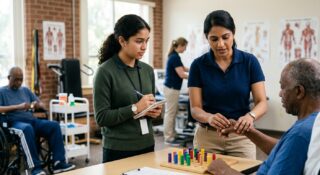
Occupational therapy experience for high school students is harder to find than shadowing a doctor or volunteering at a hospital, but it is one of the most worthwhile forms of early healthcare exposure a student can pursue. OT is a field that most people don’t encounter until they need it, which means students interested in rehabilitation, functional independence, and patient-centered care often struggle to find clear entry points. Programs like summer medical internships for high school students can provide that structured access, placing students in supervised clinical environments where they can observe occupational therapists and related rehabilitation professionals at work.
The challenge is not just finding opportunities; it is finding the right kind. Many families search for internships for high school students medical without fully understanding what a high school student can and should do in a clinical setting. For minors, any experience involving patients must be observational and carefully supervised. That is not a limitation. It is actually the appropriate and most effective way to build understanding at this stage. Students who approach early OT exposure with the right expectations come away with a clearer sense of the profession, stronger future applications, and the maturity to know whether this career truly fits them.
What Occupational Therapy Actually Looks Like in Practice
Occupational therapy is often confused with physical therapy, but the two fields serve different purposes. While physical therapy focuses on restoring movement and managing pain, occupational therapy helps people regain the ability to perform daily activities, from dressing and eating to managing schoolwork or returning to a job after an injury. OTs work with patients recovering from strokes, children with developmental delays, individuals with traumatic brain injuries, and people managing chronic conditions that interfere with everyday function.
According to the Bureau of Labor Statistics occupational therapist outlook, employment in this field is projected to grow 12% from 2022 to 2032, significantly faster than the national average. The median annual wage was $93,890 in May 2023, and demand continues to rise across hospitals, schools, rehabilitation centers, and home health services. For a high school student weighing different healthcare careers, understanding the scope and demand of OT is an important first step.
What makes OT distinctive is its focus on function and independence. A student shadowing an occupational therapist might observe a session where a therapist teaches a stroke survivor how to button a shirt with one hand, helps a child with sensory processing challenges participate in classroom activities, or fabricates a custom splint for a patient recovering from hand surgery. These are practical, creative, and deeply personal interventions. Students who are drawn to problem-solving, patient relationships, and real-world impact tend to find OT compelling once they see it in action.
How High School Students Can Start Building OT Exposure
There is no single, standard path to occupational therapy experience at the high school level, but there are several concrete options worth pursuing. The key is to look beyond the obvious and be proactive.
Local Shadowing and Volunteer Opportunities
Start by contacting occupational therapy clinics, pediatric therapy centers, rehabilitation hospitals, and school-based OT programs in your area. Many OTs are willing to let a motivated student observe for a few hours per week, especially if the student writes a professional email, explains their interest, and is flexible about scheduling. School counselors, family physicians, and local AOTA (American Occupational Therapy Association) chapter contacts can sometimes help make introductions. The AOTA overview of what occupational therapists do is a solid starting point for understanding the profession before reaching out to practitioners.
Some hospitals and health systems have formal volunteer or shadowing programs for high school students, though OT-specific placements are less common than general hospital volunteering. If a hospital does not offer OT shadowing directly, ask whether their rehabilitation department accepts student observers. Even a short-term shadowing experience of 10 to 20 hours can give a student a grounded understanding of the field. Once you are in college, our guide to occupational therapy shadowing covers how to find an OT to shadow and how many hours OT schools look for.
Structured Programs with Professional Supervision
For students who want more depth, or who live in areas where local shadowing is difficult to arrange, structured programs offer a reliable alternative. International Medical Aid, for example, places high school students in supervised clinical environments where they can observe occupational therapists and rehabilitation professionals working with real patients. These are not hands-on clinical roles. Students watch, ask questions, support non-clinical tasks like organizing therapy materials, and participate in daily reflection sessions with program staff.
This kind of structured format is especially valuable for high school students because it removes the burden of arranging your own placement, ensures proper supervision, and provides context through guided learning. Students interested in how these programs compare to other types of clinical exposure can find useful perspective in IMA’s breakdown of allied health internship options for high school students.
School-Based and Community-Based Entry Points
Some school districts employ occupational therapists who work with students receiving special education services. If your school has an OT on staff, ask your guidance counselor whether you could arrange a brief informational interview or a supervised observation. This is one of the most accessible and underused paths to early OT exposure.
Community organizations that serve individuals with disabilities, older adults, or children with developmental needs may also provide indirect exposure to the types of work OTs do. Volunteering with adaptive sports programs, assistive technology organizations, or therapeutic riding centers will not replicate clinical OT observation, but it builds relevant experience and shows genuine interest in the populations OTs serve.
What Observation and Support Roles Look Like for Minors
Parents and students need to understand clearly what a high school student can and cannot do in a clinical setting. This is not about limiting the experience; it is about protecting the student, the patients, and the integrity of the learning environment.
High school students in OT-related programs observe. They watch licensed therapists assess patients, deliver treatment, document progress, and collaborate with other members of the healthcare team. They may see a therapist guide a patient through exercises designed to improve hand strength, or watch a session where adaptive strategies are taught for dressing, cooking, or writing. In some settings, students may assist with non-clinical tasks: setting up therapy spaces, cleaning equipment, organizing supplies, or helping prepare materials for group sessions.
Students do not diagnose, treat, advise, or provide direct patient care. They do not handle medical records unsupervised, and they do not interact with patients in any therapeutic capacity without a licensed professional present. This is true whether the experience takes place in a U.S. clinic or in an international setting. IMA’s guide to clinical ethics for high school students in medical settings covers these boundaries in detail and is worth reading before any clinical placement.
These boundaries do not diminish the value of the experience. In fact, the students who gain the most from early OT exposure are the ones who focus on watching carefully, asking thoughtful questions, and reflecting on what they see. Admissions committees at OT graduate programs are far more impressed by a student who can articulate what they learned from observation than by one who exaggerates their role.
What Parents Should Know About Safety, Supervision, and Readiness
If your child is interested in occupational therapy and wants to pursue a structured clinical observation program, especially one that involves travel, your concerns about safety and supervision are entirely reasonable.
Supervision and Structure
Any reputable program for high school students should be able to tell you exactly who supervises your child, how clinical sites are selected, what the daily schedule looks like, and what protocols are in place for emergencies. With IMA, high school students are supervised at all times, both at clinical sites by local healthcare professionals and throughout the program by IMA staff. Students are never left alone in patient care areas. Clinical placements are pre-arranged, and every site is aware that the students are minors in an observational role.
Housing, Communication, and Health
For programs that involve travel, parents should ask about housing arrangements, transportation logistics, health precautions, and communication protocols. IMA provides secure accommodation, vetted transportation, pre-departure health guidance including vaccination recommendations, and clear channels for parent communication. A detailed resource for parents weighing these decisions is IMA’s parent guide to teen medical internships, safety, and support.
Maturity and Emotional Readiness
Not every 15- or 16-year-old is ready for clinical observation, and that is fine. Watching patients cope with serious injuries, chronic illness, or disability can be emotionally challenging. A student who is ready for this kind of experience should be able to follow instructions consistently, maintain professional behavior in unfamiliar settings, process difficult situations with the support of adults, and show genuine curiosity rather than just resume-building motivation. Parents know their child best, and honest self-assessment on this front matters more than any checklist.
How OT Experience Fits into Future Applications
Occupational therapy graduate programs require a master’s or doctoral degree, and admissions committees look at the full picture of an applicant’s preparation. Early exposure at the high school level is not a requirement for admission, but it can be a meaningful differentiator when presented honestly.
What matters most is not the number of hours logged, but the quality of what a student can say about the experience. OT schools that use the Occupational Therapist Centralized Application Service (OTCAS applicant portal) evaluate candidates on their understanding of the profession, their ability to reflect on clinical observations, and their evidence of sustained interest over time. A student who observed OTs working with stroke patients in a rehabilitation setting and can articulate what they noticed about the therapeutic relationship, the role of adaptive equipment, or the way therapists adjusted interventions for individual patients will stand out.
International observation experience adds another layer. Students who have seen occupational therapy delivered in a setting with fewer resources, different cultural expectations around disability, or different team structures bring a perspective that most applicants lack. The WHO fact sheet on rehabilitation provides useful context on the global need for rehabilitative services, a topic that resonates in admissions essays and interviews.
When writing about these experiences for college or graduate school applications, students should focus on specific moments and honest reflection. Describe what you observed, what surprised you, what challenged your assumptions, and how the experience shaped your understanding of occupational therapy. Avoid vague claims about “making a difference.” Instead, ground your narrative in real details and genuine learning.
Building a Pre-OT Profile While Still in High School
Students who are serious about occupational therapy do not need to wait for college to start preparing. In addition to clinical observation, there are several steps a high school student can take right now.
Take strong science courses. Biology, anatomy and physiology, psychology, and chemistry are all foundational for OT programs. Strong performance in these subjects matters more than taking the most advanced classes available if those classes come at the expense of understanding.
Seek out relevant volunteer work. Spending time with populations that OTs commonly serve, such as older adults, children with developmental needs, or individuals with physical disabilities, builds empathy, communication skills, and a grounded understanding of the people behind the clinical cases. Our guide to occupational therapy volunteer experience lists the kinds of roles that count and where to find them.
Read about the field. The American Occupational Therapy Association publishes accessible content about the profession, current research, and emerging areas of practice. Students who can speak knowledgeably about the scope of OT, including areas like mental health intervention, workplace ergonomics, and pediatric development, will stand out in future interviews.
Reflect and document. Keep a simple log of your observations, volunteer hours, and key takeaways. This is not about creating a polished portfolio. It is about building a habit of reflection that will serve you in every stage of your education and career. Students who start this practice in high school find it much easier to write compelling application essays later.
Frequently Asked Questions
Can high school students do hands-on occupational therapy during an internship or shadowing program?
No. High school students observe and support in non-clinical ways only. They do not provide direct patient care, perform assessments, or deliver therapeutic interventions. All clinical observation takes place under the supervision of a licensed professional. This boundary exists to protect both the student and the patient, and it applies in every reputable program, whether domestic or international.
Is occupational therapy experience in high school necessary to get into an OT graduate program?
It is not required, but it can strengthen your application significantly. OT admissions committees want to see that applicants understand the profession and have made an informed decision to pursue it. Even a modest amount of well-documented, reflective observation experience shows genuine interest and maturity. Quality of reflection matters far more than total hours.
What should parents ask before enrolling their teen in an OT observation program?
Ask about the supervision structure at clinical sites, who will be responsible for your child at all times, what the daily schedule includes, how housing and transportation are managed, what health and safety protocols are in place, and how the program communicates with parents during the experience. A credible program will answer all of these questions clearly and specifically before you commit.