
An occupational therapy internship can give you supervised clinical hours before OT school, but whether those hours count depends on each program. Pre-admission observation hours, Level I and Level II fieldwork are three different things, and Level II alone requires the equivalent of at least 24 weeks of full-time supervised fieldwork inside an accredited program.
If you are applying to OT programs and considering an IMA placement, one of your first questions is probably whether the hours will count. The honest answer is that it depends on your programs, and no outside organization can guarantee acceptance of any hours. Structured international clinical experience can still strengthen your application, and the steps below help you present it in a way admissions committees take seriously. If you are still choosing a field, start with our guide on how to choose a pre-health internship.
OT school admissions are competitive, and demand for the profession is rising. The Bureau of Labor Statistics occupational therapist outlook projects employment of occupational therapists to grow 15 percent from 2025 to 2035, with about 10,000 openings each year. Clinical exposure is one of the clearest ways to show you understand the profession, and the quality of your documentation matters as much as the hours themselves.
Observation, Fieldwork and School-Approved Hours
Before you count any hours, understand the three categories you will hear about.
| Category | When it happens | Who arranges it | What it shows |
|---|---|---|---|
| Pre-admission observation or experience hours | Before you apply or during the cycle | You | That you understand what OTs do and have spent real time in clinical settings |
| Level I fieldwork | During your OT program, alongside coursework | Your program’s fieldwork office | Directed learning that links classes to practice |
| Level II fieldwork | After coursework, at the end of the program | Your program’s fieldwork office | Entry-level competence; required for certification |
Occupational therapists typically need a master’s degree, and all states require them to be licensed, according to the Bureau of Labor Statistics. Accredited programs build supervised fieldwork into the degree. Virginia Commonwealth University’s description of Level II fieldwork notes that students must complete a minimum of the equivalent of 24 weeks full-time supervised Fieldwork II, within 24 months of finishing academic preparation. No program will let you substitute an international internship for that curricular requirement.
What OT Programs Actually Require in Terms of Clinical Hours
Most OT programs ask applicants to log a set number of observation or volunteer hours in occupational therapy settings before applying. Programs call these pre-requisite observation hours, clinical exposure hours or experience hours. The exact number varies widely, and some programs recommend exposure without setting a minimum. Some specify settings, such as hours in at least two or three different types of practice. Our guides to occupational therapy shadowing and OT volunteer experience cover where to find these hours.
What these hours are meant to show is simple: that you understand what occupational therapists do, that you have spent meaningful time in clinical settings and that your interest is grounded in real experience. This is where an IMA internship can be useful, as long as you document it carefully and present it accurately.
How OTCAS Handles Your Hours
If you apply through OTCAS, the OTCAS observation hours section asks for the facility, the date range, whether the hours were paid or volunteer, completed and planned hours, and the diagnoses and patients you saw. It also states that OTCAS does not verify the information entered, and it tells applicants to check each program’s materials or contact programs about documentation and minimum requirements. In practice, that means every program can treat the same hours differently.
A few OTCAS rules are easy to miss. You can list planned or in-progress hours in the same entry as your completed hours, so a placement you have booked can appear before it ends. Once you submit, you cannot edit or remove an observation hours entry, but you can add new ones as hours are completed. Entries do not display in date order, so give each one a clear facility name and setting.
OT Observation Hours Forms and Signatures
OTCAS has no single observation hours form of its own. Programs that want proof publish their own form or ask for it in the Program Materials section, and the details differ:
- University of Florida OTD: its observation verification form asks for 30 hours in at least two diverse OT settings with a licensed occupational therapist or occupational therapy assistant. It also accepts forms from other schools or from the site, and you upload the signed form to OTCAS. The practitioner adds a signature, license number and state.
- Texas Christian University OTD: its 2026-2027 required observation form asks for at least 30 hours across two settings, supervised by an OT or OTA and not an OT aide. You need a signed form for each site, submitted through OTCAS before your round’s deadline.
- Bowling Green State University OTD: its admissions FAQ says observation is not required but highly recommends at least 20 hours with a licensed OT in at least two settings.
Download each program’s form before you start, bring it on your first day, and ask the supervising therapist to sign at the end of each site rather than months later. Write down their license number and state while you are there, because several forms ask for it.
Do Virtual OT Observation Hours Count?
Only if your program says so. The OTCAS observation hours instructions do not mention virtual hours, so each program sets the rule. Francis Marion University’s OTD verification form (version dated March 2024), for example, prefers in-person observation in two clinical settings but also accepts telehealth observation and webinars such as AOTA Online Modules, with a certificate of completion for webinar hours.
Other programs ask for hours with a licensed practitioner at named sites, which a webinar cannot meet. Treat virtual hours as a supplement, label them as virtual in your entry, and check each program’s current page before you count them. In-person hours are accepted most widely; our guide to occupational therapy shadowing covers how to arrange them.
The Difference Between Pre-Admission Hours and Fieldwork
This distinction trips up many students. Pre-admission hours show exposure before you enroll. Level I and Level II fieldwork are formal, graded parts of your OT curriculum, arranged by your program at sites it has approved. An IMA internship is pre-admission experience. Never present it as fieldwork or imply that it replaces a curricular requirement.
What an IMA OT Internship Involves
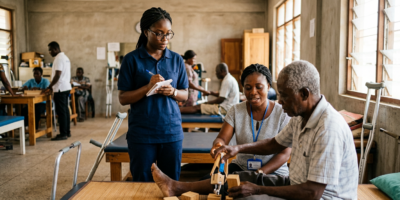
IMA’s occupational therapy program places pre-OT students, OT students, recent graduates and licensed occupational therapists at Coast General Teaching and Referral Hospital in Mombasa, Kenya. After orientation on the health system, hospital routines, safety and infection control, your placement runs six to eight hours a weekday in the hospital’s occupational therapy department. Lectures, clinical simulations, community medical clinics and health education in schools fill the rest of the week. Stays start at two weeks, and Mombasa runs year-round for 2 to 12 weeks.
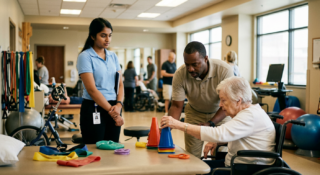
Most of your day is spent beside an occupational therapist or another clinician. You see how they assess what a patient can and cannot do and then plan therapy around daily tasks. Areas of interest include physical rehabilitation, pediatrics, mental health and care of older adults. Under supervision, interns take part in patient care at the level their training and the site allow: helping with intake and vital signs, preparing treatment areas, organizing supplies, supporting simple non-invasive tasks and joining community outreach. OT students work within the scope their program has trained them for, supervised by licensed staff.
What you will not do is independently evaluate or treat patients, plan treatment or stand in for local staff. That is a matter of ethics and law: you are not yet licensed, and a responsible program never asks you to do anything abroad that you could not do at home. A patient can always decline to have a student present. Supervised participation, guided learning, mentorship and reflection are exactly what admissions committees want to see in pre-admission experience.
The international setting adds another layer. In a hospital where resources are limited and where beliefs about disability and rehabilitation differ from what you see in a U.S. clinic, you learn how therapists adapt. Many OT programs value cultural awareness and adaptability, and this experience gives you concrete examples of both. To understand how responsible participation works in these settings, read our guide to responsible healthcare volunteering and ethical engagement.
What IMA Documents and What It Cannot Guarantee
IMA records your role, shifts and total hours, and its U.S.-based Medical Director validates the record. That gives you clear, dated documentation to share with programs. What IMA cannot do is decide how a program counts those hours, guarantee that they meet a program’s minimum, or guarantee admission. Academic credit is your school’s decision. Learn more on the occupational therapy internships abroad page.
How to Document Your Hours So They Hold Up
Documentation is where many students fall short, not because they lack experience but because they do not keep careful records. Start before you leave and update your log every day you are on site.
Keep a Daily Hour Log
Record the date, facility name, setting, supervising clinician’s name and credentials, and a brief description of what you saw and took part in. Be specific. “Watched a play-based fine motor assessment of a child with cerebral palsy, then helped set up the therapy station” is far more useful than “shadowed OT for 6 hours.” Total your hours each week and keep a running total. Our guide to tracking clinical hours shows a simple log you can adapt.
| Field | Example entry |
|---|---|
| Date and hours | Tuesday, 8:00 to 2:30, 6.5 hours |
| Facility and setting | Public referral hospital, occupational therapy department |
| Supervisor | Full name, title and credentials as written on their license |
| Activities | Helped prepare an adaptive feeding session; supported a group exercise |
| What you learned | How the therapist chose a low-cost adaptation for grip |
| Sign-off | Supervisor initials or the program’s validated record |
This template is general guidance; check whether your programs want a specific form.
Build your log around what OTCAS will ask for, so entering it later is copying, not reconstructing. For each facility, keep the date range, whether the hours were paid or volunteer, completed and planned hours, and the diagnoses and age groups you observed. Add the supervisor’s license number and state, since program forms such as the University of Florida’s ask for them.
Get a Verification Letter
Ask the supervising clinician or site coordinator for a signed letter on facility letterhead confirming your dates, total hours, activities and setting. A licensed occupational therapist’s signature carries particular weight. If your supervisor holds a different rehabilitation credential, as can happen where OTs are scarce, record their exact title honestly. Never inflate or misrepresent the supervision you received.
Write Detailed Reflections
Many OT programs ask you to discuss clinical experience in a personal statement or supplemental essay. Specific reflections stand out. A student who describes watching a therapist adapt a feeding intervention with locally available materials, because standard equipment was not available, tells a far stronger story than one who writes in generalities. For more on writing with specificity, see our post on making your essays stand out by showing instead of telling.
How to Present Your International Hours to Your Program
Do not just list hours and hope for the best. Take a proactive approach.
Contact the Program’s Admissions or Fieldwork Office Directly
Early in the cycle, contact the admissions office or academic fieldwork coordinator at each program. Ask a specific question: “I completed X hours of supervised clinical experience in an occupational therapy department in Mombasa, Kenya, through International Medical Aid. My supervisor was [name, credentials]. Will these hours count toward your pre-admission requirement?” This shows initiative and transparency.
Some programs will accept international hours without hesitation. Others want extra documentation or count only hours supervised by a licensed OT. A few may not accept them at all. Knowing this early lets you plan. If a program requires domestic hours, add local shadowing or volunteering.
Frame the Experience Accurately
When you describe your IMA experience, be precise about what you did and what you saw. Use verbs that match reality: “assisted with,” “supported,” “helped prepare,” “observed,” “learned from.” Do not exaggerate your role. Admissions committees read many applications and spot inflated claims quickly. An honest account of supervised participation in a resource-limited hospital is far more impressive than a vague claim about treating patients.
Explain what you gained that you could not have gained at home alone. That might be conditions rarely seen in a U.S. outpatient clinic, therapists adapting interventions when equipment is limited, or a deeper appreciation for cultural context in care. These insights show maturity and readiness for graduate clinical education.
Supplement, Do Not Replace
The strongest applicants draw hours from more than one source. If you complete an IMA OT internship, also consider time at a local hospital, outpatient clinic, school-based program or skilled nursing facility. A range of settings shows breadth, and domestic hours are ones every program can evaluate easily. Planning exposure strategically works the same way across professions; our article on direct patient care hours for PA school admissions shows the parallel for physician assistant applicants, and our guide to physical therapy internships covers a closely related field.
What Admissions Committees Value Beyond the Number
Hours matter, but they are not the whole story. Committees look at how you engaged with your clinical time.
They want to see that you understand the OT process: evaluation, goal-setting, intervention and reassessment. They want evidence that you reflect critically on what you saw, that you behaved professionally with clinicians, staff and patients, and that you recognize your own assumptions and respond respectfully to people whose experiences differ from yours.
An international clinical experience gives you material for all of this, but only if you paid attention, took notes, asked questions and thought about what you saw. The student who spent two weeks in a Kenyan occupational therapy department and can explain how it shaped their understanding of occupational justice will stand out. The student who can only say “it was amazing” will not.
A letter of recommendation from a supervising OT or rehabilitation professional adds real credibility, because a clinician can speak to your professionalism, curiosity and conduct. The AOTA’s information for applicants is a useful starting point when you research programs and their expectations. For more on turning exposure into direction, read how medical internships can turn OT exposure into career goals.
A Checklist for Making Your Hours Count
- List every target program’s minimum hours, required settings and documentation rules.
- Confirm by email whether each program accepts international hours and who must supervise them.
- Prepare a daily log template before you travel.
- Record supervisor names and credentials exactly as written.
- Collect a signed verification letter or the program’s validated hours record.
- Write short reflections at least every other day.
- Add domestic hours if any program requires them.
This checklist is general guidance and is not a substitute for each program’s published requirements.
Preparing Before You Go and Following Up After
Making your hours count starts before you board the plane and continues after you return.
Before departure, research the observation hour requirements for every program on your list. Create a documentation template you can fill in daily. Review basic OT terminology so you can describe what you see accurately, and read about the conditions you are likely to encounter. Our summer clinical exposure planning checklist can help you organize your timeline, and you can check program dates early so your stay fits your academic calendar.
During your placement, be consistent. Log hours daily. Write reflections while details are fresh. Ask your supervising clinician about their clinical reasoning, their training and how OT practice in their setting compares with what you might see elsewhere. Note full names, credentials and the correct spelling of the facility.
After you return, compile your documentation into a clean portfolio: your hour log, verification letter, a short summary of the setting and patients served, and your reflections. Store digital copies securely. When you contact programs, offer to share the documentation. That level of preparation signals the organized, thoughtful student OT programs want to admit.
Frequently Asked Questions
Will Every OT Program Accept International Hours From an IMA Internship?
No. Each accredited OT program sets its own policy. Some accept international hours with documentation, while others require domestic hours or supervision by a licensed OT. Contact each program before relying on international hours.
Can IMA Internship Hours Replace Level I or Level II Fieldwork?
No. Level I and Level II fieldwork are formal, graded parts of an accredited OT curriculum arranged by your program at approved sites. An IMA internship is pre-admission experience that can strengthen your application.
Does OTCAS Verify My Observation Hours?
No. OTCAS states that it does not verify the hours you enter. Each program decides whether it needs official documentation and what minimum it requires.
What Do Interns Do in IMA’s Occupational Therapy Program?
Interns work beside occupational therapists in a public hospital in Mombasa and, under supervision, take part in patient care at the level their training and the site allow, such as helping with intake, preparing treatment areas and supporting simple non-invasive tasks. They do not evaluate or treat patients on their own.
What Documentation Should I Bring Back From My Placement?
Keep a daily log with dates, facility, supervisor names and credentials, and specific descriptions; a signed verification letter or IMA’s validated hours record; and written reflections. Organize them in a portfolio you can share with programs.
How Long Is IMA’s Occupational Therapy Internship?
Stays start at two weeks, and the Mombasa program runs year-round for 2 to 12 weeks, usually six to eight hours a weekday in the occupational therapy department.
Is There an OTCAS Observation Hours Form?
No. OTCAS has an observation hours section where you list each facility, the date range, paid or volunteer status, completed and planned hours, and the diagnoses you observed, but it does not verify them. Programs that want proof use their own form, such as the University of Florida’s or TCU’s signed observation forms, uploaded through OTCAS.
Do Virtual Observation Hours Count for OT School?
It depends on the program. Some accept telehealth or webinar observation, such as AOTA Online Modules, often with a certificate of completion, while others want hours with a licensed OT or OTA at a clinical site. Check each program’s current requirements and treat virtual hours as a supplement to in-person observation.