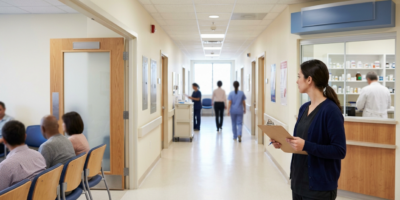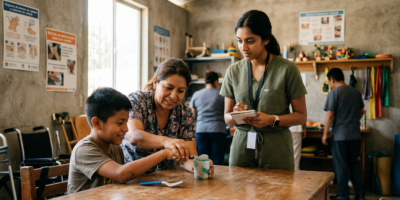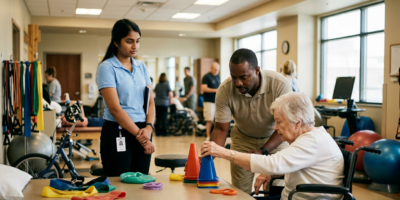
A global OT experience focused on patient-centered care starts with a simple reality: most of the world’s rehabilitation happens without the equipment, staffing, or infrastructure that students in the United States encounter during their training. The World Health Organization estimates that more than 2.4 billion people live with conditions that would benefit from rehabilitation, yet there is a global deficit of at least 2.1 million rehabilitation professionals. For pre-OT students, observing how occupational therapists work within those gaps is one of the most direct ways to understand what it means to center care around the patient rather than the system.
This is not about heroics or dramatic interventions. It is about watching skilled clinicians assess what a patient needs, consider what is actually available, and build a plan that respects both. If you are preparing for OT school and want to move beyond textbook definitions of patient-centered practice, structured observation in a resource-limited setting can give you something that domestic clinical hours alone often cannot: a clear, unfiltered view of how context shapes every clinical decision.
What “Resource-Limited” Actually Means for Rehabilitation
When people hear “resource-limited,” they sometimes picture a complete absence of care. The reality is more nuanced. In many low- and middle-income countries, rehabilitation services exist, but they operate under constraints that force clinicians to prioritize differently. An OT in a rural clinic might have a single set of resistance bands, no standardized splinting materials, and a caseload that would be unmanageable by U.S. standards. What they do have is clinical skill, community knowledge, and the ability to adapt.
For a pre-OT student observing in this context, the lessons accumulate quickly. You see therapists fabricating adaptive devices from locally available materials. You watch them train family members to carry out therapeutic exercises at home because there is no guarantee the patient will return for a follow-up visit. You notice that the OT’s clinical reasoning does not start with “what equipment do I need?” but with “what does this person’s daily life require, and how can we get closer to that with what we have?”
This kind of observation reshapes your understanding of the profession. It makes clear that occupational therapy is fundamentally about function, participation, and dignity, not about any particular tool or technology. That distinction matters, and it tends to stick with students long after they return home.
How Constraints Sharpen the Meaning of Patient-Centered Care
Patient-centered care is a phrase that appears in nearly every OT program curriculum. It is defined, discussed, and tested on. But seeing it practiced under pressure is different from reading about it in a classroom. In settings where resources are limited, patient-centered care is not an aspiration layered on top of standard protocols. It is the starting point, because there is no alternative.
Consider a straightforward example. A patient recovering from a stroke in a well-equipped U.S. rehab facility might use a dynamic arm support, a digital cognitive training program, and a standing frame, all chosen from a catalog of options. An OT working with a similar patient in a resource-constrained clinic has to start with a different set of questions: What does this person need to do to function in their home? Who is available to help them? What materials can we access or make? What cultural factors shape how they view their recovery?
The answers to those questions produce care that is, by necessity, deeply individualized. Pre-OT students who observe this process begin to understand that patient-centered care is not a checklist. It is a way of thinking that begins with the patient’s actual life, not the clinician’s preferred toolkit.
Family as the Rehabilitation Team
One of the most striking differences students observe in global settings is the central role of family in rehabilitation. In many communities, family members are the primary caregivers. An OT working in this context spends significant time training family members in safe transfers, positioning, range-of-motion exercises, and strategies for supporting daily activities. This is not a workaround; it is a model of care that recognizes where the patient actually lives and who is actually present.
For pre-OT students, watching this shifts the frame. It reinforces that occupational therapy extends well beyond the clinic walls. Understanding how to educate and partner with caregivers is a core clinical skill, not a soft add-on. Students who observe this firsthand tend to carry that understanding into their OT school applications and, eventually, into their practice.
Cultural Context and Clinical Reasoning
Effective rehabilitation also depends on understanding cultural beliefs about disability, recovery, and the body. In some settings, students may observe that patients and families integrate traditional healing practices alongside clinical rehabilitation. An OT working in that environment does not dismiss those beliefs. Instead, they find ways to align therapeutic goals with the patient’s cultural framework.
This is a practical lesson in cultural humility, a competency that OT admissions committees increasingly value. It is one thing to write about cultural sensitivity in a personal statement. It is another to describe a specific situation where you watched a clinician respectfully incorporate a family’s beliefs into a treatment plan, and to reflect on what that taught you about effective care.
What Pre-OT Students Actually Do in These Settings
It is important to be straightforward about the student role. Pre-OT students participating in structured global health programs are there to observe, learn, and assist within approved boundaries. They are not practicing occupational therapy. They are not diagnosing, prescribing, or independently delivering treatment.
What they are doing is substantial nonetheless. Under supervision, students may assist with therapeutic activities, help prepare materials for treatment sessions, observe patient assessments, and participate in community health education. They watch clinical reasoning in action, ask questions during debriefs, and reflect on what they have seen. These activities build a kind of clinical awareness that is difficult to replicate through reading or lecture alone.
Structured reflection is a key part of this process. Programs like those offered by IMA typically include debriefing sessions where students discuss their observations with supervising clinicians and program staff. This is where raw observation turns into genuine learning, where students connect what they saw in the clinic to broader concepts in rehabilitation science, public health, and ethics. Students interested in how structured clinical exposure supports professional development can find useful context in IMA’s discussion of how gaining hands-on experience supports pre-health career preparation, which outlines principles relevant across health professions.
Social Determinants of Health and Their Role in Rehabilitation Outcomes
One of the most important lessons from global OT observation is how powerfully social determinants shape rehabilitation outcomes. Poverty, food insecurity, lack of clean water, limited transportation, and low health literacy all affect whether a patient can follow a treatment plan, attend follow-up appointments, or maintain gains made during therapy.
In a domestic setting, these factors are present but sometimes less visible. In resource-limited international settings, they are often impossible to ignore. A student might observe an OT working with a child who has cerebral palsy, for example, and realize that the family’s primary barrier to consistent therapy is not motivation or understanding; it is the distance to the nearest clinic and the cost of transportation.
This kind of observation makes the concept of social determinants concrete. It moves from an abstract framework discussed in coursework to a lived reality that directly shapes clinical decisions. According to the Bureau of Labor Statistics occupational outlook for occupational therapists, employment in the field is projected to grow 12 percent from 2022 to 2032, with increasing demand in community-based and underserved settings. Pre-OT students who can speak knowledgeably about social determinants and adaptive care delivery will be well-positioned for that evolving landscape.
How This Experience Strengthens OT School Applications
OT admissions committees look for evidence that applicants understand the profession, have spent meaningful time in clinical environments, and can reflect critically on what they have observed. A structured global health experience offers material for all three.
Students returning from these programs often describe specific situations that shaped their understanding of occupational therapy. They can articulate how watching an OT adapt a treatment plan in real time reinforced their commitment to the profession. They can speak to the importance of cultural humility, caregiver education, and creative problem-solving, not in generic terms but with specific, grounded examples.
This specificity matters. Admissions committees read many essays about a desire to help people. They read far fewer that describe watching a clinician build a splint from locally sourced materials, or that reflect on the ethics of delivering care in a setting with limited follow-up capacity. Those concrete details signal genuine engagement with the realities of the profession.
It is worth noting that no experience, domestic or international, guarantees admission to any program. What it does is provide material, perspective, and clarity that strengthen your candidacy and, more importantly, your readiness for the profession itself. Students who want to think carefully about how clinical experience fits into a broader pre-health strategy may also benefit from reading about the role of internships in building relevant professional skills, which covers principles applicable beyond any single profession.
Adaptive Rehab as a Professional Skill, Not Just a Global Health Topic
It would be a mistake to think of adaptive rehabilitation as something that only happens overseas. Resource constraints exist in every healthcare system. Rural clinics in the United States face equipment shortages. Community-based OTs working in patients’ homes regularly improvise with available materials. School-based therapists adapt constantly to the tools and spaces they have.
What a global OT experience does is accelerate your exposure to this reality. It compresses the learning curve by placing you in an environment where adaptation is not occasional but constant. Students who develop this mindset early, who learn to see resourcefulness as a core clinical skill rather than a compromise, tend to become more flexible, more creative, and more effective practitioners.
This is also where the concept of sustainability becomes relevant. In resource-limited settings, the best interventions are those that can continue after the clinician leaves. An OT who trains a caregiver to perform daily stretching exercises with a child is building something sustainable. An OT who introduces a device that requires imported replacement parts may not be. Observing how experienced clinicians think about sustainability gives pre-OT students a framework they can apply in any practice setting.
Understanding how different members of a care team contribute to patient outcomes, including in settings where roles overlap or shift due to staffing constraints, is also part of this education. IMA’s coverage of how scope of practice shapes care team dynamics provides additional context on how professional roles interact in complex care environments.
Preparing Yourself Before You Go
If you are seriously considering a global OT experience, preparation matters. Start by building a foundation of observation hours in domestic settings so you have a baseline understanding of OT practice. Read about the healthcare system and cultural context of the country where you will be observing. Familiarize yourself with the WHO’s framework on rehabilitation and disability, which provides useful background on global rehabilitation needs and priorities.
Think honestly about your expectations. You are going to observe and learn, not to fix a healthcare system or provide independent care. The students who gain the most from these experiences are the ones who arrive with genuine curiosity, a willingness to sit with discomfort, and the discipline to reflect carefully on what they see. They ask questions respectfully. They take notes. They resist the urge to compare everything to what they know from home and instead try to understand the logic of the system they are in.
You should also prepare for the emotional weight of the experience. Observing patients with limited access to care can be difficult. Structured programs that include debriefing and mentorship help students process these experiences constructively, turning emotional reactions into professional growth rather than burnout.
What You Carry Forward into OT Practice
The lasting value of a global OT experience is not a line on your resume, though that matters. It is a shift in how you think about your future patients. You come away with a clearer sense of what patient-centered care actually requires: listening before acting, understanding context before prescribing solutions, and recognizing that the most effective intervention is the one the patient can actually use in their real life.
Pre-OT students who carry this perspective into their graduate programs and eventual practice tend to approach clinical reasoning with more flexibility and more humility. They are less likely to rely solely on standardized protocols and more likely to ask the questions that lead to genuinely individualized care. In a profession built around helping people participate fully in their own lives, that instinct is not just useful. It is essential.
Frequently Asked Questions
Do I need to be enrolled in an OT program to participate in a global health experience?
No. Many structured global health programs, including those offered by IMA, are designed for pre-OT and pre-health students who have not yet started graduate school. These experiences focus on observation, supervised assistance, and professional development rather than clinical practice that requires licensure.
Will a global OT experience count as observation hours for OT school applications?
Requirements for observation hours vary by program. Some OT schools accept supervised international observation hours; others have specific criteria about setting type or supervision credentials. Contact the admissions offices of the programs you are applying to and confirm their policies before relying on any experience, domestic or international, to fulfill specific hour requirements.
What should I expect in terms of clinical involvement as a student in a resource-limited setting?
Your primary role will be observing licensed or credentialed clinicians and assisting within approved limits under direct supervision. You will not independently assess, treat, or manage patients. Expect to watch clinical reasoning in action, participate in debriefing sessions, support therapeutic activities as directed, and engage in structured reflection on what you observe.