Watching a patient move through a healthcare facility is one of the most instructive things a clinical observer can do, and one of the most commonly overlooked. Most pre-health students arrive at a clinical placement focused on individual encounters: the moment when a physician examines a patient, the procedure, the diagnosis. What happens before and after those moments, the waiting, the triaging, the ordering, the dispensing, is often treated as background noise.
It is not background noise. It is the architecture of care. Understanding how patients move through a facility from their first point of contact to their final interaction before going home tells you more about how a healthcare system actually functions than any individual clinical encounter can. It reveals where resources are concentrated, where bottlenecks form, how different roles hand off responsibility, and why some patients receive timely care while others wait for hours.
For pre-health students on international clinical placements, this kind of systems-level observation is particularly valuable. Many global health settings operate under resource constraints that make every step in the patient flow visible, as well-resourced environments often obscure. When there is only one triage nurse, only one consultation room, and a single pharmacy dispensing medications to an entire outpatient population, the system’s logic becomes transparent. Learning to read that logic is a clinical skill in its own right.
What Patient Flow Actually Means
Patient flow refers to the movement of patients through a healthcare facility from admission or arrival to discharge or departure. In a well-functioning facility, that movement is efficient, safe, and appropriately prioritized. In a struggling facility, it is fragmented, slow, and frequently interrupted by bottlenecks that compound over the course of a day.
The AHRQ guide on improving patient flow and reducing emergency department crowding identifies the core components of patient flow as arrival and registration, triage and initial assessment, care delivery, diagnostic testing and results, treatment and intervention, and discharge or referral. Each of these stages involves a handoff of some kind, a transfer of information and responsibility from one part of the system to another. Failures at handoffs are where delays accumulate and where patient safety risks most often emerge.
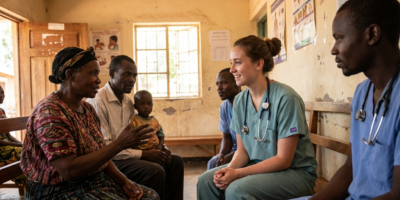
In international hospital settings where IMA places interns, the flow often differs from the textbook model. Registration may happen at the gate or at a reception window rather than a formal admissions desk. Triage may be conducted by a clinical officer rather than a nurse, using visual assessment rather than automated vital signs equipment. The pharmacy may be a single room at the end of a corridor where a pharmacist dispenses medications that were handwritten on a paper prescription. Understanding the local logic of each step, rather than expecting it to mirror a North American model, is what allows an observer to actually learn from it.
The Stages of Patient Flow in an International Outpatient Setting
Arrival and First Contact
Patients arrive from the community, sometimes having traveled significant distances. In many East African hospital settings, arrival is managed at a reception or registration point where basic identifying information is collected and a patient card or file is created or retrieved. This step is the first data point in the patient’s journey, and the quality of information collected here affects every subsequent step. Observers who pay attention to this stage often notice how quickly an experienced receptionist can identify whether a patient is returning for a known condition versus presenting with something new, and how that distinction shapes the initial routing.
Triage
Triage is the process of sorting patients by the urgency of their condition. In low-resource settings, triage is typically clinical and visual rather than technology-dependent. The clinician, often a nurse or clinical officer, assesses the patient’s appearance, vital signs, and chief complaint and assigns them to a priority category. This process is the most consequential step in patient flow because it determines who gets seen first, and errors in triage can have serious downstream consequences.
The WHO Interagency Integrated Triage Tool provides a standardized framework for triage in low-resource settings, using clinical discriminators that any trained health worker can apply without laboratory or imaging support. Observers who familiarize themselves with this tool before a shift will recognize the assessment steps as they happen and understand the reasoning behind routing decisions that might otherwise seem arbitrary.
Consultation and History Taking
Once triaged, patients move to a consultation area. In a busy outpatient setting, consultations may happen in a shared space with limited privacy, multiple physicians working simultaneously at adjacent desks or in cubicle-style areas. The consultation is where the clinical encounter proper begins: history taking, physical examination, and the initial formulation of a working diagnosis.
Observers at this stage should watch how physicians structure their histories. How do they open the encounter? How do they handle patients who are not forthcoming or who present with multiple complaints? How do they adjust their examination based on the history they have collected? These micro-decisions are the core of clinical reasoning, and they are visible to anyone paying close attention.
Diagnostics and Ordering
After consultation, many patients are directed to diagnostic services: a laboratory for blood work, a radiology room for imaging, or a procedure room for specific tests. In resource-limited settings, diagnostic availability varies significantly from day to day due to reagent stock, equipment function, and staffing. Observers often notice that clinicians in these environments maintain a mental hierarchy of which diagnostics are most essential, substituting clinical judgment for technology when the technology is unavailable. This adaptability is among the most instructive aspects an international clinical placement can teach.
Treatment, Prescription, and the Pharmacy Step
Treatment may happen in the consultation room, in a procedure area, or in an observation bay. For most outpatient patients, treatment involves a prescription that must then be filled at the facility pharmacy. The pharmacy step is one of the most common bottlenecks in outpatient patient flow. Long queues at the pharmacy window often reflect a combination of high patient volume, limited formulary, and slow prescription processing. Observers who watch the pharmacy interaction closely will notice how pharmacists navigate stock shortages, counsel patients on unfamiliar medications, and manage the pressure of a queue without compromising the quality of individual dispensing.
How to Track Flow as an Observer
The most effective way to track patient flow as a clinical observer is to follow a single patient, with appropriate permission and within the limits of your role, through as many stages of their journey as the shift allows. Watch them arrive. Watch them be triaged. Note how long they wait at each stage. Watch the consultation. Follow them to the laboratory or pharmacy if the opportunity arises. At the end of the encounter, reconstruct the full journey in your notes.
If following individual patients is not logistically possible, the next best approach is to position yourself at a single stage of the flow and observe the full range of variation across many patients. Spending an entire shift at the triage station, for example, builds a rich picture of how clinical acuity is assessed across a diverse patient population. Spending a shift at the pharmacy window reveals the last mile of care delivery in a way that few clinical observers ever notice.
Understanding the range of roles that operate within a clinical facility helps observers make sense of why different staff members manage different stages of patient flow. Each role in the system has a specific function, and the handoffs between roles are where the system’s efficiency and its vulnerabilities are most visible.
What Breakdowns in Flow Reveal
Bottlenecks are not random. They cluster at specific points in the flow for specific reasons, and learning to recognize those reasons is one of the most practically useful skills a pre-health student can develop. A long queue at triage usually reflects a mismatch between arrival volume and triage staffing. A backup at the laboratory often indicates a reagent or equipment issue that is cycling through the system. Delays at the pharmacy frequently signal a combination of high volume, formulary constraints, and prescription legibility problems.
In a well-resourced environment, many of these bottlenecks are managed by technology, electronic ordering systems, automated dispensing, and digital tracking of patient location. In resource-limited settings, they are managed by human judgment and informal coordination. Watching how experienced staff identify and work around these constraints in real time is a lesson in adaptive clinical practice that classroom learning cannot replicate.
Why Systems Thinking Matters for Future Clinicians
Medical school and clinical training focus primarily on individual patient care. The physician-patient encounter is the fundamental unit of medical education. But physicians who cannot read and navigate the systems their patients move through are less effective clinicians than those who can, regardless of how strong their individual clinical skills are. Developing a systems perspective early, during the observation phase of your training, gives you a conceptual advantage that compounds over the course of a career. Understanding what clinical internships are genuinely building in terms of skills and perspective starts with recognizing that patient flow observation is not a passive exercise. It is an active lesson in how healthcare systems succeed and fail.
Students who want to build a strong clinical foundation before applying should also consider how observation of patient flow complements other forms of clinical experience. The full range of ways to accumulate meaningful clinical hours includes roles that put you directly in the flow rather than observing it, and pairing both kinds of experience produces the most complete preparation.
Common Mistakes Observers Make
The most common mistake is arriving at a clinical placement with no framework for what to observe. Without a mental model of what patient flow involves, students tend to follow the most visually interesting activity rather than the most instructive one. Spending an entire shift watching surgeries when the most important learning was happening in the triage area is a missed opportunity.
A second mistake is treating the waiting period as dead time. Patients waiting are patients communicating information through their posture, their expressions, their behavior toward family members, and the urgency or patience with which they approach clinical staff. A skilled observer uses waiting periods to practice reading the room in exactly the way that experienced clinicians do.
A third mistake is not asking clarifying questions when appropriate. If you observed a routing decision you did not understand, a prescription you cannot read, or a triage outcome that surprised you, noting it and asking a staff member to explain it during a natural break is not an intrusion. It is exactly the kind of engagement that distinguishes an active learner from a passive one.
What to Do Next
Before your next shift, sketch a simple flow map of the stages you expect to observe. Draw boxes for each stage and arrows connecting them. Use this map as a physical prompt to direct your attention as the shift unfolds. At the end of the day, annotate the map with what you actually observed: which stages were fast, which were slow, where the handoffs were clear, and where they were ambiguous.
Over several shifts, your map will become increasingly detailed and accurate. You will begin to see patterns that were invisible on the first day. That pattern recognition, built from sustained, structured observation, is the beginning of clinical judgment.
Frequently Asked Questions
What is patient flow and why does it matter to a pre-health student?
Patient flow refers to the movement of patients through a healthcare facility from first contact to departure. It matters to pre-health students because understanding how that movement works, and where it breaks down, reveals the systems logic underlying clinical care. Physicians who understand patient flow can advocate for their patients more effectively, identify where delays are creating harm, and contribute meaningfully to quality improvement efforts throughout their careers.
How do I observe patient flow without getting in the way?
Position yourself at the edge of active spaces rather than in the middle of them. Follow the direction of the most senior staff member present. Move when they move, pause when they pause, and step back when a clinical interaction requires privacy. Ask your preceptor or supervisor before the shift begins where you should stand during busy periods. Most experienced clinical staff have a well-developed sense of how to place observers usefully, and asking shows both situational awareness and respect for the clinical environment.
What is the triage process and how can I follow it as an observer?
Triage is the clinical sorting process that determines which patients are seen first based on the urgency of their condition. As an observer, watch how the triage clinician approaches each patient: what they look at first, what questions they ask, what physical assessments they perform, and what category or priority they assign. Over multiple patients, you will begin to see the logic of the system emerge. Notice which presentations lead to immediate routing versus extended waiting, and ask yourself what clinical indicators are driving those decisions.
Is it appropriate to ask staff about the flow decisions I observe?
Yes, at the right moments. During a busy active period, asking questions is an intrusion. During natural breaks, between patients, during handoffs, or after rounds conclude, a well-framed question is almost always welcome. Keep it specific: I noticed that patient was routed directly past the waiting area. Was that based on a specific clinical sign? That kind of question signals genuine engagement and helps you learn in a way that vague questions about the general process do not.
How does patient flow differ in international settings versus domestic hospitals?
International settings, particularly in low- and middle-income countries, often have patient flow structures that rely more heavily on clinical judgment and less on technology than domestic settings. Triage may be entirely visual. Ordering may be paper-based. Pharmacy dispensing may involve negotiation over available stock. These differences are not deficiencies. They reflect adaptations to resource constraints that have produced genuine expertise in doing more with less. Observing those adaptations teaches clinical reasoning in a way that technology-dependent environments sometimes obscure.
What should I write in my notes after observing patient flow?
Write a structured account of the stages you observed, including how long each stage took for the patients you followed, where delays occurred and what seemed to cause them, how different clinical roles interacted during handoffs, and anything that surprised you about the process. At the end of your notes, write one question you want to answer during your next shift. This question-to-question continuity is what builds cumulative understanding over the course of a placement.
Can understanding patient flow help me in medical school interviews?
Yes, significantly. Medical school interviews frequently include questions about healthcare systems, quality improvement, and the non-clinical dimensions of patient care. An applicant who can describe specifically what they observed about patient flow in a resource-limited international setting, what worked, what did not, and why, is demonstrating systems thinking that most pre-health students have not developed. That level of specificity and insight is memorable to admissions committees.
How does patient flow observation connect to what I will do as a physician?
Physicians interact with patient flow systems constantly, whether or not they think explicitly about it. When a patient is delayed in reaching them because of a bottleneck earlier in the process, when a prescription cannot be filled because of a formulary gap, when a test result is lost in the handoff between laboratory and clinical team, the physician who understands how these systems work is far better equipped to address the problem than one who sees only the individual encounter. Building that systems awareness during your observation years gives you a clinical perspective that compounds over an entire career.