A healthcare volunteer program, by definition, can cover a wide range of activities, and not all of them are ethical. In the modern pre-health landscape, students are under immense pressure to accumulate clinical hours to remain competitive for medical, PA, or nursing school admissions.
However, this pressure often leads to a “checklist” mentality where the quality and ethics of the experience are sacrificed for raw totals. Some programs place untrained students in clinical settings with unclear supervision, while others position patients in underserved communities as practice opportunities for outsiders. At worst, some organizations promise hands-on clinical experience that turns out to be exploitation of both the student and the host community.
Before Choosing a Healthcare Volunteer Program
If you are considering a healthcare volunteering opportunity, whether domestic or international, the most important thing you can do is evaluate it critically before committing. Ethical engagement in global health requires clear boundaries, defined roles, real oversight, and a structure that protects patients and communities first, not student resumes. Knowing how clinical authority is distributed and regulated provides a clearer picture of your future role and ensures you contribute to the healthcare system responsibly.
What Ethical Volunteering Actually Requires
Ethical healthcare volunteering is built on a straightforward principle: the community’s needs come first, and volunteers operate within defined, appropriate roles. This is especially critical as the United States faces a projected shortage of up to 124,000 physicians by 2034, which will increase reliance on teams that include students and advanced practice providers. Ethical volunteering means several things in practice.
Volunteers do not provide care for which they are not licensed. A pre-med student does not perform clinical procedures. A nursing student on a volunteer trip does not diagnose patients. An undergraduate does not administer medications. These boundaries exist because patient safety depends on providers who have completed verified training and hold valid credentials. Good intentions do not substitute for competence. In fact, taking on tasks beyond your training can make you appear unethical and irresponsible to admissions committees, potentially disqualifying your application.
Patient consent is non-negotiable. Patients must know who is involved in their care or observation, and they must agree to it. This applies to every setting, from domestic free clinics to allied health internships and international health programs. Patients have a right to decide who is in the room. If a patient or family member indicates discomfort, even without words, it is your responsibility as an ethical volunteer to step back immediately.
Supervision must be real, not nominal. A name on a document is not supervision. Real supervision means a qualified professional is present, accessible, and actively overseeing volunteer activities. If a supervisor is “available by phone” but not physically on-site to guide you, the program does not have adequate oversight. Ethical programs provide local clinical mentors who guide students through daily hospital activities and model professional conduct.
The program should benefit the community. This is the ultimate test. If the primary outcome of the experience is that students feel good and have something to put on an application, but the community’s healthcare access or outcomes are unchanged or worse, the program is not ethically structured. Truly ethical programs prioritize long-term, sustainable partnerships with local institutions rather than “parachuting in” for short bursts of care.
Red Flags to Watch For in Clinical Programs
Evaluating a volunteer program requires asking direct questions and being willing to walk away from programs that cannot answer them clearly. Here are patterns that should raise concern.
- Instant or guaranteed acceptance: Ethical programs screen applicants. They assess readiness, verify background checks, and ensure that volunteers are prepared for the environment they are entering. A program that accepts anyone who pays a fee is prioritizing revenue over patient safety and student education.
- Vague descriptions of what volunteers actually do: If a program cannot tell you specifically what your role will be, what tasks you will perform, and what you will not be permitted to do, it is a significant problem. Marketing language like “work alongside healthcare professionals” often hides a lack of structured learning or, worse, a lack of professional boundaries.
- No mention of patient consent or privacy: Any legitimate healthcare volunteer program should have explicit protocols for patient consent and privacy protection that align with the AAMC standards for providing care. If you have to ask about these and the answer is unclear, the program has not built them into its structure.
- Communities framed as “in need of your help”: Ethical programs work with communities, not on them. If marketing positions local populations primarily as recipients of student generosity, the framing is wrong. Local clinicians and health systems should be leading the clinical work, with volunteers in supporting or observational roles.
- Photography policies that prioritize social media: Programs that encourage or permit volunteers to take photos with patients, especially children, for personal social media accounts are not prioritizing patient dignity. Ethical programs have strict photography and confidentiality policies that mirror the professional expectations of licensed clinicians.
The Difference Between Volunteering and Observation
Many pre-health students conflate volunteering with clinical observation, but these are different activities with different ethical frameworks. Understanding the distinction between shadowing vs. clinical experience is the first step toward building a competitive and ethical application.
Clinical observation (shadowing) is a passive experience. The student’s role is to watch, listen, and learn how a doctor thinks and moves through their day. You are not there to treat patients or perform procedures. Shadowing is vital because it serves as a “reality check,” ensuring you understand the administrative burdens, the emotional toll of hard conversations, and the long-term tradeoffs of a medical career.
Healthcare volunteering involves non-clinical tasks that support healthcare delivery. This could include patient intake, community health education, translation, logistics, or data entry. These roles contribute to the healthcare environment without crossing into clinical practice. They are excellent for developing relational skills like empathy, compassion, and communication.
Clinical volunteering (active) means performing tasks you are already trained and authorized to do. A certified EMT volunteering at a free clinic performs EMT-level tasks like taking vitals. This is the single most important category for your application because it tests your reliability, teamwork, and resilience in real-world situations.
The problem arises when programs blur these categories—when “volunteers” are performing clinical tasks they are not trained for, or when “observation” is marketed as “hands-on clinical experience” to make it sound more impressive than it was. Admissions committees are trained to spot these exaggerations.
International Healthcare Volunteering: Additional Considerations
International programs carry additional ethical complexity. The power dynamics between high-income-country volunteers and lower-income-country communities are real, and ethical programs explicitly account for them by following the Forum on Education Abroad guidelines.
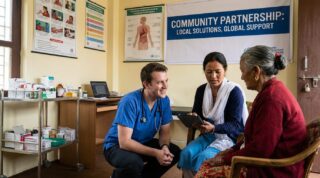
Local clinicians should lead: International programs that bring outside providers to deliver care should do so in partnership with, and under the direction of, local health professionals. Programs in which foreign volunteers are the primary providers often undermine local health systems rather than strengthen them. The goal should be mutual skills transfer, where volunteers learn about unfamiliar diseases and resource-constrained environments while supporting local providers.
Sustainability matters: A one-week medical trip that provides care and then leaves does not build local capacity. Ethical programs invest in training, infrastructure, and long-term partnerships that continue after volunteers go home. If the program were to collapse without a steady stream of foreign volunteers, its model would be dependency-based rather than capacity-building.
Language and cultural competency: Providing healthcare across language and cultural barriers requires trained interpreters and cultural awareness. Volunteers who do not speak the local language and rely on gestures cannot participate meaningfully in clinical activities. Ethical behavior means listening first, adapting language, and checking understanding without judgment.
Scope limits are paramount abroad: In some international settings, oversight and regulation may be less rigorous than in your home country. This does not mean you should do more. It means you must be even more careful about staying within your training. The absence of enforcement is not permission to practice medicine.
What Ethical Programs Look Like in Practice
A well-structured healthcare volunteer program typically includes the following pillars:
- A defined screening process: The program evaluates your maturity and readiness, often requiring an application, interview, and background check.
- Clear role descriptions: Before you arrive, you know exactly what you will and will not be doing. If your role is observation, that is stated plainly.
- Orientation and training: Before you begin, you receive training on patient privacy (HIPAA basics), consent protocols, scope of practice limits, and cultural context.
- On-site supervision: A qualified professional is present and responsible for overseeing your activities. There is a clear chain of responsibility for any incidents or concerns.
- Patient consent protocols: Patients are informed that a student observer is present and are given the choice to decline without any impact on their care.
- Documentation and accountability: The program maintains verified records of your activities and hours. You receive a signed certificate that details exactly what was observed or performed under supervision.
The Role of Service-Learning
For many students, the most impactful way to volunteer is through “service-learning.” This involves connecting what you know about biology, ethics, or communication to what you see on-site. Instead of “helping at a clinic” generally, you might support a food bank that serves patients from a local clinic, analyzing how food insecurity affects chronic conditions like diabetes. This allows you to address a specific community need while gaining a deeper understanding of the social determinants of health.
Why This Matters for Your Application
Admissions committees are moving away from raw hour totals toward a competency-based review model. When reporting your hours, you should use a pre-med clinical experience matrix to categorize your roles accurately.
Committees value quality and reflection over quantity. While you should aim for competitive clinical hour benchmarks, your ability to articulate what you learned is what truly sets you apart. A strong application uses the “STAR” method (Situation, Task, Action, Result) to describe specific moments of growth. For example, instead of saying “shadowing was eye-opening,” you might describe a challenging ethical scenario you observed and how it informed your decision to pursue medicine.
Moving Forward Intentionally
Building a competitive application is about demonstrating, through sustained and specific evidence, that you are prepared for the training and the profession. Selective programs admit only those who take the quality of their graduates seriously.
This is especially vital in regions designated as shortage areas, where primary care access is limited and ethical clinical support is most needed. Approximately 20% of Americans live in these rural or underserved areas, but only 10% of physicians practice there, creating a massive “care gap” that students and volunteers can help address, if they do so ethically.
Do the work. Get the hours. Perform well in your coursework. And be honest with yourself about why you want this path. Before you commit to any opportunity, ensure the organization follows a formal code of ethics that places patient interests above all else. That honesty and ethical clarity will come through in your personal statement, your interviews, and ultimately in the kind of clinician you become. The programs that take ethics seriously are the programs worth your time.