Occupational therapy in East Africa does not look like occupational therapy in a well-funded American rehabilitation hospital. The assessment tools are fewer. The equipment budgets are smaller, sometimes nonexistent. The patient populations carry conditions shaped by limited preventive care, delayed intervention, and socioeconomic pressures that compound disability in ways most U.S. textbooks only mention in passing. For pre-OT students considering where to build clinical perspective before graduate school, this setting offers something specific: a working understanding of how occupational therapy functions when the standard resources are stripped away and the core principles of the profession have to carry the weight.
That is not a romantic framing. It is a practical one. If you are applying to OT programs and want to demonstrate that you understand what occupation-centered care actually requires, seeing it practiced in a setting where therapists fabricate their own splints, repurpose household items as therapeutic tools, and collaborate with families who serve as the primary rehabilitation team is one of the most direct ways to build that understanding. This article breaks down what occupational therapy practice in Kenya and Tanzania actually involves, what pre-OT students can realistically expect from a structured experience in the region, and how to think about whether this kind of exposure fits your goals.
How Occupational Therapy Operates in Kenya and Tanzania
Healthcare systems in both Kenya and Tanzania are built on a mix of public, private, and faith-based providers. Public hospitals and clinics serve the majority of the population, but they consistently face shortages in staffing, equipment, and rehabilitation infrastructure. Occupational therapy, as a distinct discipline, is still growing in the region. The number of practicing occupational therapists relative to the population is far lower than in the United States, the United Kingdom, or Australia. The WHO’s World Report on Disability estimates that over one billion people globally live with some form of disability, and disability prevalence tends to be higher in low- and middle-income countries due to factors including poverty, malnutrition, limited healthcare access, and conflict. East Africa fits that pattern.
What this means in practice is that the occupational therapists who do work in these settings carry heavy caseloads and serve patients across a very wide diagnostic range. A single therapist might work with a child who has cerebral palsy in the morning, an adult recovering from a stroke at midday, and a burn patient needing hand rehabilitation in the afternoon. There is no luxury of subspecialization. The therapist adapts, prioritizes, and problem-solves continuously.
For pre-OT students, the most important thing to understand is that the profession’s core philosophy, helping people participate in the activities that matter to them, is the same everywhere. What changes is the context. In East Africa, that context includes fewer standardized assessment tools, limited access to prefabricated orthotics or adaptive devices, and a healthcare culture in which family members are often the primary support system for rehabilitation. The therapist’s role extends well beyond the clinic; it reaches into homes, communities, and the practical realities of daily life in ways that are less common in U.S. practice.
Handmade Equipment and Adaptive Practice
One of the most striking features of occupational therapy practice in East Africa is the reliance on locally fabricated equipment. When a therapist in Nairobi or Dar es Salaam needs a resting hand splint, they may not have access to a thermoplastic kit. Instead, they shape splints from available materials, sometimes using heated PVC, padded wood, or layered fabric reinforced with basic structural supports. When a patient needs an adapted utensil for self-feeding, the therapist may modify an existing spoon with wrapped handles made from foam, cloth, or rubber tubing.
This is not a workaround born of carelessness. It is skilled, intentional adaptation. Local therapists develop expertise in material science that most American OT students never encounter in their academic programs. They assess what a patient needs, determine what materials are available, and design a solution that is functional, durable enough for real use, and affordable for the patient’s family. In many cases, the patient or family must be able to maintain or replicate the device at home, so simplicity and accessibility are built into the design from the start.
For students interested in the intersection of adaptive design and patient-centered care, this is where the rubber meets the road. Watching a therapist build a positioning device for a child with spinal cord injury from wood, foam, and fabric, and then train the child’s mother to adjust it as the child grows, teaches something about clinical reasoning that a fully stocked simulation lab cannot replicate. It demonstrates that the skill of occupational therapy is not in the equipment. It is in the therapist’s ability to analyze an activity, identify barriers, and design a solution that works within the patient’s real life.
Students in structured programs like those offered by IMA observe these processes under supervision. They do not fabricate devices independently or prescribe interventions. But watching the full cycle, from assessment to fabrication to patient education, and asking questions throughout, builds a kind of clinical intuition that is hard to get any other way.
What Pre-OT Students Actually See and Do
It is important to set honest expectations. A pre-OT student participating in a structured clinical experience in East Africa is not functioning as a therapist. You are observing, assisting within approved limits, and learning professionally under the supervision of local rehabilitation staff. That boundary exists for good reason: patient safety, professional ethics, and respect for the local healthcare system all depend on it.
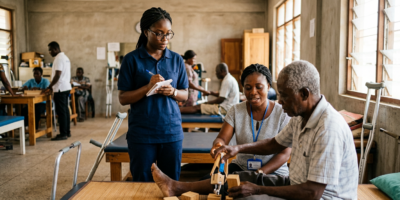
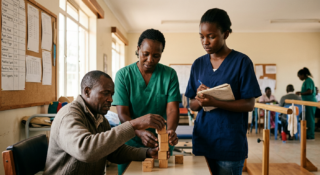
Within those boundaries, the exposure is substantial. Students typically observe patient assessments that cover functional abilities in dressing, feeding, mobility, hygiene, and work-related tasks. They see treatment plans developed in real time, often with fewer resources than a U.S. clinic would use and with greater reliance on the therapist’s clinical judgment. They may assist with preparation of treatment materials, support during group therapy sessions, or help organize community outreach activities focused on disability awareness and education.
Home Visits and Community-Based Practice
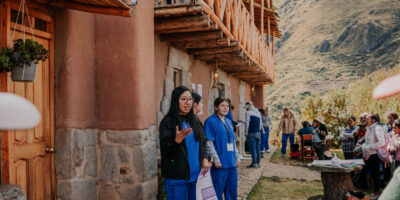
One of the most valuable components of OT practice in East Africa is community-based rehabilitation. In many areas, patients cannot travel regularly to a clinic. Therapists conduct home visits to assess environmental barriers, recommend modifications, and train family members in caregiving techniques. A student who accompanies a therapist on a home visit sees the full picture: the physical environment, the family dynamics, the economic constraints, and the creative solutions that emerge when a therapist works within all of those realities at once.
This kind of exposure connects directly to concepts that OT programs emphasize in their curricula, including client-centered practice, environmental modification, and caregiver education. Seeing it happen in a setting where the environment is a concrete-block house with an uneven dirt floor, and the caregiver is a grandparent managing multiple responsibilities, adds a layer of understanding that classroom case studies alone cannot provide. Students who have written about completing healthcare experiences in Kenya often point to these community-based moments as the ones that shaped their thinking most.
Common Patient Populations
The range of conditions seen in East African OT settings is broad. Students can expect to encounter patients with stroke, traumatic brain injury, spinal cord injury, burns, amputations, cerebral palsy, and other developmental disabilities. Musculoskeletal disorders are common, as are complications from infectious diseases such as HIV/AIDS and tuberculosis. Some conditions that are less frequently seen in U.S. OT settings, such as late-stage burn contractures or untreated congenital conditions, may be present because of delays in accessing care.
This diagnostic range is one of the reasons the experience is valuable for pre-OT students. It provides a broader view of what occupational therapy addresses and a more grounded sense of the profession’s scope. It also raises real questions about equity, access, and the social determinants of health, questions that OT programs increasingly expect applicants and students to be able to discuss with nuance.
Why This Matters for OT School Applications
OT admissions committees want to see that applicants understand what occupational therapy is, have spent meaningful time observing or supporting OT practice, and can reflect on those experiences with depth. An international clinical observation experience does not replace the need for domestic observation hours, prerequisite coursework, or a strong GPA. But it can add a dimension to your application that domestic experiences alone may not provide.
Specifically, structured exposure to OT in a resource-limited setting can demonstrate problem-solving ability, adaptability, cultural awareness, and a genuine interest in the profession’s broader role in global health. When you write about watching a therapist fabricate a splint from local materials, or about observing a home visit where environmental modification meant rearranging furniture in a one-room home to create a safe path for a wheelchair, you are showing the committee that you understand OT at a level that goes beyond textbook definitions.
The Bureau of Labor Statistics occupational outlook for OTs projects continued growth in the field, but admissions remain competitive. Committees look for applicants who can articulate why they chose OT over other health professions and who can provide specific, reflective examples of their exposure to OT practice. Experiences in East Africa, when described honestly and reflectively, give applicants concrete material to work with.
That said, the experience matters most if you process it well. Keep a reflection journal. Ask local therapists about their reasoning during and after sessions. Pay attention to the differences between what you expected and what you observed. Those gaps between expectation and reality are often where the best application material lives. If you are weighing how to strengthen a pre-health application, the specificity and self-awareness you bring to describing your experience matters more than the destination itself.
Cultural Context and the Role of Family in Rehabilitation
Occupational therapy in East Africa is deeply shaped by cultural norms around family, community, and disability. In many communities, rehabilitation is understood as a family responsibility, not just a clinical service. When a person experiences a disabling injury or condition, the family unit often reorganizes around caregiving in ways that are more immediate and all-encompassing than what most U.S. students have seen.
This has practical implications for how OT is practiced. Therapists in Kenya and Tanzania regularly train family members in transfer techniques, positioning strategies, range-of-motion exercises, and the use of adaptive equipment. The therapist may see the patient once a week or less frequently; the family provides the daily follow-through. Understanding this dynamic helps pre-OT students appreciate why caregiver education and family-centered practice are not just theoretical ideals. They are operational necessities in settings where professional rehabilitation visits are limited.
Cultural beliefs about disability also vary across communities. Some families view disability through a spiritual or traditional framework that may coexist with, or sometimes conflict with, biomedical approaches. Effective OT practice in this context requires respect, curiosity, and the ability to work within a patient’s belief system rather than against it. For students, observing how local therapists handle these conversations with sensitivity and pragmatism is a lesson in professional communication that applies far beyond East Africa.
Language is another factor. While English is widely spoken in professional settings in both Kenya and Tanzania, patients and families may communicate primarily in Swahili or a local language. Translators are often available in clinical settings, and learning even basic Swahili greetings and phrases can go a long way in building rapport. The experience of working across a language barrier, of relying on nonverbal communication and demonstration, and of watching a therapist teach a complex caregiving skill through a combination of words, gestures, and hands-on modeling, reinforces the importance of communication strategies that go beyond verbal instruction.
Ethical Responsibilities and Realistic Expectations
Any pre-OT student considering an experience in East Africa should think carefully about ethics. The most important principle is simple: you are there to learn, not to practice. You are a guest in someone else’s healthcare system, and the patients you observe are not there for your education. They are there because they need care. Your presence should support, not disrupt, that care.
This means respecting supervision at all times. It means not performing assessments, treatments, or interventions unless explicitly authorized and directly supervised by a qualified local professional. It means maintaining patient confidentiality and obtaining appropriate consent before observing clinical interactions. It means being honest about your level of training and not presenting yourself as more qualified than you are.
It also means holding realistic expectations about your impact. A two-week or four-week observation experience is not going to fix systemic resource shortages or resolve the OT workforce gap in East Africa. What it can do is give you a clearer, more grounded understanding of global health realities, sharpen your clinical observation skills, and deepen your commitment to the profession. Those are meaningful outcomes, but they are personal and professional development outcomes, not savior outcomes. The American Occupational Therapy Association’s code of ethics emphasizes beneficence, nonmaleficence, and respect for autonomy; those principles apply everywhere, including in international settings.
IMA structures its programs with these ethical boundaries in mind. Students work within defined roles, under professional supervision, and with orientation to the local healthcare context before entering clinical settings. If you are comparing international programs, asking about supervision ratios, ethical guidelines, and how student roles are defined is one of the best ways to distinguish a responsible program from one that is not. You can read more about how to evaluate and compare international healthcare programs to help inform that decision.
How to Decide If This Experience Fits Your Path
Not every pre-OT student needs an international clinical observation experience. If your primary goal is to accumulate observation hours for a specific OT program’s prerequisites, a local clinic or hospital may be more efficient. If you are early in your pre-OT journey and still sorting out whether OT is the right field, domestic observation is a smart first step. Our guide to occupational therapy shadowing covers how to set those hours up at home.
An experience in East Africa makes the most sense for students who already have some baseline understanding of OT, who want to broaden their clinical perspective, and who are genuinely interested in how rehabilitation works in different healthcare systems. It also fits well for students interested in global health, community-based practice, adaptive design, or health equity, all areas where East African OT practice offers concrete, observable examples.
Before committing, ask yourself a few practical questions. Are you comfortable with ambiguity and unfamiliar environments? Can you observe without needing to intervene? Are you prepared to process difficult clinical situations, including patients with severe disabilities who may not have access to the care they need? Do you have the maturity to stay in your role as a learner even when you feel the urge to do more?
If the answer to those questions is yes, and if the timing, cost, and logistics work for your academic schedule, this kind of structured experience can add genuine depth to your preparation for OT school and for practice. The key is to go in with clear expectations, a willingness to reflect honestly, and the understanding that the value of the experience depends less on where you go and more on how carefully you pay attention while you are there.
Frequently Asked Questions
Do I need prior OT experience before participating in a clinical observation in East Africa?
Prior OT experience is not always required, but having some baseline exposure helps you get more out of the experience. If you have shadowed an OT in a domestic setting, you will have a frame of reference that makes the differences in practice more visible and more meaningful. Check with IMA about specific program prerequisites before applying.
Will observation hours in East Africa count toward OT school application requirements?
This depends entirely on the OT program you are applying to. Some programs accept international observation hours; others require or prefer hours from domestic, licensed OT practitioners. Contact the admissions offices of your target programs directly to confirm their policies before relying on any international experience to fulfill hour requirements.
What conditions will I most likely observe in East African OT settings?
You can expect to see patients with stroke, traumatic brain injury, cerebral palsy, burns, amputations, spinal cord injury, and musculoskeletal disorders. You may also encounter patients with complications from infectious diseases such as HIV/AIDS and tuberculosis. The range is typically broader than what you would see in a single U.S. clinic, which is one of the reasons the exposure is valuable for building clinical perspective.