To become an occupational medicine physician, you earn a bachelor’s degree, finish four years of MD or DO school, complete at least one clinical year of residency, then train for 24 months in an ACGME-accredited occupational and environmental medicine residency that includes a Master of Public Health. Board certification from the American Board of Preventive Medicine follows.
Occupational medicine is one of the three specialties of preventive medicine, alongside public health and general preventive medicine and aerospace medicine. The first half of the path matches any other path to becoming a doctor. What sets this field apart is the second half: a residency built around workers, workplaces and environmental exposures, with a graduate public health degree folded into the training.
Occupational Medicine Physician Training Path at a Glance
| Stage | Length | Who sets the rule |
|---|---|---|
| Bachelor’s degree | Usually 4 years | Colleges and medical school prerequisites |
| Medical school (MD or DO) | 4 years | Medical schools, licensing boards |
| Clinical year (PGY-1) | 12 months, at least 10 in direct patient care | ACGME (2026 requirements) |
| Occupational and environmental medicine residency | 24 months (OEM-1 and OEM-2) | ACGME (2026 requirements) |
| MPH or equivalent degree | Completed before the residency ends | ACGME and ABPM |
| Board certification exam | Taken after residency | American Board of Preventive Medicine |
| Total after high school | About 11 years |
The ACGME program requirements for occupational and environmental medicine, effective July 1, 2026, state that programs “are configured in 24-month and 36-month formats.” The 36-month format builds the clinical year into the program. The 24-month format expects you to arrive with that year already done.
What an Occupational Medicine Physician Does
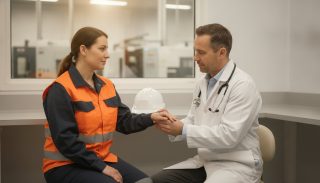
The ACGME defines the specialty as one that “focuses on health promotion and the human health impact of physical, chemical, biological, social, and psychosocial factors in the environment, both at home and at work.” In practice, that means two jobs at once. You treat individual patients who were hurt or made sick at work, and you look at the workplace itself to stop the next injury.
The American College of Occupational and Environmental Medicine (ACOEM) lists the core competencies of the OEM physician, including:
- Diagnosing and treating occupational diseases and injuries and identifying health effects of environmental exposures
- Knowing how worksites operate and the toxic properties and hazards of materials and work processes
- Determining whether an employee is physically and emotionally fit for a job
- Educating workers on health, wellness and sanitation
- Working within workers’ compensation law, local, state and federal regulations and medical record systems
- Organizing health services while keeping physician and patient confidentiality
ACOEM notes that the field touches nearly every industry, from manufacturing, agriculture and energy to health care, technology and entertainment. Occupational physicians work for corporations, group practices, hospitals, consulting firms, universities and government agencies, including the military.
Is Occupational Medicine the Same as Preventive Medicine?
Not exactly. The American Board of Preventive Medicine (ABPM) certifies three separate primary specialties: aerospace medicine, occupational and environmental medicine, and public health and general preventive medicine. Each has its own ACGME residency requirements. They share a core: all three require an MPH or equivalent degree, both the occupational and the public health and general preventive medicine requirements use the same 24-month and 36-month formats, and every ABPM specialty exam includes 50 questions on core preventive medicine. The occupational residency then adds workplace content the general track does not require, such as ergonomics, workplace toxicology and workers’ compensation case management.
Step 1: Build a Strong Pre-Med Foundation
Any undergraduate major works if you complete medical school prerequisites, score well on the MCAT and gather real clinical experience. Courses that pay off later in this field include statistics, biology, chemistry and anything touching environmental science or public health, since residency will ask you to master epidemiology and biostatistics.
Clinical experience matters for admission and for knowing whether you like patient care. Students who join IMA’s pre-med internships abroad work under the supervision of licensed clinicians on vital signs, patient intake and triage, basic patient interviews and community outreach. Seeing how working conditions, water, sanitation and access to care shape health in a community is a direct preview of how occupational and environmental physicians think. It also helps to shadow a physician at an employee health clinic or occupational health center if one is near you.
Step 2: Finish Medical School and Pass Your Licensing Exams
You need an MD from an LCME-accredited school or a DO from a school approved by the American Osteopathic Association. ABPM also accepts accredited Canadian schools and international schools it deems satisfactory. Along the way you pass the USMLE or COMLEX series, which you need for licensure.
Occupational medicine gets little attention in most medical school curricula, so you have to seek it out. ACOEM offers free membership to full-time medical students and interns earning an MD or DO, and its residents and students page connects applicants with OEM ambassadors.
Step 3: Complete the Clinical Year
Before the occupational part of training begins, you need a year of clinical medicine. For a 24-month program, the ACGME requires that residents “have successfully completed at least 12 months of clinical education” in an accredited residency, and that the PGY-1 year include “at least 10 months of direct patient care in both inpatient and outpatient settings.” Research and laboratory time does not count toward those months.
Many residents do a preliminary or transitional year in internal medicine or family medicine. Others finish an entire residency first, such as internal medicine, and move into occupational medicine later. ACOEM describes physicians entering the field mid-career after noticing how many of their patients have work-related injuries and illnesses.
Step 4: Train in an Occupational and Environmental Medicine Residency
The residency itself covers 24 months of clinical occupational and environmental medicine. The 2026 ACGME requirements set firm minimums:
- At least four months of direct patient care in an occupational setting during each year of the program
- Participation in clinical occupational medicine, disaster preparedness, environmental health, hazard recognition and control, related laws and regulations, management and administration, surveillance, toxicology, work fitness and disability, and worker health and productivity
- Competence in conducting a real or simulated workplace walk-through to identify hazards and report them to worksite administration
- Competence in applying ergonomics and toxicology “in a real or simulated workplace setting to reduce or prevent worker injury”
- Competence in opening, managing and closing workers’ compensation cases under state, federal and public insurance rules
- Competence in advising employers on trends in disability, disease or risk that carry public health significance
For background on how residency and fellowship differ in general, see this guide to how residency and fellowship training work.
How Do You Apply to an Occupational Medicine Residency?
The process differs from most specialties. According to ACOEM’s applicant guide, most civilian programs accept applications through ERAS, a few use other systems such as SOPHAS, and the military programs use their own system. Offers are then made on a coordinated offer day rather than through the main NRMP algorithm, and ACOEM has coordinated that day since 2023. Applicants who do not match can join a post-match process coordinated by the Association of Occupational and Environmental Clinics. Programs are small, most often with two residents per year. This ERAS residency application guide covers the application sections in detail, and ACOEM’s residents and students page links to its full applicant guide.
Step 5: Earn the MPH or Equivalent Degree
The graduate degree is not optional. The ACGME states that residents “must complete a Master of Public Health or another equivalent degree program prior to completion of the residency program,” with graduate courses in five areas: epidemiology, biostatistics, health services management and administration, environmental health, and the behavioral aspects of health.
What Degrees Count Instead of an MPH?
The ACGME lists equivalent degrees that may include a doctorate or master of science in epidemiology, preventive medicine, community health, environmental science, environmental toxicology or occupational science; a master of tropical medicine and hygiene; a master of occupational health; and a master of health sciences, as long as they cover the required core topics. If you already hold an MPH, you still complete 24 months of residency, and you must finish any of the five required course areas your earlier degree did not cover.
Most residents take the degree alongside rotations, often heavily in the first year. If you are still in college and already sure about population health, a joint program is another route; see how to get into an MD/MPH program. An MD/MPH does not shorten the 24-month residency.
Step 6: Get Board Certified by the ABPM
ABPM certification in occupational and environmental medicine requires an unrestricted medical license, an accredited medical degree and at least 15 equivalent hours of graduate courses across the five public health core areas. The board offers three routes:
| Pathway | Who it fits | Key requirements |
|---|---|---|
| Residency | Recent graduates | A clinical year, an ACGME or RCPSC occupational and environmental medicine residency of at least two years, an MPH or equivalent degree |
| Complementary | Mid-career physicians | Two years of accredited clinical training, one year of occupational and environmental medicine residency with at least eight months of direct patient care, an MPH or equivalent, two years of full-time occupational medicine practice within the last five years |
| Special | Physicians already certified in another ABPM specialty | Current ABPM specialty certificate and two years of full-time occupational medicine practice within the last five years |
Details come from the ABPM occupational and environmental medicine page. The exam has 200 multiple-choice questions in four one-hour blocks, with 4 hours and 30 minutes of total seat time, including 50 questions from core preventive medicine. For the 2027 cycle, ABPM lists applications opening March 10, 2027 and closing June 30, 2027, with the exam administered from October 11 to October 31, 2027. Residents finishing training that calendar year can apply for pending approval and sit for the exam before results are released.
How Hard Is the Occupational Medicine Board Exam?
The ABPM exam pass rates show 72 of 86 examinees passing in October 2025, an 84 percent pass rate. Over the previous eight administrations, the rate ranged from 84 percent to 95 percent, with 95 percent in October 2023.
Occupational Medicine Physician Salary
BLS does not publish a separate wage line for occupational medicine. Occupational medicine physicians appear in O*NET under preventive medicine physicians, whose pay data comes from the BLS category “physicians, all other.” Here is how that category compares in BLS’s physicians and surgeons pay data for May 2025:
| Occupation (BLS) | Median annual wage, May 2025 |
|---|---|
| Physicians and surgeons, all occupations | $275,930 median |
| Physicians, all other (includes preventive and occupational medicine) | $265,930 median |
| General internal medicine physicians | $256,560 median |
| Family medicine physicians | $244,180 median |
The “physicians, all other” group held 367,400 jobs in 2025 and covers many specialties beyond occupational medicine, so treat its median as a broad guide. Pay in this field varies with setting: corporate medical director roles, clinic-based injury care, government work and consulting are paid differently. For pay across all specialties, see IMA’s guide to how much doctors make.
Job Outlook for Occupational Medicine Physicians
BLS projects employment of physicians and surgeons to grow 4 percent from 2025 to 2035, about as fast as the average for all occupations, with about 22,100 openings a year. For the “physicians, all other” group that includes preventive medicine physicians, O*NET shows average growth of 3 to 4 percent and about 9,400 projected openings over 2025 to 2035. ACOEM points to growing demand as employers and governments focus more on workplace safety and environmental health.
The lifestyle is part of the appeal. ACOEM cites Medscape’s burnout report, in which public health and preventive medicine, the category that includes occupational medicine, had the lowest burnout rate at 26 percent. It also appears in lists of the happiest medical specialties.
Checklist: Your Path to Occupational Medicine
- Complete pre-med prerequisites, the MCAT and supervised clinical experience
- Graduate from an MD or DO school and pass the USMLE or COMLEX series
- Finish a clinical year with at least 10 months of direct patient care, or a full residency
- Apply to ACGME-accredited occupational and environmental medicine residencies
- Complete 24 months of residency with at least four months of occupational patient care each year
- Earn an MPH or equivalent degree covering the five public health core areas
- Hold an unrestricted medical license
- Apply to ABPM, pass the 200-question exam and keep your certification current
Frequently Asked Questions
How long does it take to become an occupational medicine physician?
About 11 years after high school: four years of college, four years of medical school, a clinical year with at least 10 months of direct patient care, and a 24-month occupational and environmental medicine residency that includes an MPH or equivalent degree.
Do you need an MPH to become an occupational medicine physician?
Yes, for the standard route. The 2026 ACGME requirements say residents must complete a Master of Public Health or an equivalent degree before finishing residency, and ABPM requires that degree for its residency pathway. Equivalent degrees include a master of occupational health and master of science degrees in fields such as epidemiology or environmental toxicology.
Which board certifies occupational medicine physicians?
The American Board of Preventive Medicine certifies occupational and environmental medicine as one of its three primary specialties, alongside aerospace medicine and public health and general preventive medicine. The exam has 200 multiple-choice questions, including 50 on core preventive medicine.
Can a family medicine or internal medicine doctor switch to occupational medicine?
Yes. ABPM’s complementary pathway is designed for mid-career physicians. It requires two years of accredited clinical training, one year of occupational and environmental medicine residency, an MPH or equivalent degree, and two years of full-time occupational medicine practice within the last five years.
How much do occupational medicine physicians make?
BLS does not report occupational medicine separately. The category that includes preventive and occupational medicine physicians, physicians all other, had a median annual wage of $265,930 in May 2025, compared with $275,930 for all physicians and surgeons.
What does an occupational medicine physician do day to day?
They treat work-related injuries and illnesses, decide whether workers are fit for specific jobs, manage workers’ compensation cases, walk through workplaces to find hazards, and advise employers on injury and illness trends. Many also handle environmental exposure questions for communities.
Is occupational medicine a competitive residency?
Programs are small, most often with two residents per year, and most need applicants who have already finished a clinical year. Programs look for familiarity with the field, academic strength and fit, so clinical experience and contact with occupational health clinics help an application.
See more of our guides in your Google results: add International Medical Aid as a preferred source on Google.