
If you have been searching for a physician assistant program at The College of Idaho in Caldwell, the first thing to understand is that you will not find a separate one, at least not in the way most applicants assume. The PA program taught at The College of Idaho is Idaho State University’s Master of Physician Assistant Studies (MPAS), delivered at a C of I site under a partnership that began in 2013. ISU runs admissions, ISU sets the curriculum, and ISU awards the degree.
That distinction is not pedantry. It determines where you apply, what you pay, and how much say you have over which of ISU’s three campuses you end up at. This guide covers the 2026-2027 application cycle, which is for students who want to start in August 2027. It explains the six prerequisites, the GRE rule, the published file score rubric, what the latest admissions statistics show, how interviews and campus offers work, what Caldwell costs in 2026-2027, and how the program has performed on the PANCE. Facts were checked on October 17, 2026.
Key Takeaways
- One program, three campuses: you apply to Idaho State University’s PA program as a whole, not to Caldwell. Each class has 72 seats: 36 in Meridian, 24 in Pocatello and 12 at The College of Idaho in Caldwell.
- Caldwell has one fee schedule: every Caldwell student pays $25,504.50 per semester in 2026-2027, or $153,027 for the six-semester program, whether or not they are an Idaho resident. Idaho residents in Meridian or Pocatello pay $95,100. The total cost of attendance is $200,135 at Caldwell and $142,208 for a resident at the other two campuses.
- Two applications, one deadline: CASPA and the ISU Graduate School application are both due November 1, 2026. The GRE must also be taken by November 1.
- Six prerequisites, 3.0 minimum: Microbiology, Biochemistry, Human Anatomy, Human Physiology, Statistics and Abnormal Psychology (or Developmental Psychology throughout the Lifespan), with a C or better in each and a prerequisite GPA of at least 3.0.
- Patient care hours are not required, but they score: 600 or more combined patient and health care hours earn file score points, and 96% to 100% of initial seat offers in each of the last five classes met that bar. Twenty hours of shadowing, at least 10 with a PA, also earns points.
- The rubric is public: ISU ranks complete applications with a file score worth up to 6.00 points. For the Class of 2028, 498 CASPA applicants produced 144 interviews, and files needed a score of 4.675 to reach committee review.
- Campus choice comes after the interview invitation: invited applicants rank their first, second and third campus. If your first choice is full when your offer comes, you can accept as-is, accept and join a waitlist for your preferred campus while keeping your seat, or decline.
- Accreditation and boards: the program holds Accreditation-Continued status from ARC-PA, confirmed after its March 2025 review, with the next comprehensive review set for March 2035. The five-year PANCE first-time pass rate for the Classes of 2021-2025 is 89%, against a national average of 92%.
College of Idaho PA Program at a Glance

| Metric | Value | Year or cohort | Source |
|---|---|---|---|
| Degree | Master of Physician Assistant Studies (MPAS), awarded by Idaho State University | Current | ISU PA, About the Program |
| Seats per class | 72 total: 36 Meridian, 24 Pocatello, 12 Caldwell | Current entering class | ISU PA, Admission FAQs |
| Accreditation | Accreditation-Continued; next comprehensive review March 2035 | ARC-PA action, March 2025 | ISU PA, Accreditation; ARC-PA accreditation history |
| Prerequisite GPA | 3.0 minimum across six courses, C or better in each | 2026-2027 cycle | ISU PA, Admission Requirements |
| Patient care experience | Not required; 600+ combined patient and health care hours earn 0.250 file score points | 2026-2027 cycle | ISU PA, File Score |
| Initial offers with 600+ hours | 100% (Class of 2028); 96% to 99% in the four classes before | Classes of 2024-2028, initial top-72 offer list | ISU PA, Admission Statistics |
| Applications and interviews | 498 CASPA applications; 144 interviews; review threshold 4.675 | Class of 2028 | ISU PA, Admission Statistics |
| Average prerequisite GPA of initial offers | 3.87 (overall science GPA 3.63) | Class of 2028, initial top-72 offer list | ISU PA, Admission Statistics |
| Caldwell tuition and fees | $25,504.50 per semester; $153,027 for six semesters, all students | 2026-2027 rates | ISU PA, Tuition and Fees (updated 8/04/26) |
| Caldwell total cost of attendance | $200,135 | 2026-2027 estimate | ISU PA, Tuition and Fees |
| Application deadline | November 1, 2026 (CASPA and ISU Graduate School) | 2026-2027 cycle, class entering August 2027 | ISU PA, Admission FAQs; CASPA cycle dates |
| PANCE first-time pass rate | 89% five-year average (national 92%) | Classes of 2021-2025 | ISU PA, PANCE report dated 03-31-2026 |
What Is the College of Idaho Physician Assistant Studies Program?
Idaho State University’s Department of Physician Assistant Studies awards the Master of Physician Assistant Studies degree and a PA certificate after a 24-month graduate curriculum. The program has three campuses: the main campus in Pocatello, the ISU-Meridian Health Sciences Center in Meridian, and a site at The College of Idaho in Caldwell, run in partnership with C of I at the West Hall Center for PA Studies. The College of Idaho presents the MPAS as a partnership with ISU, and it is ISU’s name that appears on the degree.
The program is older than the partnership. ISU matriculated its first PA class of 19 students in 1995 and graduated them in 1997 with a bachelor’s degree in PA studies. The first master’s class graduated in 2004 with 29 graduates. The program expanded to the Boise area in 2007, moved into the Meridian Health Science Center in 2009, and partnered with The College of Idaho in 2013. ARC-PA, the national accreditor for PA programs, approved the Caldwell distant campus for up to 12 students effective August 2014.
The College of Idaho also offers its own online Doctor of Medical Science (DMSc) for practicing PAs. That is a separate degree for people who are already PAs. It is not a route into the profession, so if you are a pre-PA student, the MPAS is the program you want.
Be an Informed Applicant
Idaho State University publishes more about its admissions process than most PA programs. Its pages list the six prerequisite courses, the full file score rubric with every weighting, five years of application and interview counts, the profile of applicants who received the first 72 seat offers, the interview format, the campus preference process, a per-campus PANCE report and a 2026-2027 fee table. This guide uses those figures directly and labels each with its class year.
Two things are worth keeping straight as you read. First, the admissions statistics describe the initial top-72 seat offer list, not every student who enrolled, so treat averages as a picture of competitive applicants rather than as minimums. Second, the program changes details from cycle to cycle, so check the ISU PA pages again before you submit, especially anything tied to a date.
Read This First: Caldwell Students Pay Non-Resident Tuition, Whatever Their Residency
This is the single most consequential fact about the Caldwell site, and it is easy to miss because it sits in a fee table rather than in admissions copy. For the 2026-2027 academic year, based on State Board of Education-approved rates:
- Meridian and Pocatello, Idaho resident: $15,850.00 per semester, $47,550.00 per year, $95,100.00 for the full six-semester program
- Meridian and Pocatello, non-resident: $25,504.50 per semester, $76,513.50 per year, $153,027.00 program total
- Caldwell (College of Idaho), every student regardless of residency: $25,504.50 per semester, $76,513.50 per year, $153,027.00 program total
Read that last line again. An Idaho resident placed at Caldwell pays $153,027 in tuition and fees rather than $95,100: a difference of $57,927 for the same degree, from the same university, taught over the same telepresence link. Including indirect costs, the total cost of attendance is $142,208.00 for a resident at Meridian or Pocatello and $200,135.00 for a non-resident or any Caldwell student.
There is a straightforward reason for it. The Caldwell campus operates through a public-private partnership, and as a private institution, C of I does not receive state funding to support facilities or other expenses related to educating ISU PA students. As a result, all Caldwell students follow a single fee schedule. That is a coherent explanation. It does not make the number any smaller.
The fee structure also shows where the difference comes from. A Caldwell student’s semester bill is full-time graduate tuition of $13,657.00, an ISU graduate fee of $1,150.50, an ISU administrative fee of $667.00 and the $10,030.00 program fee. A Meridian or Pocatello resident pays $4,409.62 in graduate tuition, $1,410.38 in mandatory consolidated fees and the same $10,030.00 program fee. Non-residents at those campuses add $9,654.50 in non-resident tuition, which brings them to exactly the Caldwell figure.
And You Do Not Fully Choose Your Campus
Here is where the two facts collide. You do not apply to Caldwell, Meridian or Pocatello. You apply to ISU’s PA program as a whole.
The campus question comes up later in the process. If your file score is high enough to move on to a second review, and the Admissions Committee then invites you to interview, you receive access to a campus preference survey. You list your first, second and third choice of campus. ISU tries to follow those preferences, but offers go out in order of applicant ranking, so your first choice may already be full when your offer arrives. In that case, you are offered a seat at your second or third choice, depending on what is open.
When that happens, you have three options:
- Accept the offer as it is, at the campus offered.
- Accept the offer and ask to be placed on the waitlist for your preferred campus. Being on that waitlist still guarantees your seat in the program. If a seat opens at your preferred campus over the summer before classes begin, you may be able to move.
- Decline the offer.
For an Idaho resident, this means you cannot simply assume you will land one of the 60 seats at Meridian or Pocatello, where the resident rate applies. Twelve of the 72 seats are at Caldwell, and a seat there costs a resident $57,927 more over the program. The waitlist option softens that risk, because you can hold a Caldwell seat while waiting for a resident-rate seat to open, but a move is not guaranteed.
So decide before your interview how you will rank the campuses and which offers you would accept. If cost is your deciding factor and you are an Idaho resident, think about whether you would accept a Caldwell offer outright, accept it and join the Meridian or Pocatello waitlist, or decline it. If you still have questions about how the waitlist works in practice, email the admissions office so you have the answer in writing.
None of this means Caldwell is a bad seat. The site is small, the facility is purpose-built, and 12 students in a cohort is a different experience from 36. It means the financial result of where you are placed is large and not fully within your control, and that is something to understand before you apply rather than when the offer arrives.
How the Program Is Structured
ISU’s PA program is a 24-month, six-semester graduate curriculum of 120 graduate credits, described by the university as modular and systems-based. It is divided into 12 months of didactic education (three semesters) and 12 months of clinical education (three semesters). Seventy-two students enroll each fall, distributed across three campuses:
- Meridian: 36 seats
- Pocatello: 24 seats
- College of Idaho, Caldwell: 12 seats
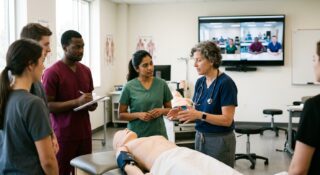
All three sites are linked by telepresence technology, and didactic instruction is delivered to all three campuses at the same time. Faculty and staff work at all three sites, and the program describes all of its PA faculty as licensed professionals who remain clinically active. The Caldwell site sits in the West Hall Center for PA Studies.
The didactic year. The fall semester (30 credits) builds the foundation: Regional Anatomy and Histology with lab, Human Pathophysiology with lab, Lectures in Human Physiology, Intro to Physician Assistant, Evidence-based Medicine and Biostatistics, Clinical Assessment and Pharmacology. The spring semester (31 credits) moves into organ-system modules: allergy, immunology, head, ear, nose, throat and ophthalmology; infectious disease; hematology and oncology; endocrinology; renal; pulmonary; cardiology; gastroenterology; rheumatology; orthopedics; psychiatry; and alternative and occupational medicine. The summer semester (23 credits) covers dermatology, genitourinary medicine, neurology, obstetrics and perinatology, pediatrics, geriatrics, surgery, an 8-credit emergency medicine module and a comprehensive evaluation.
The clinical year. Students complete eight 4-credit rotations: seven in required content areas (internal medicine, outpatient medicine, obstetrics and gynecology, pediatrics, emergency medicine, surgery and psychiatry) plus one elective, along with three capstone assessment courses, for 36 credits. The program supplies clinical sites and preceptors. No student or prospective student is asked to find their own, and students may not cold-call preceptors or sites. Rotations are spread across the United States with the heaviest emphasis on western states, including Idaho, Utah, Montana, Wyoming, Washington, Oregon, California and Nevada, and some sites further east. Travel is required during the clinical year, and students pay their own travel costs. Some students may also be asked to take a PANCE preparation course with an individual study plan.
Spanish and international options. Spanish is a real thread through the program. Students can take SPAN 5510 Spanish for the Health Professions as an optional 2-credit course in the fall, add further Spanish courses in spring and summer, or complete a Graduate Certificate in Spanish for the Health Professions. Spanish-speaking clinical rotations are available, and the elective rotation can be completed at an international site as a voluntary, student-funded option. Proficiency in a foreign language, especially Spanish, is also on the program’s list of highly recommended preparation, and intermediate or better proficiency in a non-English language earns file score points.
The Rural Health Track. Admitted students can apply to a Rural Health Track. It pairs students with a PA mentor experienced in rural care, adds telemedicine training, includes a graduate certificate in Spanish for Health Professions, Geriatrics, Rural Health or Lifestyle Medicine, offers the Area Health Education Center (AHEC) Scholar program, and places students in back-to-back interprofessional rotations at a rural clinic partner. The application is made available only after admission, so it is not part of your CASPA file.
The telepresence model is worth thinking about honestly rather than accepting at face value. It is what makes a 12-seat site viable at all, and ISU has been running it since the Caldwell site opened. But distance delivery is a different daily experience from being in the room with the lecturer, and it suits some students far better than others. If you learn best by interrupting, by catching someone after class, or by the informal density of a large cohort, a 12-person satellite site is an adjustment. If you would rather be one of twelve than one of thirty-six, it is an advantage. Visit if you can, and ask current students at the Caldwell site directly what the day-to-day feels like. The interview day includes a visit with current students, which is a good time to ask.
Mission and What the Program Looks For
The program’s mission is short: “We cultivate caring, collaborative physician assistants with a passion to serve and improve the health and well-being of patients and their communities.” Its motto is “Training medical professionals who care,” and its stated core values are compassion, inclusion, collaboration, integrity, service and intellectual curiosity.
That mission shows up in admissions in concrete ways. In 2020 the program received a federal grant from the Health Resources and Services Administration (HRSA) to recruit more PA students who intend to live and work in rural areas after PA school. The file score gives points for rural background, military service and non-English language ability. The interview mission survey adds a ranking point for applicants from backgrounds the program wants to serve, including Idaho residents. And among the “additional considerations” the program lists for every applicant are maturity, interpersonal skills, evidence of academic readiness for a rigorous program, and evidence of a desire to practice primary care in Idaho, particularly among the medically underserved.
One of the program’s stated priority objectives was to increase the share of graduates who work with underserved populations through a holistic admissions process that matriculates rural, veteran, medically underserved and underrepresented students. If those words describe you, say so clearly and concretely in your application. If they do not, you can still show the same values through what you have done: service in your community, work with patients who have trouble accessing care, or time spent in rural clinics.
Accreditation
The Accreditation Review Commission on Education for the Physician Assistant (ARC-PA) has granted Accreditation-Continued status to Idaho State University’s Department of Physician Assistant Studies. Its most recent comprehensive review, in March 2025, ended with Accreditation-Continued status and zero areas of noncompliance with the Standards noted. The next comprehensive evaluation is set for March 2035, contingent on continued compliance with the Standards and ARC-PA policy.
Accreditation-Continued is the status ARC-PA grants an established program that is in compliance with its Standards. It differs from the provisional status carried by new programs that have not yet graduated a class. Graduating from an ARC-PA accredited program is what makes you eligible to sit for the PANCE, the national certifying examination, so accreditation status is not an abstraction.
ARC-PA’s public accreditation history also records routine reports. In January 2026, ARC-PA accepted the program’s required analysis of PANCE performance after the 2024 cohort’s first-time pass rate came in at 85% or less, with no further information requested. Between March 2023 and June 2025, the program filed several required reports after enrollment exceeded the maximum entering class size, and each was accepted. In June 2024 the program asked to increase its entering class to 76 temporarily to admit students from a closing program. The history also shows a brief period of Accreditation-Administrative Probation in July 2023 tied to a late annual accreditation fee, removed in August 2023 once the fee was received. ARC-PA lists the approved maximum class size as 72. You can read the full record on the ARC-PA site, linked in the Sources section.
PANCE Pass Rates and Graduation Outcomes
ISU publishes the PANCE report that ARC-PA requires, broken out by campus. The latest report is dated March 31, 2026 and covers the Classes of 2021 through 2025.
| Class | First-time takers | Caldwell | Meridian | Pocatello | Program | National |
|---|---|---|---|---|---|---|
| 2021 | 72 | 75% | 92% | 88% | 88% | 93% |
| 2022 | 74 | 100% | 92% | 92% | 93% | 92% |
| 2023 | 69 | 100% | 94% | 90% | 94% | 92% |
| 2024 | 70 | 83% | 89% | 83% | 86% | 92% |
| 2025 | 75 | 85% | 92% | 72% | 84% | 91% |
The five-year first-time pass rate for the program is 89%, against a national five-year first-time average of 92%. The program was at or above the national rate for the Classes of 2022 and 2023 and below it for 2021, 2024 and 2025.
Read the Caldwell column with its class size in mind. Each Caldwell class had 12 or 13 first-time takers, so a single student moves the rate by about eight percentage points. In 2024, 10 of 12 Caldwell first-time takers passed; in 2025, 11 of 13 did. Small numbers make the campus figures noisy in both directions, which is why the program-wide five-year figure is the better guide to how well the curriculum prepares students.
Graduation rates are high. The program graduated 97.2% of the Class of 2023, 95.9% of the Class of 2024 and 97.4% of the Class of 2025. At Caldwell, all 12 students graduated in both 2023 and 2024, and 13 of 14 graduated in 2025 (92.86%). The program also describes its graduates as eligible to apply for licensure in all U.S. states and the District of Columbia.
Admissions Requirements
At a glance, here is what every applicant needs for the 2026-2027 cycle:
- Bachelor’s degree: from a regionally accredited U.S. institution, completed by June 30 of the year you plan to enter. Any major is accepted.
- Prerequisite courses: six required, each from a regionally accredited U.S. institution.
- Prerequisite grades: a C or better in every prerequisite, and a cumulative GPA of 3.0 or higher across the six prerequisite courses.
- GRE: required of every applicant, taken by November 1, with verbal and quantitative percentiles feeding the file score.
- Applications: both a CASPA application and a separate ISU Graduate School application, each due November 1.
- Letters of recommendation: three, through CASPA.
- Immunizations and technical standards: all entering students must meet the technical standards and have every required immunization by June 30 of the year they enter.
- Advanced placement: none. The program does not award advanced placement, and each class moves through the curriculum as a cohort.
The Six Prerequisite Courses
The required prerequisites are:
- Microbiology
- Biochemistry
- Human Anatomy (as a single course or as part of a two-semester combined anatomy and physiology sequence)
- Human Physiology (as a single course or as part of a two-semester combined anatomy and physiology sequence)
- Statistics
- Abnormal Psychology (or Developmental Psychology throughout the Lifespan)
A few rules decide whether a course counts:
- Age limit: coursework ten years old or older is not accepted as prerequisite coursework.
- Biochemistry: the word “Organic” cannot appear in the course title. Organic Chemistry, Introduction to Organic and Biochemistry, and Introduction to Bio-Organic Chemistry do not count. Titles such as Medical Biochemistry, General Biochemistry, Fundamentals of Biochemistry, Biochemistry I or Introduction to Biochemistry do.
- Psychology: Introduction to Psychology and General Psychology do not count. A developmental psychology course must cover the entire lifespan from birth to death.
- Statistics: statistics taught in any field, such as psychology, sociology, biology or mathematics, counts. Research methods courses generally do not.
- Online courses: accepted, as long as they come from a regionally accredited U.S. institution.
- Course titles: courses whose titles match the list, including prefixes such as “Medical,” “General,” “Fundamentals of,” “Survey of” or “Introduction to,” will likely count. Substitutions of similar courses are typically not accepted. The program does not offer transcript reviews, but you can email it about a specific course with the institution, course name, course number and term.
If you are a College of Idaho undergraduate, ISU publishes the C of I courses that meet each prerequisite: BIO-360 Microbiology; CHE-412 Biochemistry; BIO-224 and BIO-225 Human Anatomy and Physiology I and II (both are needed to cover anatomy and physiology); PSY-404 Abnormal Psychology or PSY-201 Introduction to Developmental Psychology; and MAT-125 Data Analysis and Statistics or MAT-212 Advanced Statistical Methods. Several of these have their own prerequisites at C of I, so plan the sequence with a C of I advisor early. ISU also lists recommended upper-level options at C of I such as Human Genetics, Genetics, Pathobiology, Immunology, Endocrinology and Neurophysiology, plus health-related courses in psychology, sociology, anthropology, health education and health and human performance.
Highly recommended, not required. Beyond the six, the program suggests upper-level biology such as advanced anatomy, advanced human physiology, immunology, genetics and endocrinology, other health-related courses, and proficiency in a foreign language, especially Spanish.
Prerequisites in Progress, Retakes and Timing
First-time applicants may have up to two prerequisite courses in progress during the spring semester of the year they would enter. At least four of the six must be finished by the end of the fall semester of the application year, and everything, including degree coursework, must be completed and posted to official transcripts by June 30 of the entry year. The program may ask for proof of registration and progress. Reapplicants must have every prerequisite complete, with none in progress, when they reapply.
Here is how that works for this cycle. If you apply by November 1, 2026 for the class entering in August 2027, four of your six prerequisites must be done by the end of fall 2026, up to two can be in progress in spring 2027, and everything must be posted by June 30, 2027.
Retaken courses are handled generously. If a retake is complete at the time of application, the best qualifying grade is used. If you are retaking a course during the fall of the application year, the original grade is used until the retake grade arrives. If the new grade is received by mid-December and is better, it replaces the original fully and your prerequisite GPA is recalculated. For prerequisite work affected by COVID-19 grading in Winter, Spring or Summer 2020, one pass/fail or satisfactory/unsatisfactory grade is forgiven without counting in the GPA, and any additional ones are calculated using either your science GPA or a B, whichever gives you the better file score.
The Prerequisite GPA
Note that the 3.0 minimum is assessed across the six prerequisite courses on their own rather than folded into a cumulative figure. That cuts both ways: a rocky first year in unrelated subjects hurts you less here than at programs screening on cumulative GPA, but a weak grade in a prerequisite is harder to bury. If your prerequisite GPA is under 3.0, retaking a course is a more productive use of a year than applying and hoping.
Meeting the minimum is only the first gate. The prerequisite GPA is also the largest single part of the file score, worth up to 4.00 of 6.00 points. The initial top-72 seat offers for the Class of 2028 averaged a 3.87 prerequisite GPA, and that average has stayed between 3.85 and 3.90 for five classes. Your overall science GPA, as calculated by CASPA, also counts for a small number of points. Beyond the score itself, committee reviewers look at grade trends over time and at whether you appear ready for a demanding curriculum.
The GRE Requirement
ISU requires the GRE of every applicant, regardless of background, education or work experience. Even though the ISU Graduate School allows some programs to waive the GRE, the PA program does not. A prior graduate degree does not exempt you, and the MCAT and PCAT are not accepted in its place. Only the General Test is needed, not a subject test.
The details that matter:
- Deadline: the GRE General Test must be taken by November 1.
- Score age: results must be ten years old or younger.
- Codes: the ISU GRE school code is 4355 and the department code is 0634. Send scores to the Graduate School, which needs the official GRE score report.
- What counts: the program uses only the verbal and quantitative percentiles, not raw scores. The analytical writing section is not used.
- Minimum: the PA program has no minimum score. Applications can still be rejected at the Graduate School stage if GRE scores do not meet Graduate School requirements.
Each percentile point is worth 0.003 file score points, so the two sections together are worth up to 0.60 points. A 55th percentile verbal score, for example, adds 0.165 points. For the Class of 2028, the initial top-72 offers averaged the 61st percentile in verbal and the 32nd percentile in quantitative reasoning. Verbal averages have run from the 57th to the 67th percentile over five classes, and quantitative averages have fallen from the 46th to the 32nd.
This matters because a great many PA programs have dropped the GRE in recent years, and applicants who built their list around GRE-optional programs sometimes discover the requirement late. If ISU is on your list, book the test early enough that you can retake it if the first score is poor. A percentile that feeds directly into a scored file is not something to leave to one attempt. Our guide to PA schools that don’t require the GRE is useful for building the rest of your list around it.
No Patient Care Experience Is Required: What That Actually Means
The rule is plain: neither health care nor patient care experience is required for admission to the program. Work and health care experience are listed as preferred, not required. For PA admissions, that is unusual. Most programs require substantial direct patient care hours, often several hundred to a couple of thousand, and that requirement is the single biggest barrier for career-changers and for applicants who could not afford to work an unpaid or low-paid clinical role for a year or two. ISU removing it as a hard gate widens who can apply.
Be careful how you read it, though. “Not required” is not the same as “not scored.” Experience earns file score points on an all-or-nothing basis, using CASPA’s own experience definitions:
| Experience category (CASPA definitions) | Hours needed | File score points |
|---|---|---|
| Combined patient care and health care experience | 600 | 0.250 |
| Volunteerism and community service | 120 | 0.100 |
| Shadowing, at least 10 hours of it with a PA | 20 | 0.050 |
| Non-health care employment | 1,000 | 0.025 |
| Leadership | 150 | 0.025 |
Points are not prorated. If you have 590 patient and health care hours, you receive nothing for that category; at 600 you receive the full 0.250. That makes the thresholds worth planning around.
The admissions statistics show how much this matters in practice. Among the initial top-72 seat offers, the share who met the 600-hour patient and health care threshold was 99% for the Class of 2024, 96% for 2025, 99% for 2026, 99% for 2027 and 100% for the Class of 2028. In other words, almost everyone offered a seat in the first round over five years had at least 600 hours. The rule removes the hard gate, not the advantage. Experience also gives you something to write about, something for recommenders to speak to, and a credible answer to why you want this profession rather than medicine or nursing.
Shadowing. Shadowing is not required either, but 20 hours, at least 10 of them with a PA, earns 0.050 points. Between 79% and 90% of initial offers in each of the last five classes met that threshold, including 81% for the Class of 2028. CASPA defines shadowing as time spent officially following and observing a health care professional at work, preferably a PA. Ten hours with a PA is a small investment, and it also prepares you to answer “why PA?” with something you have actually seen.
Volunteer, employment and leadership. Among Class of 2028 initial offers, 76% met the 120-hour volunteer threshold, 56% the 1,000-hour employment threshold and 40% the 150-hour leadership threshold.
Counting your hours correctly. CASPA separates patient care experience, where you are directly responsible for a patient’s care (for example as an EMT, CNA, phlebotomist or medical assistant, depending on the role), from health care experience, where you work in a health setting without direct responsibility for care (for example scribing, clerical work or some patient support roles). ISU combines the two toward the 600-hour threshold, but you still need to list each experience in the right CASPA category and avoid listing the same hours twice.
If you are starting from zero, there are realistic ways to build hours. Certification-based roles such as EMT, CNA and phlebotomy are the most common routes, and our guide to getting patient care hours without a certification covers jobs and volunteer roles that do not require a license first. Some applicants also add structured pre-PA internships abroad, where interns take vitals, help with intake and triage, and assist with direct patient care under the supervision of licensed clinicians. Whatever you choose, make sure the hours are real, supervised and correctly categorized, and read our guide on whether international clinical hours can help your PA school application before you count them. For a wider view of which programs drop the requirement entirely, see our list of PA programs that don’t require health care experience.
Letters of Recommendation and Background Checks
CASPA requires three letters of recommendation, and the program checks for all three when your CASPA application arrives. ISU does not specify who must write them, so choose people who have supervised your work closely: a PA or physician you worked or shadowed with, a supervisor from clinical work, and a professor who taught you in a demanding science course is a sensible mix.
Background matters for a practical reason. Clinical sites may require criminal background checks before a student can rotate there. A felony, misdemeanor or withheld judgment can lead to a student being denied a clinical placement, which can prevent completion of the program, and it may also affect licensure later. The application asks about prior PA program enrollment, academic or conduct discipline, criminal convictions and any revoked or restricted license or certification. Answer those questions fully and accurately.
Applying Through CASPA
ISU requires two separate applications: the CASPA application used across PA programs, and an Idaho State University Graduate School application (also called the “Supplemental Application”). Missing the second is a common way to fall out of a cycle without ever being reviewed, so put both on your calendar. The two systems do not share documents, and both need transcripts.
CASPA. The 2026-2027 CASPA cycle opened on April 30, 2026. CASPA charges $185 for the first program you apply to and $65 for each additional program. Your CASPA application carries your official transcripts, three letters of recommendation, your personal statement, your academic history and your work, shadowing and volunteer experience. It also includes a program-specific question about intercollegiate activities and sports, which feeds the file score. ISU’s deadline is November 1, and CASPA runs on Eastern time, so a Mountain time applicant submitting on the last evening has two fewer hours than they might think. If CASPA is new to you, our guide to CASPA mistakes to avoid is a good checklist.
ISU Graduate School application. The Graduate School application usually opens in May. Select the fall semester that follows the year you submit, which for this cycle is Fall 2027. The application needs the official GRE score report and uploaded transcripts. At the application stage, unofficial transcripts are accepted if they show your name, the institution’s wordmark or logo in the header, courses, credits, terms, grades and degree dates. Official transcripts go to the Graduate School only after you are accepted. The Graduate School charges a $65 non-refundable processing fee for master’s applications, runs on Mountain time and also closes on November 1. You cannot send a PA application directly to the program; it has to come through these two systems.
What happens when both arrive. When the Graduate School application arrives, the program checks for GRE scores and transcripts and emails you about anything missing. When CASPA arrives, it checks for three letters, confirms your degree will be complete by June 30 of the entry year, and calculates your prerequisite GPA once four of six prerequisites are complete. Quarter credits are converted to semester credits at two-thirds of a semester credit each. Only when both applications are in does the program calculate your file score.
CASPA verification takes time and takes longer the later you submit, because the queue builds through the fall. A file submitted on the last day is not a file reviewed on the last day. Build several weeks of slack into your plan. Interviews start in the first or second week of November, so an application completed in summer is better placed than one completed on October 31.
Writing the CASPA Personal Statement for ISU
ISU does not publish separate essay prompts. Your written work for this program is the CASPA personal statement, plus your experience descriptions and the program-specific question about intercollegiate activities. The ISU Graduate School application is administrative. Follow whatever instructions appear in that portal, but plan your writing time around the CASPA statement.
The CASPA personal statement asks for a brief statement of why you want to be a PA. It has a 5,000-character limit, including spaces, punctuation and line breaks, and you cannot save an essay that exceeds it. The same statement goes to every program you apply to, so keep it general rather than naming ISU. Once you submit your application, you cannot edit it.
Because one statement goes to every program, you cannot write an “ISU essay.” You can, however, write a statement that answers the questions this program clearly cares about:
- Why PA, specifically. Every program wants this, and ISU’s admissions committee reads your whole file, personal statement included, during the second review that decides interviews. Ground your answer in something you have seen PAs do, not in training length or salary.
- Service to patients and communities. The program’s mission is about caring, collaborative PAs who serve their communities. If you have worked with underserved, rural or Spanish-speaking patients, show what you did and what you learned.
- Readiness for a rigorous curriculum. If you had a weak semester, a short, factual sentence about what changed can help. Do not spend a third of the statement on it.
- Teamwork. PAs practice as part of a team. A concrete example of working well within one is more persuasive than the word “collaborative.”
A few practical points. Draft the statement before CASPA opens, not inside the form. Write in plain paragraphs with a blank line between them, because CASPA does not keep tabs, italics or other formatting. Read it aloud, cut anything that repeats your experience list, and ask someone who knows you to check whether it sounds like you. Our guide to mastering your PA school personal statement walks through structure and common mistakes.
Here is what a specific opening can look like, compared with a generic one.
Illustrative example, not an actual applicant essay:
At 2 a.m. in a rural emergency department outside Twin Falls, I was charting vitals as an EMT while a PA explained a new diabetes diagnosis to a farmworker in Spanish. She did not rush. She drew the pancreas on the back of a discharge form, asked him to explain it back, and called the pharmacy herself to check that his insulin would be covered. I had transported dozens of patients that year, but I had never watched someone close the gap between a diagnosis and a person’s actual life so completely. That night is why I want to be a PA.
Why it works: it shows a real clinical setting, a PA doing the job, and a specific moment of patient care, and it ends with a clear statement of motivation in under 600 characters. It does not name ISU, so it can go to every program. What to avoid: copying this scene. Use your own experience, even if it seems less dramatic. A clear, honest account of a clinic shift is stronger than a borrowed story.
Your Application Timeline
For the class entering in August 2027, plan around these dates:
- The year before you apply: finish as many prerequisites as possible with a C or better in each and a 3.0 or higher prerequisite GPA; take the GRE early enough to retake it if needed; build patient care, health care and shadowing hours toward the 600-hour and 20-hour thresholds; line up three recommenders.
- April 30, 2026: the 2026-2027 CASPA cycle opened. Draft your personal statement before the form is in front of you, not inside it.
- May: the ISU Graduate School application usually opens. Select Fall 2027.
- Summer: submit CASPA. Early submission matters because verification is a queue.
- Summer to early fall: complete the separate ISU Graduate School application and upload transcripts. Do not leave this to October.
- By the end of fall 2026: at least four of your six prerequisites must be complete.
- November 1, 2026: deadline for CASPA (Eastern time) and the Graduate School application (Mountain time). The GRE must be taken by this date.
- First or second week of November 2026 through the end of February 2027: interviews. If invited, complete the campus preference survey and choose an interview date and campus.
- Within a week after your interview: you receive an offer, an In Review status or a rejection. An offer must be accepted, with a seat deposit, within two weeks of the offer letter.
- By the first week of March 2027: In Review applicants are offered a seat, placed on the alternate list or rejected.
- Spring 2027: up to two prerequisites may be in progress.
- June 30, 2027: degree, all prerequisites and all immunizations must be complete and posted.
- August 2027: classes begin.
If you are working through a gap year before applying, use it for the things the file score rewards: prerequisite retakes, a GRE retake, and the hours that clear the experience thresholds. Structured pre-med gap year programs and clinical jobs can both serve that purpose if they give you supervised patient contact you can document in CASPA.
Understanding the File Score
ISU ranks every complete application with a file score, then uses a threshold to decide which files go to the Admissions Committee for a second review. The full rubric is published, and it has been in use since the 2021-2022 cycle (the Class of 2024). The maximum is 6.00 points:
| Component | How it is calculated | Maximum points |
|---|---|---|
| Prerequisite GPA | GPA across the six prerequisite courses | 4.00 |
| GRE verbal percentile | Percentile x 0.003 | 0.30 |
| GRE quantitative percentile | Percentile x 0.003 | 0.30 |
| Military service | Active duty, reservist or veteran on CASPA | 0.25 |
| Rural background | Childhood residence in an area of 49,999 people or fewer | 0.25 |
| Overall science GPA | CASPA overall science GPA x 0.025 | 0.10 |
| Experiences | Five thresholds (see the table above) | 0.45 |
| Non-English language proficiency | Intermediate, advanced or native on CASPA | 0.25 |
| Intercollegiate activities and sports | Qualifying answer to the program-specific CASPA question | 0.10 |
A few details are easy to miss. Intercollegiate activities include band, choir, debate and similar programs as well as varsity sports, but intramural and club activities do not count. Intermediate language proficiency means you can hold a comfortable conversation and use the past tense easily. Rural background is based on your CASPA childhood residency answer, not on where you live now.
How the threshold works. A file score threshold is set once enough complete applications are in. Files at or above it go to two committee reviewers, who read the whole application, including GPA trends, academic history, experiences, personal statement and letters, and recommend whether to interview. If the two disagree, a third reviewer breaks the tie. Files below the threshold are placed On Hold until the program knows whether it needs to review more files to reach its goal of about 150 interviews. If it does, the threshold is lowered and applicants are notified. If not, On Hold applicants receive a rejection letter.
The review threshold for the last five classes was 4.825 (Class of 2024), 4.70 (2025), 4.64 (2026), 4.60 (2027) and 4.675 (Class of 2028).
An illustrative file score. Here is how the rubric adds up for a made-up applicant. Illustrative example, not an actual applicant. Prerequisite GPA 3.80 (3.800 points); GRE verbal at the 60th percentile (0.180) and quantitative at the 40th (0.120); grew up in a town of 8,000 (rural background, 0.250); overall science GPA 3.50 (0.088); 1,200 hours as a medical assistant (0.250), 150 volunteer hours (0.100) and 24 shadowing hours with 12 of them with a PA (0.050); no military service, no qualifying language, employment, leadership or intercollegiate points. Total: 4.838, above the Class of 2028 threshold of 4.675.
Now remove the experiences. The same applicant with no patient care, volunteer or shadowing hours scores 4.438, below every threshold of the last five classes. That 0.40-point swing is the practical meaning of “not required but scored.” By comparison, raising the GRE quantitative score from the 40th to the 60th percentile adds 0.06 points, and raising the prerequisite GPA from 3.80 to 3.90 adds 0.10.
The practical consequence is that marginal improvements to your file count at ISU. A file score above the threshold is what gets your whole application read, and your ranking after the interview decides when your offer comes, which in turn affects which campuses are still open. Treat the application as a scored exercise and improve the inputs you control.
Interviews, the Mission Survey and Offers
Format. The interview has five parts: one 40-minute group interview with other applicants, one 20-minute individual interview, a visit with current students, a discussion of the classroom’s lectures, and a meeting with program staff about next steps. Each session includes eight to twelve applicants, with two sessions a day, and lasts about three and a half hours. You choose from a range of dates, and each day’s sessions are held at Caldwell, Pocatello or Meridian. You can interview digitally or in person. Neither format carries more weight, but the program recommends attending in person if at all possible, and the student visit is a good reason to choose the campus you are most likely to attend. If invited, you will also receive dropboxes for immunization and other documents.
Preparing. In the group interview, the reviewers can see how you work with people you have just met. Listen, build on others’ points, and make sure quieter applicants get space to speak. In the individual interview, expect questions about why you want to be a PA, your clinical experience, your readiness for a demanding curriculum and your interest in serving patients in Idaho and in underserved settings. Our list of the most common PA school interview questions is a good place to practice.
The mission survey. At the interview, every applicant completes a mission survey. It awards points for:
- being raised in a family with low income (2 points)
- attending a high school with a high percentage of students on federally subsidized lunch (1)
- attending a high school with a low graduation rate (1)
- having lived or living in a medically underserved area or population (MUA/P) or a health professional shortage area (HPSA) (2)
- coming from a family that received public assistance (1)
- earning an AHS diploma or GED (1)
- being a first-generation college student (1)
- growing up in a rural area (1)
- having a diagnosed physical or mental impairment that substantially limits participation in educational experiences (1)
- not speaking English as a primary language (1)
- having lived or living in Idaho, or having attended an Idaho school (2)
- being a veteran (2)
Applicants with two or more survey points receive one point in their total applicant ranking. Notice what that means for Idaho applicants: living in Idaho or attending an Idaho school is worth two points on its own, so it is enough by itself to earn the ranking point. This is the clearest Idaho preference in the process. It comes after the interview, not at the file score stage, and it is one point in the ranking rather than a reserved quota. Idaho applicants made up 35% of the initial top-72 offers for the Class of 2028 and between 33% and 47% over the last five classes, so most first-round offers go to applicants from outside Idaho.
Campus preference. Applicants are asked for their campus preference at the time of interview, through the survey described earlier, and offers are made based on that preference where seats allow. If your preferred site is full when your offer comes, you are offered a seat at an open campus and can accept it, accept and join the waitlist for your preferred campus, or decline.
Decisions. After the interview, applicants are ranked and receive one of three statuses within the week:
- Offer: a letter of offer is mailed. You must postmark an acceptance letter and pay a seat deposit no later than two weeks from the date of the offer letter.
- In Review: your file is held and ranked with other interviewed applicants who were not offered an early seat. No later than the first week of March, In Review applicants are offered a seat, placed on the alternate list or rejected.
- Rejection: you are no longer considered for that cycle.
In each of the last five cycles, the alternate list held 40 applicants. For the Class of 2028, the alternate list averaged a 3.86 prerequisite GPA and a 4.88 file score, close to the initial offer list’s 3.87 and 4.95, which shows how narrow the gap between an early offer and the alternate list can be.
How Competitive Is the Program?
ISU publishes application and interview counts rather than an acceptance rate. These are the latest five classes:
| Class | CASPA applications | Interviews | File score review threshold |
|---|---|---|---|
| Class of 2024 | 887 | 129 | 4.825 |
| Class of 2025 | 653 | 177 | 4.70 |
| Class of 2026 | 490 | 144 | 4.64 |
| Class of 2027 | 503 | 143 | 4.60 |
| Class of 2028 | 498 | 144 | 4.675 |
For the Class of 2028, which applied in the 2025-2026 cycle and started in August 2026, 498 applicants produced 144 interviews, about 29% of the applicant pool, for 72 seats. That interview share is not an acceptance rate, and ISU does not publish the number of offers made in total, so this guide does not state one.
The initial top-72 seat offers for the Class of 2028 looked like this:
- Average prerequisite GPA: 3.87
- Average overall science GPA: 3.63
- Average GRE verbal: 61st percentile
- Average GRE quantitative: 32nd percentile
- Average file score: 4.95
- Average age: 26
- From Idaho: 35%
- Female/male: 48/24
- Met the 600-hour patient and health care threshold: 100%
- Met the shadowing threshold: 81%
- Met the volunteer threshold: 76%
- Rural background: 71%
- Non-English language proficiency: 44%
- Intercollegiate sports or activities: 22%
- Military service: 5%
Two patterns stand out. First, prerequisite grades are high and steady, while GRE quantitative averages have drifted down over five classes, from the 46th to the 32nd percentile, so a modest quant score is not disqualifying. Second, the mission-linked categories are common among offers: 71% had a rural background and 44% had non-English language proficiency. ISU does not publish admissions statistics separately for the Caldwell campus.
Paying for It
Whichever site you land at, this is a six-figure program. The total cost of attendance for 2026-2027 is $142,208 for a Meridian or Pocatello resident and $200,135 for a non-resident or any Caldwell student. The gap between those two numbers is larger than many applicants’ entire undergraduate debt.
The indirect cost estimate of $47,108 for six semesters is the same at every campus. It covers off-campus housing and food at $16,635 a year for two years, transportation at $2,544 in year one and $5,044 in year two, and books and supplies at $4,750 in year one and $1,500 in year two. Books and supplies include a laptop, textbooks, a parking pass and required medical equipment such as a good-quality cardiology stethoscope, a suture training kit, tuning forks, a reflex hammer, a pocket eye chart, a CPR pocket mask, a short white coat and program scrubs. All tuition figures are estimates and subject to annual adjustment.
Some costs sit outside the table. All students must have active health insurance. Didactic-year students are required to attend the Idaho Academy of Physician Assistants (IAPA) conference in Boise each April and pay their own transportation, lodging, meals and registration, though the PA Student Society runs a fundraiser each year to help. Clinical-year rotation travel is paid by students.
Work is not a realistic way to close the gap. Employment during the didactic year is discouraged and strictly prohibited during class hours, and during the clinical year it is strongly discouraged and not allowed during rotation hours.
Financial aid and repayment options. ISU PA students can apply for federal and private loans through the ISU Financial Aid Office, which advises applicants to start early. Other options the program lists include:
- ISU general scholarships through the ISU Scholarship Office.
- National Health Service Corps Scholarship and the Scholarship for Disadvantaged Students, which supports disadvantaged students in the health professions, particularly those headed for shortage areas and primary care.
- WICHE funding for ISU PA students from Alaska, Nevada, Wyoming or the Commonwealth of the Northern Mariana Islands, because ISU is a member of the Western Interstate Commission for Higher Education program.
- Rural Health Care Access Program (RHCAP) grants from the Idaho Department of Health and Welfare for projects that improve access to care in rural and underserved areas.
- Loan repayment: the Idaho State Loan Repayment Program and the NHSC Loan Repayment Program for providers in Health Professional Shortage Areas, and federal Public Service Loan Forgiveness for eligible government and nonprofit employment.
Two pieces of planning follow. First, if you are an Idaho resident, model both scenarios rather than the one you are hoping for. Work out what your borrowing looks like at $95,100 and at $153,027 in tuition and fees, and decide in advance which campus offers you would accept, accept with a waitlist request, or decline. Second, treat scholarship and loan repayment funding as more valuable than usual, because every dollar of it displaces borrowing on a program at this price. Our guides to PA school cost and to scholarships versus loans go further on the financing side, and our cheapest PA schools guide is a useful comparison point if cost is driving your list.
Living in Caldwell
Caldwell sits in the Treasure Valley in southwestern Idaho, west of Boise, and The College of Idaho is a small private liberal arts college: a very different setting from ISU’s main campus in Pocatello or the health sciences center in Meridian. The Caldwell PA site’s mailing address is 2112 Cleveland Blvd., Caldwell, ID 83605, on the C of I campus. Meridian is also in the Treasure Valley, while Pocatello is in southeastern Idaho.
Housing is the first practical question. The College of Idaho has dormitories, but no graduate student housing, so Caldwell PA students should plan to rent off campus. Campus housing is available through ISU’s Housing Office in Pocatello, and there is no on-campus housing at the Meridian satellite campus. The indirect cost estimate assumes off-campus housing and food.
For a twelve-person cohort on a small campus, the other practical questions are about integration rather than amenities. How much contact do Caldwell students have with the larger Meridian and Pocatello cohorts outside shared telepresence lectures? Where do clinical rotations take place, and how far do Caldwell students typically travel for them? Which campus services, such as library access, health services and student support, are available to ISU students at a C of I site, and which require travel to Meridian or Pocatello? These are reasonable things to ask at your interview, and the answers vary more than you might expect at multi-site programs.
Is This Program Right for You?
ISU’s PA program makes a great deal of sense if you are an Idaho resident likely to be placed at Meridian or Pocatello, where $95,100 in program tuition and fees is competitive nationally. It makes sense if you lack a large number of patient care hours and need a program that will not screen you out for it, though you should still aim for 600. It makes sense if you are from a rural or underserved background, speak a second language, or want to work in Idaho, because the file score and mission survey reward exactly those things. And it makes sense if you want an established, Accreditation-Continued program with a published, transparent rubric.
Think harder if you are an Idaho resident who would struggle with the Caldwell fee schedule, because you do not fully control which site you are assigned, even with the waitlist option. Think harder if distance-delivered classroom teaching does not suit how you learn. Think harder if you built your list around GRE-optional programs, because ISU requires it of everyone. And look closely at the PANCE table, especially the program’s 84% and 86% first-time rates for 2025 and 2024, and ask at your interview what support the program offers students who are preparing for boards.
None of these are disqualifying. They are the questions worth answering before you apply rather than after you are holding an offer with a fee schedule attached to it.
Faculty and Leadership
Knowing who leads the program, and who works at the Caldwell site, helps you ask better questions at your interview. Roles below were checked on ISU’s faculty and staff directory on October 17, 2026.
- Jared Papa, MPAS, PA-C, is Program Director and Chair, Service Learning Coordinator and a Clinical Associate Professor, based in Meridian. He has worked in family and urgent care medicine with rural and underserved communities, is fluent in Spanish, trained as a PA at Pacific University (graduating in 2003), and joined the ISU PA program in 2008. His background mirrors the program’s emphasis on rural care and Spanish.
- Anntara Smith, MS, PA-C, is an Associate Program Director and Clinical Assistant Professor whose office is in Caldwell. She graduated from Idaho State University in 2003, has practiced in the Boise area since then in family medicine, HIV care and psychiatry, and joined the program in 2011. As a Caldwell-based associate director and an ISU graduate, she is closely tied to the site this guide focuses on.
- Melanie N. Murphy, MBA/HA, PA-C, is an Associate Program Director and Clinical Associate Professor in Pocatello.
- Sherwin D’Souza, MD, is a Medical Director based at the Caldwell office. Meridian and Pocatello each have their own medical director: David McClusky III, MD, FACS, in Meridian and Scott Bontrager, MD, in Pocatello.
- Sarah Maddux, DMSc, MSM, PA-C, DFAAPA, is Performance Advancement Coordinator and an Assistant Professor at the Caldwell office.
- Margo Smedshammer, MS, PA-C, is a Clinical Assistant Professor at the Caldwell office.
- H. Cathleen (Helen) Tarp, PhD, MPH, is an Associate Professor and PAS instructional faculty member who directs the Spanish for the Health Professions program and holds a joint appointment with the Department of Languages and Literature.
- Kit Moessner is the program’s Admissions Coordinator, based in Pocatello, and Deborah Harris is the Academic Assistant at the Caldwell office.
Admissions questions go to the program at [email protected].
Building the Rest of Your PA School List
ISU is an unusual program in enough respects that it should not be the only thing on your list, and its quirks tell you what to look for elsewhere.
- GRE-required versus GRE-optional. ISU requires it of everyone. Many programs no longer do. If you are a strong test-taker, ISU’s requirement works in your favor; if you are not, weight your list toward programs that have dropped it.
- Patient care hour requirements. ISU does not require them, which is rare. Most of your list will, and those requirements range from a few hundred hours to a couple of thousand. Check each program individually rather than assuming, and remember that ISU’s own offers almost always had 600 or more.
- Single-site versus multi-site. A single-campus program has one fee schedule and no campus assignment step. That certainty has real value if your finances are tight.
- Resident versus non-resident pricing. Public programs in your own state are usually the cheapest route into the profession, but as ISU shows, “public program in my state” does not automatically mean “resident rate.”
- Deadlines. ISU’s November 1 deadline is later than many. Do not let a late deadline lull you into a late submission when CASPA verification is a queue and interviews start in early November.
- Prerequisite fit. ISU’s six prerequisites are a shorter list than many programs ask for. Programs that require general chemistry, organic chemistry or physics may need extra coursework, so map your transcript against every program on your list.
Our guide to PA school requirements and prerequisites is a good framework for comparing programs systematically rather than one at a time, and IMA’s PA school map helps you find accredited programs by location.
Strengthening Your Application
Because ISU scores files and does not gate on patient care hours, the levers available to you are slightly different from the standard PA advice.
Fix the prerequisite GPA first. It is a hard threshold at 3.0, assessed on the prerequisites alone, and it is worth up to 4.00 of 6.00 file score points. If you are below the minimum, nothing else in your file compensates. Retaking a single weak prerequisite is often the highest-return work an applicant can do, and a retake completed by mid-December of the application year replaces the original grade.
Take the GRE seriously and early. Percentiles count toward the score. Book it with enough runway to retake, and treat a first attempt as a diagnostic rather than a final answer. Remember it must be taken by November 1.
Clear the experience thresholds. Aim for at least 600 combined patient and health care hours, 20 shadowing hours with at least 10 with a PA, and 120 volunteer hours. Together those are worth 0.40 points, and they are all-or-nothing. If you are close to a threshold, finishing the last few hours before you submit is worth the wait. Short clinical internships for pre-med students and pre-PA students can add supervised patient contact, but count only the hours you actually worked and list them in the correct CASPA category.
Claim every point you qualify for. Answer CASPA’s military status, childhood residency and language proficiency questions accurately, and answer the program-specific intercollegiate activities question if you played a varsity sport or took part in intercollegiate band, choir, debate or a similar program.
Choose recommenders who can be specific. Three letters are required through CASPA. A letter from someone who supervised you closely and can describe what you actually did beats a letter from a more senior person who barely knows you, every time.
Get clinical experience anyway. Not because ISU requires it, it does not, but because the rest of your list almost certainly will, because ISU’s own offers almost always have it, because it gives your personal statement something concrete to stand on, and because it is the most reliable way to confirm to yourself that this is the profession you want. Applicants who have never worked alongside a PA often struggle with the one question every program asks: why this profession rather than medicine or nursing? Our guide to building a competitive pre-PA application covers the full picture, and if you are still in college, how to choose the best pre-PA major explains why ISU’s “any major” policy is common and what still matters in your coursework.
Apply early, and prepare for reapplication. Interviews begin in early November, and offers go out in ranking order, so a complete file before the deadline gives you more chances. If you do not get in, remember that reapplicants must have every prerequisite complete when they reapply, and use the year to raise the parts of the file score you can still move.
Why Physician Assistant Rather Than Physician?
Every PA program asks some version of this, and the weak answers are recognizable: shorter training, less debt, better hours. Those may all be true, and they are all reasons about you rather than about the work.
The stronger answers tend to come from having seen the role done. PAs practice medicine as part of a team, with a scope that varies by state and setting, and with a professional structure that makes lateral movement between specialties considerably easier than it is for physicians: a PA can move from emergency medicine to dermatology without repeating a residency. For some people that flexibility is the whole appeal. For others the collaborative model is. In practice, PAs take medical histories, perform physical examinations, order and interpret tests, diagnose and treat patients, and improve access to care for underserved people in both urban and rural settings.
Whatever your reason, ground it in something you have observed rather than something you have calculated. If you are still undecided, that is worth resolving before you apply rather than during an interview. Some applicants test both paths before committing: internships for pre-med students and pre-PA students put you alongside physicians, PAs and nurses, and comparing those roles up close is often what settles the question. If you are also weighing nursing, nursing internships abroad show you that role from the inside. Our comparison of physician assistant versus doctor scope and training and our overview of how long PA school takes both help frame that decision honestly, and our step-by-step guide on how to become a PA lays out the full path.
After You Graduate
Graduating from an ARC-PA accredited program makes you eligible to sit for the PANCE, the Physician Assistant National Certifying Examination administered by the NCCPA. Passing it is what allows you to become certified, and state licensure follows from there. ISU’s graduates are eligible to apply for licensure in every U.S. state and the District of Columbia.
ISU’s program holds Accreditation-Continued status with a next comprehensive review set for March 2035, so PANCE eligibility for its graduates is not in question in the way it can be at a newly established program still working through provisional accreditation. That is a meaningful advantage of choosing an established program, and it is worth weighing against the cost considerations above. The program’s five-year first-time PANCE pass rate of 89%, against 92% nationally, and its 95.9% to 97.4% graduation rates for the last three classes are the outcome figures to keep in mind.
On earnings, PA compensation varies substantially by specialty, geography and setting, and our guide to factors affecting PA salary gives a realistic picture. Run those numbers against the borrowing you would take on at whichever site you are assigned, because a $200,135 total cost of attendance and a $142,208 one imply quite different repayment realities on the same starting salary. If you plan to work in a rural or underserved part of Idaho, look closely at the state and NHSC loan repayment programs listed above, which can change that math significantly.
Admissions Consulting and Healthcare Internships
A strong PA application comes down to a personal statement that explains why this profession rather than an adjacent one, recommenders who can speak to you specifically, and, for ISU’s file score as much as the rest of your list, real clinical exposure. International Medical Aid offers admissions consulting for medical and PA applicants, along with pre-health internships built around hands-on clinical experience.
IMA runs medical internships abroad in Kenya and other sites. Interns work alongside local clinicians, take vitals, help with patient intake and triage, and assist with direct patient care under supervision, which gives you documented clinical hours and real conversations with patients to draw on in your personal statement and interviews. For students still in college, IMA’s medical internships for undergraduates run during summer and winter sessions, and the full range of healthcare internships abroad covers medicine, PA, nursing and other fields. Because ISU rewards Spanish and many of its rotations include Spanish-speaking patients, a medical internship in Peru can build both clinical hours and medical Spanish at once. IMA is independent of Idaho State University and The College of Idaho, and no internship guarantees admission to any program.
If you are still weighing the profession itself, our guide to physician assistant versus doctor: scope and training is a good place to start.
Frequently Asked Questions About the College of Idaho PA Program
Is the PA program at The College of Idaho its own program?
No. It is Idaho State University’s Master of Physician Assistant Studies, delivered at a College of Idaho site in Caldwell under a partnership that began in 2013. ISU runs admissions and awards the degree. You apply to ISU, not to The College of Idaho.
How much does the program cost at the Caldwell campus?
For 2026-2027, every Caldwell student pays $25,504.50 per semester, $76,513.50 per year, and $153,027.00 for the full six-semester program, regardless of Idaho residency. Including the $47,108 indirect cost estimate, the total cost of attendance is $200,135.00.
Why do Idaho residents pay non-resident rates at Caldwell?
Because the Caldwell site runs as a public-private partnership. The College of Idaho is a private institution and does not receive state funding to support facilities or other expenses for educating ISU PA students, so all Caldwell students follow a single fee schedule and the state-subsidized resident rate does not apply there.
Can I choose to study at Caldwell, Meridian or Pocatello?
You can state a preference, but you cannot guarantee it. Applications are for the program as a whole. After you are invited to interview, you complete a campus preference survey ranking your first, second and third choice. Offers go out in ranking order, so if your first choice is full, you are offered a seat at your second or third choice.
How many students are in each class?
Seventy-two per year across three campuses: 36 at Meridian, 24 at Pocatello and 12 at the College of Idaho site in Caldwell.
Does the program require patient care experience?
No. Neither health care nor patient care experience is required for admission. However, 600 or more combined patient and health care hours earn 0.250 file score points, and 96% to 100% of initial seat offers in each of the Classes of 2024 through 2028 met that threshold. In practice, competitive applicants have it.
Is the GRE required?
Yes, of every applicant regardless of background. It must be taken by November 1, and scores must be ten years old or less. There is no program minimum, but verbal and quantitative percentiles each add up to 0.30 points to your file score.
What GPA do I need?
Each prerequisite course must be passed with a C or better, and the GPA across your six prerequisite courses must be 3.0 or higher. This is assessed on the prerequisites specifically rather than on your cumulative GPA. The initial top-72 offers for the Class of 2028 averaged a 3.87 prerequisite GPA and a 3.63 overall science GPA.
What is the application deadline?
November 1, 2026 for the class entering in August 2027. You must submit both a CASPA application (Eastern time) and a separate Idaho State University Graduate School application (Mountain time) by that date, and CASPA requires three letters of recommendation.
How long is the program?
Twenty-four months across six semesters and 120 graduate credits: a 12-month didactic year delivered by telepresence across the three campuses, followed by a 12-month clinical year of eight rotations.
Is the program accredited?
Yes. ARC-PA has granted Accreditation-Continued status to ISU’s Department of Physician Assistant Studies. Its most recent comprehensive review, in March 2025, noted no areas of noncompliance, and the next comprehensive review is set for March 2035. Graduating from an ARC-PA accredited program is what makes you eligible to sit for the PANCE.
Where is the Caldwell site located?
At The College of Idaho in Caldwell, in the Treasure Valley of southwestern Idaho, west of Boise. The PA teaching facility is the West Hall Center for PA Studies, which opened for the partnership in 2013.
Do Caldwell students get the same teaching as Meridian and Pocatello students?
Yes. All three campuses are linked by telepresence technology, and didactic instruction is delivered to all three at the same time. What differs is the size of the cohort you sit with day to day, 12 at Caldwell against 36 at Meridian and 24 at Pocatello, and, significantly, the fee schedule.
Which degree do I actually receive?
A Master of Physician Assistant Studies (MPAS) awarded by Idaho State University, plus a PA certificate, regardless of which of the three sites you study at. The College of Idaho hosts the Caldwell site; it does not award the degree.
Do I need to apply to The College of Idaho as well as ISU?
No. You apply to Idaho State University. What you do need is two applications: the CASPA application used across PA programs, and a separate Idaho State University Graduate School application. Missing the second is a common way to fall out of a cycle without being reviewed.
How competitive is the program?
For the Class of 2028, 498 applicants submitted CASPA applications and 144 were interviewed for 72 seats. Files needed a file score of 4.675 to reach committee review, and the initial top-72 offers averaged a 4.95 file score and a 3.87 prerequisite GPA. ISU does not publish an acceptance rate.
Is there an advantage to being an Idaho resident?
Yes, in two ways. For tuition, Idaho residents pay $95,100 at Meridian and Pocatello, against $153,027 for non-residents, though every Caldwell student pays the non-resident rate. In admissions, living in Idaho or attending an Idaho school is worth two points on the interview mission survey, which is enough to earn one point in your total applicant ranking. There is no residency quota, and 35% of the Class of 2028’s initial offers went to applicants from Idaho.
Can I decline a campus assignment?
Yes. If you are offered a seat at a campus other than your first choice, you can accept the offer as-is, accept it and ask to be waitlisted for your preferred campus, or decline the offer. Being on the campus waitlist still guarantees your seat, and you may be able to move if a seat opens over the summer before classes start.
What is the total cost including living expenses?
The total cost of attendance, including a $47,108 indirect cost estimate for six semesters, is $142,208.00 for a resident at Meridian or Pocatello and $200,135.00 for a non-resident or any Caldwell student, based on State Board of Education-approved rates for 2026-2027.
How many letters of recommendation do I need?
Three, submitted through CASPA. The program checks for all three when your CASPA application arrives.
When does the program start?
Each cohort of 72 begins in August. For the current cycle, the deadline is November 1, 2026 and classes begin in August 2027.
Does the program require the GRE if I already have a graduate degree?
Yes. The GRE is required regardless of background, education or work experience, so a prior graduate degree does not exempt you. The MCAT and PCAT are not accepted in its place. No minimum score is set, but percentiles count toward your file score.
Is prior health care experience really not required?
Correct, neither health care nor patient care experience is required for admission. That removes the barrier that most often blocks career-changers. It does not mean experience is worthless: applications are scored, 600 hours earns points, almost every initial offer over five years met that bar, and clinical exposure gives your personal statement something concrete to stand on.
What is the program’s PANCE pass rate?
The five-year first-time pass rate for the Classes of 2021 through 2025 is 89%, against a national first-time average of 92%. By class, the program’s first-time rates were 88%, 93%, 94%, 86% and 84%. Caldwell’s rates for the same classes were 75%, 100%, 100%, 83% and 85%, from classes of 12 or 13 first-time takers.
Does shadowing count?
Yes, as file score points rather than as a requirement. Twenty hours of shadowing, at least 10 of them with a PA, earns 0.050 points, and 81% of the Class of 2028’s initial offers met that threshold.
What is the file score?
It is the program’s ranking score for complete applications, worth up to 6.00 points. The prerequisite GPA provides up to 4.00, GRE percentiles up to 0.60, experiences up to 0.45, and military service, rural background, non-English language proficiency, overall science GPA and intercollegiate activities provide the rest. Files at or above the cycle’s threshold go to committee review for an interview decision.
What happens on interview day?
You take part in a 40-minute group interview with other applicants and a 20-minute individual interview, visit with current students, discuss the classroom’s lectures and meet program staff. Sessions take about three and a half hours, can be digital or in person, and are held at Caldwell, Pocatello or Meridian. You also complete the mission survey.
When will I hear back after my interview?
Within the week after your interview, you receive an offer, an In Review status or a rejection. In Review applicants hear by the first week of March whether they are offered a seat, placed on the 40-person alternate list or rejected.
Can I take prerequisites online, and can some be in progress?
Online prerequisites are accepted from regionally accredited U.S. institutions. First-time applicants may have up to two prerequisites in progress in the spring before entry, with at least four of six done by the end of fall. Reapplicants must have all prerequisites complete when they reapply.
Does Organic Chemistry count for the Biochemistry prerequisite?
No. The course must be a full biochemistry course, and “Organic” cannot appear in its title. Combined organic and biochemistry courses do not count.
Is housing available at the Caldwell campus?
The College of Idaho has dormitories but no graduate student housing, so Caldwell PA students should plan to rent off campus. Campus housing is available only on the Pocatello campus.
Can I work during the program?
Employment is discouraged during the didactic year and strictly prohibited during class hours. During the clinical year it is strongly discouraged and not allowed during scheduled rotation hours.
Is there a Rural Health Track?
Yes, for admitted students. It adds a rural PA mentor, telemedicine training, a graduate certificate, the AHEC Scholar program and back-to-back interprofessional rotations at a rural clinic partner. You apply after admission, not through CASPA.
Do I have to find my own clinical rotations?
No. The program supplies clinical sites and preceptors across the United States, with the heaviest emphasis on western states. Students must travel during the clinical year and pay their own travel costs. An international elective rotation is available as a voluntary, student-funded option.
What are the application fees?
CASPA charges $185 for your first program and $65 for each additional program. The ISU Graduate School charges a $65 non-refundable processing fee for master’s applications.
What clinical experience helps most if I am starting from zero?
Roles where you are directly involved in patient care, such as EMT, CNA, medical assistant or phlebotomist, build the combined 600 hours fastest. Supervised clinical programs, including international healthcare internships, can add hands-on hours, and 10 hours of PA shadowing completes the shadowing threshold.
Exploring Other Schools
Because campus assignment is not fully in your control and the fee difference between sites is substantial, this is a program worth applying to alongside several others rather than on its own. These guides cover the wider PA application process:
- PA School Requirements and Prerequisites: compare prerequisites, GPA rules and experience requirements across programs.
- Physician Assistant School Cost: put ISU’s resident and Caldwell totals in national context.
- Cheapest PA Schools in the US: lower-cost programs to balance your list.
- PA Schools That Do Not Require the GRE: useful if your GRE percentiles are modest.
- Physician Assistant School Rankings: how well-known programs compare.
- 10 Easiest PA Schools to Get Into: programs with less competitive profiles.
- How Long Is PA School?: program lengths and how ISU’s 24 months compares.
- Cracking the CASPA Code: avoid common CASPA mistakes.
- How to Get Patient Care Hours for PA School: reach ISU’s 600-hour scoring threshold.
- Physician Assistant vs Doctor: Scope and Training: settle the “why PA” question.
- PA School Scholarships vs Loans: plan how to pay for a six-figure program.
- Most Common PA School Interview Questions: prepare for ISU’s group and individual interviews.
Related medical school guides. If you are weighing a physician path alongside PA school, or applying in the same region, these guides cover MD and DO programs: Idaho College of Osteopathic Medicine, the DO school in Meridian; Medical Schools in Idaho, an overview of physician training options in the state; Oregon Health and Science University (OHSU), a major academic medical center in Portland, Oregon; and University of Kansas School of Medicine, a public MD program in the Midwest.
Sources
Facts were checked on October 17, 2026. Program pages are undated unless a date is shown.
- Idaho State University, Department of Physician Assistant Studies: About the Program (history, campuses, seats, telepresence) and Mission, Vision and Goals.
- ISU PA, Admission Requirements (degree, six prerequisites, prerequisite GPA, GRE codes, Graduate School application, immunizations, additional considerations) and the list of College of Idaho courses that meet the prerequisites.
- ISU PA, Admission FAQs (deadlines and time zones, prerequisite rules, GRE policy, campus preference survey and offer options, class size, housing, rotations).
- ISU PA, Admission Process (review steps, mission survey, interview format, decision statuses) and File Score (rubric in use since the 2021-2022 cycle).
- ISU PA, Admission Statistics, Classes of 2024 through 2028 (applications, interviews, thresholds, initial top-72 offer list and alternate list profiles).
- ISU PA, PANCE and Graduation: PANCE report dated March 31, 2026 (Classes of 2021-2025), NCCPA exam performance summary report, and ARC-PA graduation rate tables published April 1, 2026.
- ISU PA, Tuition and Fees, annual expense estimates for 2026-2027 (updated August 4, 2026), employment policy and financial resources.
- ISU PA, Curriculum, didactic year course list and clinical year courses; Rural Health Track; faculty and staff directory and staff biographies.
- ISU PA, Accreditation statement, and ARC-PA, Accreditation History, Idaho State University (latest entry January 2026).
- ISU Graduate School, Admissions (application fee).
- The College of Idaho, Master of Physician Assistant Studies (partnership description, DMSc).
- CASPA Applicant Help Center: 2026-2027 cycle dates, application fees, personal statement requirements and experience definitions.