The University of Kansas School of Medicine (KU School of Medicine) is the public MD-granting medical school of the University of Kansas and the only allopathic medical school in Kansas. It is one of three schools at the University of Kansas Medical Center (KU Medical Center, often shortened to KUMC), alongside the School of Nursing and the School of Health Professions. The School of Medicine is one medical school with three campuses: Kansas City, Wichita and Salina. Students apply to the MD program as a whole, not to a single campus, and choose campus preferences only after they are admitted.
This guide covers the 2026-2027 application cycle, which KU calls the 2027 application cycle. It is written for students who want to start medical school in July 2027 as part of the Class of 2031. It explains who KU considers, how the Kansas residency and “Kansas tie” rules shape your chances, which MCAT and science GPA levels trigger an automatic interview, what the 2026-2027 tuition is at each campus, and how the three campuses and the rural medicine programs differ. It also covers the ACE curriculum, clinical training sites, research centers, the people who lead the school, every confirmed question on the 2026-2027 supplemental application with a full illustrative answer and analysis, the interview day and a long list of frequently asked questions.
The KU School of Medicine has a clear purpose: train physicians for Kansas. That purpose shows up everywhere, from the way interviews are offered to the required rural rotation every student completes in the fourth year. Applicants who understand that mission, and who can show real service and real contact with patients, write stronger applications. Facts in this guide were checked on October 18, 2026.
Key Takeaways
- Kansas comes first. KU is a state-supported school that gives primary consideration to Kansas residents and to non-residents with a defined “Kansas tie.” Of the 211 students who matriculated in the 2024 entering class, 180 were Kansas residents, 19 were non-residents with a tie and 12 were non-residents with no tie.
- There is a hard MCAT floor and an automatic interview rule. Applications with an MCAT score of 496 or below are not reviewed. Kansas residents and Kansas-tie applicants in Regular Decision with an MCAT of 502 or higher and a science (BCPM) GPA of 3.4 or higher, and no red flags elsewhere in the application, are automatically offered an interview.
- Admitted students score well above the floor. For the 2025 entering class, accepted applicants had a median MCAT of 510 and a median overall GPA of 3.90 (science GPA 3.88).
- Eligibility is limited. KU considers only U.S. citizens, permanent residents and applicants with approved DACA status.
- Key dates for this cycle: the Early Decision Program AMCAS deadline is August 1, 2026 (July 1 strongly encouraged). The Regular Decision AMCAS deadline is October 15, 2026 (September 1 strongly encouraged), and the Regular Decision file, including the supplemental application and letters, must be complete by November 15, 2026.
- Tuition is charged per semester and depends on campus and residency. For 2026-2027, Kansas City tuition is $21,842.80 per semester for Kansas residents and $36,452.90 per semester for non-residents. Wichita and Salina tuition is $21,206.60 per semester for residents and $36,452.90 for non-residents, plus campus fees.
- One school, three campuses. The Fall 2026 entering class of 211 students includes 175 in Kansas City, 28 in Wichita and 8 in Salina. Campus preferences are submitted after admission, and a preferred campus is not guaranteed.
- Rural training is part of the degree. Every student completes a four-week rural preceptorship in the senior year, and optional programs add rural weeks, summers and clerkships.
- Next step: check your MCAT and BCPM GPA against the published thresholds, gather three to five letters (KU strongly recommends five), and prepare to show a clear connection to health care in Kansas, whether or not you are a resident.
Key Statistics About University of Kansas School of Medicine
The snapshot below collects the figures applicants ask about first. The median MCAT and GPA and the application and interview counts are for the 2025 entering class. The table also keeps the 2024 entering class funnel, which is broken down by Kansas residency and Kansas tie. The class size and campus split are for the Fall 2026 entering class (Class of 2030). Tuition figures are the school’s per-semester rates for the 2026-2027 academic year. The table lists the source and definition of each figure.

| Metric | Value | Year or cohort | Source and definition |
|---|---|---|---|
| School and degree | University of Kansas School of Medicine, MD; also MD/PhD, MD/MPH and MD/MHSA | Current | KU School of Medicine Admission and Aid page; public school, campuses in Kansas City, Wichita and Salina |
| Applications received | Over 4,700 | 2024 entering class | KU School of Medicine Selection Process page; all applications |
| Applicants interviewed | 473 (296 Kansas residents, 73 non-residents with a Kansas tie, 104 non-residents with no tie) | 2024 entering class | KU School of Medicine Selection Process page |
| Interviewed / applications | About 10% (473 of more than 4,700) | 2024 entering class | Calculated from the school’s figures; this is an interview ratio, not an acceptance rate |
| Matriculants | 211 (180 Kansas residents, 19 non-residents with a tie, 12 non-residents with no tie); 61 were reapplicants | 2024 entering class | KU School of Medicine Selection Process page |
| Verified applications | 4,978 (425 in-state, 4,523 out-of-state, 30 international) | 2025 entering class | AAMC MSAR; verified AMCAS applications, AAMC residency classification |
| Applicants interviewed | 438 (339 in-state, 99 out-of-state) | 2025 entering class | AAMC MSAR; interview counts supplied by the school |
| Interviewed / applications | About 9% (438 of 4,978) | 2025 entering class | Calculated from AAMC MSAR figures; this is an interview ratio, not an acceptance rate |
| Matriculants | 211 (171 in-state, 38 out-of-state, 2 international); 8 more deferred entrance | 2025 entering class | AAMC MSAR; AAMC residency classification |
| Matriculants by pathway | 29 Early Assurance, 39 Early Decision, 3 MD/PhD | 2025 entering class | AAMC MSAR |
| Acceptance rate | Not published; no total count of acceptance offers is reported | n/a | School Selection Process page and AAMC MSAR report applications, interviews and matriculants only |
| Entering class size | 211 (175 Kansas City, 28 Wichita, 8 Salina) | Fall 2026 entering class (Class of 2030) | KU Medical Center 2026 White Coat Ceremony story, July 24, 2026 |
| Class makeup | 91% with ties to Kansas; 18 states; 75 undergraduate institutions; 66 majors | Fall 2026 entering class (Class of 2030) | KU Medical Center 2026 White Coat Ceremony story |
| MD students enrolled by campus | Kansas City 614, Wichita 195, Salina 34 | Fall 2026 | KU School of Medicine Campuses page; all enrolled MD students |
| Median MCAT | 510 (mean 509.7); section medians 127 Chem/Phys, 127 CARS, 128 Bio/Biochem, 128 Psych/Soc | 2025 entering class | AAMC MSAR; all accepted applicants |
| Median GPA | 3.90 overall (mean 3.84); 3.88 science (mean 3.79) | 2025 entering class | AAMC MSAR; all accepted applicants |
| Class gender | 84 men, 125 women, 1 another gender identity, 1 declined to answer | 2025 entering class | AAMC MSAR; self-reported by matriculants |
| MCAT floor | Applications with 496 or below are not reviewed | 2027 application cycle | KU School of Medicine Eligibility and Application Requirements page |
| Automatic interview threshold | MCAT 502+ and BCPM GPA 3.4+, no red flags (Kansas residents and Kansas-tie applicants, Regular Decision only) | 2027 application cycle | KU School of Medicine How to Apply and Selection Process pages |
| Tuition, Kansas City campus | $21,842.80 per semester (Kansas resident); $36,452.90 per semester (non-resident); campus fees $446.91 per fall and spring semester | 2026-2027 academic year (estimated) | KUMC School of Medicine Tuition and Fees Guide; flat rate, 8 semesters |
| Tuition, Wichita campus | $21,206.60 per semester (resident); $36,452.90 per semester (non-resident); campus fees $349.88 per semester | 2026-2027 academic year (estimated) | KUMC School of Medicine Tuition and Fees Guide |
| Tuition, Salina campus | $21,206.60 per semester (resident); $36,452.90 per semester (non-resident); campus fees $425.40 per semester | 2026-2027 academic year (estimated) | KUMC School of Medicine Tuition and Fees Guide |
| Total cost of attendance, first year | $77,850 Kansas resident; $108,342 non-resident (tuition and fees $43,314 or $73,806, other expenses $34,536, health insurance $0) | 2025-2026 academic year | AAMC MSAR (AAMC Tuition and Student Fees survey) |
| Students receiving financial aid | 96% | 2024-2025 academic year | AAMC MSAR (LCME Part I-B); all enrolled and graduated students |
| Average medical school debt | $185,036 | 2024-2025 academic year | AAMC MSAR (LCME Part I-B); indebted graduates |
| Supplemental application fee | $50, non-residents only; waived with an AMCAS fee waiver | 2027 application cycle | KU School of Medicine Eligibility and Application Requirements page |
| Offer response, deposit and deferral | Up to two weeks to respond to an offer; no deposit required; deferral requests considered | 2026-2027 cycle | AAMC MSAR |
| Accreditation | Full LCME accreditation for an eight-year term after the October 2021 site visit; next full survey 2029-2030 | Current | KU School of Medicine Accreditation page |
Two cautions help you read these numbers. First, no acceptance rate is published, because no total count of acceptance offers is reported. The 438 interviews out of 4,978 verified applications for the 2025 entering class, and the 473 interviews out of more than 4,700 applications for 2024, show how hard it is to reach the interview stage, but that is an interview ratio. Dividing the 211 matriculants by the applications would give a matriculation ratio, which is also not an acceptance rate, because some admitted applicants enroll elsewhere and the class is filled from the alternate list. Second, the residency split matters more at KU than almost any single number. Kansas residents filled 180 of 211 seats in the 2024 entering class. A non-resident with no Kansas tie competed for roughly a dozen seats. In the 2025 entering class, 171 of the 211 matriculants were in-state, 38 were out-of-state and 2 were international under the AAMC’s residency classification, which can differ from KU’s own residency rules.
For the 2025 entering class, accepted applicants had a median MCAT of 510 (mean 509.7) and a median overall GPA of 3.90 (mean 3.84), with a median science GPA of 3.88. KU also sets two hard lines: the 496 floor, below which an application is not reviewed, and the 502 MCAT and 3.4 science GPA levels that bring an automatic interview for Kansas residents and Kansas-tie applicants. The two lines tell you exactly how your file will be handled. The medians show where admitted students actually landed, well above the automatic-interview line.
What These Numbers Mean for Different Applicants
- Kansas residents: you are the core of the class. If your MCAT is at least 502 and your BCPM GPA is at least 3.4, you will be offered an interview in Regular Decision unless something else in your file raises a red flag. Below either line, a member of the Admissions Committee reviews your file and recommends whether to interview you.
- Non-residents with a Kansas tie: you receive the same priority review and the same automatic-interview rule as residents. Make sure your AMCAS and supplemental answers make the tie easy to see.
- Non-residents with no tie: 104 of you were interviewed and 12 enrolled in the 2024 entering class. For the 2025 entering class, 4,523 out-of-state applicants applied, 99 were interviewed and 38 enrolled, a group that includes non-residents with a Kansas tie. You need a specific, honest reason to train in Kansas, and you should apply broadly.
- Reapplicants: 61 of the 211 students in the 2024 entering class were reapplicants. Reapplying to KU is common and can work, especially with clear improvement.
Mission and Educational Priorities
The KU School of Medicine vision statement is short and specific: “To improve lives and communities in Kansas through innovation in education, research, and health care.” The wider KU Medical Center vision adds “and beyond”: it is “to improve lives and communities in Kansas and beyond through partnership and innovation in education, research and health care.” The medical center lists its values as integrity, respect, innovation, stewardship and excellence.
The vision statement matters for applicants in a practical way. It is quoted word for word in one of the required 2026-2027 supplemental questions, which asks how your actions and experiences align with it. It also explains the admissions rules. The school tells every applicant, resident or not, to “show some connection or understanding of the state of healthcare in Kansas, how they plan on serving the Kansas community, and demonstrate a service mindset.”
What the Mission Looks Like in Practice
The school describes itself as a leader in addressing the national shortage of primary care doctors, especially in rural areas and for underserved populations. More than 40% of KU graduates enter primary care residencies. That commitment is visible in programs, not just words:
- A rural campus built for the purpose. The Salina campus opened in 2011 to address the shortage of physicians in Kansas. It admits eight students a year and is aimed at students with a strong desire to practice in rural areas.
- A required rural rotation. Every KU medical student completes a four-week rural preceptorship in the senior year, working at the level of an intern in a rural primary care setting.
- Statewide reach. KU Medical Center provides health care outreach to all 105 Kansas counties, and its Center for Telemedicine and Telehealth has more than 100 sites across the state.
- Community-based training in Wichita. The Wichita campus, opened in 1971, trains students in a community-based setting in the state’s largest city, at three partner hospitals and community clinics.
- Student-run clinics. Medical students, supervised by faculty, run the JayDoc Free Clinic in Kansas City, Kansas, the JayDoc Community Clinic in Wichita and the BullDoc Clinic at Wyandotte High School.
The school also stresses research and innovation. KU Medical Center is home to The University of Kansas Cancer Center, a National Cancer Institute-designated comprehensive cancer center, and to an Alzheimer’s Disease Research Center designated by the National Institutes of Health. It is one of 60 institutions in the national Clinical and Translational Science Award consortium.
KU uses a holistic review process, as recommended by the Association of American Medical Colleges (AAMC). Holistic review balances academic metrics with experiences and attributes and asks how each person might contribute as a medical student and as a future physician. The school points applicants to the AAMC Core Competencies for Entering Medical Students as a checklist of areas to develop. A strong KU applicant uses the competencies and the vision statement together: service, teamwork, reliability, cultural humility, and a real understanding of what health care looks like in Kansas towns and cities.
How IMA Aligns with the KU School of Medicine Mission
International Medical Aid (IMA) runs clinical internships abroad, in Kenya and other sites, for pre-health students. Interns work under supervision and take part in vitals, patient intake, triage and direct care. That kind of hands-on work can support the health care experience KU requires, because the school wants experiences that lead to “an understanding of how to work with patients and serve them as a physician.”
Two cautions keep this honest. IMA has no affiliation with the University of Kansas, and taking part in an IMA program does not give anyone an admissions advantage at KU or any other school. KU’s mission is also Kansas-focused, so experience abroad works best as one part of a record that already includes service at home. The strongest use of an international placement is what you learn from it about access, communication and resource limits, and how you bring that back to patients in Kansas. You can compare IMA’s healthcare internships abroad with the domestic options in this guide and decide what fits your plan.
Accreditation and Institutional Identity
Accreditation is how medical schools show that their programs meet national standards. For an MD program in the United States, the accreditor that matters is the Liaison Committee on Medical Education (LCME). Graduating from an LCME-accredited school is required for the usual route to residency and licensure.
Main Accreditations
- LCME accreditation: the LCME reviews the KU School of Medicine MD program every eight years. The most recent site visit took place October 4-6, 2021, and resulted in full accreditation for another eight-year term. The next full survey is scheduled for academic year 2029-2030. The school’s Office of Continuous Quality Improvement, created in 2018, monitors compliance with LCME standards between full surveys. Details are on the school’s accreditation page.
- Institutional accreditation: the University of Kansas as a whole is accredited by the Higher Learning Commission, the regional accreditor formerly known as the North Central Association, which is recognized by the U.S. Department of Education. KU describes this on its institutional accreditation page.
Additional Program-Specific Accreditations
- Commission on Collegiate Nursing Education (CCNE): the KU School of Nursing’s Bachelor of Science in Nursing, Master of Science in Nursing and Doctor of Nursing Practice programs and the Advanced Practice (APRN) Clinical Certificates are accredited by CCNE.
- Other accreditations: programs in the KU School of Health Professions hold specialized accreditation in their own fields. Applicants interested in those programs should check each program’s page.
Verification of Accreditation
You can confirm accreditation yourself. The KU School of Medicine accreditation page states the current LCME status and survey dates, and the LCME website lists accredited programs. It is a good habit to check accreditation for every school on your list, especially newer schools.
Institutional Identity: KU Medical Center, KU School of Medicine and KUMC
Names can be confusing at KU. The University of Kansas Medical Center is the health sciences campus of the University of Kansas. It contains three schools: Medicine, Nursing and Health Professions. “KUMC” refers to the medical center as a whole. The MD program belongs to the KU School of Medicine, so this guide uses that name for the school.
The University of Kansas Health System is a separate organization. Clinical operations on the Kansas City campus moved to an independent hospital authority in 1998, now known as The University of Kansas Health System. It shares the Kansas City campus with the medical center and is the school’s main clinical partner there.
The school’s history explains its statewide shape:
- 1880: the University of Kansas began offering a “Preparatory Medical Course.”
- 1905: the School of Medicine officially opened on September 6, with instruction at Bell Memorial Hospital in Rosedale, Kansas.
- 1924: the school opened at its current location at 39th Street and Rainbow Boulevard in Kansas City, Kansas.
- 1962: all four years of medical school were taught in Kansas City.
- 1971: KU established a community-based clinical campus in Wichita.
- 2007: the Office of Rural Medical Education was established.
- 2011: a new campus opened in Salina to produce primary care doctors for underserved areas.
- 2017: the 170,000-square-foot Health Education Building opened for the 2017-2018 academic year.
- Fall 2027: the new Wichita Biomedical Campus is scheduled to open in downtown Wichita.
Medical Programs and Affiliations
The University of Kansas School of Medicine offers a variety of programs, from the core Doctor of Medicine curriculum to combined degrees and graduate research programs. The medical center as a whole offers more than 50 programs across the health sciences.
MD Program
KU’s flagship Doctor of Medicine program is a four-year curriculum of courses, clerkships and electives. It uses the ACE curriculum (Active, Competency-based, and Excellence-driven), described in the next section. All MD students are admitted to one program and are then assigned to the Kansas City, Wichita or Salina campus. The program is built to prepare physicians to meet the health care needs of communities across Kansas, from urban neighborhoods to small towns.
Dual Degrees
The KU School of Medicine lists three dual-degree options:
- M.D./Ph.D. (Physician Scientist Training Program): for students who want careers as physician scientists in academic medicine and biomedical research. On average, students spend about seven to eight years in the program. The program accepts AMCAS applications until October 15, and the school says successful candidates typically have a 3.5 science GPA, an MCAT score at or above the 80th percentile and strong research experience. Timothy A. Fields, M.D., Ph.D., directs the program. MD/PhD interviews take place in January and February.
- M.D./MPH (Master of Public Health): for students interested in public health, community medicine, occupational medicine or health care administration.
- M.D./MHSA (Master of Health Services Administration): for students who want to combine clinical training with administrative skills for careers as physicians or health care executives.
KU does not list an MD/MBA program. If you want to combine medicine and business at another school, you can browse IMA’s guides to MD/MBA programs. IMA also keeps collections on MD/MPH and MD/PhD programs that are useful for comparison. One practical note: students in a combined degree program are not eligible for School of Medicine scholarships, so factor that into the cost of a longer program.
Graduate Degrees
The School of Medicine also offers research and professional graduate programs. The Interdisciplinary Graduate Program in Biomedical Sciences (IGPBS) offers study in anatomy, biochemistry, microbiology, pathology, pharmacology and toxicology, physiology and neuroscience. Master’s and PhD programs in graduate medicine cover biochemistry and molecular biology, cancer biology, cell biology and anatomy, microbiology, molecular and integrative physiology, neurosciences, pathology, pharmacology and toxicology. The Department of Population Health offers the Master of Public Health and the Master of Health Services Administration, and the school also offers biostatistics, data science and clinical research degrees.
Early Assurance and Pipeline Programs
KU runs several programs for students who are still in college. These matter because some lead directly to admission:
- Scholars in Health: identifies and supports Kansas undergraduates from rural and urban areas who want to practice as physicians in those communities. Participants earn 100 hours of shadowing under an assigned mentor during their junior and senior years. After completing program and School of Medicine requirements, participants receive guaranteed admission to the next entering class after college graduation.
- Health Sciences Enrichment Institute: a five-week summer experience at KU Medical Center for incoming college freshmen and sophomores.
- Preadmissions Program: a five-week summer program for college juniors and seniors that helps with MCAT preparation and the application.
- Premedical Student Conference and Primary Care Workshop: one-day events with physicians, advisors and medical students. The workshop includes a physician-led problem-based learning group and hands-on sessions on suturing and the physical exam.
- Urban Scholars: a program that provides mentorship, job shadowing and academic preparation for medical school. A member of the Fall 2026 entering class described shadowing family physicians through it.
- Events: the Office of Admissions hosts an MD Program Open House, campus tours, Jayhawk Doc 105, JayhawkMD webinars and virtual office hours.
If you are a Kansas college student, these programs are among the most useful steps you can take. They give structured shadowing, contact with KU faculty and, for Scholars in Health, a direct route to a seat.
Health Professions Programs
KU Medical Center educates a broad range of health professionals. The School of Health Professions offers programs such as physical therapy, occupational therapy, audiology, speech-language pathology, dietetics and nutrition, genetic counseling, clinical laboratory science, respiratory care, nurse anesthesia and health information management. The School of Nursing offers bachelor’s, master’s and doctoral nursing programs. Many classes and simulations in the Health Education Building are shared across the three schools, which gives medical students early practice working in interprofessional teams. Students who are weighing nursing or another health career first can also look at nursing internships abroad to test their interest in clinical care.
KU Medical Center does not list a physician assistant program among its degree programs. Students interested in PA school will need to look at other programs in Kansas and nearby states.
Continuing Education
KU Medical Center supports lifelong learning for practicing clinicians through continuing education courses, workshops and seminars across medical and health care topics, and its Center for Telemedicine and Telehealth has delivered tens of thousands of clinical consultations and educational events across Kansas since 1991. For applicants, the point is that KU’s educational role continues well after graduation, especially for physicians practicing in rural Kansas.
Collaborations at University of Kansas School of Medicine
Clinical Rotations
KU students train at a set of clinical partners on each campus:
- The University of Kansas Health System (Kansas City): the school’s main clinical partner, which shares the Kansas City campus. KU faculty physicians provide inpatient care on its staff and ambulatory care through University of Kansas Physicians.
- Wichita partner hospitals: Robert J. Dole VA Medical Center, Wesley Medical Center and Ascension Via Christi, plus community-based ambulatory clinics.
- Salina Regional Health Center: a 390-bed regional hospital with a strong family medicine residency program, where Salina students train with physicians from all specialties. Salina students also take part in the Smoky Hill Family Medicine Residency Program.
- Veterans Affairs medical centers: KU residents and fellows train at VA medical centers in Kansas City, Leavenworth and Topeka, in addition to the Robert J. Dole VA Medical Center in Wichita, where medical students train.
- Rural sites across Kansas: rural clerkship options, the extended clerkship in Pittsburg and the required senior rural preceptorship place students with physicians in communities around the state.
Research Partnerships
KU Medical Center has more than 20 major research centers and institutes. Several involve partners outside the medical center:
- The University of Kansas Cancer Center: a National Cancer Institute-designated comprehensive cancer center, the only one in the region.
- Frontiers Clinical and Translational Science Institute: part of the national network of research hubs funded by the National Center for Advancing Translational Sciences. Frontiers unites academic institutions and health care systems across the region to speed research into practice.
- Center for Children’s Healthy Lifestyles and Nutrition: brings together experts from KU Medical Center and Children’s Mercy to prevent and treat childhood obesity.
- Digital Health Co/Lab: a joint venture of KU Medical Center, the University of Kansas and The University of Kansas Health System.
- Alzheimer’s Disease Research Center: one of 31 centers nationally designated by the National Institute on Aging.
Community Health Organizations
The school works with communities across the state. KU Medical Center reports outreach in every Kansas county, coordinated through its Institute for Community Engagement. The Kansas Center for Rural Health, based in Salina, aims to reduce or eliminate health disparities in rural Kansas. Juntos advances health in rural and urban Kansas through community-based participatory research and service. Students also serve the community directly through the JayDoc and BullDoc student-run clinics.
Curriculum Overview
KU’s MD curriculum is called ACE, which stands for Active, Competency-based, and Excellence-driven. The school says physicians trained in ACE quickly adapt to changes in medicine, understand the health care system, work in interdisciplinary teams and use complex technology built on a strong physician-patient relationship. The curriculum has two phases.
Phase I: Years One and Two
The first two years are organized into nine blocks that combine foundational sciences with early clinical skills.
- Year One begins with an orientation week, followed by Intro to Doctoring; Molecular and Cellular Medicine; Infection, Blood, and Immunity; Respiration and Circulation; and Muscles and Movement. It ends with an elective during the summer break.
- Year Two continues with Gastrointestinal and Renal; Reproduction, Development and Sexuality; and Brain, Mind, and Behavior. It ends with a CBSE/OSCE exam, followed by USMLE Step 1 preparation, an Inter-Session and a four-week Transition to Clerkships.
- Scholarly Enrichment and Reflection (SER) periods fall between major blocks to support research and professional development. The first-year Rural Enrichment Week is one of the options students can choose during SER, through the usual lottery.
Early clinical skills run through Phase I. Students practice communication, history taking and physical examination in the Health Education Building’s clinical skills suite and simulation center, which includes mock exam rooms, a mock home environment and simulated hospital spaces such as an operating room, labor and delivery room and intensive care unit.
Phase II: Year Three
In year three, students complete required clerkships in Family Medicine, Obstetrics and Gynecology, Internal Medicine, Neurology, Psychiatry, Surgery and Pediatrics. An Ethical Dilemmas in Medicine course runs throughout the year. Students who want rural experience can complete part, and in some cases all, of a required clerkship at specified rural sites through the Rural Opportunities for Clerkships (ROC-3) option, available in pediatrics, family medicine, OB/GYN and surgery.
Phase II: Year Four
The fourth year lets students design a personalized course of study. It begins with USMLE Step 2 preparation, followed by four-week courses that include Critical Care, a Sub-Internship and the Rural Preceptorship. The rural preceptorship may also be completed during the Family Medicine clerkship in year three. Students finish with electives, which may include up to three away rotations. The school also offers Certificates of Distinction for students who build added depth in an area.
Academic Societies
Each entering student is assigned to one of eight academic societies and receives a society pin at the White Coat Ceremony. Mark Meyer, M.D., senior associate dean of student affairs, is executive director of the academic societies program. Societies give students a smaller community within a large class.
Learning Across Three Campuses
Students on all three campuses follow the same curriculum and graduation competencies. Salina students learn with their peers in Kansas City and Wichita through interactive video and podcasts, then train in local clinics, rural physicians’ offices and Salina Regional Health Center. Wichita students develop their skills in the campus Simulation Center and train at three partner hospitals.
Grading
KU uses competency-based assessment. Courses are graded Pass/Fail in years one and two, and third-year clerkships are graded pass with distinction, pass or fail. Students can graduate with an Honors designation. Lecture attendance is not required, and lectures are available online. Each student works with academic society directors and assistant directors, who serve as problem-based learning facilitators, academic coaches and advisors.
Board Exam Results
The school publishes first-time USMLE pass rates for its students. The most recent years on its page are 2018-19 through 2020-21. Step 1 first-time pass rates were 99% in 2018-19, 95% in 2019-20 and 96% in 2020-21, compared with national rates of 97%, 97% and 96%. Step 2 CK first-time pass rates were 99% in each of those three years, compared with national rates of 98%, 98% and 99%. Step 1 is now reported as pass or fail, so these older rates are the best published measure of preparation, but they are not current-year figures.
Admissions Requirements and Application Process
The University of Kansas School of Medicine runs a selective admissions process built around its state mission. It reviews applications holistically, but it also publishes firm rules that decide how an application moves. Knowing those rules before you apply is the single most useful thing you can do.
Admissions Process
The process has five stages:
- AMCAS application. All MD applicants apply through the American Medical College Application Service (AMCAS). You choose the Early Decision Program (EDP), Regular Decision or the MD/PhD program. See IMA’s AMCAS application guide for the mechanics of the primary application.
- Supplemental invitation. Applications selected for further consideration in all programs receive an invitation to complete the online KUMC Supplemental Application.
- File completion. KU establishes an application folder once you complete the supplemental application and, if you are not a Kansas resident, pay the $50 fee. The supplemental application includes a tracking tool to follow the status of your file.
- Interview review. Completed files from Kansas residents and applicants with strong Kansas ties are reviewed for interview first. Some applicants are offered interviews automatically, as explained below.
- Committee decision. The Admissions Committee reviews each interviewed applicant. KU uses a conservative rolling process, offering admission to a few applicants each month of Regular Decision interviews. Decisions (acceptance, alternate list or rejection) arrive by email, and most interviewees learn their final status in mid-March.
MCAT Requirements
- Required: all MD applicants must take the MCAT.
- Age of scores: KU accepts MCAT scores from tests taken up to three years before the date of entry. For the 2027 entering class, scores from 2024, 2025 and 2026 are accepted.
- Floor: KU does not consider applications with MCAT scores of 496 or below.
- Last test dates for this cycle: EDP applicants should test no later than mid-July, and the last MCAT date for the 2027 entering class EDP is July 11, 2026. Regular Decision applicants should plan to test no later than September 11, 2026.
- Timing rules: you may submit AMCAS before you sit for the MCAT, but KU will not review or consider your file complete until your expected scores arrive. If you add a test date after submitting AMCAS, update AMCAS, and your file waits for the new score. If new scores arrive after your file has already been processed, KU does not conduct another review.
If you are still deciding when to test, IMA’s guide to MCAT scores explains how to read percentiles and set a target. At KU, a sensible target for a Kansas resident or Kansas-tie applicant is the 502 automatic-interview line, combined with the science GPA line described below.
Residency, the Kansas Tie and the Automatic Interview
The University of Kansas is a state-supported institution that gives primary consideration to Kansas residents and to applicants with strong ties to Kansas. The Admissions Committee defines a “Kansas tie” as a non-resident applicant who meets one or more of these criteria:
- currently resides and works in Kansas
- has a parent who currently resides in Kansas
- graduated from a Kansas high school
- graduated from a Kansas four-year college
- has a parent who graduated from the KU School of Medicine
- has a parent who is a member of the KU School of Medicine faculty
Kansas residents and Kansas-tie applicants receive priority review for an interview invitation. In Regular Decision, those with an MCAT score of at least 502 and a BCPM (biology, chemistry, physics and math) GPA of at least 3.4, and no red flags in the rest of the application, are automatically offered an interview. The rule has limits:
- It applies only to Regular Decision, not to EDP or MD/PhD.
- An automatic interview is granted for only two application cycles. After two previous interview invitations, a committee member reviews the file to decide on an interview.
- Residents and Kansas-tie applicants below either threshold are reviewed by a member of the Admissions Committee, who recommends whether to extend an interview.
- An interview is not an offer of admission.
Out-of-state applicants are welcome, but the school is direct about what it looks for. It selects non-residents who will add to the depth and breadth of backgrounds and life experiences in the class, who have a sound awareness of issues in medicine, who have shown a commitment to serving others and who have the personal qualities to become highly competent and compassionate physicians.
Citizenship
KU considers only applicants who are U.S. citizens, U.S. permanent residents or who have approved status under Deferred Action for Childhood Arrivals (DACA). Applicants who are not citizens must submit a copy of their permanent resident card or DACA approval, and verification of permanent resident status is required before an interview is extended. International applicants are not considered.
Prerequisite Coursework
KU requires a bachelor’s degree from a college or university accredited by the Council for Higher Education Accreditation (CHEA), including these minimum courses:
| Requirement | Semesters |
|---|---|
| Biological sciences at the level of a biology major | 2 |
| Inorganic (general) chemistry, with lab | 2 |
| General organic chemistry, with at least 1 lab | 2 |
| Physics, with lab | 2 |
| English composition or writing-intensive courses (sufficient credit for the bachelor’s degree) | 2 |
Biology and chemistry prerequisites must be courses required of science majors and equal to one academic year. Physics must be based on mathematics at least at the level of college algebra and trigonometry and equal one academic year.
Strongly encouraged coursework: immunology, biochemistry (a major section of the MCAT), anatomy and physiology, and social determinants of health, which can include cultural or social anthropology, public or population health, epidemiology, environmental health, health economics, health policy, history of medicine or public health, and ethics related to health care. KU also lists genetics, physiology, microbiology, natural sciences, behavioral and social sciences, humanities, and oral and written communication as helpful.
Grading and format policies: KU accepts Pass/Fail and Credit/No Credit grades for prerequisites but prefers letter grades. If you can choose, think about how an ungraded course affects your science and cumulative GPA. Online coursework and online labs are acceptable.
Health Care Experience
KU requires health care experience through job shadowing, volunteer work or employment. There is no set number of hours. The school says these experiences “should lead you to an understanding of how to work with patients and serve them as a physician.” In practice, the strongest files show both physician shadowing, which one supplemental prompt asks about directly, and sustained hands-on patient contact. Paid roles such as CNA, EMT, medical assistant or scribe, steady clinic volunteering, hospice work and clinical internships for pre-med students that involve supervised patient care all count as health care experience, as long as you can describe what you did and what you learned.
Letters of Recommendation
- Number: three to five letters. KU strongly recommends five.
- Committee letter: not required. If your premedical advisor writes one summary letter, two to four other letters should come from sources such as faculty, current and previous employers and supervisors, or others who know you well and can evaluate you objectively.
- How to send: KU strongly prefers letters sent through the AMCAS Letter Service. Give each writer KU’s Instructions for Letter Authors form. Letters from VirtualEvals or Interfolio load into AMCAS automatically, with a delay of three to five days.
- Deadlines: August 15 for EDP applicants; November 15 for Regular Decision and MD/PhD applicants.
Assessments
KU’s official admissions pages do not list CASPer, PREview or another situational judgment test as a requirement for the 2027 application cycle. If that changes, it will appear on the admissions pages and in your supplemental instructions.
Early Decision Program
EDP lets you apply and interview before the regular process begins, but AMCAS releases your application to only one school for early consideration. If KU accepts you, you must attend KU or not attend medical school that year. The EDP timeline for the 2027 entering class:
- July 11, 2026: last accepted MCAT date
- July 1: strongly encouraged AMCAS submission date
- August 1: AMCAS application and all official transcripts due
- August 15: EDP file completion, supplemental application and letters due
- Mid-September: EDP interviews
- October 1: EDP decision notification
There are no automatic interview criteria for EDP, and applicants who have previously interviewed at KU are not offered an EDP interview. The number of EDP interview slots varies with each year’s applications. If you are not accepted through EDP, your application moves automatically to the Regular Decision pool, and you may then release your application to other schools.
EDP fits a Kansas resident with strong metrics, a clear first choice and a complete file by early summer. It is a poor fit if your MCAT is not final, your letters are slow or you need to compare offers and aid.
Application Timeline
| Date | Event |
|---|---|
| May 2026 | AMCAS application available |
| June 2026 | AMCAS submission opens |
| July 1, 2026 | Strongly encouraged AMCAS date for EDP |
| July 11, 2026 | Last MCAT date for EDP |
| August 1, 2026 | EDP AMCAS and transcript deadline |
| August 15, 2026 | EDP supplemental application, letters and file completion deadline |
| September 1, 2026 | Strongly encouraged AMCAS date for Regular Decision |
| September 11, 2026 | Plan your last Regular Decision MCAT by this date |
| Mid-September 2026 | EDP interviews |
| October 1, 2026 | EDP decision notification |
| October 15, 2026 | Regular Decision AMCAS deadline; MD/PhD AMCAS and file completion deadline; MD/PhD supplemental due |
| October 2026 to January 2027 | Regular Decision interviews |
| November 15, 2026 | Regular Decision supplemental application, letters and file completion deadline |
| January to February 2027 | MD/PhD interviews |
| Mid-February 2027 | AMCAS Choose Your Medical School tool opens to accepted applicants |
| March 2027 | Regular Decision notification (most interviewees learn their final status in mid-March) |
| April 15, 2027 | Applicants holding more than three acceptances narrow to three |
| April 30, 2027 | “Commit to Enroll” becomes available in AMCAS |
| June 30, 2027 | All accepted applicants must select “Commit to Enroll” or lose their KU acceptance |
| Mid-July 2027 | Mandatory new student orientation |
| Late July 2027 | Classes begin |
AMCAS deadlines close at 11:59 p.m. Eastern Time. Official transcripts for Regular Decision applicants must arrive within 14 calendar days of the application deadline, or the next business day if that date falls on a weekend or holiday. Because KU reviews on a conservative rolling basis, the school says it is usually smart to apply as early as you can. Students who are building clinical hours for the next cycle can use the summer before they apply for steady volunteering, a paid clinical job or pre-med summer internships with supervised patient contact, so the experience is finished and easy to describe by the time AMCAS opens.
Decisions, Commitments and the Alternate List
KU notifies applicants by email of acceptance, placement on the alternate list or rejection. Accepted applicants follow the AAMC Application and Acceptance Protocols: by April 15, anyone holding more than three acceptances should narrow to three. “Commit to Enroll” opens April 30, and selecting it withdraws you from every other school. All accepted applicants must select it by June 30, or KU withdraws the acceptance. Orientation is mandatory and begins in mid-July.
Contacting Admissions
The Office of Admissions and Premedical Programs answers questions at [email protected] and holds virtual open office hours on Tuesdays from 12:00 to 1:00 p.m. Central Time. No office hours are held on December 22 and December 29, 2026. These sessions are a good place to ask about your own residency or tie status before you apply.
Tuition, Cost of Attendance and Financial Aid
KU provides tuition information for the MD program through the KU Medical Center Registrar, and financial aid through the Office of Student Financial Aid. Tuition is a flat rate per semester regardless of credit hours, charged every fall and spring for a total of eight semesters.
MD Program Tuition (2026-2027)
These are the school’s estimated per-semester charges for the 2026-2027 academic year:
| Campus | Kansas resident tuition per semester | Non-resident tuition per semester | Required campus fees per fall and spring semester |
|---|---|---|---|
| Kansas City | $21,842.80 | $36,452.90 | $446.91 |
| Wichita | $21,206.60 | $36,452.90 | $349.88 |
| Salina | $21,206.60 | $36,452.90 | $425.40 |
A few details change the real total:
- Two semesters a year: tuition is charged in fall and spring, so a year of Kansas City resident tuition is two payments of $21,842.80, before fees.
- Assessment fee: students in ACED 800 (first year) and ACED 825 (second year) pay a $50 assessment fee each fall.
- Other required fees: all medical students pay a required tablet fee in the first year, certain course fees in the first and second years, and Kansas City students pay a smart phone fee in the third and fourth years. The school does not list those amounts on its tuition guide.
- Eight-semester minimum: students are assessed at least eight semesters of full tuition, even if they finish degree requirements early. Repeating coursework or enrolling beyond four years adds charges, and withdrawals are prorated by formula.
Tuition and Fees Policy
Tuition and fees are estimates and are subject to change by action of the Kansas Board of Regents. The tuition guide notes that the listed amounts may not reflect your final bill, and the KUMC Comprehensive Fee Schedule gives a more detailed breakdown.
Total Cost of Attendance
For the 2025-2026 academic year, the estimated first-year cost of attendance was $77,850 for Kansas residents and $108,342 for non-residents. That total combines tuition and fees of $43,314 (resident) or $73,806 (non-resident), $34,536 in other estimated expenses and $0 for health insurance. The 2026-2027 tuition rates above are newer, so ask the Office of Student Financial Aid for the current student budget for your campus before you compare offers. Living costs differ across Kansas City, Wichita and Salina, and the budget is what sets your maximum loan eligibility.
General University Fees
Beyond tuition and the campus fees above, other university charges are listed in the KUMC Comprehensive Fee Schedule, which the tuition guide links for a detailed breakdown of fees. Check that schedule for current amounts, such as transcript or payment plan charges, before you budget for them.
Financial Aid Options
- Federal aid: apply with the FAFSA at studentaid.gov using KU’s school code 001948, the same code as the Lawrence campus. Federal loans are a major source of support for many medical students.
- School of Medicine scholarships: many scholarships support enrolled and incoming students. There are two types: scholarships you apply for directly with a sponsoring agency, and scholarships awarded by the School of Medicine Scholarship Committee. Committee scholarships are generally non-renewable and may be based on financial need, merit and your answers on the scholarship application. Only students who complete the School of Medicine scholarship application are considered, and you must reapply each year. Incoming students receive an email with a deadline based on their acceptance date, and late applications are not considered.
- Eligibility limits: you are not eligible for School of Medicine scholarships if you receive the Kansas Medical Student Loan (KMSL), a National Health Service Corps Scholarship, an Indian Health Service Scholarship or a military scholarship. Students in combined degree programs are also not eligible.
- Service-linked funding: the Kansas Medical Student Loan program exchanges tuition support for future service in Kansas. It is available only to KU School of Medicine students and provides full tuition plus a monthly stipend of $2,000 to selected students who agree to enter a primary care residency and then practice in underserved areas of Kansas. Students who fulfill the terms do not repay the KMSL funds. KU faculty, including Senior Associate Dean Mark Meyer, have published on it as a tuition-service exchange model. Ask the aid office about current terms before you commit, because accepting KMSL removes eligibility for School of Medicine scholarships.
- Research, fellowships and externships: details and deadlines are available through the Office of Student Affairs. The school also lists summer research and fellowship opportunities for first-year students.
Aid and Debt at KU
In 2024-2025, 96% of all enrolled and graduated KU medical students received financial aid. Indebted graduates that year left with an average medical school debt of $185,036. Aid comes from the institution, the federal government, the State of Kansas and the KU Endowment Association, in the form of grants, scholarships, loans and work.
Applying for Financial Aid
Federal aid requires U.S. citizenship or eligible non-citizen status, enrollment in a qualifying program and satisfactory academic progress. Complete the FAFSA early, watch for the School of Medicine scholarship email after you are accepted, and meet that deadline.
Contact Information
- Office of Student Financial Aid: G035 Dykes Library, KU Medical Center; (913) 588-5170; [email protected]
- Registrar’s Office (tuition and billing): 913-588-7055; [email protected]
- Mailing address: University of Kansas Medical Center, 3901 Rainbow Boulevard, Kansas City, KS 66160
Financial aid can be complex, so contact the aid office early. Staff can explain your options and help you plan a realistic path through four years at the University of Kansas School of Medicine.
Campus Facilities and Student Life
KU medical students spend their four years on one of three campuses with very different settings. Students are encouraged to learn about all three before they apply, because campus preferences are submitted after admission.
Admissions and Campus Assignment
Students apply to the KU School of Medicine MD program, not to an individual campus. After admission, students take part in the campus selection and assignment process and can indicate their campus preferences. Because enrollment capacity differs by campus, a preferred campus cannot be guaranteed. Campus assignments are part of each student’s MD program placement.
In the Fall 2026 entering class, 175 students started in Kansas City, 28 in Wichita and 8 in Salina. Fall 2026 enrollment across all four years was 614 in Kansas City, 195 in Wichita and 34 in Salina.
Kansas City
The flagship campus opened in 1905 and sits at 39th Street and Rainbow Boulevard in Kansas City, Kansas. The campus covers 41 acres and 46 buildings. Students spend much of their time in the Health Education Building, which everyone calls “the HEB.” This 170,000-square-foot building is the primary teaching facility for the schools of Medicine, Nursing and Health Professions. It includes learning studios, active classrooms, a medical simulation center, clinical skills labs with mock exam rooms, study rooms, a wellness room and a large student lounge. The Kansas City campus is shared with The University of Kansas Health System, where many clinical experiences take place.
Wichita
Since 1971, KU School of Medicine-Wichita has given students hands-on experience in a community-based medical education environment in Wichita, the largest city in Kansas. Students study in the George J. Farha Medical Library-Wichita, practice in the campus Simulation Center and train at Robert J. Dole VA Medical Center, Wesley Medical Center and Ascension Via Christi. The Wichita campus has 17 accredited residency and fellowship programs and counts 2,711 medical student graduates from 1975 to 2026. Construction is underway on the Wichita Biomedical Campus, scheduled to open in downtown Wichita in fall 2027.
Salina
The Salina campus, established in 2011, admits eight students a year and calls itself the smallest four-year medical education site in the country. It is designed for students with a strong desire to practice in rural areas. The Health Education Center in downtown Salina includes a clinical skills lab, a procedural skills lab and a gross anatomy lab, along with study areas, classrooms, a fitness center and community space, and is shared with the KU School of Nursing. Salina students train in local clinics, rural physicians’ offices and Salina Regional Health Center.
Student Organizations at KU
KU Medical Center’s Office of Student Life supports a long list of registered student organizations. A few that are especially relevant to medical students:
- Medical Student Assembly: the student government organization for School of Medicine students.
- American Medical Association: the campus chapter of the national physician organization.
- Rural Medicine Interest Group: started in January 2007 and open to students from all years and campuses, it is the largest student interest group at KU Medical Center.
- Specialty interest groups: from family medicine, emergency medicine, internal medicine and surgery to dermatology, cardiology, geriatrics and wilderness medicine.
- Service and community groups: such as Community Health Alliance, Care4Kids and KUMC International Outreach, plus Charla, a Spanish conversation group.
Facilities at KU
- Health Education Building (Kansas City): simulation patient rooms, an operating room, labor and delivery room and intensive care unit, 17 mock exam rooms and study spaces.
- Libraries: Dykes Library in Kansas City and the George J. Farha Medical Library in Wichita.
- Simulation Center (Wichita): for clinical skills practice.
- Health Education Center (Salina): clinical skills, procedural skills and gross anatomy labs, plus a fitness center.
Student Support Services
The School of Medicine Office of Student Affairs helps students with personal, academic and professional development. Across KU Medical Center, students have access to psychological and educational support services at no cost, academic accommodation services, belonging programs and financial aid guidance. The Office of International Programs handles questions about international health opportunities and exchange programs.
Service Through Student-Run Clinics
- JayDoc Free Clinic (Kansas City, Kansas): run by students, it provides primary and preventive care to about 2,000 uninsured Wyandotte County patients a year.
- JayDoc Community Clinic (Wichita): students provide free care to people who are medically underserved.
- BullDoc Clinic: KU medical students train at the BullDoc Health Clinic at Wyandotte High School.
Housing
Affordable off-campus housing is readily available in Kansas City, Salina and Wichita. Plan to budget for rent in the city where you are assigned. Kansas City, Wichita and Salina each have different rent levels, and your campus will shape your budget. After admission, ask the Office of Student Affairs about housing resources and ask the aid office for the current cost-of-attendance budget for your campus.
A Student’s View of KU
For a first-person look at the path into KU, read IMA’s Kansas medical student interview with Mekinzee Elliott, published April 12, 2021, when she was a second-year student at the KU School of Medicine. She describes becoming a CNA and EMT in high school, shadowing several specialties and keeping her preparation steady over many years. The interview reflects her experience at that time, so check current details against the admissions requirements in this guide.
Clinical Rotations and Research Opportunities
KU’s clinical training is spread across the state. That breadth is one of the school’s real strengths for students who want to practice in Kansas.
Core Rotations and Sites
Third-year clerkships in Family Medicine, OB/GYN, Internal Medicine, Neurology, Psychiatry, Surgery and Pediatrics are completed on each student’s campus:
- Kansas City: The University of Kansas Health System and University of Kansas Physicians clinics on campus.
- Wichita: Robert J. Dole VA Medical Center, Ascension Via Christi, Wesley Medical Center and community-based ambulatory clinics.
- Salina: Salina Regional Health Center, local clinics and rural physicians’ offices.
- Other affiliated hospitals: the school’s affiliated hospitals also include Children’s Mercy Hospital, Providence Medical Center, the Kansas City VA Medical Center, Colmery-O’Neil VA Medical Center and Eisenhower VA Medical Center.
Rural Medical Education
The Office of Rural Medical Education, established in 2007, coordinates rural training in every year of medical school. The office notes that the rural patient-to-physician ratio is 39.8 physicians per 100,000 people, and that 30% of Kansas physicians will be at retirement age or older within the next 10 years. KU’s rural programs include:
- First Year Rural Enrichment Week: a week living in a rural community at least 45 miles from Kansas City, Kansas, with ambulatory, hospital and emergency care experience alongside a family physician. Students keep a daily diary and write a one-page reflection.
- Summer Training Option in Rural Medicine (STORM): an elective rotation open to students from all three campuses, with clinical training and practice-based research in rural primary care across Kansas.
- Rural Opportunities for Clerkships (ROC-3): part or all of a required third-year clerkship at rural sites, available in pediatrics, family medicine, OB/GYN and surgery.
- Extended Rural Clerkship in Pittsburg, Kansas (P-ERC): up to four students spend up to 12 months in Pittsburg completing family medicine, pediatrics, OB/GYN and half of surgery, with the option to complete fourth-year courses there too.
- Required Rural Preceptorship: a four-week rural primary care immersion in the senior year, with students working at the level of an intern.
- Rural Family Medicine Elective (FAPR975): a two-week elective in rural communities for Kansas City and Salina students after the preceptorship.
Research Opportunities
The MD curriculum does not list a formal research thesis requirement, but research is built into the schedule. Scholarly Enrichment and Reflection periods between blocks support research and professional development, and the summer after the first year is a common time for research. The School of Medicine lists summer research and fellowship programs for first-year students, from pediatric oncology and child psychiatry fellowships to neurosurgery and cardiothoracic surgery scholarships and a Children’s Mercy orthopaedics summer program.
KU Medical Center received $97,848,393 in National Institutes of Health research funding in fiscal year 2024. Research centers students can connect with include The University of Kansas Cancer Center, the Alzheimer’s Disease Research Center, the Frontiers Clinical and Translational Science Institute, the Jared Grantham Kidney Institute, the Institute for Neurological Discoveries, the Institute for Reproductive and Developmental Sciences, the Institute for Advancing Medical Innovation and the Hoglund Biomedical Imaging Center. Students who want research at the center of their careers should look closely at the MD/PhD program. The School of Medicine reported $79,414,420 in direct federal research grants and contracts in fiscal year 2024.
Global health is part of training for many students, too: 24% of graduating seniors in 2025 reported a global health experience during medical school, as an elective or as a volunteer.
Telemedicine and Statewide Reach
The KU Center for Telemedicine and Telehealth has more than 100 sites across Kansas and has delivered tens of thousands of clinical consultations and educational events since 1991. Kansas Medical Resource and the Kansas Locum Tenens programs provide temporary coverage to physicians in rural communities in specialties from general surgery and psychiatry to obstetrics and family medicine. For students, these programs show how an academic medical center can support rural practice.
Notable Alumni, Faculty, Leadership and Admissions Staff
The University of Kansas School of Medicine takes pride in its faculty, leaders and alumni. The profiles below explain each person’s verified connection to the school and why it matters to applicants. Roles were checked on October 17, 2026.
School and Medical Center Leadership
Akinlolu Ojo, M.D., Ph.D., MBA, Executive Dean of the KU School of Medicine
Dr. Ojo leads the School of Medicine as executive dean and is a professor of nephrology and hypertension and of population health. He earned his medical degree from the College of Medicine of the University of Lagos in Nigeria, an MPH in global health from the University of Alabama at Birmingham, and a PhD in epidemiology at the University of Michigan, where he also completed a nephrology fellowship. His research covers chronic kidney disease, kidney and kidney-pancreas transplantation outcomes, health disparities and global health. He is principal investigator of the NIH-funded Human Heredity and Health in Africa (H3Africa) Kidney Disease Research Network, which has more than 14,000 participants at 21 academic medical centers in seven countries. He spoke to the Class of 2030 at the July 2026 White Coat Ceremony. Why it matters: the executive dean sets the school’s academic direction, and his work on disparities lines up with the school’s mission to improve health in Kansas communities.
Steven W. Stites, M.D., Executive Vice Chancellor and Chief Health Sciences Officer, KU Medical Center
Dr. Stites leads KU Medical Center, which includes the schools of Medicine, Nursing and Health Professions. He is a pulmonary and critical care physician and professor. He has also served as chief medical officer and executive vice president of clinical affairs for The University of Kansas Health System and as vice chancellor for clinical affairs at the medical center, and he was interim executive vice chancellor for 10 months. He chaired the Department of Internal Medicine from 2007 to 2014 and directed the internal medicine residency from 2000 to 2008. He earned his MD at the University of Missouri-Columbia and completed his pulmonary and critical care fellowship at KU Medical Center. At the 2026 White Coat Ceremony he told new students, “I hope you wear your white coat with honor and humility.” Why it matters: his career links the medical school with its clinical partner, which shapes where KU students train.
Former Executive Vice Chancellor: Robert D. Simari, M.D.
Dr. Simari, a cardiologist and a graduate of the KU School of Medicine, served as executive dean of the School of Medicine from 2014 to 2019 and as executive vice chancellor of KU Medical Center from 2018 to 2024. During his time as executive dean, he helped create a new curriculum and oversaw construction of the Health Education Building. He retired from the university in 2024. Why it matters: the ACE curriculum and the HEB that current students use took shape under his leadership.
Former Executive Vice Chancellor and Executive Dean: Barbara Atkinson, M.D.
Dr. Barbara Atkinson, a pathologist, chaired KU Medical Center’s Department of Pathology and Laboratory Medicine beginning in 2000. She served as executive dean of the KU School of Medicine from 2002 to 2012 and as executive vice chancellor of KU Medical Center from 2005 to 2012. During her tenure she made National Cancer Institute designation for the KU Cancer Center a top priority, and she opened the Salina campus in 2011. She later became the founding dean of the medical school at UNLV, now the Kirk Kerkorian School of Medicine at UNLV. Why it matters: the rural Salina campus that admits eight students a year began under her leadership.
Giulia A. Bonaminio, Ph.D., Senior Associate Dean for Medical Education
Dr. Bonaminio oversees medical education in the School of Medicine, the office responsible for managing, coordinating and evaluating the MD curriculum. Why it matters: the ACE curriculum, its blocks and its clerkships run through her office.
Laura L. Tatpati, M.D., Dean of KU School of Medicine-Wichita
Dr. Tatpati is dean of the Wichita campus and the Daniel K. Roberts Professor of Obstetrics and Gynecology. She is a reproductive endocrinology and infertility specialist. She earned her MD at Creighton University School of Medicine, completed her OB/GYN residency at KU School of Medicine-Wichita and completed a fellowship at Mayo Clinic. Why it matters: if you are assigned to Wichita, she leads the campus where you will train, and her own residency there shows the campus’s long role in graduate medical education.
Scott Owings, M.D., Dean of KU School of Medicine-Salina
Dr. Owings leads the Salina campus, the school’s rural-focused site. Why it matters: students who hope to train in Salina will learn under his leadership.
Faculty
Mark C. Meyer, M.D., Senior Associate Dean for Student Affairs
Dr. Meyer is a native Kansan and a graduate of the KU School of Medicine, where he also completed his family medicine residency. He is senior associate dean of student affairs, executive director of the academic societies program, interim chair of the Department of Family Medicine and Community Health, and holder of the Alice M. Patterson, MD, and Harold L. Patterson, MD, Professorship. He has taught medical students and residents since 1992 and has served as residency program director and associate dean for student affairs. In 2025 he was elected to the National Board of Medical Examiners Council. He gave the closing remarks at the 2026 White Coat Ceremony. Why it matters: he leads the office that supports students from orientation to graduation, and his career is a clear example of a KU graduate who stayed to train Kansas physicians.
Roy A. Jensen, M.D., Professor of Pathology and Laboratory Medicine and of Cancer Biology
Dr. Jensen was appointed director of The University of Kansas Cancer Center in 2004. Through a broad university, community and regional effort, the center was designated a cancer center by the National Cancer Institute in July 2012 and a comprehensive cancer center in 2022. He is the William R. Jewell, M.D. Distinguished Kansas Masonic Professor. His research has focused on the breast cancer susceptibility gene BRCA1 for more than 20 years, and he was part of the team that provided the first direct evidence that BRCA1 is a tumor suppressor. He served as president of the Association of American Cancer Institutes from 2018 to 2020. He earned his MD at Vanderbilt University and his undergraduate degree at Pittsburg State University in Kansas. Why it matters: students interested in oncology research can train at the only NCI-designated comprehensive cancer center in the region.
Timothy A. Fields, M.D., Ph.D., Director of the M.D.-Ph.D. Physician Scientist Training Program
Dr. Fields is a professor of pathology and laboratory medicine and a diagnostic pathologist specializing in kidney disease and transplantation. He built KU’s kidney biopsy service and evaluates referrals for the Polycystic Kidney Disease Foundation. He earned his MD and PhD in biochemistry at Duke University. Why it matters: MD/PhD applicants will be reviewed by the program he directs.
Deborah Alliston, M.D., Clinical Associate Professor of Pediatrics, Wichita
Dr. Alliston received the 2026 Rainbow Award, the most prestigious award KU medical students give to a faculty member, and gave the keynote address at the 2026 White Coat Ceremony. Why it matters: the award shows what students value in their teachers, and it went to a community-based pediatrics faculty member in Wichita.
Alumni
Barney Graham, M.D., Ph.D., Class of 1979
Dr. Graham grew up in Kansas, graduated from Paola High School, earned his bachelor’s degree at Rice University and returned to Kansas to complete his MD at KU in 1979. As deputy director of the National Institutes of Health Vaccine Research Center, he and colleague Kizzmekia Corbett, Ph.D., built on his research on virus spike proteins to supply key elements for COVID-19 vaccines. In 2021 they were named Federal Employees of the Year with the Samuel J. Heyman Service to America Medal. The KU Medical Center Alumni Association named him a Distinguished Medical Alumnus in 2017, and the School of Medicine awarded him an honorary degree in 2021. Why it matters: his path, from a small Kansas town to national research leadership, shows the reach of a KU medical education.
Dr. Meyer and Dr. Simari, profiled above, are also graduates of the KU School of Medicine.
Admissions Staff
The Office of Admissions and Premedical Programs oversees admission for MD students on all three campuses:
- Elora Thomas, EdD, Associate Dean of Admissions
- Sandra Leppin, M.F.A., Director of Admissions
- Riley O’Dell, M.S., Director of Premedical Programs
- Blair Day, M.S., Admissions Manager
- Michelle Ponce, MSE, Statewide Outreach and Recruitment Specialist
- Pam Tran, Ph.D., Associate Director for Admissions and Recruitment, M.D.-Ph.D. program
Why it matters: this team runs the supplemental application, the interview calendar and the premedical programs. The weekly virtual office hours are the easiest way to reach them with a specific question.
These faculty, leaders and alumni reflect the school’s work in education, research and patient care. Their careers show what the school asks of its students: service to Kansas, strong clinical skills and a willingness to lead.
Admissions Statistics and Class Profile
The 2024 entering class funnel below is broken down by Kansas residency and Kansas tie. The 2025 entering class figures follow, with median MCAT and GPA, demographics and pathways. The newest class profile is the Fall 2026 entering class.
2024 Entering Class: Applications, Interviews and Matriculants
| Group | Interviewed | Matriculated |
|---|---|---|
| Kansas residents | 296 | 180 |
| Non-residents with a Kansas tie | 73 | 19 |
| Non-residents with no tie | 104 | 12 |
| Total | 473 | 211 |
The school received more than 4,700 applications for the 2024 entering class and does not break applications down by residency. Of the 211 matriculants, 61 were reapplicants.
The table shows how residency changes the odds after the interview. About 61% of interviewed Kansas residents (180 of 296) matriculated, compared with about 26% of interviewed Kansas-tie applicants (19 of 73) and about 12% of interviewed non-residents with no tie (12 of 104). These are matriculated/interviewed ratios. They are not acceptance rates, because some applicants who were offered seats chose other schools.
2025 Entering Class: Applications, Interviews and Matriculants
| Group | Verified applications | Interviewed | Matriculated |
|---|---|---|---|
| In-state | 425 | 339 | 171 |
| Out-of-state | 4,523 | 99 | 38 |
| International | 30 | 0 | 2 |
| Total | 4,978 | 438 | 211 |
In-state and out-of-state counts follow the AAMC’s residency classification, which can differ from KU’s own; for example, the AAMC classifies DACA recipients as international applicants, and KU considers only citizens, permanent residents and approved DACA recipients.
The numbers show the same pattern as 2024. About 80% of in-state applicants (339 of 425) were interviewed, and about 40% of in-state applicants (171 of 425) enrolled. About 2% of out-of-state applicants (99 of 4,523) were interviewed. Eight admitted applicants deferred entrance. By pathway, 29 students entered through the Early Assurance Program (Scholars in Health), 39 through the Early Decision Program and 3 through the MD/PhD program.
2025 Entering Class Profile
- Gender: 84 men, 125 women, 1 student of another gender identity and 1 who declined to answer
- Academic background: 6% held a graduate degree, 76% were science or math majors and 12 entered from postbaccalaureate programs
- Disadvantaged status: 27% reported disadvantaged status
- Geography: students came from 19 states, with Kansas and Missouri among them
Fall 2026 Entering Class (Class of 2030)
- Class size: 211 students
- Campus split: 175 in Kansas City, 28 in Wichita, 8 in Salina
- Kansas ties: 91% of incoming students have ties to Kansas
- Geography: students come from 18 states
- Education: 75 different undergraduate colleges and universities and 66 undergraduate majors; one student holds a doctoral degree in pharmacy
Enrollment
In Fall 2026, 843 students were enrolled in the MD program across the three campuses: 614 in Kansas City, 195 in Wichita and 34 in Salina. KU Medical Center reported 827 MD students and 42 MD/PhD students in Fall 2024.
MCAT and GPA
For the 2025 entering class, accepted applicants had these scores:
| Measure | Median | Mean (standard deviation) |
|---|---|---|
| MCAT total | 510 | 509.7 (6.5) |
| Chemical and Physical Foundations | 127 | 127.1 (2.3) |
| Critical Analysis and Reasoning Skills | 127 | 126.7 (2.3) |
| Biological and Biochemical Foundations | 128 | 127.6 (2.1) |
| Psychological, Social and Biological Foundations | 128 | 128.3 (2.2) |
| Overall GPA | 3.90 | 3.84 (0.19) |
| Science GPA | 3.88 | 3.79 (0.24) |
Scores are for all accepted applicants, using each applicant’s most recent MCAT score. KU itself considers your highest MCAT total from a single test date.
KU’s published thresholds are just as important for planning:
- applications with an MCAT of 496 or below are not reviewed
- Kansas residents and Kansas-tie applicants in Regular Decision with an MCAT of 502 or higher and a BCPM GPA of 3.4 or higher, and no red flags, are automatically interviewed
- successful MD/PhD candidates typically have a 3.5 science GPA and an MCAT at or above the 80th percentile
These are thresholds, not averages. Clearing the automatic-interview line gets a resident or Kansas-tie applicant an interview. It does not predict admission, which depends on the interview and the whole file. With a median MCAT of 510 and a median GPA of 3.90 among accepted applicants, a 502 and a 3.4 science GPA put you in the interview pool, not in the middle of the admitted group.
Specialty Choices of Graduates
In the 2025 Graduation Questionnaire, the most common specialty intentions among KU graduates were family medicine (18.1%), internal medicine (17.6%), emergency medicine (9.3%), obstetrics and gynecology (8.2%), neurology (6.0%), anesthesiology (5.5%) and general surgery (4.9%). Family medicine and internal medicine together account for more than a third of the class, which fits the school’s primary care mission.
What the Profile Tells You
Three patterns stand out. First, KU fills most of its class with Kansans, and 91% of the newest class has a Kansas tie. Second, KU interviews a meaningful number of non-residents with no tie, 104 in 2024, but enrolls very few of them. Third, reapplicants are a large share of each class, so a thoughtful second application is a realistic path.
Tips and Strategies for Admission
KU’s published rules make strategy more concrete than at most schools. The advice below translates those rules into decisions you can make now.
1. Know Exactly Which Group You Are In
Before you write a word, decide whether you are a Kansas resident, a non-resident with a Kansas tie or a non-resident with no tie. The tie criteria are specific: living and working in Kansas, a parent living in Kansas, a Kansas high school or four-year college diploma, or a parent who graduated from or teaches at the KU School of Medicine. If you meet one, make it obvious in your AMCAS addresses, education history and supplemental answers. If you are unsure, ask the admissions office during virtual office hours.
2. Aim for the Automatic-Interview Lines
For residents and Kansas-tie applicants, the 502 MCAT and 3.4 BCPM GPA lines are the clearest targets in the process. If your science GPA is just under 3.4, an upward trend in upper-level science, such as biochemistry and immunology (both strongly encouraged by KU), helps the committee member who reviews your file. If your MCAT is under 502, decide whether a retake is realistic before September, keeping in mind that KU does not re-review a processed file when new scores arrive. Never apply with a score of 496 or below, because that file will not be reviewed.
3. Show Kansas, Whatever Your Residency
KU asks every applicant to show a connection to, or an understanding of, health care in Kansas and a plan to serve Kansas communities. Kansas residents sometimes assume this is automatic. It is not. Name the towns, clinics and populations you know. Explain what you have seen about rural distance, workforce shortages, language access or uninsured patients in Kansas City, Kansas. Non-residents need a specific and honest reason to train and stay in Kansas, not a general compliment about the school.
4. Build Health Care Experience With Real Patient Contact
KU sets no hour minimum, but one supplemental question asks directly about experiences with “direct exposure to physicians’ clinical duties.” Plan for both shadowing and hands-on care. Shadowing shows you understand what physicians do. Hands-on roles show you can work with patients. Good options include paid clinical jobs, consistent clinic or hospital volunteering, and supervised pre-med internships where you take part in patient care. Shadowing a rural family physician in Kansas is especially useful for this school, because it connects to the required rural preceptorship and the mission.
5. Use KU’s Own Pipeline Programs if You Can
Kansas undergraduates should look early at Scholars in Health, which pairs students with a mentor for 100 hours of shadowing and leads to guaranteed admission for those who complete it. The Preadmissions Program, the Premedical Student Conference, the Primary Care Workshop and open houses also give direct contact with KU faculty and students. Attending them is a good way to learn about the three campuses before you are asked to state preferences after admission.
6. Get Five Strong Letters
KU accepts three to five letters but strongly recommends five. Ask a mix: at least two science faculty, a clinical supervisor, a service or work supervisor, and a physician you shadowed if they know you well. Give each writer KU’s Instructions for Letter Authors form, and set your own deadline weeks ahead of August 15 (EDP) or November 15 (Regular Decision).
7. Apply Early, and Choose EDP Carefully
KU’s conservative rolling process offers seats each month of interviews, so early files see more open seats. Submit AMCAS by September 1 for Regular Decision if at all possible, and complete the supplemental application soon after you receive it. EDP makes sense only if KU is clearly your first choice, your MCAT is final by mid-July and your letters can arrive by August 15. Remember that EDP has no automatic interview, and prior interviewees are not offered an EDP interview.
8. Use a Gap Year With a Plan
Many applicants take time between college and medical school, and 61 of the 211 students in the 2024 entering class were reapplicants. A gap year works when it adds something specific: a full-time clinical job, new upper-level coursework, research or sustained service in an underserved Kansas community. Structured pre-med gap year programs can be part of that plan if they include supervised clinical work, but the year should also include local service that connects to Kansas. If you are reapplying, change something measurable: a higher MCAT, more upper-level science, more patient contact or a stronger explanation of your Kansas connection.
9. Think About Rural and Global Experience Together
Many KU applicants have worked in rural Kansas, and many have served in other countries. These experiences teach similar lessons about distance, scarce resources and trust. If you have done medical internships abroad, use them to explain what you learned about access and communication, then connect those lessons to patients in Kansas. Avoid writing about international service as if it were the main reason you want to attend a school whose mission is Kansas.
10. Prepare for Two Conversations, Not a Script
KU interviews are two 30-minute conversations with members of the interviewer panel. Prepare to discuss everything in your application, especially your supplemental answers, your Kansas connection and your clinical experiences, in a natural way. The interview section below has a full plan.
Secondary Application Questions, Example Responses and Analysis
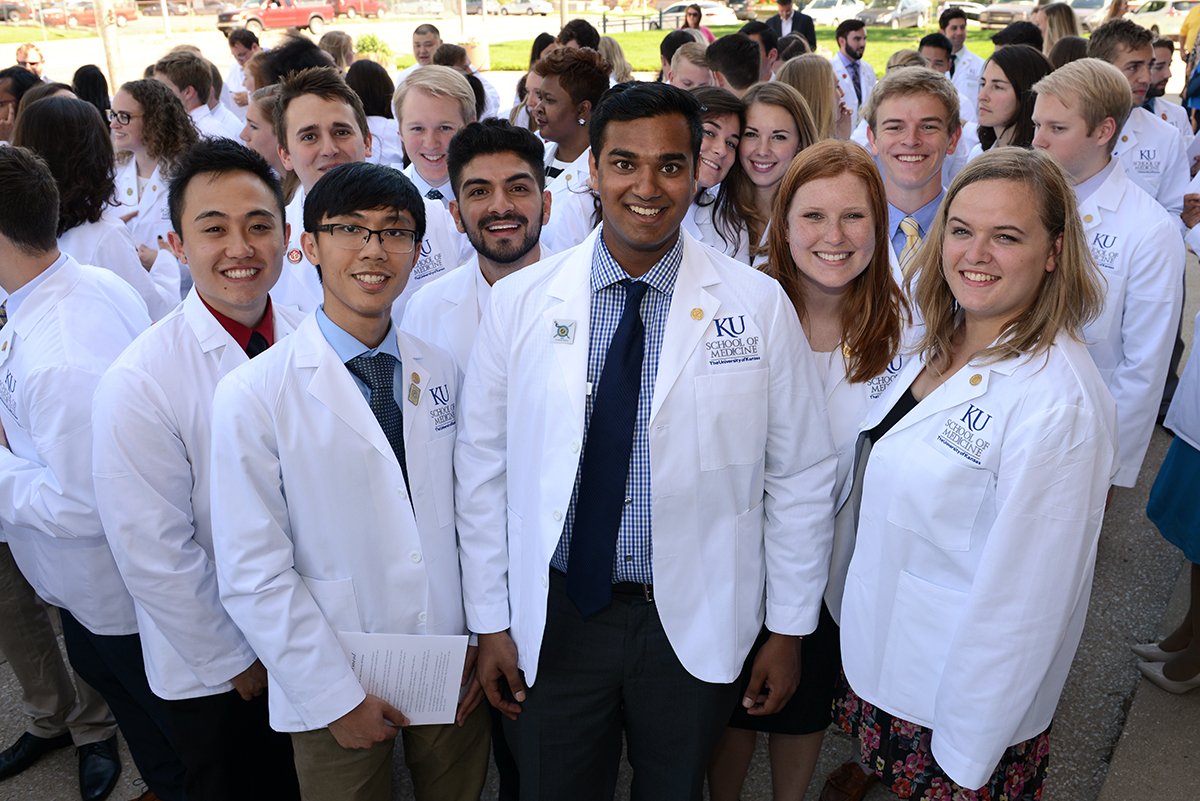
KU’s secondary is called the KUMC Supplemental Application. Applications selected for further consideration in all programs (Early Decision, Regular Decision and MD/PhD) receive an invitation to complete it online. Key facts for the 2026-2027 cycle:
- Deadlines: August 15 for invited EDP applicants, October 15 for invited MD/PhD applicants and November 15 for invited Regular Decision applicants.
- Fee: non-residents of Kansas pay a non-refundable $50 fee. The fee is waived only if your AMCAS fee waiver has been granted and is noted in AMCAS. Kansas residents pay no supplemental fee.
- File: your application folder is created once you complete the supplemental application and pay the fee if one applies. The supplemental portal includes a tracking tool for your application status.
- Length: the 2026-2027 portal shows no fixed character limit for the essay questions. Concise answers read best. Aim for about 1,000 characters per answer, including spaces, which was the limit in earlier cycles. Every example below stays under 1,000 characters.
The 2026-2027 supplemental application includes eight written questions:
| # | Question | Who answers |
|---|---|---|
| 1 | If you are not a Kansas resident, what is your specific interest in applying to the University of Kansas School of Medicine? | Non-residents |
| 2 | Please describe how your actions and experiences align with the vision statement of the University of Kansas School of Medicine: “To improve lives and communities in Kansas through innovation in education, research, and health care.” | All applicants |
| 3 | Describe your health care experiences that involved direct exposure to physicians’ clinical duties and how they have shaped your desire to apply to medical school. | All applicants |
| 4 | Describe examples of leadership experience in which you have significantly influenced others, helped resolve disputes, or contributed to group efforts over time. | All applicants |
| 5 | Beyond academics (grades and MCATs), describe the most significant challenge you have faced and the steps you have taken to address this challenge. | All applicants |
| 6 | Give an example of what you have done to make your community a better place to live. | All applicants |
| 7 | If there are academic discrepancies in your application that have not been explained in your application, use this space to clarify. Examples may include unexplained gaps in time, multiple undergraduate institutions attended, multiple course withdrawals, inconsistent academic performance, inconsistency between academic performance and MCAT scores. | Applicants with unexplained discrepancies |
| 8 | Briefly describe your current employment, community, medical, and/or educational activities. (if you answer “no” to the being a full time student question) | Applicants who are not full-time students |
There is no campus essay. You apply to the MD program, not to a campus, and you state campus preferences after admission through the school’s assignment process. You do not need to write about why you prefer Kansas City, Wichita or Salina on the supplemental application.
Conditional items you may see in the portal. Depending on your answers to the portal’s screening questions, you may also see a question for applicants enrolled in, or planning to enroll in, a graduate or professional degree program, and a question for repeat applicants. Both appeared in recent cycles. They are not confirmed as written questions for 2026-2027, so this guide gives planning advice for them below instead of full examples. If either appears in your portal, answer it exactly as written.
MD/PhD applicants. MD/PhD applicants complete the supplemental application by October 15. MD/PhD-specific questions for 2026-2027 were not published. Answer what appears in your portal, and contact the M.D.-Ph.D. program office with questions.
Before you write, make an inventory: your Kansas connection, two or three physicians you have observed closely, your hands-on patient care, one or two leadership roles, a real challenge, one community project and anything on your transcript that needs context. If your inventory shows very little hands-on patient care, consider what you can still add before interviews, such as weekly clinic volunteering or internships for pre-med students that include supervised clinical work. Never describe anything in an essay that has not happened yet.
The examples below are original teaching material written for this guide. Each one is labeled. Do not copy them. Use them to see how an answer can meet every part of a question in about 1,000 characters.
1. If you are not a Kansas resident, what is your specific interest in applying to the University of Kansas School of Medicine?
Who answers: Non-residents, including non-residents who meet a Kansas tie. Length: no fixed limit in the portal; aim for about 1,000 characters.
What it asks. Why a non-resident wants KU specifically. Because KU gives primary consideration to Kansas residents and to applicants with Kansas ties, this answer is where a non-resident shows a real reason to train, and ideally to stay, in Kansas.
Approach. Lead with your actual connection to Kansas, even if it is not a formal tie. Then name one or two verified parts of KU that match your goals, such as the required rural preceptorship, the rural clerkship options or the student-run clinics. If you meet a Kansas tie, say which one in plain words. If you do not, say so honestly and explain your plan to practice in Kansas.
Illustrative example, not an actual applicant essay
I grew up in Denver, but I spent most summers in Wichita with my grandparents. My grandmother worked as a unit clerk at a Wichita hospital for 30 years, and at her kitchen table I heard how many patients drove two or three hours from small western Kansas towns for a cardiology visit or a cancer scan. When my grandfather started dialysis, I met a man from Pratt who made an 80-mile drive three times a week for his treatments. That gap between where people live and where care is offered is the problem I want to work on, and KU is built around it. Every student completes a rural preceptorship, and options like the Rural Opportunities for Clerkships and the extended clerkship in Pittsburg let students train where physicians are scarce. I am not a Kansas resident and I do not meet a Kansas tie, so I want to be direct: I am applying because I hope to practice in Kansas, near my family, in a community that needs a physician who plans to stay.
Example length: 948 characters including spaces.
Why this example works. The answer meets the prompt’s single requirement, a specific interest in KU, in three steps. It opens with a concrete personal connection (summers in Wichita with grandparents) and describes Wichita accurately as the city where people from small western Kansas towns travel for specialty care, not as a rural place. It then names the problem the writer cares about, the distance between patients and care, with one specific example (an 80-mile dialysis drive from Pratt). Finally it links that problem to verified KU programs: the required rural preceptorship, the Rural Opportunities for Clerkships and the extended clerkship in Pittsburg. The closing sentences address the residency question directly, admit there is no formal Kansas tie and state a clear intention to practice in Kansas, which is what a state-focused committee needs to hear from a non-resident.
Mistakes to avoid. Calling Wichita rural (it is the state’s largest city); praising KU in general terms that could fit any school; claiming a Kansas tie you do not meet; writing about which campus you want, since campus preferences come after admission; and saying you want to train in Kansas without saying whether you plan to stay.
2. Please describe how your actions and experiences align with the vision statement of the University of Kansas School of Medicine: “To improve lives and communities in Kansas through innovation in education, research, and health care.”
Who answers: All applicants. Length: no fixed limit in the portal; aim for about 1,000 characters.
What it asks. Evidence that your record already reflects the school’s vision. The statement has several parts: improving lives and communities, a focus on Kansas, innovation, and three areas of work (education, research and health care).
Approach. Choose actions, not values. Map one or two experiences onto the parts of the statement, ideally in a Kansas community. You do not need to cover all three areas equally, but showing a small result or a change you helped make speaks to the word innovation better than a list of hours.
Illustrative example, not an actual applicant essay
The vision statement names three tools, education, research and health care, and I have used each one in small ways in Kansas. In health care, I have volunteered for three years as a Spanish interpreter at a free clinic in Garden City, where many patients work shifts at the meatpacking plants and miss visits when schedules change. In research, I helped the clinic’s nurse manager track no-show rates for a semester. After we added text reminders in Spanish, missed diabetes follow-ups fell from about one in four to one in seven. In education, I teach a monthly blood pressure class at my church, where I check readings and explain how to use a home cuff. None of this is large. It taught me that improving a community usually means fixing a practical barrier for a specific group of people. I want to train at KU because the school measures its success by health in Kansas, and that is the measure I want to use for my own work.
Example length: 931 characters including spaces.
Why this example works. The example organizes itself around the statement’s three areas, education, research and health care, which makes it easy for a reader to see the alignment. Each area gets one concrete Kansas action: interpreting at a Garden City free clinic, tracking no-show rates and adding Spanish text reminders, and teaching a church blood pressure class. The reminder project answers the word innovation with a measured result (missed diabetes follow-ups falling from about one in four to one in seven) rather than a claim. The writer is modest about scale, then states the lesson, that improving a community often means removing a practical barrier for a specific group. The last sentence ties that lesson back to KU’s measure of success, health in Kansas, which completes the alignment the prompt asks for.
Mistakes to avoid. Restating the vision statement in your own words without showing actions; listing many activities with no results; writing only about research or only about clinical work when you have done more; and ignoring the word Kansas, which is central to the statement.
3. Describe your health care experiences that involved direct exposure to physicians’ clinical duties and how they have shaped your desire to apply to medical school.
Who answers: All applicants. Length: no fixed limit in the portal; aim for about 1,000 characters.
What it asks. Two things: the health care experiences where you saw physicians at work up close, and how those experiences shaped your decision to apply. Both parts must be answered.
Approach. Pick one or two settings where you watched physicians closely, such as scribing, shadowing or working on a clinical team. Describe specific physician duties you observed, then explain what each one taught you about the job and how it moved your decision forward. A rural or primary care setting in Kansas is a natural fit for KU, but only if you actually had that experience.
Illustrative example, not an actual applicant essay
I first saw a physician’s full scope as a scribe in the emergency department of a Topeka hospital, where I documented about 1,200 visits over two years. I watched physicians separate a heart attack from a panic attack in minutes, and I typed the hard conversations too, including the night a doctor told a family their father would not wake up. She sat down, used his name and stopped talking long enough for them to ask questions. Later I shadowed a family physician in Colby for three weeks. In one morning she splinted a wrist fracture, managed a pregnant patient’s blood pressure and adjusted a farmer’s insulin around harvest hours. With no specialist down the hall, she owned each problem from start to finish. Those two settings showed me different sides of the same job: quick judgment, honest communication and responsibility for the person in front of you. Seeing both made me sure I want to be the physician, not the person writing the note.
Example length: 952 characters including spaces.
Why this example works. The first part of the prompt, direct exposure to physicians’ clinical duties, is covered by two settings that show different duties. The scribing role in a Topeka emergency department gives volume (about 1,200 visits) and a specific moment of physician communication. The three-week shadowing in Colby shows the breadth of rural family medicine through three concrete tasks in one morning. The second part, how the experiences shaped the decision, is answered in the last two sentences, which name what the settings had in common (judgment, communication and responsibility) and state the conclusion plainly. The rural example also connects naturally to KU’s required rural preceptorship without needing to say so.
Mistakes to avoid. Describing only your own tasks and not what the physician did; listing every shadowing day; writing a medical case summary instead of a reflection; and skipping the second half of the question about how the experience shaped your decision.
4. Describe examples of leadership experience in which you have significantly influenced others, helped resolve disputes, or contributed to group efforts over time.
Who answers: All applicants. Length: no fixed limit in the portal; aim for about 1,000 characters.
What it asks. Leadership shown through influence, conflict resolution or sustained contribution to a group. The phrase over time matters: the committee wants to see leadership that lasted.
Approach. Use one strong example rather than a list of titles. Show the situation, what you did, what changed and what you learned. If your example includes a dispute, explain how you resolved it fairly. Leadership does not require a title; a shift lead or a long-time volunteer can show it too.
Illustrative example, not an actual applicant essay
For two years I led the volunteer team at a free tutoring program for refugee high school students in Kansas City, Kansas. When I took over, we had 30 volunteers and a dispute that was splitting the group: evening tutors felt weekend tutors left sessions unplanned, and student attendance had dropped by a third. I met with each group separately, then together, and we agreed on one shared lesson log that every tutor completed after each session. I also paired each new volunteer with an experienced one for the first month. Within a semester, regular attendance rose from about 20 students to 34, and the arguments about planning stopped because the plan was visible to everyone. I learned that most conflicts on a team come from missing information, not bad intentions. I also learned to stay in a role longer than was comfortable, because the program improved most in my second year, after trust was built.
Example length: 910 characters including spaces.
Why this example works. The example answers all three parts of the prompt with a single story. It shows a dispute (evening and weekend tutors in conflict) and how the writer helped resolve it (separate meetings, a joint meeting, a shared lesson log). It shows influence on others (pairing new volunteers with experienced ones) and a measurable result (attendance rising from about 20 to 34). It also meets the phrase over time by covering two years and naming why the second year mattered. The reflection about missing information and trust gives the committee a sense of how the writer would work on a clinical team.
Mistakes to avoid. Listing several offices with no detail; describing a group’s success without your own role; leaving out the result; and choosing an example from one weekend when the prompt asks about efforts over time.
5. Beyond academics (grades and MCATs), describe the most significant challenge you have faced and the steps you have taken to address this challenge.
Who answers: All applicants. Length: no fixed limit in the portal; aim for about 1,000 characters.
What it asks. A non-academic challenge, and the specific steps you took to address it. The prompt excludes grades and test scores, so do not use a hard class or a low MCAT here.
Approach. Choose a challenge that genuinely tested you, describe it briefly and spend most of the space on your steps and what changed. Be honest about what you could and could not control. A personal loss, a family responsibility, a health problem or a difficult work situation can all work if the steps are concrete.
Illustrative example, not an actual applicant essay
When I was 17, my cousin died of diabetic ketoacidosis. He was 22, had been losing weight for months, and no one in our family in Weskan, Kansas, recognized the signs. The nearest hospital was more than an hour away, and by the time he went, he was critically ill. For a year I was angry, mostly at myself for not knowing. What helped was learning. I took a CNA course, then asked our county health nurse what I could do. With her guidance I organized two free blood sugar screening days at our county fair, staffed by her team, and handed out a one-page sheet on warning signs. Eleven people were referred for follow-up. I still miss my cousin. But I learned to turn a loss into a concrete action, to ask for help from people who know more than I do, and to respect how distance changes outcomes in rural Kansas. Those lessons are why I want to practice where care is hardest to reach.
Example length: 886 characters including spaces.
Why this example works. The example uses a serious non-academic challenge, a cousin’s death from undiagnosed diabetes in a remote Kansas town, and keeps the description short so most of the answer covers the steps taken. Those steps are specific and realistic: a CNA course, asking the county health nurse for guidance, and organizing screening days that her team staffed. A measurable result (eleven referrals) shows the steps mattered. The writer stays inside an appropriate role for a teenager and does not claim to have given medical care. The final lines name the lessons learned and connect the experience to rural Kansas, which fits KU’s mission without forcing it.
Mistakes to avoid. Using an academic setback, which the prompt excludes; spending the whole answer on the challenge and none on the steps; exaggerating your role; and ending without saying what you learned or how you changed.
6. Give an example of what you have done to make your community a better place to live.
Who answers: All applicants. Length: no fixed limit in the portal; aim for about 1,000 characters.
What it asks. One example of your own action that improved a community. The word example is singular, so depth beats breadth.
Approach. Define the community and the problem, describe what you did, give a result and explain what you learned. The project does not have to be medical. KU’s mission is about communities in Kansas, so a local project in a Kansas town is a natural fit if you have one.
Illustrative example, not an actual applicant essay
In Dodge City, my neighborhood had no grocery store within walking distance, and many families on our block did not own a car. In high school I started a community garden on an empty church lot with two friends and our youth pastor. We began with six raised beds built from donated lumber. By my senior year we had 18 beds tended by 25 families, and we gave about 400 pounds of produce to a weekly food pantry. The hardest part was not the gardening. It was keeping people involved after the first excited month, so we made a watering schedule in English and Spanish and paired older gardeners with kids who wanted to learn. In college I helped the pantry add a monthly table where a dietetics student answered questions. The garden did not solve food access in Dodge City, but it made fresh food easier to reach for a few dozen families, and it taught me that lasting change depends on shared ownership.
Example length: 904 characters including spaces.
Why this example works. The answer gives exactly one example, as the prompt asks. It defines the community (a Dodge City neighborhood without a nearby grocery store) and the problem (food access for families without cars). It shows the writer’s actions from the start of the project through college, gives concrete results (18 beds, 25 families and about 400 pounds of produce), and names the real difficulty, keeping people involved, with the practical solutions used. The final sentence is honest about limits and states a lesson, shared ownership, that also applies to clinical and community health work.
Mistakes to avoid. Listing many service activities instead of one example; describing a group project without your own role; overstating the impact; and choosing a project that ended after one day when you have a longer one.
7. If there are academic discrepancies in your application that have not been explained in your application, use this space to clarify. Examples may include unexplained gaps in time, multiple undergraduate institutions attended, multiple course withdrawals, inconsistent academic performance, inconsistency between academic performance and MCAT scores.
Who answers: Only applicants with academic discrepancies not explained elsewhere. Length: no fixed limit in the portal; aim for about 1,000 characters.
What it asks. A factual explanation of anything on your academic record that could confuse a reader, such as several schools, withdrawals, gaps or an uneven record.
Approach. If nothing on your record needs explaining, leave it blank. If something does, state the facts, give brief context, take responsibility where it is due and show what has changed since. Keep the tone plain and short.
Illustrative example, not an actual applicant essay
My transcript shows three institutions and a weak spring semester in 2023, and I want to explain both plainly. I began at a community college in Hutchinson to save money, transferred to Wichita State University after one year, and took two summer chemistry courses at a third school near my parents’ home because those courses were not offered in Wichita that summer. In spring 2023, my mother had surgery and I became the main caregiver for my two younger brothers. I withdrew from one course and earned a C in physics. I should have asked for a reduced load sooner. Since then I have completed 33 credit hours of upper-level science with a 3.8 GPA, including biochemistry and immunology, while working 15 hours a week. I share this not as an excuse but so the committee can see the context and the trend. I learned to ask for help early, and I now plan my course load around my responsibilities instead of hoping they will fit.
Example length: 929 characters including spaces.
Why this example works. The example addresses two of the listed discrepancy types, multiple institutions and inconsistent performance, and names them in the first sentence so the reader knows what is coming. It explains each one with facts: a community college start to save money, a transfer and summer courses for scheduling reasons, then a family medical situation that led to a withdrawal and a C. It takes responsibility in one sentence, then shows the trend since (33 upper-level science credits at a 3.8 while working). The last lines show what the writer learned, which reassures the committee that the problem is not likely to repeat in medical school.
Mistakes to avoid. Using this space when nothing needs explaining; blaming others; giving long personal detail; leaving out evidence of recovery; and repeating an explanation already given elsewhere in AMCAS.
8. Briefly describe your current employment, community, medical, and/or educational activities. (if you answer “no” to the being a full time student question)
Who answers: Applicants who are not full-time students. Length: no fixed limit in the portal; aim for about 1,000 characters.
What it asks. A brief, factual summary of what you are doing now: work, community activities, medical activities and education.
Approach. Cover each category that applies, with dates, hours or scale, and one or two sentences on what you are learning. The word briefly is a signal: keep it factual and organized. Include anything you will still be doing during the interview season.
Illustrative example, not an actual applicant essay
Since graduating in May 2025, I have worked full time as a medical assistant at a family medicine clinic in Kansas City, Kansas. I room about 25 patients a day, take vital signs, run point-of-care tests, give vaccines under standing orders and help Spanish-speaking patients while we wait for an interpreter. Each month I update our diabetes registry so the physicians can call patients who are overdue for an A1C test. Outside work, I volunteer four hours a week at a community food pantry and coach a middle school girls’ soccer team in the spring. Last fall I took an online medical Spanish course to build my clinical vocabulary. This year has shown me the daily work of primary care: routine visits, missed follow-ups and the small fixes that keep people healthy. It has made me more certain about medicine and more realistic about what a good clinic needs from every member of its team.
Example length: 892 characters including spaces.
Why this example works. The example follows the prompt’s four categories in order. Employment comes first, with a start date, a job title, a setting and specific supervised duties (rooming patients, vital signs, point-of-care tests and vaccines under standing orders). Medical activity includes the diabetes registry work. Community activities follow (a food pantry and coaching, with hours), then education (an online medical Spanish course). The final sentences reflect briefly on what a year in primary care has taught, which helps the committee see the year as preparation rather than waiting.
Mistakes to avoid. Writing a second personal statement; leaving out hours or dates; listing activities that ended years ago; and describing duties that go beyond your actual role or training.
Conditional Item: Graduate or Professional Degree Program Status
Who may see it: applicants who are enrolled in, or plan to enroll in during the next academic year, a graduate or professional degree program. This item appeared in recent cycles and may appear in your 2026-2027 portal if you answer yes to a graduate-enrollment question.
What it asks. Your status in the program and your intention to complete it. In recent cycles it also required a letter from your graduate program advisor or the dean of your professional school acknowledging your medical school application and describing your status. It also explained that KU expects MD students to take part full time in MD program requirements, and that outside degree programs or jobs during medical school are not compatible with the curriculum.
How to plan. If you are in a master’s or other degree program, write a factual answer that gives the program name, your start date, the credits or thesis work completed and remaining, and the date you will finish, which should be before medical school orientation in mid-July 2027. State clearly that you will complete the degree before matriculation and that you will not continue it during medical school. Ask your advisor or dean for the letter early, because it takes time. If you will not finish before July 2027, talk to the admissions office before you apply.
Mistakes to avoid. Suggesting you could finish your graduate degree during medical school; leaving out your completion date; and forgetting the advisor or dean letter.
Conditional Item: Repeat Applicants
Who may see it: repeat applicants. This item appeared in recent cycles and may appear in your 2026-2027 portal if you indicate that you applied to KU before.
What it asks. In recent cycles: the relevant academic, employment and personal experiences since your last application that make you a better future physician.
How to plan. Lead with the one or two changes that matter most, such as a higher MCAT, new upper-level science, a full-time clinical job or sustained service in Kansas. Give numbers and dates. Then explain briefly what you learned about yourself and medicine. Remember that 61 of the 211 students in the 2024 entering class were reapplicants, so a clear and honest reapplication is common at KU. Also remember the interview rules: an automatic interview is granted for only two cycles, and prior interviewees are not offered an EDP interview.
Mistakes to avoid. Listing everything you did without showing what improved; blaming the last cycle’s outcome on others; and repeating your earlier essays with small edits.
Writing Tips for Every KU Supplemental Answer
- Stay concise. The portal does not cap length this cycle, but readers see many files. About 1,000 characters is enough for a clear story with a result and a reflection.
- Use Kansas specifics. Name towns, clinics and populations you know. The vision prompt and the mission both center on Kansas.
- Do not repeat AMCAS. Use new examples or new detail where you can.
- Be accurate about KU. Mention real programs only, such as the rural preceptorship, ROC-3, the Pittsburg clerkship, Scholars in Health or the JayDoc clinics, and only when they truly connect to your goals.
- Skip campus preferences. You will state them after admission.
- Submit early. KU reviews on a conservative rolling basis, and your file is not reviewed until it is complete.
For more examples of how other schools phrase their questions, see IMA’s database of medical school secondary essay prompts.
Interview Format and Preparation
KU invites selected applicants to interview. The format is traditional, not the multiple mini interview (MMI) used at some schools.
What the School Confirms
- Format: the interview day includes two 30-minute interviews, each conducted by one or two members of the interviewer panel.
- Schedule: interviews run in two- or three-day blocks each month, from September (for EDP) through January. Regular Decision interviews run from October to January, and MD/PhD interviews take place in January and February.
- Invitations: invitations arrive by email about two to three weeks before the interview date, and more information comes with the invitation.
- Student Ambassadors: applicants can talk with current Student Ambassadors during their interview week, usually on Friday afternoons.
- Mode: all 2025-2026 interview days were virtual, with two individual 30-minute interviews, one of them open-file with a committee member. Interviewees had access to a private site with information on the admissions process and timelines, financial aid, and presentations from the Office of Student Engagement and education deans, plus virtual Q&A sessions with current students, and on-campus Second Look Days were offered at all three campuses. For 2026-2027, follow the details in your invitation.
How to Prepare
The points below are general practice guidance, not KU rules.
- Know your file cold. Two 30-minute conversations leave time for follow-up questions on your AMCAS activities and every supplemental answer. Reread them the night before.
- Prepare your Kansas story. Expect questions about why KU, why Kansas and where you hope to practice. Residents should be ready to talk about health care needs in their own region. Non-residents should be ready to explain their plan to practice in Kansas.
- Know the three campuses. You will not choose a campus at the interview, but you should know what Kansas City, Wichita and Salina offer, because campus preferences come soon after admission.
- Be ready for rural medicine. Every student completes a rural preceptorship. Think about what rural practice means to you, even if you plan to work in a city.
- Practice ethical and teamwork questions. Interviewers often ask how you would handle a disagreement on a team, a mistake or an ethical dilemma. Answer with a real example when you can.
- Use the Student Ambassador time. Ask current students about campus life, the academic societies, the student-run clinics and how campus assignment worked for them.
- Practice out loud. IMA’s list of common medical school interview questions is a good place to start.
Talking About Patients Whose Backgrounds Differ From Yours
Kansas patients include farm families hours from a hospital, meatpacking workers in southwest Kansas, refugees and immigrants in Kansas City and Wichita, and uninsured patients at the JayDoc clinics. Expect to discuss how you will work with patients whose backgrounds differ from your own. Strong answers are concrete: describe a time you used an interpreter well, adjusted an explanation for someone with limited health literacy, or learned a patient’s priorities before offering advice. Avoid general statements about valuing diversity without an example. Show that you listen first, ask about the patient’s goals and treat each person with dignity.
After the Interview
KU offers admission to a few applicants each month of Regular Decision interviews. Most interviewees learn their final status, whether acceptance, the alternate list or rejection, in mid-March. KU does not accept letters of intent or letters of interest. If you are granted an interview, you may submit one application update covering changes to your experiences, qualifications or grades since you applied, such as a new publication or a completed degree. Check your supplemental portal’s tracking tool and contact the admissions office about how to send it.
Acceptance notices go out between September 28, 2026 and March 1, 2027. You have up to two weeks to respond to an offer, and KU requires no deposit. Requests to defer entrance are considered. KU keeps one waitlist of at least 50 positions and tells applicants their numerical position on it; seats are offered as they open, and 83 offers went to waitlisted applicants in the most recent reported cycle.
Frequently Asked Questions
What is KUMC known for?
KU Medical Center, and its School of Medicine, is best known for training physicians for Kansas, especially for primary care, rural communities and underserved populations. More than 40% of its graduates enter primary care residencies. It is the only allopathic medical school in Kansas and runs campuses in Kansas City, Wichita and Salina. The medical center is also home to The University of Kansas Cancer Center, a National Cancer Institute-designated comprehensive cancer center, and to an NIH-designated Alzheimer’s Disease Research Center. If you want both a statewide clinical mission and access to major research, KU offers both.
How hard is it to get into KU Medical School?
It is competitive, and how competitive depends on residency. For the 2025 entering class, KU received 4,978 verified applications, interviewed 438 applicants and enrolled 211, and accepted applicants had a median MCAT of 510 and a median GPA of 3.90. For the 2024 entering class, KU received more than 4,700 applications, interviewed 473 applicants and enrolled 211. Kansas residents took 180 seats, non-residents with a Kansas tie took 19 and non-residents with no tie took 12. KU also publishes firm thresholds: applications with an MCAT of 496 or below are not reviewed, and residents or Kansas-tie applicants with an MCAT of 502 or higher and a BCPM GPA of 3.4 or higher, with no red flags, are automatically interviewed in Regular Decision. If you are a Kansas resident who meets those lines, your chances of an interview are strong. If you are a non-resident with no tie, apply broadly.
What is the average MCAT score for KUMC?
For the 2025 entering class, accepted applicants had a median MCAT of 510 and a mean of 509.7. KU also sets thresholds: an MCAT of 496 or below is not reviewed, and 502 is part of the automatic-interview rule for residents and Kansas-tie applicants in Regular Decision. MD/PhD applicants who succeed typically score at or above the 80th percentile. Treat 502 as a minimum target and 510 as the middle of the admitted group, and remember that the interview and your full application decide admission.
What GPA is required for KU Medical School?
KU does not list a minimum overall GPA. The science (BCPM) GPA matters most in its published rules: Kansas residents and Kansas-tie applicants with a BCPM GPA of at least 3.4 and an MCAT of at least 502, and no red flags, are automatically interviewed in Regular Decision. Applicants below 3.4 are still reviewed by a committee member. For the 2025 entering class, accepted applicants had a median overall GPA of 3.90 and a median science GPA of 3.88. The committee sees your GPA by academic year and weighs postbaccalaureate and graduate coursework, so a strong upward trend matters.
How many people apply to KU Med?
KU received 4,978 verified applications for the 2025 entering class, interviewed 438 applicants and enrolled 211. Of those applications, 425 came from in-state applicants and 4,523 from out-of-state applicants. For the 2024 entering class, KU received more than 4,700 applications, interviewed 473 applicants and enrolled 211. The Fall 2026 entering class also has 211 students.
What degree programs are offered at KUMC?
The School of Medicine offers the MD and three dual degrees: the M.D./Ph.D. Physician Scientist Training Program, the M.D./Master of Public Health and the M.D./Master of Health Services Administration. It also offers graduate research and professional degrees in the biomedical sciences, population health, biostatistics and clinical research. Across KU Medical Center, the schools of Nursing and Health Professions offer programs such as nursing, physical therapy, occupational therapy, audiology, genetic counseling and health information management. KU does not list an MD/MBA program.
Are there PA Schools in Kansas associated with KUMC?
No. KU Medical Center does not list a physician assistant program among its more than 50 degree programs. Students interested in becoming a PA should look at PA programs at other Kansas and nearby universities. If you are still deciding between PA and MD, hands-on clinical work helps you compare the two careers, and IMA’s pre-PA internships are one way to get supervised clinical experience.
What opportunities are available for clinical training at KUMC?
KU students train at The University of Kansas Health System in Kansas City; at Robert J. Dole VA Medical Center, Wesley Medical Center and Ascension Via Christi in Wichita; and at Salina Regional Health Center and rural physicians’ offices in Salina. All students complete a four-week rural preceptorship in the senior year. Optional programs include the Rural Enrichment Week, the STORM summer elective, rural clerkship options in pediatrics, family medicine, OB/GYN and surgery, and an extended clerkship of up to 12 months in Pittsburg, Kansas. Students also volunteer in the JayDoc and BullDoc student-run clinics.
What support services are available for students at KU Medical School?
The School of Medicine Office of Student Affairs supports students’ personal, academic and professional development. KU Medical Center offers psychological and educational support services at no cost, academic accommodation services, belonging programs and financial aid counseling. Each student also joins one of eight academic societies, which provide a smaller community within the class. Ask about current housing resources for your campus once you are admitted.
How does KUMC prepare students for a career in healthcare?
Through the ACE curriculum, which combines foundational science with early clinical skills in years one and two, core clerkships in year three and a personalized fourth year that includes Critical Care, a Sub-Internship and a Rural Preceptorship. Students train across urban, community-based and rural settings, practice in simulation centers, and serve patients in student-run clinics. The Wichita campus alone hosts 17 accredited residency and fellowship programs, which shows how closely training is tied to graduate medical education in Kansas.
Do I apply to a specific KU campus?
No. You apply to the KU School of Medicine MD program. After admission, you take part in the campus selection and assignment process and indicate your preferences. Because each campus has limited capacity, your first choice cannot be guaranteed. The Fall 2026 entering class placed 175 students in Kansas City, 28 in Wichita and 8 in Salina.
What counts as a “Kansas tie”?
A non-resident has a Kansas tie if they currently live and work in Kansas, have a parent who currently lives in Kansas, graduated from a Kansas high school, graduated from a Kansas four-year college, or have a parent who graduated from or is on the faculty of the KU School of Medicine. Kansas-tie applicants receive the same priority interview review and the same automatic-interview rule as Kansas residents.
Does KU accept international or DACA applicants?
KU considers only U.S. citizens, U.S. permanent residents and applicants with approved DACA status. Non-citizens must submit a copy of their permanent resident card or DACA approval, and verification of permanent resident status is required before an interview is offered. International applicants are not considered.
Does KU require CASPer or PREview?
No. KU does not require CASPer or another situational judgment test for the 2027 application cycle. KU is exploring the AAMC PREview exam for future use, but PREview will not be used in this cycle’s admissions decisions. Watch your supplemental instructions in case that changes.
Is there a character limit on the KU secondary essays?
The 2026-2027 supplemental portal shows no fixed character limit. Concise answers still read best. Aim for about 1,000 characters per answer, including spaces, which was the limit in earlier cycles, and spend the space on specific examples rather than general statements.
How much is the KU secondary fee?
Non-residents of Kansas pay a non-refundable $50 supplemental application fee. It is waived only if you have an approved AMCAS fee waiver noted in your AMCAS application. Kansas residents pay no supplemental fee.
Does KU accept pass/fail or online prerequisite courses?
Yes, with a preference. KU accepts Pass/Fail and Credit/No Credit grades for prerequisites but prefers letter grades, so consider how an ungraded course affects your science and cumulative GPA. Online coursework and online labs are acceptable.
How many letters of recommendation does KU require?
Three to five, and KU strongly recommends five. A committee letter is not required. If your advisor writes a summary letter, add two to four letters from faculty, supervisors or others who know you well. Send letters through the AMCAS Letter Service by August 15 for EDP or November 15 for Regular Decision and MD/PhD.
When will I hear back from KU?
EDP applicants are notified by October 1. In Regular Decision, KU offers admission to a few applicants each month of interviews, and most interviewees learn their final status in mid-March. Acceptance notices for this cycle go out between September 28, 2026 and March 1, 2027. Decisions arrive by email and can be an acceptance, a place on the alternate list or a rejection.
Does KU have an early assurance program?
Yes. Scholars in Health identifies Kansas undergraduates from rural and urban areas who want to practice in those communities. Participants complete 100 hours of mentored shadowing in their junior and senior years, and those who complete the program and School of Medicine requirements receive guaranteed admission to the next entering class after graduation.
How much clinical experience do I need for KU?
KU requires health care experience through shadowing, volunteering or employment but sets no minimum number of hours. Aim for steady, hands-on experience over time plus close observation of physicians, because one supplemental question asks about physicians’ clinical duties directly. Paid clinical jobs, regular clinic volunteering and supervised medical internships for undergraduates can all build that record if you can describe what you did and learned.
What is the acceptance rate at KU School of Medicine?
No acceptance rate is published, because no total count of acceptance offers is reported. What is published is the funnel: for the 2025 entering class, 4,978 verified applications, 438 interviews and 211 matriculants. That means about 9% of applicants were interviewed. Dividing matriculants by applicants would not give an acceptance rate, because some admitted applicants enroll elsewhere.
How much does KU School of Medicine cost in total?
For 2026-2027, Kansas City tuition is $21,842.80 per semester for Kansas residents and $36,452.90 per semester for non-residents, plus campus fees. The full first-year cost of attendance, including living expenses, was $77,850 for residents and $108,342 for non-residents in 2025-2026. Indebted graduates in 2024-2025 left with an average medical school debt of $185,036.
Does KU require a deposit or accept letters of intent?
KU requires no deposit, and you have up to two weeks to respond to an offer. KU does not accept letters of intent or interest. After an interview, you may submit one update covering new experiences, qualifications or grades.
How many Kansas residents are in the class?
Most of the class. In the 2024 entering class, 180 of 211 matriculants were Kansas residents. In the 2025 entering class, 171 of 211 were in-state under the AAMC’s classification. In the Fall 2026 entering class, 91% of students have ties to Kansas.
How small is the Salina campus?
Very small by design. The Salina campus admits eight students a year and calls itself the smallest four-year medical education site in the country. In Fall 2026, 34 MD students were enrolled there across all four years. It is aimed at students with a strong desire to practice in rural areas.
Does KU offer an MD/MBA?
No. KU’s dual degrees are the M.D./Ph.D., M.D./MPH and M.D./MHSA. The M.D./MHSA (Master of Health Services Administration) is the closest option for students interested in health care management.
Related Medical School Guides
These guides cover schools that KU applicants often compare. They are grouped by geography and degree, not by selectivity.
- Creighton School of Medicine: a private Midwestern MD school in nearby Omaha, Nebraska, useful as a regional option for Kansas applicants.
- Indiana University School of Medicine: another large public, multi-campus Midwestern MD school, a good comparison for KU’s one-school, three-campus model.
- UMKC School of Medicine: the public MD school across the state line in Kansas City, Missouri, so its clinical settings overlap the same metro area.
- University of Minnesota Medical School: a public Midwestern medical school with more than one campus, a useful comparison for applicants drawn to KU’s statewide mission.
- Rosalind Franklin Chicago Medical School: a private MD school in the Chicago area, a useful comparison for applicants who are looking beyond public, residency-focused schools.
- Wright State University Boonshoft School of Medicine: a community-based public MD school in Ohio, similar in spirit to KU’s community-based Wichita campus.
For a side-by-side look at every program in the state, see IMA’s guide to medical schools in Kansas.
DO Programs in Kansas and Surrounding Regions
Kansas and its neighbors also offer osteopathic (DO) programs. If you are drawn to the Midwest and to a DO degree, these schools are worth a look alongside KU:
- Kansas College of Osteopathic Medicine (KansasCOM): a DO school in Wichita, Kansas.
- Kansas City University (KCU): a DO school in Kansas City, Missouri, close to KU’s Kansas City campus.
- A.T. Still University Kirksville College of Osteopathic Medicine: in Kirksville, Missouri, the founding school of osteopathic medicine.
- Des Moines University College of Osteopathic Medicine: in Iowa, another long-established Midwestern DO program.
Explore Beyond the Borders
Expanding your search beyond the Midwest can turn up programs that fit your goals. Compare location, cost, research, community service and clinical rotation sites as you build a balanced list.
Your Ideal DO School
Choosing a DO program involves more than geography. Look for a school where your interest in whole-person care, community service and personal growth can grow, and where the clinical training matches the kind of physician you want to be.
More Medical School Guides
Researching each school’s mission, requirements and training sites helps you find programs that fit your goals. IMA’s guides to other schools:
- Charles R. Drew University of Medicine and Science College of Medicine
- Loma Linda University School of Medicine
- John A. Burns School of Medicine (JABSOM)
- Kansas College of Osteopathic Medicine (KansasCOM)
- UC Irvine School of Medicine
- Nova Southeastern University College of Allopathic Medicine
- Touro University Nevada College of Osteopathic Medicine
- University of Miami Miller School of Medicine
- Arkansas College of Osteopathic Medicine (ARCOM)
- University of Arkansas for Medical Sciences (UAMS)
- Tulane University School of Medicine
- LSU Health New Orleans School of Medicine
- LSU Shreveport Medical School
- Kirk Kerkorian School of Medicine at UNLV
- University of Nevada Reno School of Medicine
- University of Arizona College of Medicine-Tucson
- University of Arizona College of Medicine-Phoenix
- Burrell College of Osteopathic Medicine (BCOM)
- The University of New Mexico School of Medicine
- Alabama College of Osteopathic Medicine (ACOM)
- University of South Alabama College of Medicine
- University of Alabama School of Medicine
- FIU College of Medicine
- UCF College of Medicine
- USF Morsani College of Medicine
- Florida State University College of Medicine
- Morehouse School of Medicine
- Medical College of Georgia at Augusta University
- Mercer University School of Medicine (MUSM)
- Campbell University School of Osteopathic Medicine (CUSOM)
- ECU Brody School of Medicine
- Edward Via College of Osteopathic Medicine (VCOM)
- University of South Carolina Medical School
- Lewis Katz School of Medicine at Temple University
- Philadelphia College of Osteopathic Medicine (PCOM)
- Geisinger Commonwealth School of Medicine (GCSOM)
- Penn State Medical School
- CUNY School of Medicine
- SUNY Downstate Medical School
- NYIT College of Osteopathic Medicine
- NYU Long Island School of Medicine
- Albany Medical College
- TOURO College of Osteopathic Medicine
- Norton College of Medicine at Upstate Medical University
- Jacobs School of Medicine at the University at Buffalo
- Hofstra Zucker School of Medicine
- Weill Medical College of Cornell University
- University of Rochester Medical School
- Icahn School of Medicine at Mount Sinai
- Renaissance School of Medicine at Stony Brook University
- Albert Einstein College of Medicine
- Ohio University Heritage College of Osteopathic Medicine
- Northeast Ohio Medical University (NEOMED)
- University of Cincinnati College of Medicine
- University of Toledo College of Medicine
- Wright State University Boonshoft School of Medicine
- Ohio State University College of Medicine
- Rowan University School of Osteopathic Medicine
- Hackensack Meridian School of Medicine (HMSOM)
- Rutgers New Jersey Medical School (NJMS)
- Rutgers Robert Wood Johnson Medical School
- Cooper Medical School of Rowan University (CMSRU)
- A.T. Still University Kirksville College of Osteopathic Medicine
- Saint Louis University School of Medicine
- University of Missouri Medical School
- Kansas City University (KCU)
- UMKC School of Medicine
- New York Medical College
- University of Pittsburgh School of Medicine
- University of Wisconsin Medical School
- VCU School of Medicine
- University of Maryland School of Medicine
- Case Western Medical School
- University of North Carolina Medical School
- University of Florida Medical School
- Emory University School of Medicine
- Boston University College of Medicine
- California University of Science and Medicine
- UC San Diego Medical School
- California Northstate University College of Medicine
- Touro University of California
- CHSU College of Osteopathic Medicine
- UC Davis School of Medicine
- Harvard Medical School
- UC Riverside School of Medicine
- USC Keck School of Medicine
- UT Southwestern Medical School
- Long School of Medicine at UT Health San Antonio
- University of the Incarnate Word School of Osteopathic Medicine
- UT Austin’s Dell Medical School
- UTMB School of Medicine
- McGovern Medical School at UT Health
- Johns Hopkins School of Medicine
- The University of Texas Rio Grande Valley School of Medicine
- UNT Texas College of Osteopathic Medicine
- University of Houston College of Medicine
- Texas A&M College of Medicine
- Baylor College of Medicine
- George Washington University School of Medicine
- Vanderbilt University School of Medicine
- St. George’s University School of Medicine
- Lake Erie College of Osteopathic Medicine (in Pennsylvania)
- Sidney Kimmel Medical College at Thomas Jefferson University
- Wake Forest University School of Medicine
- Western University of Health Sciences (in California)
- Drexel University College of Medicine
- Stritch School of Medicine at Loyola University Chicago
- Georgetown University School of Medicine
- Yale School of Medicine
- Perelman School of Medicine
- UCLA Medical School
- NYU Medical School
- Washington University School of Medicine
- Brown Medical School
How International Medical Aid Can Help
International Medical Aid (IMA) supports pre-health students who want structured clinical experience and guidance through the application process.
- Clinical internships abroad: IMA’s pre-med internships abroad place students in clinical settings in Kenya and other sites, where interns work under supervision and help with vitals, patient intake, triage and direct care. IMA also offers pre-health internships for students still choosing between medicine and other health careers.
- Program options: IMA’s international healthcare internships cover medicine and other fields, so you can compare tracks and timing.
- Reflection and writing: an internship is most useful when you can explain what you learned. Keep a short journal of patients, teamwork and the limits of care you saw, and use it when you write supplemental answers like KU’s vision and physician-exposure questions.
- Admissions advising: IMA offers medical school admissions consulting for help with school lists, essays and interviews.
IMA is not affiliated with the University of Kansas, and taking part in an IMA program does not give anyone an admissions advantage at KU or any other school. For KU in particular, international experience works best alongside steady service and clinical work in Kansas.
Next step: to talk through your KU plan or your full school list, Book an Appointment with International Medical Aid.
Final Thoughts and Sources
Concluding Thoughts
The University of Kansas School of Medicine offers a public MD education built around one purpose: better health in Kansas. Its rules are unusually clear, and its admitted students are strong, with a median MCAT of 510 and a median GPA of 3.90 for the 2025 entering class. Kansas residents and Kansas-tie applicants come first, an MCAT of 496 or below is not reviewed, and residents or Kansas-tie applicants with a 502 MCAT and 3.4 science GPA are automatically interviewed in Regular Decision. Tuition is set per semester by campus and residency, and students learn across Kansas City, Wichita and Salina, with rural training required for everyone.
Your next step is to confirm your residency or Kansas-tie status, check your MCAT and BCPM GPA against the published lines, line up five letters and submit AMCAS by September 1, 2026, or by July 1 if you choose EDP. When your supplemental invitation arrives, answer each question with a specific Kansas example in about 1,000 characters. We wish you success as you move forward in your medical career.
Sources
Official school sources were checked on October 17, 2026, and the MSAR profile on October 18, 2026. Cohort and year labels are shown with each figure in the article.
- KU School of Medicine, Eligibility and Application Requirements (MCAT window and floor, citizenship, supplemental deadlines and $50 non-resident fee, letters, interview format): kumc.edu
- KU School of Medicine, How to Apply (EDP, Regular Decision, Kansas tie, automatic interview rule, MD/PhD criteria): kumc.edu
- KU School of Medicine, Selection Process (holistic review, vision statement, 2024 entering class applications, interviews and matriculants): kumc.edu
- KU School of Medicine, Premedical Requirements (coursework, health care experience, pass/fail and online policy): kumc.edu
- KU School of Medicine, Application Timeline (2027 application cycle dates): kumc.edu
- KU School of Medicine, M.D. Program Admission and Aid (campus assignment after admission, dual degrees): kumc.edu
- KUMC School of Medicine Tuition and Fees Guide, 2026-2027 (per-semester tuition and campus fees by campus) and About Medical Student Tuition and Fees: kumc.edu
- KU School of Medicine, Financial Aid (FAFSA code, scholarships and eligibility): kumc.edu
- KU School of Medicine, Campuses, Salina and Wichita pages (campus descriptions, Fall 2026 enrollment by campus): kumc.edu
- KU Medical Center news, “KU School of Medicine class of 2030 begins new academic journey at White Coat Ceremony,” July 24, 2026 (Fall 2026 class profile): kumc.edu
- KU School of Medicine, Curriculum (Office of Medical Education) and ACE curriculum page: kumc.edu
- Office of Rural Medical Education and Student Programs: kumc.edu
- KU School of Medicine, Clinical Education and Student-Run Clinics: kumc.edu
- KU School of Medicine, Prospective Student Programs (Scholars in Health and pipeline programs): kumc.edu
- KU School of Medicine, Accreditation (LCME status and survey dates): see the accreditation link in the Accreditation section above.
- KU School of Medicine, History; KU Medical Center About page (vision and values) and Fast Facts (enrollment, research funding): kumc.edu
- KU Medical Center, Research Centers and Institutes: kumc.edu
- KU School of Medicine Leadership and KU Medical Center Leadership Team (roles of Akinlolu Ojo, Steven Stites, Giulia Bonaminio, Mark Meyer, Laura Tatpati and Scott Owings): kumc.edu
- KU Medical Center faculty profiles of Akinlolu Ojo, Mark Meyer, Laura Tatpati, Timothy Fields, Roy Jensen and Steven Stites (kumc.edu), and the M.D.-Ph.D. program page.
- AAMC Medical School Admission Requirements (MSAR), University of Kansas School of Medicine profile, 2026 edition, accessed October 18, 2026 by subscription (2025 entering class: median and mean MCAT and GPA of accepted applicants, verified applications, interviews, matriculants, pathways, gender and background; Tuition and Student Fees survey 2025-2026 cost of attendance; LCME Part I-B 2024-2025 aid and debt; 2025 Graduation Questionnaire specialty intentions and global health; offer, deposit, deferral, waitlist, update, PREview and interview policies; affiliated hospitals; primary care share; grading).
- KU School of Medicine, Admissions Contact Us (admissions staff and office hours): kumc.edu
- KU Medical Center news, “KU alumnus Barney Graham named Federal Employee of Year for vaccine research,” October 28, 2021: kumc.edu
- KU School of Medicine, USMLE Licensing Board Exam Pass Rates (2018-19 to 2020-21): kumc.edu
- KU School of Nursing, Accreditation (CCNE): kumc.edu
- University of Kansas, Accreditation (Higher Learning Commission): see the institutional accreditation link in the Accreditation section above.
- KU Medical Center, Degree Programs list: kumc.edu
- Wikipedia biographies of Barbara F. Atkinson and Robert Simari (career dates for former KU leaders): en.wikipedia.org
- 2026-2027 supplemental questions: the school does not post its supplemental questions publicly. The wording above was confirmed from 2026-2027 applicant-reported compilations: the Student Doctor Network 2026-2027 University of Kansas School of Medicine thread (applicant posts from July 28 and 29, 2026), the Med School Insiders 2026-2027 University of Kansas listing and the MedCoach University of Kansas listing, checked October 17, 2026.