If you feel called to enter medicine as an MD, a physician assistant or a biomedical researcher, you have probably searched for “best medical schools near me” or “PA schools in Georgia,” and the Medical College of Georgia at Augusta University (MCG) has likely caught your attention. In 1828, Dr. Milton Antony led the effort that created the Medical Academy of Georgia, the school that became MCG. It is the 13th oldest medical school in the United States and was the sixth public medical school established in the country. Through wars, economic crises and constant change in medicine, it has kept training physicians for Georgia, and today it is Augusta University’s founding school and the state’s flagship medical school.
MCG’s vision reads: “MCG will be a nationally recognized leader in medicine, delivering patient-centered & technologically advanced medical education, transformative research, & exceptional clinical & preventive care, leading to healthier communities.” It has one of the five largest first-year classes in the nation, with 304 students in the Class of 2029, and nearly half of its graduates stay in Georgia to practice. Augusta University also includes the College of Nursing, the College of Allied Health Sciences and graduate programs, and MCG’s teaching hospital, Wellstar MCG Health, treats patients from all walks of life across the region.
This guide covers the 2026-2027 application cycle, for students who plan to start medical school in summer 2027. It explains MCG’s mission, campuses, 3+ curriculum, admissions requirements, costs, class statistics, all eleven secondary essay prompts with full illustrative examples, the Multiple Mini Interview and the questions applicants ask most. Facts were checked against MCG’s official pages on October 17, 2026.
Be an Informed Applicant
When it comes to applying to medical school, you cannot be too prepared or too informed. Strong medical schools are hard to get into, so you need to follow each application step carefully, write excellent essays and prepare well for the interview. This guide was written to help you prepare for the Medical College of Georgia at Augusta University and give yourself the best chance of matriculating. Read it all the way through, and reach out if you have questions.
If more schools are on your list, our medical school guides cover many other programs. If you want to apply close to home, search “medical schools near me” and then check whether we have a guide for that school. This guide was built specifically for MCG and should not be used as a guide to any other medical school.
Personalized Help
One-to-one help is one of the best ways to prepare for MCG or any medical school. Our medical school admissions consulting program was built to take some of the burden off your shoulders. Our advisors can help with your school list, primary and secondary essays and interview preparation, including mock interviews. Contact us here if you have any questions.
Key Takeaways
- Only U.S. citizens and permanent residents can be accepted. MCG requires U.S. citizenship or a valid permanent resident card to be offered acceptance, and at least the last two years of college or graduate study must be at a regionally accredited U.S. or Canadian school.
- Georgia residents get preference. About 95% of the Class of 2029 were Georgia residents, from 49 counties; only 4 of 304 students were from outside Georgia. Georgia residency must be claimed on AMCAS by November 1.
- The class profile is strong but not out of reach. The Class of 2029 had an average MCAT of 512 and an average overall GPA of 3.8, and accepted applicants for that 2025 entering class had a median MCAT of 513 and a median GPA of 3.89. Applicants below a 3.0 GPA or a 496 MCAT are not considered competitive for an interview.
- Clinical experience has a number: 200 hours. MCG expects at least 200 hours of clinical experience, plus demonstrated community service and three current letters of recommendation.
- Three ways to apply. Early Decision (Georgia residents only, binding; AMCAS by August 1, 2026), Regular Decision (AMCAS by November 1, 2026) and the Regional Clinical Campus Admissions Pathway for the Northwest or Southwest campus (AMCAS by October 30, 2026).
- The secondary is free and fast. MCG sends its secondary to applicants once it receives the AMCAS application, charges no extra fee and asks for it back within two weeks (one week for Early Decision). There are six required and five optional prompts, each with a 300-word limit.
- Costs are moderate for residents. 2026-27 tuition is $15,024 per semester for Georgia residents and $31,956 per semester for out-of-state students, plus $1,012.50 per semester in mandatory fees.
- Training is statewide. The 3+ curriculum lets students finish core training in three years, then choose one of four pathways, with clinical years in Augusta, Savannah or regional campuses in Albany, Rome/Dalton, Savannah/Brunswick and Marietta.
Key Statistics About the Medical College of Georgia
The snapshot below gathers the numbers applicants ask about first. Class figures are for the 2025 entering class (the Class of 2029), the newest class profile available, plus applications and positions for the Class of 2030. Tuition figures are for the 2026-27 academic year. The table gives the cohort and source of every figure.

| Metric | Value | Year or cohort | Source and definition |
|---|---|---|---|
| School and degree | Medical College of Georgia at Augusta University; MD, plus MD/PhD and dual degrees (MD/MBA, MD/MPH, MD/MCTS) | Current | MCG website; public, University System of Georgia |
| Accreditation | LCME, full accreditation; next survey 2031-32 | October 2026 | LCME directory of accredited programs; MCG home page |
| Four-year campuses | Augusta (main campus) and MCG Savannah (opened 2024, 40 students per class) | 2026 | MCG campuses and expansion page; MCG Savannah page |
| Regional clinical campuses (years 3 and 4) | Southwest (Albany/Thomasville), Southeast (Savannah/Brunswick), Northwest (Rome/Dalton), MCG Atlanta (Marietta) | 2026 | MCG 2026 Fact Sheet |
| Matriculated students | 304 | Class of 2029 (entered 2025) | MCG 2025 Admissions Fact Sheet |
| Total applications | 3,367 | Class of 2029 | MCG 2025 Admissions Fact Sheet |
| Applications and positions | 3,440 applications for 264 positions | Class of 2030 (entering 2026) | MCG campuses and expansion page |
| Applications by residency | 1,379 Georgia; 1,984 out-of-state; 5 international | 2025 entering class (Class of 2029) | AAMC MSAR 2026; verified AMCAS applications |
| Interview invitations | About 640 per year | Annual figure | MCG Interviews page; invited applicants, not offers |
| Applicants interviewed | 646 (616 Georgia, 30 out-of-state), about 19% of applications | 2025 entering class (Class of 2029) | AAMC MSAR 2026; interviewed out of applications, not an acceptance rate |
| Median MCAT | 513 (mean 513.3) | 2025 entering class (Class of 2029) | AAMC MSAR 2026; all accepted applicants |
| Median overall GPA | 3.89 (mean 3.84) | 2025 entering class (Class of 2029) | AAMC MSAR 2026; all accepted applicants |
| Median science GPA | 3.86 (mean 3.79) | 2025 entering class (Class of 2029) | AAMC MSAR 2026; all accepted applicants |
| Average MCAT | 512 | Class of 2029 | MCG 2025 Admissions Fact Sheet; matriculants; an average, not a minimum |
| Average overall GPA | 3.8 | Class of 2029 | MCG 2025 Admissions Fact Sheet; matriculants |
| Average science GPA | 3.8 | Class of 2028 | MCG Admissions FAQs; matriculants |
| Georgia residents | 95% (300 of 304; 4 non-Georgia residents), from 49 counties | Class of 2029 | MCG 2025 Admissions Fact Sheet and 2026 Fact Sheet |
| Out-of-state seats | At most 5% of the incoming class | 2026-2027 cycle | AAMC MSAR 2026; admissions policy |
| Acceptance rate | Not published | n/a | No offer count is published by MCG or in AAMC MSAR 2026, only applications, interviews and matriculants |
| Interview competitiveness guideline | Below a 3.0 GPA or 496 MCAT: not considered competitive for interview | 2026-2027 cycle | MCG Application Process page |
| Tuition, Georgia residents | $15,024 per semester (12 or more hours) | 2026-27 (Fall 2026 to Summer 2027) | Augusta University Tuition and Fees, Doctor of Medicine |
| Tuition, out-of-state | $31,956 per semester (out-of-country $32,880) | 2026-27 | Augusta University Tuition and Fees, Doctor of Medicine |
| Mandatory fees | $1,012.50 per semester | 2026-27 | Augusta University Tuition and Fees, Doctor of Medicine |
| Total first-year cost of attendance | $70,271 Georgia residents; $102,577 out-of-state | 2025-26 | AAMC MSAR 2026 (AAMC Tuition and Student Fees survey); tuition, fees, living costs and health insurance |
| Average debt of indebted graduates | $168,146; 72% of students receive aid | 2024-25 | AAMC MSAR 2026 (LCME Part I-B) |
| Secondary fee and deposit | No secondary fee; no deposit | 2026-2027 cycle | AAMC MSAR 2026; MCG admissions pages |
| Residency match | 98% had a residency position as of Match Day; 269 matched in 30 specialties in 29 states | Class of 2026 | MCG 2026 Fact Sheet |
The number of applicants who receive offers is not published, so any “MCG acceptance rate” you see elsewhere is an estimate or a different ratio. The 304 students who enrolled in the Class of 2029 equal about 9% of the 3,367 applications. That is a matriculation ratio, not an acceptance rate, because some admitted applicants choose other schools. The clearer signal is the interview stage: 616 of the 1,379 Georgia applicants interviewed for the 2025 entering class, compared with 30 of the 1,984 out-of-state applicants. The averages and medians describe admitted and enrolled students. They are not cutoffs.
Mission and Educational Priorities
MCG’s current mission is: “To lead the primary & specialty healthcare needs of Georgia & beyond, with an emphasis on caring for underserved communities, by delivering excellence in individualized medical education, transformative research, innovative patient care & community engagement.” Its vision is: “MCG will be a nationally recognized leader in medicine, delivering patient-centered & technologically advanced medical education, transformative research, & exceptional clinical & preventive care, leading to healthier communities.”
The mission has three practical messages for applicants. First, Georgia comes first. MCG gives preference to Georgia residents, and its selection guidelines list the applicant’s region of residence “with respect to its health professional needs” and “commitment to practice in an underserved area of Georgia” among the factors the committee considers. Second, primary care and specialty care both count. The mission names both, and 30 to 40 percent of MCG graduates practice primary care. Third, underserved communities are central. Two of the six required secondary prompts ask about underserved communities and Georgia’s health needs.
Why the Medical College of Georgia?
MCG is the state’s flagship medical school and Georgia’s leading producer of physicians. One in five Georgia physicians either attended MCG or completed residency at Wellstar MCG Health. With one of the nation’s top five largest first-year classes, it sends more physicians into the workforce than most medical schools, and nearly half of its graduates stay in Georgia to practice. MCG and Wellstar MCG Health together form the state’s only publicly funded academic medical center. Georgia now has a second public medical school as well: the University of Georgia School of Medicine in Athens, which received preliminary LCME accreditation in 2026.
Core values
MCG lists six core values. Each is described by the behaviors it should produce:
- Collegiality: reflected in collaboration, partnership, sense of community and teamwork.
- Compassion: reflected in caring, empathy and social responsibility.
- Excellence: reflected in distinction, effectiveness, efficiency, passion, quality and impact.
- Inclusivity: reflected in diversity, equality, fairness, impartiality and respect.
- Integrity: reflected in accountability, ethical behavior, honesty and reliability.
- Leadership: reflected in courage, honor, professionalism, transparency and vision.
MCG chose the Class of 2029 on criteria that include intellectual curiosity, health care experience, leadership, service to others and commitment to Georgians’ health needs, and it describes the class as reflective of these six values. In your application, show them through what you have done rather than naming them. A story about owning a mistake shows integrity better than the word itself.
How the mission shapes admissions
MCG evaluates applicants holistically and follows the AAMC experiences, attributes and metrics model, looking for qualified students who align with its mission. Its admissions pages say applicants should show genuine interest in health care through meaningful volunteering, clinical shadowing, research and community service, and that the committee looks for activities that are “thoughtful, consistent, and reflective.” The same pages list a consideration called “Demonstrate Commitment to Practice Medicine in the State of Georgia.” For an applicant, that means your activities, essays and interview answers should tell one consistent story about who you want to serve and where.
Accreditation and Institutional Identity
The MD program at the Medical College of Georgia is fully accredited by the Liaison Committee on Medical Education (LCME), the accreditor for MD programs in the United States and Canada. Its status is full accreditation, and its next LCME survey is scheduled for 2031-32. Accreditation means the program meets national standards. It is not a ranking or a guarantee of any outcome.
MCG is part of Augusta University, a public research university in the University System of Georgia, and is the university’s founding school. Its history explains its names. The Georgia legislature chartered the Medical Academy of Georgia in 1828, renamed it the Medical Institute of Georgia in 1829 and the Medical College of Georgia in 1833, the year the first MD degrees were awarded. In 2013, a university consolidation created Georgia Regents University, now Augusta University, and the medical school kept the name Medical College of Georgia.
Recent changes matter for 2026-2027 applicants:
- MCG Savannah opened in July 2024 as a four-year campus with Georgia Southern University and St. Joseph’s/Candler Health System, raising the first-year class to 304.
- MCG Atlanta opened on August 26, 2025, as a two-year clinical campus at Wellstar Kennestone Regional Medical Center in Marietta.
- The Athens campus was a four-year MCG campus run with the University of Georgia from 2010. In 2026 it transitioned to the UGA School of Medicine, and MCG graduates its last Athens-based class in 2029.
- The teaching hospital is now Wellstar MCG Health, a Level I Trauma Center and Advanced Comprehensive Stroke Center in Augusta.
The Medical College of Georgia is not the same institution as the Dental College of Georgia, the College of Nursing or the College of Allied Health Sciences, which are separate Augusta University colleges with separate applications.
Medical Programs and Affiliations
MCG offers one MD program delivered across several campuses, plus combined degrees and special admissions pathways. Every MD applicant files one AMCAS application. There is no separate application for each campus.
Campuses and how assignment works
- Augusta (main campus, since 1828). The largest campus, with 812 of MCG’s 1,132 medical students in 2026. Students here complete the pre-clerkship phase in Augusta and may be assigned to a regional clinical campus for their clinical years.
- MCG Savannah (opened 2024). A four-year campus developed with Georgia Southern University and St. Joseph’s/Candler Health System, with 40 students per class. Students complete preclinical training on Georgia Southern’s Armstrong Campus and continue with clinical training across the Southeast Campus.
- Regional clinical campuses for years 3 and 4: the Southwest Campus in Albany and Thomasville (opened 2005, capacity 40), the Southeast Campus in Savannah and Brunswick (residential since 2011, capacity 80), the Northwest Campus in Rome and Dalton (opened 2013, capacity 40) and MCG Atlanta in Marietta (opened 2025, capacity 48).
After acceptance, MCG emails every admitted student a campus preference request. Preference is strongly considered but not guaranteed, except that Early Decision admits are guaranteed their campus preference. Applicants are told their campus assignment before matriculation.
The MCG 3+ program
MCG launched its 3+ curriculum in fall 2020. “3+” means three years to complete the core MD curriculum, plus a career-focused pathway to finish the degree. The redesign had three goals: guide more students into primary care careers in Georgia, bring the strengths of MCG’s case-based learning track in Athens and its longitudinal integrated clerkship track in Rome into the whole MD program, and give students several fourth-year options that smooth the move into residency. Students choose a pathway after they matriculate. There are four:
Georgia PGY-1 Pathway (MCG’s primary care pathway)
Students finish the MD in three years and move straight into the first year of an affiliated primary care residency (PGY-1). There are two options. The first is scholarship-supported: the Peach State Scholars, in one of seven specialties (emergency medicine, family medicine, internal medicine, obstetrics and gynecology, pediatrics, psychiatry and surgery). Two years of scholarship carry a requirement of two years of practice in underserved Georgia after residency. The second option has no scholarship and is available to students who complete clerkships and residency in internal medicine, family medicine or psychiatry at the Northwest or Southwest regional campus.
Dual-Degree Pathway
Students earn the MD and a master’s degree in four years with no additional tuition, by arranging clerkship and enrichment courses around the master’s coursework. The options are the Master of Business Administration (MBA), Master of Public Health (MPH) and Master of Clinical and Translational Science (MCTS), offered with other Augusta University colleges. Students enroll after their first two years of the MD. Regional campus students can enroll in the MPH and MCTS but not the MBA. This route suits students who want to lead health systems, work in public health or run clinical research.
Advanced Residency Preparation Pathway
Most students complete the MD this way. Core training is finished in three years, and the fourth-year enrichment phase adds electives in the student’s chosen specialty to build readiness for residency, with career mentoring from faculty.
Advanced Research Pathway
Every MCG student completes a scholarly project as a graduation requirement. Students who want deeper research experience can complete most of the core curriculum in three years and add up to five consecutive months of research during the enrichment phase.
MD/PhD program
The University System of Georgia MD/PhD Program, based at MCG, trains students in the research and clinical skills needed to turn research findings into clinical care. It takes seven to eight years, was founded in 1995 and is co-directed by Lawrence Layman, MD, and David Stepp, PhD. Unlike many MD/PhD programs with one fixed entry point, it allows students to enter at different stages of their medical education. MCG had 18 MD/PhD students in 2026, and the program’s graduates hold academic posts at institutions such as the Mayo Clinic, Emory, Yale and the National Institutes of Health. It is designed for students who want a career in biomedical research or academic medicine.
Special admissions pathways
- Early Decision Program (EDP). Binding and open only to Georgia residents. Competitive EDP applicants have an MCAT of 509 or higher and a total GPA of 3.7 or higher (GPAs from 3.65 to 3.69 round to 3.7). EDP applicants may not apply to other medical schools until MCG decides.
- Regional Clinical Campus Admissions Pathway. Introduced for the 2025-2026 cycle for applicants committed to the Northwest or Southwest campus. Accepted students spend the pre-clerkship phase in Augusta and then move to their chosen regional campus. Qualified pathway applicants receive admissions preference, and 21 students in the Class of 2029 entered through it (13 Northwest, 8 Southwest).
- Assurance in Medicine (AIM). A longitudinal program for Georgia undergraduates from underserved backgrounds at nine University System of Georgia schools located near MCG’s regional campuses: Albany State, Augusta, Clayton State, College of Coastal Georgia, Columbus State, Dalton State, Georgia Southern, Savannah State and Valdosta State. It includes two four-week summer residential programs at MCG and early assurance admission for students who meet program requirements.
- Early Assurance Pathway through the MS in Medical Physiology. Students in Augusta University’s two-semester MS in Medical Physiology can earn early assurance to the MD by keeping a cumulative GPA of 3.2 or higher with no grade below a B, following the Advanced Coursework Pathway and completing at least 20 hours of clinical exposure or service. No extra interview or MCAT retake is required, and these students are guaranteed a campus assignment.
Physician Assistant program at Augusta University
Augusta University’s Master of Physician Assistant program is offered by the College of Allied Health Sciences, not by MCG. Physician assistants are medically trained and licensed to treat illnesses, plan prevention strategies and write prescriptions, and the program puts its heaviest emphasis on clinical work with patients. It has its own application and requirements. If you are weighing the PA route as an alternative, pre-PA internships can help you test that path with supervised patient care before you commit.
Clinical affiliations
MCG’s teaching hospital is Wellstar MCG Health in Augusta. On the same medical campus are Wellstar Children’s Hospital of Georgia, a Level II Pediatric Trauma Center, and the Wellstar Georgia Cancer Center. Statewide, MCG trains students at more than 350 urban and rural sites, including St. Joseph’s/Candler in Savannah, the Southeast Georgia Health System in Brunswick, Phoebe Putney in Albany, Wellstar Kennestone in Marietta and hospitals and practices in Rome and Dalton. A network of federally qualified and community health centers gives students team-based primary care experience in underserved areas, and Augusta University coordinates the Georgia Statewide Area Health Education Centers (AHEC) Network, which addresses health workforce shortages in rural and underserved parts of the state.
Curriculum Overview
MCG’s curriculum is broad-based and designed to prepare graduates for any field of medicine. The 3+ structure has three phases: pre-clerkship, clerkship and enrichment.
Pre-clerkship phase (about 18 months)
The pre-clerkship phase builds foundational medical knowledge, clinical skills and an understanding of patient care systems. It takes about 18 months. Regional Clinical Campus Pathway students complete it in Augusta before moving to their regional campus. The phase includes:
- A modular course structure with regular assessments.
- Small-group and case-based learning (CBL).
- Simulation and standardized patient experiences.
- Guided academic advising and support.
- Opportunities for research, observerships and telemedicine coursework.
The phase includes MCG’s YOU+ course and preparation for CBSE and USMLE testing. Although most of this phase is classroom-based, students are introduced to clinical settings and electronic medical records early. This approach balances the weight of academic learning with clinical work, which has long been part of how MCG explains its curriculum.
Clerkship phase
The clerkship phase is full-time clinical training under faculty supervision across MCG’s campuses and clinical sites. Most clerkships run in six-week blocks:
| Clerkship | Length and structure |
|---|---|
| Family and Community Medicine | Six weeks |
| Internal Medicine | Three weeks of general medicine plus three weeks of subspecialty |
| Neurology | Three weeks, paired with Psychiatry in a six-week block |
| Psychiatry and Health Behavior | Three weeks, paired with Neurology |
| Obstetrics and Gynecology | Six weeks |
| Pediatrics | Six weeks |
| Surgery | Three weeks of general surgery plus three weeks of subspecialty |
Each clerkship ends with required assessments, including NBME subject exams. During this phase, students declare a sponsoring department that matches the specialty they plan to pursue. That department then advises them on residency preparation and graduation planning.
Enrichment phase
The enrichment phase lets students complete remaining required courses while building a schedule around their residency goals. It includes required fourth-year courses, electives, away rotations arranged through the AAMC’s Visiting Student Learning Opportunities (VSLO) system and scholarly projects. Students on the Georgia PGY-1 Pathway earn the MD in three years and go straight into residency instead of a fourth year. Students on the Advanced Research Pathway use part of it for up to five consecutive months of research.
How the experience differs by campus and track
- Northwest Campus (Rome and Dalton) uses a longitudinal integrated curriculum. Instead of rotating through one specialty at a time, students follow patients and preceptors across disciplines over months, a model that stresses patient-centered care and tends to produce more primary care physicians. Each student has more than a thousand patient contacts, and no student must leave the campus for a clinical rotation.
- MCG Atlanta offers a traditional track curriculum with 24 students per cohort. Inpatient rotations are mainly at Wellstar Kennestone Hospital, a tertiary-care Level I Trauma Center, with ambulatory experiences across the region.
- Southwest and Southeast campuses offer all required clerkships with one-on-one teaching from community physicians and volunteer clinical faculty.
- MCG Savannah students follow the 3+ curriculum, with preclinical training on Georgia Southern’s Armstrong Campus.
Scholarship and assessment
The scholarly project is a graduation requirement for every MCG student, and research opportunities begin early. Assessment combines regular module exams in the pre-clerkship phase, NBME subject exams and clinical evaluations in clerkships and the USMLE licensing exams required of all U.S. MD students. All students must also meet MCG’s technical standards for admission, matriculation, continuation and graduation. These cover five areas: observation; communication; motor function and coordination; conceptualization, integration and quantitation; and behavioral and social attributes.
Admissions Requirements and Application Process
MCG’s admissions committee looks for applicants with the academic ability, personal attributes and interests to help meet the health care needs of “a widely dispersed and highly diverse Georgia population.” The school is competitive, so prepare carefully and do your best at every step. This section separates firm requirements from the typical class profile.
What the committee considers
MCG’s selection guidelines say the committee uses, among other information:
- Responsibilities before medical school, such as work or providing financial support to a family.
- Extracurricular and community activities, physician shadowing and clinical volunteering.
- Ethnic, socioeconomic and cultural background, such as family income and education level.
- Region of residence with respect to its health professional needs.
- Commitment to practice in an underserved area of Georgia.
- Letters of recommendation.
- Motivation and potential for serving as a physician.
- Performance in MCG’s Multiple Mini Interviews.
- MCAT performance.
- College grades, including undergraduate, graduate and post-baccalaureate work.
MCG reviews applicants holistically and uses the AAMC’s premed competencies for entering medical students, such as service orientation, teamwork, ethical responsibility, resilience and adaptability, and scientific and quantitative reasoning. The committee wants applicants who are committed to serving patients with integrity, show knowledge of the medical field and behave professionally. Legacy status does not affect interview or admission decisions.
Eligibility and citizenship
- Citizenship: you must be a U.S. citizen or a permanent resident with a valid permanent resident card to be offered acceptance. Applicants without either status cannot be offered a seat.
- Where you studied: all applicants, including U.S. citizens, must have completed at least the last two years of undergraduate or graduate education at a regionally accredited U.S. or Canadian institution. Coursework from outside the U.S. must be evaluated course by course by Josef A. Silny & Associates and sent directly to MCG.
- Degree: applicants must earn a bachelor’s degree from a regionally accredited college or university before matriculation. No specific major is required. Applicants in a graduate program must finish that degree before starting medical school.
- Georgia residency: preference goes to Georgia residents. You can be classified as a resident of only one state, and you must claim Georgia residency on AMCAS no later than November 1. No residency changes are allowed afterward, and an admitted Georgia resident who later changes residency in AMCAS has the acceptance withdrawn and is reviewed again as a non-resident.
Prerequisite coursework
Required courses must be completed, or in progress, by January of the year you plan to matriculate. The Office of Admissions may approve, case by case, completing a course in a spring or summer term that ends no later than July of that year. One academic year equals two semesters or three quarters.
| Subject | Requirement | AP credit |
|---|---|---|
| Biology | One academic year of biology or zoology with lab | Not accepted |
| Chemistry | One academic year of chemistry: one semester must be organic chemistry and one semester must be biochemistry | Not accepted |
| Physics | One academic year with two semesters of lab | Accepted to place out |
| English | One academic year: English, English-based composition, writing, literature or communication; humanities courses can meet one semester | Accepted to place out |
| Statistics | One semester of probability, statistics, biostatistics or an equivalent | Accepted |
A few rules matter here:
- The chemistry requirement is specific. Many applicants assume two semesters of general chemistry and two of organic chemistry. MCG asks for one academic year of chemistry in which one semester is organic chemistry and one is biochemistry. Plan biochemistry early.
- Statistics: courses with a STAT or MATH number count automatically. Courses with other prefixes need approval as equivalent from your school’s pre-health advisor or, if there is none, a math or science department chair.
- AP credit can be used for non-biology and non-chemistry requirements if your college accepted it and it appears on your official transcript.
- Online coursework is acceptable from a regionally accredited institution.
- Grades: letter grades are preferred, and pass/fail is acceptable if the course was completed at a regionally accredited institution.
MCAT
The MCAT is required. For 2027 matriculation, your score must be no more than three years old, which means you cannot have tested earlier than January 2024. The last test date MCG accepts is June 27, 2026, for Early Decision and September 12, 2026, for Regular Decision and the Regional Clinical Campus Pathway. MCAT dates are based on when scores are released, not when you test.
MCG does not set a hard minimum score. Its official guideline is that applicants with a GPA below 3.0 or an MCAT below 496 are not considered competitive for an interview. The Class of 2029 averaged 512, and competitive Early Decision applicants have an MCAT of 509 or higher.
Clinical experience and service
The MCG Admissions Committee expects at least 200 hours of clinical experience. MCG defines clinical exposure as direct observation of or interaction with patients across a variety of health care settings, and it says these experiences help applicants gain a realistic understanding of medicine, get comfortable in clinical environments and confirm their commitment. Volunteering at health clinics, helping at vaccination events, shadowing physicians and working in patient care roles all build this record. Hours in underserved and rural parts of Georgia are especially relevant to MCG’s mission, so list them all.
MCG also expects demonstrated service to the community, pursued in a way that reflects compassion, empathy and a desire to make a positive impact. If you are short of the 200-hour expectation, clinical internships for pre-med students are one structured way to add supervised patient contact, alongside local volunteering, scribing or work as a medical assistant, CNA or EMT.
Letters of recommendation
All applicants must submit at least three current letters of recommendation through AMCAS. The committee will not review a file until all three arrive. Letters can come from science professors, a pre-health advisory committee and/or personal references, and MCG strongly recommends that one come from a physician who can speak to your preparation for medicine. Each letter needs a date and letterhead and/or a handwritten signature. MCG’s selection guidelines describe the usual mix as a letter from a premedical advisor or faculty member plus two personal references. MCG accepts three to five letters through the AMCAS Letters Service, including committee letters, letter packets and individual letters.
If something significant happens after you apply, such as a publication, an honor or major new clinical or service work, upload it to your file through the document upload feature on the secondary portal. Letters of intent can be added the same way. Updates meant for the admissions committee must be in your file by December 1, 2026.
Situational judgment tests
MCG’s 2026-2027 application requirements list the AMCAS primary, the MCG secondary, prerequisites, three letters, a valid MCAT, clinical exposure, community service and U.S. citizenship or permanent residency. They do not include CASPer, PREview or another situational judgment test, so you do not need to take one for MCG.
Technical standards
To be eligible, applicants must be able to meet MCG’s technical standards for admission, matriculation, continuation and graduation. They cover observation, communication, motor function and coordination, conceptualization, integration and quantitation, and behavioral and social attributes. In practice, students must be able to take in information accurately, integrate it, learn quickly and communicate sensitively with patients and colleagues, with reasonable accommodations where appropriate.
Primary and secondary applications
MCG uses the American Medical College Application Service (AMCAS) for the primary application and letters. If AMCAS is new to you, our AMCAS application guide walks through each section, and the AAMC’s AMCAS website has the official instructions. AMCAS processes your application and forwards it to MCG. Once MCG receives the primary, it sends a secondary application. MCG does not charge an additional application fee beyond the AMCAS fee.
Return the secondary within two weeks of receiving it (one week for Early Decision). Supplemental items include the secondary, residency documentation, required course listings and any other requested documents. Once your file is complete, the committee reviews it for an interview invitation. Reaching the interview stage is an accomplishment, and the interview is a large part of who receives an offer.
Application pathways and 2026-2027 dates
| Step | Early Decision (Georgia residents only) | Regular Decision | Regional Clinical Campus Pathway |
|---|---|---|---|
| AMCAS opens | May 28, 2026 | May 28, 2026 | May 28, 2026 |
| AMCAS application deadline | August 1, 2026 (transcripts also by August 1) | November 1, 2026 | October 30, 2026 |
| Last accepted MCAT | June 27, 2026 | September 12, 2026 | September 12, 2026 |
| Official transcripts to AMCAS | August 1, 2026 | November 15, 2026 | Follows the Regular Decision timeline |
| Return the secondary | Within one week of receipt | Within two weeks of receipt | Within two weeks of receipt |
| File complete | August 15, 2026 | December 1, 2026 | November 30, 2026 |
| Interviews | August 18, 20 and 25, 2026 | Rolling, by invitation | Rolling, plus an interview with campus leadership |
| Decisions | Usually by the second week of September; guaranteed by October 1, 2026 | Rolling, beginning in September after Early Decision | Rolling, on the Regular Decision timeline |
How each route works:
- Early Decision is binding. You must commit to MCG if accepted and cannot apply to other medical schools until MCG decides. If you are not accepted under Early Decision, you must update your application type in AMCAS to be considered in Regular Decision. For 2026-2027, Early Decision applicants can also elect the Regional Clinical Campus Pathway on the Early Decision secondary.
- Regular Decision is rolling. Reviews begin once your primary, secondary and documents are complete, and offers begin in September.
- Regional Clinical Campus Pathway applicants select “Other Special Programs” on AMCAS, choose either the Northwest or Southwest campus on the secondary and answer extra questions about that campus. The pathway is not binding; you can apply to other schools. Acceptance depends on attending the chosen campus for clinical training. Application types cannot be changed in AMCAS after the secondary is submitted. If you are not selected for the pathway, MCG still reviews you for its four-year campuses.
After you are accepted
- Offer timing and response: acceptance notices go out from October 16, 2026, through July 1, 2027. You have one week to respond to an Early Decision offer and two weeks to respond to a Regular Decision offer. No deposit is required to hold your seat.
- Campus preference: a campus preference form arrives through your application portal after an offer.
- Waitlist: waitlist offers usually begin on a rolling basis in the last week of April or first week of May and can continue until about two weeks before matriculation. Applicants are placed in quintiles based on committee ranking, and the quintile is only a starting position. Individual updates on waitlist movement are not usually available. Students selected from the waitlist must be willing to be assigned to either four-year campus, Augusta or Savannah.
- Background check: every accepted student completes an AAMC-facilitated criminal background check through Certiphi.
- Health insurance: students must carry comprehensive coverage, either the Board of Regents student plan or an equivalent plan with at least $1 million in major medical coverage, certified each year.
- Deferment: deferment is considered case by case for one year in extenuating circumstances only, and it is not available to applicants accepted from the alternate list.
- Transfer: MCG considers transfers from LCME-accredited schools case by case into the second part of the pre-clerkship phase or the start of the clinical curriculum, when space allows, never into the final clinical year. Transfer students must accept regional campus placement.
Tuition, Cost of Attendance and Financial Aid
As a public school, MCG charges Georgia residents less than half the tuition it charges non-residents. The figures below are Augusta University’s Doctor of Medicine rates for students enrolling for Fall 2026 to Summer 2027, the 2026-27 academic year. Tuition and fees are due at registration and can change at the end of any academic term.
2026-27 tuition and fees per semester
| Item | Georgia residents | Out-of-state | Out-of-country |
|---|---|---|---|
| Tuition, 12 or more hours | $15,024.00 | $31,956.00 | $32,880.00 |
| Tuition, 1 to 11 hours | $1,252 per hour | $2,663 per hour | $2,740 per hour |
| Mandatory fees | $1,012.50 | $1,012.50 | $1,012.50 |
The $1,012.50 in mandatory fees combines the activity ($85.50), athletic ($280.50), health ($210.00), student center ($73.50), technology ($165.00), transportation ($111.00) and wellness ($87.00) fees.
Program fees and insurance
| Item | 2026-27 rate |
|---|---|
| Anatomy lab fee | $400.00 |
| Immunization tracking fee | $25.00 |
| Medicine disability insurance | $93.00 |
| Medicine liability insurance | $37.00 |
| Needlestick/exposure insurance | $41.00 |
| Student health insurance, fall | $1,342.00 |
| Student health insurance, spring/summer | $1,850.00 |
| Student health insurance, summer only | $817.00 |
You can waive the student health plan if you carry equivalent coverage that meets MCG’s minimum standards, including at least $1 million in major medical coverage.
What this means for a year of school
For a Georgia resident, fall and spring tuition at the 12-hour rate add up to $30,048, or $32,073 with two semesters of mandatory fees, before program fees, insurance and living costs. For an out-of-state student, fall and spring tuition add up to $63,912. Summer-term billing for MD students is not posted, so confirm how many terms you will be billed each year with the Bursar or Financial Aid Office. MCG rounds annual tuition to $29,650 plus fees for Georgia residents and $61,956 or more plus fees for non-residents.
Total cost of attendance
The estimated total cost of attendance for a first-year MCG student in 2025-26 was $70,271 for Georgia residents and $102,577 for out-of-state students. That budget combines tuition and fees ($32,205 in-state, $64,511 out-of-state), $35,080 in other expenses and $2,986 for health insurance, which can be waived with comparable coverage. Ask the Office of Student Financial Aid for the official budget for your class year, and build your own estimate for housing, food, transportation, books, a laptop that meets MCG’s requirements and board exam fees. If you rotate at a regional campus in years 3 and 4, plan for a move.
| Cost item, first year | Georgia residents | Out-of-state |
|---|---|---|
| Tuition and fees | $32,205 | $64,511 |
| Other expenses | $35,080 | $35,080 |
| Health insurance | $2,986 | $2,986 |
| Total cost of attendance | $70,271 | $102,577 |
Aid and debt
In 2024-25, 72% of MCG students received financial aid, and graduates who borrowed left with an average of $168,146 in medical school debt. Even with in-state tuition, most students rely on aid, so plan your loans and scholarship applications early.
Financial aid and scholarships
- Federal aid: apply for financial aid by completing the FAFSA as soon as possible after October 1. Accepted students also complete Augusta University’s online financial aid application and Direct Loan entrance counseling. Graduate and professional students can borrow Direct Unsubsidized Loans, and Direct PLUS loans are listed for students who need more. Federal loan rules for graduate and professional students changed for new borrowers in 2026-27, and Augusta University’s Financial Aid site has a page on those changes, so confirm current limits before you borrow.
- MCG scholarships: non-federal scholarships for medical students are awarded by the MCG Scholarship Committee, which meets from January through August to choose recipients from all four classes.
- Harrison Scholarships: about six full and six partial scholarships go to entering students with exceptionally strong academic and leadership records. They are funded by a $66 million gift from the estate of the late Dr. J. Harold Harrison, a vascular surgeon and 1948 MCG graduate.
- Peach State Scholars: students on the Georgia PGY-1 Pathway can receive two years of scholarship in exchange for two years of practice in underserved Georgia after residency.
- Dual degrees: the MBA, MPH and MCTS add no extra tuition when completed on the Dual-Degree Pathway.
- Other sources: options for MCG students include National Medical Fellowships, external scholarships, the National Health Service Corps, AAMC resources and residency and relocation loans for fourth-year students.
A three-year MD on the Georgia PGY-1 Pathway also means one less year of tuition and living costs. Learning how medical school finances work is as important as getting in. For comparison costs at other schools, see our Medical School Database of tuition in the United States and Canada.
Campus Facilities and Student Life
Augusta, Georgia, draws many students with its riverfront and its mid-sized-city cost of living, and the Savannah River runs along the edge of Augusta University’s Riverfront Campus. MCG’s main campus is the Health Sciences Campus in Augusta, home to the medical school, the Dental College of Georgia, the College of Nursing and Wellstar MCG Health.
Facilities on the Health Sciences Campus
- J. Harold Harrison, M.D. Education Commons: MCG’s academic home, opened in 2014 and named for the alumnus whose gifts helped build it. Students began classes there in January 2015.
- Simulation and clinical skills center: used for standardized patient encounters and clinical skills practice during the pre-clerkship phase.
- Wellstar MCG Health Medical Center, Wellstar Children’s Hospital of Georgia and the Wellstar Georgia Cancer Center: the core clinical training sites in Augusta.
- Housing and dining: accepted students receive housing information, and the Health Sciences Campus residence halls are within walking distance of classes. Dining spots include the Education Commons, the Student Center food court and cafés in the hospital, the Cancer Center and the Children’s Hospital.
Augusta University’s other campuses
Augusta University has four campuses in Augusta. Most MCG coursework happens on the Health Sciences Campus, but medical students can use university facilities elsewhere:
- Riverfront Campus: along the Savannah River in Augusta’s cybersecurity corridor, home to the state-owned Georgia Cyber Center, with the School of Computer and Cyber Sciences, a cyber range and a 340-seat auditorium.
- Forest Hills Campus: home to Christenberry Fieldhouse, which houses 11 of the Augusta Jaguars’ 13 competition sports, the athletics department and the Department of Kinesiology, plus a full-size golf course and baseball, softball and soccer fields.
- Summerville Campus: built around a former U.S. arsenal and home to the university’s liberal arts curriculum, including the Katherine Reese Pamplin College of Arts, Humanities and Social Sciences, the James M. Hull College of Business and the College of Education.
- Health Sciences Campus: also home to the College of Science and Mathematics.
Student organizations
MCG students run dozens of organizations listed in Augusta University’s student organization directory. The groups below are described there as serving MCG or medical students.
Academic and specialty interest groups: Allergy and Immunology; Burn Medicine and Research; Business in Medicine; Cardiology; Cardiothoracic Surgery; Emergency Medicine; Family Medicine; Genetic Medicine; Infectious Disease; Interventional Radiology; Lifespan Development; MCG Pediatrics; MCG Orthopaedic Scholars Program; Medical Spanish; Neurosurgery; OB/GYN; Ophthalmology; Orthopedic Surgery; Otolaryngology; Pathology; Plastic and Reconstructive Surgery; Public Health and Preventive Medicine; Rheumatology; Student Interest Group in Neurology; Surgery; Trauma Surgery; Urology; Vascular Surgery; Wilderness Medicine; the Association of Women Surgeons; Medical Students for Choice; and the Regional Campus Interest Group, which helps students learn about clinical training at MCG’s regional campuses.
Professional and identity organizations: the American Medical Association MCG Chapter, the Asian Pacific American Medical Student Association, the Latino Medical Student Association, the Student National Medical Association, MCG PRIDE and MCG First-Generation and/or Low-Income, whose board also wrote a first-year transition guide for new students. Each class also elects a student executive board.
Service and student-run clinics: Equality Clinic of Augusta, Heritage Health (a free interdisciplinary clinic), the Vision Clinic and Musculoskeletal Student Clinic run with ALAS, the Women’s Clinic run through the MCG Department of Family Medicine and St. Vincent de Paul, Asian Clinic, the Druid Park Community Health Center Student Clinic, the Teddy Bear Clinic, the MCG Community Pop-Up Clinic in Savannah, Healing and Hope Alliance, MCG Best Buddies, the MCG Literacy Initiative, the MCG MCAT Outreach and Mentorship Program, the Medical College of Georgia American Red Cross Club, Medical Students for a Sustainable Future, the Community Art Enrichment Program, Relay for Life MCG and Walk With A Doc.
Social and wellness groups: MCG Running Club, Club Tennis, the Medical Coffee Society, Sero-TONEins (music for the health sciences campus), and the annual MCG’s Got Talent show. MCG’s Office of Learner Well-Being supports student wellness. Augusta University also has many religious, cultural, fraternity and sorority organizations.
Student-run clinics are where many MCG students first practice the mission’s focus on underserved communities. If you are still building that kind of experience before medical school, pre-health internships and local free clinics both give you supervised, hands-on patient contact to talk about in your secondary.
Traditions
MCG traditions mark each stage of training. The White Coat Ceremony welcomes entering students with an oath of service and their first white coats. The Sinking Ship Debate, sponsored by the MCG Alumni Association, has faculty argue for their specialties as a surgeon, an internist and a pediatrician compete for one raft, which helps second- and third-year students think about specialty choice. Match Day has a new theme each year, and the hooding ceremony at graduation administers the Hippocratic Oath.
Clinical Rotations and Research Opportunities
MCG trains students across Georgia at more than 350 urban and rural clinical sites, from tertiary and quaternary care hospitals to small-town solo practices.
Where clinical years happen
- Augusta: Wellstar MCG Health Medical Center, the region’s only Level I Trauma Center, plus Wellstar Children’s Hospital of Georgia, the Wellstar Georgia Cancer Center and outpatient practices.
- MCG Savannah and the Southeast Campus: St. Joseph’s/Candler Health System in Savannah and the Southeast Georgia Health System in Brunswick, with a mix of urban and rural medicine and many one-on-one learning experiences. St. Joseph’s/Candler plans MCG-affiliated residencies in internal medicine (2027) and family medicine (2028).
- Southwest Campus: based at Phoebe Putney Health System in Albany, with rotations across Southwest Georgia in Tifton, Cordele, Valdosta, Albany, Bainbridge, LaGrange, Americus, Thomasville, Colquitt, Senoia and Columbus. The campus relies on full-time practicing physicians who volunteer as clinical faculty.
- Northwest Campus: Rome and Dalton, with three hospital systems, a multispecialty clinic and more than 300 providers, using a longitudinal integrated curriculum.
- MCG Atlanta: Wellstar Kennestone Hospital in Marietta, a tertiary referral hospital and Level I Trauma Center, about 20 miles northwest of Atlanta.
How students are assigned
Regular Decision students state a campus preference after acceptance, and MCG strongly considers it but does not guarantee it. Students on the Augusta campus may be assigned to a regional clinical campus for their clinical years. Early Decision admits are guaranteed their campus preference, Regional Clinical Campus Pathway students commit to their Northwest or Southwest campus at admission, and Early Assurance Pathway students are guaranteed a campus assignment. If you are open to a regional campus, say so; if your family or finances tie you to one city, plan your application route around that.
Electives, away rotations and service
In the enrichment phase, students take electives listed in MCG’s elective bulletin and can schedule away rotations through VSLO. MCG’s FQHC and CHC Educational Network places students in team-based primary care at federally qualified and community health centers across Georgia, and the Georgia Statewide AHEC Network supports training in rural and underserved areas. Student-run clinics in Augusta and Savannah, listed in the student life section above, add volunteer clinical service throughout medical school.
Research at MCG
All students complete a scholarly project, and research opportunities begin early in the curriculum. In 2026, MCG had $97 million in total grants and contracts, ranked 75th among U.S. medical schools in National Institutes of Health funding with nearly $59 million and ranked among the top 10 medical schools in American Heart Association funding, first in Georgia. Its research areas of emphasis are:
- Aging and inflammaging
- AI and health
- Cancer
- Cardiovascular biology and disease
- Diabetes and obesity
- Immunology
- Neuroscience and behavioral science
- Personalized medicine and genomics
- Reparative and regenerative medicine
- Vision
MCG’s centers include the Immunology Center of Georgia and the Center for Healthy Aging, both established under Dean David Hess. Students who want more time for research can take the Advanced Research Pathway’s up to five months in year 4, an MCTS through the Dual-Degree Pathway or the MD/PhD.
Residency outcomes
For the Class of 2026, 269 graduates matched in 30 specialties in 29 states. 169 entered primary care and 100 entered subspecialty programs. 31% stayed in Georgia for their first postgraduate year, 13% at MCG-affiliated residencies, and as of Match Day 98% of MCG graduates had a residency position. MCG is also the second-largest provider of graduate medical education in Georgia, with residents and fellows in 48 ACGME-accredited programs.
Notable Alumni, Faculty, Leadership and Admissions Staff
The people below held the roles shown as of October 2026. Their roles show what MCG values and who shapes the student experience. They do not imply that any one person controls admissions or will mentor a given student.
School leadership
David C. Hess, MD, Dean. Dr. Hess is MCG’s 27th dean and Augusta University’s executive vice president for medical affairs and integration, and he has led the school since 2017. A stroke specialist and honored educator, he is also a Presidential Distinguished Chair and professor of neurology. He graduated from Johns Hopkins University and the University of Maryland School of Medicine and completed his neurology residency and vascular neurology/stroke fellowship at MCG. He helped develop the REACH telestroke network in rural Georgia, which grew to more than 20 hospitals, and has more than 250 peer-reviewed publications. As dean he oversaw the 3+ curriculum redesign, the largest curriculum change in MCG’s history, and the creation of the Center for Healthy Aging and the Immunology Center of Georgia. For applicants, his work explains MCG’s focus on rural access and primary care.
Kelli Braun, MD, Vice Dean for Academic Affairs. Dr. Braun serves as MCG’s vice dean for academic affairs, the leadership role over the school’s educational programs.
Shilpa Brown, MD, Associate Dean for Curriculum. Dr. Brown is associate dean for curriculum, the area that covers the pre-clerkship, clerkship and enrichment phases described above.
Jennifer Tucker, MD, Associate Dean for Student Affairs. Dr. Tucker is associate dean for student affairs, the MCG office accepted students work with once they enroll.
Doug Patten, MD, Associate Dean, Southwest Campus. A surgeon by training and former chief medical officer of the Georgia Hospital Association, Dr. Patten helped build MCG’s first regional campus while serving as chief medical officer at Phoebe Putney. He earned his MD at Louisiana State University in New Orleans and completed general surgery residency at the University of South Florida. He guides faculty recruitment and supports Southwest Campus students, which makes him one of the leaders a Southwest pathway applicant may meet.
Elizabeth Gray, MD, MCG Savannah. Dr. Gray, an internist, leads the Savannah location of the Southeast Campus, home to about 80 third- and fourth-year students. She came to MCG from Nova Southeastern University’s allopathic medical school, where she directed clinical sciences and clerkship curriculum, and she earned her MD and an MBA at Texas Tech University.
Admissions leadership and staff
Lashon Sturgis, MD, PhD, Interim Associate Dean for Admissions. Dr. Sturgis leads the MCG Office of Admissions. As an MCG medical student in 2011, she received the AAMC’s Herbert W. Nickens Medical Student Scholarship, one of five awarded nationally each year.
Scott Barman, PhD, FAHA, Assistant Dean for Admissions. Dr. Barman is a professor and vice chair of education in the Department of Pharmacology and Toxicology. His research studies the mechanisms of pulmonary arterial hypertension, with support from the NIH and the American Heart Association. He earned his doctorate in physiology at the University of North Dakota.
Lacey White, MSOL, Interim Director of Admissions and Recruitment Operations. An Augusta University alumna (BS in kinesiology), she joined the university in 2019 and has served MCG admissions as admissions counselor, senior admissions counselor and associate director. Applicants with questions about the process will often deal with her office, which offers walk-in hours on Wednesdays from 1:00 to 4:00 p.m. and scheduled appointments.
Faculty
J. Kenneth Byrd, MD, Otolaryngology and Neurosurgery. Dr. Byrd is a professor of otolaryngology and neurosurgery, chief of head and neck surgery and vice chair of clinical affairs. He joined MCG in 2014 after residency at the Medical University of South Carolina and a two-year head and neck oncology and skull base surgery fellowship at the University of Pittsburgh. His clinical work includes transoral robotic surgery and endoscopic skull base surgery, and his research focuses on functional outcomes, pain and quality of life in head and neck cancer.
Satish S.C. Rao, MD, PhD, Gastroenterology. Dr. Rao holds the J. Harold Harrison MD Distinguished University Chair in Gastroenterology and is a professor of medicine. A past president of the American Neurogastroenterology and Motility Society, he has received the American Gastroenterological Association’s Distinguished Clinician, Distinguished Educator and Master Researcher awards. His work covers irritable bowel syndrome, visceral pain such as esophageal chest pain, anorectal disorders and new ways of testing esophageal, gastric, colonic and anorectal function, and he pioneered biofeedback therapy for dyssynergic defecation.
Humberto Sifuentes, MD, Gastroenterology. Dr. Sifuentes is a professor, interim chief of gastroenterology and hepatology, co-director of the Digestive Health Center, medical director of endoscopy and fellowship program director. He completed his gastroenterology and hepatology fellowship at MCG and joined the faculty in July 2014. An expert in inflammatory bowel disease, he is fluent in Spanish and board certified in internal medicine and gastroenterology.
Lawrence Layman, MD, and David Stepp, PhD, MD/PhD Program. They co-direct the University System of Georgia MD/PhD Program at MCG, the route for applicants who want to combine clinical training with a PhD.
Alumni
J. Harold Harrison, MD (1948). A renowned vascular surgeon, the late Dr. Harrison and his wife, Sue, supported the education building that bears his name, and a $66 million gift through his estate established endowed chairs and MCG’s first full-tuition scholarships. The Harrison Scholarships still support entering students.
E. Vanessa Spearman-McCarthy, MD (2005). Dr. Spearman-McCarthy grew up in Augusta and graduated from MCG, like her parents, Drs. Ronald and Barbara Spearman. She is president of the MCG Alumni Association and MCG’s associate dean for student, alumni and community engagement.
Koosh Desai, MD (2016). Dr. Desai trained at the Southwest Campus, graduated from MCG in 2016 and returned three years later. He is a board-certified internist practicing hospital medicine at Phoebe Putney in Albany and serves as assistant dean of the Southwest Campus, where he directs curriculum. He has earned grants from the FCC, USDA and CDC to reduce health disparities in rural Georgia. His path is the regional campus model working as designed.
MCG has 9,721 living alumni, 5,181 of them in Georgia.
Admissions Statistics and Class Profile
MCG publishes an admissions fact sheet for each entering class. The newest full profile, the 2025 Admissions Fact Sheet, covers the Class of 2029, which entered in 2025.
Class of 2029 profile
| Measure | Class of 2029 |
|---|---|
| Total applications | 3,367 |
| Matriculated students | 304 |
| Women / men | 178 / 126 |
| Georgia counties represented | 49 |
| Non-Georgia residents | 4 |
| Average overall GPA | 3.8 |
| Average MCAT | 512 |
| Students from underserved counties | 71 |
| Regional Clinical Campus Pathway | 21 (Northwest 13, Southwest 8) |
| Nontraditional students | 119 |
| Master’s degree earned | 24 |
| Colleges represented | 64 |
The most popular majors were biology, cell and molecular biology, biochemistry, neuroscience, cellular biology, chemistry and psychology, with additional students from biomedical engineering, neuroscience and behavioral biology and molecular and cellular biology. Colleges ranged from Georgia schools such as the University of Georgia, Georgia Tech, Georgia State, Georgia Southern, Kennesaw State, Mercer, Emory and Augusta University to schools across the country.
Trends and other cohorts
| Cohort | Applications | Class or positions | Academic profile |
|---|---|---|---|
| 2024 entering class (Class of 2028) | About 3,243 | 304 | Average overall GPA 3.8, science GPA 3.8, MCAT 512 |
| Class of 2029 (entered 2025) | 3,367 | 304 | Average overall GPA 3.8, MCAT 512 |
| Class of 2030 (entering 2026) | 3,440 | 264 positions | Not yet published |
For the Class of 2030, MCG received 3,440 applications for 264 positions. That is fewer positions than the 304 seats in each of the two previous classes, so check MCG’s newest fact sheet for the Class of 2030 profile when it is published. MCG invites about 640 applicants to interview each year.
2025 entering class by residency and accepted-applicant medians
| Measure, 2025 entering class | Georgia residents | Out-of-state | International | Source |
|---|---|---|---|---|
| Verified applications | 1,379 | 1,984 | 5 | AAMC MSAR 2026 |
| Interviewed | 616 | 30 | 0 | AAMC MSAR 2026 |
| Matriculated | 300 | 4 | 0 | AAMC MSAR 2026; MCG 2025 Admissions Fact Sheet |
| Accepted applicants, 2025 entering class | Median | Mean | Source |
|---|---|---|---|
| MCAT total | 513 | 513.3 | AAMC MSAR 2026 |
| Chemical and Physical Foundations | 128 | 128.3 | AAMC MSAR 2026 |
| Critical Analysis and Reasoning Skills | 127 | 127.2 | AAMC MSAR 2026 |
| Biological and Biochemical Foundations | 128 | 128.4 | AAMC MSAR 2026 |
| Psychological, Social and Biological Foundations | 130 | 129.4 | AAMC MSAR 2026 |
| Total GPA | 3.89 | 3.84 | AAMC MSAR 2026 |
| Science GPA | 3.86 | 3.79 | AAMC MSAR 2026 |
About 45% of Georgia applicants interviewed for the 2025 entering class, compared with about 1.5% of out-of-state applicants. Admissions policy caps out-of-state students at 5% of the incoming class, and Canadian, international and DACA applicants are not considered.
Who enrolled in 2025
- Special programs: 34 students entered through Early Decision, 16 through the BS/MD program with Augusta University, 6 through the Early Assurance Pathway and 4 through the MD/PhD program, all Georgia residents.
- Experience: 94% reported shadowing or clinical observation, 93% research, 88% community service, 85% clinical volunteering and 72% paid clinical work.
- Background: 8% held a graduate degree, 65% majored in science or math, 26% reported disadvantaged status and 24% grew up in a medically underserved area.
- Age: 191 students were 19 to 23, 103 were 24 to 29, 8 were 30 to 39 and 2 were 40 or older.
- Home states: Georgia, Massachusetts, Pennsylvania, South Carolina and Washington.
How to read these numbers
- There is no published acceptance rate. Applications, interviews and matriculants are published, but offers are not. The matriculants divided by applications for the Class of 2029 (about 9%) is not an acceptance rate, and neither is the interview ratio (646 of 3,367 applications, about 19%).
- Averages and medians are not minimums. A 512 average MCAT means many students scored below 512, and a 513 median means half of accepted applicants scored 513 or lower. MCG’s only stated guideline is that applicants below a 3.0 GPA or 496 MCAT are not considered competitive for interview.
- Residency matters more than any single number. With 300 of 304 students from Georgia in the Class of 2029, out-of-state applicants face a very small pool of seats.
- Nontraditional paths are common. 119 of 304 students were nontraditional and 24 already held a master’s degree, so a bridge year spent working in health care is normal here. If you are still in college, medical internships for undergraduates and campus or local clinical jobs are ways to build experience before you apply.
- Underserved roots show up in the class. 71 students came from underserved counties, which fits the mission and the AIM and Regional Clinical Campus pathways.
For context on how MCG’s profile compares with other schools, see our list of the average GPA and MCAT score by medical school.
Tips and Strategies for Admission
MCG is clear about what it wants: students who can handle the science, who have tested their interest in medicine with real patients and who are likely to care for Georgians, especially in underserved communities. The tips below turn those priorities into decisions you can make now.
1. Decide your route before June
Your first decision is the application route. If you are a Georgia resident, MCG is your clear first choice and your numbers are near or above the Early Decision benchmarks (509 MCAT and 3.7 GPA), Early Decision gives you an answer by October 1 and a guaranteed campus preference. The cost is that you cannot apply anywhere else until MCG decides, so a late Early Decision rejection compresses your timeline for other schools. If you are committed to the Northwest or Southwest region, the Regional Clinical Campus Pathway gives admissions preference without binding you. Everyone else should submit Regular Decision early, because review is rolling.
2. Claim Georgia residency correctly and on time
Georgia residency must be claimed on AMCAS by November 1, with no changes afterward. If your residency is complicated because your parents moved, you attended college out of state or you are in the military, confirm your status with the Office of Admissions before you submit.
3. Build clinical hours with patients, not paperwork
The 200-hour clinical expectation is a floor, not a target. Strong applicants usually have a longer record of direct patient interaction: a job as a medical assistant, scribe, EMT or CNA, a long-term volunteer role at a free clinic or hospice, or supervised pre-med internships where you take vitals and help with intake. Keep a log with dates, hours, settings and one sentence about something you learned each week. You will need those details for AMCAS, for MCG’s optional clinical experience list and for interview stories.
4. Make the underserved focus real
Two required secondary prompts ask about underserved communities and Georgia’s health needs, and the committee considers commitment to practice in an underserved area of Georgia. The strongest evidence is sustained service: months or years with one community, not a handful of one-day events. If you grew up in a rural county or depended on a safety-net clinic, that history counts too. Experience outside the United States can add perspective on how care works when resources are short. If you choose pre-med internships abroad, connect what you learned back to a Georgia community in your essays.
5. Plan your summers and gap years on purpose
Use summers to fill gaps in your record. If you have research but little patient contact, look for pre-med summer internships or summer clinical jobs. If you need biochemistry or statistics, take them early, since MCG’s chemistry requirement includes a semester of biochemistry. Gap years are common at MCG, where 119 of the 304 students in the Class of 2029 were nontraditional. A full-time clinical job or structured pre-med gap year programs can strengthen both your clinical record and your answer to MCG’s optional question about plans for the rest of the cycle.
6. Choose letter writers who have seen your work
MCG requires three current letters and strongly recommends one from a physician. Ask a physician who has seen you work with patients, not only one you shadowed for a day. A science professor and a supervisor from your longest clinical or service role round out the set. Make sure every letter is dated and on letterhead or signed, since the committee does not review files missing a letter.
7. Time your MCAT for the right route
Early Decision requires an MCAT by June 27, 2026. Regular Decision and the regional pathway allow scores through September 12, 2026, but a late score delays your file in a rolling process. Your score must be from January 2024 or later for 2027 entry. Aim to test once with full preparation, and plan a retake date before you see your score in case you need it.
8. Write your secondaries before the invitation arrives
MCG sends its secondary as soon as it receives your AMCAS application and asks for it back within two weeks (one week for Early Decision). With six required 300-word essays, start drafting in May. Reuse your research on MCG’s campuses and 3+ pathways across prompts 1, 5 and 6, but tell different stories in each.
9. Show that you understand the 3+ curriculum and campus system
You do not need to choose a pathway before you apply, but you should know that they exist. Mention a pathway only when it fits your goals: Georgia PGY-1 and Peach State Scholars for primary care in underserved Georgia, the Dual-Degree Pathway for an MPH, MBA or MCTS, Advanced Research for deeper research and Advanced Residency Preparation for most students. Likewise, be honest about campuses. Saying you would welcome a regional campus helps only if you mean it.
10. Prepare for the MMI as a skill
The Multiple Mini Interview is part of MCG’s selection guidelines, so practice it like an exam. The interview section below explains the format and how to prepare.
Secondary Application Questions, Example Responses and Analysis
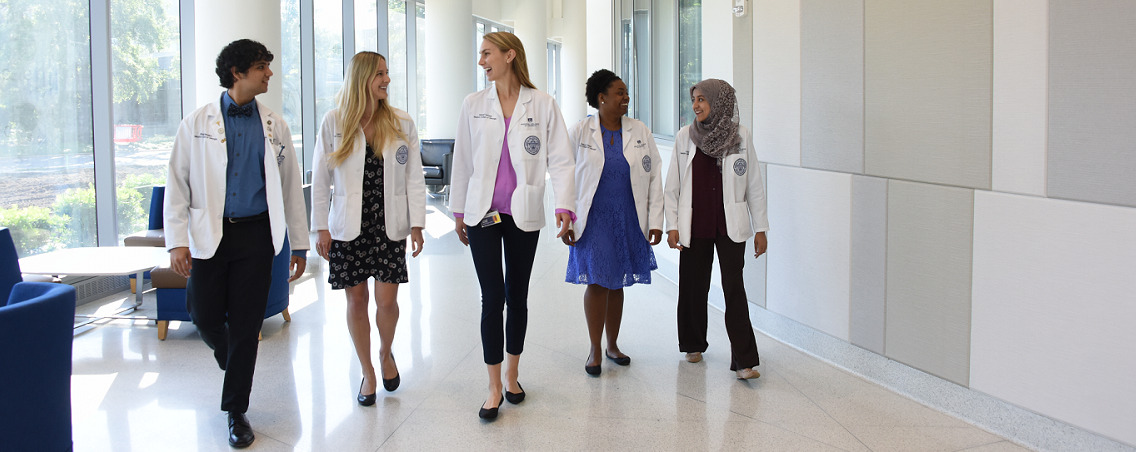
MCG sends a secondary application to applicants once it receives the AMCAS primary. There is no secondary fee beyond the AMCAS fee. Return it within two weeks of receiving it, or within one week for Early Decision. All supplemental items must be in your file by December 1, 2026, for Regular Decision, by November 30, 2026, for the Regional Clinical Campus Pathway and by August 15, 2026, for Early Decision.
The 2026-2027 MCG secondary has eleven prompts. Six are required and five are optional, and every prompt has a 300-word limit. The prompts below are word for word. For more schools’ prompts, see our medical school secondary essay prompts database.
Before you write, read MCG’s mission, vision and values, and keep a short list of the MCG features that fit your goals: a campus, a 3+ pathway, a student-run clinic or a research area. Each response below is an original illustrative example written for this guide. It shows one way to answer the prompt. It is not an essay to copy, and your answer must come from your own experiences.
Regional Clinical Campus Pathway questions. Applicants who choose the Northwest or Southwest Regional Clinical Campus Pathway, including Early Decision applicants who elect it, answer additional questions about their selected campus on the MCG secondary. MCG has not published the wording, number or limits of those questions. Expect them to ask why you chose that region and what you know about its health care challenges, follow the limit shown in your portal and draw on any time you have spent in that part of Georgia.
MD/PhD applicants. MD/PhD applicants apply through AMCAS as MD/PhD applicants. MCG has not published MD/PhD-specific secondary prompts for this cycle, so answer whatever additional questions appear in your portal and keep your research story consistent with your AMCAS essays.
Prompt 1: Why MCG and your career goals
Please discuss your primary interest in attending the Medical College of Georgia and how medical education at MCG will help you achieve your future career goals and desired specialty.
Limit: 300 words. Required. Who answers: every applicant.
What it asks and how to approach it: This prompt has three parts: why MCG, how an MCG education moves you toward your career goals and which specialty you want. Name a specialty, even if you hold it loosely, and say so honestly. Then connect two or three verified MCG features to that goal: the 3+ curriculum and its four pathways, a regional clinical campus, MCG Savannah, the FQHC and community health center network or the scholarly project requirement. The live version of this question has always rewarded applicants who knew MCG’s mission, vision and values, so read them first. Your reasons should be true for you and specific to MCG rather than true of any public medical school.
Illustrative example, not an actual applicant essay (298 words):
I grew up in Tifton, where my grandmother drove 40 minutes to Albany every month to see the cardiologist who managed her heart failure. Her family doctor in town, who knew every one of her medications by heart, kept her out of the hospital for six years. I want to be that doctor for a town like mine, and to train where that goal is part of the plan from day one.
Three parts of MCG’s design fit what I am working toward. First, the Southwest Campus would let me complete clerkships with physicians in Albany and in towns such as Tifton, Americus and Thomasville, learning medicine in the counties where I hope to practice. Second, the 3+ curriculum offers a Georgia PGY-1 Pathway. If I prove ready, the Peach State Scholars option in family medicine would let me move straight into residency and repay the scholarship with service in an underserved part of the state, work I already plan to do. Third, MCG’s network of federally qualified and community health centers would put me in team-based primary care settings like the health center where I have volunteered for two years, checking in patients and helping with diabetes education classes.
My goal is a career in rural family medicine with a focus on chronic disease care for older adults. In ten years I hope to run a practice that offers same-day visits, manages heart failure and diabetes close to home and teaches MCG students who rotate through. I also want to stay honest with myself. If my clerkships show me that internal medicine fits me better, the Advanced Residency Preparation Pathway gives me a fourth year to prepare well.
MCG has trained physicians for Georgia since 1828. I want to be one of the ones who goes home.
Analysis: Why this example works: it answers all three parts in order. The opening story explains the career goal through one specific relationship, not a general wish to help. The middle paragraph names three verified MCG features (Southwest Campus sites, the Georgia PGY-1 Pathway with Peach State Scholars, the FQHC/CHC network) and ties each to the goal instead of listing them. The specialty is named (family medicine) with a realistic note that clerkships may change it, which shows maturity rather than indecision. The close links the applicant’s plan to MCG’s mission of meeting Georgia’s primary care needs. Note that campus preference is strongly considered but not guaranteed for Regular Decision applicants, so the essay says the campus “would” offer these experiences rather than assuming an assignment.
Mistakes to avoid: Praising faculty in general terms or listing rankings; naming a program MCG does not offer; claiming a guaranteed campus or Peach State Scholars spot; leaving out the specialty; copying the mission statement back to the committee instead of showing how you already live it.
Prompt 2: Engagement with underserved communities
At the core of MCG’s mission is community engagement and providing care to underserved communities. Please describe your engagement or your personal experience with underserved communities.
Limit: 300 words. Required. Who answers: every applicant.
What it asks and how to approach it: Community engagement and care for underserved communities sit at the core of MCG’s mission, and its selection guidelines name commitment to practice in an underserved area of Georgia. Describe what you actually did, for whom, for how long and what you learned about the barriers people face. Personal experience counts too: if you grew up in a medically underserved county or relied on safety-net care, you can write from that view. Show reflection, not only hours.
Illustrative example, not an actual applicant essay (292 words):
On Saturday mornings during college I interpreted at a free clinic run out of a church fellowship hall in Gainesville, Georgia. Most patients worked in poultry processing plants. Many had gone years without a blood pressure check, and some arrived with hand injuries they had wrapped themselves because missing a shift felt riskier than missing care.
My job was simple on paper. I took vitals, recorded intake histories in Spanish and English and helped the volunteer nurse practitioner explain prescriptions. In practice I learned how much of medicine happens before the exam starts. One man had stopped his blood pressure pills because the label said to take them with food, and he ate only once a day during long shifts. Nobody had asked about his schedule. Once we did, the plan changed to a once-daily medicine taken with his evening meal, and his pressure was controlled at the next visit.
Over three years I logged more than 250 hours there and helped start text message reminders in Spanish, which cut our missed follow-up visits. I also saw the limits of a once-a-week clinic. Patients who needed imaging or a specialist often waited months or gave up.
These years taught me that serving an underserved community means learning its routines, its fears and its barriers, not only its diagnoses. MCG’s emphasis on caring for underserved communities matches the career I want. I would join the Medical Spanish Interest Group to keep building clinical language skills, and I hope to volunteer with ALAS and the student-run clinics that serve Hispanic families in Augusta. My long-term goal is to practice in a north Georgia county like the one where I learned that asking one more question can be the most important part of a visit.
Analysis: Why this example works: it answers the prompt’s request for engagement with a concrete role, setting, duration (three years, 250+ hours) and patient population. The blood pressure story shows a barrier (work schedule) and a fix that came from listening, which demonstrates reflection. The applicant names a limit of the work (no imaging or specialist access), which reads as honest rather than heroic. The last paragraph links the experience to verified MCG opportunities: the Medical Spanish Interest Group and ALAS-affiliated student clinics listed in Augusta University’s organization directory. The patient is described without identifying details, which respects privacy.
Mistakes to avoid: Writing about a one-day service trip as if it were long-term engagement; describing patients as objects of pity; using identifying patient details; claiming you “saved” someone; saying nothing about what you learned.
Prompt 3: Motivation and an impactful clinical encounter
Please describe your motivation for becoming a physician. Provide an example of an impactful clinical experience or patient encounter which reinforced your desire to enter medicine.
Limit: 300 words. Required. Who answers: every applicant.
What it asks and how to approach it: This is two questions: why you want to be a physician, and one clinical experience or patient encounter that reinforced that choice. Pick one moment and tell it with enough detail that the reader can see your role. Then explain what it taught you about the physician’s work specifically, not health care in general. Avoid repeating your AMCAS personal statement word for word; choose a different encounter or a different angle.
Illustrative example, not an actual applicant essay (293 words):
I first thought about medicine because I liked biology. I decided on medicine because of a night shift as an emergency medical technician in Macon.
We were called to a home where a 68-year-old man had slumped at the dinner table. His wife met us at the door holding a list of his medications written on the back of an envelope. His speech was slurred and his right arm was weak. My partner checked his blood sugar while I asked his wife when she had last seen him normal. She said 6:40, because the evening news had just started. That detail mattered more than anything I did with my hands. It meant he was still inside the window for clot-dissolving treatment, and we called a stroke alert to the receiving hospital before we arrived.
Two weeks later his wife came by the station to tell us he was walking with a cane and talking again. I had done very little that night. Still, I saw what good medicine looks like when it works as a system: a clear history, fast decisions, a team that trusted each other and a physician who could act on the information we brought.
That call shaped my motivation in two ways. I want the training to be the person who makes the decision, not only the person who relays the information. I also want to stay close to the human details, like the time on the evening news, that turn a list of symptoms into a story a clinician can act on.
Since then I have spent more than 900 hours on the ambulance and 120 hours shadowing an internist. The work has confirmed that I want a career where clinical reasoning and careful listening carry equal weight.
Analysis: Why this example works: the first two sentences answer the motivation question directly and set up the turning point. The encounter is specific (age, symptoms, the time of onset) and the applicant’s role is modest and accurate, which makes the reflection believable. The essay explains why the experience points to becoming a physician rather than staying an EMT: the wish to make the decision, not only relay information. It ends with hours that show the motivation was tested over time. Because the prompt does not ask about MCG, the essay spends its words on motivation; the school connection belongs in prompt 1.
Mistakes to avoid: Telling several short stories instead of one; making yourself the hero of a patient’s recovery; describing a procedure you were not trained to do; spending half the essay on why you like science; ending without saying what the experience showed you about being a doctor.
Prompt 4: Resilience and being part of a failure
The art of medicine requires resilience on the part of its practitioners. There can be perceived failure even when the medical team has done everything right. Please describe a time when you were part of something that failed. What did you learn from this experience?
Limit: 300 words. Required. Who answers: every applicant.
What it asks and how to approach it: Choose a real failure where you had a meaningful role, ideally a team effort, since the prompt says “part of something.” Spend about a third of the essay on what happened and two thirds on your response and what you learned. The prompt’s framing about medical teams that do everything right and still see a poor outcome invites you to separate what was in your control from what was not. Show that you owned your share, changed something and would apply the lesson in medicine.
Illustrative example, not an actual applicant essay (297 words):
In my junior year I led a team of six students that tried to launch a blood pressure screening program at three barbershops in south Augusta. We had a small student government grant, donated cuffs and a plan to screen 300 men in one semester. We screened 41, and only six of the men with high readings followed up with a doctor.
The program failed for reasons I should have seen. We picked shops by location, not relationships. We scheduled screenings on weekday afternoons, when the shops were slow, because that fit our class schedules. We handed out a printed list of clinics but did not check which ones took new patients without insurance. Two barbers told us later that their customers saw us as students practicing on them.
The hardest part was admitting to my team and our faculty adviser that the plan, which was mostly mine, had not worked. I wrote an honest report instead of a hopeful one. Then I asked the barbers what they would change. They said to come on Saturdays, bring someone the customers knew and make an appointment for people on the spot.
Our second semester was smaller and better. We partnered with one shop, brought a nurse from a church health ministry the owner trusted and arranged same-week appointments at a community health center. We screened 63 men, and 19 of the 25 with high readings saw a clinician.
I learned that a failure often starts with a plan built around the team’s convenience instead of the community’s needs. I also learned that owning a mistake quickly is what lets a group fix it. When outcomes disappoint in medicine, I want to respond the same way: review what happened honestly, listen to the people affected and change the plan.
Analysis: Why this example works: it describes a clear, measurable failure (41 of 300 screened, 6 follow-ups) in a team the applicant led, so the “part of something” condition is met. The causes are specific and the applicant takes responsibility without self-punishment. The turning point comes from listening to community members, which fits MCG’s emphasis on community engagement. Results from the second semester show the lesson was applied, and the final paragraph answers “What did you learn?” in terms that transfer to clinical teams and patient outcomes. A medical failure is not required; a community or team setting works if the lesson connects to medicine.
Mistakes to avoid: Choosing a “failure” that is really a success; blaming teammates; describing a failure with no lesson; picking a story about a patient death you only observed and turning it into your own growth story; leaving out what you would do differently.
Prompt 5: Contributing to the MCG community and Georgians’ health needs
The Admissions Committee considers an applicant’s personal attributes and life experiences to be vital in fulfilling MCG’s educational mission and addressing the healthcare needs of Georgia’s complex and geographically dispersed population. In this context, how would you contribute to the MCG community and help meet the healthcare needs of Georgians?
Limit: 300 words. Required. Who answers: every applicant.
What it asks and how to approach it: This prompt asks how your personal attributes and life experiences would help MCG’s community and Georgia’s “complex and geographically dispersed population.” It is the best place in the secondary to share your background, languages, family responsibilities, rural or urban roots, military service or nontraditional path. Give the committee a real piece of yourself. Then make two concrete links: what you would add to your class and how you would help meet a Georgia health need after training. Naming a region of the state and a verified MCG group or campus makes the answer specific.
Illustrative example, not an actual applicant essay (291 words):
I grew up in Dalton, where my parents work on the production floors of carpet mills and where Spanish is the first language in many homes, including mine. I was the first in my family to finish college, and for years I was also my family’s interpreter at doctor’s visits, including the appointment where my father learned he had type 2 diabetes. I was fourteen. I understood the words but not what they meant for our meals, our budget or his shifts.
These experiences shape what I would bring to MCG. In study groups and small-group cases, I would add the view of a family that had to translate medicine into daily life. I would join the MCG First-Generation and/or Low-Income organization and help newer students learn the unwritten rules I had to figure out alone, from finding research mentors to building a study schedule. I would also volunteer with the MCG MCAT Outreach and Mentorship Program, because I remember how far away medical school felt from a mill town.
For Georgians, my goal is to practice internal medicine in northwest Georgia, where many patients work hourly jobs, speak Spanish at home and manage chronic illness with little time off. I hope to complete clerkships through the Northwest Campus, where the longitudinal integrated curriculum would let me follow patients over months in Rome and Dalton. Continuity is what my father lacked in his first years with diabetes, and it is what I want to offer.
Georgia’s population is spread across cities, small towns and farm counties with very different needs. I cannot represent all of them. I can bring a bilingual voice, a working-family view of health and a commitment to returning to a region that needs physicians who understand it.
Analysis: Why this example works: it answers both questions in the prompt. The first paragraph gives personal attributes and life experience through one memory rather than a list of identities. The second paragraph answers “contribute to the MCG community” with two verified student organizations (MCG First-Generation and/or Low-Income; MCG MCAT Outreach and Mentorship Program). The third answers “meet the healthcare needs of Georgians” with a region, a specialty and a verified MCG feature (the Northwest Campus longitudinal integrated curriculum in Rome and Dalton). The close acknowledges Georgia’s varied population, echoing the prompt’s language without copying it.
Mistakes to avoid: Listing demographic labels without showing how they shaped you; claiming to speak for an entire group; writing only about your past without answering how you would contribute; promising to practice in a region you have no tie to and cannot explain.
Prompt 6: Where you would practice and why
Please describe the specific geographical area (state, city, town or country if applicable) in which you would most likely practice medicine and why.
Limit: 300 words. Required. Who answers: every applicant.
What it asks and how to approach it: Name a specific place: state, city, town or region. MCG’s mission centers Georgia, especially underserved and rural communities, and its selection guidelines name commitment to practice in an underserved area of Georgia. If you truly plan to practice elsewhere, say so honestly and explain why. If you plan to stay in Georgia, show that you know the region’s health needs and your tie to it. Then connect your plan to how MCG trains students in that region.
Illustrative example, not an actual applicant essay (276 words):
I would most likely practice general pediatrics in Glynn County, Georgia, in or near Brunswick, or in another coastal Georgia community with a similar mix of small cities and rural counties.
I grew up in Waycross and have spent the last two summers as a camp counselor for children with asthma and type 1 diabetes in McIntosh County. Many families drove more than an hour for specialty visits, and several parents told me their child’s pediatrician was the only doctor they saw regularly. That made the pediatrician’s role larger than it looks on paper: the first person to notice a developmental delay, the person who explains a new insulin plan and the person a parent calls before going to the emergency room.
Coastal Georgia also has needs I want to learn to manage well. Hurricanes and flooding interrupt care, summer heat affects children with asthma and some families move between counties for seasonal work, which makes continuity hard. I want to build a practice that keeps simple routines strong, such as school asthma action plans and reliable vaccine reminders, so children do not fall through the gaps when life is disrupted.
My path toward that goal fits MCG’s structure. The Southeast Campus, based at St. Joseph’s/Candler in Savannah and the Southeast Georgia Health System in Brunswick, would let me train with physicians who already care for the communities I want to serve. I also hope to use the Advanced Residency Preparation Pathway in my fourth year to strengthen my pediatrics skills before residency.
I want to be a pediatrician who stays. The coast raised me, and its children deserve doctors who plan to build careers there.
Analysis: Why this example works: the first sentence answers the question directly with a county, a city and a specialty. The second and third paragraphs explain “why” with a personal tie (Waycross, camp work) and region-specific health needs (travel distance, storms, heat, seasonal moves). The fourth paragraph connects the plan to verified MCG training sites at the Southeast Campus and to the 3+ Advanced Residency Preparation Pathway. The essay stays realistic: it does not promise a campus assignment and it names a practice style the applicant can describe.
Mistakes to avoid: Answering “Georgia” with no detail; naming a rural area with no connection or knowledge of it; claiming you will practice in an underserved area only because you think the committee wants to hear it; ignoring the “why” half of the question.
Prompt 7: Academic inconsistencies or delays (optional)
Please explain any inconsistencies in your academic record or delays in your path to medicine. This may include below average course performance, grade trends, MCAT scores, bridge (gap) years etc. If no inconsistencies have occurred, please select “N/A.”
Limit: 300 words. Optional. Who answers: any applicant to whom it applies; otherwise select N/A.
What it asks and how to approach it: Answer only if something in your record needs context: a low grade, a withdrawal, a downward trend, an MCAT retake or bridge (gap) years. Select N/A if not. State the issue plainly, give the reason in a sentence or two without excuses and spend most of the space on what you changed and the evidence that it worked. Bridge years are not a weakness at MCG: 119 of the 304 students in the Class of 2029 are listed as nontraditional. Use this space to show that your path was a choice.
Illustrative example, not an actual applicant essay (295 words):
My transcript shows a drop in my sophomore spring: a C in organic chemistry and a withdrawal from physics. That semester my father was injured at work and could not drive his truck route for four months. I took a night job stocking shelves to help cover our rent and kept a full course load because I did not want to lose my scholarship. I was wrong to think I could do both well, and I should have reduced my courses sooner.
Once my father returned to work, I rebuilt carefully. I retook physics the next fall and earned an A, then earned an A in biochemistry and a B+ or better in every remaining science course. My science GPA for my last four semesters is 3.81.
My path also includes a bridge year. After graduation I began working full time as a medical assistant at a family medicine clinic in Columbus, where I room patients, take vitals, give vaccinations and manage prior authorizations. I chose that year on purpose. I wanted proof, for myself and for an admissions committee, that I could carry a demanding schedule and keep improving. The year has also shown me how much primary care depends on follow-through after the visit ends.
I took the MCAT twice. My first score, 503, came during a semester when I worked nights. I changed my preparation, took a full-length practice test every week and scored 511 on my second attempt in 2025.
I am not asking the committee to ignore the C. I am asking it to read the grade next to the trend that followed. That semester taught me to ask for help early and to protect time for the work that matters most, two habits I will need in medical school.
Analysis: Why this example works: it addresses each part of the prompt that applies (below-average course performance, MCAT scores and a bridge year) in the order the prompt lists them. The reason is stated once, without drama, and the applicant takes responsibility for a choice. Most of the words go to evidence of change: retaken course, later grades, a 3.81 recent science GPA and an eight-point MCAT increase. The bridge year is framed as purposeful clinical work. The MCAT date (2025) also satisfies MCG’s rule that scores be no older than January 2024 for 2027 matriculation.
Mistakes to avoid: Writing an essay when nothing needs explaining; blaming professors; giving a long story about the hardship and no evidence of recovery; hiding a retake that AMCAS already reports; repeating the same explanation in several prompts.
Prompt 8: Additional coursework or certifications (optional)
Please list any additional coursework or certifications which may not be captured on your primary AMCAS application. If not applicable, please select “N/A.”
Limit: 300 words. Optional. Who answers: any applicant to whom it applies; otherwise select N/A.
What it asks and how to approach it: This is a logistical field. List only courses or certifications that AMCAS does not capture: non-credit courses, certifications such as BLS, CNA or EMT, courses taken after your AMCAS transcripts were sent or training required for a job. Use one line per item with the name, issuing body or school, date and status. Select N/A if you have nothing to add. A tidy list beats an essay here.
Illustrative example, not an actual applicant essay (128 words):
– Basic Life Support (BLS) Provider, American Heart Association. Earned March 2024; renewed March 2026; current through March 2028.
– Certified Nursing Assistant (CNA), State of Georgia. Completed a state-approved training program and skills exam in June 2023. Used in 400 hours of paid work listed on my AMCAS application.
– Medical Spanish for Health Care Workers, community college continuing education course, 30 contact hours, completed August 2025. Non-credit; not on my transcript.
– Introduction to Epidemiology, online course for credit through my university’s school of public health, Spring 2026. Grade: A. Completed after my AMCAS transcripts were sent, so it does not appear on my primary application.
– CITI Program human subjects research training (Biomedical Research, Basic Course). Completed January 2026 for my clinical research coordinator position.
Analysis: Why this pattern works: every line answers the prompt’s test (“not captured on your primary AMCAS application”) and gives the facts a reviewer needs: name, issuer, date and status. It explains in a few words why each item is not on AMCAS. It avoids padding with high school awards or courses already on the transcript. Online coursework from a regionally accredited institution is acceptable at MCG, so listing the epidemiology course is useful.
Mistakes to avoid: Repeating AMCAS coursework; listing expired certifications as current; writing paragraphs; leaving the field blank instead of selecting N/A when nothing applies.
Prompt 9: Plans for the rest of the cycle (degree holders, optional)
If you have completed an undergraduate degree, please describe your plans for the remainder of the current application cycle. (Ex. may include post-bacc, Master’s, employment…). If no additional information is applicable, please select “N/A.”
Limit: 300 words. Optional. Who answers: applicants who have completed an undergraduate degree; everyone else selects N/A.
What it asks and how to approach it: Answer if you have already earned your bachelor’s degree; others select N/A. Give a clear schedule: what you are doing, where, how many hours, through when and what you are learning. Include clinical work, research, service, coursework and any planned changes. Keep it factual and current, and update MCG later if plans change.
Illustrative example, not an actual applicant essay (214 words):
I graduated in May 2026 and am working full time through June 2027 as a clinical research coordinator in the cardiology division of a teaching hospital in Atlanta. I screen and consent patients for two heart failure studies, collect vital signs and study data at follow-up visits and enter data into the study database. Each week I work with nurses, physicians and patients who are deciding whether to join a trial, and I have learned how much trust and clear explanation that decision requires.
Outside of work, I will keep volunteering four hours a week at a free clinic in DeKalb County, where I help with intake and blood pressure checks for uninsured patients. I am also taking an online graduate course in biostatistics this fall to strengthen my research skills before medical school. My supervisor has agreed to let me help draft an abstract from our study’s enrollment data for a regional meeting in spring 2027.
I chose this year to deepen two interests I want to carry into medical school: chronic disease care and clinical research. If admitted, I would look for a scholarly project in cardiovascular outcomes and would consider MCG’s Advanced Research Pathway in my fourth year. I will update the admissions committee if my responsibilities or course plans change.
Analysis: Why this example works: it answers exactly what the prompt asks, the plan for “the remainder of the current application cycle,” with dates (through June 2027), weekly hours and responsibilities. It mixes paid clinical research, ongoing service and coursework, which shows continued growth rather than waiting. The last paragraph links the year to verified MCG features (the scholarly project graduation requirement and the Advanced Research Pathway) without overstating them, and it promises updates.
Mistakes to avoid: Vague plans (“I will gain experience”); listing activities that have not been arranged as if they are certain; ignoring the question and writing another personal statement; forgetting to update MCG if a job ends.
Prompt 10: Additional clinical experiences (optional list)
Please list any additional clinical experiences that are not included on your AMCAS application. Please include the physician’s name OR type of experience (i.e., Nursing, PA, EMT, E.R. Scribe, etc.) in the description column below along with the location, dates and total number of hours. If no additional experiences have occurred, please select “N/A.”
Limit: 300 words. Optional. Who answers: any applicant to whom it applies; otherwise select N/A.
What it asks and how to approach it: List clinical experiences that are not in your AMCAS Work/Activities, with the physician’s name or the type of experience, the location, the dates and total hours, as the prompt asks. This is a place to add hours earned after you submitted AMCAS or smaller experiences you left out because of the activity limit. MCG expects at least 200 hours of clinical experience, so make your total easy to see. Select N/A if there is nothing to add.
Illustrative example, not an actual applicant essay (120 words):
– Hospice volunteer (patient companion), hospice inpatient unit, Macon, Georgia. January 2026 to present. 64 hours. Sat with patients, supported families and helped nursing staff with comfort tasks such as repositioning and meal setup. Began after AMCAS submission.
– Medical interpreter (volunteer, Spanish), church-based free clinic, Gainesville, Georgia. Summer 2022. 36 hours. Earlier period of a role listed on AMCAS; these hours are not included in the AMCAS total.
– Shadowing, rural family medicine physician, Tifton, Georgia. December 2025. 24 hours. Observed clinic visits, nursing home rounds and a minor procedure clinic.
– EMT clinical rotation during certification training, county EMS, Bibb County, Georgia. Fall 2021. 48 hours. Required clinical component of the EMT course; not listed separately on AMCAS.
Analysis: Why this pattern works: each entry gives the four items the prompt requests: type of experience, location, dates and total hours. It notes why the item is not already on AMCAS, which prevents double counting. Shadowing is labeled as shadowing, while hands-on roles describe the actual tasks. The list adds 172 hours without inflating any role.
Mistakes to avoid: Re-entering AMCAS activities to look larger; counting the same hours twice; using a physician’s name without permission when the type of experience would do; describing shadowing as hands-on care.
Prompt 11: Updates since AMCAS submission (optional)
If applicable, indicate any updates to your application since AMCAS submission or other information you feel the admissions committee should consider which may not be captured in other areas of your application. If no additional information is applicable, please select “N/A.”
Limit: 300 words. Optional. Who answers: any applicant to whom it applies; otherwise select N/A.
What it asks and how to approach it: Use this field for real changes since you submitted AMCAS: new roles, grades, a new MCAT score, awards, publications or posters, major service additions or a change in plans. Write in short dated entries. Do not repeat earlier essays. If nothing has changed, select N/A. If a special experience or significant circumstance is not covered anywhere else in your file, you can note it briefly here.
Illustrative example, not an actual applicant essay (159 words):
– New position: In August 2026 I was promoted from medical assistant to lead medical assistant at the family medicine clinic listed in my AMCAS Work/Activities. I now train new staff on rooming and vaccine documentation and help run the clinic’s monthly walk-in diabetes screening day.
– Coursework: I am enrolled in Medical Biochemistry II (4 credits) at Georgia State University this fall as a non-degree student and will send an updated transcript when grades post in December.
– Research: An abstract from my undergraduate project on blood pressure control at a community health center was accepted as a poster for a statewide public health meeting in March 2027.
– Service: I added a monthly shift with a mobile health unit that offers blood pressure and glucose checks at churches in rural Talbot County. I have completed 18 hours since July 2026.
– Clinical hours: My total clinical hours, including AMCAS-listed experiences and these additions, are now about 1,450.
Analysis: Why this pattern works: each entry is new information dated after AMCAS submission, which is what the prompt asks for. The applicant gives scope (credits, hours, dates) and states how the school will receive proof (an updated transcript). The final line totals clinical hours, which helps a reviewer check MCG’s 200-hour expectation at a glance. It avoids restating essays.
Mistakes to avoid: Pasting a new personal statement; listing minor updates such as a single shadowing day as major news; reporting plans as completed; forgetting to send documents you promise.
Interview Format and Preparation
Each year MCG invites about 640 applicants to interview. For the 2025 entering class, 646 applicants interviewed: 616 Georgia residents and 30 out-of-state applicants. Invitations begin in August, and interviews are generally held on Tuesdays and Thursdays from August through January. Getting an invitation is an accomplishment, because the committee reviews your full file before it invites you. Interviews are by invitation only, and applicants below a 3.0 GPA or 496 MCAT are not considered competitive for one.
The format: a Multiple Mini Interview
MCG uses the Multiple Mini Interview (MMI). The MCG MMI has 7 stations of 8 minutes each over a 90-minute period. The stations are designed to assess personal characteristics in line with the AAMC’s core competencies for entering medical students, and the MMI format lets MCG evaluate every candidate in a consistent way. Performance in the MMI is one of the factors in MCG’s selection guidelines. The MCG Interviews page links to the AAMC’s guide to participating in MMIs.
What is confirmed and what is not:
- Confirmed: 7 stations, 8 minutes each, about 90 minutes in total; roughly 640 invitations per year; Early Decision interview dates of August 18, 20 and 25, 2026; and an additional interview with campus leadership for Regional Clinical Campus Pathway applicants, built into the same interview day so you do not need to attend anything extra.
- Delivery mode: MCG’s interviews are virtual, and on interview day you can talk with current students from both four-year campuses. Follow your invitation’s instructions for technology checks and timing.
- Not published: the station topics and scoring. Any list of “MCG MMI questions” online is a guess.
What the stations are likely to test
Because MCG ties the MMI to the AAMC competencies, expect stations that test how you think and how you treat people rather than what you know about medicine. Common station types at MMI schools include ethical scenarios, teamwork tasks, role-play with an actor, questions about health policy or community health and short personal questions. Admissions committees want to see the same qualities across stations:
- Solid interpersonal ability
- Good at following directions
- A careful listener
- Clear communication
- Self-confidence without arrogance
- Compassion
- Awareness of social issues
- A passion for medicine
- A genuine wish to help others
How to prepare
- Practice the structure. Read a prompt for two minutes, then talk for six to eight. Practice with a timer until you can state a position, consider other views and close with a clear next step.
- Know Georgia health care. Several MCG secondary prompts center on underserved communities and Georgia’s dispersed population. Read about rural hospital access, physician shortages and chronic disease in the state, so you can discuss them with specifics.
- Review your own file. Your secondary essays are fair game in personal stations. Know your clinical hours, your service and why MCG.
- Rehearse role-play calmly. Practice delivering difficult news, handling a frustrated person or resolving a team conflict. Listen first and acknowledge feelings.
- Prepare for the campus interview. If you applied through the Regional Clinical Campus Pathway, prepare to talk with campus leaders about why you chose that region, what you know about its health needs and how you would contribute.
- Check your setup. For a virtual interview, test your camera, lighting, internet connection and a quiet room ahead of time.
The interview day is also your chance to decide whether MCG is right for you. Ask current students about campus assignment, the 3+ pathways and life in Augusta or on a regional campus.
Preparing for an MMI can feel stressful no matter how confident you are. Our list of the most common medical school interview questions is a good place to start. Many applicants also find personalized coaching and mock MMIs with our medical school admissions consulting team helpful.
Frequently Asked Questions
What is the Medical College of Georgia’s acceptance rate?
MCG does not publish an acceptance rate because the number of offers it makes is not released. For the Class of 2029, which entered in 2025, MCG received 3,367 applications, interviewed 646 applicants and enrolled 304 students. Dividing enrolled students by applications gives about 9%, but that is a matriculation ratio, not an acceptance rate, because some admitted applicants choose other schools. Interviews went to about 19% of applicants overall, and to 616 of 1,379 Georgia applicants (about 45%) compared with 30 of 1,984 out-of-state applicants (about 1.5%). The more useful takeaway is that Georgia residents fill almost every seat: 300 of the 304 students in the Class of 2029 were Georgia residents. If you are a Georgia resident with a GPA of 3.0 or higher and an MCAT of 496 or higher, you meet the interview competitiveness guideline, and the Class of 2029 averages (3.8 GPA, 512 MCAT) show where most admitted students fall.
What GPA and MCAT do I need for MCG?
There is no hard minimum, but applicants with a GPA below 3.0 or an MCAT below 496 are not considered competitive for an interview. The Class of 2029 had an average overall GPA of 3.8 and an average MCAT of 512, and the Class of 2028 had an average science GPA of 3.8. Accepted applicants for the 2025 entering class had a median MCAT of 513, a median overall GPA of 3.89 and a median science GPA of 3.86. The committee looks at your highest MCAT total and can see all of your scores, and it considers only scores from January 2024 or later. For Early Decision, competitive applicants have an MCAT of 509 or higher and a total GPA of 3.7 or higher, with GPAs from 3.65 to 3.69 rounded up to 3.7. Averages are not cutoffs, so a strong upward trend, clinical record and Georgia commitment can matter as much as a point or two.
Does the Medical College of Georgia in Augusta require the CASPer exam?
No. MCG’s 2026-2027 application requirements list the AMCAS primary, MCG secondary, prerequisites, three letters, a valid MCAT, clinical exposure, community service and U.S. citizenship or permanent residency. CASPer, PREview and other situational judgment tests are not on that list. Spend that preparation time on your secondaries and on MMI practice instead, since the MMI is the assessment MCG actually uses.
Does MCG accept out-of-state or international applicants?
MCG accepts out-of-state applicants, but gives preference to Georgia residents, and out-of-state students make up at most 5% of the incoming class. Only 4 of the 304 students in the Class of 2029 were not Georgia residents, and 30 of 1,984 out-of-state applicants interviewed. Canadian, international and DACA applicants are not considered. Early Decision is open only to Georgia residents. International applicants must be U.S. permanent residents with a valid permanent resident card to be offered acceptance, and every applicant must complete at least the last two years of college or graduate study at a regionally accredited U.S. or Canadian school. If you are not a Georgia resident, apply only if you have a genuine tie to Georgia that you can explain.
How many clinical hours does MCG require?
MCG expects at least 200 hours of clinical experience, defined as direct observation of or interaction with patients across a variety of health care settings. Shadowing counts as observation, but hands-on roles such as medical assistant, scribe, EMT, CNA or clinic volunteer give you stronger stories for the secondary and the MMI. MCG also expects demonstrated community service. If you need more hours before you apply, local clinic work and structured internships for pre-med students can both add supervised patient contact. Log dates and hours as you go so you can report them on AMCAS and in MCG’s optional clinical experience list.
What are the prerequisites for MCG?
You need one academic year each of biology or zoology with lab, chemistry, physics with two semesters of lab and English, plus one semester of statistics. The chemistry year must include one semester of organic chemistry and one semester of biochemistry. AP credit can cover non-biology and non-chemistry requirements if it appears on your transcript. Online courses from regionally accredited schools are acceptable, and pass/fail is acceptable, though letter grades are preferred. Courses must be completed or in progress by January of the year you plan to matriculate.
How does MCG’s Early Decision Program work?
Early Decision is a binding option for Georgia residents only. You submit AMCAS by August 1, 2026, have an MCAT by June 27, 2026, return the secondary within one week and complete your file by August 15, 2026. Interviews take place in August, and decisions usually arrive by the second week of September, with all decisions by October 1, 2026. If accepted, you must attend MCG, and you cannot apply to other medical schools until MCG decides. Early Decision admits are guaranteed their campus preference. Choose this route only if MCG is your clear first choice and your profile is near the 509 MCAT and 3.7 GPA benchmarks.
What is the Regional Clinical Campus Admissions Pathway?
It is an admissions route for applicants committed to completing clinical training at MCG’s Northwest Campus (Rome and Dalton) or Southwest Campus (Albany). You select “Other Special Programs” on AMCAS by October 30, 2026, choose one campus on the secondary and answer campus-specific questions. Accepted students complete the pre-clerkship phase in Augusta and then move to their regional campus for the clerkship and enrichment phases. Qualified applicants receive admissions preference, the pathway is not binding and invited applicants have an additional interview with campus leadership on their interview day. In the Class of 2029, 21 students entered this way.
What is the MCG 3+ program?
MCG’s 3+ curriculum, launched in fall 2020, completes the core MD curriculum in three years and then lets students choose one of four pathways: the Georgia PGY-1 Pathway into primary care residency (including Peach State Scholars), the Dual-Degree Pathway for an MBA, MPH or MCTS at no extra tuition, the Advanced Residency Preparation Pathway used by most students and the Advanced Research Pathway with up to five months of research. You choose after you matriculate, not when you apply.
Can I choose which MCG campus I attend?
You can state a preference, but it is not guaranteed for most applicants. After an offer, MCG sends a campus preference request, and preference is strongly considered. Early Decision admits are guaranteed their preference, Regional Clinical Campus Pathway students commit to their regional campus at admission and Early Assurance Pathway students are guaranteed a campus assignment. Students on the Augusta campus may be assigned to a regional clinical campus for their clinical years. The four-year campuses are Augusta and MCG Savannah.
Is MCG still the only public medical school in Georgia?
No. MCG is Georgia’s flagship public medical school, and together with Wellstar MCG Health it forms the state’s only publicly funded academic medical center. The University of Georgia School of Medicine in Athens is now a second public medical school. In 2026 the former AU/UGA Medical Partnership campus in Athens transitioned to the UGA School of Medicine, and MCG graduates its last Athens-based class in 2029. If you want to train in Athens, look at UGA’s own admissions process.
How much does MCG cost?
For 2026-27, tuition for 12 or more hours is $15,024 per semester for Georgia residents, $31,956 for out-of-state students and $32,880 for out-of-country students, plus $1,012.50 per semester in mandatory fees. Program fees include a $400 anatomy lab fee and small insurance and tracking fees, and the student health plan costs $1,342 for fall and $1,850 for spring and summer unless you waive it with equivalent coverage. Two semesters of in-state tuition and fees come to $32,073 before living costs. The total first-year cost of attendance for 2025-26, including living costs and health insurance, was $70,271 for Georgia residents and $102,577 for out-of-state students. Graduates who borrowed in 2024-25 left with an average of $168,146 in medical school debt. Ask the Office of Student Financial Aid for the official budget for your year.
Does MCG charge a secondary fee or require a deposit?
No to both. Every applicant receives the MCG secondary, and there is no secondary fee beyond the AMCAS fee, so there is no fee waiver to request. Accepted students do not pay a deposit to hold a seat. You have one week to respond to an Early Decision offer and two weeks to respond to a Regular Decision offer, and deferral requests are considered case by case.
Can I send update letters or a letter of intent to MCG?
Yes. Upload letters of intent and significant updates, such as a publication, an honor or major new clinical or service work, through the document upload feature on the secondary portal. Updates meant for the committee must be in your file by December 1, 2026. Keep them short and factual, and send them only when you have real news.
Does MCG offer scholarships?
Yes. About six full and six partial Harrison Scholarships go to entering students with exceptionally strong academic and leadership records. Peach State Scholars on the Georgia PGY-1 Pathway receive two years of scholarship in exchange for two years of practice in underserved Georgia. The MCG Scholarship Committee also awards other non-federal scholarships from January through August each year. File the FAFSA soon after October 1 so you are considered for need-based aid.
Does MCG have an early assurance or pipeline program for undergraduates?
Yes, two. The Assurance in Medicine (AIM) program serves Georgia undergraduates from underserved backgrounds at nine University System of Georgia schools near MCG’s regional campuses, with two four-week summer residential programs and early assurance for students who meet requirements. The Early Assurance Pathway lets students in Augusta University’s MS in Medical Physiology earn MD admission with a cumulative GPA of 3.2 or higher, no grade below a B, the Advanced Coursework Pathway and at least 20 hours of clinical exposure or service, with no additional interview or MCAT retake.
How long do I have to return the MCG secondary?
Return it within two weeks of receiving it for Regular Decision and the Regional Clinical Campus Pathway, and within one week for Early Decision. Final file deadlines are December 1, 2026, for Regular Decision, November 30, 2026, for the regional pathway and August 15, 2026, for Early Decision. Because MCG sends the secondary as soon as it receives your AMCAS application and reviews on a rolling basis, draft your six required essays before you submit AMCAS.
Does MCG offer a PA program?
Augusta University offers a Master of Physician Assistant program through its College of Allied Health Sciences, not through the Medical College of Georgia. It has a separate application and requirements. If you are deciding between the MD and PA routes, compare the training length, cost and scope of practice, and get patient care experience that lets you see both roles up close.
How does the MCG waitlist work?
Waitlisted applicants are placed into quintiles based on committee ranking, and the quintile is only a starting position that can change as others withdraw. Waitlist offers usually begin in the last week of April or first week of May and can continue until about two weeks before matriculation. MCG does not usually give individual updates on waitlist position. Applicants accepted from the waitlist cannot defer.
Related Medical School Guides
If MCG is on your list, these guides cover schools that applicants often consider alongside it:
- Mercer University School of Medicine (MUSM): another Georgia MD school whose mission centers on rural and medically underserved parts of the state, a natural comparison for MCG’s Georgia focus.
- University of Georgia School of Medicine: Georgia’s newest public medical school, based in Athens, where MCG’s former Medical Partnership campus transitioned in 2026.
- Morehouse School of Medicine: an Atlanta MD school with a mission centered on underserved communities and primary care, a good comparison for applicants drawn to MCG’s mission.
- Emory University School of Medicine: a private research-intensive MD school in Atlanta for Georgia applicants who want to compare a private option.
- University of South Carolina Medical School: a public MD school in neighboring South Carolina, useful for applicants from the Augusta area and the Southeast who want an in-region comparison.
- Alice L. Walton School of Medicine: a newer Southern MD school in Arkansas with a different, whole-health model, for applicants comparing regional options.
For a side-by-side look at every program in the state, see our guide to medical schools in Georgia.
More medical school guides
Whether you are looking at medical schools in another state or searching for medical schools near me, these guides cover other MD and DO programs across the country:
- Campbell University School of Osteopathic Medicine (CUSOM)
- ECU Brody School of Medicine
- Edward Via College of Osteopathic Medicine (VCOM)
- Lewis Katz School of Medicine at Temple University
- Philadelphia College of Osteopathic Medicine (PCOM)
- Geisinger Commonwealth School of Medicine (GCSOM)
- Penn State Medical School
- CUNY School of Medicine
- SUNY Downstate Medical School
- NYIT College of Osteopathic Medicine
- NYU Long Island School of Medicine
- Albany Medical College
- TOURO College of Osteopathic Medicine
- Norton College of Medicine at Upstate Medical University
- Jacobs School of Medicine at the University at Buffalo
- Hofstra Zucker School of Medicine
- Weill Medical College of Cornell University
- University of Rochester Medical School
- Icahn School of Medicine at Mount Sinai
- Renaissance School of Medicine at Stony Brook University
- Albert Einstein College of Medicine
- Ohio University Heritage College of Osteopathic Medicine
- Northeast Ohio Medical University (NEOMED)
- University of Cincinnati College of Medicine
- University of Toledo College of Medicine
- Wright State University Boonshoft School of Medicine
- Ohio State University College of Medicine
- Rowan University School of Osteopathic Medicine
- Hackensack Meridian School of Medicine (HMSOM)
- Rutgers New Jersey Medical School (NJMS)
- Rutgers Robert Wood Johnson Medical School
- Cooper Medical School of Rowan University (CMSRU)
- A.T. Still University Kirksville College of Osteopathic Medicine
- Saint Louis University School of Medicine
- University of Missouri Medical School
- Kansas City University (KCU)
- UMKC School of Medicine
- New York Medical College
- University of Pittsburgh School of Medicine
- University of Wisconsin Medical School
- VCU School of Medicine
- University of Maryland School of Medicine
- Case Western Medical School
- University of North Carolina Medical School
- University of Florida Medical School
- Boston University College of Medicine
- California University of Science and Medicine
- UC San Diego Medical School
- California Northstate University College of Medicine
- Touro University of California
- CHSU College of Osteopathic Medicine
- UC Davis School of Medicine
- Harvard Medical School
- UC Riverside School of Medicine
- USC Keck School of Medicine
- UT Southwestern Medical School
- Long School of Medicine at UT Health San Antonio
- University of the Incarnate Word School of Osteopathic Medicine
- UT Austin’s Dell Medical School
- UTMB School of Medicine
- McGovern Medical School at UT Health
- Johns Hopkins School of Medicine
- The University of Texas Rio Grande Valley School of Medicine
- UNT Texas College of Osteopathic Medicine
- University of Houston College of Medicine
- Texas A&M College of Medicine
- Baylor College of Medicine
- George Washington University School of Medicine
- Vanderbilt University School of Medicine
- St. George’s University School of Medicine
- Lake Erie College of Osteopathic Medicine (in Pennsylvania)
- Sidney Kimmel Medical College at Thomas Jefferson University
- Wake Forest University School of Medicine
- Western University of Health Sciences (in California)
- Drexel University College of Medicine
- Stritch School of Medicine at Loyola University Chicago
- Georgetown University School of Medicine
- Yale School of Medicine
- Perelman School of Medicine
- UCLA Medical School
- NYU Medical School
- Washington University School of Medicine
- Brown Medical School
How International Medical Aid Can Help
Researching, applying and interviewing for medical school takes hard work. At International Medical Aid (IMA), our goal has always been to help the next generation of medical students reach the schools of their choice, because more well-prepared students means more qualified doctors in communities like the ones MCG serves.
Clinical experience abroad. IMA runs medical internships abroad for pre-health students in Kenya and other sites. Interns work under the supervision of local physicians and nurses, taking vitals, doing patient intake and triage and helping with direct patient care. Former participants describe few experiences more educational than working alongside skilled clinicians in an unfamiliar setting and seeing what it is like to work in a hospital or clinic in another country. Our programs are built for pre-medical and gap year students who want to prepare for a future as humanistic, globally minded physicians. You can compare all of our healthcare internships abroad, including a medical internship in Peru that suits students building Spanish-language clinical skills, the kind of skill MCG’s Medical Spanish Interest Group and ALAS clinics put to use.
These experiences add supervised patient contact and reflection you can write about in MCG’s underserved-communities and motivation prompts. They do not replace sustained clinical work and service in Georgia, they are not affiliated with MCG and they do not give any admissions advantage.
Admissions advising. If one-on-one coaching through your school list, essays and interviews would help, our medical school admissions consulting team works with applicants on AMCAS essays, MCG’s eleven secondary prompts and mock MMIs. You will have someone alongside you who understands how the process works.
Next step: if you have questions about the application process, our guides, our internships or consulting, contact us and we will help you find the right support.
Final Thoughts and Sources
MCG offers Georgia residents a large, mission-driven public MD program with modest in-state tuition, a three-year core curriculum with four pathways and clinical training across the state. The applicants who do best show three things clearly: academic readiness at or near a 3.8 GPA and 512 MCAT, at least 200 hours of real clinical experience and a believable commitment to caring for Georgians, especially in underserved communities.
Your next actions are to choose your route (Early Decision, Regular Decision or the Regional Clinical Campus Pathway), confirm your Georgia residency and prerequisites, line up three letters including one from a physician and draft your six required secondary essays before your AMCAS goes in. As you take your first step toward matriculating at the Medical College of Georgia at Augusta University, we wish you the best of luck, and we hope this guide helps you along the way.
Sources
Facts in this guide were checked on October 17 and 18, 2026, against the following sources. Statistics are labeled by cohort or academic year in the tables above.
- AAMC Medical School Admission Requirements (MSAR), 2026 edition, Medical College of Georgia profile, accessed October 18, 2026 (2025 entering class applications, interviews, matriculants and accepted-applicant MCAT and GPA medians; 2025-26 cost of attendance; 2024-25 aid and debt; 2026-2027 admissions policies)
- MCG 2025 Admissions Fact Sheet, Class of 2029 profile: augusta.edu
- MCG 2026 Fact Sheet (Class of 2029 summary, Class of 2026 Match, campuses, research and tuition): augusta.edu
- Augusta University Tuition and Fees, Doctor of Medicine, Fall 2026 to Summer 2027: augusta.edu
- MCG Application Process page (requirements, prerequisites, MCAT, letters, clinical experience): augusta.edu
- MCG Admissions General Information, Early Decision, Regular Decision and Regional Clinical Campus Pathway pages: General Information, Early Decision, Regular Decision, Regional Clinical Campus Pathway
- MCG Admissions FAQs and Interviews pages: FAQs
- MCG 3+ program page: augusta.edu
- MCG campuses and expansion page (campus history, Class of 2030 applications and positions): augusta.edu
- MCG curriculum office pages (pre-clerkship, clerkship and enrichment phases) and MCG Technical Standards policy (revised November 11, 2025): Clerkship Phase
- MCG Office of the Dean, Admissions staff, leadership directory, MCG Alumni, Southwest Campus leadership and MCG Savannah dean’s office pages; MCG Gastroenterology/Hepatology and Otolaryngology faculty pages: Office of the Dean, Admissions staff
- MCG Harrison Scholarships, AIM, Early Assurance Pathway and MD/PhD pages; Historical Highlights of the Medical College of Georgia (Office of the Dean, 2015): Harrison Scholarships, MD/PhD
- Augusta University Financial Aid, College of Medicine Students page and Augusta University campus maps page: Financial Aid, Campus maps
- Augusta University student organization directory: augusta.presence.io
- LCME directory of accredited MD programs: lcme.org
- Wellstar MCG Health Medical Center: wellstar.org
- Secondary prompt wording for 2026-2027: MCG does not publish its secondary prompts; the wording above is the current MCG secondary as reported by applicants and secondary prompt compilations.