
The Alice L. Walton School of Medicine (AWSOM) is not just another entry in the growing list of new medical schools. It is a nonprofit, four-year MD program in Bentonville, Arkansas, founded in 2021 by philanthropist Alice Walton and built around whole health, the arts and humanities, and care for rural and underserved communities. Its first class of 48 students arrived in July 2025, its second class of 48 began in July 2026, and the school holds preliminary accreditation from the Liaison Committee on Medical Education (LCME).
This is not a school that simply follows tradition. It does not center prestige or research rankings. It aims to train physicians who will serve real people in real communities, especially in parts of the Heartland where access to care is uneven. For the classes entering from Fall 2025 through Fall 2029, the school waives all tuition and most fees for four years, which makes it one of the most affordable MD programs in the country.
This guide covers the 2026-2027 application cycle, for students who would enter in July 2027 as the Class of 2031. It walks through what AWSOM values, who is eligible, what the first two classes looked like, what a student actually pays after the tuition waiver, how the ARCHES curriculum works, and how to answer every current secondary prompt. Facts were checked against the school’s own pages on October 17, 2026.
If you are looking for a medical school where whole-person care applies to physicians in training as well as patients, and where empathy and evidence-based practice stand side by side, AWSOM may be the right fit for you.
Key Takeaways
- Eligibility is strict. Only U.S. citizens and permanent residents can apply. You need an MCAT of at least 500, taken within four years of matriculation (for this cycle, January 2023 or later), and a minimum overall GPA of 3.4 plus at least 24 BCPM credit hours with a BCPM GPA of 3.4 (or 3.5 for post-baccalaureate or graduate BCPM work). Only applicants who meet every minimum receive the secondary.
- The class is small. AWSOM enrolls 48 students per class. The second class, the Class of 2030, was chosen from nearly 5,000 applications.
- Admitted students are strong. The inaugural Class of 2029 had a median MCAT of 513, a mean GPA of 3.89 and a mean BCPM GPA of 3.87. Accepted applicants in that 2025 entering class had a median GPA of 3.92, and 207 of 2,021 verified applicants were interviewed.
- The mission is rural and underserved health in Arkansas and nearby states. The school’s five values are Empathy, Self-care, Humanism, Entrepreneurialism and Community Focus. Your application should show all of them through real experience.
- Key dates for 2026-2027: AMCAS deadline November 1, 2026; secondary deadline December 1, 2026; virtual interviews from early September through late February; rolling offers from mid-October until the class is full.
- Tuition is waived, but school is not free. Tuition is $69,650 a year and is waived for classes entering Fall 2025 through Fall 2029. The remaining 2026-27 cost of attendance after the waiver is $38,181 for year 1, $39,611 for year 2, $42,800 for year 3 and $36,083 for year 4.
- Federal loans are not available yet. AWSOM does not currently participate in the Direct Loan program or other federal loan programs, so students who borrow use private loans for now.
- Next step: Submit AMCAS early, then plan seven secondary responses of up to 1,500 characters each (five required, two optional).
Key Statistics About Alice L. Walton School of Medicine
The snapshot below brings together the figures applicants ask about most. Class size and application counts are for the Class of 2030, which entered in July 2026. MCAT, GPA and interview figures are for the inaugural Class of 2029 (the 2025 entering class), the newest cohort with published admissions data. Costs are for the 2026-27 academic year and are the same for Arkansas residents and nonresidents.

| Metric | Value | Year or cohort | Source and definition |
|---|---|---|---|
| School and degree | Alice L. Walton School of Medicine (AWSOM); four-year MD only | Current | AWSOM About page; nonprofit, one campus in Bentonville, Arkansas |
| Founded | 2021; first class entered July 2025 | Current | AWSOM news releases, July 2025 and July 2026 |
| Accreditation | Preliminary LCME accreditation | Current | AWSOM Accreditation page; next LCME visit planned for 2026-27 (provisional) |
| Entering class size | 48 | Class of 2030 (entered July 2026) | AWSOM news release, July 17, 2026; matriculants |
| Applications | Nearly 5,000 | Class of 2030 (2025-2026 cycle) | AWSOM news release, July 17, 2026; all applications received |
| Verified applications | 2,021 (175 Arkansas residents, 1,835 nonresidents, 11 international) | 2025 entering class (Class of 2029) | AAMC MSAR, 2026 edition; verified AMCAS applications |
| Applicants interviewed | 207 (38 Arkansas residents, 169 nonresidents) | 2025 entering class (Class of 2029) | AAMC MSAR, 2026 edition; about 10% of verified applications |
| Matriculants by residency | 15 Arkansas residents, 33 nonresidents | 2025 entering class (Class of 2029) | AAMC MSAR, 2026 edition; 48 matriculants, none deferred |
| Median MCAT | 513 | Class of 2029 (entered July 2025) | AWSOM Class Profiles page; matriculants |
| MCAT mean and section medians | Mean 513.3; section medians 128 (Chemical and Physical), 127 (CARS), 128 (Biological and Biochemical), 129 (Psychological and Social) | 2025 entering class (Class of 2029) | AAMC MSAR, 2026 edition; all accepted applicants |
| Mean overall GPA | 3.89 | Class of 2029 | AWSOM Class Profiles page; matriculants |
| Mean BCPM GPA | 3.87 | Class of 2029 | AWSOM Class Profiles page; matriculants |
| Median overall GPA | 3.92 | 2025 entering class (Class of 2029) | AAMC MSAR, 2026 edition; all accepted applicants |
| Median science GPA | 3.9 | 2025 entering class (Class of 2029) | AAMC MSAR, 2026 edition; all accepted applicants |
| Minimum MCAT | 500, within four years of matriculation | 2026-2027 cycle | AWSOM Admissions Requirements and FAQ; a minimum, not a typical score |
| Minimum GPA | 3.4 overall; BCPM 3.4 with at least 24 credit hours (3.5 post-bacc or graduate) | 2026-2027 cycle | AWSOM Admissions Requirements |
| Latest MCAT considered | September 12, 2026 (oldest January 2023) | 2026-2027 cycle | AAMC MSAR, 2026 edition; AWSOM Admissions FAQ for the oldest date |
| Acceptance rate | Not reported | 2025 entering class | Offer counts are not published by AWSOM or in the AAMC MSAR, 2026 edition, so no acceptance rate can be calculated |
| Tuition | $69,650 per year; waived for classes entering Fall 2025 through Fall 2029 | 2026-27 academic year | AWSOM 2026-2027 Estimated Cost of Attendance; same for all residencies |
| Cost of attendance after the waiver | $38,181 (year 1); $39,611 (year 2); $42,800 (year 3); $36,083 (year 4) | 2026-27 academic year | AWSOM 2026-2027 Estimated Cost of Attendance, living off campus |
| Secondary fee | $100, nonrefundable; fee waiver available | 2026-2027 cycle | AWSOM Admissions Process page (fee); AAMC MSAR, 2026 edition (waiver) |
| Deposit and deferral | No deposit required; deferral requests considered case by case | 2026-2027 cycle | AAMC MSAR, 2026 edition |
| Early Decision | Not offered | 2026-2027 cycle | AWSOM admissions pages; AAMC MSAR, 2026 edition |
| Campus type | Suburban | Current | AAMC MSAR, 2026 edition |
| Rural and regional mix | 25% from rural communities; 65% from the Heartland region | Class of 2030 | AWSOM news release, July 17, 2026 |
| First-year retention | 100% | 2025-26 | AWSOM Student Achievement Data |
Offer counts are not published, so there is no verified acceptance rate. For the 2025 entering class, 207 of 2,021 verified applications reached an interview, about 1 in 10. That is an interview rate, not an acceptance rate. Forty-eight seats for nearly 5,000 Class of 2030 applications works out to about one seat for every 100 applications, but that is a seats-to-applications ratio, not an acceptance rate either. Some admitted applicants choose other schools, so the share who receive offers is higher than the seat ratio. To compare AWSOM’s class figures with other schools, see our list of the average GPA and MCAT score for every medical school.
Mission and Educational Priorities
AWSOM’s mission is direct, but wide in its reach. The school states it this way:
Alice L. Walton School of Medicine trains physicians who are devoted to transforming the health of medically underserved and rural communities in Arkansas, its surrounding states, and beyond. AWSOM physicians make a difference by pioneering whole health principles, deploying contemporary technologies, and developing novel partnerships to bridge the gaps to high quality medical care and to promote health and well-being for all individuals and communities.
The vision is to “equip and support physicians and health professionals to successfully tackle the health care challenges of the 21st century.” In practice, that means moving beyond rote memorization of medical facts and learning how health care is delivered, how health is defined, and how a physician can improve a system from wherever they practice. In AWSOM’s view, doctors are clinical experts and also community partners and problem-solvers.
Everything at AWSOM flows from five values, listed by the school as:
- Empathy: understanding patients’ lived experiences.
- Self-care: treating your own well-being as part of good patient care.
- Humanism: respecting the dignity of every patient and colleague.
- Entrepreneurialism: looking for new ways to deliver care.
- Community Focus: serving with purpose where care is needed most.
These are not principles tucked into a website footer. They show up in the curriculum, in the student support model and in the school’s community partnerships. The admissions office says applicants who are most successful in its process “demonstrate empathy, self-care, humanism, an entrepreneurial spirit, collaboration, and a community focus.” It also says it welcomes nontraditional paths.
What “whole health” means here
Whole health is the idea that health does not come only from clinical visits. It grows out of a person’s relationships, culture, habits, purpose and environment, and care works best when it starts with what matters to the patient. The concept is used widely in the Veterans Health Administration, and the National Academies have published a report on Whole Health principles and how to put them into practice. At AWSOM, whole health is one of six curriculum threads, and the course catalog describes it as “an operating philosophy for health and human flourishing” with “a key emphasis on trust.”
The school’s founder, Alice Walton, has said she started the school after her own health care experiences showed her the need for a whole-person approach that includes physical, behavioral, spiritual and socioeconomic well-being, along with better access to care in rural areas.
What the mission means for applicants
The mission has practical consequences:
- Regional focus. AWSOM recruits nationally and has no stated in-state preference, but its 2026-2030 strategic plan sets a goal that more than 70% of matriculants come from Arkansas and the Heartland states. In the Class of 2030, 65% came from the Heartland region. If you are from outside the region, explain clearly why rural and underserved care in this part of the country matters to you.
- Service that lasts. One-time volunteering is weaker evidence than sustained work with a community. The school’s own class profile reports community service hours in the tens of thousands.
- Personal wellness is part of the evaluation. Self-care is a school value and the subject of a secondary prompt. You will be asked how you practice whole health in your own life.
- Trust matters. The school builds trust into its whole health teaching, and a secondary prompt asks how you build rapport with people unlike you.
The school’s strategic plan rests on three pillars: training physicians to provide whole health care, unifying local health education resources, and collaborating with mission-aligned organizations. For applicants, the message is the same throughout. AWSOM is looking for people who will build lasting relationships with patients and communities, not for people who want a famous name on a diploma.
Building trust and inspiring rural careers
The school’s approach to rural medicine is about presence and continuity. Students meet patients in primary care clinics in their first year, serve with local community partners from their first week, and are mentored by practicing physicians from the region for all four years. AWSOM does not require graduates to practice in rural areas. Instead, it puts students in front of the people and places where care is needed and lets them see themselves practicing there.
Accreditation and Institutional Identity
AWSOM is an independent, nonprofit medical school. It is not part of a university system, and it offers one degree: the MD. Its campus sits at 1001 NE J Street in Bentonville, on the Crystal Bridges Campus, which it shares with Crystal Bridges Museum of American Art and Heartland Whole Health Institute.
LCME. AWSOM holds preliminary accreditation from the Liaison Committee on Medical Education, granted in October 2024 after a June 2024 site visit. Preliminary accreditation allowed the school to recruit and admit its first class. Its next site visit is planned for the 2026-27 academic year, seeking provisional accreditation, followed by a visit in 2029-30 in anticipation of full accreditation. The school states that students graduating from a medical school with preliminary accreditation are considered graduates of an accredited institution, eligible for graduate medical education and eligible for licensure. Preliminary status is the normal first step for every new MD school, but it is not the same as full accreditation, and you should follow the school’s progress through the next two reviews. Details are on the AWSOM accreditation page.
State authorization. The Arkansas Division of Higher Education has certified AWSOM to grant the MD degree in Arkansas. The school will seek recertification during 2026-27.
Institutional accreditation and federal aid. AWSOM is not currently accredited by the Higher Learning Commission (HLC) and is seeking candidacy status, a required early step. Students are not eligible for federal financial aid until the school achieves HLC candidacy and is approved to participate in Title IV programs. This is the single most important difference between AWSOM and an established medical school, and the cost section below explains what it means for your budget.
Leadership and governance. The founding dean and CEO is Sharmila Makhija, MD, MBA. Lloyd Minor, MD, dean of the Stanford University School of Medicine, chairs AWSOM’s board of directors.
Medical Programs and Affiliations
One program, one campus
AWSOM offers a single four-year MD program at one campus in Bentonville. There are no combined degrees (no MD/MPH, MD/MBA or MD/PhD), no accelerated three-year track, and no early assurance or linkage program that admits college students early. Every applicant applies through AMCAS to the same MD program and is reviewed by the same process. The school does not accept transfer students from any medical school, domestic or international.
Students who are interested in public health, policy or business can still pursue those interests. The required research courses give every student a mentored project, the Health Systems Science thread covers how care is organized and paid for, and the school’s Entrepreneurialism value runs through the curriculum.
Clinical partners
AWSOM does not own a hospital. It trains students through clinical partnerships across Northwest Arkansas. The school lists these partners:
- Mercy Hospital Northwest Arkansas (primary education partner)
- Washington Regional Medical Center
- Fayetteville Veterans Affairs Medical Center
- Arkansas Children’s Northwest
- University of Arkansas for Medical Sciences (UAMS)
- Highlands Oncology
- Springwoods Behavioral Health
- Arisa Health
- Community Clinic
- Vantage Point Behavioral Health Hospital
The Mercy relationship is the largest. The Alice L. Walton Foundation, Heartland Whole Health Institute and Mercy have committed to a 30-year, $700 million affiliation agreement to expand access to care, reduce costs and improve health outcomes in the Heartland, and Mercy serves as AWSOM’s primary educational partner. That agreement also includes a collaboration with Cleveland Clinic to strengthen cardiovascular care in the region. The full list is on the school’s clinical partnerships page.
The partner list matters for applicants in three ways. First, it shows the range of settings you would train in: a large regional hospital system, a VA medical center, a children’s hospital, an oncology practice, community health clinics and two behavioral health hospitals. Second, it explains why the curriculum can put students in clinics so early. Third, it gives you real names to use in your essays if your interests match. A student drawn to behavioral health, for example, could note that two of the listed partners are behavioral health hospitals and that the psychiatry clerkship includes a survey of mind-body approaches. If that is your interest, experience in mental health internships abroad or in a local crisis or counseling setting can help you speak about it with substance.
Heartland Whole Health Institute and community partners
AWSOM’s neighbor on the Crystal Bridges Campus is Heartland Whole Health Institute, a partner in the Mercy affiliation and part of the same whole health effort in the region. The school also works with mission-aligned community organizations that have signed community partner affiliation agreements to offer service opportunities to students, faculty and staff. In January 2026 the school listed these community partners:
- Alzheimer’s Arkansas
- American Foundation for Suicide Prevention, Arkansas Chapter
- American Red Cross of Arkansas
- Boys and Girls Club of Benton County
- Benton County Children and Family Advocacy Center
- Bentonville School District
- Family Network NWA
- Freedom Finder
- Museum of Native American History
- NWA Center for Sexual Assault
- Northwest Arkansas Children’s Shelter
- Northwest Arkansas Food Bank
- Northwest Arkansas Head Start
- Samaritan Community Center
- Scott Family Amazeum
- SOAR Afterschool
Some of these partners have ongoing service opportunities, and others are still being planned. Service-learning is also part of the Integrated Principles of Medicine course, so community work is part of the curriculum, not only something students do on weekends.
Stanford and other collaborations
The school’s board is chaired by Stanford’s medical school dean, and AWSOM and Stanford Medicine have co-hosted a conference on artificial intelligence and community health in the Heartland. The strategic plan also refers to collaboration with Stanford on faculty development. These are institutional relationships. They do not create a Stanford track or a separate admissions route.
Curriculum Overview
ARCHES: six threads across four years
At AWSOM, the curriculum is not a rigid, inherited structure. It is built around six longitudinal threads that spell ARCHES:
- Art of Healing
- Research
- Clinical
- Health Systems Science
- Embracing Whole Health
- Science of Medicine
These are not electives or tracks. They run through every phase and every semester, for every student. Rather than boxing off ethics, health disparities or mental health into a single module, the curriculum layers them into each organ system and each clinical skill. The phases and courses page lists every required course.
How students learn
Medical education at AWSOM does not start with slide decks and end with shelf exams. It begins with context and connection. The school uses a flipped classroom: students complete faculty-curated online modules before class, then spend class time in small groups applying what they learned through problem-based learning, case discussions, simulation, role-play and game-based sessions. In those sessions students diagnose, order tests and build treatment plans while faculty guide the discussion. Associate Dean for Curricular Affairs Yerko Berrocal, MD, MHPE, has published research suggesting the flipped classroom works especially well for higher-order thinking, which is the skill clinical work demands.
The building is designed for this. The second floor has two large learning spaces for up to 96 students, two medium classrooms for up to 24 that combine into one room for 48, and nine small group rooms. AWSOM does not require students to buy textbooks; required learning resources are provided by the school.
Phase 1 (Year 1): foundations and early patients
Phase 1 builds the scientific foundation. Courses include Biomolecular Origins of Medicine, Foundations of Immunology, Microbiology, Pathology and Pharmacology, and Keystones in Function and Structure, a longitudinal course in anatomy, imaging, histology, embryology and physiology.
Patient contact starts early. Students begin working with patients and simulations within their first month on campus. In Early Clinical Skills and Experiences I, students learn patient-centered communication, history-taking and professionalism in the Clinical Skills Center and begin onsite clinical training at primary care sites, caring for patients as their skills allow. Integrated Principles of Medicine (IPM) I weaves together Art of Healing, Embracing Whole Health and Health Systems Science, including engagement with the arts and humanities. Research I teaches students to build a research protocol.
Phase 2 (Years 1 and 2): organ systems
Phase 2 moves through organ-system courses: blood and lymphoreticular, cardiovascular, respiratory, renal and urinary, behavioral sciences, endocrine and metabolism, gastrointestinal, nervous system and special senses, reproductive systems and breast health, and skin, musculoskeletal and connective tissue. Each course integrates anatomy, physiology, histology, embryology, pathology, genetics and clinical information. A cardiovascular course, for example, covers the heart’s structure and function along with disease and its management.
Early Clinical Skills and Experiences continues. Students keep working in primary care settings in ECSE II, then move to supervised patient contact in the inpatient setting in ECSE III and IV, working with clinicians who understand whole health principles. Research II through IV take students from data collection to draft posters or papers and a final review with their research mentors. IPM continues, and a USMLE Step 1 review course closes the phase. Students must pass USMLE Step 1 before starting clerkships.
Phase 3 (Year 3): the clerkship year
Phase 3 begins with Transition to Clerkship, a simulation-heavy course that prepares students for inpatient, emergency and consult work. Then comes a 48-week clinical program:
- Internal Medicine (8 weeks)
- Surgery (8 weeks)
- Obstetrics and Gynecology (6 weeks)
- Pediatrics (6 weeks)
- Psychiatry and Behavioral Health (4 weeks)
- Family Medicine (4 weeks)
- Two 2-week elective experiences
Emergency Medicine (4 weeks) can be completed at the end of Year 3 or during Year 4. IPM V and VI run alongside the clerkships, with grand-rounds-style case presentations that focus on whole health, social determinants and ethics, and a stated priority on self-care, resilience and humanistic medicine.
Phase 4 (Year 4): electives and residency readiness
Phase 4 is largely chosen by the student. It includes IPM VII, a four-week USMLE Step 2 review, Medical Bridges (a capstone course where students demonstrate the skills their chosen residency discipline expects) and Selective or Elective Rotations I through VIII in areas such as intensive care and medical and surgical specialties. Students also continue to build leadership, entrepreneurship and teaching skills.
Grading and assessment
Assessment is competency-based. All preclerkship courses in Phases 1 and 2 are graded Pass/Fail. In the clerkship year, an Honors grade is added to recognize exceptional performance. Students who fall short of a passing standard have a defined remediation pathway under the school’s academic policies. A Medical Student Performance Evaluation (MSPE) letter goes with each student’s residency application, and students have the right to review it. Students are placed in quartiles for the MSPE. To graduate, students must pass every course, clerkship, the third-year OSCE and electives; demonstrate the school’s program objectives, including professionalism; pass Step 1 before clerkships and Step 2 CK within three attempts; and finish within six years of matriculation.
This is not an easy curriculum, but it is a thoughtful one. It is designed to produce doctors who are excellent clinicians, careful thinkers and advocates for their patients and communities.
Admissions Requirements and Application Process
Minimum requirements
AWSOM screens before it sends secondaries. Applicants must meet every minimum requirement, including academic benchmarks, MCAT scores and citizenship or residency status, to receive a secondary application. The minimums for the 2026-2027 cycle are:
| Requirement | Minimum |
|---|---|
| MCAT | 500 or higher, taken within four years of matriculation. For the 2027 cycle, accepted test dates run from January 2023 through September 12, 2026. |
| Overall GPA | 3.4 |
| BCPM coursework | At least 24 credit hours in biology, chemistry, physics and math, with a cumulative undergraduate BCPM GPA of 3.4, or a post-baccalaureate BCPM GPA of 3.5, or a graduate BCPM GPA of 3.5 |
| Degree | Bachelor’s degree from a regionally accredited U.S. or Canadian institution, completed before matriculation |
| Citizenship | U.S. citizen or permanent resident |
A minimum is not a target. The Class of 2029’s median MCAT was 513 and its mean GPA was 3.89. Meeting 500 and 3.4 gets you a secondary. It does not make you competitive. If you are deciding when to test or retest, our guide to MCAT prep for medical school explains how scores are used.
MCAT timing
Your score must be within four years of matriculation, which for students entering in July 2027 means a test date of January 2023 or later. The latest test date considered for this cycle is September 12, 2026. Test early enough that your score is released well before the November 1 primary deadline. The committee sees all of your lifetime scores, your score trend and your section scores, so plan each attempt rather than testing casually. Because offers are rolling, a score that arrives in late fall puts you behind applicants who were complete in the summer.
Coursework
AWSOM does not require specific prerequisite courses. Instead, every applicant must complete at least 24 credit hours of BCPM coursework. AP and IB credit does not count toward those 24 hours. The school recommends advanced coursework in biochemistry, genetics, histology, human anatomy, human physiology, immunology, behavioral sciences and statistics. Recommended courses are encouraged, not required, and you can apply while still completing coursework as long as you meet every minimum. Coursework does not expire. The school also encourages a broad foundation in biology, chemistry, physics and the humanities.
Citizenship and residency
Only U.S. citizens and permanent residents are eligible. International applicants are not eligible, including graduates of universities outside the U.S. AWSOM has no in-state preference in its admissions rules and welcomes out-of-state applicants whose experiences match its mission. As noted above, the strategic plan aims for more than 70% of matriculants from Arkansas and the Heartland states, and 65% of the Class of 2030 came from the Heartland region.
Experience
AWSOM does not publish minimum hours, but it tells applicants what it looks for: community service, leadership of a team or project, work in a clinical setting, practicing whole health principles, and research. The Class of 2029 reported 35,605 combined community service hours and 59,321 medical exposure hours, and 94% had research experience. That is roughly 740 service hours and 1,235 medical exposure hours per student on average. These are class totals, not requirements, but they show the depth of experience the class brought.
Hands-on clinical work is the strongest form of medical exposure. Paid roles such as medical assistant, scribe, certified nursing assistant or EMT give you direct patient contact over months. Structured pre-med internships can add supervised patient care in a different setting. Shadowing still matters, especially in primary care, but it should not be your only clinical experience. Whatever you do, keep a short log of patients and moments you learned from. You will need those stories for five essays and two interviews.
Letters of recommendation
Letters are due with the secondary. You must submit at least three and no more than five letters through the AMCAS Letter Service, signed or on letterhead. A committee letter from a prehealth advising office that compiles feedback from several sources is accepted. AWSOM recommends that at least one letter come from a faculty member who knows you, and discourages letters from family or friends. There is no required science professor or physician letter. If you use a committee letter, pairing it with at least one individual letter from a faculty member, supervisor or physician who knows your work well covers the requirement fully. Our guide to medical school letters of recommendation explains how to choose and prepare writers.
PREview and other assessments
The AAMC PREview professional readiness exam is not required, but AWSOM highly recommends it. The school’s assistant dean for admissions helped develop PREview while at another school, which is one more reason to take the recommendation seriously. AWSOM does not list CASPer among its requirements.
Primary and secondary applications
AWSOM uses AMCAS. The application opens in early May and can be submitted starting in early June. If you are new to the system, our AMCAS application guide walks through each section, and our AMCAS 2027 timeline gives month-by-month targets.
After AMCAS verifies your application, applicants who meet every minimum receive emailed instructions for the electronic secondary, starting in early July. The secondary carries a nonrefundable $100 fee, paid on submission. A fee waiver is available for the secondary fee; if you received AMCAS Fee Assistance, ask the admissions office how to request it before you pay. The secondary includes seven prompts of up to 1,500 characters each, five required and two optional, plus your letters. The secondary section below covers every prompt.
You cannot edit your AMCAS application after submitting it, but you can upload a PDF with significant updates through the AWSOM admissions portal.
Review, interviews and offers
AWSOM reviews applications for alignment with its mission, values and learning environment, looking at academic metrics, experiences, personal attributes and competencies together. Selected applicants are invited to a virtual interview day. Interview invitations go out on a rolling basis starting in August, and interviews run from early September through late February. Each interview day includes two 30-minute one-on-one interviews by Zoom, held on Friday afternoons.
Offers begin in mid-October and continue on a rolling basis until the class of 48 is full. Decisions are sent by email and posted in the admissions portal. AWSOM has no Early Decision Program. No deposit is required to hold a seat, and requests to defer entrance are considered case by case. The school does not publish waitlist size or how many waitlisted applicants are admitted. Applicants offered admission must hold only one acceptance by April 30, following AAMC traffic rules, and commit to enroll by June 1. Admitted students must complete a criminal background check before matriculation and meet the school’s technical standards.
Timeline for the 2026-2027 cycle
| Date | Step |
|---|---|
| Early May 2026 | AMCAS application opens |
| Early June 2026 | AMCAS applications can be submitted |
| Early July 2026 | Secondary invitations begin for applicants who meet minimums |
| August 2026 | Interview invitations begin, on a rolling basis |
| Early September 2026 | First interview day |
| September 12, 2026 | Latest MCAT test date considered for this cycle |
| Mid-October 2026 | Offers of admission begin, on a rolling basis |
| November 1, 2026 | AMCAS primary application deadline |
| December 1, 2026 | Secondary application materials deadline, including letters |
| Late February 2027 | Final interview day |
| April 30, 2027 | Plan-to-enroll deadline; admitted students may hold only one acceptance |
| June 1, 2027 | Commit-to-enroll deadline |
| July 12 to 16, 2027 | M1 orientation week for the Class of 2031, with the White Coat Ceremony on July 16 |
The deadlines are firm, but rolling admission means early applicants compete for more open seats. A realistic plan is to take the MCAT by spring of your application year, submit AMCAS in June, and return the secondary within two weeks of receiving it. If you are still a year or more away from applying, use the summer before to build clinical experience. Pre-med summer internships and full-time summer clinical jobs are both good ways to add patient contact without competing with coursework.
The school’s admissions requirements page and admissions process page are the final word on dates and minimums.
Tuition, Cost of Attendance and Financial Aid
The tuition waiver
One of AWSOM’s most compelling features is its financial model. The school will waive all tuition and most fees for its first five classes, those entering from Fall 2025 through Fall 2029, for four years of enrollment. Applicants in the 2026-2027 cycle would enter in July 2027 as the third class, so they fall within the waiver. The waiver is not tied to income or a service commitment. Alice Walton has described it as a way to encourage promising students to pursue medicine.
Students who enter in Fall 2030 or later are outside the announced waiver unless the school extends it. If you are planning a gap of several years, keep that date in mind.
What students still pay
The waiver covers tuition, most fees and part of insurance, but not living costs. The school’s 2026-2027 estimated cost of attendance for a student living off campus looks like this:
| Item | Year 1 (11 months) | Year 2 (11 months) | Year 3 (12 months) | Year 4 (9 months) |
|---|---|---|---|---|
| Tuition | $69,650 | $69,650 | $69,650 | $69,650 |
| Mandatory fees | $2,360 | $225 | $125 | $225 |
| Health and disability insurance | $4,710 | $4,710 | $4,710 | $4,710 |
| Tuition and partial fee waiver | ($74,264) | ($72,129) | ($72,029) | ($72,129) |
| Billed to the student after the waiver | $2,456 | $2,456 | $2,456 | $2,456 |
| Living expenses | $22,000 | $22,000 | $24,000 | $18,000 |
| Books, supplies and equipment | $1,500 | $1,500 | $1,500 | $1,500 |
| Personal and miscellaneous | $6,050 | $6,050 | $6,600 | $4,950 |
| Transportation | $6,175 | $6,175 | $6,814 | $4,427 |
| Licensure, certification and credentials | none | $1,430 | $1,430 | $4,750 |
| Total cost of attendance after the waiver | $38,181 | $39,611 | $42,800 | $36,083 |
Source: AWSOM 2026-2027 Estimated Cost of Attendance, living off campus. Year 1 fees include a $125 student association fee and a $2,235 technology fee; later years include small diagnostic equipment and research fees.
The four published annual totals add up to about $156,700 over four years. That is far less than a typical private MD program, but it is a real cost. Each year about $2,456 is billed by the school (the share of fees and insurance the waiver does not cover), and the rest is living, transportation, personal and licensing costs. Students are required to carry health insurance. Licensure costs rise in year 4, when students pay for USMLE Step 2 and residency applications.
The budget is the same for Arkansas residents and nonresidents. Living costs in Bentonville are lower than in many large cities, which helps students stretch personal savings and loans.
Federal loans are not available yet
This is the most important point in this section. AWSOM does not currently participate in the Direct Loan program or any other federal loan program. The school is in the process of applying to participate in federal student aid, but students are not eligible for federal aid until the school achieves Higher Learning Commission candidacy and is approved for Title IV. Until then, students cannot use federal Direct Loans. Private loans are not eligible for federal programs such as Public Service Loan Forgiveness, so keep that in mind when you compare costs with other schools. Once approved, students will be able to apply for Direct Unsubsidized Loans through the FAFSA.
For now, students who need to borrow use private lenders. The Office of Financial Aid has compiled a list of lenders through ELMselect, a lender-neutral loan service, and encourages students to compare terms carefully, including lenders not on the list. Private loans usually require a credit check or cosigner and have different repayment protections from federal loans, so plan ahead. The types of aid page and the cost of attendance page have the current details.
Scholarships and financial wellness
The financial aid office helps students find outside scholarships and lists starting points such as AAMC financial aid resources, community foundation locators, National Medical Fellowships, the Tylenol Future Care Scholarship and the American Medical Association’s scholarship search tool. It also runs financial wellness programming: individual advising, group sessions, help building a budget and planning for loan repayment. Ann Lockridge, FAAC, is Director of Financial Aid. AWSOM’s assistant dean for admissions previously directed a four-year financial wellness program at another medical school, and that focus shows in the support offered here.
If you are comparing tuition-free and low-cost options, our guide to tuition-free medical schools in the U.S. explains what each program covers and what students still pay.
Campus Facilities and Student Life
The building
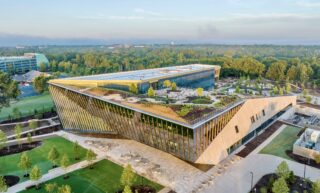
Located in a growing corner of Northwest Arkansas, the AWSOM campus offers more than attractive surroundings. The 154,000-square-foot, four-story building was designed by Polk Stanley Wilcox Architects as an extension of the surrounding forest, with landscape and rooftop design by the New York studio OSD. It includes learning halls, small group rooms, a public gallery, a library, clinical teaching spaces, a cafe, a student lounge and covered bicycle parking. The campus has 14 acres of green space and connects to Crystal Bridges Museum of American Art and five miles of bike and walking trails through the Ozark forest. The two-acre rooftop park is among the largest in the region. The site also includes healing gardens, outdoor classrooms and urban farming space.
Key learning spaces:
- Clinical Skills Center: 16,900 square feet with 12 exam rooms, a central observation space, debriefing rooms, triage rooms and a point-of-care testing room. Rooms are equipped with ultrasound and other diagnostic tools, and sessions with standardized patients are recorded so students can review their communication and exam skills.
- Simulation Lab: four high-fidelity simulation suites with one-way mirrored control rooms and debriefing classrooms. Students train on full-body patient simulators, surgical scrub sinks and booms, simulated ICU monitors and electronic records, part-task trainers and virtual and mixed reality headsets, in settings that mimic emergency departments, operating rooms, labor and delivery and intensive care units.
- Anatomy Resource Center: 3,010 square feet with more than 100 plastinated specimens and virtual reality for surface, regional and cross-sectional anatomy, embryology and histology. AWSOM teaches anatomy without traditional cadaver dissection.
- Maker Space: 3D modeling software and FDM and PolyJet 3D printers, where students design and print anatomical and clinical models.
- Library: about 4,000 square feet of open, wellness-minded study space, plus group and private study rooms and a quiet room on the third floor.
- Standardized Patient Program: community members trained to portray patients give students realistic practice and direct feedback.
Wellness built into daily life
Many medical schools have wellness programs. At AWSOM, self-care is a school value, a curriculum priority and a part of the building’s design. The goal is not only to prevent burnout but to help students build habits that let them practice for decades.
The Student Lounge includes exercise and yoga space, a recreation area, a mother’s room, a quiet room, a theater, lockers and an outdoor balcony, plus coffee and tea, charging stations and a kitchenette. The building also has a gym, a wellness center and a cafe. Fitness and wellness classes are organized based on student demand and may include yoga, weight training, guided meditation and activities on local trails. Workshops through the year cover nutrition, resilience and self-care, and structured sessions address topics such as preventing burnout, coping with grief and staying well while preparing for the USMLE.
Mental health services are provided through online providers and referrals to local counseling centers, including 24/7 online support, counseling with licensed therapists and wellness coaching. All services are private and confidential. Student Affairs also offers facilitated peer support and wellness-based programming.
Primary care: AWSOM has arranged priority access for medical students at two Mercy primary care clinics, in Bella Vista and Centerton. Students must carry health insurance, which is part of the cost of attendance.
Houses and mentors
Each student is assigned before orientation to one of four Houses, AWSOM’s learning communities. Each House has 12 students and is led by a pair of Career Mentors, practicing physicians from the local community who stay with students from orientation through graduation. The school says Career Mentors continue to support students during their first two years of residency. The Houses are named for four pioneering American physicians:
- House of La Flesche Picotte, for Dr. Susan La Flesche Picotte, the first Indigenous woman in the U.S. to earn a medical degree.
- House of Salk, for Dr. Jonas Salk, who developed one of the first safe and effective polio vaccines.
- House of Taussig, for Dr. Helen B. Taussig, widely recognized as the founder of pediatric cardiology.
- House of Williams, for Dr. Daniel Hale Williams, who performed the first successful open-heart surgery in the U.S. and founded Provident Hospital.
House luncheons are held monthly and give students time for mentorship, reflection and peer connection, with discussions on professional identity and the realities of practice. Each House chooses a House Representative who coordinates wellness and community activities and serves on the Student Government Association. The learning communities page describes the model.
These layers mean students are not expected to figure everything out alone. With 48 students per class, close contact with faculty and mentors is realistic.
Academic support
The flipped classroom asks students to do more learning on their own, and AWSOM supports that with Learning Specialists, trained educators who know the curriculum. They meet with students individually or in small groups, use exam reports and self-assessments to guide their advice, and teach skills such as strategic reading, time management and exam preparation. Before each summative exam they host “Power Hour” sessions where students and faculty work through questions together. USMLE preparation begins in the first year with practice tests, modules and facilitated small groups. A peer tutoring program with trained upper-year students starts in Fall 2026. Academic difficulty is treated as something to address early, with a defined path to a passing grade.
Student organizations
AWSOM supports student government, student interest groups, national organization chapters, clubs and student seats on school committees. The school’s examples include:
- Student Interest Groups: Dermatology, Internal Medicine, Neurology and Psychiatry, Obstetrics and Gynecology, Pediatrics, Orthopedics, Surgery, Artificial Intelligence in Medicine, the Literacy, Education, and Access Program (LEAP), the AWSOM Community Health Initiative, and Food as Medicine.
- National and professional organizations: the American Medical Student Association (AMSA) and a state medical association chapter.
- Clubs: Art in Medicine, the Asian Student Association and the American Muslim Medical Student Association.
- Committees: curriculum, research and wellness.
Because the school is new, students in the first classes are helping shape this list. The Director of Student Life and Development oversees student organizations and student life programming. The current list is on the student organizations page.
Community engagement and traditions
AWSOM students start serving the community during their first week of school through a Day of Service. During the 2025 Day of Service, the inaugural class painted nearly 2,000 square feet of educational space at the Northwest Arkansas Children’s Shelter, made 250 care packages for veterans in local hospitals with the American Red Cross of Arkansas, wrapped 6,800 diapers for Family Network NWA, and assembled 200 go-bags for survivors of domestic violence with Freedom Finder. After orientation, service continues through events planned by staff, student interest groups and student government, and through service-learning in the IPM course. Students log their hours and sites on GivePulse, a volunteer tracking platform. The school’s community partners article describes the program.
The school’s milestone events are Student Orientation, the White Coat Ceremony, Match Day and Graduation with hooding. The first White Coat Ceremony was held in July 2025 and the second on July 17, 2026.
Living in Bentonville
Bentonville sits where innovation meets small-town Ozark life. It is home to Walmart’s headquarters and a growing health care sector, and the wider Northwest Arkansas region includes three Fortune 500 companies. Students regularly take advantage of:
- Crystal Bridges Museum of American Art, next to campus, which offers free admission, and the Momentary, its contemporary arts space downtown.
- The OZ Trails, about 322 miles of natural surface trails that have made Bentonville known as a mountain biking capital.
- The Razorback Greenway, a 40-plus-mile trail that connects seven Northwest Arkansas cities.
- Downtown restaurants, a farmers market and a lively arts scene.
The campus setting is suburban. Most students live off campus, and the cost of attendance assumes off-campus living. The school reserves AWSOM student apartments at local complexes, and dedicated student housing is set to open in 2027 with easy access to campus, the Crystal Bridges trails and downtown Bentonville. In October 2024 the school announced the plan for that complex on an 11-acre site next to the school; ask Student Affairs about current options when you are admitted.
Clinical Rotations and Research Opportunities
Clinical training from year one
Unlike schools that delay patient contact, AWSOM puts students in clinical settings early. Early Clinical Skills and Experiences I and II place first-year students in primary care clinics, where they practice history-taking and communication with real patients under supervision. ECSE III and IV move students into the inpatient setting in year two. The goal is to make patient contact routine from the beginning, so the clerkship year builds on two years of supervised experience.
Core clerkships and sites
The third-year clerkships are Internal Medicine, Surgery, Obstetrics and Gynecology, Pediatrics, Psychiatry and Behavioral Health, and Family Medicine, plus two 2-week electives and a four-week Emergency Medicine clerkship at the end of Year 3 or in Year 4. In Family Medicine, students work in assigned clinics alongside the attending physician and team. Internal Medicine covers hospitalized adults, from the emergency department through admission and consult services. Psychiatry includes psychiatric interviewing, treatment planning, behavioral emergencies and a survey of mind-body approaches.
Rotations take place at the school’s clinical partners in Northwest Arkansas, led by Mercy Hospital Northwest Arkansas, with Washington Regional Medical Center, the Fayetteville VA Medical Center, Arkansas Children’s Northwest, UAMS, Highlands Oncology, Springwoods Behavioral Health, Arisa Health, Community Clinic and Vantage Point Behavioral Health Hospital. The school has not published how students are assigned to sites or how much travel each rotation requires. Most listed partners are within a short drive of Bentonville. Students are required to have a current driver’s license and a vehicle, and the budget includes transportation costs. Year 4 electives allow students to rotate in intensive care and medical and surgical specialties in more depth, and students can plan externships with their advisors.
Required research for every student
Every AWSOM student completes a mentored scholarly project through four required courses. This is the school’s version of a capstone, and it is a sustained, mentored effort rather than a last-minute poster:
- Research I (Year 1): formulate a research question, review the literature, choose a study design, consider research ethics and build a protocol, through team-based learning and faculty mentorship.
- Research II: collect and organize data, explore how research applies to clinical cases and create project milestones.
- Research III: continue data collection and prepare draft posters or white papers, with feedback from small groups.
- Research IV: work with research mentors to revise materials, plan future directions and renew research credentials needed for clerkships.
The project is not limited to laboratory science. Faculty research interests include health services research, health disparities, infectious disease epidemiology, antimicrobial stewardship, medical education and the use of artificial intelligence in teaching. Whether the focus is a clinical outcomes question, a community health need or a medical education innovation, the work is expected to be rigorous and ethical.
Research areas, mentors and partners
AWSOM protects time for research within the curriculum and matches students with faculty mentors from AWSOM and from Stanford University. Students lead research in clinical and translational sciences, social determinants of health, public health policy, health systems and services, and medical education. The school’s research partners include Stanford University School of Medicine, Mercy, Highlands Oncology, the Institute for Integrative and Innovative Research (I3R) and select University of Arkansas laboratories, which expand student opportunities in human nutrition, health equity, medical imaging, translational science and population health.
Research support and early results
Research is led by the Assistant Dean for Research Education, who supervises student projects; the Director of Medical Student Research Projects, who connects students with resources and mentors; and the Associate Dean for Clinical Research, who guides research opportunities and partnerships with clinical research sites. A Clinical Research Team handles research infrastructure, compliance and ethical review. The Maker Space supports students who want to prototype devices or models.
The first class has already presented work nationally. At the Society of General Internal Medicine 2026 Annual Meeting in Washington, D.C., AWSOM had five scientific abstracts accepted involving ten first-year students. Eight students presented posters, and two were selected for a curated session on top hospital medicine abstracts. The projects covered topics such as Clostridioides difficile infection outcomes, invasive aspergillosis and burnout. In June 2026, four first-year students became the first from AWSOM to present research at an international conference, at the International Association of Medical Science Educators (IAMSE) annual meeting, with a pilot study on AI-generated feedback for clinical reasoning tests. The school’s SGIM 2026 article lists every abstract.
Research is expected, but it is not cutthroat. The school’s emphasis is quality, collaboration and meaningful contribution.
Career advising and residency preparation
Because AWSOM’s first class graduates in 2029, there is no Match data yet. The school says Match and graduation data will be available in Summer 2029, and USMLE Step 1 and Step 2 results in Spring 2028 and Spring 2029. First-year retention for 2025-26 was 100%.
The school has built advising infrastructure for that first Match:
- Individual advising that is personal, proactive and longitudinal, with an individualized career plan for each student and academic planning for clerkships, electives and externships.
- Residency Rx, a structured online program for specialty exploration, CV development and residency application readiness.
- Careers in Medicine, the AAMC’s specialty exploration platform, available from the start.
- Specialty Advisers, faculty and community physicians who explain training pathways in their fields.
- Workshops and seminars, including Specialty Speed Rounds (small-group conversations with practicing physicians) and specialty panels.
- Interview preparation, including mock interviews, feedback on application materials and help with ERAS and the NRMP Match.
AWSOM does not restrict students from pursuing competitive specialties. Its mission favors primary care and rural practice, but the goal is to match each graduate where they will thrive. Details are on the career services and advising page.
Notable Alumni, Faculty, Leadership and Admissions Staff
Alumni
AWSOM has no alumni yet. The inaugural Class of 2029 entered in July 2025 and will graduate in 2029. Anyone described as an AWSOM graduate before then is not one. In place of alumni, the profiles below cover the school’s leadership, admissions team and faculty, the people applicants are most likely to meet or learn from. Roles were checked on the school’s site on October 17, 2026.
School leadership
Sharmila Makhija, MD, MBA, Founding Dean, CEO and Professor. Dr. Makhija has led AWSOM since its founding and works with health systems and partners to shape how the school prepares students for community practice. She is an internationally known gynecologic oncologist. Before AWSOM she chaired the Department of Obstetrics and Gynecology and Women’s Health at Albert Einstein College of Medicine and Montefiore Health System in New York, and she held faculty and leadership roles at the University of Pittsburgh, the University of Alabama at Birmingham, Emory University and the University of Louisville. She earned her MD at UAB and an executive MBA at Emory. Applicants will see her vision in the school’s emphasis on science, self-care, the humanities and the arts.
Beth Nelson, MD, Interim Executive Vice Dean and Senior Associate Dean, Undergraduate Medical Education. Dr. Nelson oversees Curricular Affairs, Student Affairs and Admissions. She was a founding faculty member and Senior Associate Dean of Undergraduate Medical Education at Dell Medical School at the University of Texas at Austin, and earlier held the same senior dean role at Baylor College of Medicine. A board-certified internist trained at UCSF, she received the AAMC Southern Group on Educational Affairs Career Educator Award in 2020. Her experience opening Dell Medical School is directly relevant to a school in its early years.
Kristin A. Kassaw, MD, Associate Dean, Student Affairs and Professor. Dr. Kassaw joined AWSOM on July 1, 2026, and leads career advising, academic assistance, student progress, financial aid, registration and academic events. She is a psychiatrist who previously served as Associate Dean for Student Affairs at the University of Houston Fertitta College of Medicine. For admitted students, her office is the hub for most support services.
Yerko Berrocal, MD, MHPE, Associate Dean, Curricular Affairs and Professor. Dr. Berrocal is responsible for developing, implementing and evaluating the integrated ARCHES curriculum. He previously taught at the University of Illinois College of Medicine and Florida International University’s Herbert Wertheim College of Medicine and has won multiple basic science teaching awards. His research on the flipped classroom and higher-order thinking shaped how AWSOM teaches.
Chris Candler, MD, EdD, Senior Associate Dean, Faculty Affairs and Development. Dr. Candler oversees faculty recruitment, development and well-being. He spent 28 years in medical education, most recently as Senior Associate Dean for Academic Affairs at the University of Oklahoma College of Medicine. He was the founding Editor-in-Chief of the AAMC’s MedEdPORTAL and has served as a field secretary for the LCME. He earned his doctorate in higher education at the University of Arkansas.
Sarah Assem, MD, Assistant Dean, Clinical Education and Associate Professor. Dr. Assem oversees the clinical parts of the ARCHES curriculum, including clinical skills. A board-certified internist and University of Arkansas biology graduate, she was program director of the UAMS Northwest Internal Medicine Residency and has hospitalist privileges at Mercy Hospital Northwest. She mentored first-year students who presented at SGIM and IAMSE in 2026, a sign that clinical faculty here are involved in student research.
Loretto Glynn, MD, MBA, FACS, FAAP, Associate Dean, Clinical Affairs. Dr. Glynn is responsible for the school’s clinical activities and its relationships with clinical partners. A pediatric surgeon with more than 30 years of experience, she was Professor of Surgery and Pediatrics and Director of Pediatric Surgery at NYU Grossman Long Island School of Medicine.
Lloyd Minor, MD, Chair, AWSOM Board of Directors. Dr. Minor is the Carl and Elizabeth Naumann Dean of the Stanford University School of Medicine, a professor of otolaryngology and a member of the National Academy of Medicine. His role is board governance, not teaching or admissions.
Admissions team
Dan Kallenberger, MS, Assistant Dean, Recruitment, Admissions, and Whole Health Initiation. Kallenberger oversees the admissions process, recruitment, community engagement and pathway programs. He previously served as Assistant Dean for Admissions and Financial Services at Oakland University William Beaumont School of Medicine, where he directed a four-year financial wellness program and was selected by the AAMC to partner on developing the PREview professional readiness exam. Earlier he worked in admissions at Western Michigan University Homer Stryker M.D. School of Medicine and was a founding staff member at Marian University’s College of Osteopathic Medicine. His background explains AWSOM’s recommendation that applicants take PREview and its attention to financial wellness.
Daniel Goodpaster, MS, Director, Admissions. Goodpaster runs day-to-day admissions operations and prospect management and helps shape pathway programs, admissions policy and recruitment. He was previously Director of Admissions at Western Michigan University Homer Stryker School of Medicine and Director of Enrollment Management at Marian University College of Osteopathic Medicine.
Gina Britton, MS, Senior Admissions Counselor. Britton is part of the three-person admissions team listed on the school’s How to Apply page. Questions about your application can go to the admissions office at [email protected].
Faculty and educators
Jacquelyn M. Paykel, MD, MBA, Assistant Dean, Whole Health Education and Associate Professor. Dr. Paykel leads the Embracing Whole Health thread and oversees how whole health is used across the curriculum. Board-certified in obstetrics and gynecology and in integrative medicine, she served as Chief Well-being Officer and Chief of Whole Health Service at the James A. Haley Veterans’ Hospital in Tampa. If you are writing the whole health secondary, her background shows the clinical, evidence-based version of whole health the school teaches.
Kevin Kunkler, MD, Assistant Dean, Simulation and Clinical Skills and Professor. Dr. Kunkler leads the simulation and clinical skills programs and helps connect the preclerkship and clerkship years. He was a founding professor and Executive Director of Simulation at the TCU Burnett School of Medicine and earlier worked on medical simulation research for the U.S. Army Medical Research and Materiel Command.
Shahrzad Bazargan-Hejazi, PhD, Assistant Dean, Research Education and Professor. Dr. Bazargan-Hejazi leads the research education curriculum and supervises student research projects. She was Professor and Vice-Chair for Research in Psychiatry at Charles R. Drew University of Medicine and Science, where she directed research education, and her work focuses on health disparities, substance use and mental health.
Abhishek Deshpande, MD, PhD, FIDSA, Director, Medical Student Research Projects and Associate Professor. Dr. Deshpande connects students with research resources and mentors them through their projects. An infectious diseases epidemiologist formerly at Cleveland Clinic and its Lerner College of Medicine, he has authored more than 175 publications and presentations and leads a multicenter trial on antibiotic stewardship in pneumonia. He co-authored most of the students’ SGIM 2026 abstracts.
Jessica Atrio, MD, MSc, Associate Dean, Clinical Research. Dr. Atrio directs the school’s clinical research and student research opportunities. Formerly Vice Chair of Research in Obstetrics and Gynecology at Montefiore, she led a clinical trial that informed World Health Organization contraceptive guidance, and her research on early pregnancy loss was incorporated into ACOG guidelines.
Ian Murray, PhD, Professor. Dr. Murray designs and teaches the physiology curriculum and serves on the board of the International Association of Medical Science Educators. He mentored the four students who presented at IAMSE 2026, and his research focuses on AI tutoring and assessment in medical education.
Lance Bridges, PhD, Department Chair, Medical Education and Professor. Dr. Bridges chairs the Department of Medical Education and teaches biochemistry within the active-learning curriculum. An Arkansas native, he was founding chair of biochemistry at the Arkansas College of Osteopathic Medicine and has won teaching awards at both MD and DO schools.
Alexis Gillett, PT, DPT, EdD, Associate Professor and Interim Anatomy Lab Director. Dr. Gillett helps design the anatomy curriculum and directs the anatomy lab. A pelvic health physical therapist who previously directed a public health master’s program at Arkansas Colleges of Health Education, she brings an interprofessional perspective to anatomy teaching.
Other current members of the Department of Medical Education include Marie Berenguer, PhD (Assistant Professor, genetics and cell and molecular biology); Diptiman Bose, PhD, MEd, RPh (Professor, pharmacology); Patrick Brooks, MD, FASCRS (Director, Clinical Integration Education and Associate Professor); Jonathan Brown, PhD (Professor, microbiology and immunology); Chelsey Deel, MD (Associate Professor, pathology); Ryan Downey, PhD (Associate Professor, physiology); Lori Garman, PhD (Associate Professor, medical microbiology and immunology); Trager Hintze, PharmD, BCCCP (Associate Professor, pharmacology); Sylvia Merino, MBA, MPH (Director, Simulation and Instructor); and Stephen Nix, MD, MA (Associate Professor, pathology, and Course Director for Integrated Principles of Medicine). The campus lists more than 100 full-time faculty and staff, and the full roster is on the faculty and leadership page.
This team brings together basic scientists, experienced physicians and other health professionals, which matches the school’s interdisciplinary approach. Many leaders have helped open or rebuild medical schools before, at Dell, TCU, Marian and elsewhere. That is useful context for applicants weighing a new school: the people running AWSOM have done this work before.
Admissions Statistics and Class Profile
Class of 2029 (entered July 2025)
The inaugural class is the only one with a published academic profile. All 48 students:
| Measure | Class of 2029 |
|---|---|
| Median MCAT | 513 |
| Mean GPA | 3.89 |
| Mean BCPM GPA | 3.87 |
| First-generation college students | 19% |
| From rural areas | 15% |
| With research experience | 94% |
| Double majors | 14 students |
| Combined community service hours | 35,605 |
| Combined medical exposure hours | 59,321 |
| Applications for the first class | More than 2,000 |
About one-third of the class came from Arkansas and 21% from states bordering Arkansas. The top home states were Arkansas, Texas, California, Virginia, Utah and Florida. The top undergraduate schools were the University of Arkansas, Baylor University, Ouachita Baptist University, the University of Alabama, the University of Texas at Austin and Washington University in St. Louis. The school’s class profiles page has the full profile.
Applicant pool and selection, 2025 entering class
These figures cover the same inaugural class, entering in 2025, and add the size of the applicant pool and the scores of everyone who was accepted:
| Measure | 2025 entering class (Class of 2029) |
|---|---|
| Verified applications | 2,021 (175 Arkansas residents, 1,835 nonresidents, 11 international) |
| Applicants interviewed | 207 (38 Arkansas residents, 169 nonresidents) |
| Matriculants | 48 (15 Arkansas residents, 33 nonresidents) |
| Acceptance offers | Not reported |
| Median MCAT, accepted applicants | 513 (mean 513.3) |
| MCAT section medians, accepted applicants | Chemical and Physical 128; CARS 127; Biological and Biochemical 128; Psychological and Social 129 |
| Median overall GPA, accepted applicants | 3.92 |
| Median science GPA, accepted applicants | 3.9 |
About 10% of verified applications reached an interview: 38 of 175 Arkansas applications (about 22%) and 169 of 1,835 nonresident applications (about 9%). Arkansas residents sent about 9% of the applications and filled 31% of the seats. International applications were not eligible, which is why none of the 11 reached an interview.
Matriculants in the 2025 entering class reported these premedical experiences: physician shadowing or clinical observation 90%, community service 81%, medical or clinical volunteering 78%, paid clinical employment 68% and military service 3%, alongside the 94% with research experience. Fifteen percent held a graduate degree, 69% were science or math majors and 27% reported disadvantaged status. Thirty-five percent came from a medically underserved area. Twenty-nine students were 19 to 23 when they entered, 15 were 24 to 29 and 4 were 30 to 39. The class came from 20 states.
Class of 2030 (entered July 2026)
The second class also enrolled 48 students. The school received nearly 5,000 applications, more than double the first year. Twenty-five percent of the class comes from rural communities, and 65% from the Heartland region, including Arkansas and its surrounding states. The school has not yet published MCAT or GPA figures for this class.
Reading the numbers
A few points help put these figures in context:
- Applications more than doubled in one year. That trend, plus the tuition waiver, means you should expect a more competitive pool than the first class faced.
- The regional share grew. The rural share rose from 15% to 25% and the Heartland share is now 65%, which matches the strategic plan’s goal of more than 70% from Arkansas and the Heartland states.
- Experience depth matters. The first class averaged about 1,235 medical exposure hours and 740 community service hours per student. Those are averages from class totals, not cutoffs, but they show that strong applicants bring sustained work. Internships for pre-med students and long-term clinical jobs are two ways to build that depth.
- The minimums are far below the medians. A 500 MCAT and 3.4 GPA meet the screen, but the median admitted student in the first class scored 513.
- About 1 in 10 applications reached an interview. For the 2025 entering class, 207 of 2,021 verified applications led to an interview. Offer counts are not published, so any acceptance rate you see elsewhere is an estimate.
- Nonresidents fill most seats. Thirty-three of the 48 students in the 2025 entering class came from outside Arkansas, although Arkansas applicants were interviewed at more than twice the nonresident rate.
Tips and Strategies for Admission
1. Clear every minimum, then aim for the class medians
AWSOM will not send a secondary to an applicant below any minimum, no matter how strong the rest of the file is. Check each one: MCAT 500 or above from January 2023 or later, overall GPA 3.4, BCPM GPA 3.4 with 24 hours (or 3.5 for post-bacc or graduate work), and citizenship or permanent residency. If your undergraduate BCPM GPA is below 3.4, a post-baccalaureate or graduate BCPM GPA of 3.5 is an accepted alternative route. Then compare yourself with the medians. Accepted applicants in the 2025 entering class had a median MCAT of 513 and a median GPA of 3.92. An application near those numbers will be read very differently from one at the minimum.
2. Show sustained service, not a list of events
The first class reported more than 35,000 service hours together. What matters is depth: a role you held for a year or more, a community you came to know, and something that changed because you were there. Use your AMCAS activities to show progression from volunteer to organizer. Our guide to AMCAS Work and Activities shows how to describe that progression.
3. Get real patient contact
AWSOM puts students in clinics during their first month, so it wants applicants who already know what patient care feels like. Paid clinical jobs and clinical internships for pre-med students give you supervised, hands-on contact with patients. If you are still in college, medical internships for undergraduates can fit into a summer or a semester break. For a sense of how many hours other applicants bring, see our guide on how many clinical hours you need for medical school.
4. Practice whole health, and be able to talk about it
Self-care is one of AWSOM’s five values and the subject of a secondary prompt. You do not need training in integrative medicine. You do need honest, specific habits: how you sleep, move, eat, connect with people and handle stress, and what you learned when those habits broke down. Experience with lifestyle-focused care, health coaching, community nutrition or behavioral health also fits the school’s mission well.
5. Connect your story to the Heartland
With 65% of the Class of 2030 from the Heartland region, applicants from Arkansas and nearby states have a natural connection to the mission. If you are from elsewhere, explain concretely why rural and underserved care in this region matters to you: family ties, work in similar communities or a clear plan to practice in a place like Northwest Arkansas. Do not claim a connection you cannot explain.
6. Take PREview
The school highly recommends the AAMC PREview exam. Taking it is a simple way to show you followed the school’s guidance, and it gives the committee another view of your professional readiness.
7. Choose letter writers who know your character
AWSOM asks for three to five letters and recommends at least one from a faculty member who knows you. Because the school weighs values such as empathy and humanism, ask writers who have seen you work with people, such as a clinical supervisor or service coordinator, in addition to a professor.
8. Apply early
Offers start in mid-October and continue until 48 seats are filled. Submit AMCAS in June, return the secondary within about two weeks, and be ready for an interview as early as September.
9. Make your personal statement and secondaries work together
AWSOM’s seven secondary prompts cover mission fit, lived experience, community, trust, whole health, gap years and anything else you want to share. Map your strongest stories across them before you write so you do not repeat yourself. Your personal statement should explain why medicine; the secondaries should show how you work with people and communities. For structure and tone, see our AMCAS personal statement examples.
10. Weigh the risks of a new school honestly
AWSOM offers a rare combination: no tuition, a small class, early clinical training and a clear mission. It also has preliminary accreditation, no federal loans yet and no Match history. Applying is a reasonable choice for many students, but go in with your eyes open and be ready to explain in an interview why you want a new school.
Secondary Application Questions, Example Responses and Analysis
AWSOM does not post its secondary prompts on its website. The prompts below are the 2026-2027 AWSOM secondary prompts, word for word, checked on October 17, 2026. They are the same seven prompts the school used in 2025-2026. Every prompt has a limit of 1,500 characters, including spaces. Five are required and two are optional. Write to 1,500 characters and follow any limit shown in your portal.
Only applicants who meet every minimum requirement receive the secondary. The fee is $100, and the secondary and letters are due by December 1, 2026. There are no separate prompts for special tracks, reapplicants or combined degrees, because AWSOM has none.
Each example below is original teaching material written for this guide. Use it to see how a response can answer every part of a prompt within the limit, then write your own from your own experiences. For prompts from other schools, see our medical school secondary essay prompts database.
Prompt 1: Mission and values alignment (required, 1,500 characters)
Describe how AWSOM’s mission and values align with your personal and professional goals. Please include how you believe AWSOM will help you develop into the kind of person and physician you hope to become.
What it asks. This prompt has two parts. First, show how the school’s mission (rural and underserved health in Arkansas and nearby states, whole health, new technologies and partnerships) and its five values match your goals. Second, explain how AWSOM in particular will help you grow, as a person and as a physician.
How to approach it. Pick one or two of the five values and prove each with your own experience. Then name two to four real AWSOM features and tie each one to a specific goal. Close with the kind of physician you want to become.
Illustrative example, not an actual applicant essay (1,420 characters):
My grandmother drove 70 miles each way from our town in the Missouri Ozarks to see a cardiologist, and she skipped follow-ups whenever the truck needed tires. As a scribe at a rural health clinic, I saw that pattern again and again: patients who knew what they needed but could not reach it. I want to practice primary care in a town like mine, and AWSOM’s mission to serve rural and underserved communities in Arkansas and its surrounding states names that goal plainly.
Two of AWSOM’s values match how I want to work. Community Focus means building care around where people live. Self-care matters to me because I watched our clinic’s only physician burn out and leave, and the town lost more than a doctor.
AWSOM would shape me in specific ways. Early Clinical Skills and Experiences would place me in primary care clinics in my first year, so I would learn to take histories from patients like the ones I scribed for. The Embracing Whole Health thread would teach me to ask what matters to a patient before asking what is wrong. In the Research courses I hope to study how travel distance affects follow-up visits. A House led by local physician mentors would let me learn from doctors who have built lasting careers in the region.
I want to become a physician who stays: steady, curious and still present for patients ten years from now. AWSOM is built to train that kind of doctor, and I want to be one of them.
Why this example works. It answers both halves of the prompt. The opening story shows a real access problem in the Heartland in two sentences, and the applicant connects it to the mission in one plain sentence instead of quoting it. The second paragraph names two of the school’s actual values and gives a reason for each that comes from experience: a community that lost its only physician to burnout makes the case for Self-care better than any definition could. The third paragraph answers the “how will AWSOM help you develop” part with four real features: first-year clinical experience in primary care, the Embracing Whole Health thread, the required research courses and the House mentoring model. Each one is tied to a goal. The closing line answers the “kind of person and physician” question directly. At 1,420 characters, it leaves room for small edits.
Mistakes to avoid. Do not list all five values with a sentence each; that reads like a summary of the website. Do not quote the full mission statement, which uses a fifth of your space. Do not lead with the tuition waiver, which suggests money is your main reason. Do not mention programs AWSOM does not have, such as a rural track, an MD/MPH or early assurance. And do not skip the “kind of person” part of the question.
Prompt 2: Unique qualities and lived experiences (required, 1,500 characters)
The Admissions Committee evaluates a range of student qualities, characteristics, and life experiences that complement demonstrated academic excellence. What unique qualities or individual lived experiences do you possess that make you uniquely suited to become a physician?
What it asks. The committee already has your grades and MCAT. This prompt asks what else you bring: qualities, characteristics or lived experiences that would make you a good physician. “Unique” does not mean dramatic. It means specific to you.
How to approach it. Choose two or three qualities and back each with a concrete experience. Explain what you learned and how it will matter in patient care. Avoid repeating your personal statement; use this space for a different side of you.
Illustrative example, not an actual applicant essay (1,371 characters):
I grew up as the family translator. At nine I explained a water bill to my parents in Vietnamese; at fifteen I sat with my father while a surgeon described his hernia repair, and I realized I was choosing which words he would hear. That job taught me that understanding is not the same as being told. I learned to check back, to watch faces and to say “let me try that again” without embarrassment.
That habit grew when I worked night shifts as a certified nursing assistant through college. Many of my residents had dementia, and words often failed. I learned to read a clenched hand as pain and a slow walk to the window as loneliness. One resident refused every bath until I noticed she relaxed when I hummed hymns her daughter had mentioned. Small observations, repeated over 2,000 hours, made me patient in a way that classes could not.
Working nights while carrying a full science load also taught me to plan. I studied for organic chemistry on breaks and kept a 3.7 GPA by protecting sleep on my days off, a lesson in self-care I learned the hard way after one rough semester.
What I bring is not one dramatic story but a set of practiced skills: translating between worlds, noticing what people cannot say and staying calm at 3 a.m. Those skills will help me earn trust from patients who, like my parents, are often unsure what a doctor is really telling them.
Why this example works. It names three qualities (translating meaning, reading what patients cannot say, and planning under pressure) and supports each with a lived experience instead of an adjective. The details are small and believable, such as the hymns and the clenched hand, and the 2,000 hours show this was sustained work. The third paragraph quietly touches Self-care, one of AWSOM’s values, without forcing it. The final paragraph answers the “uniquely suited to become a physician” part by turning the experiences into skills a patient would benefit from. The tone is confident without bragging.
Mistakes to avoid. Do not list traits (“I am compassionate, resilient and hardworking”) without evidence. Do not tell a hardship story without explaining what it taught you. Do not assume “unique” requires a rare background; ordinary experiences described precisely work well. And do not repeat the same story you used in your personal statement.
Prompt 3: Community engagement (required, 1,500 characters)
Describe your experiences engaging in the community, and how those experiences have prepared you for a future as a physician.
What it asks. Two things: what community work you have done, and how it has prepared you to be a physician. Community Focus is one of AWSOM’s five values, and students begin serving local partners in their first week, so this essay carries weight.
How to approach it. Pick one sustained commitment, or two related ones, rather than listing many. Show how your role grew, what you learned about the community’s real needs, and which lessons you will carry into medicine.
Illustrative example, not an actual applicant essay (1,374 characters):
For three years I coordinated Saturday distributions for a mobile food pantry that served four small towns south of my college. My first job was unloading trucks. By my second year I was scheduling 25 volunteers and mapping which church parking lots could handle a semi.
The work prepared me for medicine in three ways. First, it taught me that need is local. One town wanted fresh produce; another needed diabetic-friendly options because so many families were managing the disease. We started a simple sign-up asking what people actually ate, and waste dropped by a third.
Second, it taught me consistency. People came back because we came back, every Saturday, even in sleet. When a regular named Ms. Ruth stopped coming, a volunteer drove to her house and found she had fallen. That moment taught me that showing up is a form of care.
Third, it taught me to work with partners. I learned to ask the county health department for blood pressure screening at our sites instead of trying to do everything ourselves. Twelve people were referred for follow-up in one season.
As a physician, I expect to rely on the same lessons: learn what a community needs before offering solutions, be reliable over the long term, and build partnerships rather than working alone. I would bring that approach to AWSOM’s community partnerships and to service in my first week and beyond.
Why this example works. It focuses on one commitment over three years and shows growth from unloading trucks to coordinating volunteers. The three lessons are clearly organized, and each has a result: less waste, a fall caught early and twelve referrals. The lessons match how the school describes good community work: learning local needs, staying consistent and working through partnerships. The final paragraph answers the “prepared you for a future as a physician” part directly, and the brief mention of AWSOM’s community partnerships and first-week service shows the applicant knows how the school works without turning the essay into a school summary.
Mistakes to avoid. Do not list every service activity you have done; the AMCAS activities section does that. Do not count hours as a substitute for reflection. Do not describe the community as people to be rescued; describe them as partners. And do not stop at what you did without explaining how it prepares you for medicine.
Prompt 4: Trust and rapport (required, 1,500 characters)
Trust and rapport are essential in your day-to-day interactions with people. How do you cultivate a relationship with a person who may be very different from you?
What it asks. This is a “how” question. The committee wants to see your process for building trust with someone whose background, beliefs or experience differ from yours. AWSOM’s whole health teaching puts a key emphasis on trust, so this prompt connects directly to how the school trains physicians.
How to approach it. Use one specific relationship to show your method, then state the method in a way that applies beyond that one person. Change names and identifying details to protect privacy.
Illustrative example, not an actual applicant essay (1,399 characters):
Mr. Hale was a 78-year-old retired cattle farmer at the hospice where I volunteered. He told me on my first visit that he did not trust doctors, college students or anyone who used the word “journey.” I was all three things he disliked, minus the doctor.
I did not try to win him over with talk. I asked about his cattle and then listened, really listened, for forty minutes. I came back the next Tuesday at the same time, and the one after that. Consistency did more than charm ever could. By the fourth visit he was correcting my understanding of hay prices and asking about my classes.
I learned to start where the other person is. He valued plain speech, so I stopped softening everything. When he asked me directly whether his new medication meant he was getting worse, I told him I did not know and offered to bring the question to his nurse with him. He later told me that answer was why he kept talking to me.
We disagreed on plenty, from politics to football, and I never pretended otherwise. Respect did not require agreement. It required honesty, curiosity about his life and follow-through on small promises.
Those steps are how I build trust with anyone very different from me: show up reliably, listen before explaining, speak plainly, admit what I do not know and keep my word. I expect future patients to test me the way Mr. Hale did, and I want to earn their trust the same way.
Why this example works. It answers the “how” directly with a clear process, shown through one relationship and then summarized in a single sentence the reader can remember. The details make the method believable: same day and time every week, forty minutes of listening, an honest “I do not know” and an offer to involve the nurse. That last move also shows good clinical judgment, since a volunteer should not answer medication questions. The paragraph on disagreement shows maturity: respect does not require agreement. The ending connects the method to future patients.
Mistakes to avoid. Do not claim you “treat everyone the same”; the prompt asks how you bridge real differences. Do not reduce the other person to a label or use their identity as a prop. Do not describe a difference without describing what you actually did. And do not share private details that could identify a patient or client.
Prompt 5: Whole health (required, 1,500 characters)
Whole health considers the needs of the whole person with the goal of preventing disease, improving health outcomes, and sustaining wellness. How do you practice whole health in your personal life, and how do you aspire to incorporate whole health principles when caring for the community?
What it asks. Two parts again: your own whole health practices, and how you will use whole health principles when caring for a community. Self-care is one of AWSOM’s values and Embracing Whole Health is one of its six curriculum threads, so this prompt is central to fit.
How to approach it. Describe a few real, sustainable habits and what you learned when they were tested. Then move from your own life to patients and the community, with one concrete example of whole-person care you have seen or practiced.
Illustrative example, not an actual applicant essay (1,365 characters):
For me, whole health started as survival. During my junior year I was taking 18 credits, working 20 hours a week and sleeping five hours a night. I got sick twice in a month and my grades slipped. I rebuilt my routine around a few anchors: a fixed bedtime, trail runs three mornings a week, Sunday meal prep with my roommates and a standing call with my sister. I also started seeing a campus counselor, which I now see as maintenance, not crisis care.
Those habits taught me that health depends on what a person can sustain, not on what is ideal. A plan I could not keep was worse than a modest plan I could.
I want to bring that lesson to patients. As a medical assistant, I watched a patient with diabetes nod through a diet handout and then admit she worked two jobs and ate from gas stations. The doctor asked what one change felt possible. She chose to swap soda for water at work. That question, what matters to you and what can you do, is the core of whole health care.
In a community setting, I hope to ask that question at scale: partnering with food banks, schools and churches, and making care fit people’s real schedules. AWSOM’s Embracing Whole Health thread and its Food as Medicine interest group would help me learn to do this well. I want to care for patients as whole people while caring for myself well enough to stay in the work for decades.
Why this example works. The personal half is honest. It starts with a failure, names specific habits (sleep, exercise, food, connection and counseling) and draws a lesson: sustainability beats perfection. The community half uses a real clinical moment to show the core of whole health, asking what matters to the patient and what is possible for her. It then scales the idea to community partners and names two real AWSOM resources, the Embracing Whole Health thread and the Food as Medicine student interest group. The last sentence ties self-care to staying in practice, which is exactly why the school treats Self-care as a value.
Mistakes to avoid. Do not present a perfect wellness routine; it reads as unrealistic. Do not fill the essay with wellness buzzwords. Do not answer only the personal half and forget the community. And do not preach to patients; whole health starts with what the patient values, not with your advice.
Prompt 6: Gap year(s) (optional, 1,500 characters)
Gap Year(s) if applicable: If you are taking time off between college graduation and medical school matriculation, please tell us why you made this decision and what you will be doing or have done during this gap time.
Who should answer. Applicants who have graduated or will graduate before July 2027 and are not going straight from college to medical school. If you are a current senior who will enroll right after graduation, you can skip this prompt.
What it asks. Why you chose time off, and what you have done or will do with it, through matriculation.
How to approach it. Give a clear, positive reason in one or two sentences, describe your main activities with specifics, and finish with your plans until July 2027 and what the time has taught you.
Illustrative example, not an actual applicant essay (1,258 characters):
I graduated in May 2025 and chose a gap year for two reasons: I wanted more consistent patient contact than I could fit into school, and I wanted to finish a research project I started as a senior.
Since July 2025 I have worked full time as a medical assistant at a family medicine practice that serves many uninsured patients. I room patients, take vital signs, update medication lists and help with point-of-care testing. The work has shown me how much of primary care happens between visits: refill calls, transportation problems and patients who need someone to explain lab results again.
I also volunteer four hours a week on a crisis text line. The training taught me to listen without rushing to fix, a skill I now use with anxious patients in clinic.
My research on rural hospital closures and emergency transport times, done with a public health professor, became a poster at a regional meeting in March 2026. I am now helping prepare a manuscript.
Through matriculation I will continue working at the clinic, keep volunteering and finish the manuscript. This year confirmed my interest in primary care and showed me I can handle full-time clinical work. I am entering medical school with clearer goals and steadier habits than I had in college.
Why this example works. It gives two concrete reasons up front, then answers “what you have done” with specific duties, a lesson from each activity and a dated research result. It answers “what you will be doing” with a plan through matriculation. The tone is confident, not apologetic. Every activity connects to themes AWSOM values: primary care, underserved patients, mental health support and rural health research.
Mistakes to avoid. Do not apologize for taking time off. Do not write “I am gaining experience” without saying what you do each week. Do not forget to cover the months between now and matriculation. Make sure dates match your AMCAS activities. If you are still deciding how to spend a gap year, structured pre-med gap year programs and full-time clinical jobs both give you material for this prompt.
Prompt 7: Additional information (optional, 1,500 characters)
Is there any additional information not included elsewhere in your application you would like the admissions committee to know?
Who should answer. Anyone with important context that does not appear elsewhere: a grade dip, a gap in your record, a recent significant update or a family responsibility. If you have nothing new to add, leave it blank. A blank optional essay will not hurt you.
What it asks. Information not found elsewhere in your application. It is not an invitation to write a sixth essay on a topic you already covered.
How to approach it. State the issue plainly, give brief context, show what you did about it and point to evidence that it is resolved. Keep it short and factual.
Illustrative example, not an actual applicant essay (1,112 characters). This is a worked pattern for explaining a low semester; use this prompt only if a similar situation applies to you.
I want to explain my spring 2023 semester, when my GPA was 2.8. In February of that year my mother was diagnosed with breast cancer, and I drove home every weekend, three hours each way, to take her to treatment and care for my younger brother. I did not withdraw from classes because I did not want to fall behind, but I should have reduced my course load.
I learned two lessons. First, asking for help is part of being responsible. That summer I met with my advisor, set a realistic plan and used campus tutoring for the first time. Second, I learned how much caregivers carry. Sitting in infusion rooms, I saw families juggling work, children and fear, and I saw how a nurse who took two minutes to explain side effects could change my mother’s whole week.
My mother finished treatment in late 2023 and is doing well. My grades recovered: I earned a 3.8 or higher every semester afterward, including in biochemistry and physiology. I share this not as an excuse but as context, and because the experience shaped the kind of physician I want to be: one who sees the family in the room as well as the patient.
Why this example works. It names the problem and the semester in the first sentence, gives just enough context, takes responsibility (“I should have reduced my course load”) and shows the fix and the evidence of recovery. It also draws a short, genuine lesson about families and caregiving that fits AWSOM’s whole health approach. It uses well under the limit, which is right for this kind of response.
Mistakes to avoid. Do not make excuses or blame others. Do not repeat content from your other essays. Do not overshare medical details about family members. And do not use this space to list more activities.
Interview Format and Preparation
What the school confirms
AWSOM invites selected applicants to a virtual interview day. Interviews are typically held from September to February, with the first interview day in early September and the final one in late February. Invitations are sent on a rolling basis starting in August. Interview day is a chance for the school to learn your story and for you to learn about the design of its campus and curriculum.
Each applicant has two one-on-one interviews of 30 minutes each, held by Zoom on Friday afternoons. Interviewers are blinded to your MCAT performance, academic background and biographic information. The rest of the day is built for you to learn about AWSOM and ask questions through conversations with faculty and staff. That is a traditional interview format, not a multiple mini interview (MMI).
What recent interviewees describe
Applicants who interviewed early in the 2026-2027 cycle describe conversational interviews with faculty that centered on their experiences, their reasons for medicine and their fit with the mission. Treat these reports as helpful context rather than a guarantee, since details can change during a cycle.
How to prepare
Because your interviewers do not see your scores, grades or background details, the conversation will focus on your experiences, your reasons for medicine and your fit with the mission. Tell each story in full rather than assuming your interviewer has read your file. Prepare for these areas:
- Why AWSOM? Be specific: early primary care clinical training, the ARCHES threads, the Houses and Career Mentors, the required research courses and the regional mission. Avoid making the tuition waiver your main reason.
- The five values. Have a short story ready for Empathy, Self-care, Humanism, Entrepreneurialism and Community Focus.
- Whole health. Expect questions about how you take care of yourself and how you would care for a patient as a whole person.
- Trust across difference. Be ready to describe a time you built a relationship with someone very different from you.
- Rural and underserved care. Explain your connection to the Heartland or to similar communities.
- A new school. Interviewers may ask how you feel about joining a school with preliminary accreditation, no federal loans yet and no Match history. A thoughtful answer shows maturity.
- Your secondaries. Reread every essay before interview day; interviewers may ask you to expand on them.
Our list of the most common medical school interview questions is a good place to start practicing. If another school on your list uses the multiple mini interview format, our guide to MMI-style interviews explains how it differs.
Virtual interview tips
Test your camera, microphone and internet the day before. Choose a quiet, well-lit space with a plain background. Look at the camera when you speak, keep notes out of view, and have a phone number ready in case your connection drops. Treat the school presentations as part of the interview: take notes so you can mention something specific if you are asked what stood out.
After the interview, you can upload significant updates as a PDF through the admissions portal. Offers are sent by email and posted in the portal, on a rolling basis from mid-October.
Frequently Asked Questions
Does AWSOM accept out-of-state applicants?
Yes. AWSOM recruits from across the United States and has no in-state preference in its admissions rules. Its focus on Arkansas and the Heartland still shapes the class: 65% of the Class of 2030 came from the Heartland region, and the school’s strategic plan aims for more than 70% of matriculants from Arkansas and the Heartland states. Out-of-state applicants should explain a real connection to rural or underserved care in the region. International applicants are not eligible; only U.S. citizens and permanent residents can apply.
What is the class size?
AWSOM enrolls 48 students per class. The inaugural Class of 2029 had 48 students, and the Class of 2030, which entered in July 2026, also has 48. The small size supports close faculty contact and the four-House learning community model, with 12 students per House.
Is prior experience in integrative or holistic health required?
No. You do not need formal training in whole health or integrative care. The school looks for experience practicing whole health principles, along with service, leadership, clinical work and research. Applicants should be open to learning and practicing these principles. A demonstrated interest in lifestyle medicine, community health or your own wellness can strengthen your application.
Are MCAT and GPA thresholds strictly enforced?
Yes. The minimums are a hard screen. You must have an MCAT score of at least 500 from within four years of matriculation, an overall GPA of at least 3.4, and at least 24 BCPM credit hours with a BCPM GPA of 3.4 (or 3.5 for post-baccalaureate or graduate BCPM coursework). Applicants who do not meet every minimum do not receive a secondary. After the screen, review is holistic and centers on mission and values alignment.
Do students have to commit to working in rural areas after graduation?
No. There is no service commitment, and the tuition waiver is not tied to where you practice. AWSOM’s mission favors rural and underserved care, and students train in primary care clinics from year one with mentors from the local physician community. The school does not restrict students from competitive specialties.
Is the full-tuition waiver guaranteed for all students?
The waiver applies to every student in the first five classes, those entering from Fall 2025 through Fall 2029, for four years of enrollment. It covers all tuition and most fees. Students still pay about $2,456 a year in billed fees and insurance after the waiver, plus living costs, for a total cost of attendance of $38,181 to $42,800 per year in 2026-27. Students entering in Fall 2030 or later are outside the announced waiver.
Does AWSOM offer dual degrees (MD/MPH, MD/MBA, etc.)?
Not at this time. AWSOM offers only the four-year MD. Students interested in public health, policy or business can pursue those interests through the required research project, the Health Systems Science thread and elective rotations in the fourth year.
How are clinical sites chosen, and will I have to travel far?
Students rotate through AWSOM’s clinical partners in Northwest Arkansas, led by Mercy Hospital Northwest Arkansas and including Washington Regional Medical Center, the Fayetteville VA Medical Center, Arkansas Children’s Northwest, UAMS and several community and behavioral health sites. The school has not published how students are assigned to sites. Most partners are within a short drive of Bentonville. Students must have a current driver’s license and a vehicle, and the cost of attendance includes transportation.
What should I focus on in my personal statement or secondary essays?
Reflect on why you want to be a physician and how your experiences match AWSOM’s mission and its five values: Empathy, Self-care, Humanism, Entrepreneurialism and Community Focus. Show maturity, self-awareness and a desire to serve, using specific experiences rather than general claims. The secondary asks about mission fit, lived experience, community engagement, trust and whole health, so plan your stories across all seven prompts before writing.
Is there a preference for nontraditional applicants?
AWSOM welcomes nontraditional applicants and says every path adds to its community. Coursework does not expire, and a post-baccalaureate or graduate BCPM GPA of 3.5 is an accepted alternative to the undergraduate BCPM minimum. There is no stated preference, but career changers, first-generation students and applicants with varied academic histories are encouraged to apply. In the Class of 2029, 19% were first-generation college students.
Is AWSOM accredited?
Yes. AWSOM has preliminary accreditation from the LCME, the accrediting body for U.S. MD programs. Its next LCME site visit is planned for 2026-27, seeking provisional accreditation, with a later visit in 2029-30 in anticipation of full accreditation. Students who graduate from a school with preliminary accreditation are considered graduates of an accredited institution and are eligible for residency and licensure. The school is also certified by the Arkansas Division of Higher Education and is seeking candidacy with the Higher Learning Commission.
Can I use federal student loans at AWSOM?
Not yet. AWSOM does not currently participate in the Direct Loan program or other federal loan programs, and students are not eligible for federal aid until the school achieves Higher Learning Commission candidacy and Title IV approval. Students who need to borrow use private loans for now. Once approved, students will be able to apply for federal Direct Unsubsidized Loans through the FAFSA.
What are the median MCAT and GPA at AWSOM?
For the inaugural Class of 2029, the median MCAT was 513, the mean GPA was 3.89 and the mean BCPM GPA was 3.87. Accepted applicants in that 2025 entering class had a median overall GPA of 3.92 and a median science GPA of 3.9, with MCAT section medians of 128, 127, 128 and 129. The school has not yet published MCAT or GPA figures for the Class of 2030. These figures are far above the minimums of 500 and 3.4.
What is the acceptance rate at AWSOM?
Offer counts are not published, so there is no verified acceptance rate. For the 2025 entering class, 207 of 2,021 verified applications reached an interview, about 10%, and 48 students enrolled. For the Class of 2030, AWSOM received nearly 5,000 applications for 48 seats. That works out to about one seat for every 100 applications, which is a seats-to-applications ratio, not an acceptance rate.
Does AWSOM accept DACA recipients or international students?
AWSOM’s rule is that only U.S. citizens and permanent residents are eligible for admission. International applicants, including graduates of universities outside the U.S., are not eligible, and neither are DACA recipients. If your status is different, contact the admissions office before applying.
What does the AWSOM interview look like?
The school holds a virtual interview day between September and February, which is also your chance to learn about the campus and curriculum. You have two one-on-one interviews of 30 minutes each by Zoom, held on Friday afternoons, with interviewers who do not see your MCAT performance, academic background or biographic information.
When should I submit my secondary?
As soon as you can do it well. Secondary invitations begin in early July, offers begin in mid-October and continue until the class is full, and the final secondary deadline is December 1, 2026. A strong secondary returned within about two weeks keeps you in the early review pool.
How much clinical experience do I need for AWSOM?
AWSOM does not set a minimum number of hours. The Class of 2029 reported 59,321 combined medical exposure hours, about 1,235 per student on average. Sustained, hands-on patient contact counts most. Clinical jobs such as medical assistant or scribe work, along with internships abroad or close to home that involve supervised patient care, give you stories to use in your secondaries and interviews.
Do AWSOM students dissect cadavers?
No. AWSOM teaches anatomy without traditional cadaver dissection. Its Anatomy Resource Center has more than 100 plastinated specimens and virtual reality tools for studying surface, regional and cross-sectional anatomy, embryology and histology.
Is there an Early Decision Program?
No. AWSOM does not offer an Early Decision Program. Admission is rolling, with offers from mid-October until the class of 48 is full. Requests to defer entrance are reviewed case by case.
Does AWSOM require a deposit?
No. Admitted students do not pay a deposit to hold a seat. They still select Plan to Enroll by April 30, 2027 and Commit to Enroll by June 1, 2027 through AMCAS.
Can the $100 secondary fee be waived?
Yes. A fee waiver is available for the secondary application fee. If you received AMCAS Fee Assistance, ask the admissions office how to request the waiver before you pay.
What is the latest MCAT test date AWSOM accepts this cycle?
For students entering in July 2027, AWSOM considers MCAT scores from January 2023 through the September 12, 2026 test date. The committee sees all of your lifetime scores, your score trend and your section scores, so every attempt counts.
Related Medical School Guides
While AWSOM offers a rare opportunity, particularly with its tuition waiver for the first five classes, no single school defines your path to becoming a physician. Admissions can be unpredictable, and applying broadly gives you more options. These guides cover schools that share a region, a mission focus or an applicant consideration with AWSOM. They are not claims of equal selectivity.
- University of Arkansas for Medical Sciences (UAMS): Arkansas’s other MD program and one of AWSOM’s clinical partners, with a strong in-state focus that makes it a natural pair for Arkansas residents.
- TCU Burnett School of Medicine: another new MD program in a nearby state, useful for applicants weighing the trade-offs of joining a young school.
- FSU College of Medicine: a Southern MD program with a community-based, primary care and rural health mission similar in spirit to AWSOM’s.
- Mercer University School of Medicine (MUSM): a Southern school focused on rural and medically underserved communities, worth comparing if that mission drew you to AWSOM.
- Eastern Virginia Medical School (EVMS): a community-founded Southern MD program with a strong service mission and a different cost structure to compare.
- NSU MD: a newer MD program in the South with its own approach to curriculum and patient-centered training.
- Arkansas College of Osteopathic Medicine (ARCOM): a DO option in nearby Fort Smith for applicants who want to train in the region and are open to osteopathic medicine.
For every medical school in the state, including admission strategies, see our guide to medical schools in Arkansas.
How International Medical Aid Can Help
AWSOM is a new MD program with a mission to improve the health of rural and underserved communities through whole health principles. Its review looks for more than strong academics: it looks for service, meaningful clinical experience, leadership and an honest understanding of whole-person care. With tuition waived for its first five classes, competition for its 48 seats is intense. International Medical Aid (IMA) can help you build that kind of experience and present it clearly.
Clinical internships. IMA runs pre-health internships in clinics and hospitals in Kenya and at other IMA sites. Interns take vital signs, do patient intake and triage, and help with direct patient care under the supervision of local clinicians. That gives you hands-on clinical experience in settings where resources are limited and care depends on trust, the kind of material AWSOM’s community, trust and whole health prompts ask about. You can learn more about IMA’s medical internships abroad and compare all of our healthcare internships abroad by field and location. Some applicants use pre-med internships abroad to add a different patient population and health system to the clinical work they do at home.
Admissions consulting. IMA’s medical school admissions consulting helps with school selection, general advising, personal statements, AMCAS activities, secondary essays and letters of intent or waitlist letters. Our advisors can help you frame your experiences around the qualities AWSOM values, such as leadership, community service and whole-person care, and plan a timeline that gets your secondary in early. We also give guidance to nontraditional and post-baccalaureate applicants, which matters at a school that welcomes varied paths.
Interview preparation. Our medical school interview coaching includes mock interviews with feedback on your answers, delivery and tone. For AWSOM, we focus on its two one-on-one interviews, where your interviewer does not see your scores, and on clear answers about whole health, trust and why you want to train at a new school.
Test planning. If your MCAT is close to AWSOM’s 500 minimum or well below the class median of 513, start with our guide to MCAT scores and plan a retest date that still lets you submit early.
If you are not sure which step comes first, start with your timeline. Applicants who still need meaningful patient contact usually benefit most from clinical experience first. Applicants applying this cycle usually benefit most from help with secondaries and interviews.
IMA is not affiliated with Alice L. Walton School of Medicine, and no internship or consulting service can guarantee admission to any medical school. What we can do is help you gain real clinical experience and tell your story well. When you are ready, explore our medical school admissions support.
Final Thoughts and Sources
The Alice L. Walton School of Medicine is not for everyone, and that is by design. It is not focused on rankings or prestige. It is a place for future doctors who believe medicine can be more humane, more sustainable and more connected to the communities it serves. If you value listening as much as doing, believe medicine must address the mind and spirit as well as the body, and see service, reflection and wellness as tools of the trade, AWSOM may be exactly the place where you will thrive.
It takes some courage to apply to a new medical school. AWSOM offers no tuition for its first five classes, a class of 48, patients in your first month and mentors from the local physician community for all four years. It also has preliminary accreditation, no federal loans yet and no Match history. If those trade-offs work for you, your plan is straightforward: confirm every minimum, submit AMCAS early, return a thoughtful secondary within about two weeks, and prepare to talk honestly about whole health, trust and community. If AWSOM’s values mirror your own, let your application show it.
Sources and notes
Facts in this guide were checked on October 17 and 18, 2026. Cohort and year labels are given with each figure in the text and tables.
- Alice L. Walton School of Medicine, Admissions Requirements (MCAT, GPA and BCPM minimums, citizenship, letters, PREview, background check, transfer policy).
- AWSOM, Admissions FAQ (deadlines, MCAT age for the 2027 cycle, coursework, letters, interviews, out-of-state applicants, updates after AMCAS).
- AWSOM, Admissions Process and How to Apply pages (screening, $100 secondary fee, virtual interview day, rolling offers, 2026-2027 cycle timeline, admissions team).
- AWSOM, Class Profiles (Class of 2029 median MCAT, mean GPA and BCPM GPA, class makeup and experience totals).
- AAMC Medical School Admission Requirements (MSAR), 2026 edition, Alice L. Walton School of Medicine profile, accessed October 18, 2026 (2025 entering class verified applications, interviews and matriculants by residency; median GPA, science GPA and MCAT section medians for accepted applicants; premedical experience and background of matriculants; latest MCAT date, secondary fee waiver, deposit, deferral and interview format for the 2026-2027 cycle; MSPE quartiles, campus type, housing and transportation requirements).
- AWSOM news, “AWSOM Hosts White Coat Ceremony for Class of 2030,” July 17, 2026 (Class of 2030 size, applications, rural and Heartland share), and “Alice L. Walton School of Medicine Hosts White Coat Ceremony for Inaugural Class of 2029,” July 18, 2025 (first-class applications and home states).
- AWSOM, Cost of Attendance and the 2026-2027 Estimated Cost of Attendance PDF, living off campus (tuition, fees, insurance, waiver and totals by year).
- AWSOM, Types of Aid (tuition and fee waiver for Fall 2025 through Fall 2029; federal and private loans; scholarships) and Financial Aid office pages.
- AWSOM, Accreditation (LCME preliminary accreditation and site visit plans, Arkansas Division of Higher Education certification, Higher Learning Commission and Title IV status), and the October 29, 2024 accreditation news release.
- AWSOM, Why AWSOM and the 2026-2030 Strategic Plan (mission, vision, five values, regional enrollment goal).
- AWSOM, ARCHES Curriculum, Phases and Courses, Integrated Education, and the 2026-2027 Course Catalog (courses, clerkship lengths and grading).
- AWSOM, Student Handbook 2026-2027 (grading system, graduation requirements, facilities, 2026-27 and 2027-28 academic calendars).
- AWSOM, Clinical Partnerships, Simulation and Clinical Skills, Anatomy Resource Center and The Campus pages.
- AWSOM, Student Wellness, Student Experience, Academic Support, Learning Communities, Career Services and Advising, Student Organizations and Student Achievement Data pages.
- AWSOM blog, “Get to Know Alice L. Walton School of Medicine’s Community Partners,” January 29, 2026; the admissions cycle overview, October 30, 2025; SGIM 2026 article, May 29, 2026; IAMSE 2026 article, June 24, 2026.
- AWSOM faculty and leadership profiles for each person named in this guide, and AWSOM’s July 1, 2026 news release on new student affairs leadership.
- National Academies of Sciences, Engineering, and Medicine, Achieving Whole Health (background on whole health principles).
- Secondary prompts for 2026-2027: current-cycle applicant compilations (the Student Doctor Network 2026-2027 AWSOM thread and the MedCoach and Med School Insiders AWSOM listings), checked October 17, 2026. AWSOM does not post its secondary prompts publicly; the secondary portal is the final word on wording and limits.
- Interview format (two 30-minute one-on-one Zoom interviews on Friday afternoons, blinded to MCAT performance, academic background and biographic information) comes from the school’s MSAR profile; the interviewee observations in the Interview section come from applicant reports in the Student Doctor Network 2026-2027 AWSOM thread.
- The IMA data snapshot in the Key Statistics section is built from the July 17, 2026 Class of 2030 announcement, the AWSOM Class Profiles page, the AAMC MSAR 2026 edition (2025 entering class interviews, verified applications and median GPA) and the 2026-2027 Estimated Cost of Attendance.