If you are pursuing a career in medicine as a doctor, physician assistant or biomedical researcher, you have probably searched “best medical schools near me” or “PA schools in Florida.” The Florida State University College of Medicine, often called FSU Medical School or FSU COM, shows up in those searches as one of the best-known public medical schools in Florida. It awards the Doctor of Medicine (M.D.) degree, and it is built around one idea: training physicians who will care for Floridians, especially older adults and people in rural, minority and underserved communities.
The college is young. The Florida Legislature created it in June 2000, its first class of 30 students arrived in May 2001, and that class graduated in 2005. It was designed as a community-based medical school. Students spend Years 1 and 2 on the FSU campus in Tallahassee, then complete Years 3 and 4 at one of six regional campuses: Daytona Beach, Fort Pierce, Orlando, Pensacola, Sarasota or Tallahassee. Rural training sites in Marianna, Immokalee and Thomasville, Georgia, extend that model into small towns and farm communities. The class has grown from 30 students to a maximum of 120 new medical students a year.
FSU wants its graduates to be lifelong learners who keep growing as medicine changes. Basic science is taught on campus, but most clinical learning happens in community hospitals and physician offices, with patients from every background and income level.
This guide covers the 2026-2027 application cycle, the cycle for students who want to start medical school in May 2027 as the Class of 2031. It explains who is eligible, the school’s minimum MCAT and GPA, current 2026-27 costs, the curriculum and regional campuses, the people who lead the college, the Zoom interview, and all 15 questions on the current FSU secondary application, each with an original example answer and analysis. Facts were checked on October 17, 2026.
Be an Informed Applicant
Getting into medical school, no matter which school it is, is challenging and stressful. You cannot be completely prepared, but you can be as prepared as possible. Part of that preparation is research like this.
This guide was written specifically for FSU College of Medicine and should not be used as a guide for any other medical school. Read it through, come back to it as the cycle moves, and reach out if you have questions. If more than one school is on your list, IMA publishes medical school guides for programs across the country, with the same detail on requirements, costs and secondary essays.
Personalized Help
One-to-one, personalized help is one of the best ways to prepare for Florida State Medical School, or any school. IMA’s medical school admissions consulting program was built to take some of the burden off your shoulders. Advisors help with your application, give feedback on your essays and prepare you for the interview with mock sessions. Contact us here if you have questions.
Key Takeaways
- Eligibility is narrow. FSU considers only U.S. citizens and permanent residents who hold a green card at the time of application. Florida residents are strongly preferred, and usually fewer than 10 out-of-state students join each class.
- There are firm academic minimums. Except in special circumstances, FSU does not consider regular M.D. applicants with an MCAT below 500 or an undergraduate GPA below 3.5. Special circumstances include medically, financially or educationally disadvantaged backgrounds. Accepted applicants for the 2025 entering class had a median MCAT of 509 and a median GPA of 3.9, so most admitted students sit well above the floors.
- Mission fit decides a great deal. The mission calls for physicians who are responsive to community needs, “including service to older adult, rural, minority and underserved populations.” The college gives preference to applicants who want to practice in Florida and who show a steady commitment to underserved communities.
- No CASPer or PREview. FSU does not use a situational judgment test. It does require 3 to 6 letters of recommendation, and it prefers individual letters to a committee packet.
- Key dates for 2026-2027. Early Decision: AMCAS by August 3, 2026, secondary by August 24, 2026. Regular admission: AMCAS by November 15, 2026, secondary materials by December 10, 2026. No extensions are granted. The secondary fee is $30, waived for AMCAS Fee Assistance Program participants.
- Costs. 2026-27 first-year tuition is $25,611 for Florida residents and $69,315 for nonresidents. The first-year budget, including living costs, is $73,858 in state and $117,562 out of state.
- Distinctive training. After two years in Tallahassee, students train in community settings at one of six regional campuses, with rural options in Marianna, Immokalee and Thomasville. About half of graduates pursue primary care.
- Next step. Check your MCAT date (no older than five years at matriculation, 2021 at the earliest), line up three to six letters, and start your 15 secondary answers before the invitation arrives.
Key Statistics About FSU College of Medicine

The table collects the numbers applicants ask about first. Each row names its year or cohort and its source, because admissions, cost and accreditation facts come from different pages and different years.
| Metric | Value | Year or cohort | Source and definition |
|---|---|---|---|
| School and degree | Florida State University College of Medicine, four-year M.D. | Current | Public; Years 1-2 in Tallahassee, Years 3-4 at six regional campuses (FSU COM Educational Program page) |
| Accreditation | Full LCME accreditation, through 2027 | Next site visit April 12-14, 2027 | FSU COM Accreditation page |
| Maximum class size | 120 new M.D. students a year (full enrollment 480) | Current | FSU COM Our Story page |
| Applications reviewed | More than 6,500 | Each cycle (school’s current figure) | FSU COM Admission Requirements and FAQ pages |
| Applicants interviewed | About 250-300 | Typical admission cycle | FSU COM Admission Process and Timeline page |
| Verified applications | 6,730 (2,872 in state; 3,821 out of state; 37 international) | 2025 entering class | AAMC MSAR; verified AMCAS applications |
| Applicants interviewed, dated count | 263 (251 in state; 12 out of state) | 2025 entering class | AAMC MSAR; interview data reported by the school |
| Students who enrolled | 120 (117 in state; 3 out of state) | 2025 entering class | AAMC MSAR; first-year matriculants |
| Interviewed / verified applications | About 3.9% (263 of 6,730) | 2025 entering class | Computed from AAMC MSAR counts; an interview ratio, not an acceptance rate |
| Minimum MCAT, regular M.D. | 500 | 2026-2027 cycle | FSU COM Admission Requirements; a minimum, waived only in special circumstances |
| Minimum undergraduate GPA, regular M.D. | 3.5 | 2026-2027 cycle | FSU COM Admission Requirements; same exception |
| Median MCAT, accepted applicants | 509 (mean 509.5) | 2025 entering class | AAMC MSAR; all accepted applicants, most recent score |
| Median GPA, accepted applicants | 3.9 overall; 3.85 science (BCPM) | 2025 entering class | AAMC MSAR; all accepted applicants |
| Out-of-state students | Usually fewer than 10 per class | Current | FSU COM Admissions FAQs |
| Tuition, Year 1 | $25,611 in state; $69,315 out of state | 2026-2027 award year | FSU COM In-State and Out-of-State Student Budgets |
| Total first-year budget | $73,858 in state; $117,562 out of state | 2026-2027 award year | Same budgets; tuition, fees, books, housing, food, transportation and personal costs |
| Secondary fee | $30 (waived for AMCAS Fee Assistance Program participants) | 2026-2027 cycle | FSU COM Admission Requirements |
| Acceptance deposit | None required; up to 2 weeks to respond to an offer | 2026-2027 cycle | AAMC MSAR |
| Waitlist | About 120 positions; 50 offers made from the waitlist | Typical cycle | AAMC MSAR |
| Average debt of indebted graduates | $169,600; 82% of students receive financial aid | Academic year 2024-2025 | AAMC MSAR (LCME Part I-B) |
| USMLE pass rates | Step 1: 94% (national 93%); Step 2: 99% (national 94%) | Step 1 AY2025; Step 2 AY2024-25 | FSU COM Educational Program page |
| 2026 Match | 55 of 115 NRMP participants (47%) matched in Florida; 94 of 115 (almost 81%) in the Southeast | Class of 2026 | FSU COM Match Day 2026 news |
Two cautions help you read these numbers. First, the 500 MCAT and 3.5 GPA are floors, not targets. FSU reviews more than 6,500 applications and interviews about 250 to 300 people for 120 seats, so most admitted students are well above the minimums. For the 2025 entering class, accepted applicants had a median MCAT of 509 and a median overall GPA of 3.9. Second, interviewed applicants divided by applications is not an acceptance rate. It only shows how few applicants reach the interview stage: 263 of 6,730 verified applicants, about 3.9%, were interviewed for the 2025 entering class. FSU does not publish its number of offers, so any single “FSU acceptance rate” you see elsewhere is an estimate or a different measure. For a broader comparison across schools, IMA keeps a table of medical school GPA and MCAT averages.
How FSU Is Recognized
National rankings score schools on research, primary care, diversity and the share of graduates practicing in rural or underserved areas. Ranking methods change from year to year, so check the current edition of any list you rely on and read what it measures. For FSU, the outcomes that match its mission are more useful than a research rank: about half of graduates pursue primary care, almost half of the Class of 2026 matched into Florida residencies, and students pass Step 1 and Step 2 at rates above the national average.
Mission and Educational Priorities
The current mission of the FSU College of Medicine reads:
“The Florida State University College of Medicine will educate and develop exemplary physicians, healthcare professionals and scientists who advance patient-centered health care, discovery and knowledge, and are responsive to community needs, including service to older adult, rural, minority and underserved populations.”
The vision reads:
“The FSU College of Medicine will lead the state and nation in transforming health and healthcare through innovation in medicine and science.”
Both statements are posted on the college’s overview page. The mission now names healthcare professionals and scientists alongside physicians, which reflects the college’s PA, Ph.D. and Bridge programs as well as the M.D.
Compassionate care and lifelong learning
The college is committed to compassionate, patient-centered care, and it stresses that idea throughout training. Medicine changes quickly, and physicians have to keep learning so they can stay current and meet every patient’s needs. Dean Alma Littles describes the culture this way: FSU students “learn in an environment that values mutual respect, teamwork and open communication,” and they take part in a curriculum that prepares them “to become lifelong learners in an era of explosive growth in medical knowledge and information technology.” Respect, teamwork, communication and continuous learning are the values you will hear about on interview day.
What the mission means for applicants
FSU puts its mission into the admissions process in plain terms. When the committee reviews a regular M.D. applicant, it weighs course load and rigor, post-baccalaureate work, service and volunteering, shadowing and knowledge of medicine, research, the likelihood of practicing in Florida, GPA, MCAT and the degree of “fit” with the mission. The college also tells applicants that it “will give preference to applicants who desire to practice medicine in the state of Florida and who can demonstrate a strong and consistent commitment to serving underserved communities.”
That gives you three practical tests for your application:
- Florida. Can a reader see why you will practice in Florida? Florida residents have the clearest path. Out-of-state applicants need real ties, such as attending college in Florida, a past Florida residence or close relatives in the state.
- Underserved and community service. Is there a steady record of service to people who struggle to get care: rural families, older adults, people without insurance, migrant workers or people in neighborhoods with few clinics? A long commitment counts for more than many short ones.
- Primary care and community practice. You do not have to promise a specialty, but the college trains for community practice and about half of its graduates pursue primary care. Show that you understand and value that kind of medicine.
Diversity and the people FSU serves
FSU is committed to a student body as varied as the state it serves, and to fair treatment in the medical workplace. That shows in its pathway programs. The Bridge to Clinical Medicine program was created to expand the pool of successful applicants from medically underrepresented, rural and inner-city communities. The college’s mission statement names minority and underserved populations directly. Student groups such as the Student National Medical Association, the Latino Medical Student Association, the Asian Pacific American Medical Student Association, PRIDE in Healthcare and the Multicultural Association of Pre-Med Students give students places to lead and find support.
There are many reasons applicants choose FSU over other Florida medical schools. The college also sponsors residency programs, including internal medicine residencies in Tallahassee, Pensacola, Sarasota and other cities, so graduates can continue training in Florida communities. For applicants who want to practice community medicine in Florida, few schools are built so directly around that goal.
Accreditation and Institutional Identity
The FSU College of Medicine is part of Florida State University, a public research university in Tallahassee. The college’s M.D. program holds full accreditation from the Liaison Committee on Medical Education (LCME), the accreditor for M.D. programs in the United States and Canada.
The accreditation history is short but notable:
- 2000: The Florida Legislature created the college in June 2000 (Chapter 2000-303, Laws of Florida) to serve the needs of Floridians.
- 2002: Provisional LCME accreditation on October 17, 2002.
- 2005: Full accreditation on February 3, 2005. The college describes itself as the first new U.S. allopathic medical school to be established and accredited in more than 20 years.
- 2011: The college became the first new 21st-century medical school to achieve full reaccreditation.
- 2019: An LCME site visit in April 2019 led to full accreditation through 2027.
- 2026-2027: A self-study began in January 2026, and the next LCME site visit is scheduled for April 12-14, 2027.
FSU medical education is older than the college. In 1970, the Program in Medical Sciences (PIMS) began at FSU to address the need for physicians in rural Northwest Florida. PIMS students completed their first year at FSU and then transferred to the University of Florida. The college still uses admissions ideas that began with PIMS, including an interest in applicants with varied life experience.
Keep the programs distinct as you research. The M.D. program is accredited by the LCME. The School of Physician Assistant Practice, the Ph.D. in Biomedical Sciences, the Bridge M.S. and the undergraduate Interdisciplinary Medical Sciences degree are separate programs with their own admissions processes. Accreditation confirms that the M.D. program meets national standards. It does not rank the school or guarantee any outcome.
Medical Programs and Affiliations
Medical Doctor (M.D.)
The four-year M.D. is the college’s core program. It follows a 2+2 structure: two pre-clerkship years in Tallahassee and two clerkship years at a regional campus. FSU redesigned its pre-clerkship curriculum, moving from a traditional model to a fully integrated biopsychosocial model based on research about what works in medical training. The curriculum keeps evolving.
The human being is the frame for everything in the curriculum. Students learn to understand patients in every aspect, physical, psychological and social, and to think, reason and research on their own so they can adapt to a changing field.
Highlights of the M.D. program include:
- Activities that develop professional behavior, wellness and an understanding of medicine in society
- Early clinical experiences with simulated and real patients
- Less lecture time, replaced by interactive small- and large-group sessions
- A 7-week USMLE Independent Study block for Step 1
- A 3-week Preclerkship Boot Camp before clerkships begin
- Medical Spanish electives in Years 1 and 2
Candidates for the M.D. degree must meet these degree requirements:
- Be able to fully perform the essential functions in each of these categories: Observation, Communication, Motor, Intellectual, and Behavioral/Social Attributes, as described in the College’s Technical Standards
- Complete all required and elective courses and clerkships, Years 1 through 4
- Pass the USMLE Step 1 and Step 2 CK exams
- Complete all requirements listed in the patient encounter documentation, including CME conference attendance, all listed procedures, ACLS and BLS
- Complete all required evaluation surveys
- Remain a “student in good standing” in the spring semester of Year 4
FSU does not offer a combined M.D./Ph.D., M.D./M.P.H. or other dual M.D. degree on its current program pages. Its graduate degrees are the M.D., the M.S. in Physician Assistant Practice, the M.S. in Biomedical Sciences (including the Bridge major) and the Ph.D. in Biomedical Sciences.
Physician Assistant (PA)
The FSU School of Physician Assistant Practice is known as one of the best PA schools in Florida. It is a 27-month, 7-semester, 111-credit-hour program designed to prepare graduates to practice medicine as part of the physician-PA team. Graduates earn a Master of Science in Physician Assistant Practice.
The PA program is demanding, with in-depth biomedical science, simulation and the procedural skills needed to care for patients. PA students share the college’s community-based model, and the Student Academy of the American Academy of Physician Assistants is one of the college’s registered student groups. Applicants who are weighing a PA career against the M.D. can build direct patient care experience through pre-PA internships before choosing a path. The PA program has its own application and requirements and is separate from the M.D.
Biomedical Sciences Ph.D. Program
The Ph.D. in Biomedical Sciences trains scientists to answer some of medicine’s hardest questions. The program was approved in October 2003, during Dean J. Ocie Harris’s tenure. Research spans individual molecules to whole organisms, from how cells change as cancer develops to how heart muscle proteins work. Faculty such as Jose R. Pinto, Ph.D., and Jerome Irianto, Ph.D., profiled later in this guide, lead funded labs in the Department of Biomedical Sciences. The range of research questions and methods is wide, so students rarely repeat the same kind of project.
Bridge to Clinical Medicine M.S. (the Bridge Program)
The Bridge to Clinical Medicine major of the M.S. in Biomedical Sciences, known as the Bridge Program, was designed to expand the pool of successful medical school applicants from medically underrepresented, rural and inner-city communities. It is a 12-month, three-semester program that combines medical coursework with clinical practice.
Bridge students take two courses with first-year medical students: Medicine 1 in summer (clinical anatomy, embryology, imaging, physical examination and Values and Virtues of Medicine) and Medicine 2 in fall (foundations of molecules and mechanisms). They also take a two-semester clinical ethics course, statistics and a healthcare seminar. In spring they complete a Community Service Preceptorship and a Health Research course that includes at least six weeks of supervised, community-based field research with a written report and oral presentation.
You cannot apply directly to the Bridge Program. FSU selects Bridge students from the regular M.D. applicant pool. Students who complete all M.S. requirements with a grade of B or better in every course and meet the other program requirements are admitted to the FSU College of Medicine. This is one reason some applicants do not hear a final decision until late May. If FSU sends a rejection, it means the college could not offer a place in either the regular class or the Bridge Program.
Honors Medical Scholars Program
The Honors Medical Scholars Program is a professional-track program for a small number of first-year FSU Honors undergraduates, offered on a highly competitive basis. Scholars take a special seminar, join a mentorship program, complete premed prerequisites, volunteer in medical and community settings, observe classes and shadow current medical students. The program does not state a guaranteed seat in the M.D. class. Scholars still apply through AMCAS.
Interdisciplinary Medical Sciences (IMS) B.S. Degree Program
The College of Medicine also offers an undergraduate B.S. in Interdisciplinary Medical Sciences through its Division of Interdisciplinary Medical Sciences. It is meant for FSU students who want a career in health care. The degree combines challenging science courses with individualized advising, hands-on learning and a seminar and capstone sequence that helps students find their academic strengths, decide which health career fits them and plan the route to get there. Students who want hands-on patient care before medical school can add medical internships for undergraduates to the clinical work they do in Tallahassee. The IMS degree is an undergraduate program and is separate from M.D. admission.
Clinical affiliations
Each regional campus lists its affiliated institutions. Major hospital and health system partners include:
| Regional campus | Hospital and health system partners (selected) |
|---|---|
| Tallahassee | Tallahassee Memorial HealthCare, HCA Florida Capital Hospital, Archbold Medical Center, Jackson Hospital, Doctors’ Memorial Hospital, Apalachee Center |
| Orlando | AdventHealth, Orlando VA Medical Center, Nemours Children’s Hospital, HCA Florida Lake Monroe Hospital, South Lake Hospital |
| Pensacola | Ascension Sacred Heart, Baptist Health Care, HCA Florida West Hospital, Naval Hospital Pensacola, The Studer Family Children’s Hospital |
| Sarasota | Sarasota Memorial Health Care System, HCA Florida Sarasota Doctors Hospital, Manatee Memorial Hospital, Lakewood Ranch Medical Center |
| Daytona Beach | Halifax Health, AdventHealth Daytona Beach, AdventHealth DeLand, AdventHealth Palm Coast, Florida Health Care Plans |
| Fort Pierce | Cleveland Clinic Indian River, Martin North, Martin South and Tradition hospitals, HCA Florida Lawnwood Hospital, HCA Florida St. Lucie Hospital, Jupiter Medical Center |
Campuses also partner with clinics and physician practices. Clinical teaching is done largely by community physicians: the college reports a clinical faculty of more than 3,000 physicians across the state.
Curriculum Overview
FSU’s M.D. curriculum is a 2+2 community-based model with an early start. Mandatory orientation for the Class of 2031 begins May 25, 2027, so Year 1 starts in summer rather than August. The curriculum map below uses the college’s current published course sequence.
Year 1: foundations and systems
- Summer (11 weeks): Foundations of Medicine 1: Organization and Structure.
- Fall and spring (18 weeks each): Foundations of Medicine 2: Molecules to Mechanisms; Host-Defense; Cardiovascular and Pulmonary Systems; Endocrine and Renal-Urinary Systems.
- Summer (3 weeks): Summer Clinical Practicum, a community-based clinical experience at the end of the first year.
Year 2: systems, Step 1 and transition
- Gastrointestinal System; Neuroscience: CNS and Behavior; Musculoskeletal and Integumentary Systems; Reproductive System; Hematologic System.
- USMLE Independent Study (7 weeks) to prepare for Step 1.
- Preclerkship Boot Camp (3 weeks) before clerkships.
Courses in Years 1 and 2 cover the biological, behavioral and social sciences. Communication skills, epidemiology, biostatistics and public health issues are taught as course content and built into patient encounters. Preceptorships, student organizations and interest groups connect students with physicians in primary care and specialty fields from the start. Elective Medical Spanish courses (Elementary I and II, Intermediate) run in Years 1 and 2. Spanish matters across much of Florida, and students who want to go further with language and culture can look at a medical internship in Peru before or after starting medical school.
The Doctoring Continuum
The Doctoring Continuum spans Years 1 to 3. Through it, students build clinical skills step by step and learn to combine knowledge, skills and attitudes in a biopsychosocial model of patient care. Simulated patients come first, then real patients in community practices.
Year 3: six required clerkships plus longitudinal care
Year 3 is spent at a regional campus or in the Marianna rural program. It includes:
- Family Medicine (6 weeks), Surgery (6 weeks), Internal Medicine (6 weeks), Psychiatry (6 weeks), Pediatrics (6 weeks) and OB/GYN (6 weeks)
- Community Medicine (2 weeks), which introduces community resources that help care for patients
- FLEX elective time
- Doctoring 3 and the Longitudinal Clinical Experience, one day per week, focused on continuity of care and chronic illness
Year 4: advanced clerkships and electives
- A Family Medicine or Internal Medicine sub-internship (4 weeks)
- Emergency Medicine (4 weeks)
- Primary Care Geriatrics (4 weeks)
- Residency Preparation Boot Camp (3 weeks)
- 16 weeks of electives, with at least 8 weeks at FSU regional campuses
Students are encouraged to use elective time to fill knowledge gaps and explore specialties. Ethics, geriatrics, diagnostic imaging, evidence-based medicine and the appropriate use of bioinformatics and technology run through all four years.
Geriatrics: a mission priority you can see
In July 2003, FSU became the first medical school in Florida with a separate department devoted to geriatrics training for medical students. The Department of Geriatrics, chaired by Lisa Granville, M.D., supports the required Primary Care Geriatrics clerkship in Year 4. If your experience includes work with older adults, such as hospice volunteering, memory care or helping a grandparent through chronic illness, it fits a real part of FSU’s training.
Assessment and outcomes
FSU publishes its licensing exam results. In academic year 2025, 94% of FSU students passed Step 1 (national average 93%). In academic year 2024-25, 99% passed Step 2 (national average 94%). Step 2 CS no longer exists, so the degree requirement is now Step 1 and Step 2 CK.
What the curriculum means for applicants
The 2+2 model means you will move after Year 2. Your regional campus becomes your home for two years, with its own dean, hospitals and community physicians. Clinical teaching often happens one-on-one with a community physician rather than in a large academic medical center. Applicants who learn well with independence and enjoy community practice tend to thrive. Applicants who want a single campus for all four years should weigh that carefully.
Admissions Requirements and Application Process
Selection factors: what FSU Medical School looks for in an applicant
The Admissions Committee has about 70 members: faculty from every department and regional campus, fourth-year medical students and community physicians. It uses academic, personal, experiential and demographic information. Personal qualities such as motivation, sensitivity to the needs of others, strong oral communication and maturity receive particular attention, along with strong academics. Compassion and altruism are “of special interest,” and the committee is “especially interested in applicants who have demonstrated, through their lifestyle, consistent motivation for service to others.”
The committee wants applicants who are passionate about medicine, compassionate and committed to their studies, and who will bring good care to underserved parts of Florida. Getting into Florida State Medical School is competitive. The college reviews more than 6,500 applications each year, so prepare carefully and stay organized. Test scores matter, but they are only part of what the committee reads.
To be seriously considered, you need:
- U.S. citizenship or permanent residency with a green card at the time of application
- Florida residency, or significant ties to Florida if you live elsewhere
- All prerequisite courses completed with a C or better
- An MCAT of at least 500 and an undergraduate GPA of at least 3.5, unless special circumstances apply
- Knowledge of the medical field through shadowing and clinical experience
- A record of service, especially to underserved people
- Professionalism throughout the application
- Three to six letters of recommendation
Send questions to the admissions office by email at [email protected]. The office does not answer phone inquiries, does not give individual advice on applications and does not meet with applicants who drop by.
Basic eligibility
- Degree. You must earn at least a bachelor’s degree before matriculation. All degree requirements must be complete and the degree posted to your official transcript before orientation in May 2027.
- Citizenship. Only U.S. citizens and permanent residents with a green card are considered. Permanent residents must hold the green card when they apply.
- Residency. Florida residents receive strong preference. Out-of-state applicants are usually considered only if their county of residence borders Florida or they show significant ties, such as attending college in Florida, being a former Florida resident or having close relatives who live in Florida. Describe those ties in the Self-Critical Analysis section of the secondary.
- Transfers. FSU is not currently accepting transfer petitions.
- Technical standards. Every candidate must be able to perform the essential functions in five categories: Observation, Communication, Motor, Intellectual, and Behavioral/Social Attributes. FSU follows Section 504 and the ADA, and the technical standards describe the abilities a student needs for admission and graduation.
Minimum GPA and MCAT requirements for the FSU College of Medicine
FSU does not, except in special circumstances, consider regular M.D. applicants with an MCAT score below 500 or an undergraduate GPA below 3.5. Special circumstances include applicants from medically, financially or educationally disadvantaged backgrounds.
MCAT rules for the 2026-2027 cycle:
- Scores must be no more than five years old at matriculation. Scores from 2021 are the oldest FSU will consider.
- At least one MCAT score must be on file with AMCAS by August 22 for Early Decision and December 10 for regular admission.
- Scores from the January 2026 MCAT can be considered as an update, but a score must already be on file for the application to be complete.
Volunteer service and clinical experience
FSU does not publish a minimum number of volunteer or clinical hours. Its review explicitly weighs “service and volunteer record” and “shadowing and knowledge of the medical field,” and it looks for consistent service to others. Take that as encouragement to build steady, real clinical experience well before you apply.
No experience is too small if it is real and sustained. Volunteer hours in rural and underserved parts of Florida fit the mission especially well, so list them clearly. Working as a medical assistant, scribe or EMT, shadowing a family physician, volunteering at a free clinic, helping at a vaccine site or serving older adults in a nursing home all count. Hands-on roles where you take vital signs, talk with patients and see how a care team works give you the most to write about.
Applicants who need more patient contact often look at clinical internships for pre-med students, where you take vital signs, do intake and help with care under supervision. IMA runs healthcare internships abroad in culturally different settings, with local clinicians and mentors beside you. If your schedule is tight during the school year, pre-med summer internships can add concentrated clinical time before you submit AMCAS. Whatever you choose, keep weekly local service going too. FSU wants to see a commitment that lasts, not one trip.
The FSU College of Medicine letters of recommendation
FSU requires a minimum of 3 and a maximum of 6 letters of recommendation. A committee letter or letter packet from your undergraduate institution fulfills the requirement, but the Admissions Committee prefers to see individual letters.
The strongest letters usually come from people who:
- Taught you in college classes, preferably science or biomedical courses
- Can speak to your work with patients in a clinical setting, such as physicians, PAs or nurses you worked with
- Can describe traits that will help you succeed in medical school
Letters from family members or close family friends are not considered. Non-traditional applicants whose professors no longer remember them should ask people who have worked with them and know them well. All letters must go through the AMCAS Letter Service. FSU does not accept letters by email or mail. Letters are Part II of the secondary materials and are due by the secondary deadline.
Required and recommended coursework at FSU Medical School
All matriculants must complete these prerequisites:
| Course | Status | Lab | Semester hours |
|---|---|---|---|
| College English or other writing-intensive course | Required | No | 6 |
| College Mathematics (Statistics recommended) | Required | No | 6 |
| Biology | Required | Yes | 8 |
| Organic Chemistry | Required | Yes | 4 |
| Physics | Required | Yes | 8 |
| Biochemistry | Required | No (1 lab hour preferred) | 3 |
| Social and Behavioral Sciences | Recommended | No | 6 |
| Genetics | Recommended | No | 3 |
| Spanish | Recommended | No | 6 |
| Cellular/Molecular Biology | Recommended | No | 3 |
Course policies:
- Biochemistry must require at least one organic chemistry course as a prerequisite. A biochemistry course designed for pre-health students is generally acceptable. If you are unsure, email the syllabus to the admissions office.
- AP, CLEP and dual enrollment credits fulfill requirements, but courses in a traditional classroom at a four-year institution are considered more academically competitive.
- Prerequisites taken for a letter grade need a C or better. Pass/Fail prerequisites are read in the context of your whole application, and letter grades are preferred.
- Online and distance courses from a U.S.-accredited institution are acceptable in most cases, though classroom courses are preferred.
The recommended courses connect directly to the mission. Social and behavioral sciences prepare you for the biopsychosocial curriculum, and Spanish helps with patients across Florida.
Does FSU Medical School require the CASPer exam?
No. FSU does not require CASPer, PREview or any other situational judgment test for the 2026-2027 cycle. None of its admissions pages lists one. Put that preparation time into your secondary and interview instead.
Application process and timeline
FSU uses AMCAS, the AMCAS application service run by the Association of American Medical Colleges, for the primary application and letters. FSU does not screen secondaries. Every U.S. citizen or green-card holder who submits a complete, verified AMCAS application receives an invitation to complete the supplemental application. Invitations go out weekly from July through November 2026. A completed secondary does not guarantee further review.
| Date | Step |
|---|---|
| May 28, 2026 | AMCAS application opens |
| July through November 2026 | Secondary invitations sent weekly to all verified U.S. citizen and permanent resident applicants |
| August 3, 2026, 11:59 PM EST | Early Decision: AMCAS deadline |
| August 22, 2026 | Early Decision: initial MCAT score due |
| August 24, 2026, 11:59 PM EST | Early Decision: all secondary materials due |
| August 2026 | Early Decision interview invitations |
| Early to mid-September 2026 | Early Decision interviews |
| October 1, 2026 | Early Decision decisions; others deferred to the regular pool |
| Mid-October 2026 through March 2027 | Regular interviews, most Thursdays and Fridays |
| October 2026 through May 2027 | Rolling decisions for regular applicants |
| November 15, 2026, 11:59 PM EST | Regular AMCAS deadline (no extensions) |
| December 10, 2026, 11:59 PM EST | Regular secondary materials and initial MCAT score due (no extensions) |
| April 23, 2027 | Second Look on-campus event for accepted applicants |
| April 2027 | AAMC deadline to choose one school when holding multiple acceptances |
| Late May 2027 | Final waitlist decisions |
| May 25-26, 2027 | Orientation for the Class of 2031 |
| August 2027 | White Coat Ceremony |
All deadlines are Eastern time, and FSU makes no exceptions for time zones. It is your responsibility to make sure everything arrives. FSU will not notify you of missing documents.
Early Decision. Early Decision is for applicants who are sure FSU is their first choice. Interviews take place in early to mid-September, and every Early Decision applicant is accepted or deferred to the regular pool by October 1.
Decisions. After the interview, applicants are accepted, placed on hold (the waitlist) or not accepted. Accepted applicants return a signed acceptance offer letter, residency classification and technical standards acknowledgement. Decisions are based on the strength of the application, not the date it arrived. Because of the holistic review and the Bridge Program, some applicants do not hear a final decision until late May. For the 2026-2027 cycle, acceptance notices go out from October 15, 2026, through May 13, 2027. Accepted applicants have up to two weeks to respond to an offer, no deposit is required, and deferred entrance is decided case by case. The waitlist is ranked and typically holds about 120 applicants; in a typical cycle about 50 offers go to waitlisted applicants. FSU does not tell applicants their exact waitlist position.
Updates and letters of intent. Send significant updates, such as new research, shadowing or service, by email once your application is complete. FSU accepts letters of intent or interest only in the spring and only from waitlisted applicants.
Planning your experiences. Most applicants build clinical hours in the summers before they apply. If you are planning a summer, a placement through pre-med internships or steady work as a medical assistant both give you patient contact you can describe in the secondary.
Tuition, Cost of Attendance and Financial Aid
FSU College of Medicine is one of the cheapest medical schools in the US for Florida residents. The figures below come from the college’s financial aid student budgets for the 2026-2027 award year, posted as up to date on July 29, 2026. Budgets are estimates used to award aid. Actual costs depend on your campus, housing and lifestyle, and fees are subject to change.
Year 1 (summer, fall and spring)
| Item | Florida resident | Out of state |
|---|---|---|
| Tuition | $25,611 | $69,315 |
| Fees (equipment and material and supply fees) | $1,997 | $1,997 |
| Books and supplies | $3,950 | $3,950 |
| Housing | $17,700 | $17,700 |
| Food | $7,700 | $7,700 |
| Transportation by car | $7,900 | $7,900 |
| Personal | $9,000 | $9,000 |
| Total | $73,858 | $117,562 |
Year 2 (fall and spring only)
| Item | Florida resident | Out of state |
|---|---|---|
| Tuition | $25,610 | $69,316 |
| Fees | $1,384 | $1,384 |
| Books and supplies | $2,600 | $2,600 |
| Housing | $13,400 | $13,400 |
| Food | $5,800 | $5,800 |
| Transportation | $5,100 | $5,100 |
| Personal | $5,400 | $5,400 |
| USMLE Step 1 | $670 | $670 |
| Total | $59,964 | $103,670 |
Year 3
| Item | Florida resident | Out of state |
|---|---|---|
| Tuition | $25,608 | $69,315 |
| Fees | $1,347 | $1,347 |
| Books and supplies | $4,550 | $4,550 |
| Housing | $17,700 | $17,700 |
| Food | $7,700 | $7,700 |
| Transportation | $6,800 | $6,800 |
| Personal | $7,250 | $7,250 |
| USMLE Step 2 CK | $1,300 | $1,300 |
| Total | $72,255 | $115,962 |
Year 4
| Item | Florida resident | Out of state |
|---|---|---|
| Tuition | $25,608 | $69,315 |
| Fees | $1,149 | $1,149 |
| Books and supplies | $2,850 | $2,850 |
| Housing | $17,700 | $17,700 |
| Food | $7,700 | $7,700 |
| Transportation | $6,800 | $6,800 |
| Personal | $7,250 | $7,250 |
| Total | $69,057 | $112,764 |
What the numbers mean
- Tuition is billed by term. First-year students pay $8,536.86 per term in state or $23,105.94 out of state for three terms. Year 2 has only fall and spring, at $12,805.30 or $34,658.92 per term. Years 3 and 4 run $8,492.86 or $23,105.96 per term for three terms. A $345 equipment fee and a material and supply fee are added, as shown on the college’s tuition and fees page.
- Year 2 costs less because there is no summer term. Year 1 costs more because the early start adds a summer.
- Four-year estimate. Adding the four official yearly budgets gives about $275,000 for a Florida resident and about $450,000 for a nonresident. FSU does not publish a four-year total; this is a simple sum of its budgets.
- Health insurance is not a separate line in the budgets. Check coverage requirements with the financial aid office before you enroll.
- Residency status matters a great deal. The out-of-state tuition gap is about $43,700 a year. Your residency classification is part of accepting an offer.
Financial aid and scholarships
Most medical students use a mix of federal loans, institutional scholarships and outside awards. In academic year 2024-2025, 82% of FSU medical students received financial aid, and graduates who borrowed left with an average medical school debt of $169,600. FSU’s financial aid office uses these budgets to set the maximum aid a student can receive. Apply for federal aid with the FAFSA as soon as it opens, and ask the office about college scholarships and their eligibility rules when you receive an offer. The secondary fee is waived automatically if you are in the AMCAS Fee Assistance Program when you submit your primary application.
Understanding the financial side of medical school is as important as getting in. For more on costs at other schools, see IMA’s Medical School Database of tuition in the US and Canada.
Campus Facilities and Student Life
Facilities
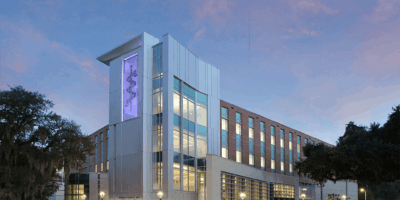
Years 1 and 2 take place in the College of Medicine complex on the northwest corner of the FSU campus in Tallahassee. The college broke ground on the 300,000-square-foot complex on February 4, 2003, and moved in during October 2004. The main mailing address is 1115 West Call Street, Tallahassee.
For Years 3 and 4, each regional campus has its own office, campus dean and staff, and serves as the student’s base while they rotate through family medicine, pediatrics, surgery, internal medicine, psychiatry, obstetrics and gynecology, geriatrics and emergency medicine. That gives students a wide set of clinical possibilities in different parts of the state.
FSU M.D. campuses and training sites:
- Daytona Beach
- Fort Pierce
- Orlando
- Pensacola
- Sarasota
- Tallahassee
- Marianna Rural Program
- Immokalee Health Education Site
- Thomasville Program (Georgia)
Student support and well-being
The Division of Student Affairs runs career advising, financial aid, the Office of Student Counseling, student learning communities, housing resources and student events. Nicki Taylor, Ph.D., is assistant dean for student counseling services. Students also have a process to report mistreatment and access to student support coordinators. Honor societies at the college include the Gold Humanism Honor Society and Alpha Omega Alpha.
Housing realities
FSU budgets for off-campus housing ($17,700 for a 12-month year). Most students rent in Tallahassee for Years 1 and 2 and then move to their regional campus city. Plan for two moves, and budget for a car: the student budgets include transportation by car because clinical sites are spread out.
Student organizations
FSU lists dozens of registered student organizations for medical, PA and graduate students, including:
- American Medical Association / Florida Medical Association
- American Medical Student Association (AMSA)
- American Medical Women’s Association (AMWA)
- Anesthesiology Interest Group (AIG)
- Asian Pacific American Medical Student Association (APAMSA)
- Biomedical Science Graduate Student Association
- Business and Medicine (BAM)
- Cardiology Interest Group (CIG)
- Christian Medical Association (CMA)
- Dermatology Interest Group (DIG)
- Emergency Medicine Interest Group (EMIG)
- Family Medicine Interest Group (FMIG)
- Family Medicine Scholars
- Florida Rural Health Association (FRHA), Medical Student Chapter
- Cares Society at FSU
- Geriatrics Interest Group (GIG)
- Humanities and Medicine (HAM)
- Interprofessional Allies (IPA)
- Jewish Medical Student Association (JMSA)
- Internal Medicine Interest Group (IMIG)
- Latino Medical Student Association (LMSA)
- Medicine Interest Group (MIG)
- Terminal Medical Ethics (TME)
- Medical Student Council (MSC)
- Military and Veteran Medicine Interest Group (MVMIG)
- Multicultural Association of Pre-Med Students (MAPS)
- Nutrition, Exercise, and Wellness Organization (NEW)
- Obstetrics and Gynecology Interest Group (OGIG)
- Organization of Student Representatives (OSR)
- Ophthalmology Interest Group (OIG)
- Pediatrics Interest Group (PIG)
- PRIDE in Healthcare (Promoting Recognition of Identity, Dignity, & Equality)
- Psychiatry Student Interest Group (PSIG)
- Radiology Interest Group (RIG)
- Research Interest Group
- Student Academy of the American Academy of Physician Assistants (SAAAPA)
- Students Interested in Global Health (SIGH)
- Student Interest Group in Neurology (SIGN)
- Student National Medical Association (SNMA)
- Surgery Interest Group (SIG)
- Wilderness Medical Society (WMS)
Other student programs include the Chapman Community Health Program, Arts in Medicine (supported by the Jules B. Chapman, M.D. and Annie Lou Chapman Private Foundation), H.E.A.L., Leadership in Medicine and HOME Street Medicine. The full list is on the college’s student organizations page. Nariman Heshmati, president of the first graduating class, co-founded the Medical Student Council, which still serves as the umbrella for these groups.
Life in Tallahassee and beyond
Tallahassee is Florida’s capital and a college town, home to FSU and Florida A&M University. Living costs are moderate by Florida standards. The regional campuses range from large metro areas such as Orlando to coastal cities such as Pensacola, Sarasota, Daytona Beach and Fort Pierce, and the rural sites put students in small towns and farm communities. Where you train for Years 3 and 4 shapes your daily life, so think about which settings you would enjoy.
Clinical Rotations and Research Opportunities
Regional campuses
The original regional campuses opened in Orlando, Pensacola and Tallahassee in 2003. Sarasota followed in 2005, and Daytona Beach and Fort Pierce opened in July 2007. Each campus has a regional campus dean:
| Campus | Opened | Regional campus dean |
|---|---|---|
| Tallahassee | 2003 | Kerwyn L. Flowers, D.O., FAAFP |
| Orlando | 2003 | Mark S. Chaet, M.D. |
| Pensacola | 2003 | Paul A. McLeod, M.D. (also senior associate dean for regional campuses) |
| Sarasota | 2005 | Nicole Bentze, D.O. |
| Daytona Beach | 2007 | George Bernardo, M.D. |
| Fort Pierce | 2007 | Juliette Lomax-Homier, M.D. |
Students are assigned to a regional campus for Years 3 and 4. Clerkships are taught mostly by community physicians in their own practices and hospitals, so you often work one-on-one with an attending. Expect to drive between sites.
Rural training: Marianna, Thomasville and Immokalee
- Marianna Rural Program. Opened in 2005, it lets a limited number of third-year students spend the entire year completing rotations in Marianna, about an hour west of Tallahassee. Jackson Hospital is a partner.
- Thomasville Program. Opened in 2006 as a satellite of the Tallahassee Regional Campus in Thomasville, Georgia, 45 miles north of Tallahassee. Four to six students complete their third and fourth years there.
- Immokalee Health Education Site. Opened in 2007 in a farm community on the edge of the Everglades in South Florida. Students from all six regional campuses can take required or elective rotations there, in a setting closely tied to the mission of serving the medically underserved.
Hospital affiliations
Here are a few of the hospitals where FSU students and residents train.
Tallahassee Memorial HealthCare. TMH is a 772-bed acute care hospital that serves a 21-county region in North Florida and South Georgia, as described on its about page. It is a core partner of the Tallahassee Regional Campus, hosts FSU-sponsored residency programs, and many FSU alumni now lead its medical staff.
Sarasota Memorial Health Care System. Sarasota Memorial is a full-service public health system and the anchor partner of the Sarasota Regional Campus, which also works with HCA Florida Sarasota Doctors Hospital, Manatee Memorial Hospital and Lakewood Ranch Medical Center.
Winter Haven Hospital. FSU sponsors a family medicine residency and a transitional year residency in Winter Haven. Residents train at Winter Haven Hospital, a 468-bed acute care hospital founded in 1926, with services that include interventional cardiology and cardiothoracic surgery, emergency care, oncology, orthopedics and inpatient psychiatry, and at the 61-bed Winter Haven Women’s Hospital nearby. Both are part of BayCare Health System. Winter Haven is a graduate medical education site for residents, not one of the six regional campuses where M.D. students complete Years 3 and 4.
Graduate medical education and the Match
FSU sponsors residency programs across the state, including family medicine, internal medicine, general surgery, OB/GYN, pediatrics, psychiatry and transitional year programs, under its Graduate Medical Education office led by William C. Boyer, DHSc, associate dean for GME and designated institutional official.
In the 2026 Match, 115 FSU students took part in the National Resident Matching Program. Of those, 55 (47%) matched in Florida and 94 (almost 81%) stayed in the Southeast. Internal medicine was the most common specialty (28 of 120 students in any match, 23%), followed by psychiatry (15), pediatrics and surgery (13 each) and family medicine (12). Counting OB/GYN, 59 students (51%) matched in primary care. Four students matched with military hospitals.
Research opportunities
Research is encouraged but not a graduation requirement. Options for medical students include:
- Summer Research Fellowship. Between Years 1 and 2, selected students receive $5,000 to do research with an FSU faculty mentor, on an existing project or one they design. Fellowships are limited and competitive.
- FSU College of Medicine and Mayo Clinic Florida Research Fellowship. Selected students spend the summer after Year 1 with a Mayo Clinic mentor in Jacksonville and receive $6,000.
- Tallahassee Orthopedic Clinic Orthopedic and Sports Medicine Research Program. A community research program for FSU medical students in Tallahassee.
- National fellowships. The college keeps an internal database of national summer programs for current students.
Every project needs approval before it starts, through a research request form in Years 1 and 2 or Form B through the regional campus in Years 3 and 4. Details are on the medical student research page. The college also runs research centers that match its mission, including the Center for Rural Health Research and Policy, the Center for Medicine and Public Health, the Center on Global Health, the Autism Institute and the Florida Institute for Pediatric Rare Diseases.
Notable Alumni, Faculty, Leadership and Admissions Staff
One reason FSU College of Medicine works well is the quality of the people who run it and teach in it. The profiles below come from the college’s leadership page, faculty pages and news releases, checked October 17, 2026. They explain who these people are. They do not imply that any of them will mentor you or influence your admission.
School leadership
Alma B. Littles, M.D., Dean. Dr. Littles became interim dean on February 1, 2023, and was named dean on July 1, 2024. Before that she was the college’s senior associate dean for medical education and academic affairs. A Gadsden County native and board-certified family physician, she completed her family medicine residency at what is now Tallahassee Memorial HealthCare in 1989 and opened a practice in her home county the same year. On August 1, 2026, she was installed as the 150th president of the Florida Medical Association, the first medical school dean to hold the post. She is a former president of the Florida Academy of Family Physicians and was Florida Family Physician of the Year in 1993. Her own career, rural family medicine in North Florida, is a direct example of the mission.
Anthony C. Speights, M.D., Senior Associate Dean for Medical Education and Academic Affairs. Dr. Speights leads the M.D. curriculum, the role Dr. Littles held before becoming dean. Applicants with questions about the 2+2 structure and curriculum design are asking about work his office oversees.
Paul A. McLeod, M.D., Senior Associate Dean for Regional Campuses and Regional Campus Dean, Pensacola. Dr. McLeod oversees the regional campus system that defines Years 3 and 4 and leads the Pensacola campus directly.
Xian Jin Xie, Ph.D., Senior Associate Dean for Research and Graduate Programs. Dr. Xie joined the college on October 28, 2024. He came from the University of Iowa, where he was associate dean for research at the College of Dentistry and Dental Clinics, after earlier leadership roles at the University of Texas Southwestern Medical Center. He has directed quantitative research on 60 peer-reviewed grants and 40 clinical trials and published more than 175 peer-reviewed articles. He succeeded Jeffrey Joyce, Ph.D., who led growth in the college’s research portfolio and returned to the private sector in summer 2023. Students interested in research and the Ph.D. program will find his office behind the college’s research funding and graduate programs.
Cheryl Porter, Ph.D., Assistant Dean for Student Affairs. Dr. Porter works in the Division of Student Affairs, which supports medical students from orientation through graduation. Student Affairs also oversees counseling, career advising, learning communities and student organizations.
Admissions staff
Robert Campbell, M.D., Associate Dean for Student Affairs and Admissions. Dr. Campbell leads both student affairs and admissions, so he oversees the process from application to graduation.
Eric Laywell, Ph.D., Assistant Dean for Admissions. Dr. Laywell is a neuroscientist. He completed graduate study in the University of Tennessee’s neuroscience program, did postdoctoral work at the University of Utah, and taught at the University of Tennessee and the University of Florida before joining FSU in 2011. He also runs a research lab at the college.
Remember that the admissions office communicates by email only, at [email protected].
Faculty
Joedrecka Brown Speights, M.D., Chair, Department of Family Medicine and Rural Health. Her department carries the college’s primary care and rural mission, including the family medicine clerkship and rural training sites.
Lisa Granville, M.D., Chair, Department of Geriatrics. FSU’s Department of Geriatrics, founded in July 2003, was the first separate geriatrics department at a Florida medical school. Dr. Granville leads the department behind the required Primary Care Geriatrics clerkship.
Charles G. “Gerry” Maitland, M.D., Professor of Neurology. Dr. Maitland is a professor of neurology and clerkship faculty in Tallahassee, with expertise in movement disorders, neuropsychiatric and neurodegenerative diseases and traumatic brain injury. He is one of the faculty advisors for the Student Interest Group in Neurology. Students interested in neurology meet him through the clerkship and the interest group.
Jose R. Pinto, Ph.D., Professor of Biomedical Sciences. In October 2026, Dr. Pinto received a $2.6 million grant from the National Heart, Lung and Blood Institute to study how mutations in troponin C, the heart’s calcium sensor, contribute to cardiomyopathies. His lab is an example of the basic science behind the Ph.D. program and the summer research fellowships.
Jerome Irianto, Ph.D., Assistant Professor of Biomedical Sciences. In August 2026, Dr. Irianto secured $2.8 million from the National Cancer Institute to study how physical changes in pancreatic cells drive pancreatic cancer, using organoids grown from human tissue. His bioengineering background shows the range of research at the college.
Susan Epstein, MSLS, AHIP, Faculty Librarian. Epstein is a faculty librarian in the Department of Behavioral Sciences and Social Medicine. In February 2026 she joined the Information Discovery and Interchange Topic Committee of the National Information Standards Organization, and she was lead chapter author of an open-access textbook on cognitive information processing. Medical librarians teach students how to search and judge evidence, a skill that runs through the curriculum’s evidence-based medicine thread.
Alumni
FSU has 2,477 alumni of its graduate programs (M.D., PA, M.S. and Ph.D. combined), counted at its 25th anniversary in 2025.
Nariman Heshmati, M.D. (Class of 2005). President of the college’s first graduating class, Dr. Heshmati served as the first student senator for the college in FSU Student Government and co-founded the Medical Student Council. After an OB/GYN residency, he led surgical and specialty operations at The Everett Clinic and The Polyclinic in Washington state, chaired the Washington Section of the American College of Obstetricians and Gynecologists and served as president of the Washington State Medical Association. He returned to Florida in 2024 and was inducted into the college’s Medical Hall of Fame in 2025.
Angela Guzman, M.D. (Class of 2014). Dr. Guzman’s path runs through FSU’s pathway programs. She joined the college’s SSTRIDE outreach as an FSU freshman in 2005, led in the Multicultural Association of Pre-medical Students and completed the Bridge to Clinical Medicine program before earning her M.D. She is OB/GYN clerkship faculty at the Orlando Regional Campus and associate program director for the UCF/HCA Osceola OB/GYN residency. She was inducted into the Medical Hall of Fame in 2025.
Nora Pepper, M.D. (Class of 2010). A board-certified pediatrician, Dr. Pepper was elected chair of Tallahassee Memorial HealthCare’s Medical Executive Committee for a term that ran through September 30, 2026. She is an assistant professor at the College of Medicine and will lead FSU Health Precision Pediatrics at the Florida Institute for Pediatric Rare Diseases.
Brett Howard, M.D. (Class of 2012). Dr. Howard is chief of surgery at TMH, associate program director of the FSU/TMH General Surgery Residency, and was elected chair-elect of the TMH Medical Executive Committee, succeeding Dr. Pepper after her term. As a student he was inducted into the Gold Humanism and Alpha Omega Alpha honor societies.
Alex Ho, M.D. (Class of 2005). Dr. Ho has practiced emergency medicine at TMH since 2008, has been medical director of TMH Emergency Services since 2016 and teaches as emergency medicine clerkship faculty for the Tallahassee Regional Campus.
Thomas Beardsley, M.D. (Class of 2014). An FSU graduate for both his bachelor’s degree and M.D., Dr. Beardsley trained in emergency medicine and medical simulation at Yale and now leads simulation education for emergency medicine residents at the University of Florida College of Medicine, Jacksonville. He was inducted into the Medical Hall of Fame in 2025.
These alumni show the pattern FSU hopes for: graduates who return to lead and teach in Florida communities.
Admissions Statistics and Class Profile
What FSU publishes
FSU’s own pages give a clear picture of the scale of admission, even without a published class profile:
- More than 6,500 applications are reviewed each cycle.
- About 250 to 300 applicants are interviewed each cycle.
- 120 new M.D. students a year is the maximum class size, with full enrollment of 480.
- Usually fewer than 10 out-of-state students join each class.
- Minimums: MCAT 500 and undergraduate GPA 3.5 for the regular M.D. program, except in special circumstances.
The 2025 entering class in numbers
- 6,730 verified applications: 2,872 from Florida residents, 3,821 from out-of-state applicants and 37 from international applicants.
- 263 applicants interviewed: 251 Florida residents and 12 out-of-state applicants.
- 120 students enrolled: 117 Florida residents and 3 out-of-state students, with no deferrals.
- Early programs: 13 of the 120 enrolled through Early Decision (11 in state, 2 out of state) and 8 through the Early Assurance Program.
- Background: 44% of the class reported disadvantaged status, 38% grew up in a medically underserved area, 15% held a graduate degree and 67% were science or math majors.
- Age: 64 students were 19 to 23, 54 were 24 to 29 and 2 were 30 to 39.
- Experience: 97% reported physician shadowing or clinical observation, 91% community service, 87% medical or clinical volunteering, 88% research and 80% paid clinical work.
Only 12 of 3,821 out-of-state applicants were interviewed for the 2025 entering class, which is why the Florida-ties question matters so much.
These figures use different denominators, so read them carefully. About 250 to 300 interviews out of more than 6,500 applications means that only about 4 in 100 applicants are interviewed. That is an interview ratio, not an acceptance rate. The number of offers is higher than 120 because some admitted applicants choose other schools, and some seats are filled from the waitlist or through the Bridge Program. For the 2025 entering class, 263 of 6,730 verified applicants (about 3.9%) were interviewed. The number of offers is not published, so a true acceptance rate (offers divided by applicants) cannot be calculated.
Median MCAT and GPA
For the 2025 entering class, all accepted applicants had a median MCAT of 509 (mean 509.5) and a median overall GPA of 3.9 (mean 3.85). The median science (BCPM) GPA was 3.85. By section, the median MCAT scores were 127 in Chemical and Physical Foundations, 126 in CARS, 127 in Biological and Biochemical Foundations and 129 in Psychological, Social and Biological Foundations. The minimum is not the typical score. Given the volume of applicants, a competitive applicant should aim well above 500 and 3.5, while knowing that FSU reads the whole application, including the mission fit that numbers cannot show.
Residency mix
FSU strongly prefers Florida residents, and usually fewer than 10 members of each class come from out of state. Out-of-state applicants are considered only if they live in a county that borders Florida or have significant Florida ties, except in rare circumstances.
Outcomes worth knowing
- Primary care: about half of FSU graduates pursue primary care (family medicine, internal medicine, pediatrics and OB/GYN).
- Staying in Florida: 47% of the Class of 2026 NRMP participants matched in Florida, and almost 81% stayed in the Southeast.
- Licensing exams: 94% Step 1 pass rate (AY2025) and 99% Step 2 pass rate (AY2024-25), both above the national averages.
Tips and Strategies for Admission
1. Prove your Florida commitment
Florida residency is the clearest asset you can have. If you live out of state, describe specific ties to Florida, such as college, family or past residence, in the Self-Critical Analysis section of the secondary. If you have none, think hard about whether FSU belongs on your list, since fewer than 10 out-of-state students usually join a class.
2. Make underserved service the center of your story
FSU says it gives preference to applicants with “a strong and consistent commitment to serving underserved communities.” Choose one or two service commitments and stay with them for years: a free clinic, a rural health fair, a food bank that serves farmworker families, a nursing home. Depth beats a long list.
3. Get hands-on patient care
Shadowing shows you know what physicians do. Hands-on roles show you can do part of the work. FSU weighs both. Medical assistant, scribe, EMT and patient care technician jobs give strong material. If you are short on patient contact, internships for pre-med students that include supervised vitals, intake and triage can add it, especially before your application year.
4. Show respect for primary care and older adults
You do not need to commit to family medicine, but show that you understand community practice and the needs of older adults. Experience with geriatric patients connects to FSU’s Department of Geriatrics and its required geriatrics clerkship.
5. Clear the academic minimums with room to spare
Treat 500 and 3.5 as a floor. Take prerequisites in a traditional classroom at a four-year college when you can, earn letter grades and add the recommended courses, especially social and behavioral sciences and Spanish.
6. Ask for individual letters
FSU prefers individual letters over a committee packet. Ask a science professor who taught you and a clinician who has watched you with patients. Do not use family friends.
7. Apply early and turn the secondary around quickly
FSU does not screen secondaries and has no extensions. Submit AMCAS early, then return the secondary within about two weeks. Decisions are not based on submission date, but interview spots run from mid-October through March, and an early complete file gives you more options.
8. Choose Early Decision only if FSU is clearly your first choice
Early Decision ties you to FSU during the early part of the cycle. If you are accepted, you are committed. If you are deferred, you join the regular pool by October 1.
9. Plan a gap year with purpose
If you take time off, fill it with full-time clinical work, service and, if useful, coursework. The secondary asks how you spend that time. Structured pre-med gap year programs can add a block of supervised patient care, but steady local work for most of the year usually says more about commitment.
10. Reapplicants: change something real
FSU asks reapplicants what specific steps they took to strengthen their application. New clinical hours, a stronger MCAT, new letters and a rewritten essay set are the changes that answer that question. FSU allows you to reuse essays from last year but strongly suggests revising them.
Secondary Application Questions, Example Responses and Analysis
The FSU secondary, called the supplemental application, is submitted online as part of the AMCAS application. Every U.S. citizen and green-card holder with a verified AMCAS application receives an invitation. For 2026-2027, invitations began on July 15, 2026, and continue weekly through November. The fee is $30 (non-refundable), waived automatically for applicants in the AMCAS Fee Assistance Program when they submitted the primary. Allow three to five business days for fee payment information to arrive by email. The secondary materials have two parts: Part I, the supplemental application, and Part II, three to six letters of recommendation. Both are due by August 24, 2026 for Early Decision and December 10, 2026 for regular admission, with no extensions.
The 2026-2027 secondary has 15 written questions in three sections: Section A (Personal Background), Section C (Self-Critical Analysis) and Section D (Additional Questions). Section A and C answers are limited to 500 words each. Section D’s specialty list is limited to 500 characters. The other Section D questions show no stated limit, so keep those answers concise and follow any limit shown in your portal. The questions below are printed exactly as they appear for this cycle, including small typos in the original.
| # | Question (short form) | Limit | Who answers |
|---|---|---|---|
| A1 | Description of your family | 500 words | All applicants |
| A2 | Geographic, economic and social environment where you were raised | 500 words | All applicants |
| A3 | What you do for fun and diversion | 500 words | All applicants |
| A4 | A unique trait, experience or interest | 500 words | All applicants |
| A5 | Employment during college (Yes/No, then explain) | 500 words | Yes/No for all; narrative if employed |
| A6 | Academic record explanation | 500 words | Optional |
| C1 | Why FSU COM | 500 words | All applicants |
| C2 | Personal and scholastic qualifications | 500 words | All applicants |
| C3 | Contribution to FSU COM and its mission | 500 words | All applicants |
| C4 | Gap year, time off or reapplication | 500 words | If applicable |
| C5 | Preparing for the demands of training and your support system | 500 words | All applicants |
| D1 | List up to three specialties | 500 characters | All applicants |
| D2 | Using those specialties to advance the mission | No stated limit | All applicants |
| D3 | Engaging with people from different backgrounds | No stated limit | Optional |
| D4 | Community service with an underserved population | No stated limit | Optional |
Out-of-state applicants should describe their significant ties to Florida in the Self-Critical Analysis section (Section C), most naturally in C1. The current secondary has no separate COVID-19 question, no separate identity question and no separate essay on Florida residency. Reapplicant questions are now part of C4. To compare FSU’s questions with other schools, IMA keeps a database of medical school secondary essay prompts.
Before you write, make an inventory: your family and hometown, your jobs with hours, your hobbies, your clinical and service roles, the times you worked with people unlike yourself, and any part of your record that needs context. Fifteen answers is a lot, so plan them as a set. Each answer should show something new.
The examples below are original teaching material written for this guide. Each one is labeled and each is written in a different applicant’s voice. Do not copy them. Use them to see how an answer can meet every part of a question within the limit.
Section A. Personal Background
A1. Please provide a description of your family. (500 words)
What it asks. Who your family is and, implicitly, how they shaped you. It is not marked optional, so plan to answer it.
Approach. Introduce the people who raised you or matter most, give one or two concrete details about each, then show what you learned from them. Keep the focus on you through them.
Illustrative example, not an actual applicant essay
I grew up in a three-generation house in Lake City. My father drives a truck for a grocery distributor and is gone four nights a week. My mother works the front desk at a pediatric practice, which is how I learned the difference between a copay and a deductible before I learned long division. My younger brother, Marcus, is a junior in high school and wants to be a lineman like our uncle. And for most of my life, my grandmother, Miss Ruth, lived in the back bedroom.
Miss Ruth had diabetes, heart failure and the kind of stubbornness that kept her alive longer than anyone expected. When I was fourteen, my mother asked me to take over her evening medications because my mother’s shift ran late. I made a chart on the refrigerator with her pills, her blood sugar and her weight. I learned that a three-pound jump in two days meant a call to the clinic, and that Miss Ruth would hide salty crackers in her robe pocket. I also learned that she took her pills more faithfully when I sat with her and let her tell stories about picking tobacco in Suwannee County.
Our family runs on shared work. My father fixes everyone’s cars on Sunday. My mother keeps a folder for every relative’s insurance appeal. When Miss Ruth needed rides to her cardiologist in Gainesville, an hour away, we rotated drivers, and I took the Tuesday visits once I had my license. Those drives showed me how much effort it takes for a rural family to keep one older person well.
Miss Ruth died during my sophomore year of college. At the funeral, her cardiologist’s nurse came up to my mother and said she had never seen a patient’s grandchild bring a weight log to every visit. I did not think of it as anything special then. Now I see that my family taught me the basics of chronic disease care before I ever took biology: watch closely, write it down, show up and listen to the person, not just the numbers.
My family is not medical, but it is the reason I want to practice in a small Florida town where the nearest specialist is an hour away. I want to be the doctor who knows the family behind the chart.
Why this example works. It describes each family member with a specific detail rather than adjectives. The grandmother’s care becomes the center, which connects naturally to FSU’s interest in older adults and rural communities without forcing it. The final paragraph says what the family means for the applicant’s goals in two sentences. It runs 386 words, well within 500.
Mistakes to avoid. Writing a list of relatives with no story. Turning the answer into a second personal statement about medicine. Sharing private details about family members that they would not want shared.
A2. Please describe the geographic, economic, and social environment in which you were raised. How did these aspects of your upbringing shape who you are today or influence your goals? (500 words)
What it asks. Three parts: geography, economics and social setting; then how those shaped you; then how they influence your goals. Answer all three.
Approach. Describe the place in concrete terms, including money and the people around you, then draw a clear line from that setting to who you are and what you want to do.
Illustrative example, not an actual applicant essay
I was raised in Immokalee, an agricultural town in Collier County where the tomato and citrus harvests set the calendar. Geographically, it is closer to the Everglades than to the beach towns most people picture when they hear “Southwest Florida.” Naples is 35 miles away, but for my neighbors it might as well have been another state.
Economically, most families I knew worked in the fields, in packing houses or in the restaurants that fed them. My parents picked tomatoes when I was small and later ran a small tienda that sold phone cards, rice and remittance services. Income rose and fell with the season. In a good winter we paid ahead on rent. In a bad summer, when the harvest moved north and so did many of our neighbors, we sold on credit and hoped.
Socially, Immokalee is Mexican, Guatemalan, Haitian and African American, with Spanish, Kreyol, English and several Mayan languages spoken on the same block. Children translate for adults everywhere: at the bank, the school office and the clinic. I translated for my mother at prenatal visits when I was ten. I learned early that a medical visit could go well or badly depending on whether anyone in the room understood the patient.
These conditions shaped me in three ways. First, I am comfortable moving between languages and cultures, and I notice quickly when someone is nodding without understanding. Second, I respect hard physical work and the people who do it. Many of the patients I hope to treat will be people who cannot take a day off for an appointment. Third, I learned that health depends on things outside the clinic: heat, pesticides, crowded housing and whether a family can afford gas to drive to a specialist.
My goals come straight from this place. I want to become a family physician who practices in a farmworker community in Florida, speaks with patients in their language and builds care around the harvest season rather than against it. I know FSU sends students from every regional campus to rotate in Immokalee. That told me the school sees my hometown the way I do: as a place that needs doctors, and as a place that can teach them.
Why this example works. Each of the three named aspects gets its own paragraph, then the “shape” and “goals” parts are answered directly with a numbered set of effects. The mention of FSU’s Immokalee site is accurate and short. It runs 369 words.
Mistakes to avoid. Describing only geography and skipping money or social setting. Writing about hardship without explaining what it taught you. Exaggerating disadvantage. Describe your real setting, whether it is rural, suburban or urban.
A3. Tell us what you do for fun and diversion (hobbies, special interests, etc.). (500 words)
What it asks. What you do when you are not working or studying. FSU wants to know you as a person and to see that you have healthy outlets.
Approach. Pick two or three real interests, give specific details and, if it is natural, show what each gives you. Keep it light. This is not the place for another service story.
Illustrative example, not an actual applicant essay
Most Saturdays from October to April, I am in a kayak on the Wakulla or Wacissa River before the sun is fully up. I started paddling with my dad when I was twelve, and I still keep a waterproof notebook where I log every manatee, otter and limpkin I see. My record is eleven manatees in one morning near the Wakulla bridge. Paddling slows my mind down. After a hard exam week, two hours on a spring-fed river does more for me than any amount of sleep.
When I am on land, I cook. My grandmother left me a stack of handwritten recipe cards, and I have been working through them one by one, from her smothered chicken to a sweet potato pie that took me five tries to get right. I host a monthly dinner for my roommates and lab friends where everyone brings one dish from their family. Last spring we had Haitian griot, Vietnamese spring rolls and my grandmother’s cornbread on the same table. Those dinners have become the way our group checks in on each other.
I also play bass guitar, badly but happily, in a church praise band. I am the least talented person in the group, which is good for me. It reminds me what it feels like to be a beginner and to keep showing up anyway.
These three things balance each other. The river gives me quiet, the kitchen gives me people, and the band keeps me humble. I plan to keep all three in medical school, and I have already looked up which rivers are close to each regional campus.
Why this example works. Specific, memorable details (the notebook, the eleven manatees, five tries at a pie) make the applicant real. The last paragraph explains why these interests matter and ties them to sustaining wellness in training without preaching. It runs 269 words.
Mistakes to avoid. Listing ten hobbies with no detail. Turning a hobby into a résumé item. Claiming interests you do not actually pursue; interviewers often ask about them.
A4. What is a unique trait, experience, or interest that we would not normally learn about you? (500 words)
What it asks. Something that does not appear elsewhere in your application. It can be a trait, an experience or an interest.
Approach. Choose one thing and tell it as a short story. Explain why it matters to you. It does not have to connect to medicine, but a quiet connection to how you work with people can help.
Illustrative example, not an actual applicant essay
I have a stutter. You will not see it in my transcript or my activities list, and on a good day you might not hear it in an interview. But it has shaped almost everything about how I talk with people.
In elementary school, I could not say my own name without getting stuck on the first sound. My speech therapist in Ocala, Ms. Patel, taught me techniques I still use: slowing my rate, easing into hard consonants and pausing before I answer. She also taught me something no technique could. She told me that the people worth talking to will wait for you, and that I should be one of those people for others.
In high school I joined the debate team because it terrified me. I lost my first eight rounds. By senior year I was team captain, not because I was the fastest speaker but because I was the best listener. I wrote down every argument my opponent made and answered each one. Judges started writing “thorough” on my ballots.
The stutter still shows up when I am tired or nervous. When I started volunteering at a hospice in Gainesville, I worried it would make patients uncomfortable. The opposite happened. Many hospice patients speak slowly, lose words or struggle to breathe between sentences. I knew how it felt to be rushed. I sat, waited and let them finish. One man with ALS spelled out messages on a letter board, and our conversations took half an hour. His wife told me I was the only volunteer who never finished his sentences for him.
I do not think of my stutter as an obstacle I overcame. It is part of how I communicate, and it made me patient in a way I might not have been otherwise. In medicine, where so much depends on hearing what a patient means, I think that patience will be one of my most useful traits.
Why this example works. It reveals something genuinely not visible elsewhere and tells it through specific moments. It shows growth without claiming the issue is “fixed,” and it ends with a clear statement of how the trait helps with patients. It runs 322 words.
Mistakes to avoid. Repeating your biggest activity. Choosing a “unique” fact that is only a fun fact with no reflection. Oversharing medical or mental health details you are not comfortable discussing in an interview.
A5. Were you employed during your college years? (Yes/No). If yes, describe why employment was necessary, how it impacted your college experience, and approximately how many hours per week you worked. (500 words)
What it asks. A Yes/No answer from everyone. If yes, three facts: why you needed to work, how it affected college and roughly how many hours a week. If you did not work, answer “No” and move on.
Approach. Be factual and direct. Give the hours plainly. Explain impact honestly, including grades if work affected them, and show what you gained.
Illustrative example, not an actual applicant essay
Yes.
I worked throughout college because my family could not cover my living costs. My Bright Futures scholarship paid most of my tuition at the University of West Florida, but rent, food, books and my car payment were mine. My parents were supporting my two younger sisters and helping my grandfather after his stroke, so asking them for money was not an option.
During my first two years, I worked about 25 hours a week as a server at a seafood restaurant on Pensacola Beach, mostly nights and weekends. In my junior year, I moved to a job as a patient care technician at a local hospital, working three 12-hour night shifts every two weeks, about 18 hours a week, plus extra shifts during breaks. As a PCT, I took vital signs, drew blood, helped patients to the bathroom and turned bedbound patients every two hours.
Work affected my college experience in real ways. I could not join clubs that met in the evenings, and I took 13 to 15 credits instead of 18 so I could keep my grades steady. My GPA dipped to a 3.2 in the fall of my sophomore year, when I was working close to 30 hours a week during the holiday rush. After that semester I cut back to a firm 25-hour limit and planned my study time around my schedule. My grades recovered and stayed above 3.7 for the rest of college.
Work also gave me things a lighter schedule would not have. Serving taught me to read people quickly and stay calm when six tables need something at once. The PCT job gave me hundreds of hours with patients and nurses at 3 a.m., when the hospital is quiet and patients are often scared. I learned how much a warm blanket and a few minutes of conversation matter to someone who cannot sleep.
Working while studying was hard, but it taught me to manage my time and to respect the staff who keep a hospital running overnight. I expect both lessons to help me in medical school.
Why this example works. It answers Yes/No first, then each of the three required parts in order. Hours are specific. It addresses a GPA dip honestly with a cause and a fix, which reads as maturity. It runs 345 words.
Mistakes to avoid. Leaving out hours. Apologizing for working. Inflating job duties. If you worked only a few hours for spending money, say so briefly; it is still fine.
A6. Is there anything in your academic record that you feel requires further explanation or context for the Admissions Committee? If applicable, please include information about any academic challenges, course withdrawals, or grades lower than a B. (500 words, optional)
What it asks. Context for withdrawals, low grades (below a B) or other academic challenges. It is optional. Answer only if your record has something that needs explaining.
Approach. State what happened, the cause and what you did about it, then point to evidence of improvement. Keep it factual and short. Take responsibility.
Illustrative example, not an actual applicant essay
My transcript shows a withdrawal from Organic Chemistry I and a C+ in Physics I during the spring of my sophomore year. Both came during the semester my mother was diagnosed with breast cancer.
In February of that year, my mother began chemotherapy in Jacksonville, two hours from my campus. My father works offshore for weeks at a time, so I drove home every Thursday night to take her to treatment on Friday and stay through the weekend. I missed several Friday labs and fell behind in organic chemistry. By the withdrawal deadline, I knew I could not catch up, and I withdrew rather than risk a failing grade. I stayed in physics but did not use the tutoring center or office hours the way I should have, and my exam grades showed it.
That semester taught me to ask for help early. When I retook Organic Chemistry I the next fall, I met with the professor in the first week, told her about my family situation and set up a weekly study group. I earned an A-. I then took Organic Chemistry II, Biochemistry and Physics II and earned an A in each. My science GPA for the last four semesters is 3.86.
My mother finished treatment and is now in remission. I am grateful that I could be with her, and I believe the experience made me a better student. I now plan ahead, use every resource available and speak up before a problem becomes a crisis.
Why this example works. It names the exact courses, gives the cause without drama, accepts responsibility for not seeking help and shows measurable recovery. It runs 249 words, the right length for this question.
Mistakes to avoid. Blaming professors. Explaining every B-. Using this space for a hardship story when your record has nothing that needs context. If your record is clean, leave it blank.
Section C. Self-Critical Analysis
C1. Why are you choosing to apply to the FSU College of Medicine? Please be specific describing what is particularly attractive about FSU COM and why you believe FSU COM is right for you. (500 words)
What it asks. Two things: what specifically attracts you to FSU, and why FSU is right for you. Generic praise will not work. If you are out of state, this is the best place to describe your Florida ties.
Approach. Start with your goal, then connect two or three verified features of FSU to that goal, and finish with why your way of learning fits FSU’s model.
Illustrative example, not an actual applicant essay
I want to practice family medicine in a small North Florida town, and FSU is the medical school built to train that kind of physician.
The first thing that drew me to FSU is its community-based model. After two years in Tallahassee, students train at a regional campus with community physicians in their own practices. I learn best by doing, and I have seen how much a single physician can teach. During two summers as a medical assistant at a family practice in Perry, I worked beside Dr. Hall, who has cared for some families for three generations. She taught me to check a foot exam on every diabetic patient and to ask about the family’s well water. I want my clinical training to look like that: one-on-one teaching in the kind of setting where I plan to work.
Second, FSU’s rural programs match my goals exactly. The Marianna Rural Program, where a third-year student can spend the full year in a rural community, would let me learn medicine in a town much like the one where I hope to practice. I also want to take a rotation in Immokalee to learn how care works for farmworker families, since many of the patients in Taylor County where I grew up work in timber and agriculture.
Third, FSU’s attention to older adults matters to me. FSU was the first Florida medical school with a separate Department of Geriatrics, and every student completes a Primary Care Geriatrics clerkship. In rural North Florida, the population is aging and many patients have no geriatric specialist within an hour’s drive. Family physicians fill that role. I want that training built into my education, not added as an elective.
I also believe FSU is right for me because of how it measures success. Its graduates match into every specialty, but about half choose primary care and almost half of the Class of 2026 stayed in Florida for residency. Those numbers tell me FSU means what its mission says about serving the state.
Finally, I am a Florida resident who has never wanted to leave. My family has lived in Taylor County for four generations. I want to train at a school that will teach me in Florida, through Florida’s communities, so I can return to one of them. FSU is that school.
Why this example works. It answers both parts, what is attractive and why it is right, with features that are verified and specific: the regional campus model, Marianna, Immokalee, the geriatrics department and clerkship, and Match outcomes. Each feature is tied to a real experience. It runs 386 words.
Mistakes to avoid. Praising “excellent faculty” or “great reputation” with no specifics. Listing features without connecting them to you. Getting facts wrong; check every program you name on FSU’s site.
C2. What do you feel are your personal and scholastic qualifications for the study of medicine? (500 words)
What it asks. Two kinds of qualifications: personal (character, skills, experience) and scholastic (academic preparation). Cover both.
Approach. Name two or three of each and prove each with evidence. Show self-awareness, since this is the Self-Critical Analysis section.
Illustrative example, not an actual applicant essay
My scholastic preparation rests on a strong science record built over time. I earned a B.S. in biochemistry at the University of Central Florida with a 3.78 overall GPA and a 3.72 science GPA. My strongest courses were biochemistry, genetics and physiology, which I took in a traditional classroom with labs. I also completed six hours of Spanish and a medical sociology course because I knew I would need both to care for patients in Central Florida.
Research gave me a second kind of academic training. For two years I worked in a microbiology lab studying antibiotic resistance in bacteria from hospital wastewater. I ran PCR, managed a freezer inventory of 400 samples and presented a poster at the university research showcase. The lab taught me to design an experiment, tolerate failure and read a paper critically. It also showed me that I prefer research that answers patient questions, which pushed me toward medicine.
My personal qualifications come mostly from patient care. I have worked for 18 months as an emergency department scribe, about 1,400 hours, documenting for physicians during busy shifts. I learned medical language, the logic of a differential diagnosis and how physicians explain bad news. I also volunteer every other Saturday at a free clinic in Orlando, where I take vitals and do intake in English and Spanish.
Three personal qualities connect these experiences. First, I am steady under pressure. In the emergency department, I learned to stay accurate when the physician is moving between four rooms. Second, I am a careful communicator. At the free clinic, I learned to check understanding by asking patients to repeat instructions back. Third, I am honest about what I do not know. When I made a documentation error early as a scribe, I flagged it to the physician myself, and we built a checklist that the scribe team still uses.
I also know my weaknesses. I tend to take on too much. In my junior year I held four leadership roles and my sleep and grades suffered. I now limit myself to two major commitments at a time and protect one day a week for rest. I expect that discipline to matter in medical school.
Taken together, my academic record shows I can handle FSU’s science curriculum, and my clinical work shows I understand what patients and care teams need. I am ready to learn the rest.
Why this example works. It separates scholastic and personal qualifications, backs each with numbers and specifics, and includes a real weakness with a fix, which fits a section called Self-Critical Analysis. It runs 397 words.
Mistakes to avoid. Restating your GPA and MCAT with no meaning. Listing virtues without proof. Claiming no weaknesses.
C3. How do you feel you will contribute to the success of the FSU College of Medicine and our unique mission? (500 words)
What it asks. What you will add to FSU, during school and after, and how that supports its mission of serving older adult, rural, minority and underserved populations.
Approach. Name the mission in your own words, then give two or three specific contributions you will make, each supported by past evidence and a plan at FSU.
Illustrative example, not an actual applicant essay
FSU’s mission asks for physicians who respond to community needs, especially the needs of older adults and rural, minority and underserved people. I believe I can contribute to that mission in three ways: through my experience with older adults, my work in rural health outreach and my habit of building things that last.
First, I bring years of work with older adults. Since high school, I have worked as a certified nursing assistant at an assisted living community in Ocala, about 20 hours a week during college. I help residents bathe, dress and eat, and I have sat with residents in their final days. I know how much a physician’s patience matters to an 88-year-old who cannot hear well. At FSU, I would join the Geriatrics Interest Group, and I look forward to the Primary Care Geriatrics clerkship. I hope to help classmates who have not worked with older adults feel more comfortable at the bedside.
Second, I have helped bring health screenings to rural communities. As a member of my university’s public health club, I helped organize quarterly blood pressure and glucose screenings at churches in Levy and Dixie counties. We screened more than 300 people over two years and referred 41 to a federally qualified health center. I learned that rural outreach depends on trust: we always worked through pastors and community leaders who already knew their neighbors. At FSU, I would bring that experience to the Florida Rural Health Association medical student chapter, and I hope to complete clinical training at a rural site.
Third, I try to build things that keep running after I leave. When our screening program kept losing volunteers, I wrote a training guide and set up a sign-up system that the club still uses. At FSU, I would apply that habit to student-led service, helping projects keep going as classes move to regional campuses.
After graduation, I plan to practice internal medicine with a focus on older adults in a Florida community with too few physicians. Each graduate who stays and serves where the need is greatest is how FSU’s mission succeeds. I intend to be one of them.
Why this example works. It restates the mission accurately, then gives three contributions with past proof and a specific FSU outlet for each (real FSU student groups and clerkships). It covers both school-time and career contributions. It runs 357 words.
Mistakes to avoid. Repeating C1. Promising to “change healthcare” without evidence. Naming FSU groups or programs that do not exist.
C4. If you are planning to take a gap year, are currently in a gap year, or have taken time off between college and medical school, please describe how you have spent (or are spending) this time. If you are have applied previously, we ask that you describe any specific steps you have taken to strengthen your application. (500 words, if applicable)
What it asks. Two possible audiences. Applicants with time off describe how they spent or are spending it. Reapplicants describe specific steps taken to strengthen their application. Answer the parts that apply to you. If neither applies, leave it blank or follow the portal’s instructions.
Approach. Give a clear timeline with roles, hours and what you learned. If you are a reapplicant, name each weakness you addressed and the evidence of change.
Illustrative example, not an actual applicant essay
I graduated from Florida State University in May 2025 and applied to medical school that summer. I was not accepted. I am now in my second gap year, and I have used both years to address the weaknesses in my first application.
After my first cycle, I asked my pre-health advisor to review my application with me. She pointed to three problems: limited direct patient care, an MCAT of 503 and a personal statement that described what I wanted rather than what I had done. I worked on each one.
For patient care, I started working full time as a medical assistant at a federally qualified health center in Quincy in August 2025. I work about 40 hours a week. I room patients, take vital signs, give vaccines under standing orders, do diabetic foot checks and call patients with normal lab results. Many of our patients are uninsured or on Medicaid, and about a third speak Spanish as their first language. I have logged more than 1,500 hours.
For my academics, I studied for six months while working and retook the MCAT in January 2026. My new score is 510, with improvement in every section. I also took an online biostatistics course through FSU and earned an A.
For service, I continued volunteering two Saturdays a month at a food pantry that serves families in Gadsden County, as I have since 2023, and I now coordinate its volunteer schedule.
Finally, I rewrote my personal statement and every secondary answer from scratch. I asked a physician at my clinic and my biostatistics professor for new letters, because both have seen my work in the past year.
Through May 2027, I will keep working at the health center. These two years have confirmed my goal of practicing family medicine in a rural Florida county, and they have shown me the daily realities of primary care for underserved patients far better than my college experiences did.
Why this example works. It answers both halves of the question because this applicant is both in a gap year and a reapplicant. Each weakness has a concrete fix with numbers and dates. The timeline runs through matriculation, so there are no gaps. It runs 323 words.
Mistakes to avoid. Saying you “gained perspective” with no specifics. Listing new activities without showing what changed. Criticizing the school for your earlier rejection. If you are a first-time applicant still in college, do not invent a gap year.
C5. Medical school requires significant personal commitment, including long hours, emotional challenges, and limited personal time. How have you prepared for these demands, and what strategies will you use to maintain a healthy work-life balance during your training? Please also share how your personal support system – family, friends, mentors, or others – will help you during this journey (500 words)
What it asks. Three parts: how you have prepared for the demands of medical school, your strategies for balance, and how your support system will help. Address each.
Approach. Give evidence from a demanding period you have already handled, list practical strategies you actually use, and name specific people in your support system and what each provides. Remember that FSU will move you to a regional campus for Years 3 and 4, so plan for support at a distance.
Illustrative example, not an actual applicant essay
The hardest stretch of my life so far was the year I worked 36 hours a week as an EMT while finishing my last 30 credits of college. I rode a 24-hour shift every third day in Leon County, studied on quiet nights at the station and took exams the morning after shifts. That year prepared me for medical school in two ways. It showed me I can handle long hours and emotional calls, and it showed me what happens when I do not take care of myself.
Two months into that year, after a pediatric drowning call, I stopped sleeping well and snapped at my roommate over nothing. My crew chief noticed and sent me to our agency’s peer support program. Talking through that call with a counselor helped, and I learned that asking for help early is a skill, not a weakness.
Since then I have used four strategies. First, I protect sleep. Even on study days, I keep a seven-hour sleep window. Second, I exercise four mornings a week, usually a run before class, because it settles my mind. Third, I schedule one fully off evening each week. Fourth, I debrief hard experiences instead of carrying them alone, whether with a counselor, a mentor or a friend. In medical school, I plan to use FSU’s student counseling services and wellness programs from the start rather than waiting for a crisis.
My support system is small but strong. My wife, Daniela, is a nurse at a Tallahassee hospital. She understands shift work and difficult cases, and we have agreed on a family calendar that protects time together. My parents live in Crawfordville and help us with meals during exam weeks. My mentor, a paramedic captain who later became a PA, checks in with me monthly and has already offered to keep doing so through medical school. My two closest friends from my EMT class keep a group text where we talk through bad shifts.
I also know that Years 3 and 4 will take me to a regional campus. Daniela and I have discussed this and will choose our ranking together. Wherever we go, I will keep the habits that worked: sleep, exercise, one evening off and honest conversations with the people who know me best.
Why this example works. It answers all three parts in order, with a real example of struggle and recovery. Strategies are specific and believable, and the support system names roles rather than generic praise. It shows awareness of FSU’s regional campus move. It runs 378 words.
Mistakes to avoid. Claiming you never feel stress. Listing strategies you do not use. Naming support people without saying how they help. Ignoring the support-system part of the question.
Section D. Additional Questions
D1. In what field/specialty of medicine do you envision yourself working ten years from now? Please LIST no more than three (3) specialties. Please do not include a narrative; simply list the specialties. (500 characters)
What it asks. A list only: up to three specialties, no explanation. The instruction is explicit, so follow it exactly.
Approach. List one to three specialties that match your experiences and the answer you will give in D2. Use standard specialty names.
Illustrative example, not an actual applicant essay
Family Medicine; Geriatric Medicine; Internal Medicine
Worked response pattern. Specialty 1; Specialty 2; Specialty 3. No sentences, no reasons.
Why this example works. It follows the instruction exactly, uses three standard specialty names and is far under 500 characters (54 characters). The choices fit together and set up D2.
Mistakes to avoid. Adding a narrative after being told not to. Listing more than three. Listing specialties that contradict the rest of your application without explanation in D2.
D2. Write a short statement explaining how you envision using the specialty or specialties you listed above to advance the mission of the FSU College of Medicine. Please describe the patient population or community you are most passionate about serving and how your goals align with the College’s commitment to underserved and rural populations. (No stated limit)
What it asks. Three parts: how you will use your listed specialties to advance FSU’s mission, the population or community you most want to serve, and how your goals align with FSU’s commitment to underserved and rural populations.
Limit. No limit is stated for this cycle. The question asks for a “short statement,” so aim for about 200 to 300 words and follow any limit shown in your portal.
Illustrative example, not an actual applicant essay
Ten years from now, I hope to be a family physician with added training in geriatrics, practicing in a rural county in the Florida Panhandle. The community I care about most is older adults in small towns, people like my grandmother, who managed heart failure and diabetes with a cardiologist an hour away and a pharmacy that closed at 6 p.m.
Family medicine would let me care for whole families, from newborns to great-grandparents, in a place where one physician may be the only doctor for miles. Geriatric training would help me manage the complex medication lists, falls and memory problems common in aging rural populations. If I choose internal medicine instead, I would still focus on chronic disease in older adults and would want to work in a rural hospital or clinic.
These goals match FSU’s mission directly. The mission names older adults and rural and underserved populations, and FSU trains students in communities like the one I want to serve. I hope to complete clinical training through a rural site, learn from community physicians and then complete residency in Florida. My aim is a practice that offers home visits for patients who cannot drive, works with local churches on screenings and keeps older adults living safely in their own homes.
Why this example works. It covers all three parts, uses the same specialties listed in D1 and names a specific population. It connects to the mission’s exact wording without copying the mission statement. It runs 212 words.
Mistakes to avoid. Writing a full essay when the prompt asks for a short statement. Choosing a population with no connection to your experience. Ignoring the rural and underserved part.
D3. The FSU College of Medicine has 6 regional campus locations and 2 rural training sites across the state of Florida, serving multifaceted populations. Describe a time when you engaged with people from backgrounds different from your own. What did you learn from that experience, and how has it influenced the way you interact with populations that have differing values, customs, and life histories? (No stated limit, optional)
What it asks. One experience with people from backgrounds different from yours, what you learned and how it changed the way you interact with people whose values, customs and histories differ from yours. It is optional.
Limit. No limit is stated. Aim for about 250 to 350 words and follow the portal.
Illustrative example, not an actual applicant essay
During college, I volunteered for two years with a refugee resettlement agency in Jacksonville, helping families from Afghanistan get to medical appointments in their first months in the United States. I grew up in a suburban, English-speaking Baptist family, and I had never spent much time with Muslim families or anyone who had fled a war.
The first family I worked with included a mother, Farida, and her four children. At her first prenatal visit, the physician was a man, and Farida would not undress for the exam. I assumed she was being difficult and quietly asked the interpreter to help “explain how things work here.” The interpreter took me aside and told me that I had it backward: Farida knew exactly how things worked, and she needed a female clinician. The clinic arranged one for the next visit, and Farida attended every appointment after that.
I learned that my own discomfort is not a reliable guide to what is reasonable. What looked like resistance was a clear, sincere value that the system could easily accommodate. I also learned to ask before I assume, and to let the person tell me what matters.
Since then, I start conversations with patients and families by asking about their preferences, whether it is who should be in the room, how they want to receive news or what foods they eat during a fast. At a free clinic, I now ask every patient how they prefer to be addressed and whether they want a family member present. Those questions take a minute and often change the whole visit. In a state as varied as Florida, I expect to use them every day.
Why this example works. It tells one clear story with a real mistake, explains exactly what the applicant learned and shows a changed habit with current examples. It respects the family and avoids stereotypes. It runs 278 words.
Mistakes to avoid. Describing a group of people as a lesson for you rather than as people. Claiming you “fully understand” another culture after one experience. Picking a difference so small that there is little to learn.
D4. Please describe a community service experience, outside of direct patient care, in which you served an underserved or marginalized population. What drew you to this experience, and how did it contribute to your personal growth and learning? What aspects of your involvement did you find most meaningful or fulfilling? (No stated limit, optional)
What it asks. A service experience that is not direct patient care, with an underserved or marginalized population, plus three answers: what drew you to it, how it helped you grow and what you found most meaningful. It is optional.
Limit. No limit is stated. Aim for about 250 to 350 words and follow the portal.
Illustrative example, not an actual applicant essay
For three years, I tutored adults working toward their high school equivalency diploma at a public library in Fort Pierce. Most of my students were in their 30s to 60s. Several had left school to work in citrus groves or to care for family, and two had recently come home from prison.
I was drawn to this work because of my uncle. He left school in tenth grade and spent most of his life in jobs where he could not read the safety signs or the instructions on his own blood pressure pills. When he finally earned his diploma at 52, he told me it was the first time he felt he could ask a doctor questions. I wanted to help other adults reach that point.
The work changed me. I started as a confident college student who thought tutoring meant explaining things clearly. I learned that the real work was building trust. My student Mr. Reggie, a 58-year-old grandfather, would not attempt a math problem in front of me for weeks because a teacher had once mocked him. I stopped correcting him on the spot and started working problems alongside him. He passed his math section in his second year. I learned patience, and I learned that people who seem unmotivated are often protecting themselves from being shamed again.
The most meaningful moment came when Mr. Reggie read his granddaughter’s report card out loud to me, slowly, from start to finish. He said he had never been able to do that for his own children. That moment showed me how literacy connects to dignity and to health. Many of my students struggled with medication labels, forms and appointment reminders. As a future physician, I will remember that a patient who seems not to follow instructions may not have been able to read them, and I will ask in a way that does not shame them.
Why this example works. It is clearly service outside patient care, serves an underserved group and answers the three questions in order. It connects the experience to medicine at the end without turning it into a clinical story. It runs 316 words.
Mistakes to avoid. Choosing a clinical role (the prompt excludes direct patient care). Describing a one-day event. Writing about the population as a backdrop for your own heroism.
Program-specific questions
FSU does not offer a combined M.D./Ph.D. or other dual M.D. program, so there are no program-specific secondary questions. The Bridge Program has no separate application or essay; candidates are selected from the regular M.D. pool. Section B of the supplemental application may include non-essay items such as prerequisite checklists. Answer every field in your portal, including any background or disclosure questions, and follow the instructions shown there.
Interview Format and Preparation
What to expect
All interviews for the 2026-2027 cycle are virtual, held on Zoom. Invited applicants take part in two required virtual sessions:
- An informational session, where you meet current FSU medical students, staff and senior administrators and can ask questions.
- Interview day, with two one-on-one interviews with members of the Admissions Committee. Each interview may last up to 50 minutes.
The interview is a traditional, informal format, not a multiple mini interview. Interviewers have your application file and use it as a springboard to get to know you. The interview is informal, but dress appropriately. Early Decision interviews take place in early to mid-September. Regular interviews run from mid-October 2026 through March 2027, most Thursdays and Fridays. About 250 to 300 applicants are interviewed each cycle.
FSU’s own interview requirements
- Log in at least 5 minutes early to check for technical problems.
- Make your Zoom display name match the name on your application.
- Use a quiet space free of interruptions, and be alone for the whole interview.
- Do not read from notes or look away.
- Dress appropriately and make eye contact with the camera.
- Answer sincerely and ask questions during the interview and the informational session.
Likely topics
FSU tells applicants to be ready for common questions such as “Why do you want to become a doctor?” and “Why would you like to attend this medical school?” Interviewers may ask about any discrepancies or weak grades in your academic record, your interests outside academics and your motives for medicine. FSU also says it is important to know about current health care issues. For Florida, that might include the physician shortage, rural hospital access, the health of an aging population and access to care for uninsured patients.
How to prepare
- Know your file. Your interviewers have read your application. Be ready to talk about every activity and every secondary answer.
- Know FSU. Learn as much as you can about the school: the 2+2 regional campus model, the rural sites, the Bridge Program, the geriatrics clerkship and the mission. Have a sense of which campuses interest you and why.
- Practice two long conversations. A 50-minute conversation is very different from a short answer. Practice telling stories with detail and listening to follow-up questions.
- Prepare your questions. Bring thoughtful questions for both the informational session and your interviewers. Asking them shows real interest.
- Show up early and be yourself. FSU says it most wants to learn who you are.
Interviewers look for qualities every medical school values: strong interpersonal skills, the ability to follow directions, good listening, clear communication, self-confidence, compassion, awareness of social issues, a passion for medicine and a real desire to help others. Preparing can feel stressful no matter how confident you are. Many applicants find it useful to have personalized coaching and a mock interview with IMA’s medical school admissions consulting team. IMA also keeps a list of the medical school interview questions applicants hear most often.
Frequently Asked Questions
Does FSU Medical School require the CASPer exam?
No. FSU does not require CASPer, PREview or any other situational judgment test for the 2026-2027 cycle. You need an MCAT score, a verified AMCAS application, the supplemental application and three to six letters of recommendation. Spend the time you would have used on CASPer preparation on your 15 secondary answers and your interview.
What is the FSU Medical School acceptance rate?
FSU does not publish an acceptance rate, because its number of offers is not published. The scale is clear, though. For the 2025 entering class, 6,730 verified applicants applied, 263 were interviewed and 120 enrolled. That means only about 4 in 100 applicants were interviewed. In every cycle FSU reviews more than 6,500 applications for a maximum class of 120. Any acceptance rate you see that divides 120 by the number of applicants is a matriculation ratio, not an acceptance rate, because FSU makes more offers than it has seats. Focus on what you can control: meeting the minimums with room to spare, showing Florida ties and building a steady record of service.
What GPA and MCAT do I need for FSU College of Medicine?
Except in special circumstances, FSU does not consider regular M.D. applicants with an MCAT below 500 or an undergraduate GPA below 3.5. Special circumstances include medically, financially or educationally disadvantaged backgrounds. These are minimums, not typical scores. For the 2025 entering class, accepted applicants had a median MCAT of 509 and a median overall GPA of 3.9 (3.85 science GPA). With more than 6,500 applicants for 120 seats, competitive applicants are usually well above the minimums.
Do I have to be a Florida resident?
Not strictly, but it helps a great deal. FSU gives strong preference to Florida residents and usually admits fewer than 10 out-of-state students per class. Out-of-state applicants are considered only if their county borders Florida or they show significant ties, such as attending a Florida college, being a former resident or having close relatives in the state. If you are out of state, describe those ties in the Self-Critical Analysis section of the secondary.
Can international students or DACA recipients apply?
No. FSU considers only U.S. citizens and permanent residents who hold a green card at the time of application. FSU’s admissions pages describe no separate pathway for international applicants or DACA recipients.
Is there a secondary application fee?
Yes. The secondary costs $30 and is non-refundable. If you take part in the AMCAS Fee Assistance Program when you submit your primary application, the fee is waived automatically. Allow three to five business days for fee payment information to arrive by email.
Does FSU screen secondaries?
No. Every U.S. citizen or green-card holder who submits a complete, verified AMCAS application receives the secondary. A completed secondary does not guarantee an interview. Read the mission carefully before you pay the fee, because FSU tells applicants it gives preference to those who want to practice in Florida and serve underserved communities.
How many letters of recommendation do I need?
Three to six, sent through the AMCAS Letter Service. A committee letter or packet fulfills the requirement, but FSU prefers individual letters. The strongest letters usually come from a college science professor and a clinician who has seen you with patients. Letters from family members or close family friends are not considered.
How much clinical experience do I need?
FSU does not set a minimum number of hours. It weighs service, shadowing and knowledge of medicine, and it looks for a consistent commitment to serving others. Aim for steady, hands-on roles over months or years, such as medical assistant, scribe, EMT or free clinic volunteer, plus physician shadowing, ideally in primary care. Students who want concentrated patient contact sometimes add pre-health internships during a summer or gap year.
When are the 2026-2027 deadlines?
For Early Decision, AMCAS is due August 3, 2026, and all secondary materials by August 24, 2026. For regular admission, AMCAS is due November 15, 2026, and secondary materials and an initial MCAT score by December 10, 2026. All deadlines are 11:59 PM Eastern, and no extensions are granted.
How old can my MCAT score be?
No more than five years old at matriculation. For the 2026-2027 cycle, 2021 is the oldest score FSU will consider. You need at least one score on file by the deadline, and January 2026 scores can be considered as an update.
Are interviews at FSU virtual?
Yes. All 2026-2027 interviews are on Zoom. You attend a required informational session and then an interview day with two one-on-one interviews of up to 50 minutes each. Regular interviews run mid-October 2026 through March 2027, mostly on Thursdays and Fridays.
What is the Bridge Program, and can I apply to it?
The Bridge to Clinical Medicine program is a 12-month M.S. in Biomedical Sciences for applicants from medically underrepresented, rural and inner-city backgrounds. You cannot apply to it directly. FSU selects Bridge students from the regular M.D. applicant pool. Students who finish with a B or better in every course and meet the program requirements are admitted to the M.D. program.
When does FSU’s M.D. program start?
FSU is an early start program. Mandatory orientation for the Class of 2031 is May 25-26, 2027, and the first year begins with an 11-week summer course. The White Coat Ceremony follows in August 2027.
How much does FSU College of Medicine cost?
For 2026-27, first-year tuition is $25,611 for Florida residents and $69,315 for nonresidents. The full first-year budget, including fees, books, housing, food, transportation and personal costs, is $73,858 in state and $117,562 out of state. Year 2 costs less because there is no summer term.
Where will I do my clinical training?
After Years 1 and 2 in Tallahassee, you are assigned to one of six regional campuses for Years 3 and 4: Daytona Beach, Fort Pierce, Orlando, Pensacola, Sarasota or Tallahassee. A limited number of third-year students can spend the year in the Marianna rural program, four to six students train in Thomasville, Georgia, and students from every campus can rotate in Immokalee.
Does FSU accept letters of intent?
Only in the spring, and only from waitlisted applicants. Significant updates, such as new research, shadowing or service, are accepted from any applicant with a complete application. Send all correspondence by email; the admissions office does not answer phone calls.
Does FSU accept transfer students?
No. FSU is not currently accepting transfer petitions.
Can I reuse my essays from last year?
Yes, but FSU strongly suggests revising them, and rewriting is often better if your experiences have changed. The 2026-2027 questions also differ from older cycles, so most older answers will not fit.
Related Medical School Guides
Most FSU applicants are Florida residents applying to several public and private Florida schools. These guides cover schools that share something useful with FSU, such as location, mission or a public in-state option. None of them is a “safety” school.
- NSU MD (Nova Southeastern University): a private M.D. program in Broward County with case-based small-group learning, useful for comparing a private school’s cost and structure with FSU’s public, community-based model.
- FIU Medical School: a public Miami school whose household-care program shares FSU’s focus on serving Florida communities.
- Florida Atlantic University Charles E. Schmidt College of Medicine: a public M.D. school in Boca Raton, another in-state option with community hospital partners in South Florida.
- Mayo Clinic Alix School of Medicine: has a Jacksonville, Florida campus and is FSU’s partner for a summer research fellowship, a good comparison for applicants weighing research depth.
- UF College of Medicine: Florida’s flagship public research medical school in Gainesville, the most common comparison for in-state applicants deciding between a single academic campus and FSU’s regional model.
- USF Morsani College of Medicine: a public M.D. school in Tampa that many Florida applicants list alongside FSU.
For every M.D. and D.O. option in the state, see IMA’s guide to medical schools in Florida.
Applying to other medical schools?
Whether you looked for medical schools in a different state or searched for “medical schools near me,” FSU College of Medicine is a strong choice for applicants who want to serve Florida. IMA also publishes detailed guides to M.D. and D.O. programs across the country:
- Morehouse School of Medicine
- Medical College of Georgia at Augusta University
- Mercer University School of Medicine (MUSM)
- Campbell University School of Osteopathic Medicine (CUSOM)
- ECU Brody School of Medicine
- Edward Via College of Osteopathic Medicine (VCOM)
- University of South Carolina Medical School
- Lewis Katz School of Medicine at Temple University
- Philadelphia College of Osteopathic Medicine (PCOM)
- Geisinger Commonwealth School of Medicine (GCSOM)
- Penn State Medical School
- CUNY School of Medicine
- SUNY Downstate Medical School
- NYIT College of Osteopathic Medicine
- NYU Long Island School of Medicine
- TOURO College of Osteopathic Medicine
- Albany Medical College
- Norton College of Medicine at Upstate Medical University
- Jacobs School of Medicine at the University at Buffalo
- Hofstra Zucker School of Medicine
- Weill Medical College of Cornell University
- University of Rochester Medical School
- Icahn School of Medicine at Mount Sinai
- Renaissance School of Medicine at Stony Brook University
- Albert Einstein College of Medicine
- Ohio University Heritage College of Osteopathic Medicine
- Northeast Ohio Medical University (NEOMED)
- University of Cincinnati College of Medicine
- University of Toledo College of Medicine
- Wright State University Boonshoft School of Medicine
- Ohio State University College of Medicine
- Rowan University School of Osteopathic Medicine
- Hackensack Meridian School of Medicine (HMSOM)
- Rutgers New Jersey Medical School (NJMS)
- Rutgers Robert Wood Johnson Medical School
- Cooper Medical School of Rowan University (CMSRU)
- A.T. Still University Kirksville College of Osteopathic Medicine
- Saint Louis University School of Medicine
- University of Missouri Medical School
- Kansas City University (KCU)
- UMKC School of Medicine
- New York Medical College
- University of Pittsburgh School of Medicine
- University of Wisconsin Medical School
- VCU School of Medicine
- University of Maryland School of Medicine
- Case Western Medical School
- University of North Carolina Medical School
- Emory University School of Medicine
- Boston University College of Medicine
- California University of Science and Medicine
- UC San Diego Medical School
- California Northstate University College of Medicine
- Touro University of California
- CHSU College of Osteopathic Medicine
- UC Davis School of Medicine
- Harvard Medical School
- UC Riverside School of Medicine
- USC Keck School of Medicine
- UT Southwestern Medical School
- Long School of Medicine at UT Health San Antonio
- University of the Incarnate Word School of Osteopathic Medicine
- UT Austin’s Dell Medical School
- UTMB School of Medicine
- McGovern Medical School at UT Health
- Johns Hopkins School of Medicine
- The University of Texas Rio Grande Valley School of Medicine
- UNT Texas College of Osteopathic Medicine
- University of Houston College of Medicine
- Texas A&M College of Medicine
- Baylor College of Medicine
- George Washington University School of Medicine
- Vanderbilt University School of Medicine
- St. George’s University School of Medicine
- Lake Erie College of Osteopathic Medicine (in Pennsylvania)
- Sidney Kimmel Medical College at Thomas Jefferson University
- Wake Forest University School of Medicine
- Western University of Health Sciences (in California)
- Drexel University College of Medicine
- Stritch School of Medicine at Loyola University Chicago
- Georgetown University School of Medicine
- Yale School of Medicine
- Perelman School of Medicine
- UCLA Medical School
- NYU Medical School
- Washington University School of Medicine
- Brown Medical School
How International Medical Aid Can Help
Researching, applying and interviewing for medical school takes hard work and dedication. International Medical Aid (IMA) was built to help the next generation of medical students reach the schools they choose. Our goal is your success, because that means more qualified doctors in Florida communities. IMA is independent of Florida State University and its College of Medicine, and taking part in an IMA program does not create any admissions advantage at FSU or any other school.
Admissions consulting. If you could use one-on-one coaching through the application, essays and interviews, IMA’s advisors are ready to help. It helps to work with someone who understands how the process works and what admissions committees look for. For FSU, that means planning 15 secondary answers as a set so each one adds something new, describing Florida ties clearly and practicing two 50-minute Zoom interviews. Take a moment to schedule a free consultation with one of our experts here.
Clinical internships abroad. IMA runs medical internships abroad in Kenya and other countries for pre-med and pre-health students. Interns take vital signs, do patient intake and triage, and help with direct patient care under the supervision of local clinicians. Former participants describe few experiences more educational than working with real patients in unfamiliar settings and seeing how a hospital or clinic works in another country. Our pre-med internships abroad were designed for pre-medical and gap-year students who want to prepare as humanistic, globally minded future physicians. For FSU applicants, that work can deepen your understanding of care with limited resources and of patients whose language and customs differ from yours, which connects to the secondary questions on different backgrounds and underserved communities. It should add to, not replace, steady service in Florida.
Explore IMA’s program pages for dates and locations, and reach out with any questions.
Next step: if your application needs more hands-on patient care, look at IMA’s program dates for the summer before you apply, and start your FSU secondary inventory now.
Final Thoughts and Sources
As you take your first steps toward FSU College of Medicine, remember what the school is built to do: train physicians who serve Florida’s communities, especially older adults and rural, minority and underserved people. Admission is competitive, but what you can control is clear. Meet the 500 MCAT and 3.5 GPA minimums with room to spare, show your Florida ties, build steady hands-on care and service, line up three to six individual letters and answer all 15 secondary questions with specific, honest stories. We wish you the best of luck.
If you have questions or are struggling with your application, our experts can help anytime. Spend some time exploring IMA’s medical school admissions consulting program, and feel free to contact us with questions about the application process, our guides, our clinical internships or admissions consulting.
Sources
School sources were checked on October 17, 2026, and the MSAR profile on October 18, 2026. Cohort and year labels are shown with each figure in the article.
- FSU COM Admission Requirements (holistic factors, MCAT and GPA minimums, citizenship, prerequisites, secondary fee and components, letters, MCAT rules, Bridge admission): med.fsu.edu
- FSU COM Admission Process and Timeline (committee, Early Decision, 2026-2027 timeline, interview volume, decisions, letters of intent): med.fsu.edu
- FSU COM Admissions FAQs (out-of-state policy, early start, fee, transfers, updates, course policies): med.fsu.edu
- FSU COM Interview page (Zoom format, sessions, requirements, topics): med.fsu.edu
- FSU COM Special Programs and Bridge to Clinical Medicine pages: med.fsu.edu
- FSU COM Overview (mission, vision, dean’s statement), Our Story, Accreditation and Educational Program pages (history, class size, campuses, rural sites, pass rates): med.fsu.edu
- FSU COM Curriculum Map and Degree Requirements: med.fsu.edu
- FSU COM In-State and Out-of-State Student Budgets, 2026-2027 award year (up to date as of July 29, 2026), and Tuition and Fees: med.fsu.edu
- FSU COM College Leadership page: med.fsu.edu
- FSU COM regional campus partner pages (Tallahassee, Orlando, Pensacola, Sarasota, Daytona Beach, Fort Pierce), Marianna, Immokalee and Thomasville pages, and the Family Medicine Residency Winter Haven facilities page: med.fsu.edu
- FSU COM Student Organizations and Medical Student Research pages.
- FSU COM news: Match Day 2026 (March 20, 2026); Medical Hall of Fame 2025 (November 8, 2025); alumni leadership at TMH; Dean Littles to lead the Florida Medical Association (2026); Xian Jin Xie joins leadership (October 29, 2024); Irianto NCI grant (August 14, 2026); Pinto NIH grant (October 5, 2026); Epstein faculty librarian spotlights (2024, 2026); Charles G. Maitland expert profile.
- AAMC Medical School Admission Requirements (MSAR), 2026 edition, Florida State University College of Medicine profile (2025 entering class: verified applications, interviews, enrollment, median MCAT and GPA of accepted applicants, matriculant background; 2026-2027 acceptance dates, deposit, deferral and waitlist; AY2024-2025 aid and debt), accessed October 18, 2026 (subscription).
- Tallahassee Memorial HealthCare About page (beds and service region): tmh.org
- 2026-2027 secondary questions: FSU does not post its secondary questions publicly. The wording and limits were confirmed from three 2026-2027 applicant-reported compilations: the Student Doctor Network 2026-2027 FSU thread (July 15, 2026, including an FSU admissions office post on July 20, 2026), the Med School Insiders 2026-2027 FSU listing and the MedCoach FSU listing marked verified for 2026-2027, checked October 17, 2026. Fee, deadlines, invitation policy and portal come from FSU’s Admission Requirements and Admission Process pages.